
Introduction to Space Weather The Sun Solar Magnetism

- Slides: 22
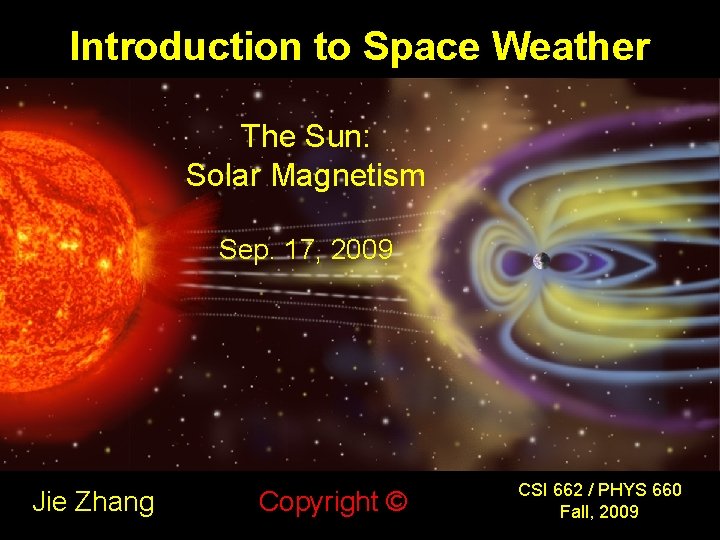
Introduction to Space Weather The Sun: Solar Magnetism Sep. 17, 2009 Jie Zhang Copyright © CSI 662 / PHYS 660 Fall, 2009
Roadmap • Part 1: The Sun 1. • Part 2: The Heliosphere 2. • Part 3: The Magnetosphere 3. 4. • Part 4: The Ionsophere • Part 5: Space Weather Effects The Structure of the Sun: Interior and Atmosphere Solar Magnetism: Sunspots, Solar Cycle, and Solar Dynamo Solar Corona: Magnetic Structure, Active Regions, Coronal Heating Major Solar Activities: Flares and Coronal Mass Ejections
CSI 662 / PHYS 660 September 17 2009 Solar Magnetism: Sunspot, Solar Cycle, and Solar Dynamo References: • Kallenrode: Chap 2. 1, Chap. 3, and Chap. 6 • NASA/MSFC Solar Physics at http: //solarscience. msfc. nasa. gov/
Plasma Physics 1. Maxwell’s Equations and Generalized Ohm’s Law – Kallenrode: Chap 2. 1 – Aschwanden: Chap 5. 1 2. Magnetohydrokinematics: Magnetic Induction Equation and Frozen-in Magnetic Field – Kallenrode: Chap 3. 4 – Aschwanden; Chap 5. 1 3. MHD Dynamo – Kallenrode: Chap 3. 6
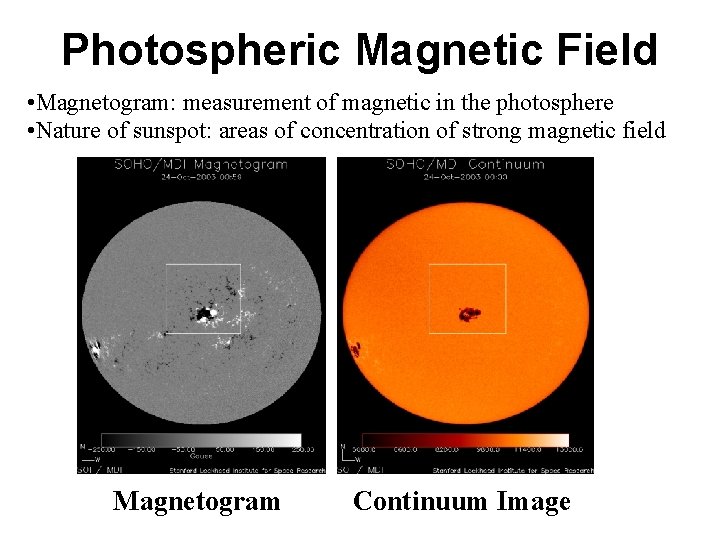
Photospheric Magnetic Field • Magnetogram: measurement of magnetic in the photosphere • Nature of sunspot: areas of concentration of strong magnetic field Magnetogram Continuum Image
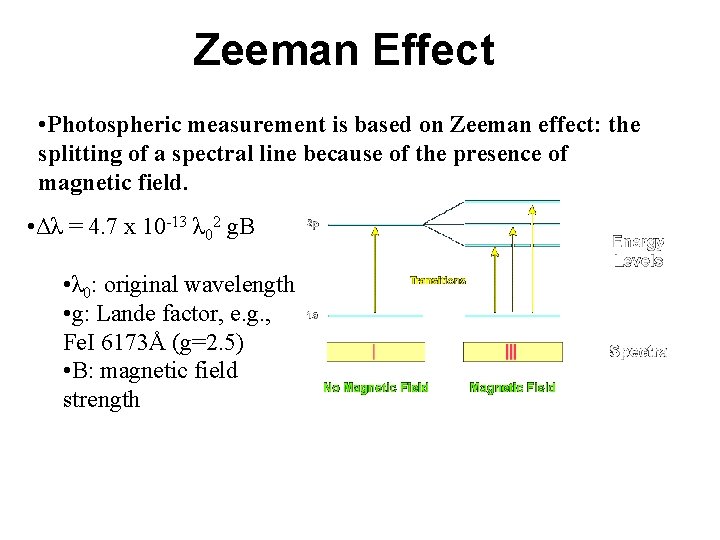
Zeeman Effect • Photospheric measurement is based on Zeeman effect: the splitting of a spectral line because of the presence of magnetic field. • Δλ = 4. 7 x 10 -13 λ 02 g. B • λ 0: original wavelength • g: Lande factor, e. g. , Fe. I 6173Å (g=2. 5) • B: magnetic field strength
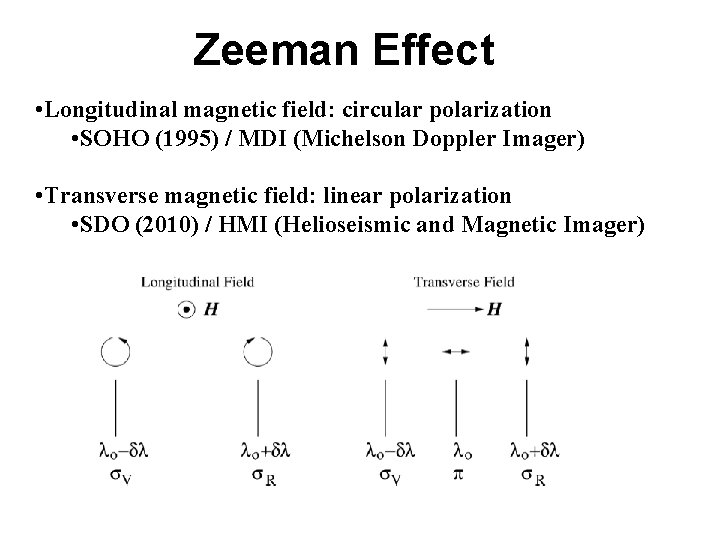
Zeeman Effect • Longitudinal magnetic field: circular polarization • SOHO (1995) / MDI (Michelson Doppler Imager) • Transverse magnetic field: linear polarization • SDO (2010) / HMI (Helioseismic and Magnetic Imager)
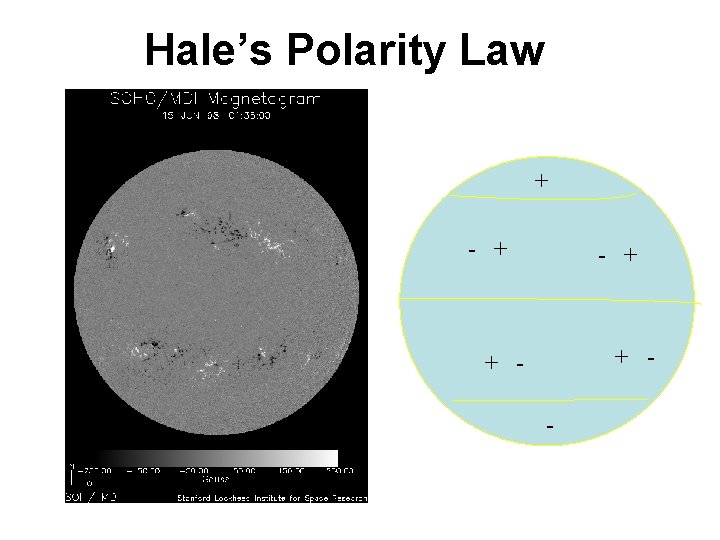
Hale’s Polarity Law + - + + -
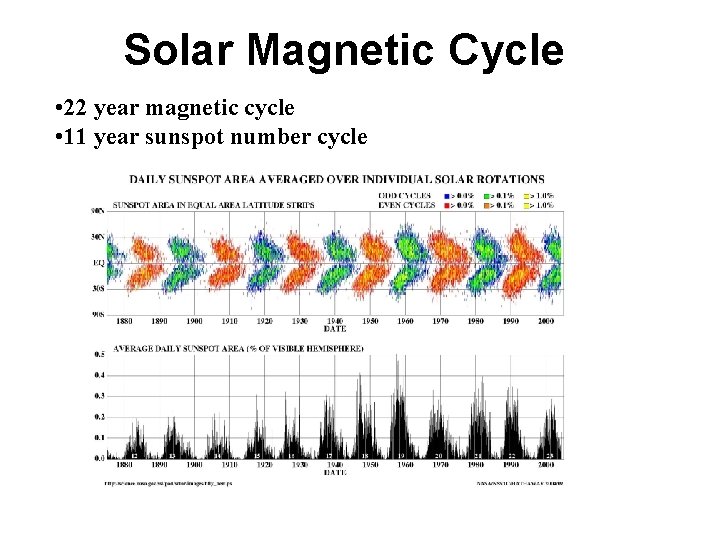
Hale’s Polarity Law 1. Sunspots are grouped in pairs of opposite polarities 2. The ordering of leading polarity/trailing polarity with respect to the east-west direction (direction of rotation) is the same in a given hemisphere, but is reversed from northern to southern hemisphere 3. The leading polarity of sunspots is the same as the polarity in the polar region of the same hemisphere 4. From one sunspot cycle to the next, the magnetic polarities of sunspot pairs undergo a reversal in each hemisphere. The Hale cycle is 22 years, while the sunspot cycle is 11 years
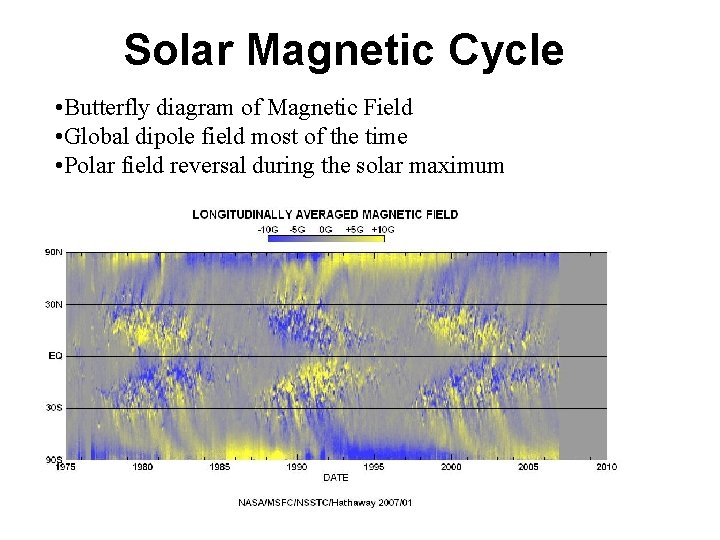
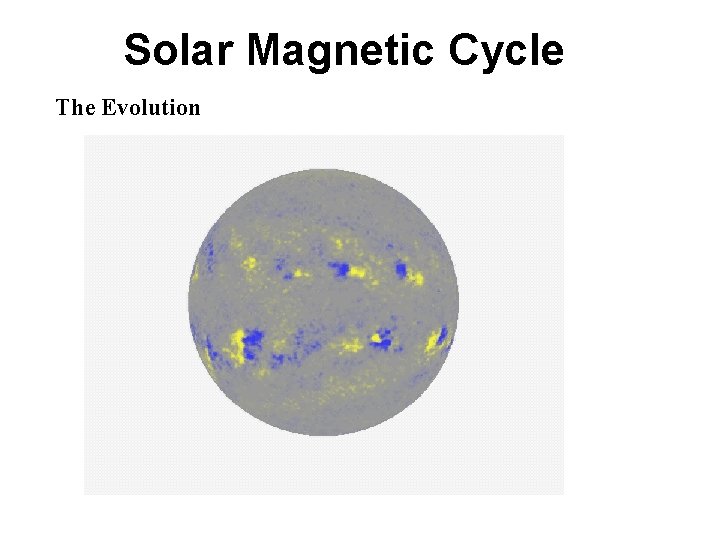
Solar Magnetic Cycle • Butterfly diagram of Magnetic Field • Global dipole field most of the time • Polar field reversal during the solar maximum
Other Laws Sporer’s Law: Sunspot emerge at relatively high latitudes and move towards the equator Joy’s Law: The tilt angle of the active regions is proportional to the latitude
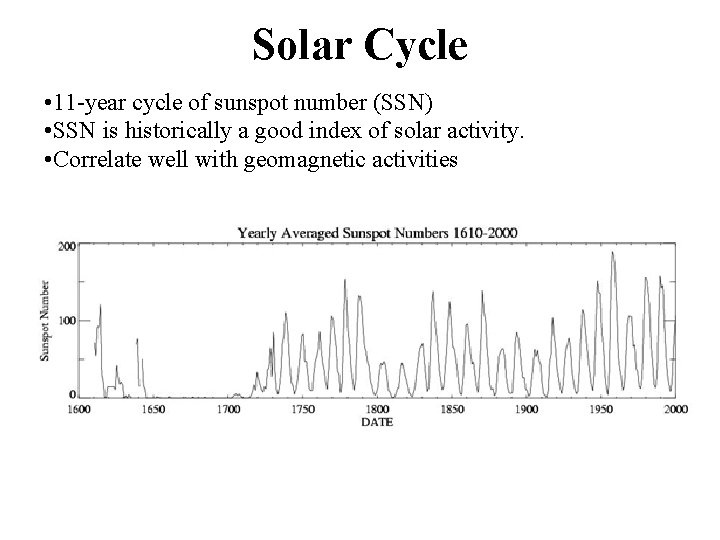
Solar Cycle • 11 -year cycle of sunspot number (SSN) • SSN is historically a good index of solar activity. • Correlate well with geomagnetic activities
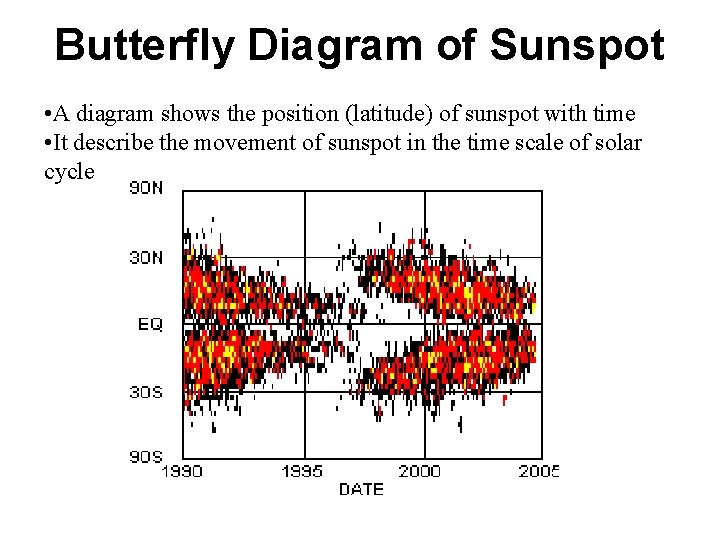
Butterfly Diagram of Sunspot • A diagram shows the position (latitude) of sunspot with time • It describe the movement of sunspot in the time scale of solar cycle
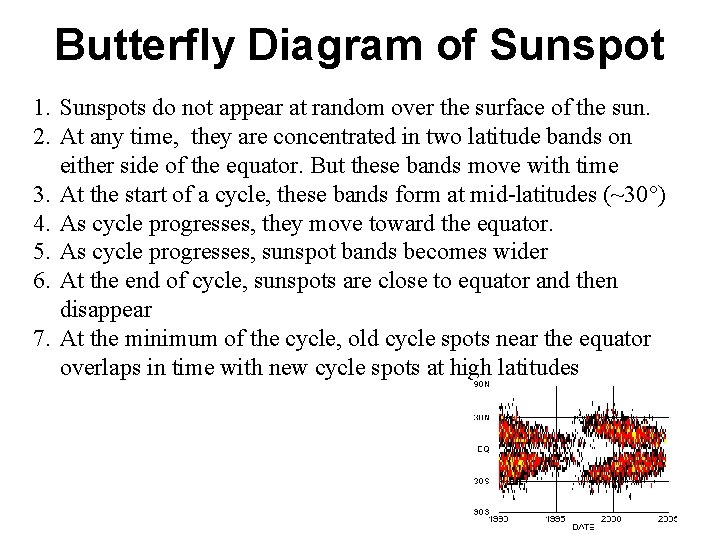
Butterfly Diagram of Sunspot 1. Sunspots do not appear at random over the surface of the sun. 2. At any time, they are concentrated in two latitude bands on either side of the equator. But these bands move with time 3. At the start of a cycle, these bands form at mid-latitudes (~30°) 4. As cycle progresses, they move toward the equator. 5. As cycle progresses, sunspot bands becomes wider 6. At the end of cycle, sunspots are close to equator and then disappear 7. At the minimum of the cycle, old cycle spots near the equator overlaps in time with new cycle spots at high latitudes
Solar Magnetic Cycle • 22 year magnetic cycle • 11 year sunspot number cycle
Solar Magnetic Cycle The Evolution
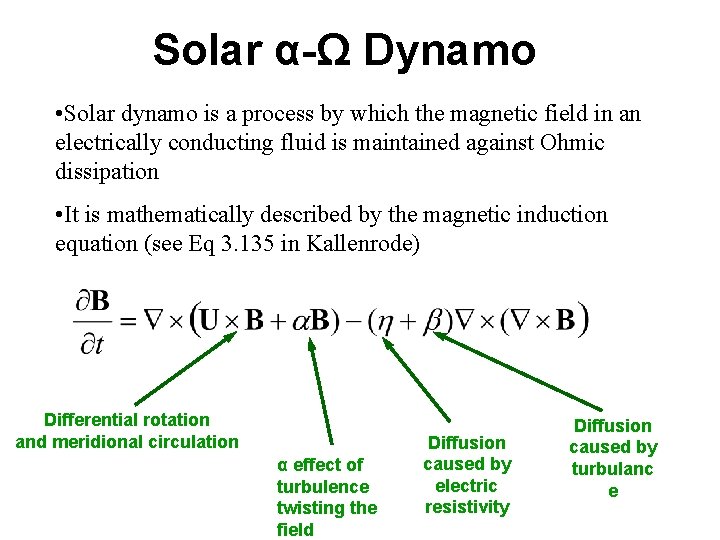
Solar α-Ω Dynamo • Solar dynamo is a process by which the magnetic field in an electrically conducting fluid is maintained against Ohmic dissipation • It is mathematically described by the magnetic induction equation (see Eq 3. 135 in Kallenrode) Differential rotation and meridional circulation α effect of turbulence twisting the field Diffusion caused by electric resistivity Diffusion caused by turbulanc e
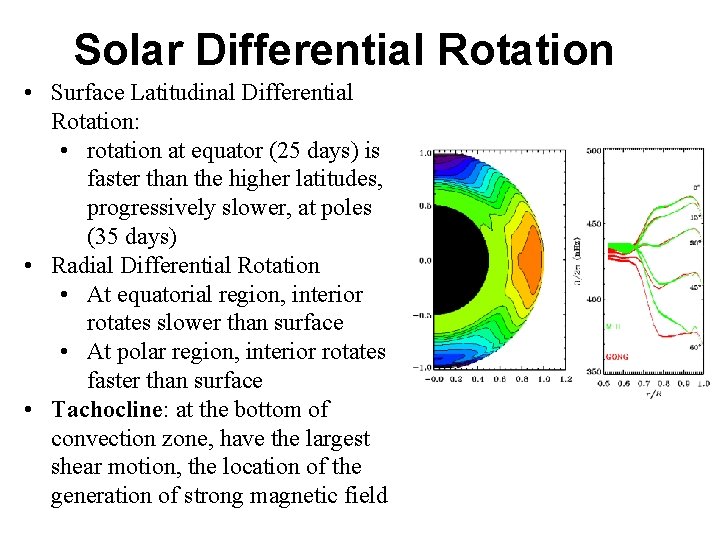
Solar Differential Rotation • Surface Latitudinal Differential Rotation: • rotation at equator (25 days) is faster than the higher latitudes, progressively slower, at poles (35 days) • Radial Differential Rotation • At equatorial region, interior rotates slower than surface • At polar region, interior rotates faster than surface • Tachocline: at the bottom of convection zone, have the largest shear motion, the location of the generation of strong magnetic field
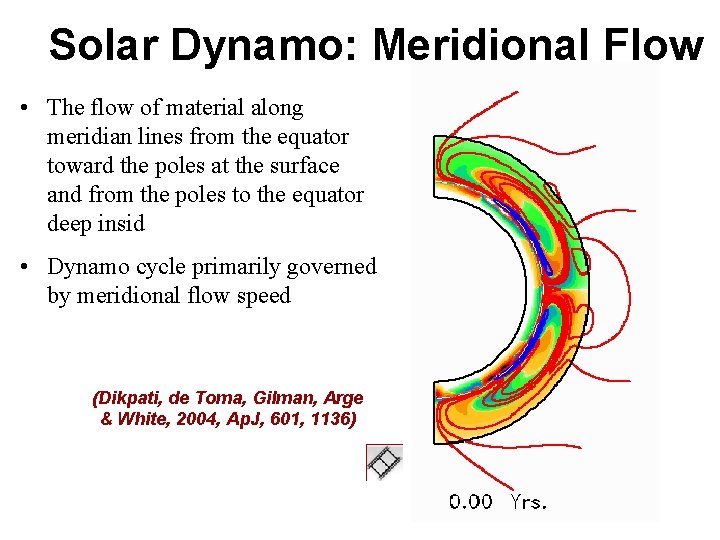
Solar Dynamo: Meridional Flow • The flow of material along meridian lines from the equator toward the poles at the surface and from the poles to the equator deep insid • Dynamo cycle primarily governed by meridional flow speed (Dikpati, de Toma, Gilman, Arge & White, 2004, Ap. J, 601, 1136)
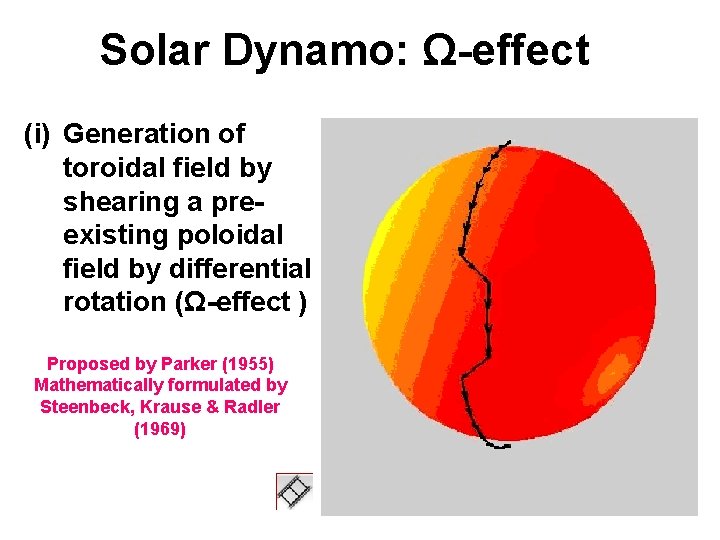
Solar Dynamo: Ω-effect (i) Generation of toroidal field by shearing a preexisting poloidal field by differential rotation (Ω-effect ) Proposed by Parker (1955) Mathematically formulated by Steenbeck, Krause & Radler (1969)
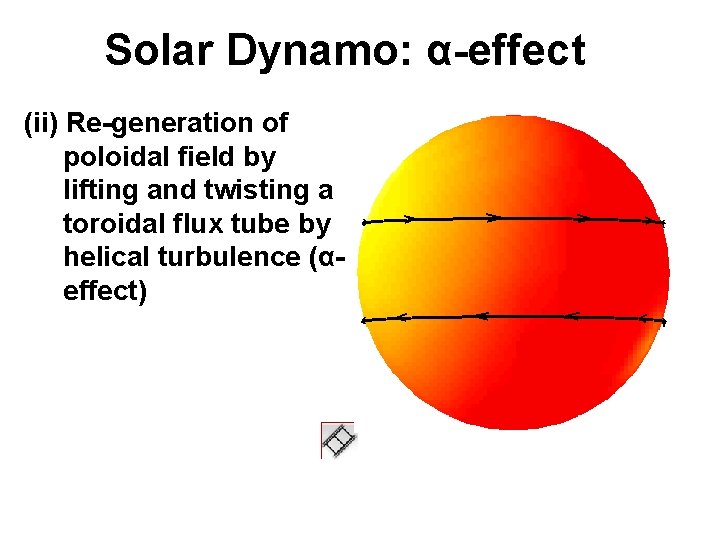
Solar Dynamo: α-effect (ii) Re-generation of poloidal field by lifting and twisting a toroidal flux tube by helical turbulence (αeffect)
The End