
Introduction to Space Weather The Heliosphere Solar Wind

- Slides: 26
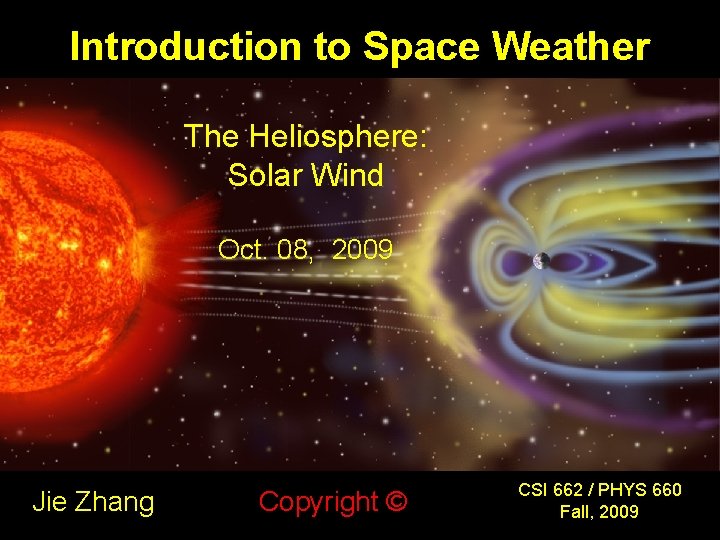
Introduction to Space Weather The Heliosphere: Solar Wind Oct. 08, 2009 Jie Zhang Copyright © CSI 662 / PHYS 660 Fall, 2009
Roadmap • Part 1: The Sun • Part 2: The Heliosphere • Part 3: The Magnetosphere • Part 4: The Ionsophere • Part 5: Space Weather Effects • Part 2: The Heliosphere 1. Solar wind (steady state) 2. Solar wind transients (ICMEs, shocks), and energetic particles
CSI 662 / PHYS 660 October 8 The Heliosphere: Solar Wind References: • Kallenrode: Chap. 6 • Prolss: Chap. 6 2009
Plasma Physics 1. MHD waves, Alfven waves – Kallenrode: Chap 4. 1, Chap 4. 2
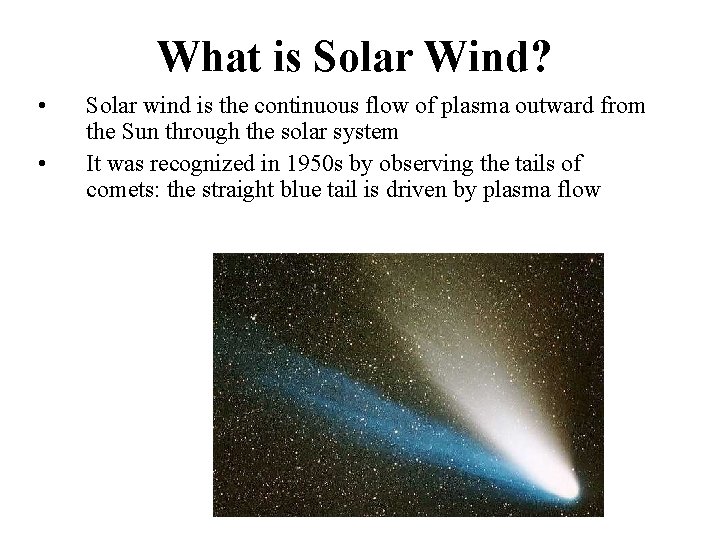
What is Solar Wind? • • Solar wind is the continuous flow of plasma outward from the Sun through the solar system It was recognized in 1950 s by observing the tails of comets: the straight blue tail is driven by plasma flow
What Causes Solar Wind? • High thermal pressure in hot corona overcomes the gravitational constraints, resulting in coronal expansion • Extremely low pressure (10 orders of magnitude smaller) in interstellar medium can not contain the coronal pressure • Expansion becomes supersonic
Solar Wind Solution 1. Hydrostatic, isothermal
Solar Wind Solution 2. Chapman’s solution: Hydrostatic, but non-isothermal
Solar Wind Solution 3. Parker’s solution: Hydrodynamic (steady state), isothermal
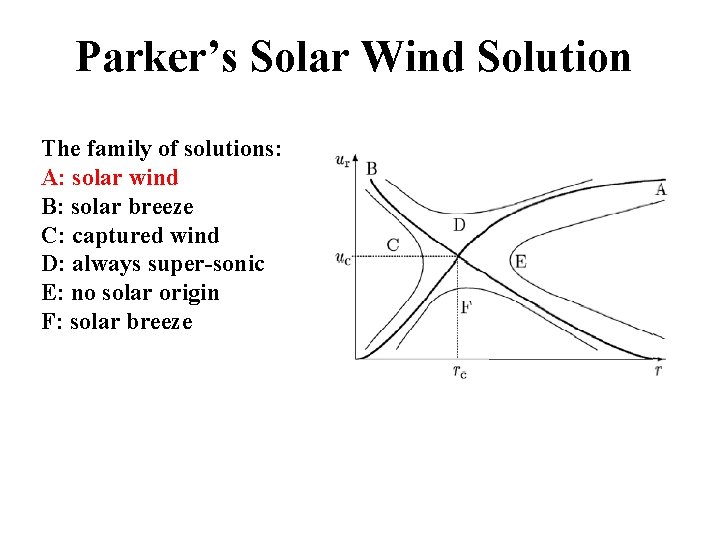
Parker’s Solar Wind Solution The family of solutions: A: solar wind B: solar breeze C: captured wind D: always super-sonic E: no solar origin F: solar breeze
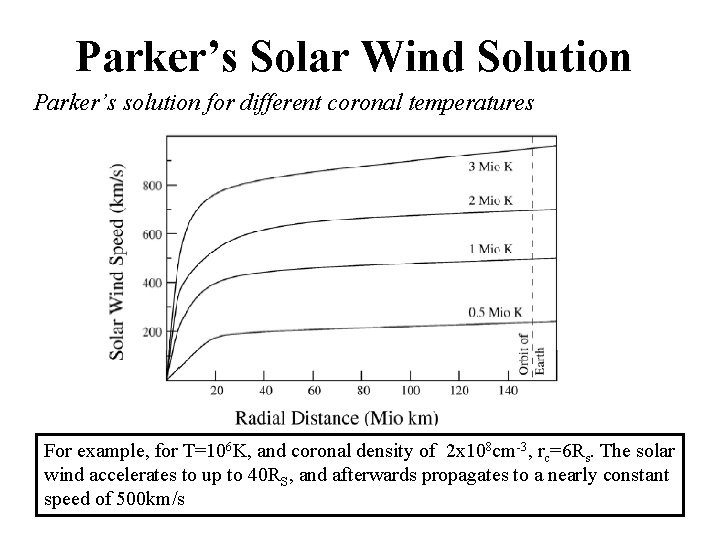
Parker’s Solar Wind Solution Parker’s solution for different coronal temperatures For example, for T=106 K, and coronal density of 2 x 108 cm-3, rc=6 Rs. The solar wind accelerates to up to 40 RS, and afterwards propagates to a nearly constant speed of 500 km/s
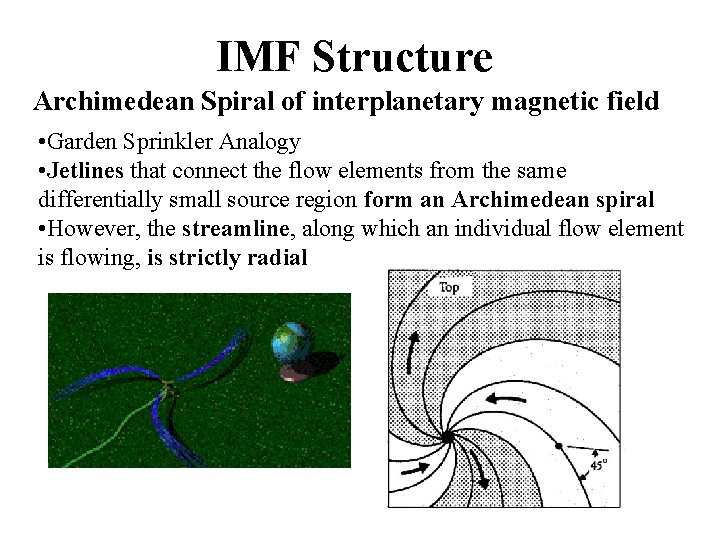
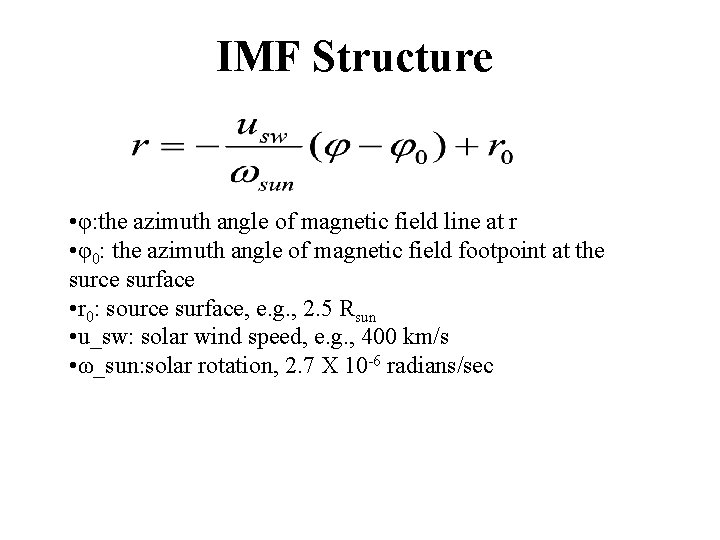
IMF Structure Archimedean Spiral of interplanetary magnetic field • Garden Sprinkler Analogy • Jetlines that connect the flow elements from the same differentially small source region form an Archimedean spiral • However, the streamline, along which an individual flow element is flowing, is strictly radial
IMF Structure • φ: the azimuth angle of magnetic field line at r • φ0: the azimuth angle of magnetic field footpoint at the surce surface • r 0: source surface, e. g. , 2. 5 Rsun • u_sw: solar wind speed, e. g. , 400 km/s • ω_sun: solar rotation, 2. 7 X 10 -6 radians/sec
IMF structure • Frozen-in theorem: Plasma elements connected at any point in time by a common magnetic field line remain connected by a common field line • Since the plasma flow in a single spiral jet-line originates from a common source, the IMF should follow the jet-line, thus also display an Archimedean spiral pattern. • At certain height (e. g. , 2. 5 Rs), all magnetic field lines open and point radial. A surface of this is called source surface • The spiral pattern is traced back to the source surface
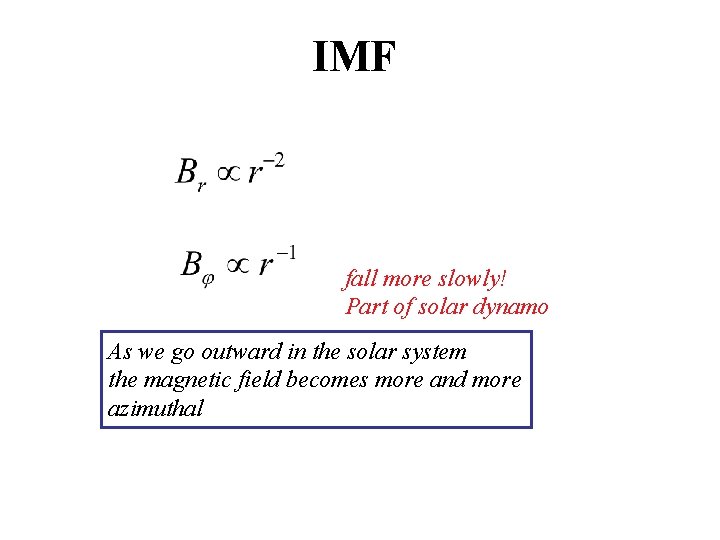
IMF fall more slowly! Part of solar dynamo As we go outward in the solar system the magnetic field becomes more and more azimuthal
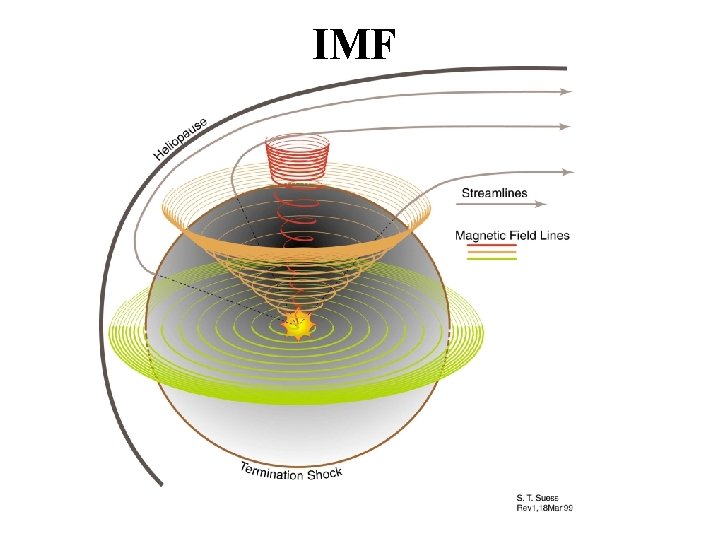
IMF
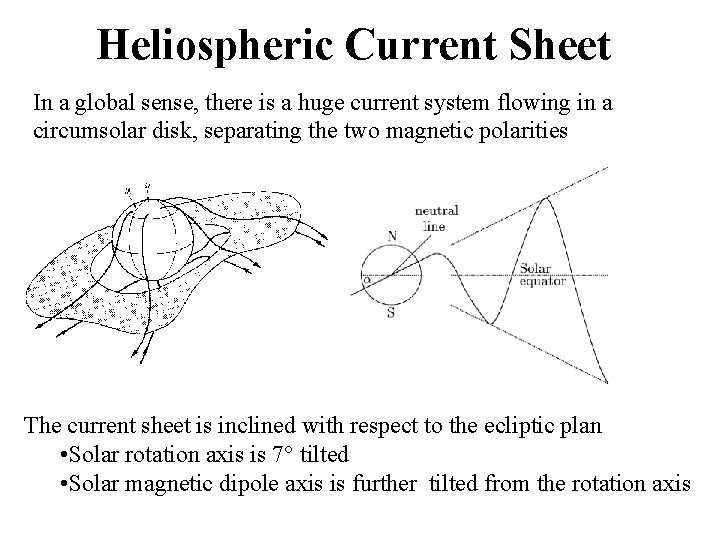
Heliospheric Current Sheet In a global sense, there is a huge current system flowing in a circumsolar disk, separating the two magnetic polarities The current sheet is inclined with respect to the ecliptic plan • Solar rotation axis is 7° tilted • Solar magnetic dipole axis is further tilted from the rotation axis
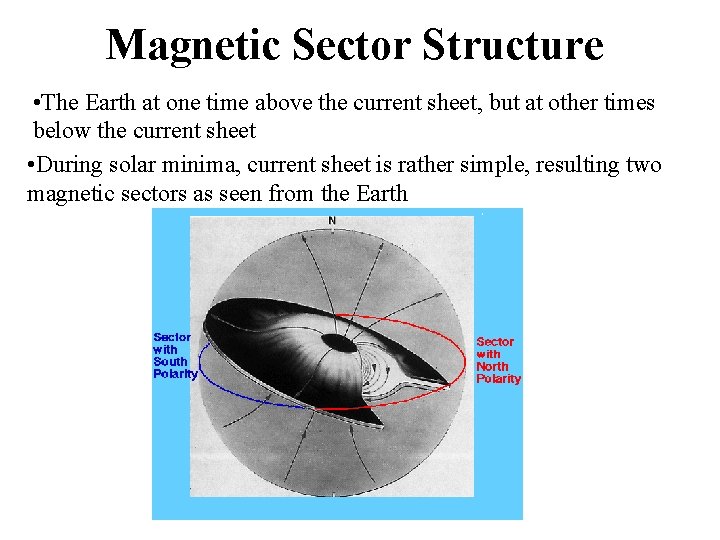
Magnetic Sector Structure • The Earth at one time above the current sheet, but at other times below the current sheet • During solar minima, current sheet is rather simple, resulting two magnetic sectors as seen from the Earth
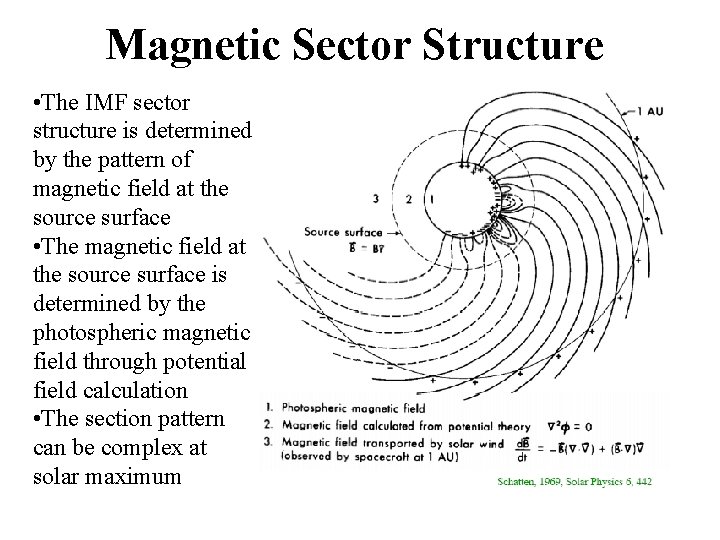
Magnetic Sector Structure • The IMF sector structure is determined by the pattern of magnetic field at the source surface • The magnetic field at the source surface is determined by the photospheric magnetic field through potential field calculation • The section pattern can be complex at solar maximum
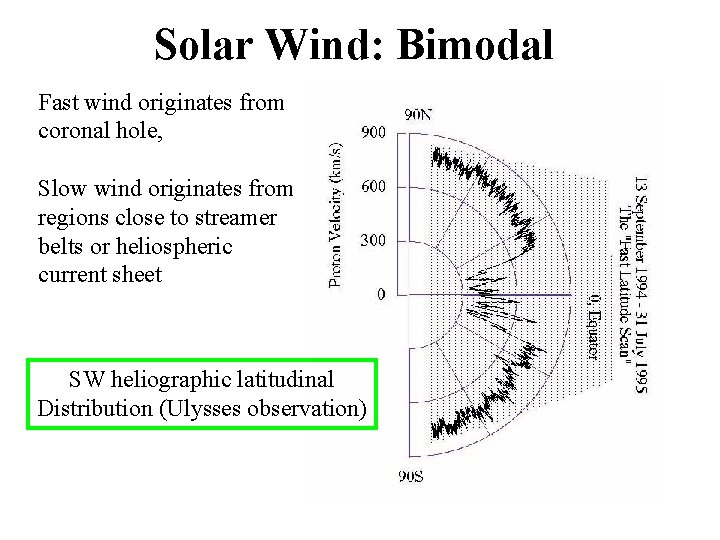
Solar Wind: Bimodal Fast wind originates from coronal hole, Slow wind originates from regions close to streamer belts or heliospheric current sheet SW heliographic latitudinal Distribution (Ulysses observation)
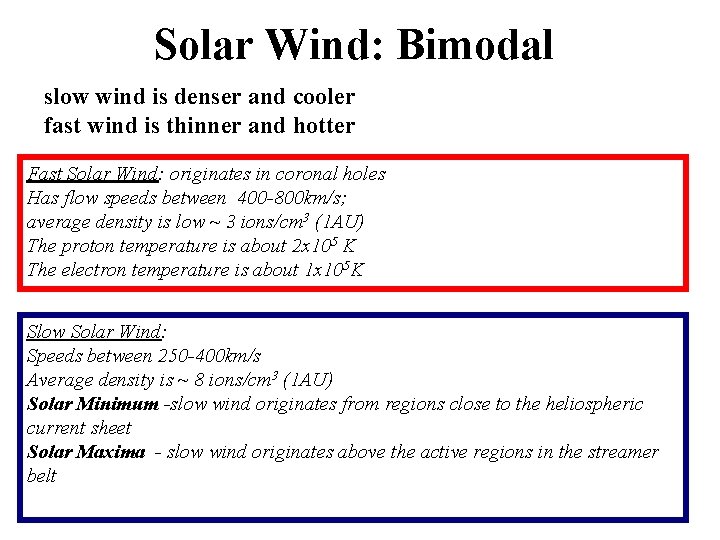
Solar Wind: Bimodal slow wind is denser and cooler fast wind is thinner and hotter Fast Solar Wind: originates in coronal holes Has flow speeds between 400 -800 km/s; average density is low ~ 3 ions/cm 3 (1 AU) The proton temperature is about 2 x 10⁵ K The electron temperature is about 1 x 10⁵ K Slow Solar Wind: Speeds between 250 -400 km/s Average density is ~ 8 ions/cm 3 (1 AU) Solar Minimum -slow wind originates from regions close to the heliospheric current sheet Solar Maxima - slow wind originates above the active regions in the streamer belt
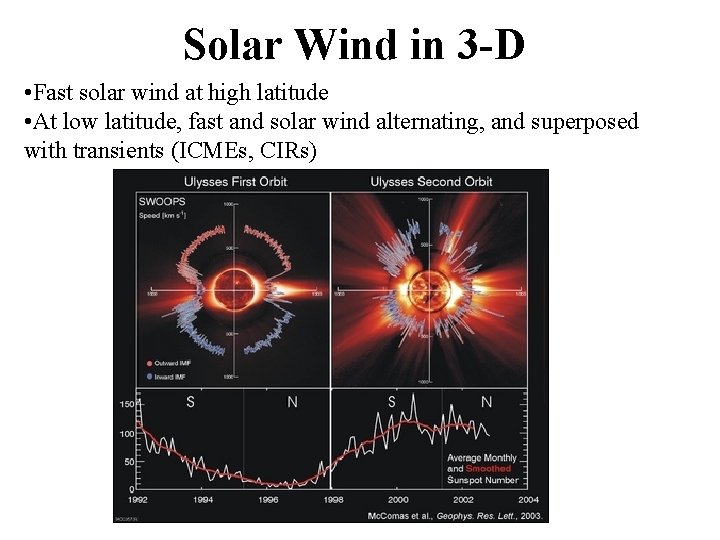
Solar Wind in 3 -D • Fast solar wind at high latitude • At low latitude, fast and solar wind alternating, and superposed with transients (ICMEs, CIRs)
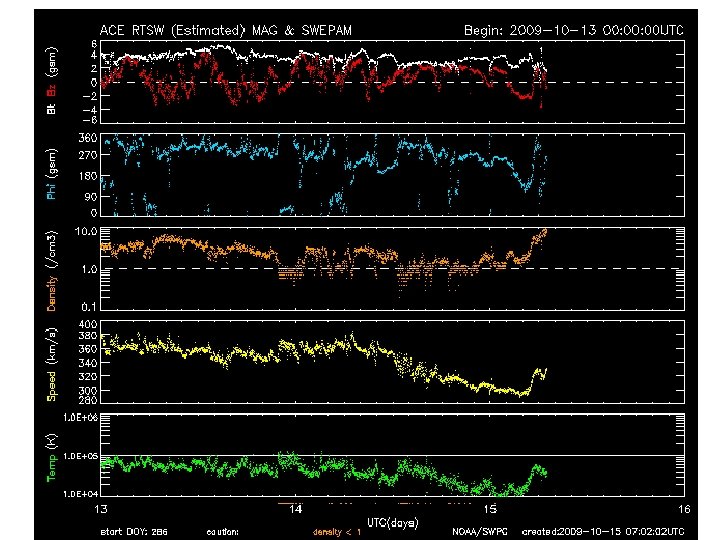
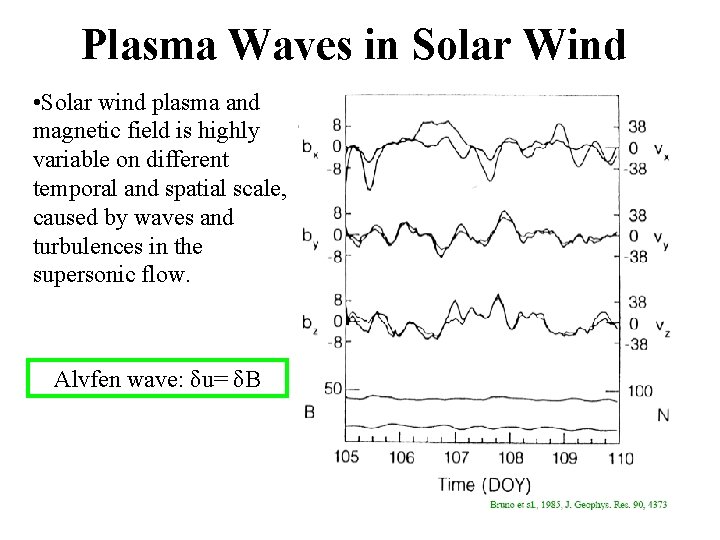
Plasma Waves in Solar Wind • Solar wind plasma and magnetic field is highly variable on different temporal and spatial scale, caused by waves and turbulences in the supersonic flow. Alvfen wave: δu= δB
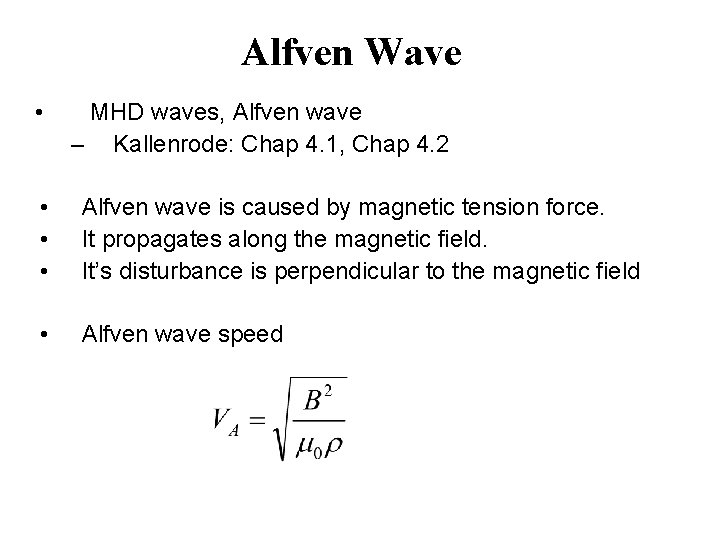
Alfven Wave • MHD waves, Alfven wave – Kallenrode: Chap 4. 1, Chap 4. 2 • • • Alfven wave is caused by magnetic tension force. It propagates along the magnetic field. It’s disturbance is perpendicular to the magnetic field • Alfven wave speed
The End