
Introduction to Software Testing Chapter 8 2 Syntactic

- Slides: 22
Introduction to Software Testing Chapter 8. 2 Syntactic Logic Coverage Criteria (Disjunctive Normal Form) Paul Ammann & Jeff Offutt http: //www. cs. gmu. edu/~offutt/softwaret est/ updated April, 2017
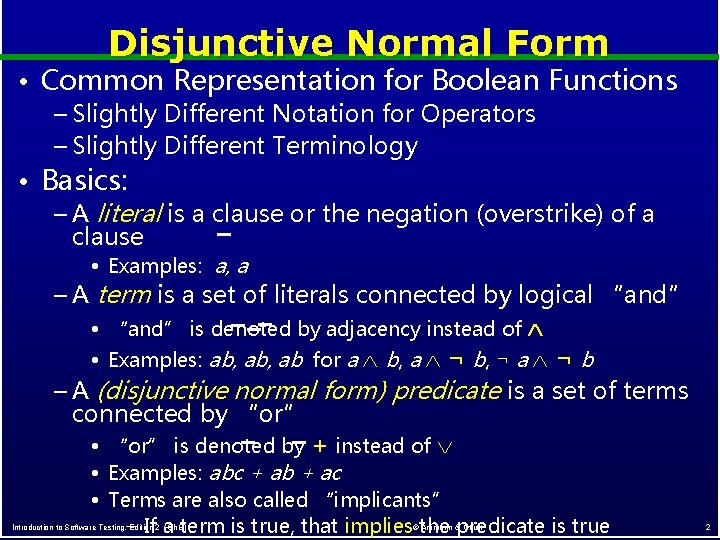
Disjunctive Normal Form • Common Representation for Boolean Functions – Slightly Different Notation for Operators – Slightly Different Terminology • Basics: – A literal is a clause or the negation (overstrike) of a clause • Examples: a, a – A term is a set of literals connected by logical “and” • “and” is denoted by adjacency instead of • Examples: ab, ab for a b, a ¬ b, ¬ a ¬ b – A (disjunctive normal form) predicate is a set of terms connected by “or” • “or” is denoted by + instead of • Examples: abc + ab + ac • Terms are also called “implicants” – If a term is true, that implies the predicate is true Introduction to Software Testing, Edition 2 (Ch 8) © Ammann & Offutt 2
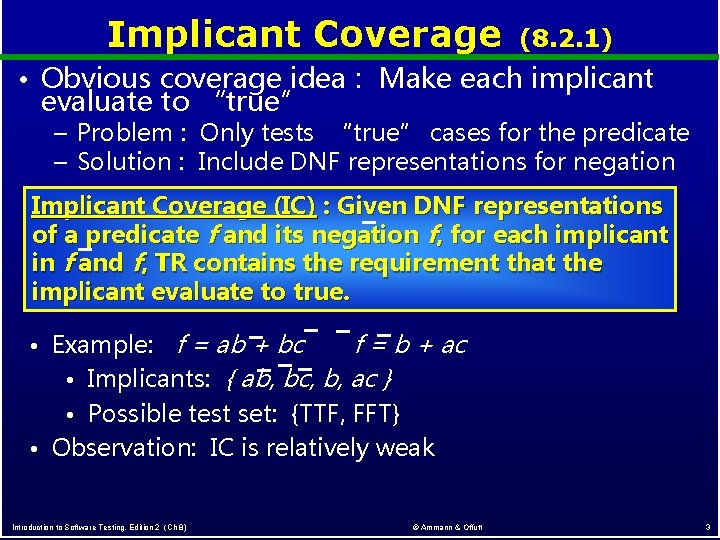
Implicant Coverage (8. 2. 1) • Obvious coverage idea : Make each implicant evaluate to “true” – Problem : Only tests “true” cases for the predicate – Solution : Include DNF representations for negation Implicant Coverage (IC) : Given DNF representations of a predicate f and its negation f, for each implicant in f and f, TR contains the requirement that the implicant evaluate to true. f = ab + bc f = b + ac • Implicants: { ab, bc, b, ac } • Example: • Possible test set: {TTF, FFT} • Observation: IC is relatively weak Introduction to Software Testing, Edition 2 (Ch 8) © Ammann & Offutt 3
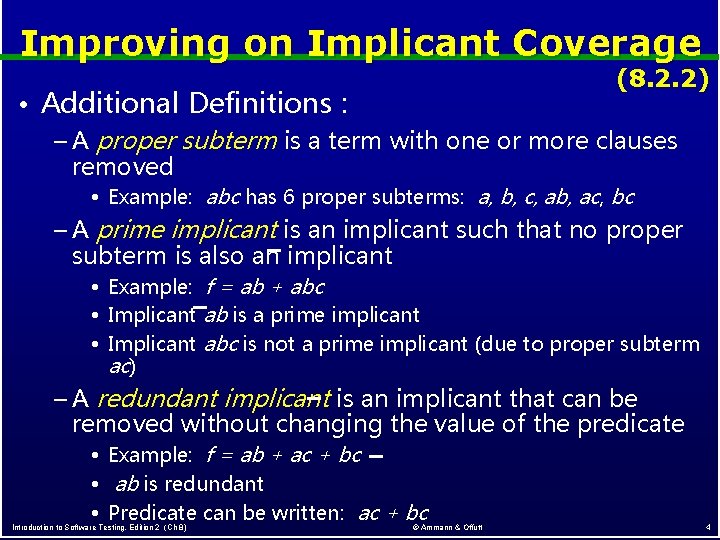
Improving on Implicant Coverage (8. 2. 2) • Additional Definitions : – A proper subterm is a term with one or more clauses removed • Example: abc has 6 proper subterms: a, b, c, ab, ac, bc – A prime implicant is an implicant such that no proper subterm is also an implicant • Example: f = ab + abc • Implicant ab is a prime implicant • Implicant abc is not a prime implicant (due to proper subterm ac) – A redundant implicant is an implicant that can be removed without changing the value of the predicate • Example: f = ab + ac + bc • ab is redundant • Predicate can be written: ac + bc Introduction to Software Testing, Edition 2 (Ch 8) © Ammann & Offutt 4
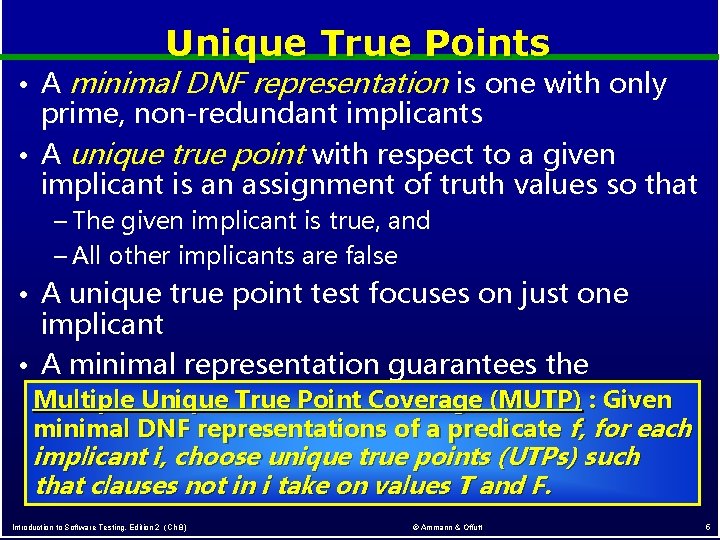
• A Unique True Points minimal DNF representation is one with only prime, non-redundant implicants • A unique true point with respect to a given implicant is an assignment of truth values so that – The given implicant is true, and – All other implicants are false • A unique true point test focuses on just one implicant • A minimal representation guarantees the existence of at. True least. Point one Coverage unique true point for Multiple Unique (MUTP) : Given each implicant minimal DNF representations of a predicate f, for each implicant i, choose unique true points (UTPs) such that clauses not in i take on values T and F. Introduction to Software Testing, Edition 2 (Ch 8) © Ammann & Offutt 5
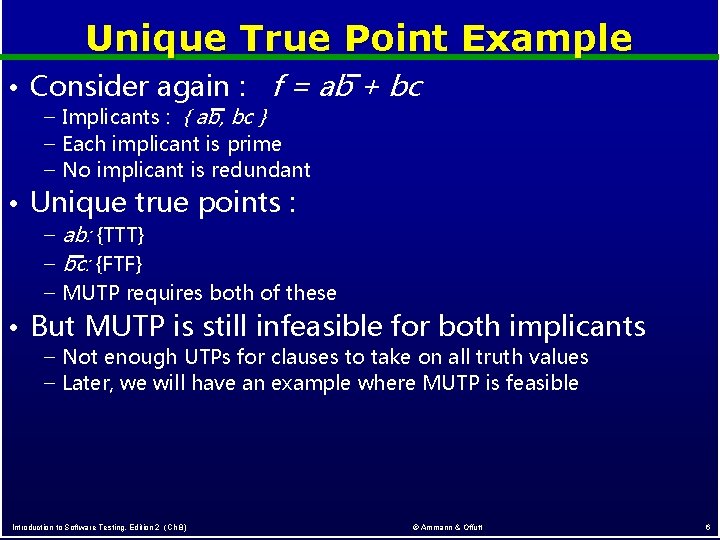
Unique True Point Example • Consider again : f = ab + bc – Implicants : { ab, bc } – Each implicant is prime – No implicant is redundant • Unique true points : – ab: {TTT} – bc: {FTF} – MUTP requires both of these • But MUTP is still infeasible for both implicants – Not enough UTPs for clauses to take on all truth values – Later, we will have an example where MUTP is feasible Introduction to Software Testing, Edition 2 (Ch 8) © Ammann & Offutt 6
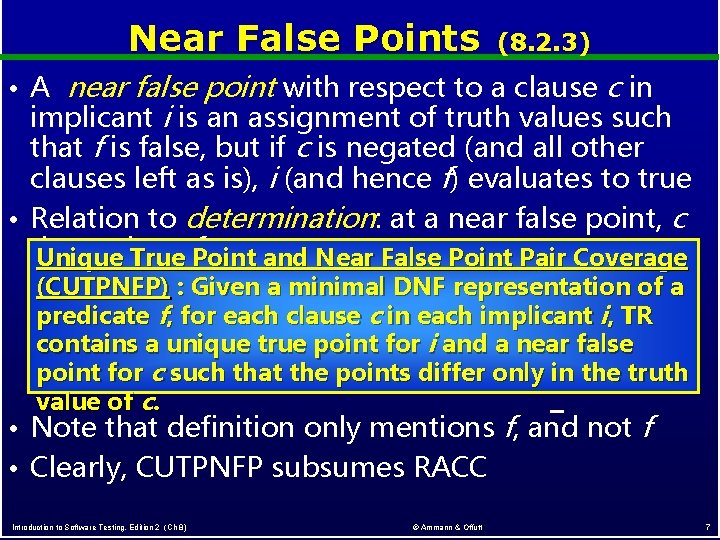
Near False Points (8. 2. 3) near false point with respect to a clause c in implicant i is an assignment of truth values such that f is false, but if c is negated (and all other clauses left as is), i (and hence f) evaluates to true • Relation to determination: at a near false point, c determines Unique True f. Point and Near False Point Pair Coverage • A – Hence we : should relationship to ACC criteria (CUTPNFP) Given expect a minimal DNF representation of a predicate f, for each clause c in each implicant i, TR contains a unique true point for i and a near false point for c such that the points differ only in the truth value of c. • Note that definition only mentions f, and not f • Clearly, CUTPNFP subsumes RACC Introduction to Software Testing, Edition 2 (Ch 8) © Ammann & Offutt 7
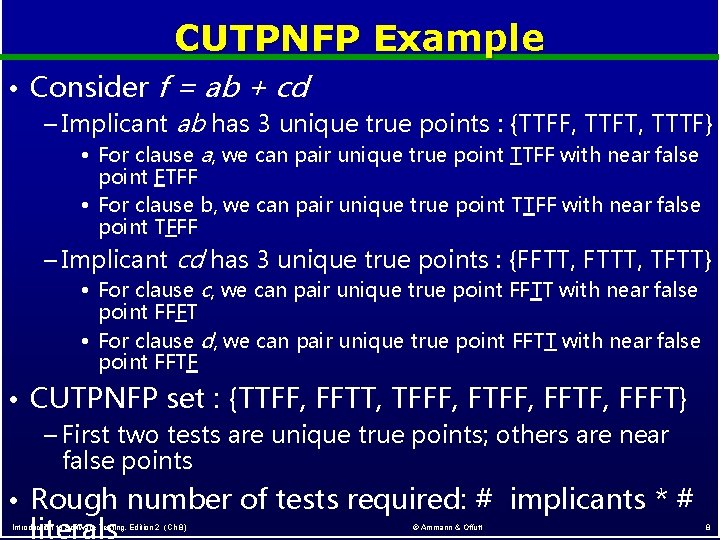
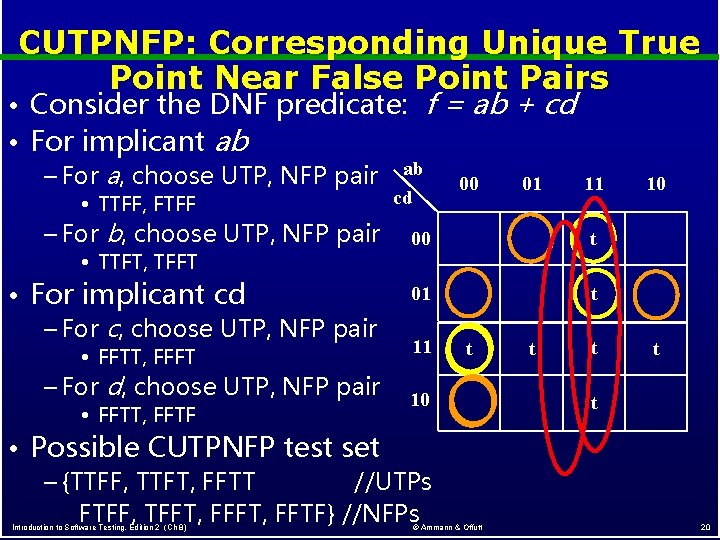
CUTPNFP Example • Consider f = ab + cd – Implicant ab has 3 unique true points : {TTFF, TTFT, TTTF} • For clause a, we can pair unique true point TTFF with near false point FTFF • For clause b, we can pair unique true point TTFF with near false point TFFF – Implicant cd has 3 unique true points : {FFTT, FTTT, TFTT} • For clause c, we can pair unique true point FFTT with near false point FFFT • For clause d, we can pair unique true point FFTT with near false point FFTF • CUTPNFP set : {TTFF, FFTT, TFFF, FTFF, FFTF, FFFT} – First two tests are unique true points; others are near false points • Rough number of tests required: # implicants * # literals Introduction to Software Testing, Edition 2 (Ch 8) © Ammann & Offutt 8
The MNFP Criterion (8. 2. 3) The next two criteria provide enough scaffolding to make guarantees about fault detection (see later slides) Multiple Near False Point Coverage (MNFP) : Given a minimal DNF representation of a predicate f, for each literal c in each implicant i, TR choose near false points (NFPs) such that clauses not in i take on values T and F. Introduction to Software Testing, Edition 2 (Ch 8) © Ammann & Offutt 9
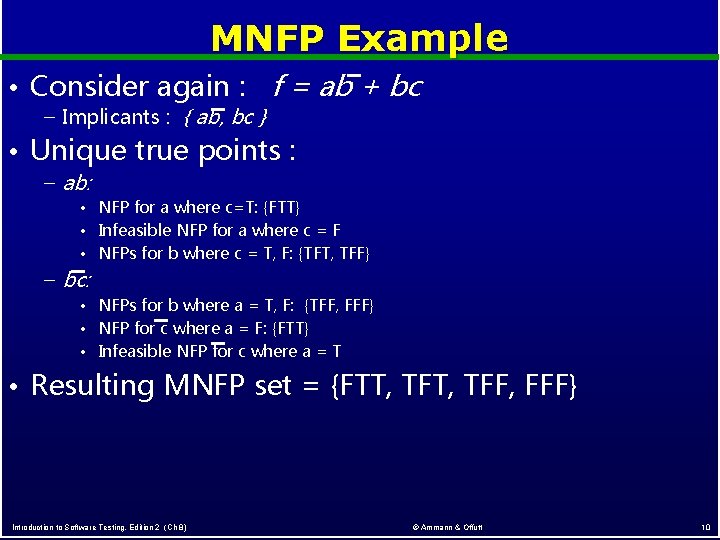
MNFP Example • Consider again : – Implicants : { ab, bc } f = ab + bc • Unique true points : – ab: • NFP for a where c=T: {FTT} • Infeasible NFP for a where c = F • NFPs for b where c = T, F: {TFT, TFF} – bc: • NFPs for b where a = T, F: {TFF, FFF} • NFP for c where a = F: {FTT} • Infeasible NFP for c where a = T • Resulting MNFP set = {FTT, TFF, FFF} Introduction to Software Testing, Edition 2 (Ch 8) © Ammann & Offutt 10
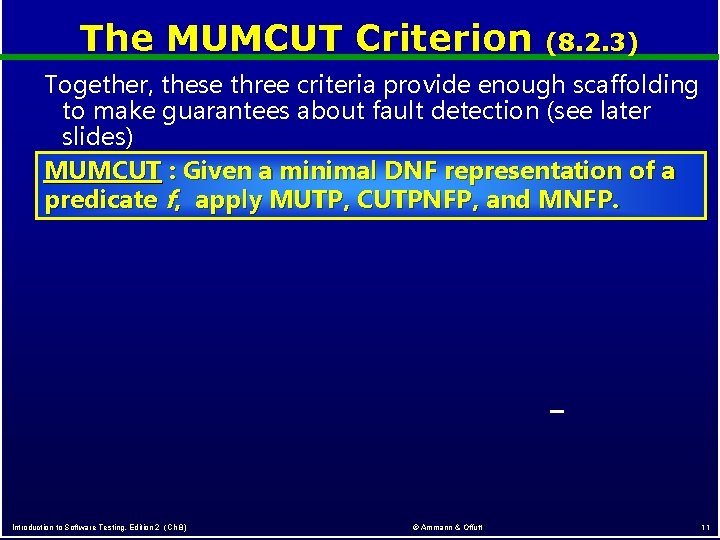
The MUMCUT Criterion (8. 2. 3) Together, these three criteria provide enough scaffolding to make guarantees about fault detection (see later slides) MUMCUT : Given a minimal DNF representation of a predicate f, apply MUTP, CUTPNFP, and MNFP. Introduction to Software Testing, Edition 2 (Ch 8) © Ammann & Offutt 11
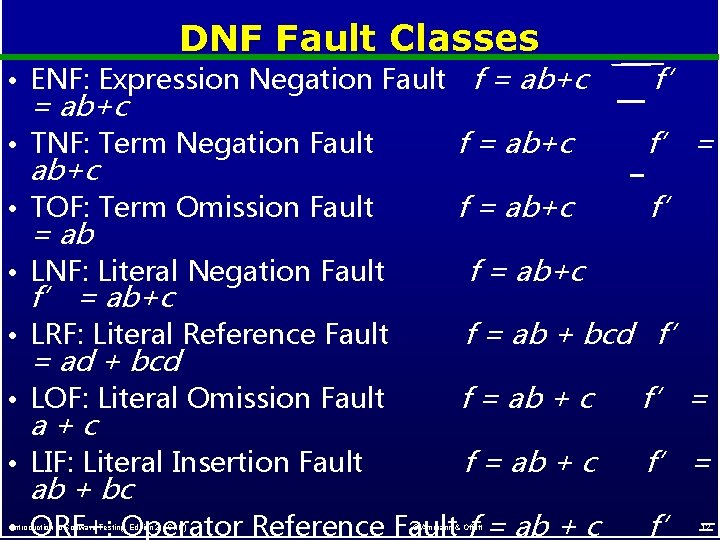
DNF Fault Classes f = ab+c • ENF: Expression Negation Fault = ab+c f’ • TNF: Term Negation Fault f = ab+c f’ = • TOF: Term Omission Fault f = ab+c f’ ab+c = ab • LNF: Literal Negation Fault f = ab+c • LRF: Literal Reference Fault f = ab + bcd f’ • LOF: Literal Omission Fault f = ab + c f’ = • LIF: Literal Insertion Fault f = ab + c f’ = ab+c = ad + bcd a+c ab + bc • ORF+: Operator Reference Fault Introduction to Software Testing, Edition 2 (Ch 8) © Ammann & Offutt 12
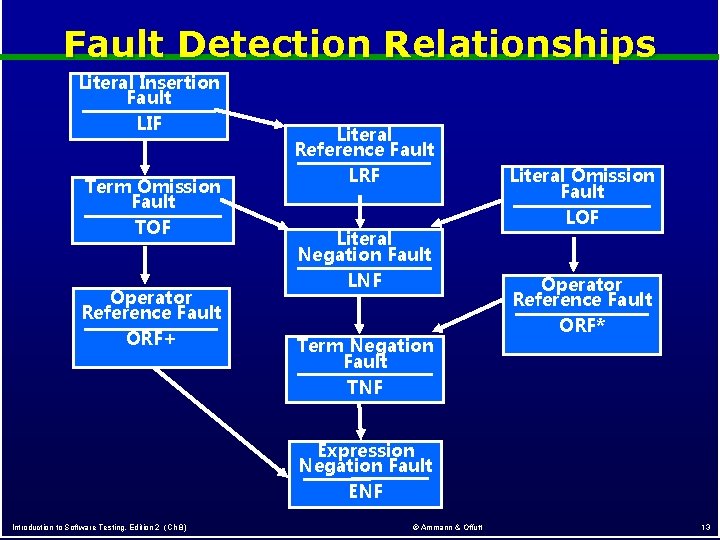
Fault Detection Relationships Literal Insertion Fault LIF Term Omission Fault TOF Operator Reference Fault ORF+ Literal Reference Fault LRF Literal Negation Fault LNF Term Negation Fault TNF Literal Omission Fault LOF Operator Reference Fault ORF* Expression Negation Fault ENF Introduction to Software Testing, Edition 2 (Ch 8) © Ammann & Offutt 13
• Karnaugh Maps for Testing Logic Expressions (8. 2. 4) Fair Warning – We use, rather than teach, Karnaugh Maps – Newcomers to Karnaugh Maps probably need a tutorial • Suggestion: Google “Karnaugh Map Tutorial” • Our goal: Apply Karnaugh Maps to concepts used to test logic expressions – Identify when a clause determines a predicate – Identify the negation of a predicate – Identify prime implicants and redundant implicants – Identify unique true point / near false point pairs • No new material here on testing – Just fast shortcuts for concepts already presented Introduction to Software Testing, Edition 2 (Ch 8) © Ammann & Offutt 14
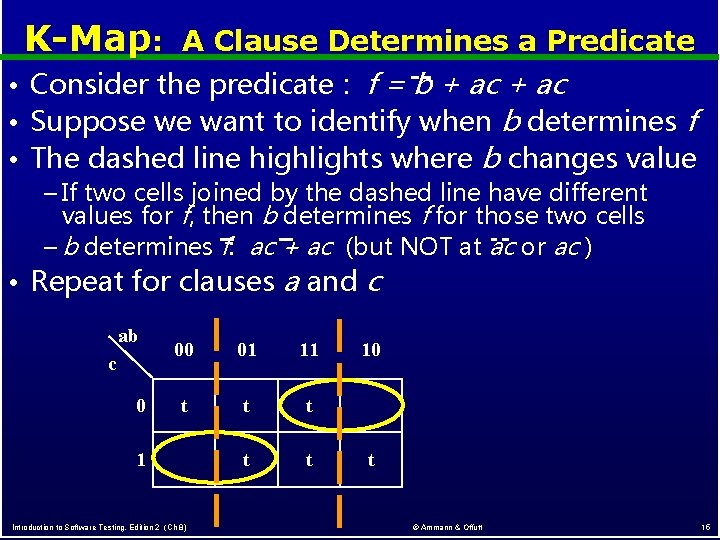
K-Map: A Clause Determines a Predicate • Consider the predicate : f = b + ac • Suppose we want to identify when b determines f • The dashed line highlights where b changes value – If two cells joined by the dashed line have different values for f, then b determines f for those two cells – b determines f: ac + ac (but NOT at ac or ac ) • Repeat for clauses ab c 0 a and c 00 01 11 t t t 1 Introduction to Software Testing, Edition 2 (Ch 8) 10 t © Ammann & Offutt 15
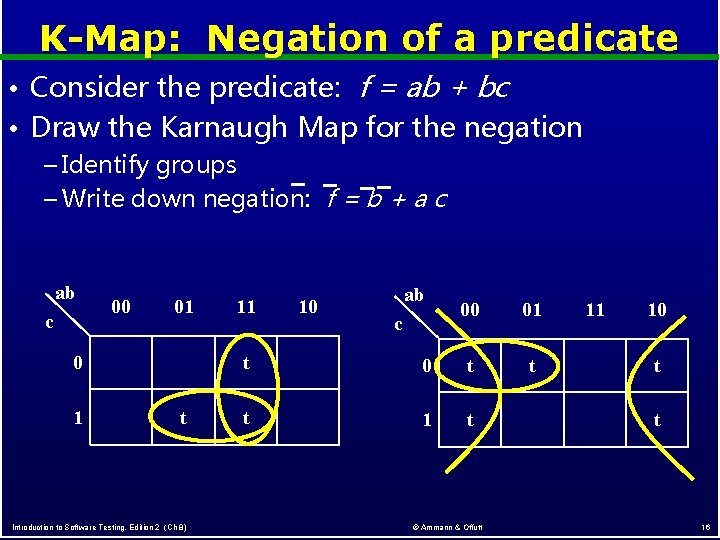
K-Map: Negation of a predicate • Consider the predicate: f = ab + bc • Draw the Karnaugh Map for the negation – Identify groups – Write down negation: f = b + a c ab c 00 01 0 1 t Introduction to Software Testing, Edition 2 (Ch 8) 11 10 ab c 00 01 t t 0 t t 1 t © Ammann & Offutt 11 10 t t 16
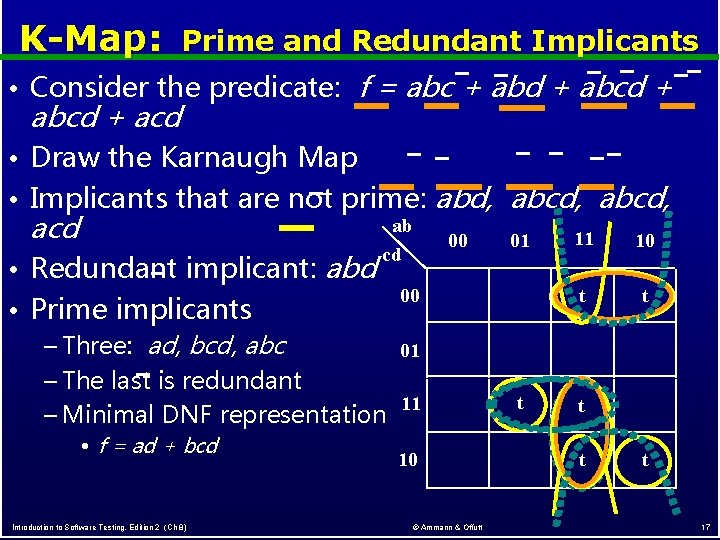
K-Map: Prime and Redundant Implicants • Consider the predicate: abcd + acd f = abc + abd + abcd + • Draw the Karnaugh Map • Implicants that are not prime: acd • Redundant implicant: abd ab cd abd, abcd, 00 00 • Prime implicants – Three: ad, bcd, abc 01 – The last is redundant 11 – Minimal DNF representation • f = ad + bcd Introduction to Software Testing, Edition 2 (Ch 8) 01 10 © Ammann & Offutt t 11 10 t t t 17
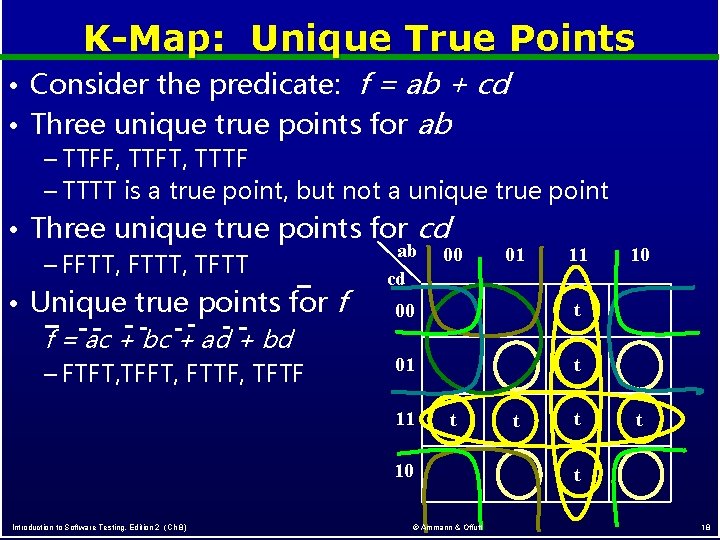
K-Map: Unique True Points f = ab + cd • Three unique true points for ab • Consider the predicate: – TTFF, TTFT, TTTF – TTTT is a true point, but not a unique true point • Three unique true points for cd ab 00 – FFTT, FTTT, TFTT • Unique true points for f = ac + bc + ad + bd – FTFT, TFFT, FTTF, TFTF f 11 10 cd 00 t 01 t 10 Introduction to Software Testing, Edition 2 (Ch 8) 01 © Ammann & Offutt t t 18
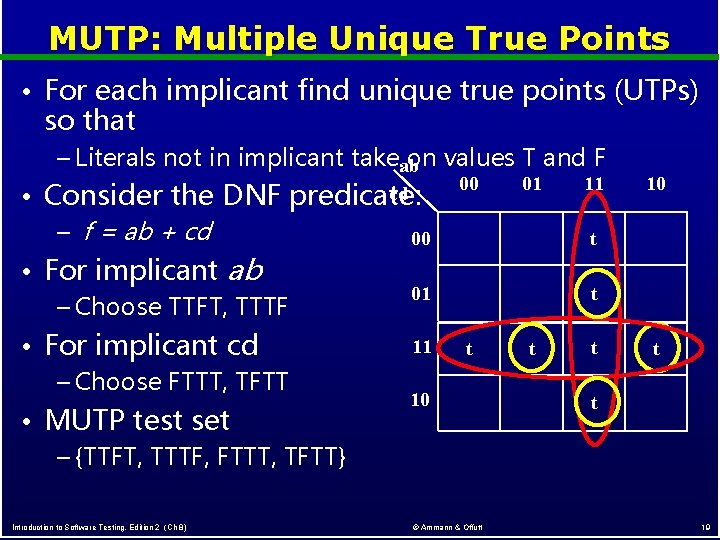
MUTP: Multiple Unique True Points • For each implicant find unique true points (UTPs) so that – Literals not in implicant takeab on values T and F • Consider the DNF – f = ab + cd cd predicate: • For implicant ab – Choose TTFT, TTTF • For implicant cd – Choose FTTT, TFTT • MUTP test set – {TTFT, TTTF, FTTT, TFTT} Introduction to Software Testing, Edition 2 (Ch 8) 00 01 11 00 t 01 t 10 © Ammann & Offutt t t 10 t t 19
CUTPNFP: Corresponding Unique True Point Near False Point Pairs f = ab + cd • Consider the DNF predicate: • For implicant ab – For a, choose UTP, NFP pair • TTFF, FTFF – For b, choose UTP, NFP pair • TTFT, TFFT • For implicant cd – For c, choose UTP, NFP pair • FFTT, FFFT – For d, choose UTP, NFP pair • FFTT, FFTF ab cd 01 11 00 t 01 t 10 • Possible CUTPNFP test set – {TTFF, TTFT, FFTT //UTPs FTFF, TFFT, FFTF} //NFPs Introduction to Software Testing, Edition 2 (Ch 8) 00 © Ammann & Offutt t t 10 t t 20
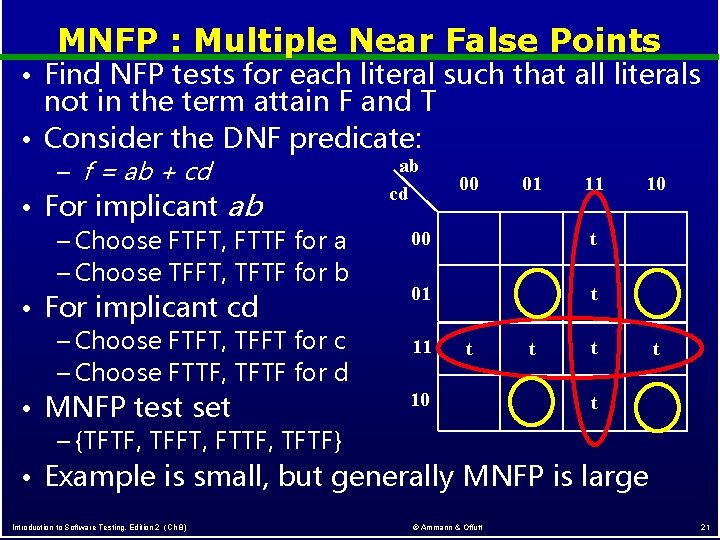
MNFP : Multiple Near False Points • Find NFP tests for each literal such that all literals not in the term attain F and T • Consider the DNF predicate: – f = ab + cd ab cd 00 01 • For implicant ab 00 – Choose FTFT, FTTF for a – Choose TFFT, TFTF for b 01 • For implicant cd – Choose FTFT, TFFT for c 11 t t – Choose FTTF, TFTF for d 10 • MNFP test set – {TFTF, TFFT, FTTF, TFTF} • Example is small, but generally MNFP is Introduction to Software Testing, Edition 2 (Ch 8) © Ammann & Offutt 11 10 t t t large 21
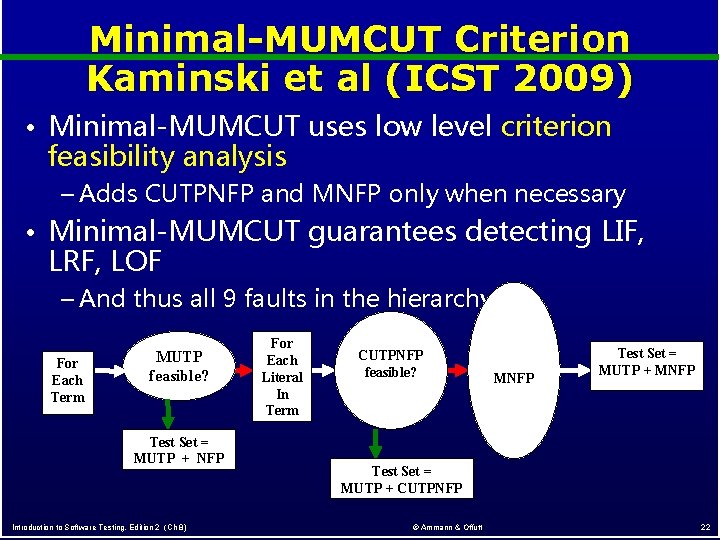
Minimal-MUMCUT Criterion Kaminski et al (ICST 2009) • Minimal-MUMCUT uses low level criterion feasibility analysis – Adds CUTPNFP and MNFP only when necessary • Minimal-MUMCUT guarantees detecting LIF, LRF, LOF – And thus all 9 faults in the hierarchy For Each Term MUTP feasible? Test Set = MUTP + NFP Introduction to Software Testing, Edition 2 (Ch 8) For Each Literal In Term CUTPNFP feasible? MNFP Test Set = MUTP + CUTPNFP © Ammann & Offutt 22