
Introduction to Software Testing Chapter 2 ModelDriven Test



- Slides: 24
Introduction to Software Testing Chapter 2 Model-Driven Test Design Paul Ammann & Jeff Offutt https: //www. cs. gmu. edu/~offutt/softwarete st/ SWE 437
Complexity of testing software n No other engineering field builds products as complicated as software n The term correctness has no meaning – Is a building correct? – Is a car correct? – Is a subway system correct? n Like other engineers, we must use abstraction to manage complexity – This is the purpose of the model-driven test design process – The “model” is an abstract structure Introduction to Software Testing, Edition 2 (Ch 2) © Ammann & Offutt 2
In-class exercise Discuss software correctness Have you thought of correctness in software as possible or impossible? Do you agree with the claim in the book, or is it hard to accept? You have five minutes Introduction to Software Testing, Edition 2 (Ch 2) © Ammann & Offutt 3
Software testing foundations (2. 1) Testing can only show the presence of failures Not their absence Not all inputs will “trigger” a fault into causing a failure Introduction to Software Testing, Edition 2 (Ch 2) © Ammann & Offutt 4
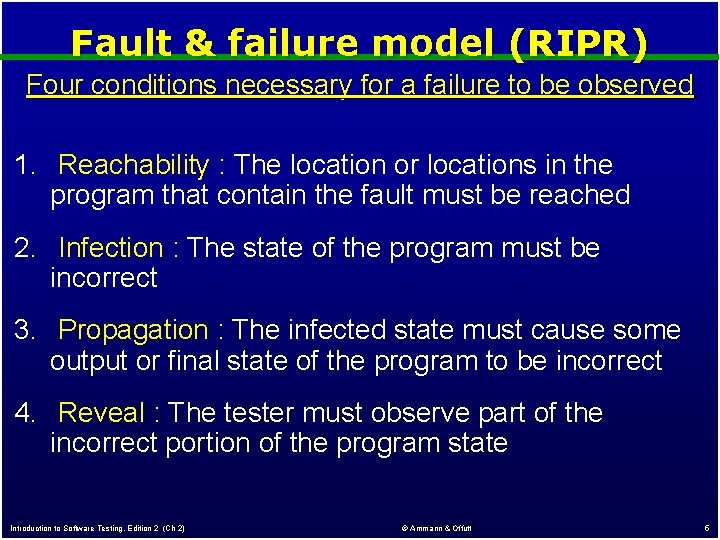
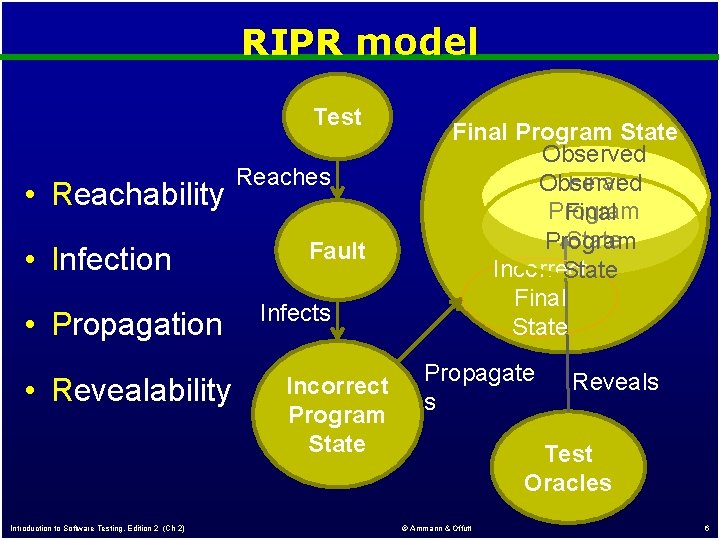
Fault & failure model (RIPR) Four conditions necessary for a failure to be observed 1. Reachability : The location or locations in the program that contain the fault must be reached 2. Infection : The state of the program must be incorrect 3. Propagation : The infected state must cause some output or final state of the program to be incorrect 4. Reveal : The tester must observe part of the incorrect portion of the program state Introduction to Software Testing, Edition 2 (Ch 2) © Ammann & Offutt 5
RIPR model Test • Reachability • Infection • Propagation • Revealability Introduction to Software Testing, Edition 2 (Ch 2) Reaches Fault Infects Incorrect Program State Final Program State Observed Final Observed Program Final State Program Incorrect State Final State Propagate s Reveals Test Oracles © Ammann & Offutt 6
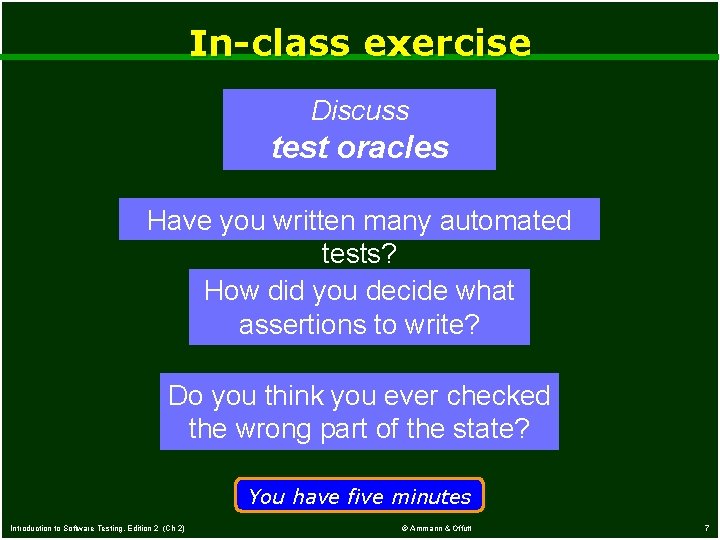
In-class exercise Discuss test oracles Have you written many automated tests? How did you decide what assertions to write? Do you think you ever checked the wrong part of the state? You have five minutes Introduction to Software Testing, Edition 2 (Ch 2) © Ammann & Offutt 7
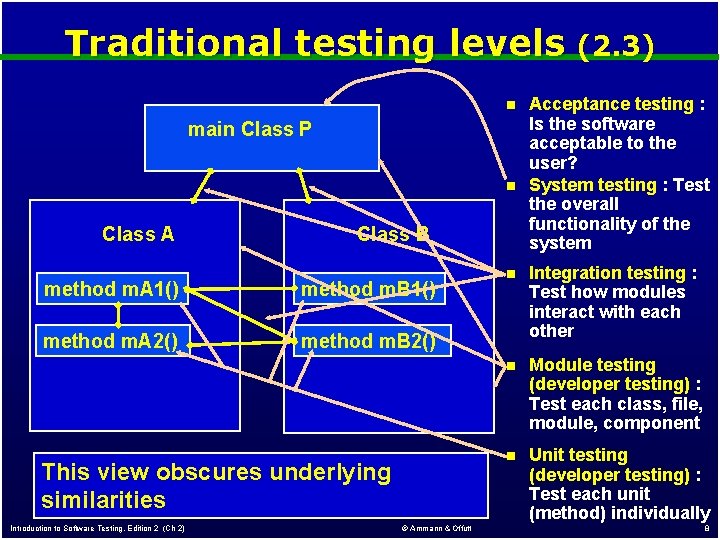
Traditional testing levels (2. 3) n main Class P n Class A Class B method m. A 1() method m. B 1() method m. A 2() method m. B 2() This view obscures underlying similarities Introduction to Software Testing, Edition 2 (Ch 2) © Ammann & Offutt Acceptance testing : Is the software acceptable to the user? System testing : Test the overall functionality of the system n Integration testing : Test how modules interact with each other n Module testing (developer testing) : Test each class, file, module, component n Unit testing (developer testing) : Test each unit (method) individually 8
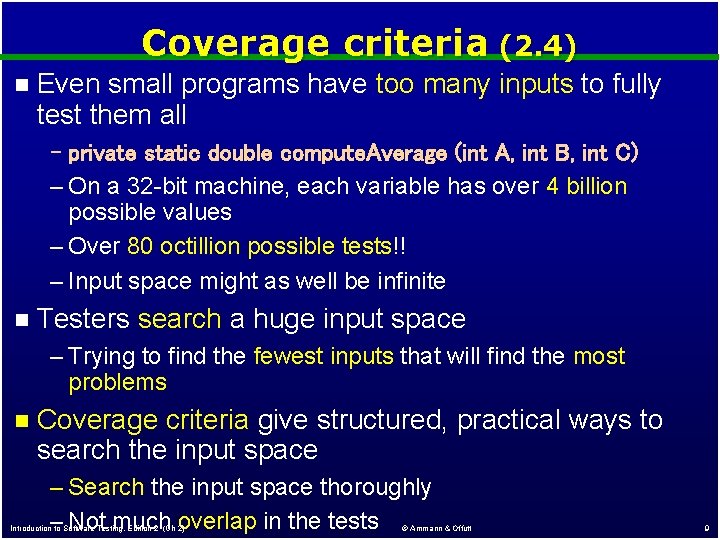
Coverage criteria (2. 4) n Even small programs have too many inputs to fully test them all – private static double compute. Average (int A, int B, int C) – On a 32 -bit machine, each variable has over 4 billion possible values – Over 80 octillion possible tests!! – Input space might as well be infinite n Testers search a huge input space – Trying to find the fewest inputs that will find the most problems n Coverage criteria give structured, practical ways to search the input space – Search the input space thoroughly – Not much overlap in the tests Introduction to Software Testing, Edition 2 (Ch 2) © Ammann & Offutt 9
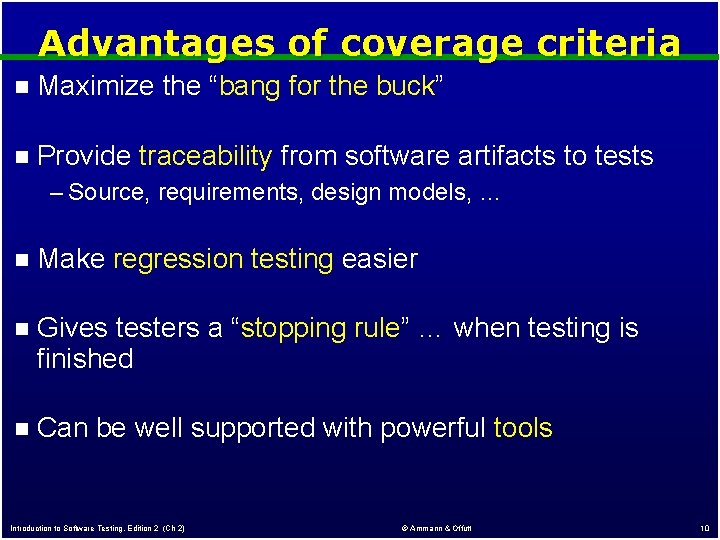
Advantages of coverage criteria n Maximize the “bang for the buck” n Provide traceability from software artifacts to tests – Source, requirements, design models, … n Make regression testing easier n Gives testers a “stopping rule” … when testing is finished n Can be well supported with powerful tools Introduction to Software Testing, Edition 2 (Ch 2) © Ammann & Offutt 10
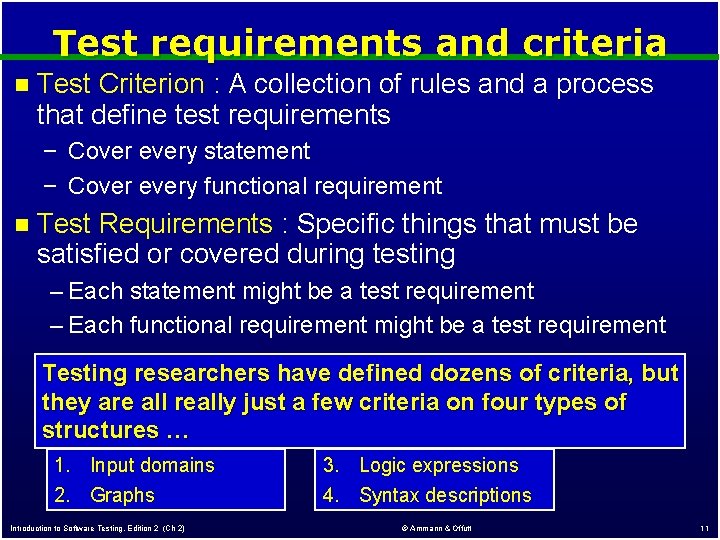
Test requirements and criteria n Test Criterion : A collection of rules and a process that define test requirements Cover every statement Cover every functional requirement n Test Requirements : Specific things that must be satisfied or covered during testing – Each statement might be a test requirement – Each functional requirement might be a test requirement Testing researchers have defined dozens of criteria, but they are all really just a few criteria on four types of structures … 1. Input domains 2. Graphs Introduction to Software Testing, Edition 2 (Ch 2) 3. Logic expressions 4. Syntax descriptions © Ammann & Offutt 11
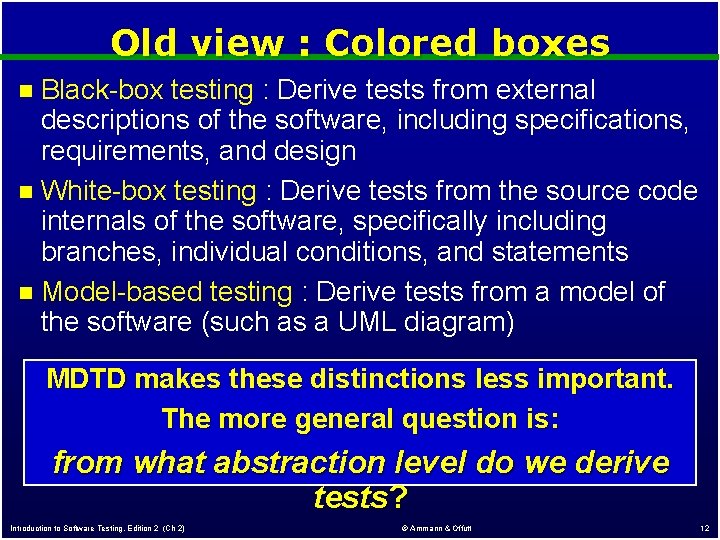
Old view : Colored boxes Black-box testing : Derive tests from external descriptions of the software, including specifications, requirements, and design n White-box testing : Derive tests from the source code internals of the software, specifically including branches, individual conditions, and statements n Model-based testing : Derive tests from a model of the software (such as a UML diagram) n MDTD makes these distinctions less important. The more general question is: from what abstraction level do we derive tests? Introduction to Software Testing, Edition 2 (Ch 2) © Ammann & Offutt 12
Model-Driven Test Design (2. 5) n Test Design is the process of designing input values that will effectively test software n Test design is one of several activities for testing software – Most mathematical – Most technically challenging Introduction to Software Testing, Edition 2 (Ch 2) © Ammann & Offutt 13
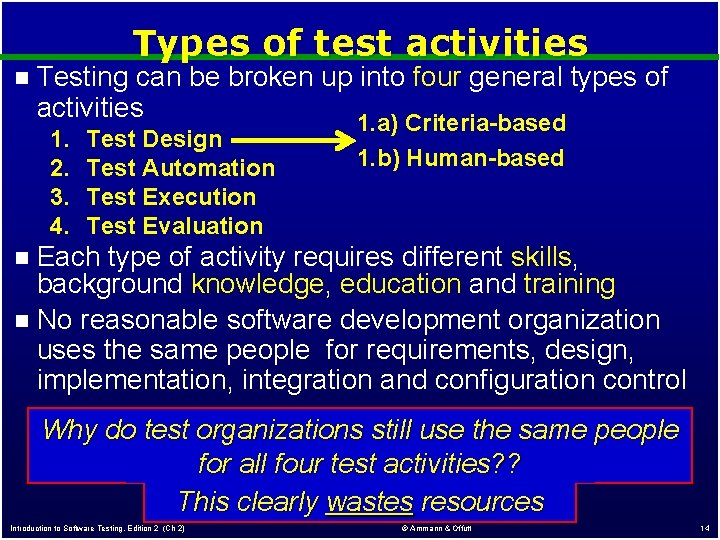
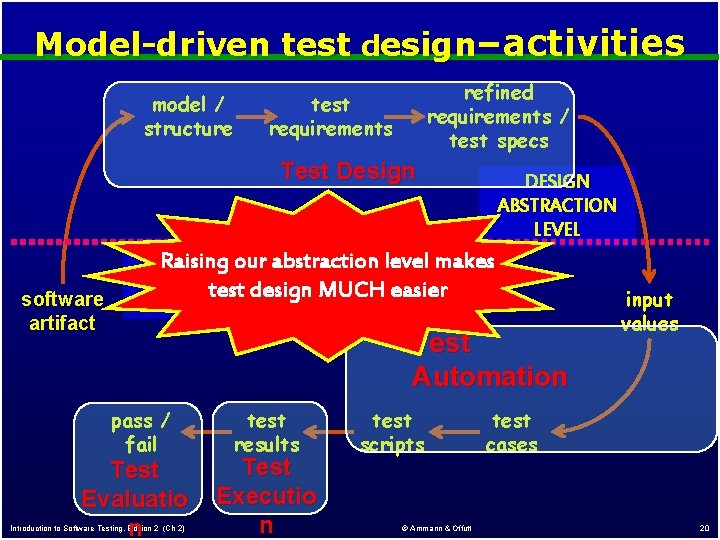
Types of test activities n Testing can be broken up into four general types of activities 1. 2. 3. 4. Test Design Test Automation Test Execution Test Evaluation 1. a) Criteria-based 1. b) Human-based Each type of activity requires different skills, background knowledge, education and training n No reasonable software development organization uses the same people for requirements, design, implementation, integration and configuration control n Why do test organizations still use the same people for all four test activities? ? This clearly wastes resources Introduction to Software Testing, Edition 2 (Ch 2) © Ammann & Offutt 14
1. Test design—(a) criteria-based Design test values to satisfy coverage criteria or other engineering goal This is the most technical job in software testing n Requires knowledge of : n – Discrete math – Programming – Testing Requires much of a traditional CS degree n This is intellectually stimulating, rewarding, and challenging n Test design is analogous to software architecture on the development side n Using people who are not qualified to design tests is a sure way to get ineffective tests n Introduction to Software Testing, Edition 2 (Ch 2) © Ammann & Offutt 15
1. Test design—(b) human-based Design test values based on domain knowledge of the program and human knowledge of testing n This is much harder than it may seem to developers n Criteria-based approaches can be blind to special situations n Requires knowledge of : – Domain, testing, and user interfaces n Requires almost no traditional CS – A background in the domain of the software is essential – An empirical background is very helpful (biology, psychology, …) – A logic background is very helpful (law, philosophy, math, …) n This is intellectually stimulating, rewarding, and challenging Introduction to Software Testing, Edition 2 (Ch 2) © Ammann & Offutt 16
2. Test automation Embed test values into executable scripts n This is slightly less technical n Requires knowledge of programming n Requires very little theory n Often requires solutions to difficult problems related to observability and controllability n Can be boring for test designers n Programming is out of reach for many domain experts n Who is responsible for determining and embedding the expected outputs ? – Test designers may not always know the expected outputs – Test evaluators need to get involved early to help with this Introduction to Software Testing, Edition 2 (Ch 2) © Ammann & Offutt 17
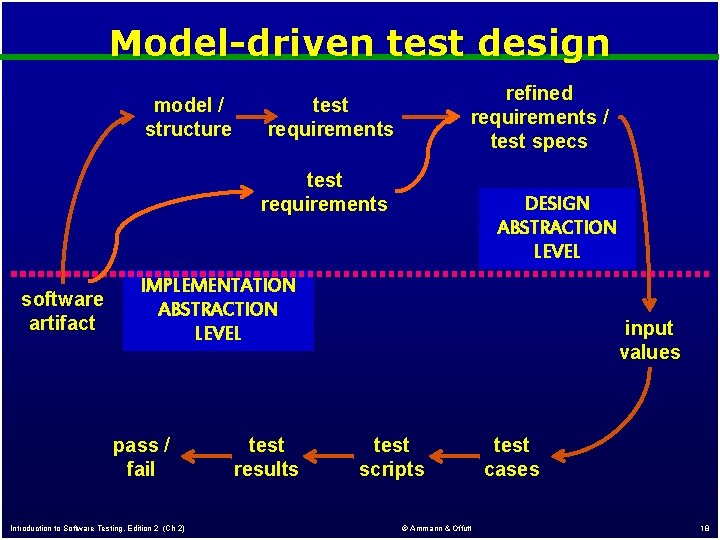
Model-driven test design model / structure refined requirements / test specs test requirements software artifact DESIGN ABSTRACTION LEVEL IMPLEMENTATION ABSTRACTION LEVEL pass / fail Introduction to Software Testing, Edition 2 (Ch 2) test results input values test scripts © Ammann & Offutt test cases 18
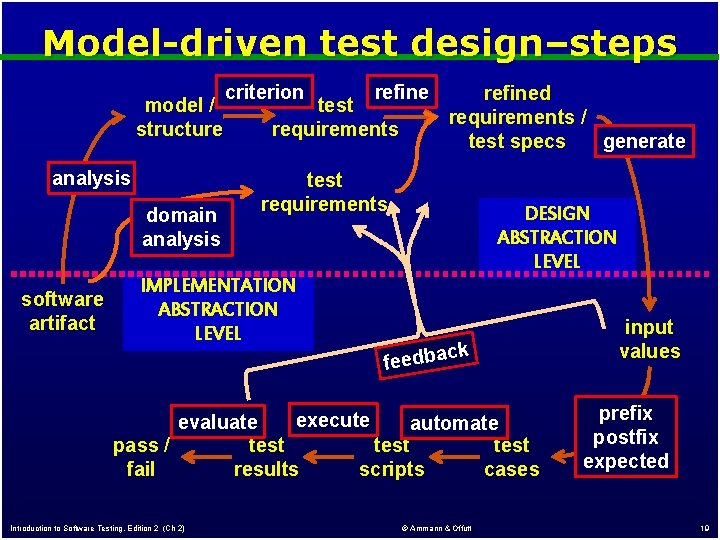
Model-driven test design–steps model / structure analysis domain analysis software artifact criterion refined test requirements / requirements test specs generate test requirements IMPLEMENTATION ABSTRACTION LEVEL DESIGN ABSTRACTION LEVEL ck feedba execute evaluate automate pass / test fail results scripts cases Introduction to Software Testing, Edition 2 (Ch 2) © Ammann & Offutt input values prefix postfix expected 19
Model-driven test design–activities model / structure refined requirements / test specs test requirements Test Design software artifact DESIGN ABSTRACTION LEVEL IMPLEMENTATION Raising our abstraction level makes ABSTRACTION test design MUCH easier LEVEL Test Automation pass / fail Test Evaluatio n Introduction to Software Testing, Edition 2 (Ch 2) test results Test Executio n test scripts © Ammann & Offutt input values test cases 20
Small example Control Flow Graph Software Artifact : Java Method /** * Return index of node n at the * first position it appears, * -1 if it is not present */ public int index. Of (Node n) { for (int i=0; i < path. size(); i++) if (path. get(i). equals(n)) return i; return -1; } Introduction to Software Testing, Edition 2 (Ch 2) 1 i = 0 2 i < path. size() 3 if 5 return -1 © Ammann & Offutt 4 return i 21
Example (2) Support tool for graph coverage https: //www. cs. gmu. edu/~offutt/softwaretest/ Graph Abstract version 1 2 3 5 Introduction to Software Testing, Edition 2 (Ch 2) 6 requirements for Edges Edge-Pair 12 Coverage 23 1. [1, 2, 3] 32 2. [1, 2, 5] 34 3. [2, 3, 4] 25 4. [2, 3, 2] Initial Node: 1 5. [3, 2, 3] Final Nodes: 4, 6. [3, 2, 5] 5 Test Paths [1, 2, 5] Find values … [1, 2, 3, 2, 5] 4 [1, 2, 3, 4] © Ammann & Offutt 22
Types of activities in the book Most of this book is about test design Other activities are well covered elsewhere Introduction to Software Testing, Edition 2 (Ch 2) © Ammann & Offutt 23
In-class exercise Discuss coverage criteria Why do software organizations use coverage criteria? Why don’t more software organizations use coverage criteria? You have five minutes Introduction to Software Testing, Edition 2 (Ch 2) © Ammann & Offutt 24