
Introduction to Software Testing 2 nd edition Chapter

- Slides: 19
Introduction to Software Testing (2 nd edition) Chapter 4 Putting Testing First Paul Ammann & Jeff Offutt http: //www. cs. gmu. edu/~offutt/softwaretest/ August 2014
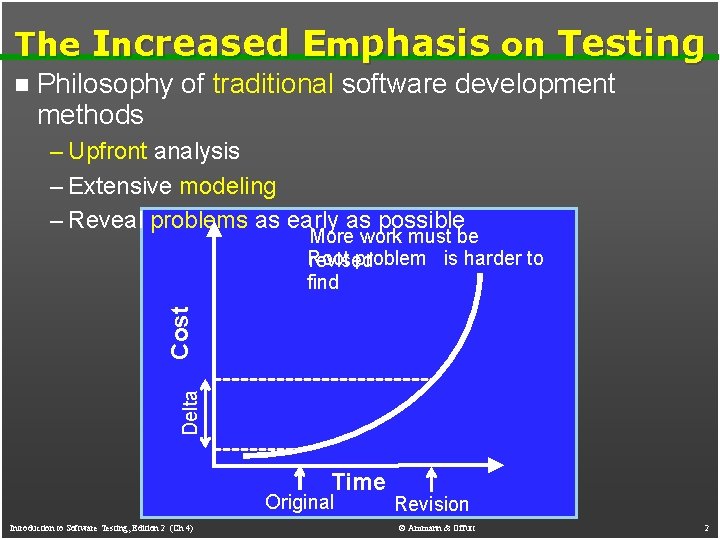
The Increased Emphasis on Testing n Philosophy of traditional software development methods – Upfront analysis – Extensive modeling – Reveal problems as early as possible Delta Cost More work must be Root problem is harder to revised find Time Original Introduction to Software Testing, Edition 2 (Ch 4) Revision © Ammann & Offutt 2
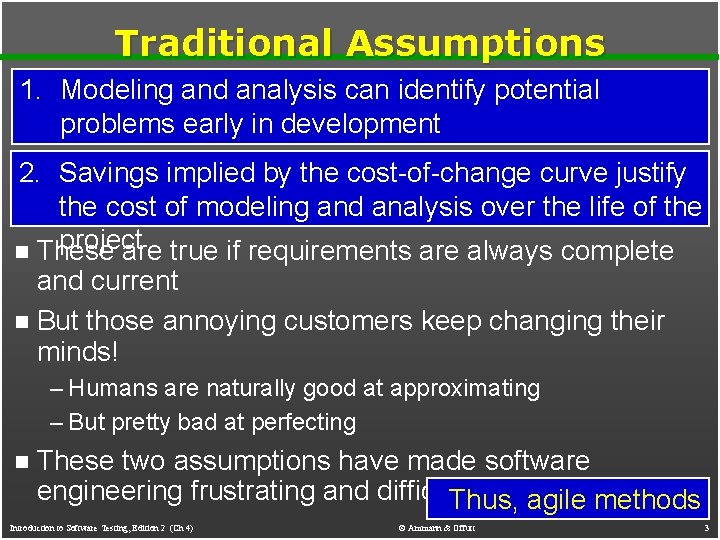
Traditional Assumptions 1. Modeling and analysis can identify potential problems early in development 2. Savings implied by the cost-of-change curve justify the cost of modeling and analysis over the life of the project n These are true if requirements are always complete and current n But those annoying customers keep changing their minds! – Humans are naturally good at approximating – But pretty bad at perfecting n These two assumptions have made software engineering frustrating and difficult for decades Thus, agile methods Introduction to Software Testing, Edition 2 (Ch 4) © Ammann & Offutt 3
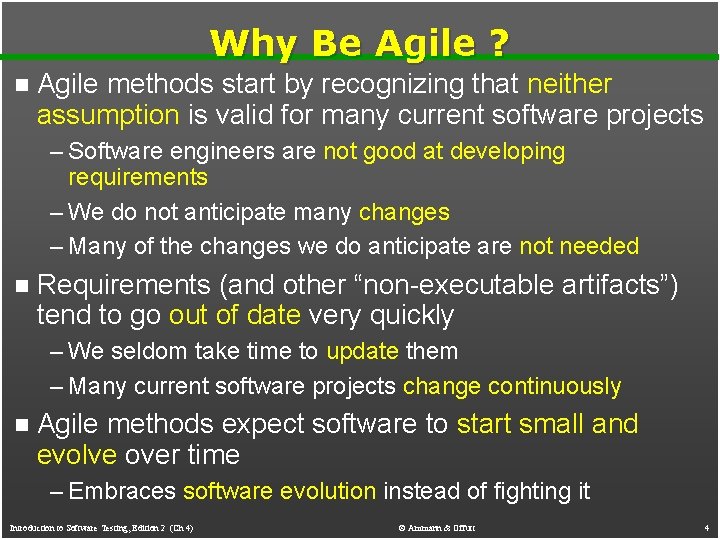
Why Be Agile ? n Agile methods start by recognizing that neither assumption is valid for many current software projects – Software engineers are not good at developing requirements – We do not anticipate many changes – Many of the changes we do anticipate are not needed n Requirements (and other “non-executable artifacts”) tend to go out of date very quickly – We seldom take time to update them – Many current software projects change continuously n Agile methods expect software to start small and evolve over time – Embraces software evolution instead of fighting it Introduction to Software Testing, Edition 2 (Ch 4) © Ammann & Offutt 4
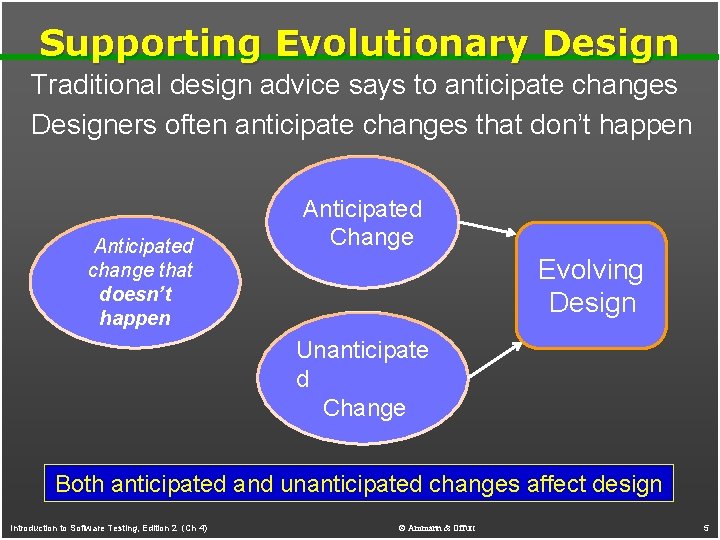
Supporting Evolutionary Design Traditional design advice says to anticipate changes Designers often anticipate changes that don’t happen Anticipated change that doesn’t happen Anticipated Change Evolving Design Unanticipate d Change Both anticipated and unanticipated changes affect design Introduction to Software Testing, Edition 2 (Ch 4) © Ammann & Offutt 5
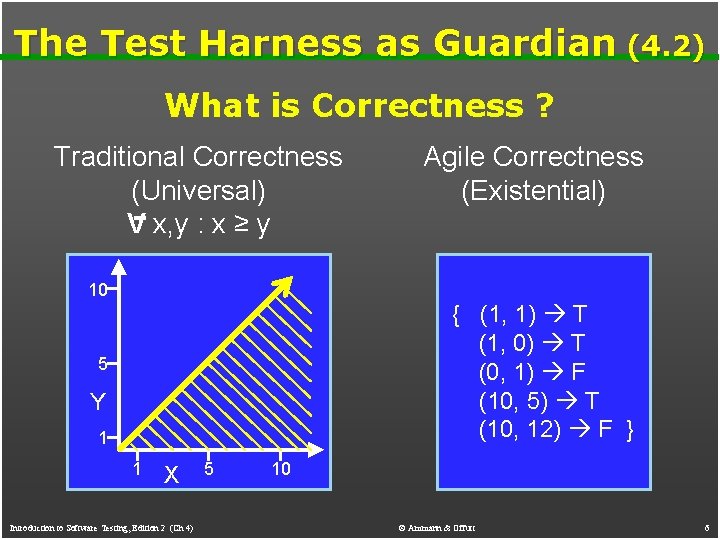
The Test Harness as Guardian (4. 2) What is Correctness ? Traditional Correctness (Universal) V x, y : x ≥ y Agile Correctness (Existential) 10 { (1, 1) T (1, 0) T (0, 1) F (10, 5) T (10, 12) F } 5 Y 1 1 X Introduction to Software Testing, Edition 2 (Ch 4) 5 10 © Ammann & Offutt 6
A Limited View of Correctness n In traditional methods, we try to define all correct behavior completely, at the beginning – What is correctness? – Does “correctness” mean anything in large engineering products? – People are VERY BAD at completely defining correctness n In agile methods, we redefine correctness to be relative to a specific set of tests – If the software behaves correctly on the tests, it is “correct” – Instead of defining all behaviors, we demonstrate some behaviors – Mathematicians may be disappointed at the lack of But software engineers ain’t mathematicians! completeness Introduction to Software Testing, Edition 2 (Ch 4) © Ammann & Offutt 7
Test Harnesses Verify Correctness A test harness runs all automated tests efficiently and reports results to the developers n Tests must be automated – Test automation is a prerequisite to test driven development Every test must include a test oracle that can evaluate whether that test executed correctly n The tests replace the requirements n Tests must be high quality and must run quickly n We run tests every time we make a change to the software n Introduction to Software Testing, Edition 2 (Ch 4) © Ammann & Offutt 8
Continuous Integration n Agile methods work best when the current version of the software can be run against all tests at any time A continuous integration server rebuilds the system, returns, and reverifies tests whenever any update is checked into the repository Mistakes are caught earlier n Other developers are aware of changes early n The rebuild and reverify must happen as soon as possible n – Thus, tests need to execute quickly A continuous integration server doesn’t just run tests, it decides if a modified system is still correct Introduction to Software Testing, Edition 2 (Ch 4) © Ammann & Offutt 9
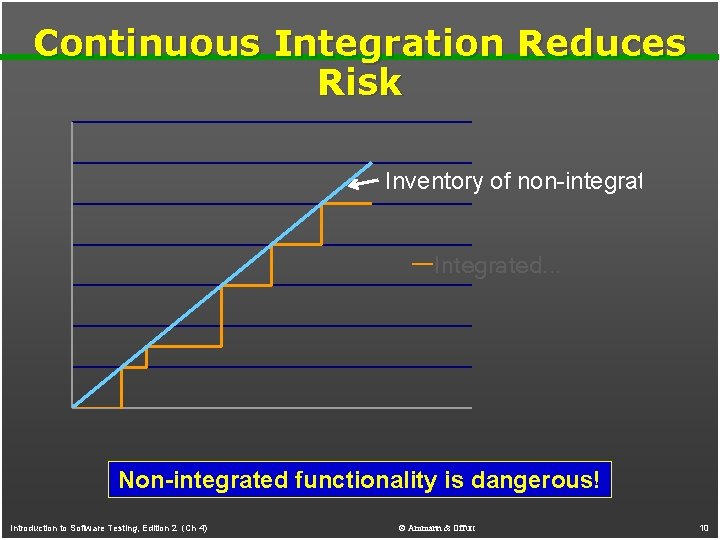
Continuous Integration Reduces Risk Inventory of non-integrated work Integrated. . . Non-integrated functionality is dangerous! Introduction to Software Testing, Edition 2 (Ch 4) © Ammann & Offutt 10
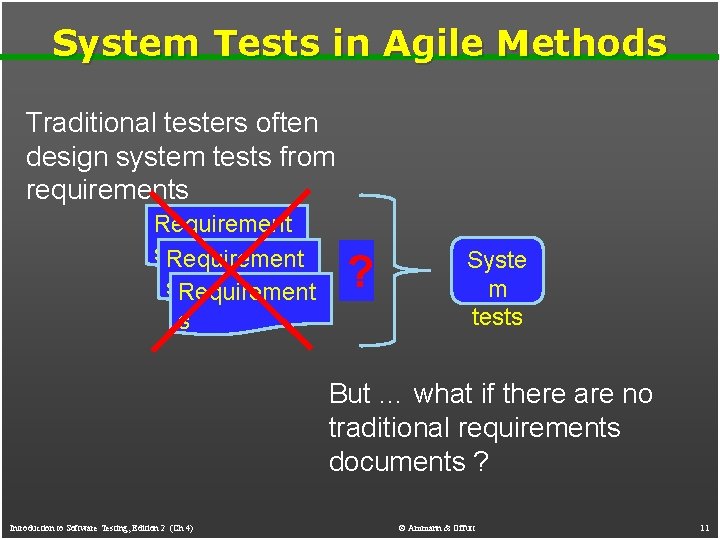
System Tests in Agile Methods Traditional testers often design system tests from requirements Requirement s ? Syste m tests But … what if there are no traditional requirements documents ? Introduction to Software Testing, Edition 2 (Ch 4) © Ammann & Offutt 11
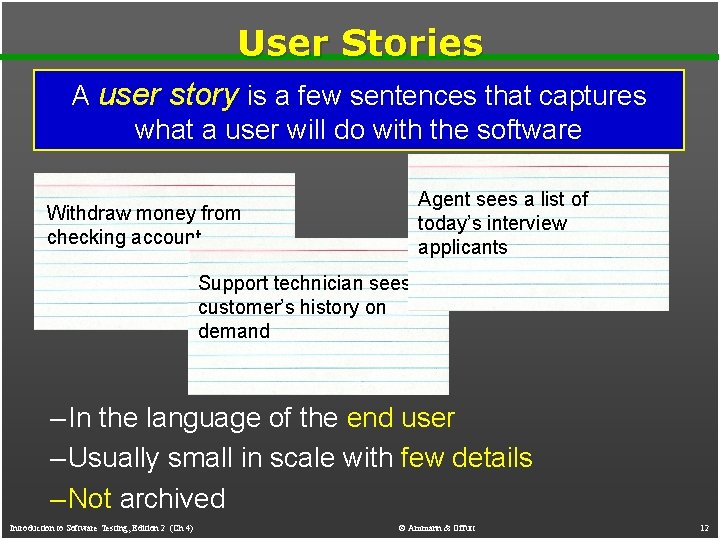
User Stories A user story is a few sentences that captures what a user will do with the software Agent sees a list of today’s interview applicants Withdraw money from checking account Support technician sees customer’s history on demand – In the language of the end user – Usually small in scale with few details – Not archived Introduction to Software Testing, Edition 2 (Ch 4) © Ammann & Offutt 12
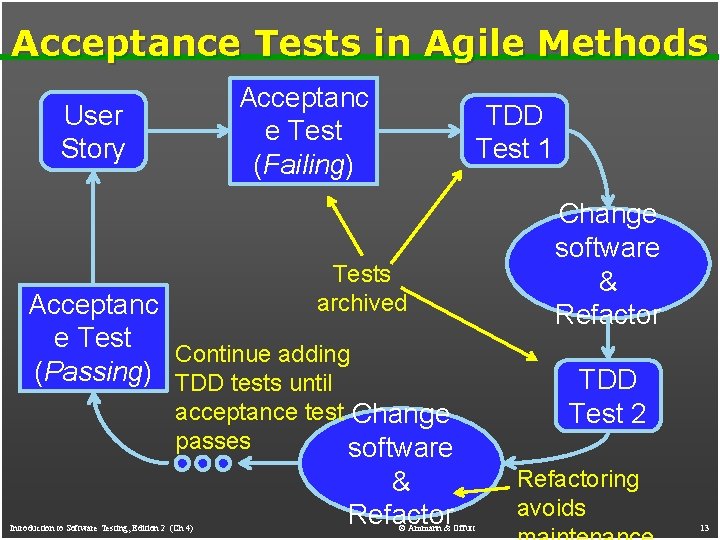
Acceptance Tests in Agile Methods Acceptanc e Test (Failing) User Story TDD Test 1 Tests archived Acceptanc e Test Continue adding (Passing) TDD tests until acceptance test Change passes software Introduction to Software Testing, Edition 2 (Ch 4) & Refactor © Ammann & Offutt Change software & Refactor TDD Test 2 Refactoring avoids 13
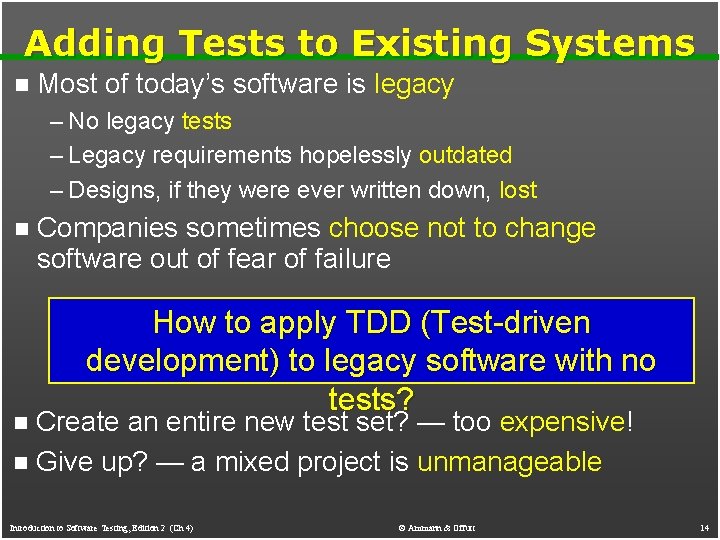
Adding Tests to Existing Systems n Most of today’s software is legacy – No legacy tests – Legacy requirements hopelessly outdated – Designs, if they were ever written down, lost n Companies sometimes choose not to change software out of fear of failure How to apply TDD (Test-driven development) to legacy software with no tests? Create an entire new test set? — too expensive! n Give up? — a mixed project is unmanageable n Introduction to Software Testing, Edition 2 (Ch 4) © Ammann & Offutt 14
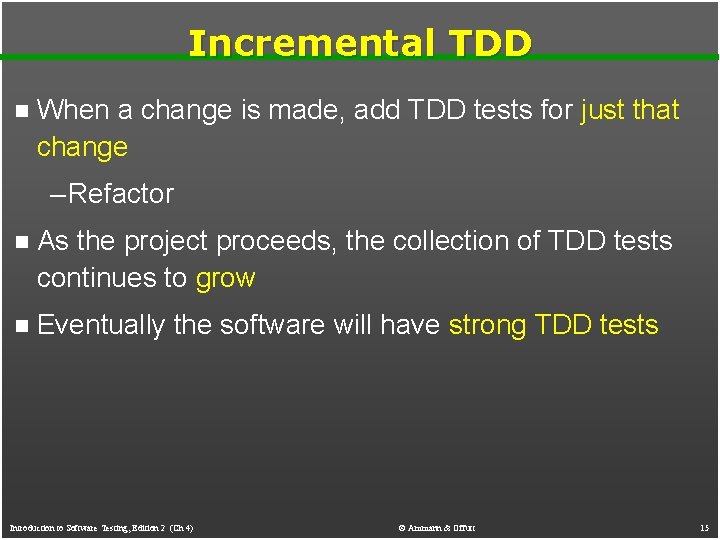
Incremental TDD n When a change is made, add TDD tests for just that change – Refactor n As the project proceeds, the collection of TDD tests continues to grow n Eventually the software will have strong TDD tests Introduction to Software Testing, Edition 2 (Ch 4) © Ammann & Offutt 15
The Testing Shortfall n Do TDD tests (acceptance or otherwise) test the software well? – Do the tests achieve good coverage on the code? – Do the tests find most of the faults? – If the software passes, should management feel confident the software is reliable? NO! Introduction to Software Testing, Edition 2 (Ch 4) © Ammann & Offutt 16
Why Not? n Most agile tests focus on “happy paths” – What should happen under normal use n They often miss things like – Confused-user paths – Creative-user paths – Malicious-user paths The agile methods literature does not give much guidance Introduction to Software Testing, Edition 2 (Ch 4) © Ammann & Offutt 17
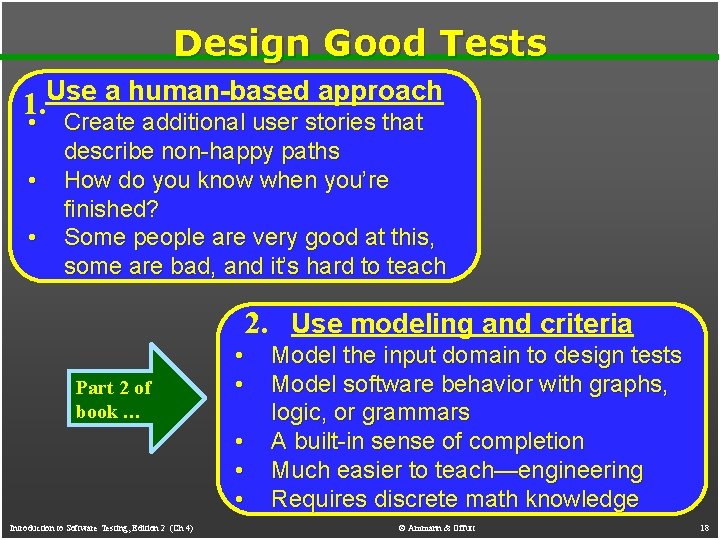
Design Good Tests 1. Use a human-based approach • • • Create additional user stories that describe non-happy paths How do you know when you’re finished? Some people are very good at this, some are bad, and it’s hard to teach 2. Use modeling and criteria Part 2 of book … • • • Introduction to Software Testing, Edition 2 (Ch 4) Model the input domain to design tests Model software behavior with graphs, logic, or grammars A built-in sense of completion Much easier to teach—engineering Requires discrete math knowledge © Ammann & Offutt 18
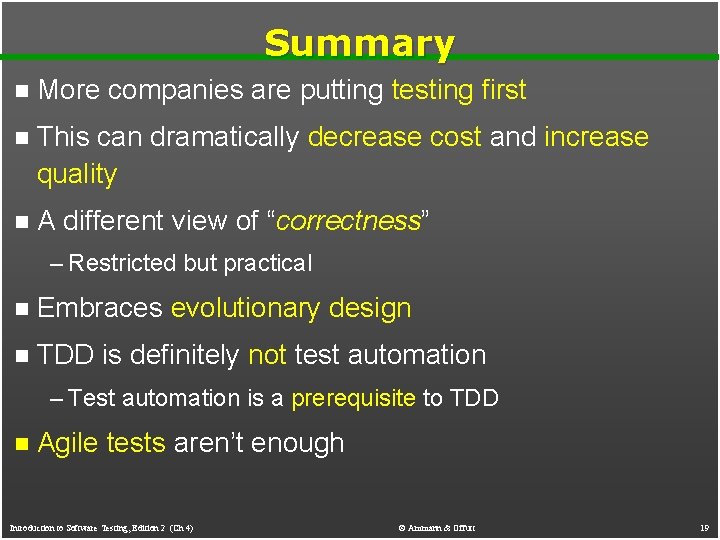
Summary n More companies are putting testing first n This can dramatically decrease cost and increase quality n A different view of “correctness” – Restricted but practical n Embraces evolutionary design n TDD is definitely not test automation – Test automation is a prerequisite to TDD n Agile tests aren’t enough Introduction to Software Testing, Edition 2 (Ch 4) © Ammann & Offutt 19