
Introduction to Software Engineering A Practitioners Approach 7e
![Software Engineering Definition The seminal definition: [Software engineering is] the establishment and use of](https://slidetodoc.com/presentation_image_h/0743b6df7e34e22837f2fcbe17e85dc9/image-10.jpg "Software Engineering Definition The seminal definition: [Software engineering is] the establishment and use of")
- Slides: 13
Introduction to Software Engineering: A Practitioner’s Approach, 7/e by Roger S. Pressman Chapter 1 1
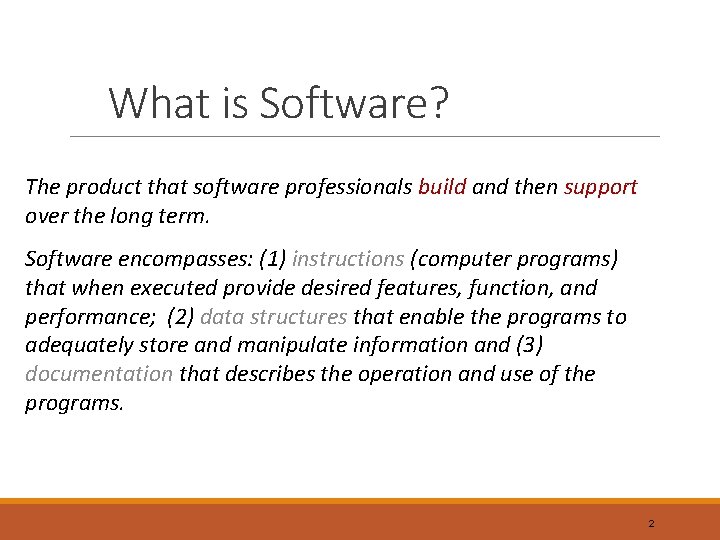
What is Software? The product that software professionals build and then support over the long term. Software encompasses: (1) instructions (computer programs) that when executed provide desired features, function, and performance; (2) data structures that enable the programs to adequately store and manipulate information and (3) documentation that describes the operation and use of the programs. 2
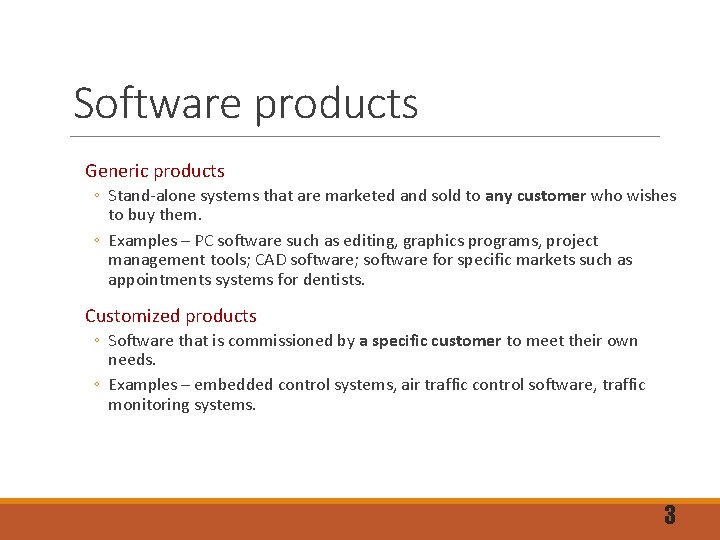
Software products Generic products ◦ Stand-alone systems that are marketed and sold to any customer who wishes to buy them. ◦ Examples – PC software such as editing, graphics programs, project management tools; CAD software; software for specific markets such as appointments systems for dentists. Customized products ◦ Software that is commissioned by a specific customer to meet their own needs. ◦ Examples – embedded control systems, air traffic control software, traffic monitoring systems. 3
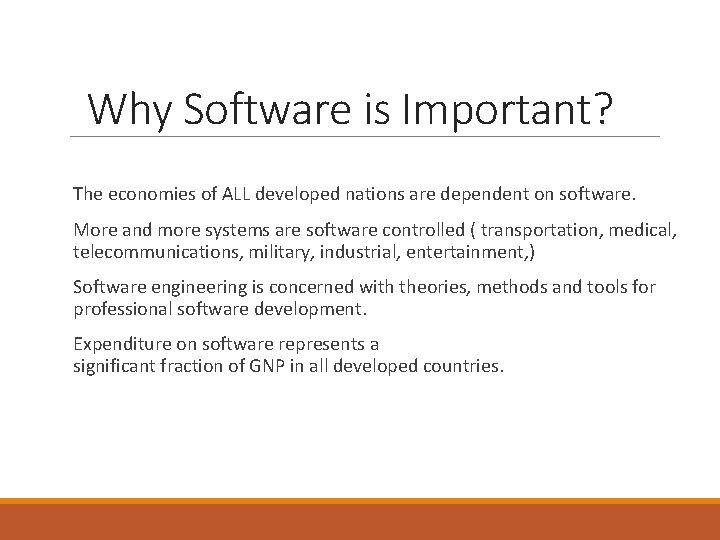
Why Software is Important? The economies of ALL developed nations are dependent on software. More and more systems are software controlled ( transportation, medical, telecommunications, military, industrial, entertainment, ) Software engineering is concerned with theories, methods and tools for professional software development. Expenditure on software represents a significant fraction of GNP in all developed countries.
Software costs often dominate computer system costs. The costs of software on a PC are often greater than the hardware cost. Software costs more to maintain than it does to develop. For systems with a long life, maintenance costs may be several times development costs. Software engineering is concerned with cost-effective software development.
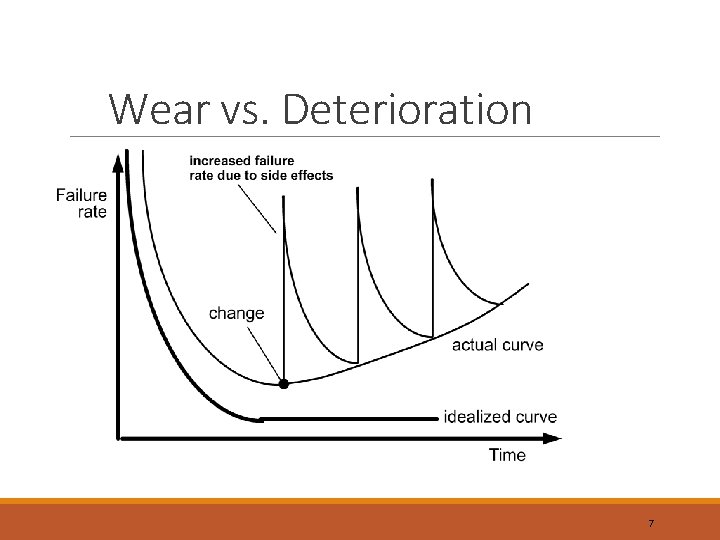
Features of Software? Its characteristics that make it different from other things human being build. Features of such logical system: Software is developed or engineered, it is not manufactured in the classical sense which has quality problem. Software doesn't "wear out. ” but it deteriorates (due to change). Hardware has bathtub curve of failure rate ( high failure rate in the beginning, then drop to steady state, then cumulative effects of dust, vibration, abuse occurs). Although the industry is moving toward component-based construction (e. g. standard screws and off-the-shelf integrated circuits), most software continues to be custom-built. Modern reusable components encapsulate data and processing into software parts to be reused by different programs. E. g. graphical user interface, window, pull-down menus in library etc. 6
Wear vs. Deterioration 7
Software Applications 1. System software: such as compilers, editors, file management utilities 2. Application software: stand-alone programs for specific needs. 3. Engineering/scientific software: Characterized by “number crunching”algorithms. such as automotive stress analysis, molecular biology, orbital dynamics etc 4. Embedded software resides within a product or system. (key pad control of a microwave oven, digital function of dashboard display in a car) 5. Product-line software focus on a limited marketplace to address mass consumer market. (word processing, graphics, database management) 6. Web. Apps (Web applications) network centric software. As web 2. 0 emerges, more sophisticated computing environments is supported integrated with remote database and business applications. 7. AI software uses non-numerical algorithm to solve complex problem. Robotics, expert system, pattern recognition game playing 8
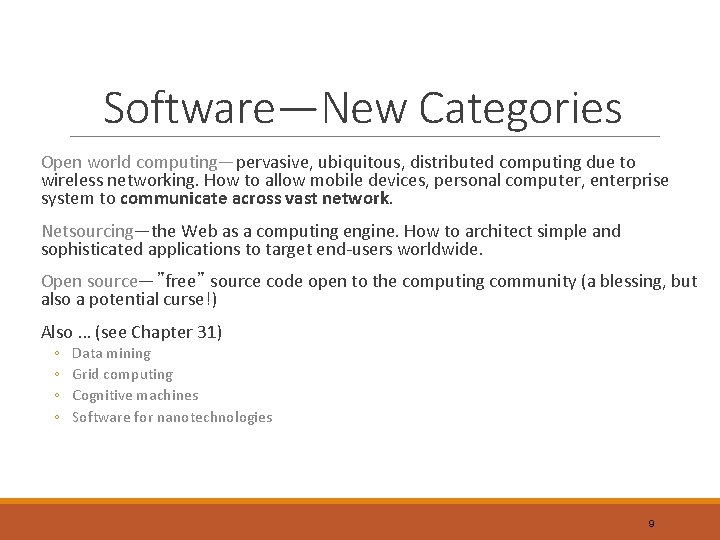
Software—New Categories Open world computing—pervasive, ubiquitous, distributed computing due to wireless networking. How to allow mobile devices, personal computer, enterprise system to communicate across vast network. Netsourcing—the Web as a computing engine. How to architect simple and sophisticated applications to target end-users worldwide. Open source—”free” source code open to the computing community (a blessing, but also a potential curse!) Also … (see Chapter 31) ◦ ◦ Data mining Grid computing Cognitive machines Software for nanotechnologies 9
Software Engineering Definition The seminal definition: [Software engineering is] the establishment and use of sound engineering principles in order to obtain economically software that is reliable and works efficiently on real machines. The IEEE definition: Software Engineering: (1) The application of a systematic, disciplined, quantifiable approach to the development, operation, and maintenance of software; that is, the application of engineering to software. (2) The study of approaches as in (1).
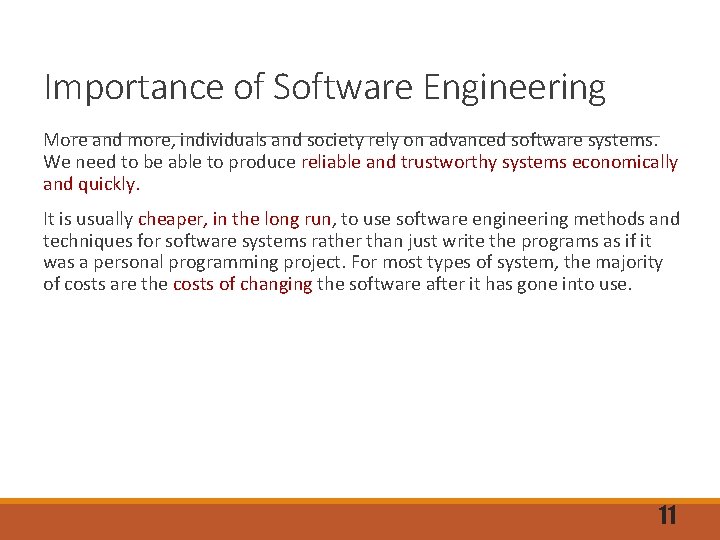
Importance of Software Engineering More and more, individuals and society rely on advanced software systems. We need to be able to produce reliable and trustworthy systems economically and quickly. It is usually cheaper, in the long run, to use software engineering methods and techniques for software systems rather than just write the programs as if it was a personal programming project. For most types of system, the majority of costs are the costs of changing the software after it has gone into use. 11
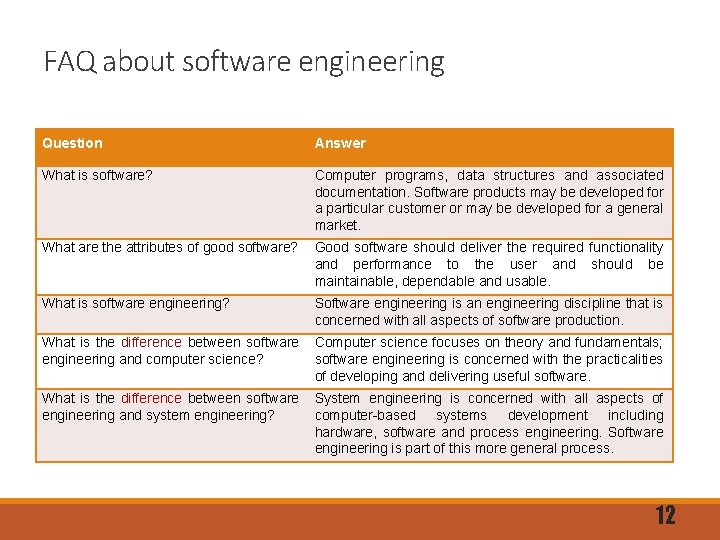
FAQ about software engineering Question Answer What is software? Computer programs, data structures and associated documentation. Software products may be developed for a particular customer or may be developed for a general market. What are the attributes of good software? Good software should deliver the required functionality and performance to the user and should be maintainable, dependable and usable. What is software engineering? Software engineering is an engineering discipline that is concerned with all aspects of software production. What is the difference between software engineering and computer science? Computer science focuses on theory and fundamentals; software engineering is concerned with the practicalities of developing and delivering useful software. What is the difference between software engineering and system engineering? System engineering is concerned with all aspects of computer-based systems development including hardware, software and process engineering. Software engineering is part of this more general process. 12
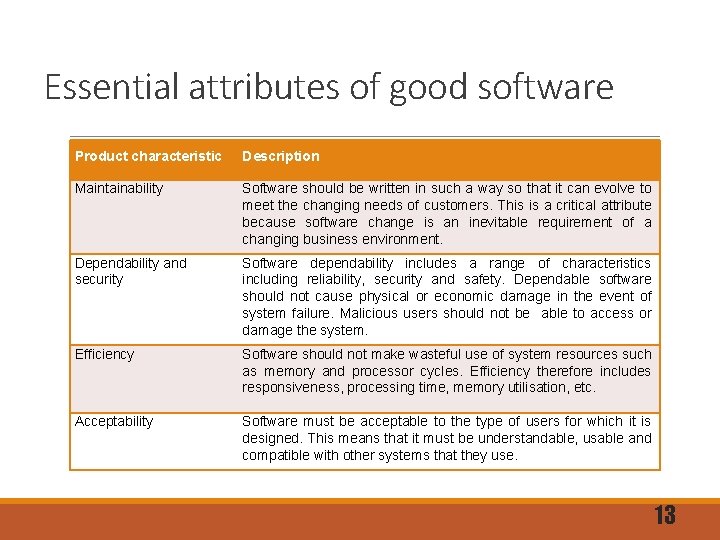
Essential attributes of good software Product characteristic Description Maintainability Software should be written in such a way so that it can evolve to meet the changing needs of customers. This is a critical attribute because software change is an inevitable requirement of a changing business environment. Dependability and security Software dependability includes a range of characteristics including reliability, security and safety. Dependable software should not cause physical or economic damage in the event of system failure. Malicious users should not be able to access or damage the system. Efficiency Software should not make wasteful use of system resources such as memory and processor cycles. Efficiency therefore includes responsiveness, processing time, memory utilisation, etc. Acceptability Software must be acceptable to the type of users for which it is designed. This means that it must be understandable, usable and compatible with other systems that they use. 13