
Introduction to Software Development Environment Environment refers to
- Slides: 13
Introduction to Software Development Environment : Environment refers to the collection of hardware and software tools a system developer uses to build software systems. As technology improves and user expectations grow, an environment's functionality tends to change. Programming environment and software development environment are often used synonymously, but here we will make a distinction between the two.
programming Environment: we mean an environment that supports only the coding phase of the software development cycle—that is, programming-inthe-small tasks such as editing and compiling.
software development environment: we mean an environment that augments or automates the activities comprising the software development cycle, including programming-in-the-large tasks such as configuration management and programming-in-the-many tasks such as project and team management
Operating System üProgram that controls the execution of application programs. üAn interface between applications and hardware.
Operating System Objectives üConvenience Makes the computer more convenient to use. üEfficiency Allows computer system resources to be used in an efficient manner. üAbility to evolve Permit effective development, testing, and introduction of new system functions without interfering with service
Services Provided by the Operating System: üProgram development -Editors and debuggers üProgram execution üAccess to I/O devices üControlled access to files üSystem access
Operating System Task: üResponsible for managing resources üFunctions same way as ordinary computer software üIt is program that is executed üOperating system relinquishes control of the processor
Programming Languages: A vocabulary and set of grammatical rules for instructing a computer to perform specific tasks. The term programming language usually refers to high-level languages, such as BASIC, C, C++, COBOL, FORTRAN, Ada, and Pascal. Each language has a unique set of keywords (words that it understands) and a special syntax for organizing program instructions. Contd…
High-level programming languages, while simple compared to human languages, are more complex than the languages the computer actually understands, called machine languages. Each different type of CPU has its own unique machine language. Contd…
Lying between machine languages and high-level languages are languages called assembly languages. Assembly languages are similar to machine languages, but they are much easier to program in because they allow a programmer to substitute names for numbers. Machine languages consist of numbers only
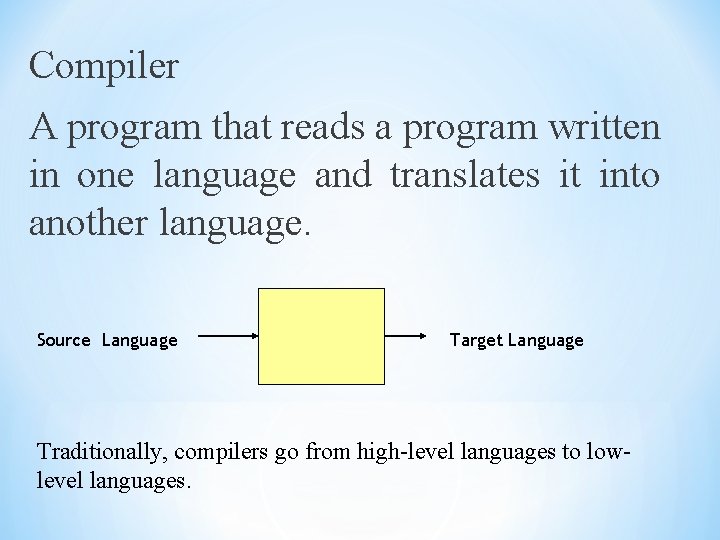
Compiler A program that reads a program written in one language and translates it into another language. Source Language Target Language Traditionally, compilers go from high-level languages to lowlevel languages.
Editor üProgramming editors, also known as source code editors, are text editors that are specifically designed for programmers or developers for writing the source code of an application or a program. üMost of these editors are built with useful features, which may include colour syntax highlighting, auto indentation, auto complete, bracket matching, syntax check, plugins, etc. , to effectively support the users during coding, debugging and testing. Contd…
Notepad++ is a popular and widely-used editor loaded with features to make the users' programming more productive, including syntax and brace highlighting for many languages, search and replace using regular expressions, macro recording, and playback. It is also highly configurable through plug-ins, has a wide range of themes and offers multi-language support. Other features include color source code printing, auto-completion, multi-document and multiview, drag and drop, syntax folding, bookmark, ASCII art display and more.