
Introduction to Sociology Module 12 Education Why It




- Slides: 36
Introduction to Sociology Module 12: Education
Why It Matters: Education • Education begins at birth with an informal process • The process of education becomes more formal throughout development and as the child moves through the school system • The education system socializes us to our society through both formal processes and informal mechanisms • Schools can be agents of change or conformity, teaching individuals to think outside the family and local norms while also acclimatizing them to their place in society
Introduction to Global Education • • Today, some degree of education is necessary for people in most countries UNESCO has calculated that in the next 30 years, more people will receive formal education than in any prior period of human history In general, education is a means through which the aims and habits of a group of people are passed from one generation to the next Technically, education is the formal process by which society deliberately passes accumulated knowledge, skills, customs, and values from one generation to the next
Education Around the World • Education is a social institution through which society teaches children basic • • • academic knowledge, learning skills, and cultural norms Available resources and money are both factors that affect education systems around the world International differences in education systems are not solely a financial issue as value placed on education, the amount of time devoted, and the distribution of education within a country also play a role The PISA test helps to highlight differences in education distribution, showing U. S. students to lag behind other high-income countries Top ranked nations and city-states all have well established education standards and clear student goals Analysts attributed 20% of performance differences and low U. S. rankings to differences in social backgrounds and underperformance of the middle class
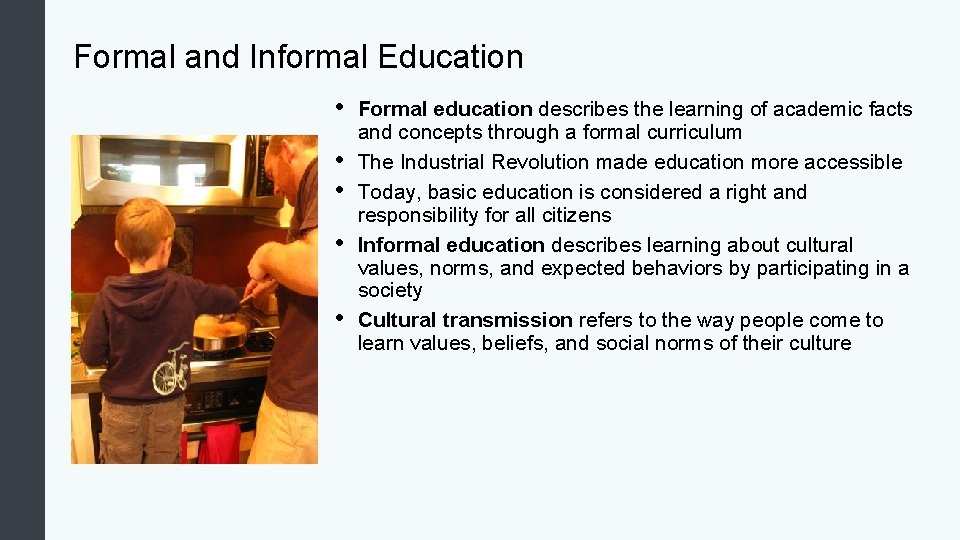
Formal and Informal Education • • • Formal education describes the learning of academic facts and concepts through a formal curriculum The Industrial Revolution made education more accessible Today, basic education is considered a right and responsibility for all citizens Informal education describes learning about cultural values, norms, and expected behaviors by participating in a society Cultural transmission refers to the way people come to learn values, beliefs, and social norms of their culture
Universal Access to Education • • • Universal access refers to people’s equal ability to participate in an education system UN’s Universal Declaration on Human Rights calls for all individuals to be entitled to a free education at the primary level Universal access is more difficult in practice The 1972 Mills v. Board of Education of the District of Columbia was on behalf of seven school-age children with special needs and upheld the right to free education Today the optimal way to include differently-abled students in standard classrooms is still being researched and debated
Practice Question 1 While 8 -year old Lebron might learn about multiplication tables in school, sociologists would emphasize that he will also learn _____. a. b. c. d. cultural expectations and norms such as taking turns on the swings at recess humanities such as history and language studies to use scientific inquiry to learn about the world around him about nutrition in his society
Practice Question 1 Answer While 8 -year old Lebron might learn about multiplication tables in school, sociologists would emphasize that he will also learn _____. a. b. c. d. cultural expectations and norms such as taking turns on the swings at recess humanities such as history and language studies to use scientific inquiry to learn about the world around him about nutrition in his society
Practice Question 2 The major factors that affect education systems are _____ that are utilized to support those systems in different nations. a. b. c. d. school houses and desks the books the resources and money government agencies
Practice Question 2 Answer The major factors that affect education systems are _____ that are utilized to support those systems in different nations. a. b. c. d. school houses and desks the books the resources and money government agencies Explanation of answer: Resources and money are utilized to support education, systems and affect how education is organized, structured, and administered to students.
Practice Question 3 The term formal education is defined by the text as: a. b. c. d. Learning about cultural values, norms, and expected behaviors through participation in a society. The education one receives at a private school, parochial school, or private college. An education that is accompanied by a tutor at all times. The learning of academic facts and concepts.
Practice Question 3 Answer The term formal education is defined by the text as: a. b. c. d. Learning about cultural values, norms, and expected behaviors through participation in a society. The education one receives at a private school, parochial school, or private college. An education that is accompanied by a tutor at all times. The learning of academic facts and concepts. Explanation of answer: Formal education is usually acquired in school where informal education describes learning about cultural values, norms, and expected behaviors by participating in a society.
Practice Question 4 A precedent for universal access to education in the United States was set with the 1972 U. S. District Court for the District of Columbia’s decision in _____, brought on the behalf of seven school-age children with special needs who argued that the school board was denying their access to free public education. a. b. c. d. United States v. Lopez Brown v. Board of Education Abington School District v. Schempp Mills v. Board of Education of the District of Columbia
Practice Question 4 Answer A precedent for universal access to education in the United States was set with the 1972 U. S. District Court for the District of Columbia’s decision in _____, brought on the behalf of seven school-age children with special needs who argued that the school board was denying their access to free public education. a. b. c. d. United States v. Lopez Brown v. Board of Education Abington School District v. Schempp Mills v. Board of Education of the District of Columbia Explanation of answer: This case upheld the students’ right to education, finding that they should either be given public or private education paid for by their board of education.
Functionalist Theory on Education • • • Functionalists view education as one of the more important social institutions in society with both manifest and latent functions Manifest functions are the primary functions that are intended and visible functions of education The first manifest function is socialization: children are taught to practice various societal roles beginning in preschool School systems in the United States transmit the core values of the nation through manifest functions like social control Social placement: Education also provides one of the major methods used by people for upward social mobility
Functionalist Theory on Education, continued • • • Education also fulfills latent functions The educational setting introduces students to social networks that might last for years and can help people find jobs after schooling is complete Another latent function is the ability to work with others in small groups Important U. S. values students learn include individualism and patriotism Schools also prepare students for competition in life through athletics and academics Functionalists content that school is taking over some of the functions that were traditionally undertaken by family
Conflict Theory on Education • • Conflict theorists believe the education system reinforces and perpetuates social inequalities that arise from differences in class, gender, race, and ethnicity Educational systems preserve the status quo and push people of lower status into obedience and maintain socioeconomical disadvantage Fulfillment of education is closely linked to social class Cultural capital: cultural knowledge that serves as metaphorical currency and helps to navigate a culture
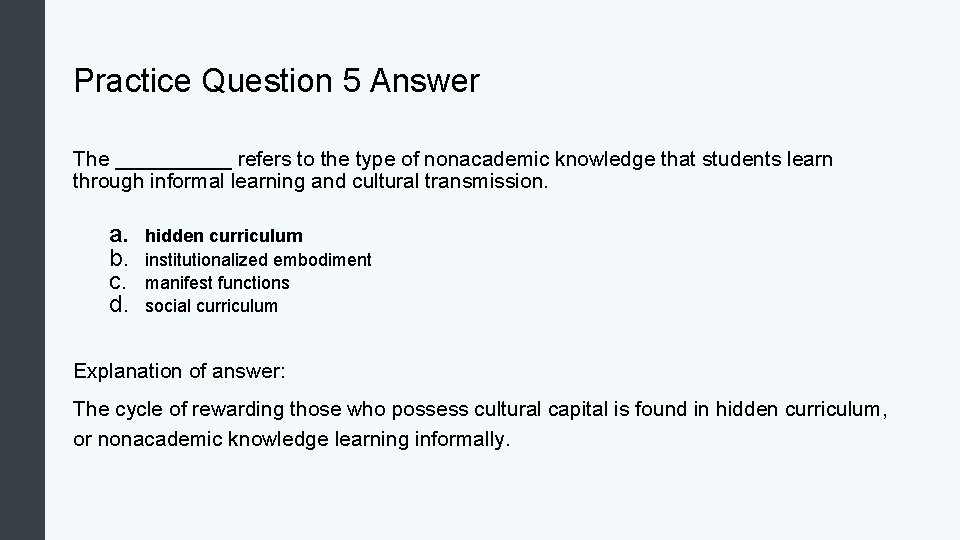
Conflict Theory on Education, continued • • • Members of the upper and middle classes have more cultural capital than families of lower-class status The educational system maintains a cycle in which the dominant values are rewarded Hidden curriculum is the type of nonacademic knowledge that students learn through informal learning and cultural transmission Tracking is a formalized learning system that places students on “tracks” perpetuate inequalities Schools play a role of training working-class students to accept and retain their position as lower members of society IQ tests have been attacked for being biased and testing cultural knowledge rather than actual intelligence
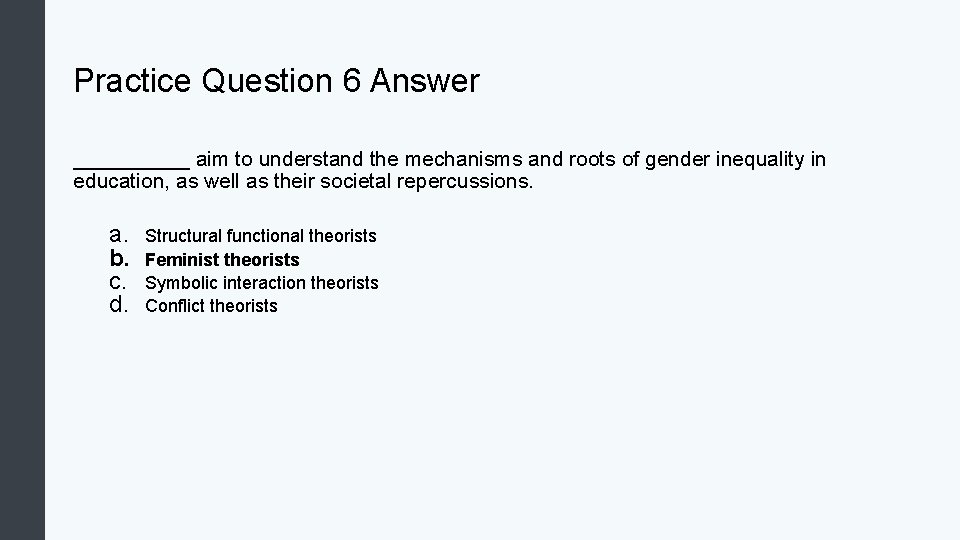
Feminist Theory on Education • • Feminist theory aims to understand the mechanisms and roots of gender inequality, particularly in education Educational systems are characterized by unequal treatment and opportunity for women Women in the United States have been relatively late to be granted entry to the public university system There is also a post-education gender disparity between what male and female college graduates earn with women earning 80% of what men make and racial minority women earning even less
Symbolic Interactionist Theory on Education • • Symbolic interactionism sees education as one wat that labeling theory is seen in action Labels are difficult to “shake off” and can create self-fulfilling prophecies Credentialism embodies the emphasis on certificates or degrees to show that a person has a certain skill, has attained a certain education level, or has certain job qualifications Certificates and degrees are labeling of an individual based on what that individual should be expected to be based on their credential
Discuss: Labeling Theory • How is the importance of credentialism in today’s society explained by labeling theory? Illustrate your explanation with original examples.
Hot Topics in Education • • Equal Education: Until the 1954 Brown v. Board of Education ruling, school had operated under Plessy v. Ferguson (1896) allowing racial segregation in schools and private businesses and introduced “separate but equal” phrase Presently, students of all races and ethnicities are permitted into schools but there remains a troubling gap in education equality Today’s public schools are positioned to help remedy those gaps Children from families of lower socioeconomic status often enter school with learning deficits they struggle to overcome throughout education (Coleman Report of 1966)
Hot Topics in Education, continued (1) • Head Start: Still active and successful today, it was developed to give low-income students an opportunity to make up the preschool deficit identified in the Coleman report • Transfers and Busing: Courts across the United States ordered some school districts to begin a program that involved bringing students to schools outside their neighborhoods to bring racial diversity into balance and was met with a great deal of resistance • No Child Left Behind: The No Child Left Behind Act was passed in 2001 and requires states to test students in designated grades to determine whether they can continue to receive federal funding • Sociologists and teachers contented that the impact is far more negative than positive and that “one size fits all” cannot apply to education
Hot Topics in Education, continued (2) • Teaching to the Test: When a curriculum focuses on equipping students to succeed on standardized tests to the detriment of broader educational goals and concepts of learning • Critics of “teaching to the test” argue that it only equips students to regurgitate facts while proponents argue that it fosters lifelong learning and transferable work skills • Bilingual Education: Attempts to give equal opportunity to minority students through offering instruction in languages other than English • Supporters of bilingual education argue that it allows for equal opportunities in education while opponents argue that English fluency is needed in everyday life and in the professional world
Hot Topics in Education, continued (3) • • Since the Individuals with Disabilities Education Act (IDEA), states and local districts have continually increased their investment in the quality of education for students with disabilities. Students with dyslexia, ADHD, and other disorders are either not diagnosed, not taken seriously, or not given as much support as they require in order to succeed. In general, programs have improved to the point that students with disabilities are graduating from high school at a national average of about 73 percent (the average rate is 88) – a dramatic improvement Students from lower-income and areas and states with lower education budgets still are offered far fewer services and because identification remains a major gap, many students with disabilities may be in the “mainstream” population but are not supported as well as they should be.
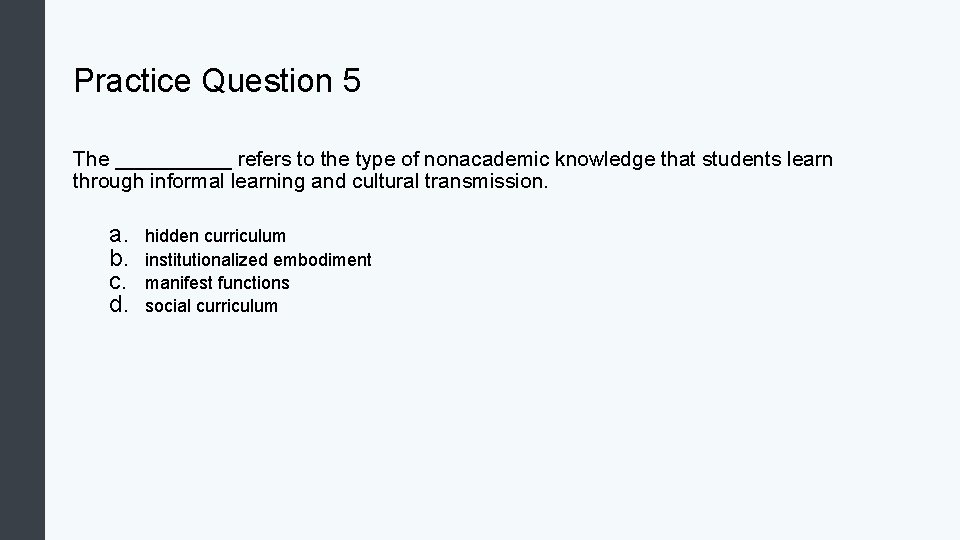
Practice Question 5 The _____ refers to the type of nonacademic knowledge that students learn through informal learning and cultural transmission. a. b. c. d. hidden curriculum institutionalized embodiment manifest functions social curriculum
Practice Question 5 Answer The _____ refers to the type of nonacademic knowledge that students learn through informal learning and cultural transmission. a. b. c. d. hidden curriculum institutionalized embodiment manifest functions social curriculum Explanation of answer: The cycle of rewarding those who possess cultural capital is found in hidden curriculum, or nonacademic knowledge learning informally.
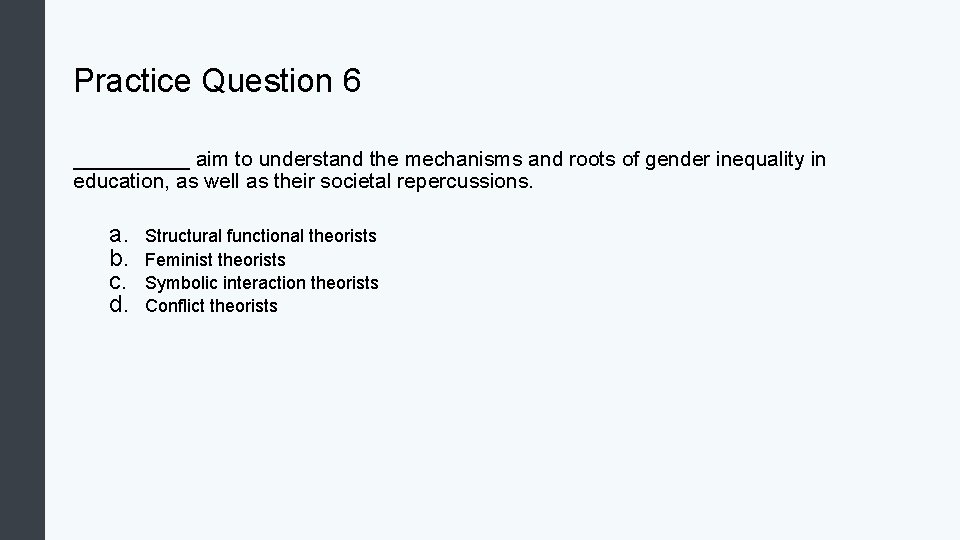
Practice Question 6 _____ aim to understand the mechanisms and roots of gender inequality in education, as well as their societal repercussions. a. b. c. d. Structural functional theorists Feminist theorists Symbolic interaction theorists Conflict theorists
Practice Question 6 Answer _____ aim to understand the mechanisms and roots of gender inequality in education, as well as their societal repercussions. a. b. c. d. Structural functional theorists Feminist theorists Symbolic interaction theorists Conflict theorists
School Choice • • • As we have seen, education is not equal, and people have varied needs. Parents, guardians, and child advocates work to obtain the best schooling for children, which may take them outside the traditional environment Public school alternatives to traditional schools include vocational schools, special education schools, magnet schools, charter schools, alternative schools, early college schools, and virtual schools Private school options may include religious and non-religious options, as well as boarding schools. Homeschooling refers to children being educated in their own homes, typically by a parent, instead of in a traditional public or private school system. School choice advocates promote the idea that more choice allows parents and students a more effective educational experience that is right for them.
Remote and Hybrid Schooling • • • The COVID-19 pandemic brought about countless education arguments over the following: attendance, mental health, instructional quality, safety, testing, academic integrity, and the best ways to move forward as the situation began to improve College students and their families went through similar disruptions and debates, compounded by the fact that many students felt that the high costs of particular colleges were not worth it. Overall college enrollment dipped significantly during the pandemic the sociological and educational impact of the pandemic is difficult to assess, though many are studying it. • • Overall data indicates that most outcomes are negative. Students underperformed, stress and mental health problems increased, and overall plans and pathways were interrupted.
Contemporary Issues in Education • • Teacher effectiveness: Many teachers in the United States teach subject matter that is outside their own field of study, impacting their ability to adequately teach Social promotion: Passing students to the next grade regardless of whether grade standards are met Affirmative Action: Opponents suggest that minority students are given greater weighted priorities for admittance while supporters say that it grants opportunities to students who are traditionally done a disservice in college admissions Rising Student Loan Debt: students are hard-pressed to repay their education earning entry-level wages, even at the professional level
Discuss: Social Promotion • What is social promotion? How can it be both functional and dysfunctional?
Class Activity: Sex Education • In small groups, design a sex ed curriculum for 5 th, 8 th, and 11 th grade public school students. What topics would you cover at each grade level and why? What topics would you exclude and why? What is the overall goal of your curriculum? Discuss as a class. Each group will add a written chart on the board.
Putting It Together: Education • • Education may be formal or informal and may be mandated as it is in the United States The quality of education is varied within the United States as well as between countries There has been an emphasis on the benefits of attending college in recent decades College pays off in regards to lifetime earnings, but it pays off more for those who earn a degree and are from non-poor families
Quick Review • • • What is the concept of universal access to education? What differences exist in educational resources around the world? What is the functionalist view on education and definitions of manifest and latent functions of education? What is the feminist theory on education? How is education viewed through conflict theory? How does a symbolic interactionist view education? What are legal and equality concerns in education? What are some alternatives to traditional public schools? How are teacher training, affirmative action, and the cost of education contemporary issues in education?