
Introduction to Sociology Lecture 16 Social Stratification 1


- Slides: 19
Introduction to Sociology Lecture 16 – Social Stratification (1) Phua Kai Lit, Ph. D ADTP Sunway University
Lecture Objectives l Social Stratification l Power, prestige and wealth l Life chances l Effects of social stratification on health l Marginalization
Strata l Strata = layers of rocks in the ground l Social stratification means social inequality, with some people on top and some at the bottom (social hierarchy)
n e q Power, prestige, wealth differentials chances – unequal chances in achieving these u Life Reproduction of this system of inequality a Social mobility – upward (downward is also possible) Social mobility – intra-generational, inter-generational l “Ascribed” position versus “achieved” position Ascribed position i. e. position you are born into (born into a particular i ethnic group or caste, born a female, etc. ) Achieved position e. g. you become a member of a high prestige occupation because you “worked your way up” into it t Absolute poverty versus relative poverty class, middle class, lower class (working class, working poor, y Upper underclass) l l l Thorstein Veblen – invidious comparison, conspicuous consumption
Inequality is functional? l Some conservative sociologists have argued that inequality is actually functional i. e. positive for society’s survival Davis-Moore hypothesis (Kingsley Davis and Wilbert Moore) : some jobs are more important or require more skill than other ones, thus these jobs would enjoy higher prestige and pay better. The best people would therefore strive to be successful and get to hold these jobs. l Meritocracy? l
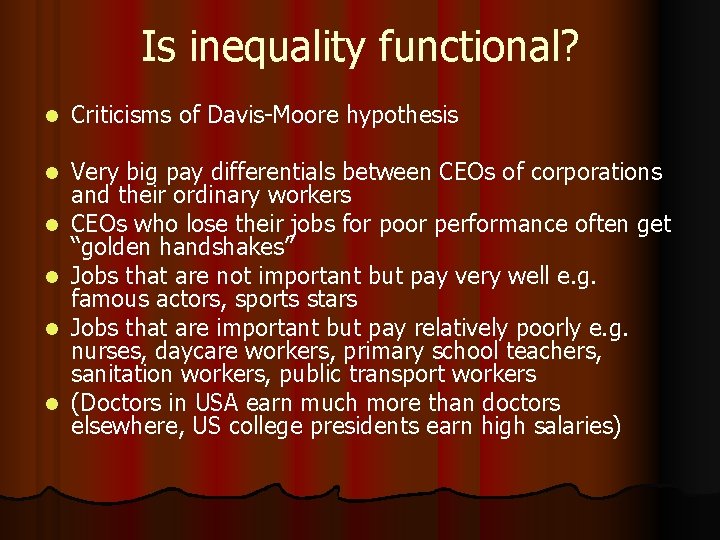
Is inequality functional? l Criticisms of Davis-Moore hypothesis l Very big pay differentials between CEOs of corporations and their ordinary workers CEOs who lose their jobs for poor performance often get “golden handshakes” Jobs that are not important but pay very well e. g. famous actors, sports stars Jobs that are important but pay relatively poorly e. g. nurses, daycare workers, primary school teachers, sanitation workers, public transport workers (Doctors in USA earn much more than doctors elsewhere, US college presidents earn high salaries) l l
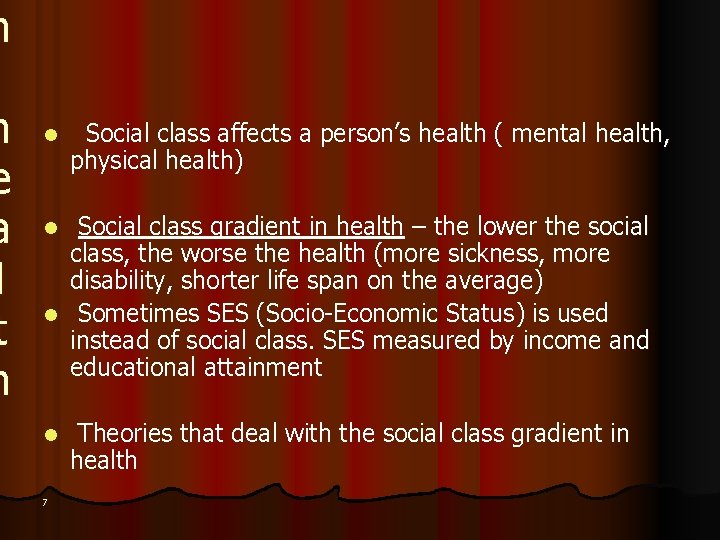
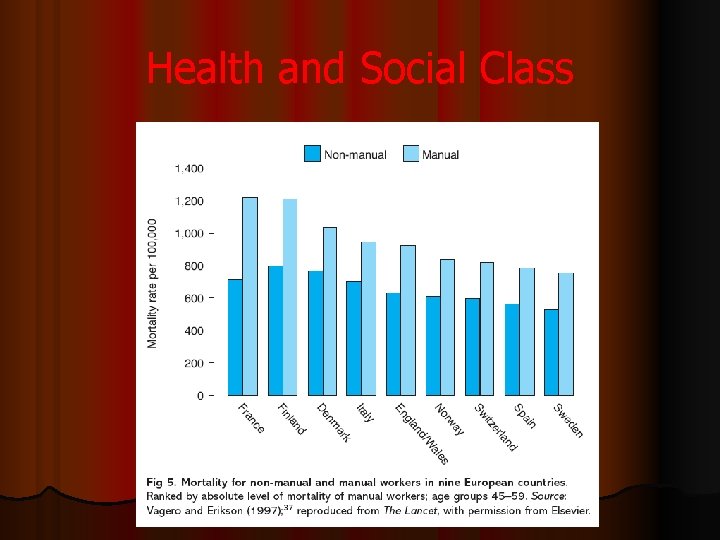
n h e a l t h l Social class affects a person’s health ( mental health, physical health) Social class gradient in health – the lower the social class, the worse the health (more sickness, more disability, shorter life span on the average) l Sometimes SES (Socio-Economic Status) is used instead of social class. SES measured by income and educational attainment l l 7 Theories that deal with the social class gradient in health
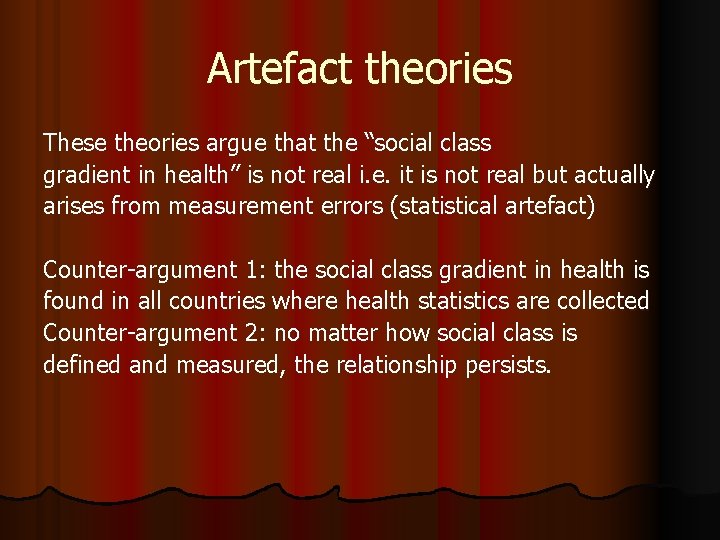
Artefact theories These theories argue that the “social class gradient in health” is not real i. e. it is not real but actually arises from measurement errors (statistical artefact) Counter-argument 1: the social class gradient in health is found in all countries where health statistics are collected Counter-argument 2: no matter how social class is defined and measured, the relationship persists.
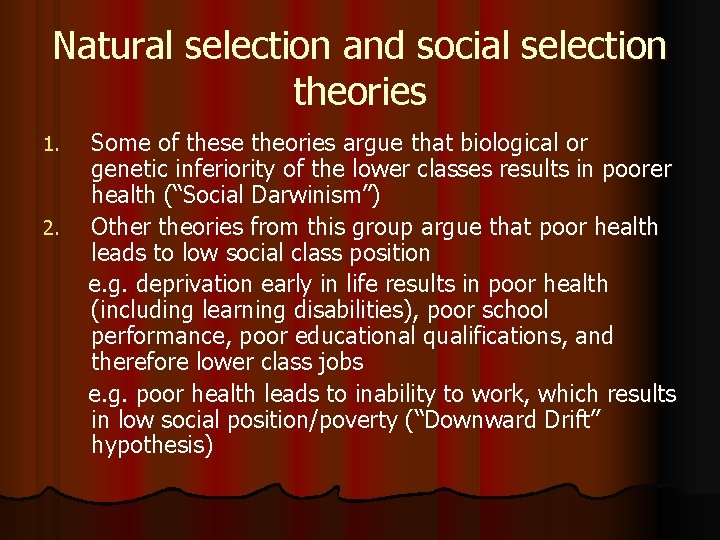
Natural selection and social selection theories 1. 2. Some of these theories argue that biological or genetic inferiority of the lower classes results in poorer health (“Social Darwinism”) Other theories from this group argue that poor health leads to low social class position e. g. deprivation early in life results in poor health (including learning disabilities), poor school performance, poor educational qualifications, and therefore lower class jobs e. g. poor health leads to inability to work, which results in low social position/poverty (“Downward Drift” hypothesis)
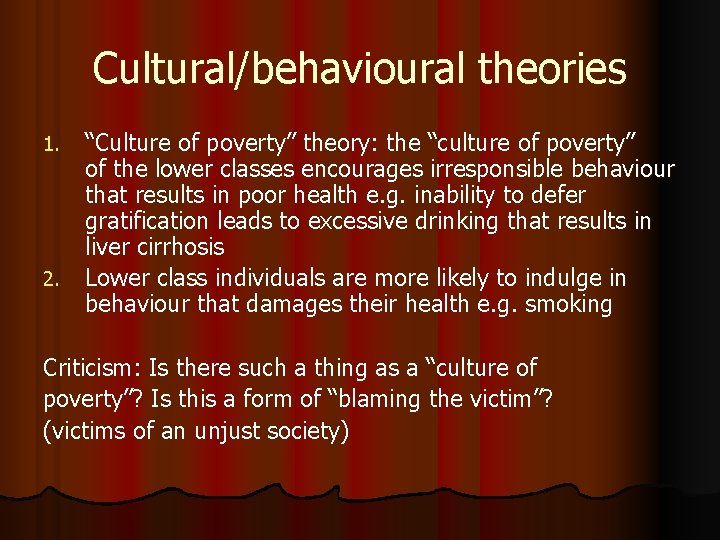
Cultural/behavioural theories 1. 2. “Culture of poverty” theory: the “culture of poverty” of the lower classes encourages irresponsible behaviour that results in poor health e. g. inability to defer gratification leads to excessive drinking that results in liver cirrhosis Lower class individuals are more likely to indulge in behaviour that damages their health e. g. smoking Criticism: Is there such a thing as a “culture of poverty”? Is this a form of “blaming the victim”? (victims of an unjust society)
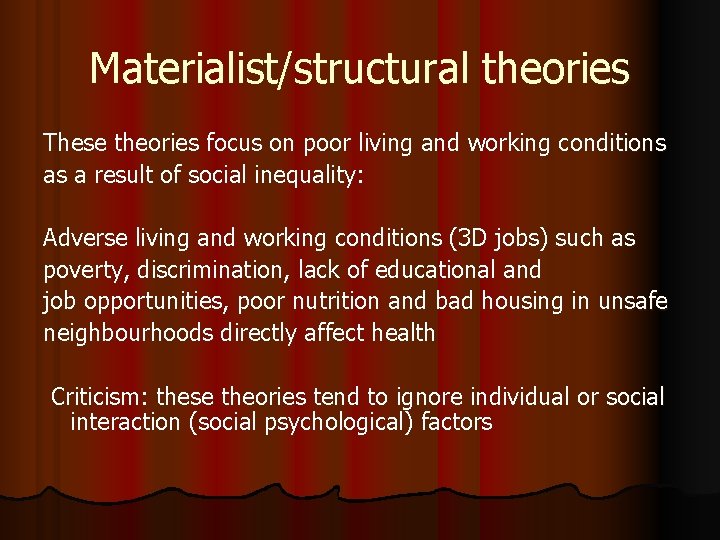
Materialist/structural theories These theories focus on poor living and working conditions as a result of social inequality: Adverse living and working conditions (3 D jobs) such as poverty, discrimination, lack of educational and job opportunities, poor nutrition and bad housing in unsafe neighbourhoods directly affect health Criticism: these theories tend to ignore individual or social interaction (social psychological) factors
More on Materialist/structural theories These theories argue that the main influences on a person’s health can be traced back to the structure of the society and the resulting living conditions that different groups experience. The way that society is organised systematically disadvantages certain groups of people so that they inevitably experience poor health e. g. Paul Farmer and his writings on health in Haiti Friedrich Engels argued in his book “The Condition of the Working Class in England” (1845) that ill health is a direct result of capitalists’ pursuit of profit & exploitation of workers – dangerous working conditions, long hours, poor pay Karl Marx argued that throughout history, one dominant class exploited the other (dominated) class e. g. slave-owners exploit slaves (ancient slavery), lords exploit peasants (feudal society) and capitalists exploit workers (capitalist society). Exploitation results in ill health (Marx said: “Work mortifies the body and ruins the mind”).
Health and Social Class
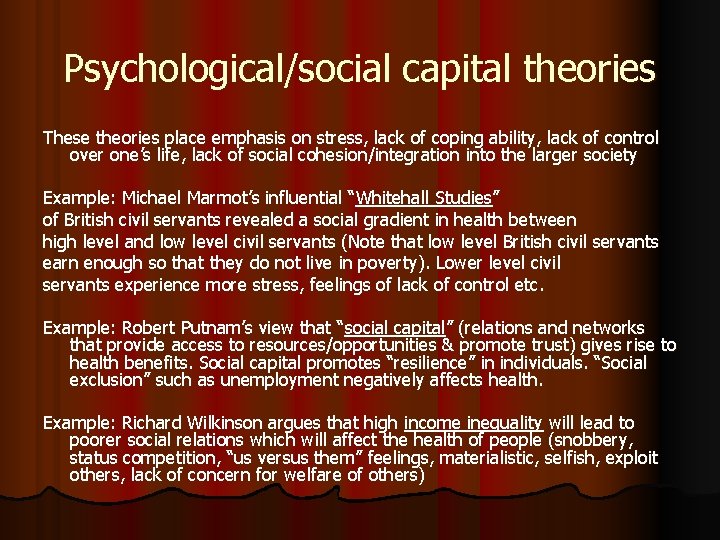
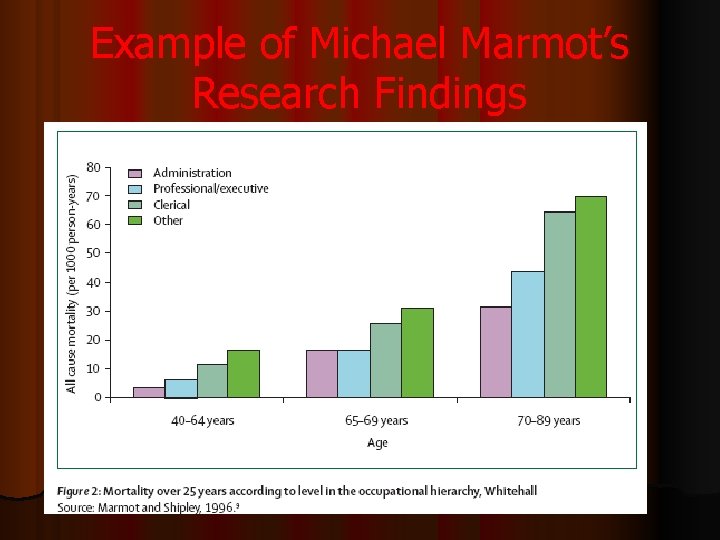
Psychological/social capital theories These theories place emphasis on stress, lack of coping ability, lack of control over one’s life, lack of social cohesion/integration into the larger society Example: Michael Marmot’s influential “Whitehall Studies” of British civil servants revealed a social gradient in health between high level and low level civil servants (Note that low level British civil servants earn enough so that they do not live in poverty). Lower level civil servants experience more stress, feelings of lack of control etc. Example: Robert Putnam’s view that “social capital” (relations and networks that provide access to resources/opportunities & promote trust) gives rise to health benefits. Social capital promotes “resilience” in individuals. “Social exclusion” such as unemployment negatively affects health. Example: Richard Wilkinson argues that high income inequality will lead to poorer social relations which will affect the health of people (snobbery, status competition, “us versus them” feelings, materialistic, selfish, exploit others, lack of concern for welfare of others)
Example of Michael Marmot’s Research Findings
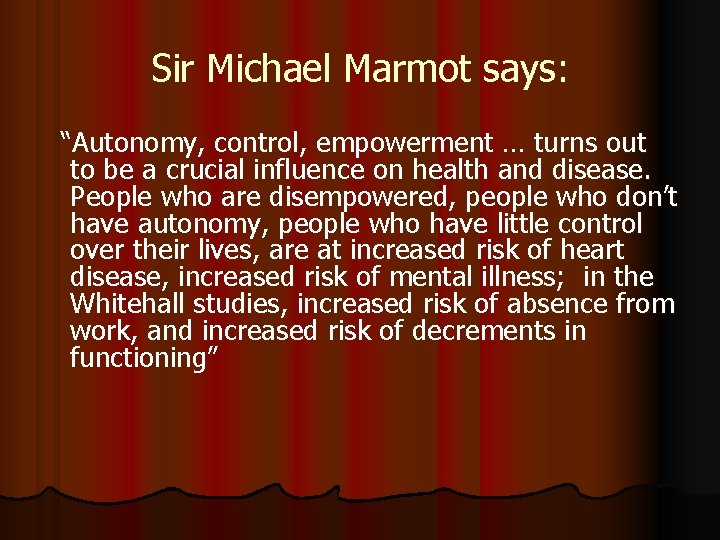
Sir Michael Marmot says: “Autonomy, control, empowerment … turns out to be a crucial influence on health and disease. People who are disempowered, people who don’t have autonomy, people who have little control over their lives, are at increased risk of heart disease, increased risk of mental illness; in the Whitehall studies, increased risk of absence from work, and increased risk of decrements in functioning”
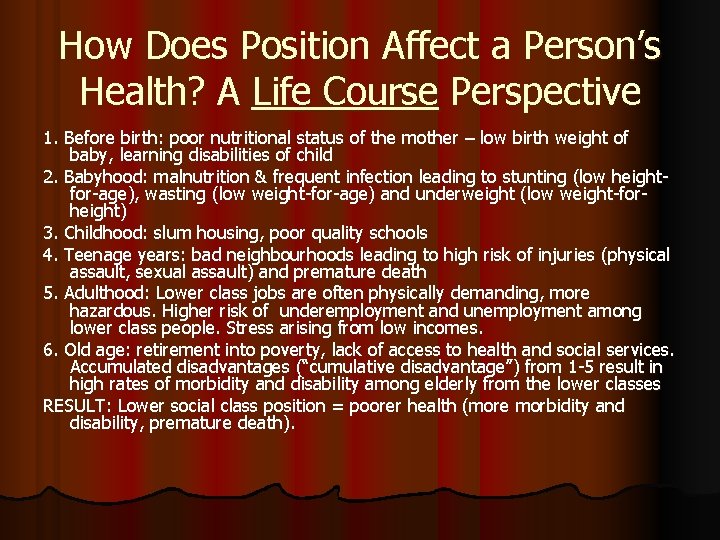
How Does Position Affect a Person’s Health? A Life Course Perspective 1. Before birth: poor nutritional status of the mother – low birth weight of baby, learning disabilities of child 2. Babyhood: malnutrition & frequent infection leading to stunting (low heightfor-age), wasting (low weight-for-age) and underweight (low weight-forheight) 3. Childhood: slum housing, poor quality schools 4. Teenage years: bad neighbourhoods leading to high risk of injuries (physical assault, sexual assault) and premature death 5. Adulthood: Lower class jobs are often physically demanding, more hazardous. Higher risk of underemployment and unemployment among lower class people. Stress arising from low incomes. 6. Old age: retirement into poverty, lack of access to health and social services. Accumulated disadvantages (“cumulative disadvantage”) from 1 -5 result in high rates of morbidity and disability among elderly from the lower classes RESULT: Lower social class position = poorer health (more morbidity and disability, premature death).
Marginalization l Living on the margins of society l Homeless people l Long-term unemployed l Social outcasts e. g. drug addicts l 18 Persecuted minority groups – Rohingya in Burma, Rohingya refugees in Malaysia
k Y o u