
Introduction to Sociology Chapter 11 Race and Ethnicity
- Slides: 29
Introduction to Sociology Chapter 11 - Race and Ethnicity Mrs. Hefele
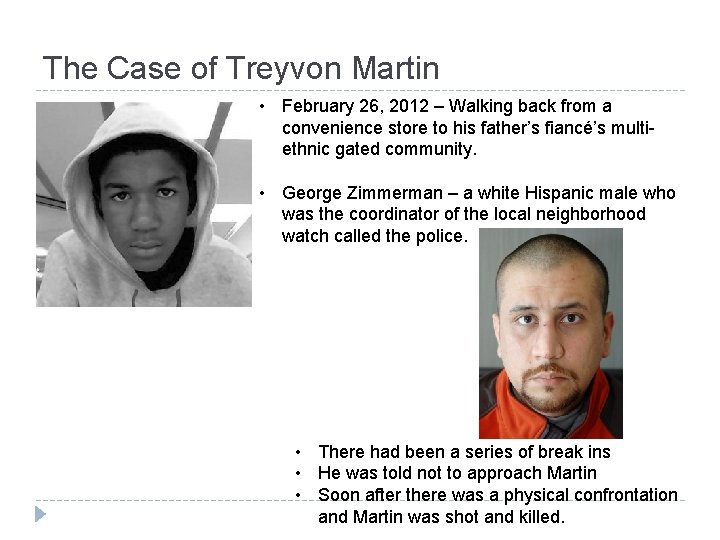
The Case of Treyvon Martin • February 26, 2012 – Walking back from a convenience store to his father’s fiancé’s multiethnic gated community. • George Zimmerman – a white Hispanic male who was the coordinator of the local neighborhood watch called the police. • There had been a series of break ins • He was told not to approach Martin • Soon after there was a physical confrontation and Martin was shot and killed.
Zimmerman said Martin Attacked him and he defended himself. There was a public outcry of racial profiling – the use of race alone by law enforcement to determine whether to stop and detain someone. Zimmerman was arrested on April 11 th, charged with 2 nd degree murder, and found not guilty. Do you think race played a role in Martin’s death?
The Social Meaning of Race and Ethnicity Race - A socially constructed category of people who share biologically transmitted traits that members of a society consider important We think of race in biological terms but it is a socially constructed concept The meaning and importance of race not only differ from place to place but also change over time Generally, sociologists, anthropologists, and psychologists believe that the idea of race was social constructed in order to support racist policies and pseudo science.
Today, our ideas of race are often based on socioeconomic assumptions In modern society some people who consider themselves “white” actually have more melanin in their skin than others who identify as “black. ” In some countries, such as Brazil class is more important than skin color in determining race. People may consider themselves “white” if they live in a middle class style.
The term African American was created in the late 20 th century to replace the word Negro. He point was to celebrate the multiple identities tha ta black person might hold. Why was this a bad choice?
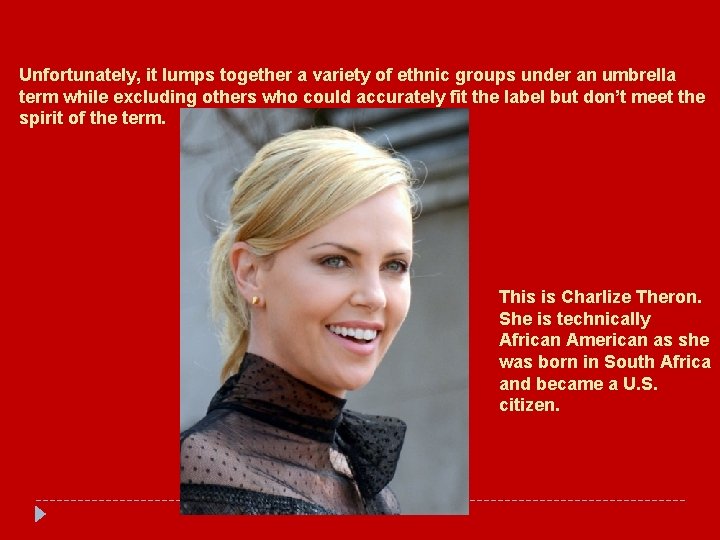
Unfortunately, it lumps together a variety of ethnic groups under an umbrella term while excluding others who could accurately fit the label but don’t meet the spirit of the term. This is Charlize Theron. She is technically African American as she was born in South Africa and became a U. S. citizen.
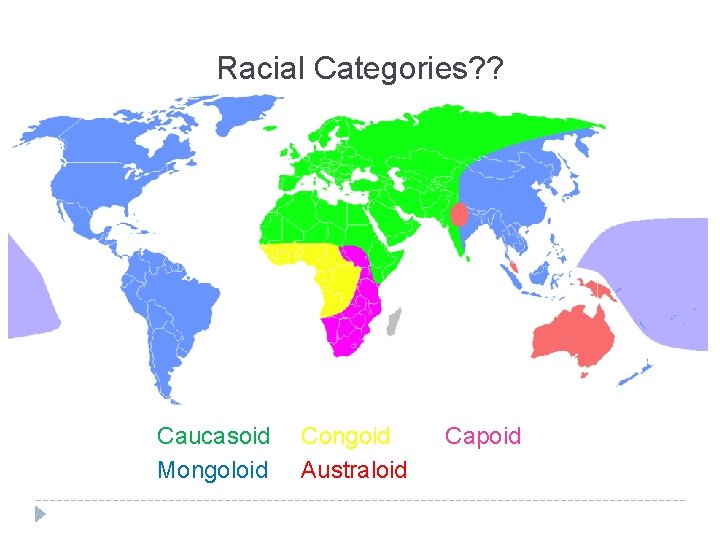
The Social Meaning of Race and Ethnicity Scientists invented the concept of race to organize the world’s physical diversity Caucasoid Negroid Mongoloid Sociologists consider such terms misleading and harmful There is more genetic variation within each category than between categories From a biological point of view, knowing people’s racial category allows us to predict nothing about them
Racial Categories? ? Caucasoid Mongoloid Congoid Australoid Capoid
The Social Meaning of Race and Ethnicity - A shared cultural heritage Common ancestors Language Religion Like race, ethnicity is socially constructed Race is constructed from biological traits and ethnicity is constructed from cultural traits
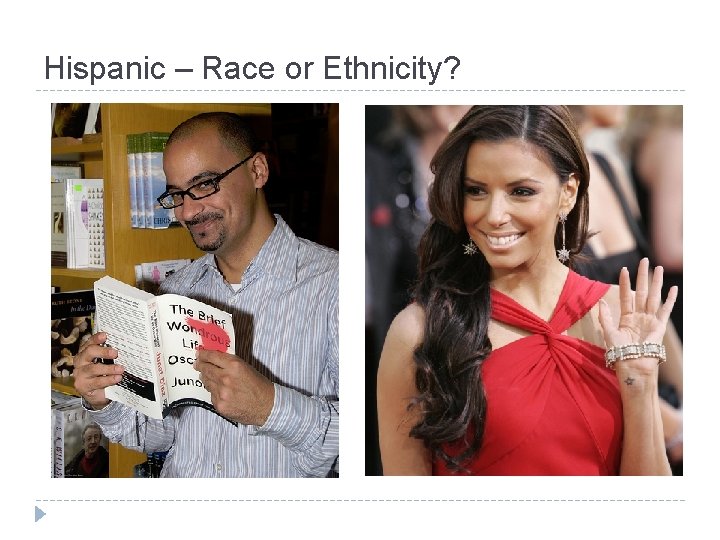
Hispanic – Race or Ethnicity?
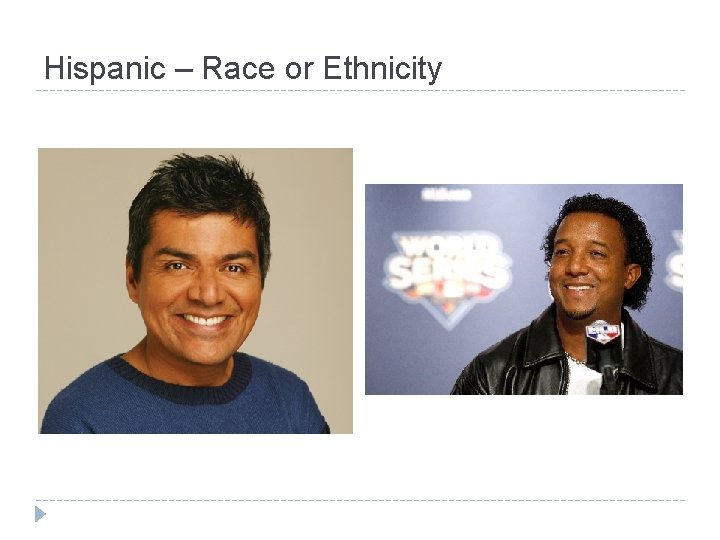
Hispanic – Race or Ethnicity
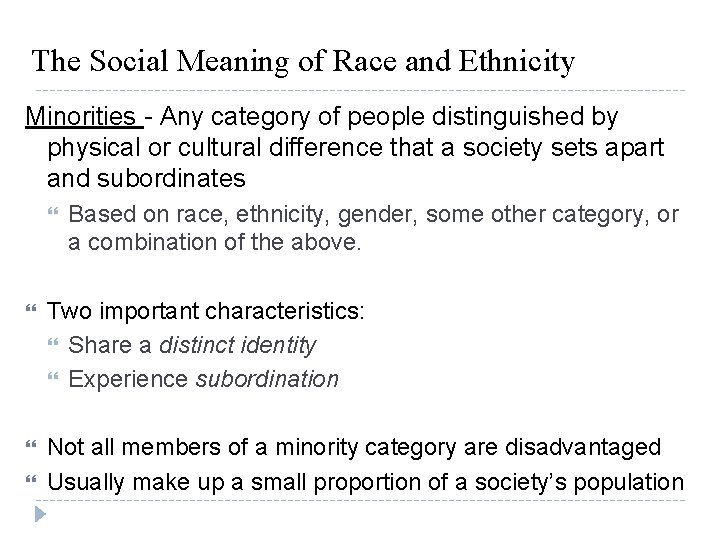
The Social Meaning of Race and Ethnicity Minorities - Any category of people distinguished by physical or cultural difference that a society sets apart and subordinates Based on race, ethnicity, gender, some other category, or a combination of the above. Two important characteristics: Share a distinct identity Experience subordination Not all members of a minority category are disadvantaged Usually make up a small proportion of a society’s population
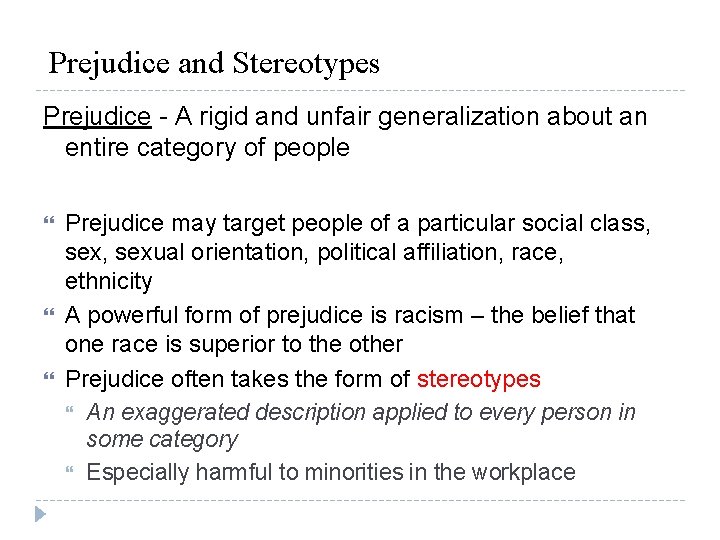
Prejudice and Stereotypes Prejudice - A rigid and unfair generalization about an entire category of people Prejudice may target people of a particular social class, sexual orientation, political affiliation, race, ethnicity A powerful form of prejudice is racism – the belief that one race is superior to the other Prejudice often takes the form of stereotypes An exaggerated description applied to every person in some category Especially harmful to minorities in the workplace
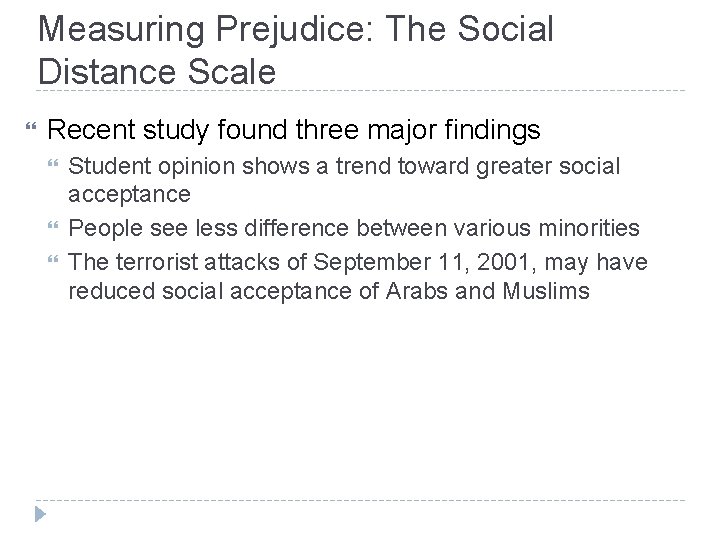
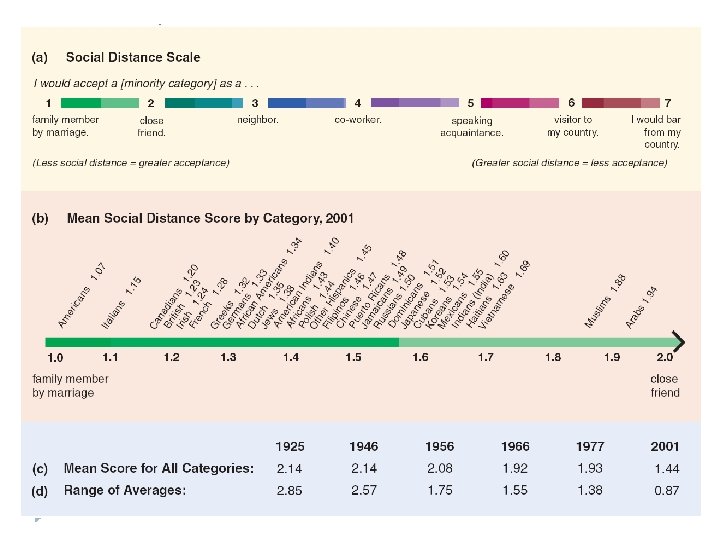
Measuring Prejudice: The Social Distance Scale Recent study found three major findings Student opinion shows a trend toward greater social acceptance People see less difference between various minorities The terrorist attacks of September 11, 2001, may have reduced social acceptance of Arabs and Muslims
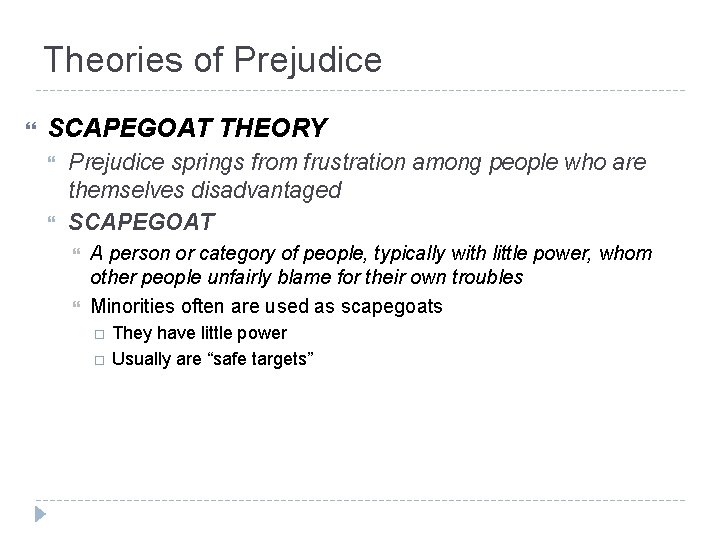
Theories of Prejudice SCAPEGOAT THEORY Prejudice springs from frustration among people who are themselves disadvantaged SCAPEGOAT A person or category of people, typically with little power, whom other people unfairly blame for their own troubles Minorities often are used as scapegoats They have little power Usually are “safe targets”
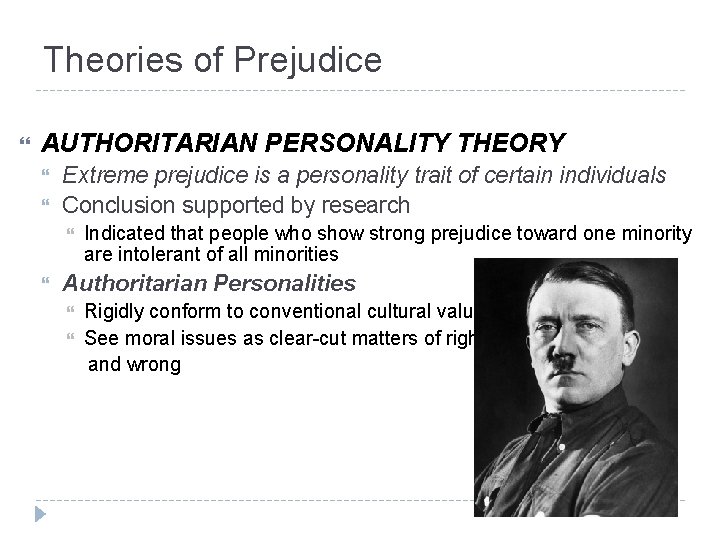
Theories of Prejudice AUTHORITARIAN PERSONALITY THEORY Extreme prejudice is a personality trait of certain individuals Conclusion supported by research Indicated that people who show strong prejudice toward one minority are intolerant of all minorities Authoritarian Personalities Rigidly conform to conventional cultural values See moral issues as clear-cut matters of right and wrong
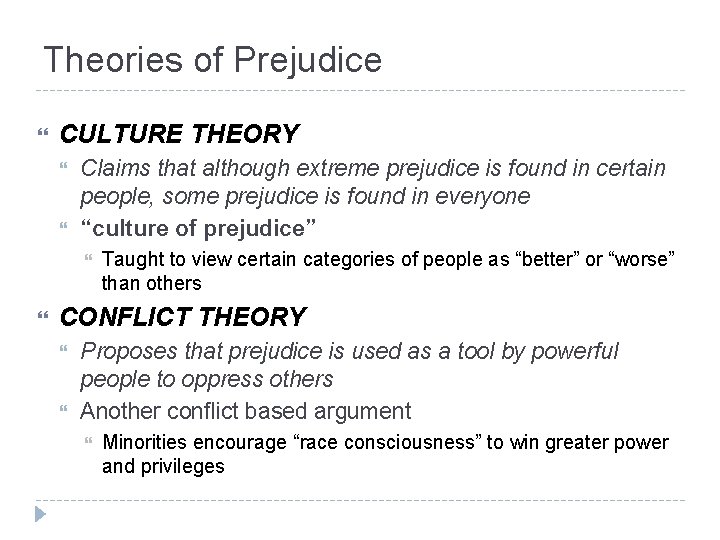
Theories of Prejudice CULTURE THEORY Claims that although extreme prejudice is found in certain people, some prejudice is found in everyone “culture of prejudice” Taught to view certain categories of people as “better” or “worse” than others CONFLICT THEORY Proposes that prejudice is used as a tool by powerful people to oppress others Another conflict based argument Minorities encourage “race consciousness” to win greater power and privileges
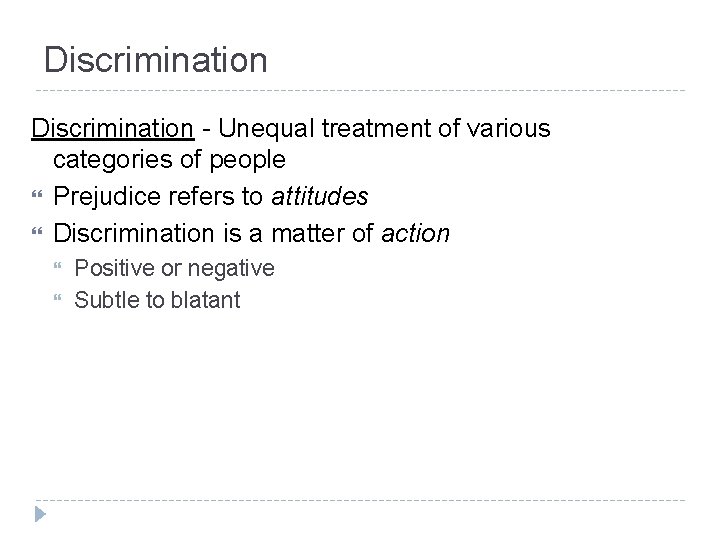
Discrimination - Unequal treatment of various categories of people Prejudice refers to attitudes Discrimination is a matter of action Positive or negative Subtle to blatant
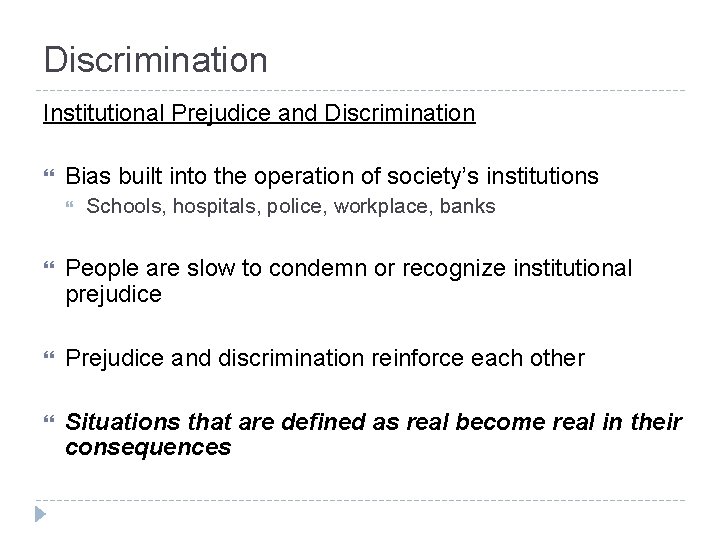
Discrimination Institutional Prejudice and Discrimination Bias built into the operation of society’s institutions Schools, hospitals, police, workplace, banks People are slow to condemn or recognize institutional prejudice Prejudice and discrimination reinforce each other Situations that are defined as real become real in their consequences
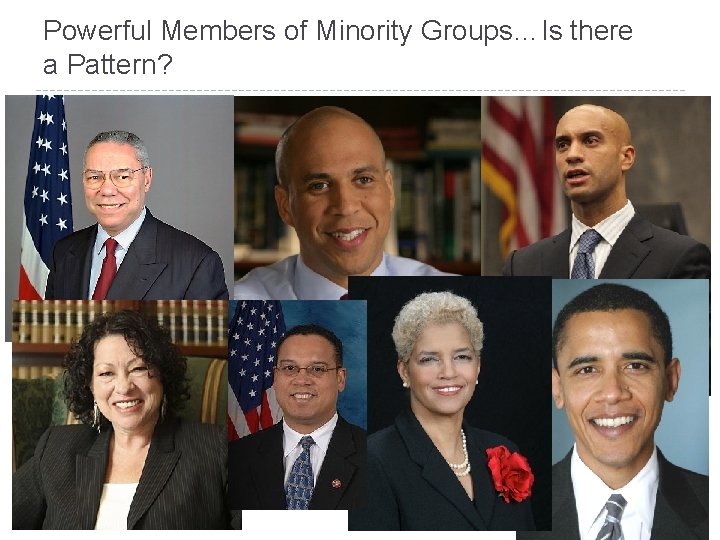
Powerful Members of Minority Groups…Is there a Pattern?
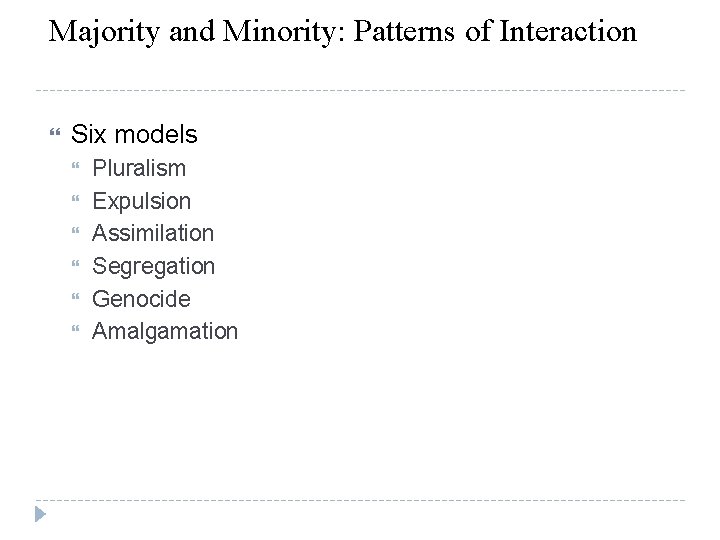
Majority and Minority: Patterns of Interaction Six models Pluralism Expulsion Assimilation Segregation Genocide Amalgamation
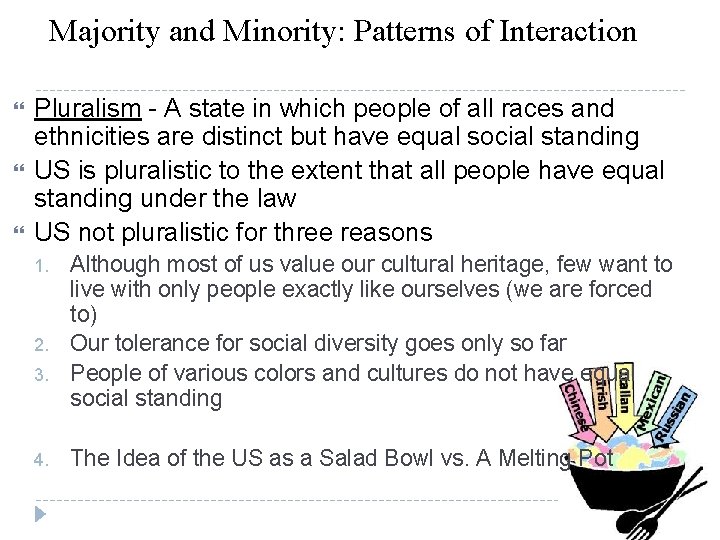
Majority and Minority: Patterns of Interaction Pluralism - A state in which people of all races and ethnicities are distinct but have equal social standing US is pluralistic to the extent that all people have equal standing under the law US not pluralistic for three reasons 1. 2. 3. 4. Although most of us value our cultural heritage, few want to live with only people exactly like ourselves (we are forced to) Our tolerance for social diversity goes only so far People of various colors and cultures do not have equal social standing The Idea of the US as a Salad Bowl vs. A Melting Pot
Expulsion When a subordinate group is forced out by a dominate group Trail of tears, holocaust. It can be a factor in Genocide. Can also be done on it’s own: Executive Order 9066 Japanese Americans with as little as 1/8 th Japanese heritage were forced into internment camps during WWII.
Majority and Minority: Patterns of Interaction Assimilation - The process by which minorities gradually adopt patterns of the dominant culture Assimilation is… Avenue to upward social mobility Way to escape prejudice and discrimination directed against more visible foreigners Amount of assimilation varies by category Assimilation involves changes in ethnicity but not in race
Majority and Minority: Patterns of Interaction Segregation - the physical and social separation of categories of people Segregation enforces separation that harms a minority de jure segregation (by law) de facto segregation (in fact) Continues in the US (de facto) Hypersegregation Having little contact of any kind with people beyond the local community
Genocide - The systematic killing of one category of people by another Deadly form of racism and ethnocentrism Common throughout history Even the US committed genocide against Native Americans
Amalgamation The process by which a minority group and a majority group combine to form a new group. This is the classic “Melting Pot” analogy. This is also known as miscegenation and is generally achieved through intermarriage. Antimiscegenation laws flourished in the United States during the Jim Crow era until they were struck down by Loving v. Virginia in 1967