
Introduction to Social Research Purpose of Research The













- Slides: 20
Introduction to Social Research
Purpose of Research? The basic purpose of Research is to produce Knowledge and understanding
What is Social Research? � Research is a scientific and systematic search for information �P. V. Young: social research is a systematic method of discovering new facts or verifying the old facts, their sequences, inter-relationship, casual explanations and the natural laws which govern them (Quantitative Perspective)
�Qualitative perspective: ‘‘The systematic collection, organization, and interpretation of textual material derived from talk or conversation. It is used in the exploration of meanings of social phenomena as experienced by individuals themselves, in their natural context’’ (Malterud, 2001, p. 483).
Objectives of research The purpose of research is: � To discover answers to questions through the application of scientific procedures. � To gain familiarity with a phenomenon or to achieve new insights into it (studies with this object in view are termed as exploratory or formulate research studies) � To portray accurately the characteristics of a particular individual, situation or a group (studies with this object in view are known as descriptive research studies) � To determine the frequency with which something occurs or with which it is associated with something else (studies with this object in view are known as diagnostic research studies) � To test a hypothesis of a causal relationship between variables (such studies are known as hypothesis-testing research studies)
Types of Research Two types of Research : 1. Qualitative 2. Quantitative
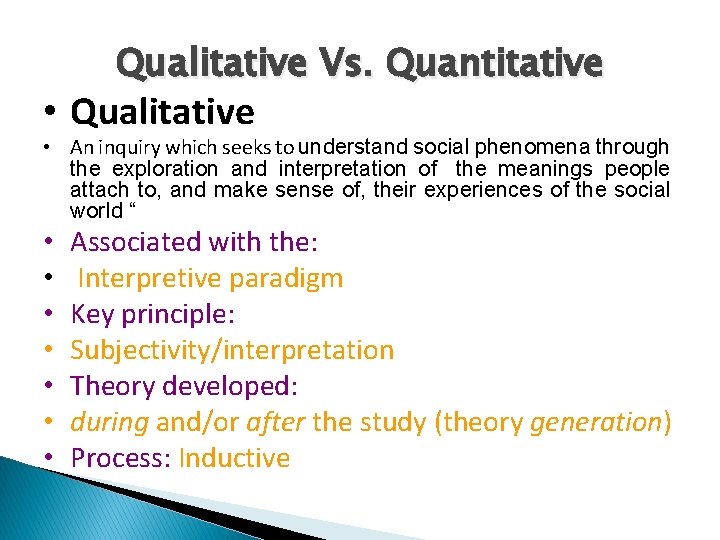
Qualitative Vs. Quantitative • Qualitative • An inquiry which seeks to understand social phenomena through the exploration and interpretation of the meanings people attach to, and make sense of, their experiences of the social world “ • • Associated with the: Interpretive paradigm Key principle: Subjectivity/interpretation Theory developed: during and/or after the study (theory generation) Process: Inductive
Quantitative • An inquiry based on testing a theory composed of variables, measured with numbers and analysed with statistical procedures, in order to determine whether the predictive generalisations of theory hold true Associated with: Post/positivist paradigm Key principle: Objectivity Theory Production: before the study (theory verification) (Hypothodeductive) • Process: Deductive • • •
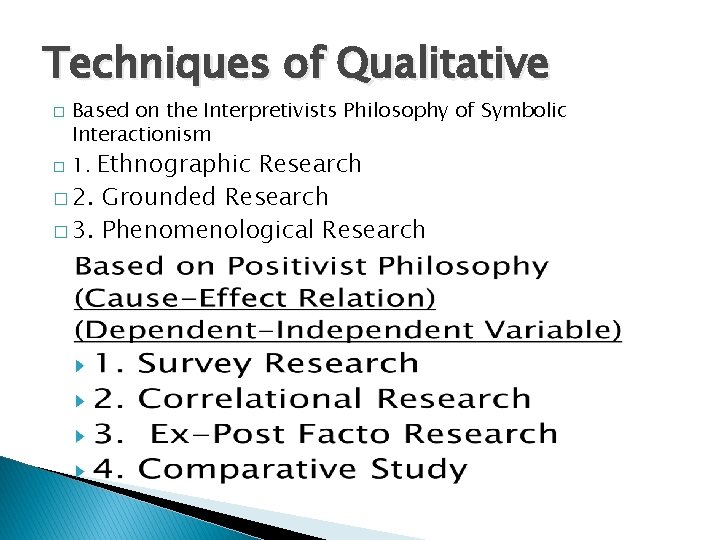
Techniques of Qualitative � Based on the Interpretivists Philosophy of Symbolic Interactionism Ethnographic Research � 2. Grounded Research � 3. Phenomenological Research � 1.
Ethnographic research � is a qualitative method here researchers observe and/or interact with a study's participants in their real-life environment. � Ethnography was popularized by anthropology, but is used across a wide range of social sciences.
Grounded Research � Grounded Theory is an inductive methodology. � It is the systematic generation of theory from systematic research. � It is a set of rigorous research procedures leading to the emergence of conceptual categories.
Phenomenology � is a qualitative research method that is used to describe how human beings experience a certain phenomenon. �A phenomenological study attempts to set aside biases and preconceived assumptions about human experiences, feelings, and responses to a particular situation.
Techniques of Quantitative Based on Positivist Philosophy (Cause-Effect Relation) (Dependent-Independent Variable) � 1. Survey Research � 2. Correlational Research � 3. Ex-Post Facto Research � 4. Comparative Study
. Cross Sectional study � 6. longitudinal study � 5
� In survey research, the researcher selects a sample of respondents from a population and administers a standardized questionnaire to them. � The questionnaire, or survey, can be a written document that is completed by the person being surveyed, an online questionnaire, a face-to-face interview, or a telephone interview. � Correlational research is a type of non-experimental research method, in which a researcher measures two variables, understands and assess the statistical relationship between them with no influence from any extraneous variable.
� Ex-post-facto research examine how an independent variable, present prior to the study in the participants, affects a dependent variable. � When translated literally, ex post facto means ‘from what is done afterwards’. � In the context of social and educational research the phrase means ‘after the fact’ or ‘retrospectively’ and refers to those studies which investigate possible cause-and-effect relationships by observing an existing condition or state of affairs and searching back in time for plausible (seeming to be true) causal factors.
Comparative research � essentially compares two groups in an attempt to draw a conclusion about them. � Researchers attempt to identify and analyze similarities and differences between groups, and these studies are most often cross-national, comparing two separate people groups. � Comparative studies can be used to increase understanding between cultures and societies and create a foundation for compromise and collaboration. These studies contain both quantitative and qualitative research methods.
Importance of Social Research � All progress is born of inquiry. Doubt is often better than overconfidence, for it leads to inquiry, and inquiry leads to invention. � Research increases our knowledge of nature and its working � Research increases the existing body of knowledge about any social problem � Research provides answers to nearly all social problems � Research goes beyond common sense approach � Research give us clear picture of the phenomenon understudy � It helps to study the cause and effect relationships � Social Research helps us in taking better decisions � Research provide base for all government policies and economic system � It helps in evaluating government polices