
Introduction to Social Media Social media are internetbased


Introduction to Social Media � Social media are internet-based applications that build on the foundations of Web 2. 0 for supporting increasing social interaction � Creation and exchange of User Generated Content (UGC) � Social media enabling us to achieve near-real time information awareness � Twitter is a famous micro-blogging application
Twitter � 465. 000 users � 175. 000 tweets/day � 600. 000 searches/day � 1. 000 new accounts/day � 1. 500% annual growth � 3. 000 API requests/day
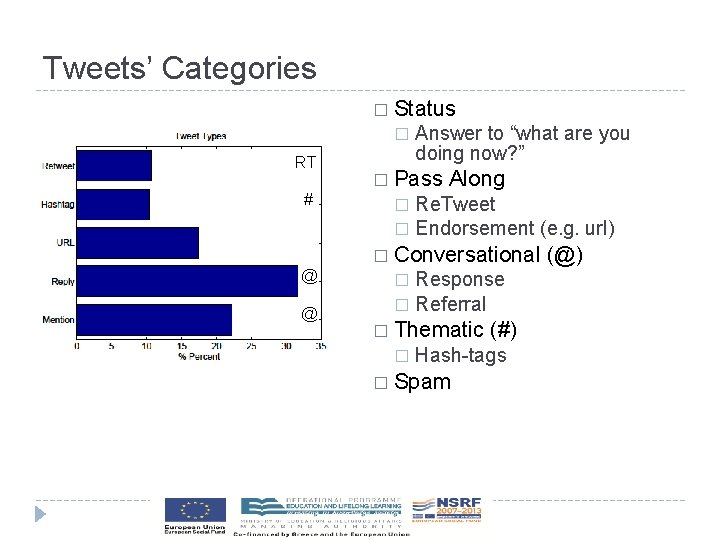
Tweets’ Categories � Status � RT # Answer to “what are you doing now? ” � Pass Along Re. Tweet � Endorsement (e. g. url) � � Conversational @ @ Response � Referral � � Thematic � (#) Hash-tags � Spam (@)
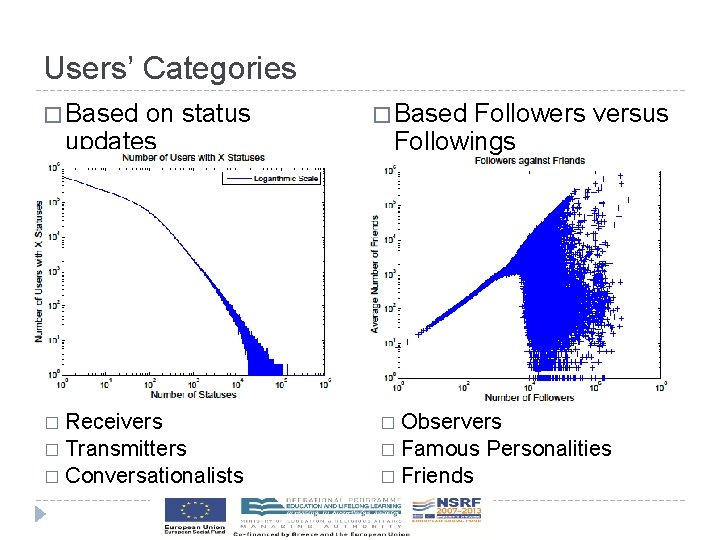
Users’ Categories � Based on status updates � Based Followers versus Followings � Receivers � Observers � Transmitters � Famous � Conversationalists � Friends Personalities
Social Media Analytics � Emerging � look � Real Trends Monitoring: for words or phrases of high co-occurrence World Events Detection: � some related words would show an increase in the usage when an event is happening � In most of the cases are formulated as a clustering problem: � Several machine learning (ML) clustering algorithms have been proposed E. g. k-means, hierarchical, TStream
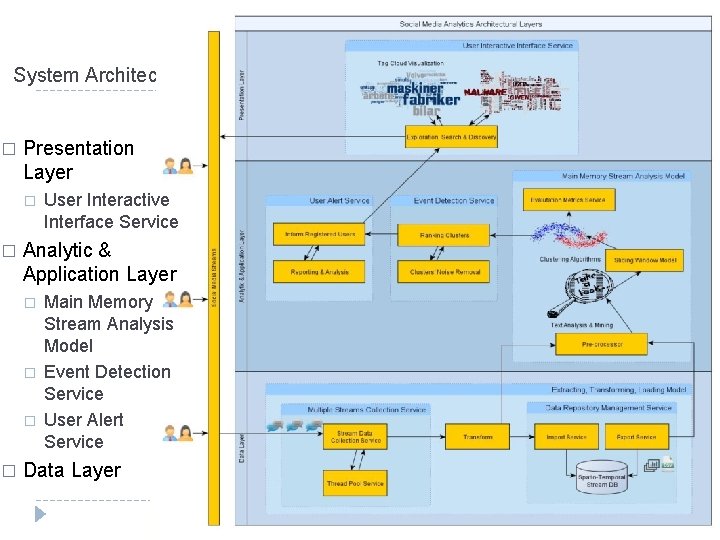
System Architecture � Presentation Layer � � Analytic & Application Layer � � User Interactive Interface Service Main Memory Stream Analysis Model Event Detection Service User Alert Service Data Layer Hellas. GI 2014, 11 – 12 December 2014
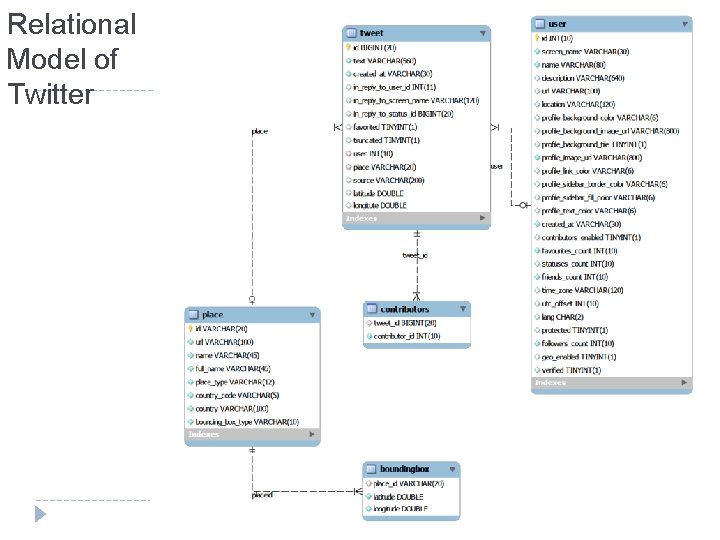
Relational Model of Twitter Hellas. GI 2014, 11 – 12 December 2014
Focusing on Content versus Tags � Reasons � Relate of filtering on content different tags of the same topic � Distinction of subtopics � Distinction of spams versus non spams � Group of tweets without having the same tag � Match tweets to a tag
Events � Tweets � Does around a common theme the language play a role? � Spatial and temporal dimension: � Happens in a specific place at a specific time � Can we identify events that are reported on twitter before being reported by conventional media? � Analysis � Tweet clustering � What is the required threshold to consider a topic interesting? � Proportional space, etc. to: time (duration), cluster evolution,
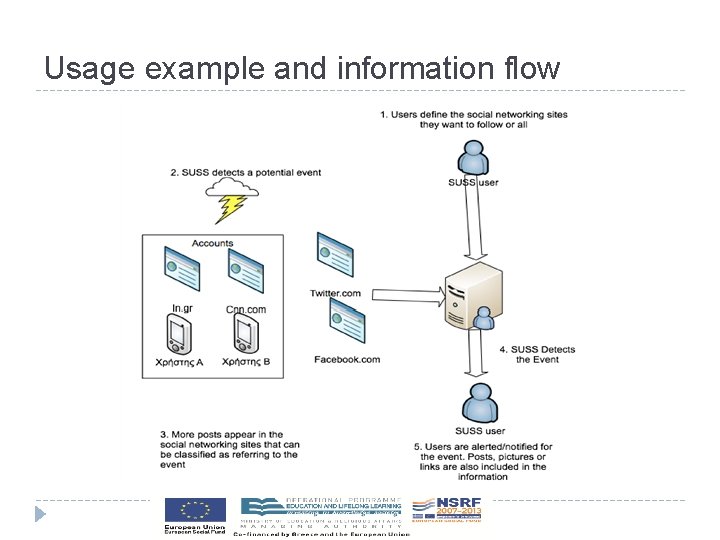
Usage example and information flow
Conclusions � Identifying events from social networks can provide real time information the same way sensor deployed on the road or in a building provide real time information on various variables � We can rely on information from social networks since it comes from a variety of sources (independence) � Information from social networks is multivariable so much harder to manage than sensor based information � Fusing information from multiple social networks complicates things even further

Acknowledgements � This research is implemented through the Operational Program "Education and Lifelong Learning" and is co-financed by the European Union (European Social Fund) and Greek national funds.
Thank You!
- Slides: 24