
Introduction to Simulation Methods Professor Stewart Robinson Loughborough
Introduction to Simulation Methods Professor Stewart Robinson Loughborough University 1
Session Outline § What is simulation? § Why use simulation? § Four simulation approaches Stewart Robinson Loughborough University 2
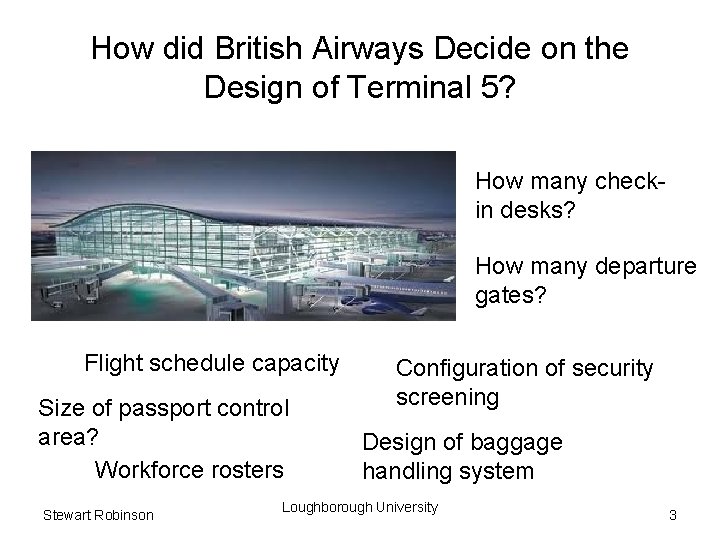
How did British Airways Decide on the Design of Terminal 5? How many checkin desks? How many departure gates? Flight schedule capacity Size of passport control area? Workforce rosters Stewart Robinson Configuration of security screening Design of baggage handling system Loughborough University 3
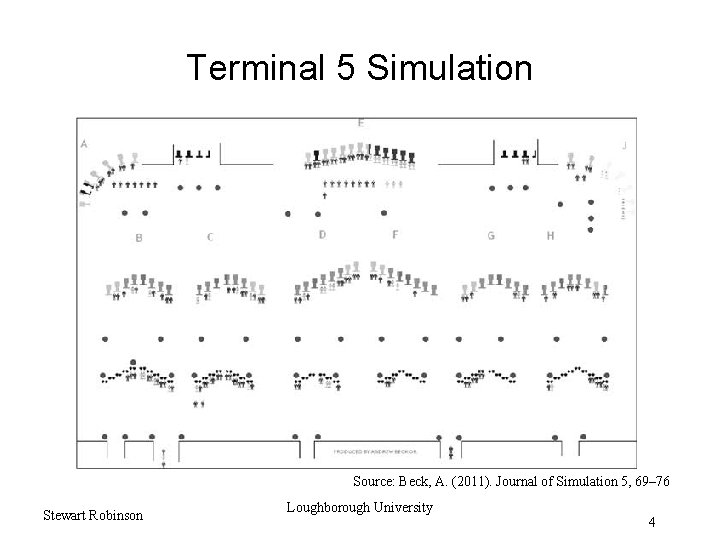
Terminal 5 Simulation Source: Beck, A. (2011). Journal of Simulation 5, 69– 76 Stewart Robinson Loughborough University 4
What is Simulation? Simulation is: an imitation of a system Simulation video Experimentation with a simplified imitation (on a computer) of a. . . system as it progresses through time, for the purpose of better understanding and/or improving that system. (Robinson, 2014) Stewart Robinson Loughborough University 5
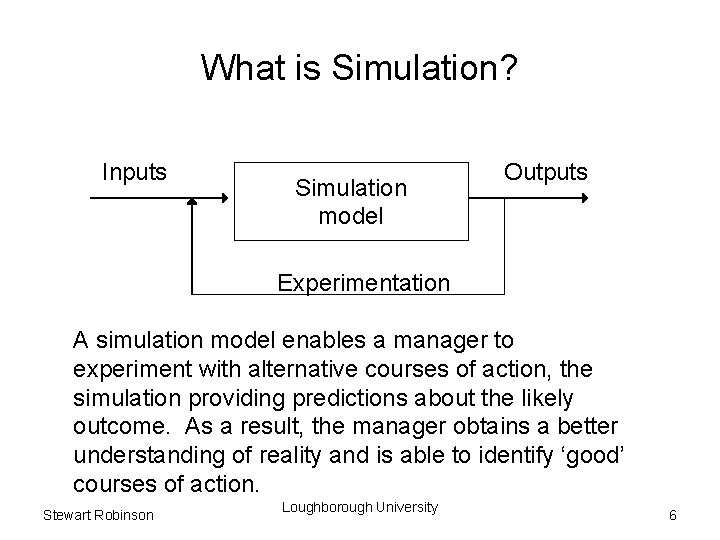
What is Simulation? Inputs Simulation model Outputs Experimentation A simulation model enables a manager to experiment with alternative courses of action, the simulation providing predictions about the likely outcome. As a result, the manager obtains a better understanding of reality and is able to identify ‘good’ courses of action. Stewart Robinson Loughborough University 6
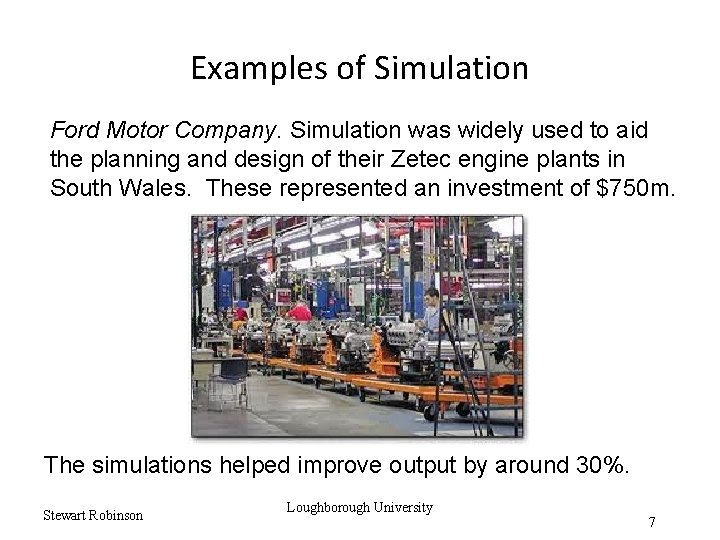
Examples of Simulation Ford Motor Company. Simulation was widely used to aid the planning and design of their Zetec engine plants in South Wales. These represented an investment of $750 m. The simulations helped improve output by around 30%. Stewart Robinson Loughborough University 7
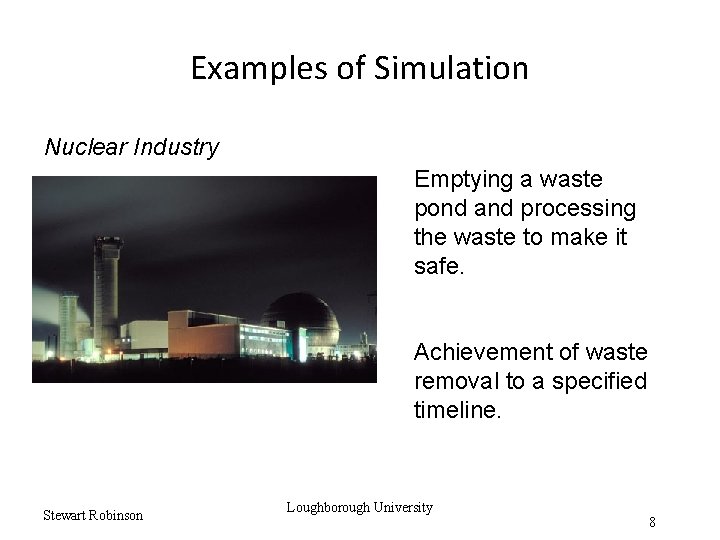
Examples of Simulation Nuclear Industry Emptying a waste pond and processing the waste to make it safe. Achievement of waste removal to a specified timeline. Stewart Robinson Loughborough University 8
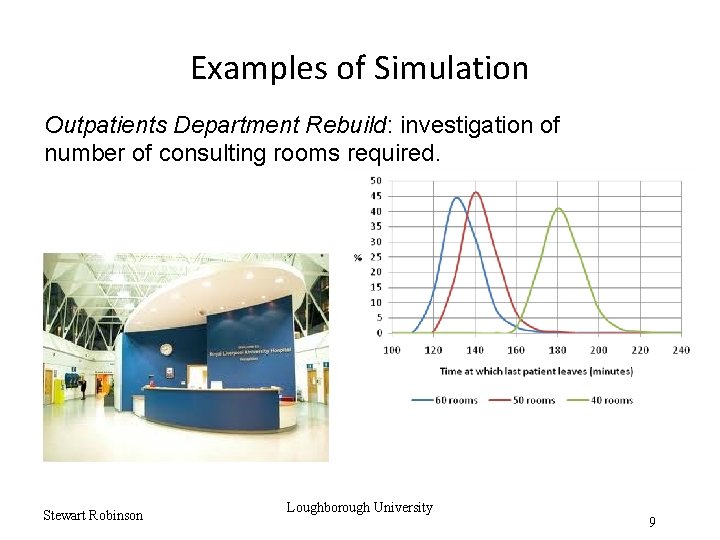
Examples of Simulation Outpatients Department Rebuild: investigation of number of consulting rooms required. Stewart Robinson Loughborough University 9
Why Use Simulation? Because systems are subject to variability, are interconnected and complex. 1. Variability: • Predictable variability e. g. shift changeovers, preventative maintenance • Unpredictable variability e. g. customer arrivals, breakdown Stewart Robinson Loughborough University 10
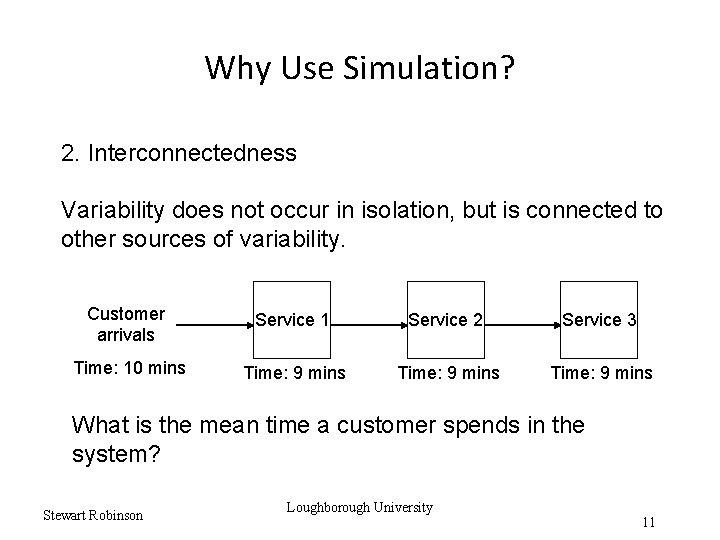
Why Use Simulation? 2. Interconnectedness Variability does not occur in isolation, but is connected to other sources of variability. Customer arrivals Service 1 Service 2 Service 3 Time: 10 mins Time: 9 mins What is the mean time a customer spends in the system? Stewart Robinson Loughborough University 11
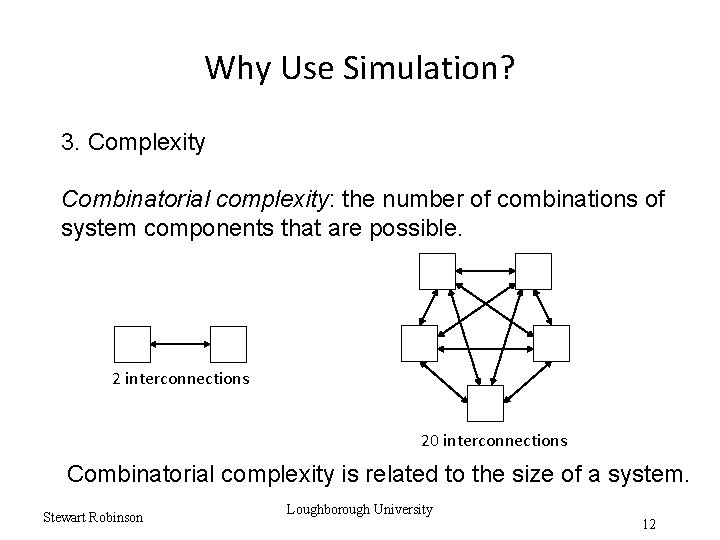
Why Use Simulation? 3. Complexity Combinatorial complexity: the number of combinations of system components that are possible. 2 interconnections 20 interconnections Combinatorial complexity is related to the size of a system. Stewart Robinson Loughborough University 12
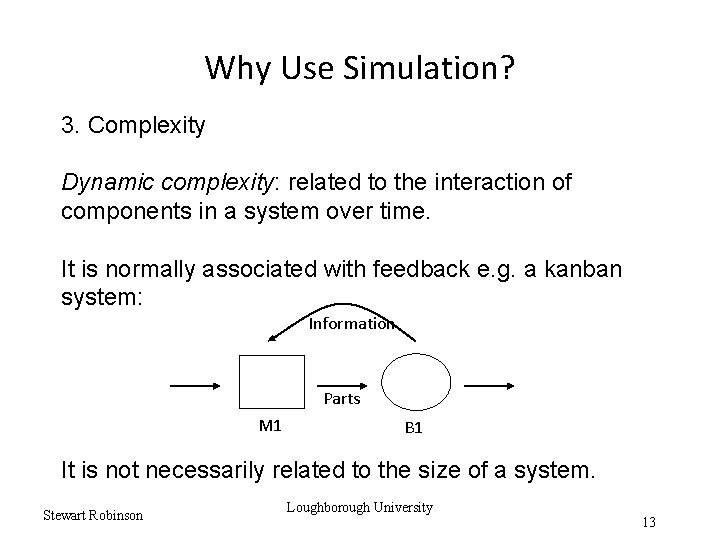
Why Use Simulation? 3. Complexity Dynamic complexity: related to the interaction of components in a system over time. It is normally associated with feedback e. g. a kanban system: Information Parts M 1 B 1 It is not necessarily related to the size of a system. Stewart Robinson Loughborough University 13
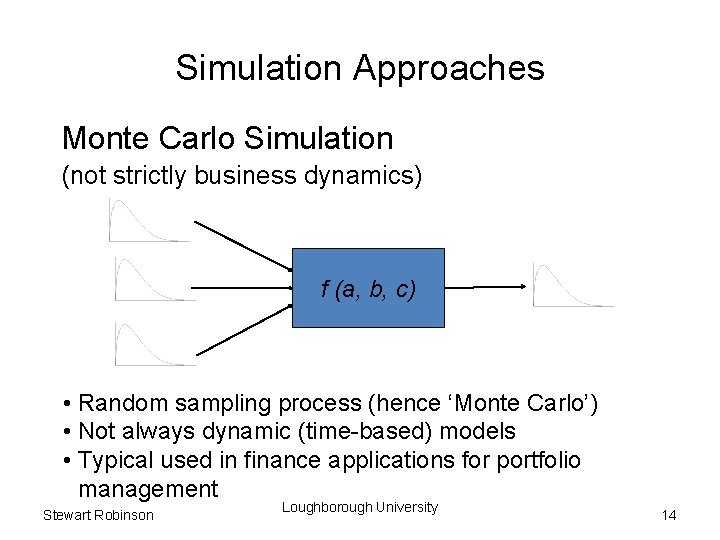
Simulation Approaches Monte Carlo Simulation (not strictly business dynamics) f (a, b, c) • Random sampling process (hence ‘Monte Carlo’) • Not always dynamic (time-based) models • Typical used in finance applications for portfolio management Stewart Robinson Loughborough University 14
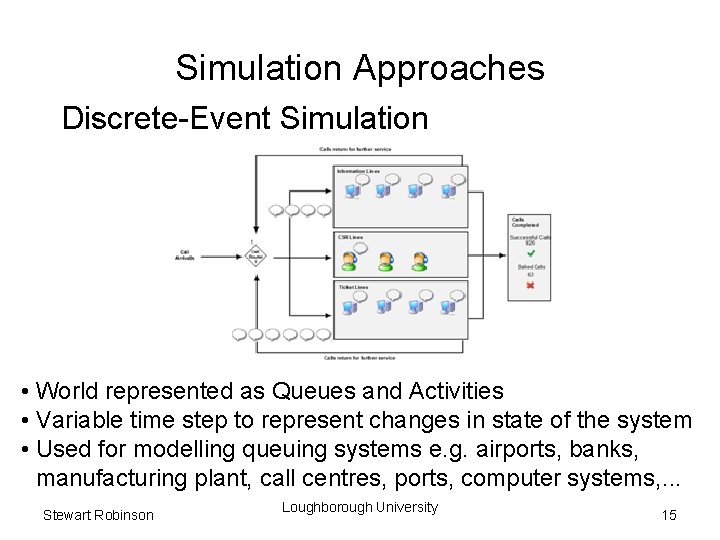
Simulation Approaches Discrete-Event Simulation • World represented as Queues and Activities • Variable time step to represent changes in state of the system • Used for modelling queuing systems e. g. airports, banks, manufacturing plant, call centres, ports, computer systems, . . . Stewart Robinson Loughborough University 15
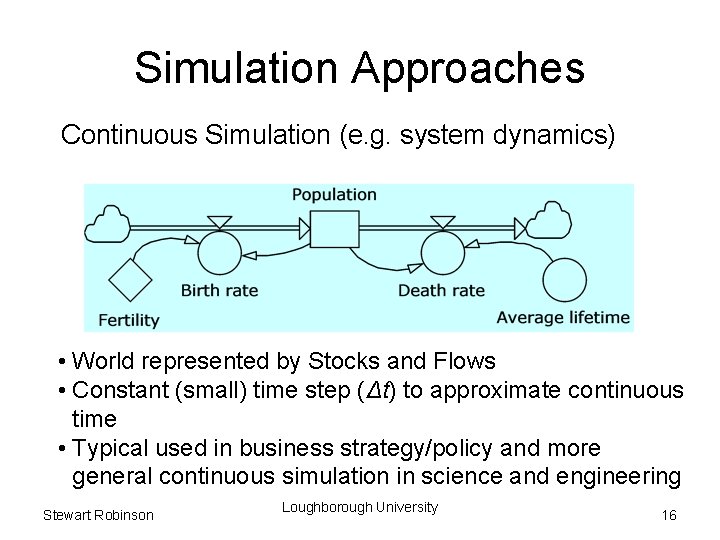
Simulation Approaches Continuous Simulation (e. g. system dynamics) • World represented by Stocks and Flows • Constant (small) time step (Δt) to approximate continuous time • Typical used in business strategy/policy and more general continuous simulation in science and engineering Stewart Robinson Loughborough University 16
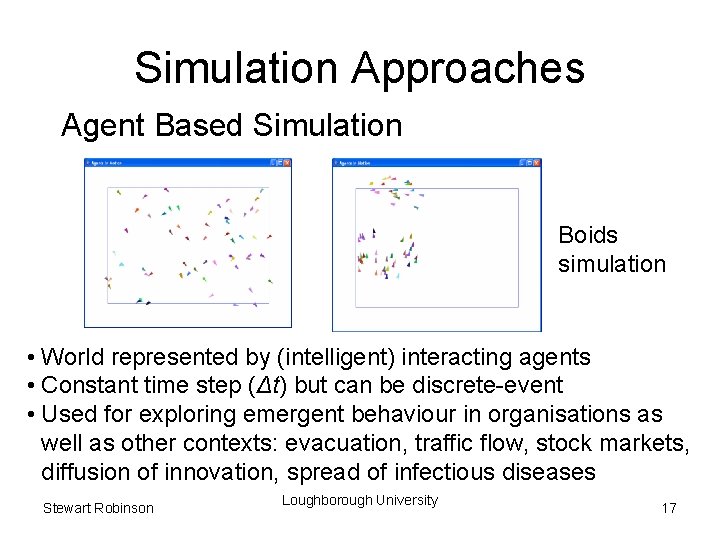
Simulation Approaches Agent Based Simulation Boids simulation • World represented by (intelligent) interacting agents • Constant time step (Δt) but can be discrete-event • Used for exploring emergent behaviour in organisations as well as other contexts: evacuation, traffic flow, stock markets, diffusion of innovation, spread of infectious diseases Stewart Robinson Loughborough University 17
Reading Discrete-Event Simulation Robinson, S. (2014). Simulation: The Practice of Model Development and Use, 2 nd ed. Palgrave, London. Law, A. M. (2014). Simulation Modeling and Analysis, 5 th ed. Mc. Graw-Hill, New York. System Dynamics Morecroft, J. (2007). Strategic Modelling and Business Dynamics: A Feedback Systems Approach. Wiley, Chichester. Sterman, J. D. (2000). Business Dynamics: Systems Thinking and Modeling for a Complex World. Mc. Graw-Hill, New York. Stewart Robinson Loughborough University 18
Reading Agent Based Modelling Robertson, D. A. and Caldart, A. A. (2009). The Dynamics of Strategy: Mastering Strategic Landscapes of the Firm. Oxford University Press. Axelrod, R. (1997). The Complexity of Cooperation: Agent-Based Models of Competition and Collaboration. Princeton University Press. North, M. J. and Macal, C. M. (2007). Managing Business Complexity: Discovering Strategic Solutions with Agent-Based Modeling and Simulation. Oxford University Press. Stewart Robinson Loughborough University 19
- Slides: 19