
Introduction to Shakespeares Macbeth John Worston Macbeth and
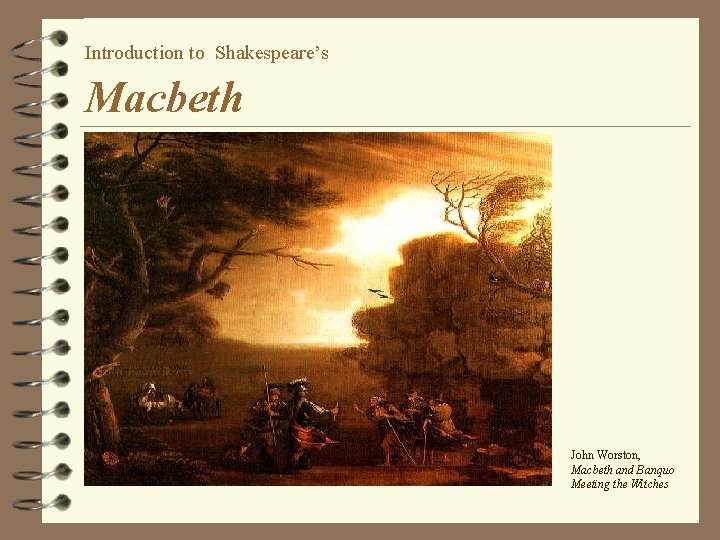
Introduction to Shakespeare’s Macbeth John Worston, Macbeth and Banquo Meeting the Witches
The Many Meanings of Macbeth 4 A historical thriller – a fast-moving, action-packed murder mystery demonstrating that crime doesn’t pay 4 A psychological study of a murderer’s mind 4 A play of political and social realism – how oppressive and hierarchical society can corrupt individuals 4 A play of illusions – the effect of the mysterious or supernatural on humans 4 A play of ideas or themes – for example, “appearance versus reality” 4 A tragedy – the fall of a great person brought about by a fatal flaw in their character
Historical Context of Macbeth 4 Shakespeare was a playwright, not an historian. However, he knew that history provided great material for plays: war, conflict, ambition, the downfall of great rulers. 4 Eleventh-Century Scotland was a violent and troubled country. 4 Feuding families and clans fought to control trade and territory. 4 The castle was the power base of each rival war-lord (thane). 4 Political murder and revenge killings were commonplace.
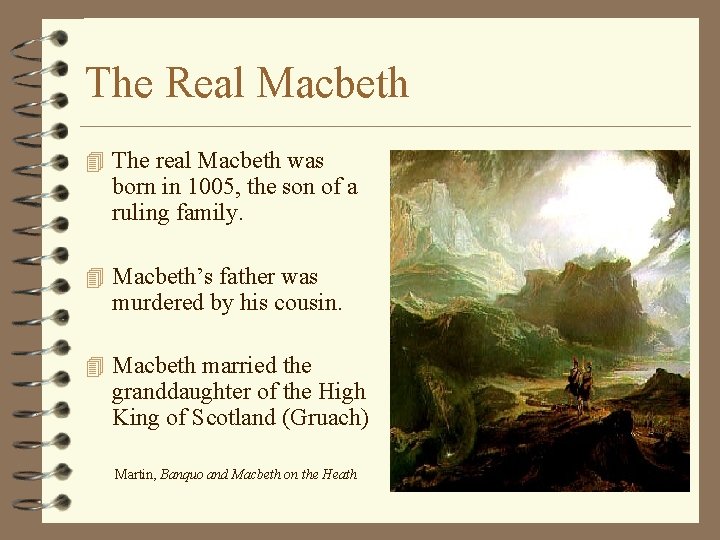
The Real Macbeth 4 The real Macbeth was born in 1005, the son of a ruling family. 4 Macbeth’s father was murdered by his cousin. 4 Macbeth married the granddaughter of the High King of Scotland (Gruach) Martin, Banquo and Macbeth on the Heath
Duncan and Macbeth 4 Duncan was the king of Scotland at the time the real Macbeth was born 4 Duncan was 38 at the time of his murder - a murder possibly committed by the real Macbeth. 4 Macbeth ruled Scotland for 17 years, during which time Scotland became comparatively peaceful and stable. 4 Duncan’s son, Malcolm, invaded Scotland in 1054, supported by Edward the Confessor. 4 Macbeth was killed on August 4 Macbeth was elected High King of Scotland in 1040. 15, 1057 and buried at Iona, the sacred burial place of the Kings of Scotland.
A Macbeth for King James? 4 King James succeeded Queen Elizabeth in 1603 - a Stuart, he was already King of Scotland 4 Shakespeare’s Macbeth may have been performed for the first time before King James in 1606 4 Macbeth contains many echoes of King James’ interests. . .
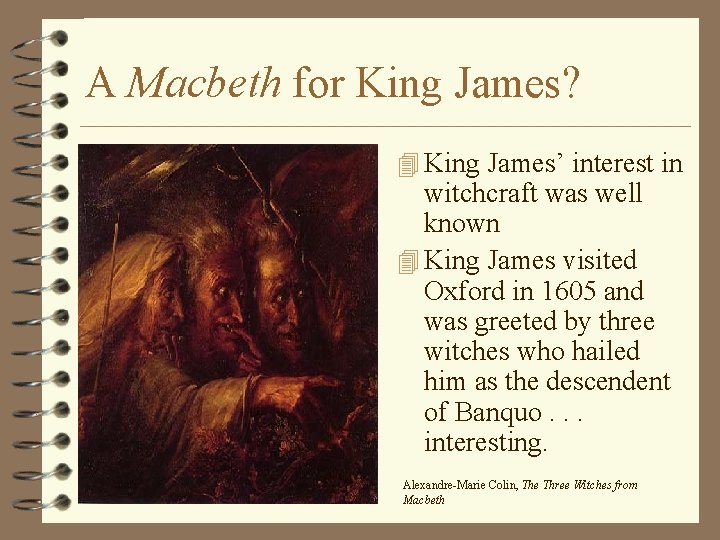
A Macbeth for King James? 4 King James’ interest in witchcraft was well known 4 King James visited Oxford in 1605 and was greeted by three witches who hailed him as the descendent of Banquo. . . interesting. Alexandre-Marie Colin, The Three Witches from Macbeth
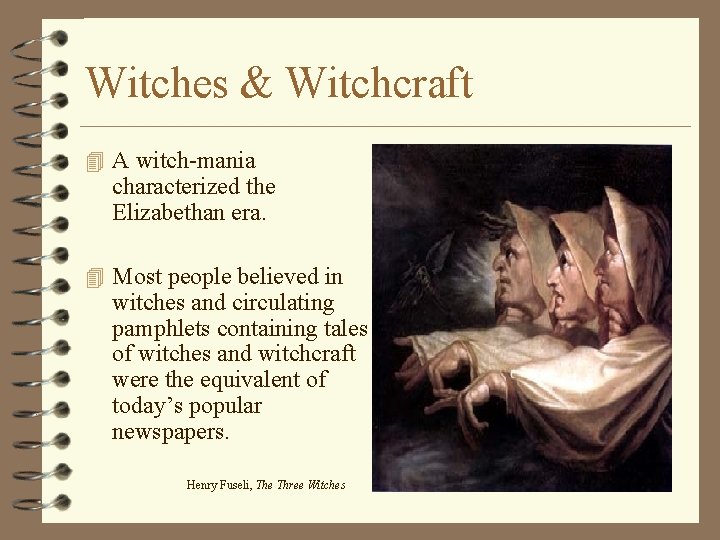
Witches & Witchcraft 4 A witch-mania characterized the Elizabethan era. 4 Most people believed in witches and circulating pamphlets containing tales of witches and witchcraft were the equivalent of today’s popular newspapers. Henry Fuseli, The Three Witches
Witches and Witchcraft 4 Witches were said to have “diabolical” powers. They could: – predict the future – bring on night in the daytime – cause fogs and tempests – kill animals – curse enemies with fatal, wasting diseases – cause nightmares and sterility – take demonic possession of any individual – raise evil spirits by concocting a brew 4 It was believed that witches allowed the devil to suck their blood. Accused witches were examined for the “Devil’s Mark” - a red mark on their body from which the devil had sucked blood.
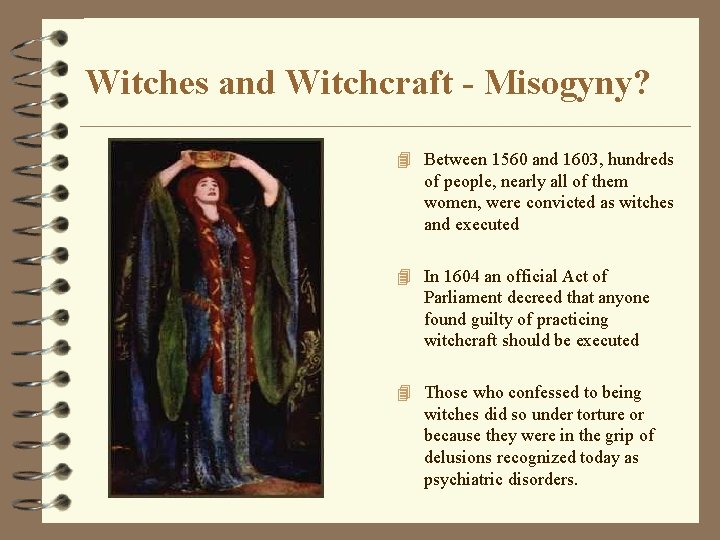
Witches and Witchcraft - Misogyny? 4 Between 1560 and 1603, hundreds of people, nearly all of them women, were convicted as witches and executed 4 In 1604 an official Act of Parliament decreed that anyone found guilty of practicing witchcraft should be executed 4 Those who confessed to being witches did so under torture or because they were in the grip of delusions recognized today as psychiatric disorders.
- Slides: 10