
Introduction to sequence alignment What can we learn
- Slides: 15
Introduction to sequence alignment
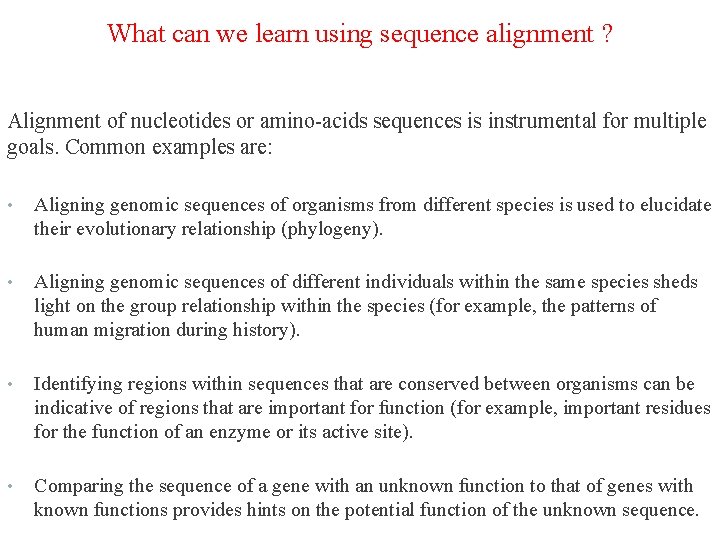
What can we learn using sequence alignment ? Alignment of nucleotides or amino-acids sequences is instrumental for multiple goals. Common examples are: • Aligning genomic sequences of organisms from different species is used to elucidate their evolutionary relationship (phylogeny). • Aligning genomic sequences of different individuals within the same species sheds light on the group relationship within the species (for example, the patterns of human migration during history). • Identifying regions within sequences that are conserved between organisms can be indicative of regions that are important for function (for example, important residues for the function of an enzyme or its active site). • Comparing the sequence of a gene with an unknown function to that of genes with known functions provides hints on the potential function of the unknown sequence.
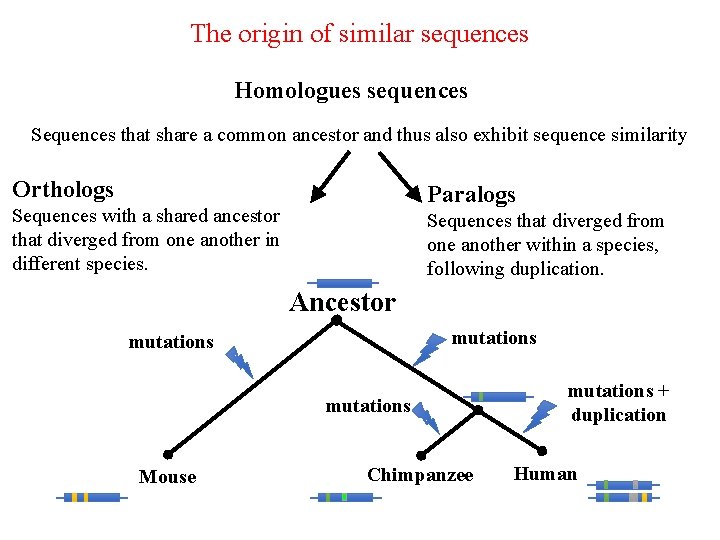
The origin of similar sequences Homologues sequences Sequences that share a common ancestor and thus also exhibit sequence similarity Orthologs Paralogs Sequences with a shared ancestor that diverged from one another in different species. Sequences that diverged from one another within a species, following duplication. Ancestor mutations Mouse Chimpanzee mutations + duplication Human
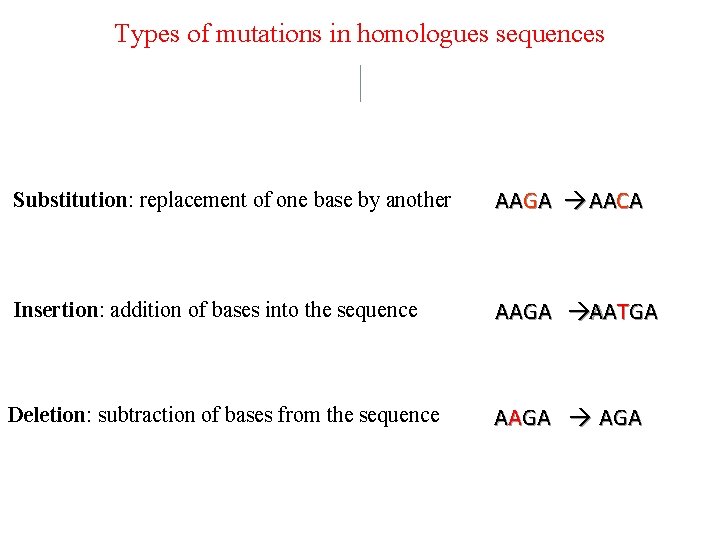
Types of mutations in homologues sequences Substitution: replacement of one base by another AAGA AACA Insertion: addition of bases into the sequence AAGA AATGA Deletion: subtraction of bases from the sequence AAGA
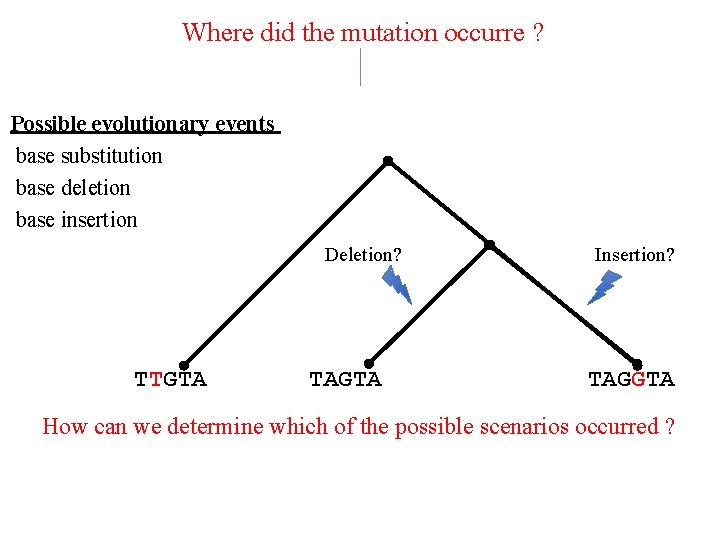
Where did the mutation occurre ? Possible evolutionary events base substitution base deletion base insertion Deletion? TTGTA TAGTA Insertion? TAGGTA How can we determine which of the possible scenarios occurred ?
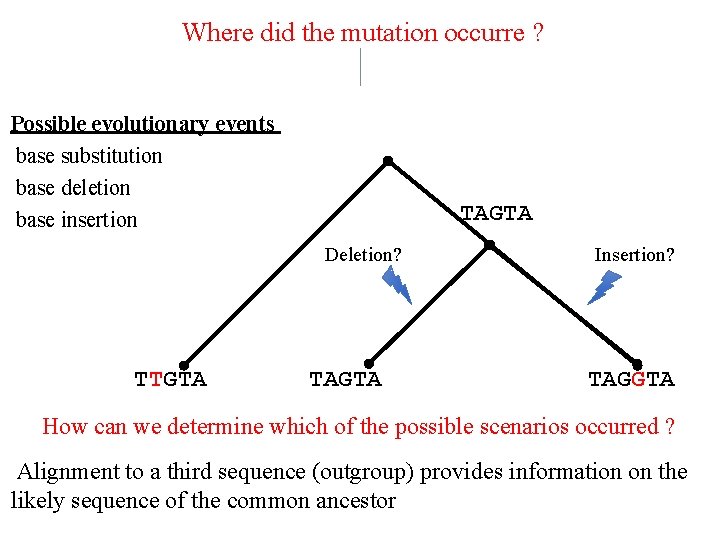
Where did the mutation occurre ? Possible evolutionary events base substitution base deletion base insertion TAGTA Deletion? TTGTA TAGTA Insertion? TAGGTA How can we determine which of the possible scenarios occurred ? Alignment to a third sequence (outgroup) provides information on the likely sequence of the common ancestor
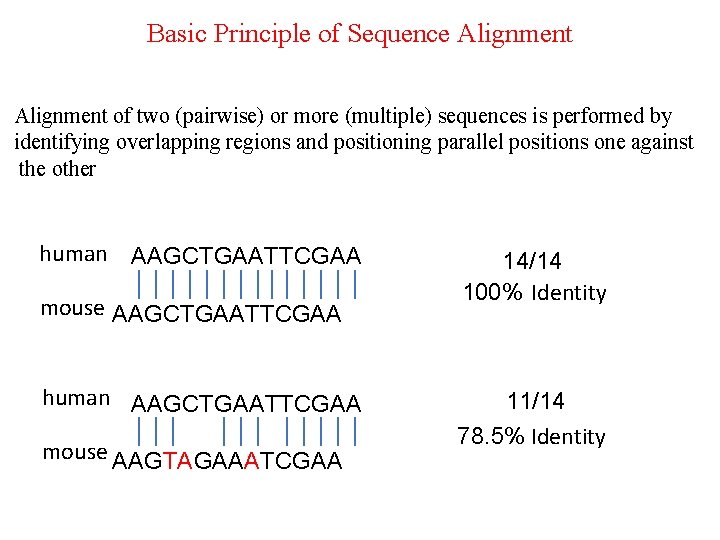
Basic Principle of Sequence Alignment of two (pairwise) or more (multiple) sequences is performed by identifying overlapping regions and positioning parallel positions one against the other human AAGCTGAATTCGAA mouse AAGCTGAATTCGAA human AAGCTGAATTCGAA mouse AAGTAGAAATCGAA 14/14 100%-Identity 11/14 78. 5% Identity-
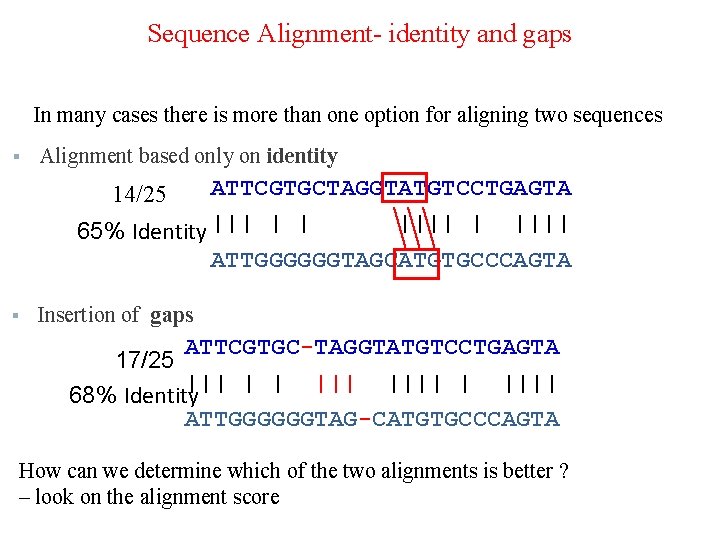
Sequence Alignment- identity and gaps In many cases there is more than one option for aligning two sequences § Alignment based only on identity ATTCGTGCTAGGTATGTCCTGAGTA |||| | |||| -65% Identity ||| | | 14/25 ATTGGGGGGTAGCATGTGCCCAGTA § Insertion of gaps ATTCGTGC-TAGGTATGTCCTGAGTA 17/25 ||| | | |||| -68% Identity ATTGGGGGGTAG-CATGTGCCCAGTA How can we determine which of the two alignments is better ? – look on the alignment score
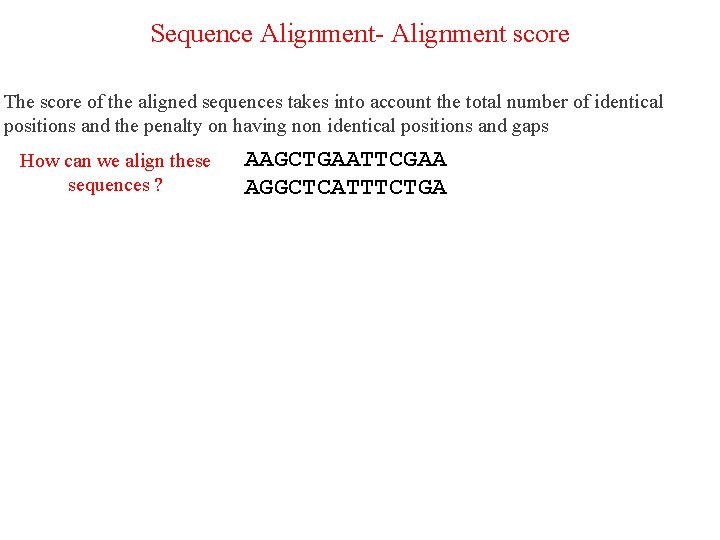
Sequence Alignment- Alignment score The score of the aligned sequences takes into account the total number of identical positions and the penalty on having non identical positions and gaps How can we align these sequences ? AAGCTGAATTCGAA AGGCTCATTTCTGA
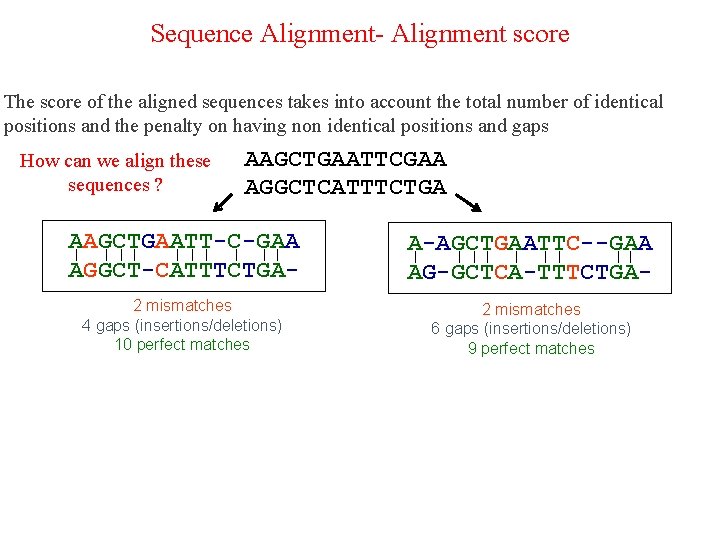
Sequence Alignment- Alignment score The score of the aligned sequences takes into account the total number of identical positions and the penalty on having non identical positions and gaps How can we align these sequences ? AAGCTGAATTCGAA AGGCTCATTTCTGA AAGCTGAATT-C-GAA ן ן ן ן AGGCT-CATTTCTGA- A-AGCTGAATTC--GAA ן ן ן AG-GCTCA-TTTCTGA- 2 mismatches 4 gaps (insertions/deletions) 10 perfect matches 2 mismatches 6 gaps (insertions/deletions) 9 perfect matches
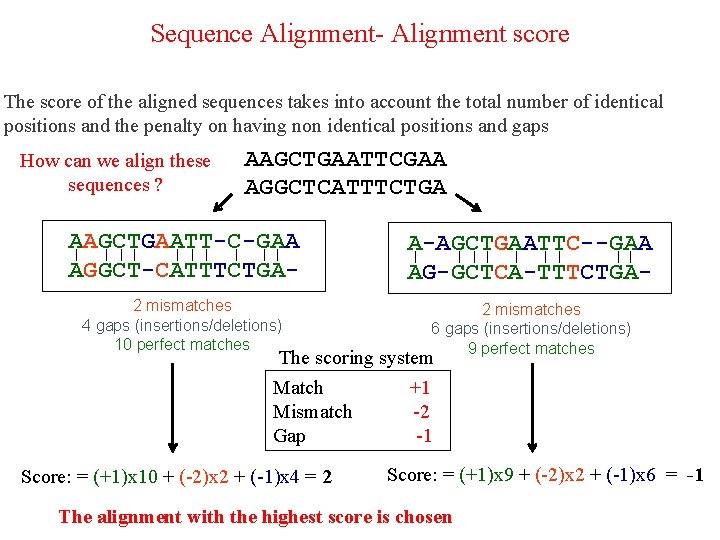
Sequence Alignment- Alignment score The score of the aligned sequences takes into account the total number of identical positions and the penalty on having non identical positions and gaps How can we align these sequences ? AAGCTGAATTCGAA AGGCTCATTTCTGA AAGCTGAATT-C-GAA ן ן ן ן AGGCT-CATTTCTGA- A-AGCTGAATTC--GAA ן ן ן AG-GCTCA-TTTCTGA- 2 mismatches 4 gaps (insertions/deletions) 10 perfect matches 2 mismatches 6 gaps (insertions/deletions) 9 perfect matches The scoring system Match +1 Mismatch -2 Gap -1 Score: = (+1)x 10 + (-2)x 2 + (-1)x 4 = 2 Score: = (+1)x 9 + (-2)x 2 + (-1)x 6 = -1 The alignment with the highest score is chosen
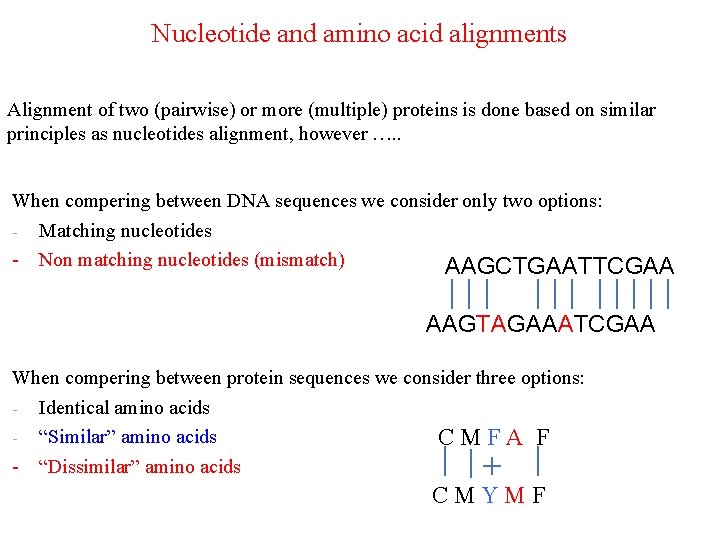
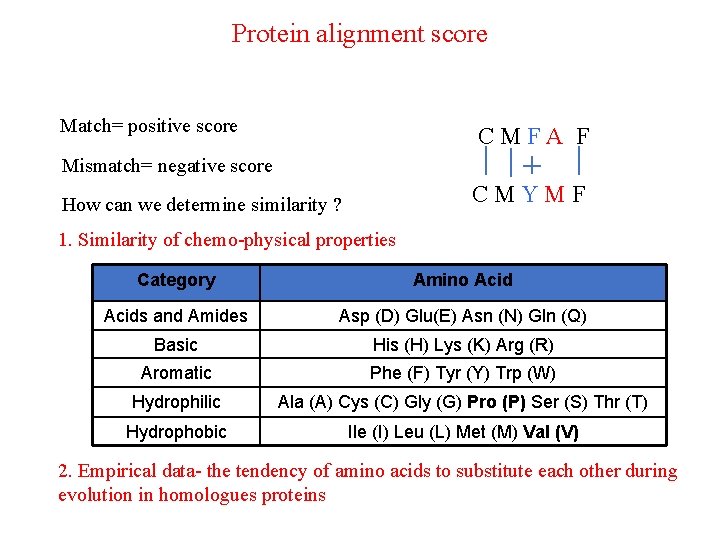
Nucleotide and amino acid alignments Alignment of two (pairwise) or more (multiple) proteins is done based on similar principles as nucleotides alignment, however …. . When compering between DNA sequences we consider only two options: - Matching nucleotides - Non matching nucleotides (mismatch) AAGCTGAATTCGAA AAGTAGAAATCGAA When compering between protein sequences we consider three options: - Identical amino acids - “Similar” amino acids CMFA F - “Dissimilar” amino acids CMYMF
Protein alignment score Match= positive score CMFA F Mismatch= negative score CMYMF How can we determine similarity ? 1. Similarity of chemo-physical properties Category Amino Acids and Amides Asp (D) Glu(E) Asn (N) Gln (Q) Basic His (H) Lys (K) Arg (R) Aromatic Phe (F) Tyr (Y) Trp (W) Hydrophilic Ala (A) Cys (C) Gly (G) Pro (P) Ser (S) Thr (T) Hydrophobic Ile (I) Leu (L) Met (M) Val (V) 2. Empirical data- the tendency of amino acids to substitute each other during evolution in homologues proteins
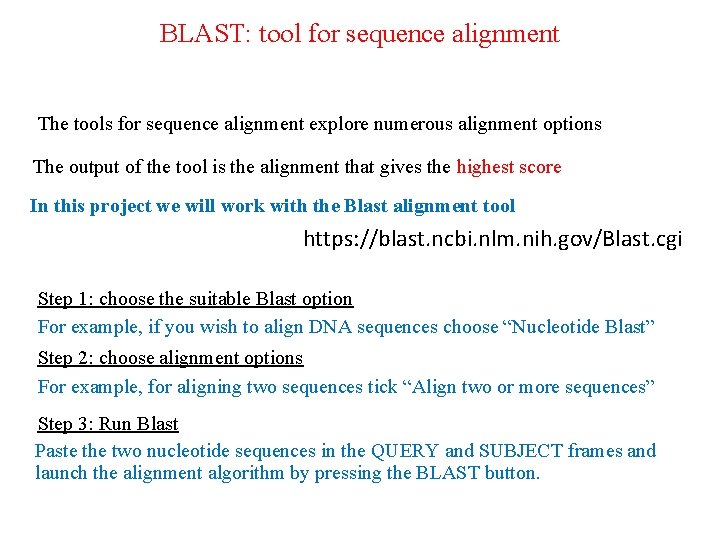
BLAST: tool for sequence alignment The tools for sequence alignment explore numerous alignment options The output of the tool is the alignment that gives the highest score In this project we will work with the Blast alignment tool https: //blast. ncbi. nlm. nih. gov/Blast. cgi Step 1: choose the suitable Blast option For example, if you wish to align DNA sequences choose “Nucleotide Blast” Step 2: choose alignment options For example, for aligning two sequences tick “Align two or more sequences” Step 3: Run Blast Paste the two nucleotide sequences in the QUERY and SUBJECT frames and launch the alignment algorithm by pressing the BLAST button.
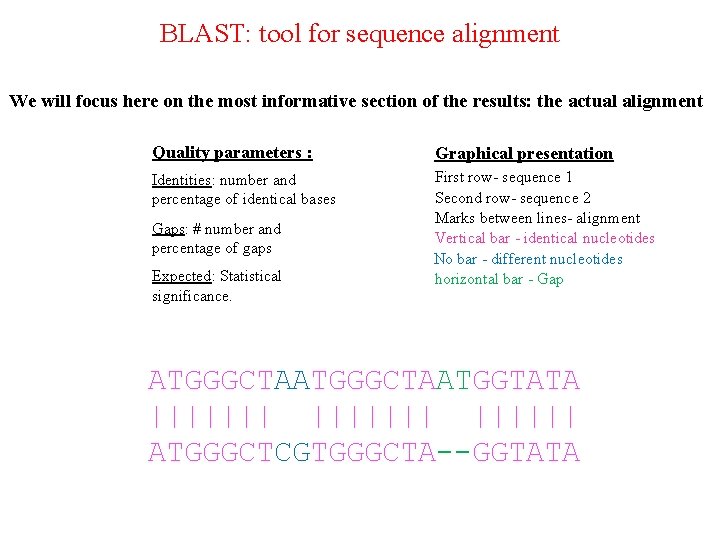
BLAST: tool for sequence alignment We will focus here on the most informative section of the results: the actual alignment Quality parameters : Graphical presentation Identities: number and percentage of identical bases First row- sequence 1 Second row- sequence 2 Marks between lines- alignment Vertical bar - identical nucleotides No bar - different nucleotides horizontal bar - Gaps: # number and percentage of gaps Expected: Statistical significance. ATGGGCTAATGGTATA ||||||| ATGGGCTCGTGGGCTA--GGTATA