
Introduction to Secondary Transition Planning for Students with
- Slides: 62
Introduction to Secondary Transition Planning for Students with Disabilities This training was developed by the Project 10: Transition Education Network, a special project funded by the Florida Department of Education, Division of Public Schools, Bureau of Exceptional Education and Student Services, through federal assistance under the Individuals with Disabilities Education Act (IDEA), Part B.
Objectives After this training, participants will be able to: Define secondary transition Identify key components of secondary transition planning in Florida Discuss importance of moving from compliance to outcomes in secondary transition Access evidence-based practices and resources for secondary transition planning
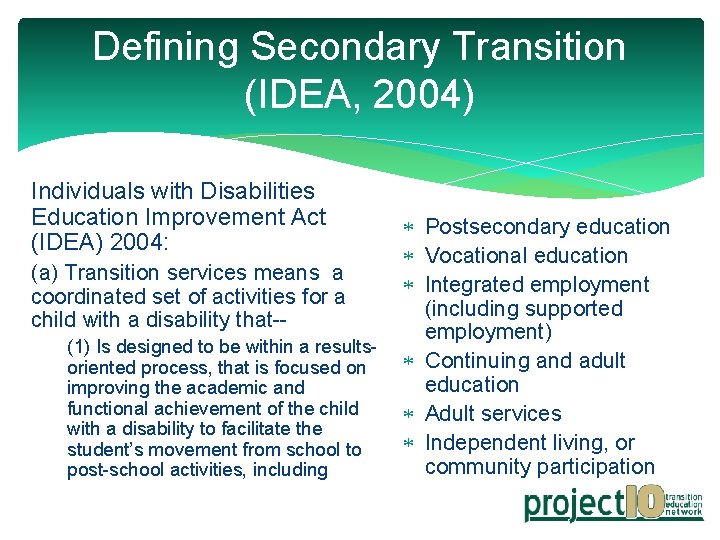
Defining Secondary Transition (IDEA, 2004) Individuals with Disabilities Education Improvement Act (IDEA) 2004: (a) Transition services means a coordinated set of activities for a child with a disability that-(1) Is designed to be within a resultsoriented process, that is focused on improving the academic and functional achievement of the child with a disability to facilitate the student’s movement from school to post-school activities, including Postsecondary education Vocational education Integrated employment (including supported employment) Continuing and adult education Adult services Independent living, or community participation
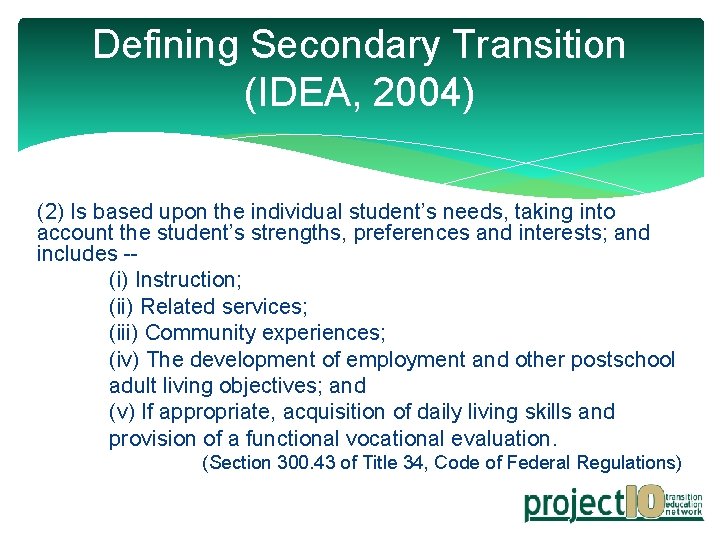
Defining Secondary Transition (IDEA, 2004) (2) Is based upon the individual student’s needs, taking into account the student’s strengths, preferences and interests; and includes -(i) Instruction; (ii) Related services; (iii) Community experiences; (iv) The development of employment and other postschool adult living objectives; and (v) If appropriate, acquisition of daily living skills and provision of a functional vocational evaluation. (Section 300. 43 of Title 34, Code of Federal Regulations)
Defining Secondary Transition (IDEA, 2004) According to IDEA, the IEP must include a statement of Appropriate measurable postsecondary goals based upon age-appropriate transition assessments relating to training, education, employment, and where appropriate, independent living skills The transition services (including course of study) needed to assist the (student) in reaching those goals (34. C. F. R. 300. 320[b] and [c]; 2. U. S. C. 1414 [d][1][A][i][VIII])
Secondary Transition Planning: Rule 6 A-6. 03028 (12) (h), Florida Administrative Code (F. A. C. ) (h) Contents of the IEP [Individual Educational Plan]. The IEP for each student with a disability must include: 1. A statement of the student’s present levels of academic achievement and functional performance 2. A statement of measurable annual goals 3. A description of benchmarks or short-term objectives for: a. b. Students with disabilities who take alternate assessment Any other student with a disability, at the discretion of the IEP Team.
Secondary Transition Planning: Rule 6 A-6. 03028 (12) (h), F. A. C. 4. A statement of the special education and related services and supplementary aids and services 5. A statement of any individual appropriate accommodations in the administration of state or district assessments 6. The projected date for the beginning of the special education, services, accommodations and modifications 7. At statement of how the student’s progress toward meeting the annual goals will be measured
Secondary Transition Planning: Rule 6 A-6. 03028 (12) (h), F. A. C. 8. In accordance with Commissioner of Education Rule 6 A 1. 09961 F. A. C. , during the student’s eighth (8 th) grade year or during the school year of the student’s fourteenth (14 th) birthday, whichever comes first A statement of whether the student is pursuing a course of study leading to a standard or special diploma Alert – New Legislation
Secondary Transition Planning: Rule 6 A-6. 03028 (12) (h), F. A. C. 9. In order to ensure more quality transition planning and services, IEP Teams shall begin the process of identifying transition services needs of students with disabilities, to include consideration of the student’s need for instruction or the provision of information in the area of self-determination to assist the student to be able to actively and effectively participate in IEP meetings and self-advocate, beginning no later than age fourteen (14), so that needed postsecondary goals may be identified and in place by age sixteen (16).
Secondary Transition Planning: Rule 6 A-6. 03028 (12) (h), F. A. C. 10. Beginning not later than the first IEP to be in effect when the student turns sixteen (16), or younger, if determined appropriate by the IEP Team and updated annually: a. A statement of appropriate measurable postsecondary goals based upon age appropriate transition assessments related to training, education, employment, and, where appropriate, independent living skills and the transition services (including course of study) needed to assist the student in reaching those goals.
Secondary Transition Planning: Rule 6 A-6. 03028 (12) (h), F. A. C. b. If a participating agency responsible for transition services, other than the school district, fails to provide the transition services described in the IEP, the school Must obtain prior consent district shall reconvene the IEP Team to identify to invite alternative strategies to meet the transition objectives agency for the student set out in the IEP. However, this does not relieve any participating agency, including Division of Vocational Rehabilitation Services, of the responsibility to provide or pay for any transition services that agency would otherwise provide to students with disabilities who meet the eligibility criteria of that agency.
Secondary Transition Planning: Florida Rule 6 A-6. 03028 (h) 11. Beginning at least one (1) year before the student’s eighteenth (18 th) birthday, a statement that the student has been informed of his or her rights under Part B of the IDEA, that will transfer from the parent to the student on reaching the age of majority, which is eighteen (18) years of age.
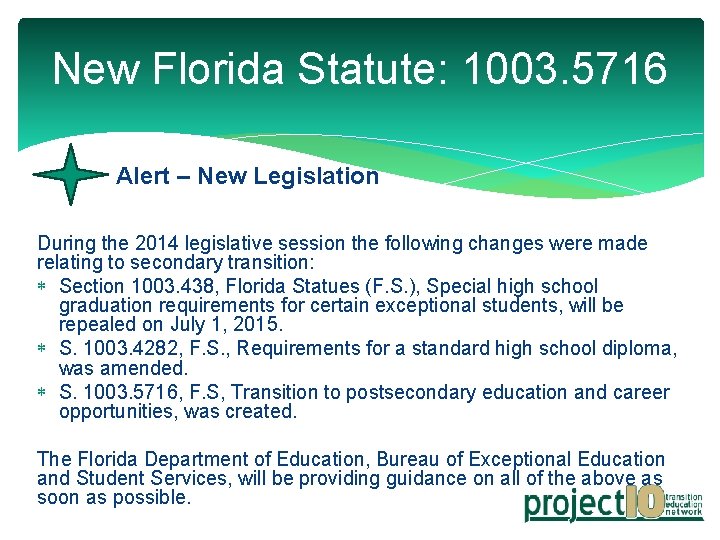
New Florida Statute: 1003. 5716 Alert – New Legislation During the 2014 legislative session the following changes were made relating to secondary transition: Section 1003. 438, Florida Statues (F. S. ), Special high school graduation requirements for certain exceptional students, will be repealed on July 1, 2015. S. 1003. 4282, F. S. , Requirements for a standard high school diploma, was amended. S. 1003. 5716, F. S, Transition to postsecondary education and career opportunities, was created. The Florida Department of Education, Bureau of Exceptional Education and Student Services, will be providing guidance on all of the above as soon as possible.
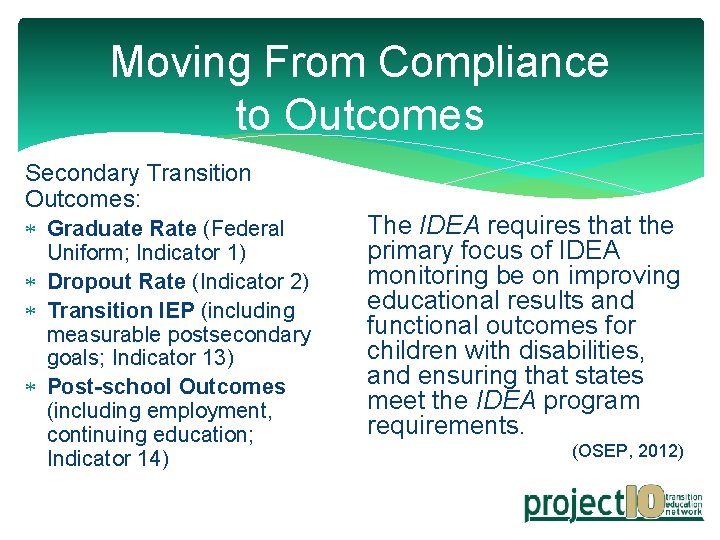
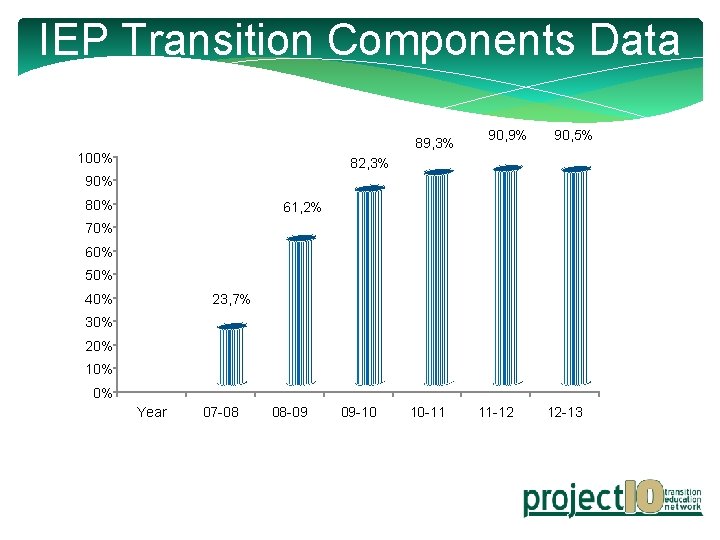
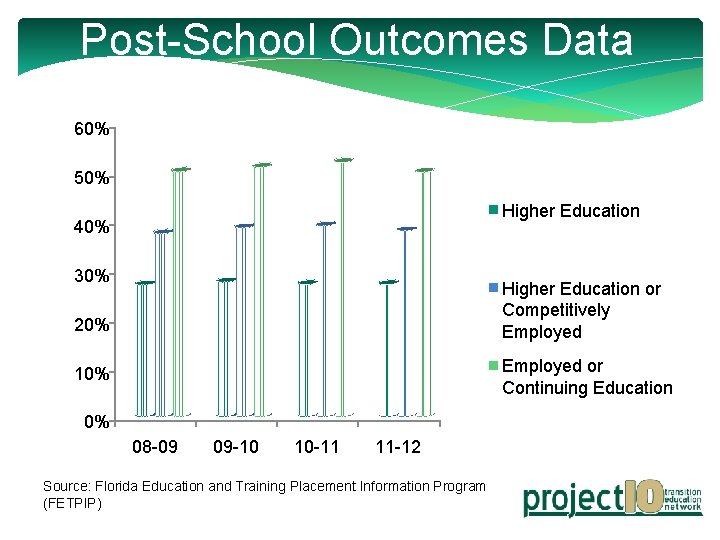
Moving From Compliance to Outcomes Secondary Transition Outcomes: Graduate Rate (Federal Uniform; Indicator 1) Dropout Rate (Indicator 2) Transition IEP (including measurable postsecondary goals; Indicator 13) Post-school Outcomes (including employment, continuing education; Indicator 14) The IDEA requires that the primary focus of IDEA monitoring be on improving educational results and functional outcomes for children with disabilities, and ensuring that states meet the IDEA program requirements. (OSEP, 2012)
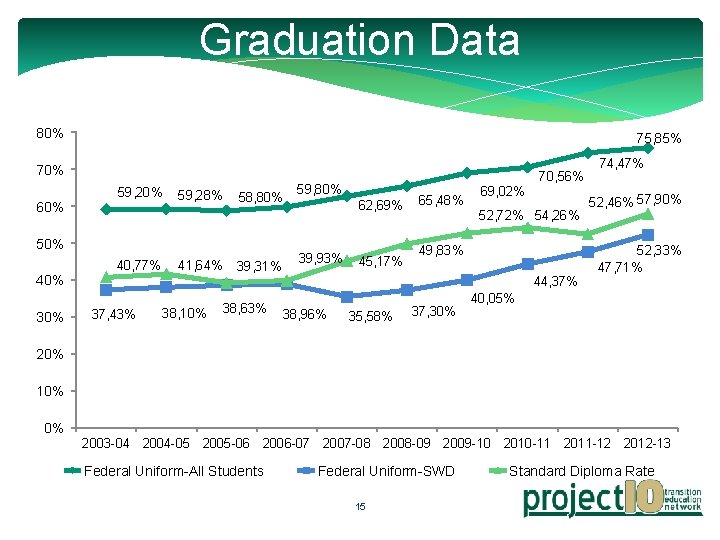
Graduation Data 80% 75, 85% 70% 60% 59, 28% 58, 80% 50% 40% 30% 40, 77% 41, 64% 39, 31% 70, 56% 59, 80% 62, 69% 39, 93% 45, 17% 65, 48% 69, 02% 52, 72% 54, 26% 49, 83% 44, 37% 37, 43% 38, 10% 38, 63% 38, 96% 35, 58% 37, 30% 74, 47% 52, 46% 57, 90% 52, 33% 47, 71% 40, 05% 20% 10% 0% 2003 -04 2004 -05 2005 -06 2006 -07 2007 -08 2008 -09 2009 -10 2010 -11 2011 -12 2012 -13 Federal Uniform-All Students Federal Uniform-SWD 15 Standard Diploma Rate
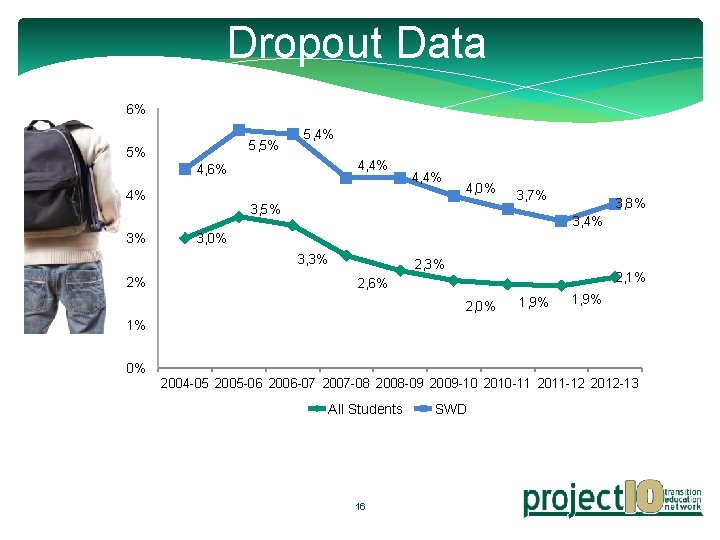
Dropout Data 6% 5, 5% 5% 5, 4% 4, 6% 4% 3% 4, 0% 3, 5% 3, 7% 3, 8% 3, 4% 3, 0% 3, 3% 2% 4, 4% 2, 3% 2, 1% 2, 6% 2, 0% 1, 9% 1% 0% 2004 -05 2005 -06 2006 -07 2007 -08 2008 -09 2009 -10 2010 -11 2011 -12 2012 -13 All Students 16 SWD
IEP Transition Components Data 89, 3% 100% 90, 9% 90, 5% 82, 3% 90% 80% 61, 2% 70% 60% 50% 40% 23, 7% 30% 20% 10% 0% Year 07 -08 08 -09 09 -10 10 -11 11 -12 12 -13
Post-School Outcomes Data 60% 50% Higher Education 40% 30% Higher Education or Competitively Employed 20% Employed or Continuing Education 10% 0% 08 -09 09 -10 10 -11 11 -12 Source: Florida Education and Training Placement Information Program (FETPIP)
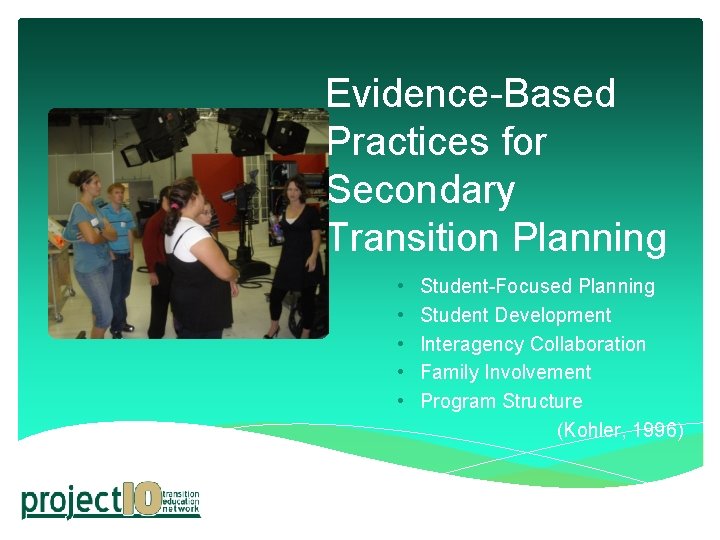
Evidence-Based Practices for Secondary Transition Planning • • • Student-Focused Planning Student Development Interagency Collaboration Family Involvement Program Structure (Kohler, 1996)
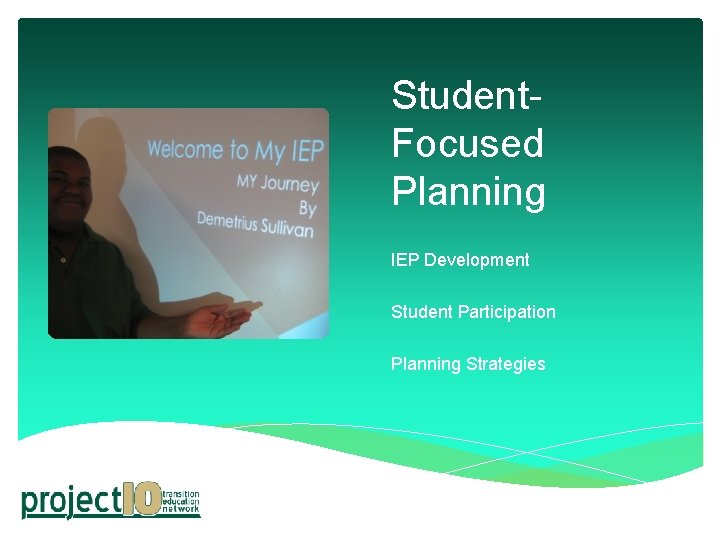
Student. Focused Planning IEP Development Student Participation Planning Strategies
IEP Development Ø Options identified for each outcome area or goal Ø Post-secondary education or training goals and objectives specified in the IEP Ø Vocational goals and objectives specified Ø Community-related and residential goals and objectives specified (e. g. , voting) Ø Recreation and leisure goals and objectives specified Ø Educational program corresponds to specific goals Ø Goals are measurable Ø Personal needs are addressed in planning (e. g. , financial, medical, guardianship) Ø Specific goals and objectives result from consumer choices Ø Progress or attainment of goals is reviewed annually Ø Responsibility of participants or agencies specified Ø Evaluation of participant fulfillment of responsibilities
Student Participation Ø Planning team includes student, family members, and school and participating agency personnel Ø Assessment information is used as basis for planning Ø Transition-focused planning begins no later than age 14 Ø Meeting time adequate to conduct planning Ø Preparation time adequate to conduct planning Ø Planning meeting time and place conducive to student and family participation Ø Accommodations made for communication needs (e. g. , interpreters) Ø Referral to adult service provider(s) occurs prior to student’s exit from school Ø Planning team leader identified
Planning Strategies Ø Self-determination facilitated within the planning process Ø Planning decisions driven by student and family Ø Planning process is student-centered Ø Student involvement in decision making Ø Documentation of student interests and preferences Ø IEP involvement training for students Ø Career counseling services provided to student Ø Student self-evaluation of process
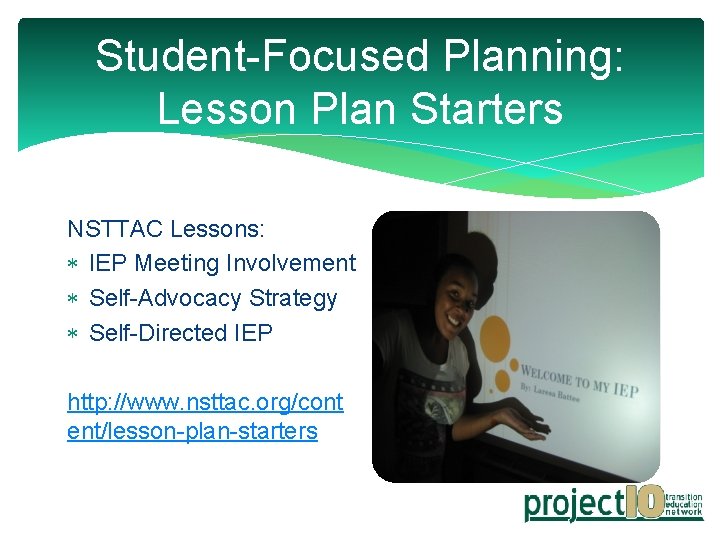
Student-Focused Planning: Lesson Plan Starters NSTTAC Lessons: IEP Meeting Involvement Self-Advocacy Strategy Self-Directed IEP http: //www. nsttac. org/cont ent/lesson-plan-starters
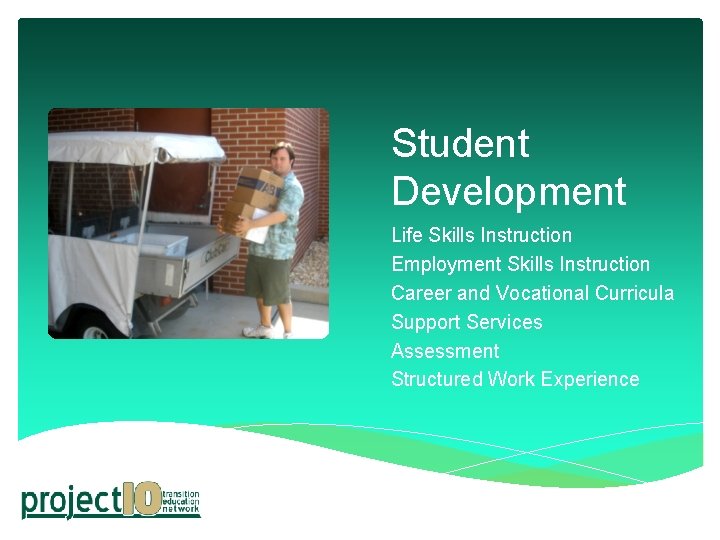
Student Development Life Skills Instruction Employment Skills Instruction Career and Vocational Curricula Support Services Assessment Structured Work Experience
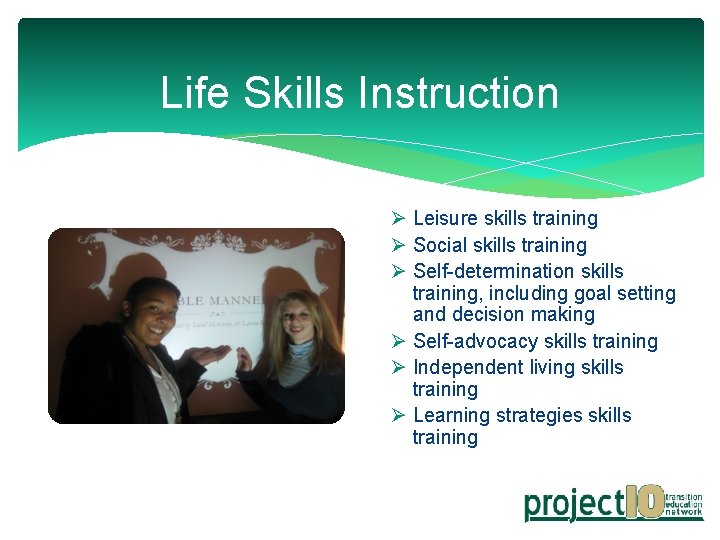
Life Skills Instruction Ø Leisure skills training Ø Social skills training Ø Self-determination skills training, including goal setting and decision making Ø Self-advocacy skills training Ø Independent living skills training Ø Learning strategies skills training
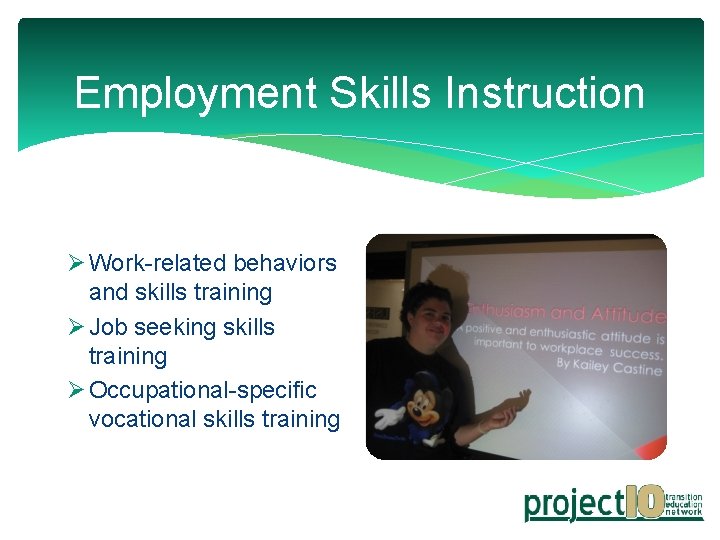
Employment Skills Instruction Ø Work-related behaviors and skills training Ø Job seeking skills training Ø Occupational-specific vocational skills training
Support Services and Assessment Support Services Ø Identification and development of environmental adaptations Ø Identification and development of accommodations Ø Identification and development of natural supports Ø Provision of related services (e. g. , OT, PT, speech therapy, transportation) Ø Use of mentors Assessment Ø Vocational assessment (including curriculumbased and situational assessment) Ø Academic, cognitive, and adaptive behavior assessments
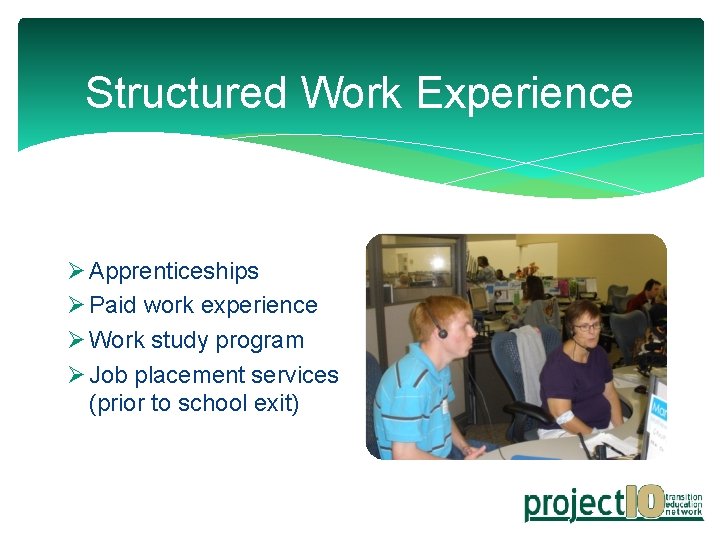
Structured Work Experience Ø Apprenticeships Ø Paid work experience Ø Work study program Ø Job placement services (prior to school exit)
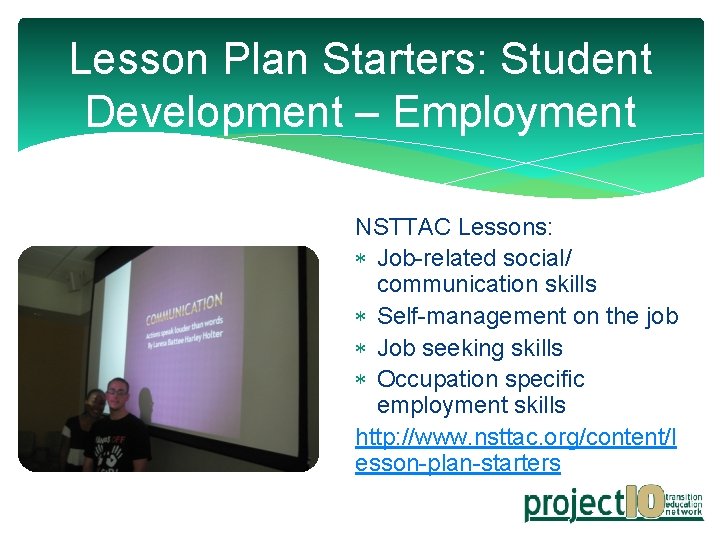
Lesson Plan Starters: Student Development – Employment NSTTAC Lessons: Job-related social/ communication skills Self-management on the job Job seeking skills Occupation specific employment skills http: //www. nsttac. org/content/l esson-plan-starters
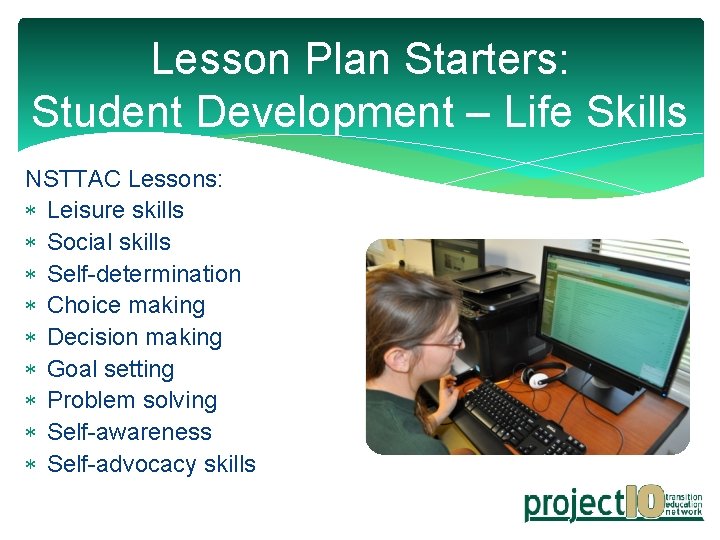
Lesson Plan Starters: Student Development – Life Skills NSTTAC Lessons: Leisure skills Social skills Self-determination Choice making Decision making Goal setting Problem solving Self-awareness Self-advocacy skills
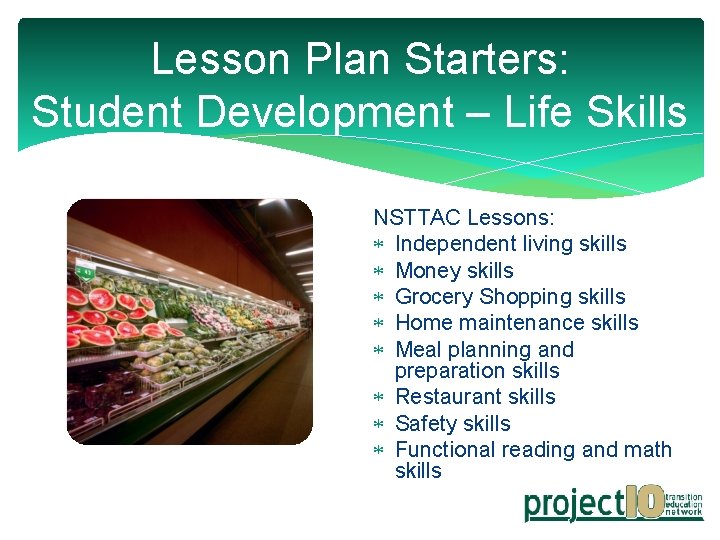
Lesson Plan Starters: Student Development – Life Skills NSTTAC Lessons: Independent living skills Money skills Grocery Shopping skills Home maintenance skills Meal planning and preparation skills Restaurant skills Safety skills Functional reading and math skills
Interagency Collaboration Collaborative Service Delivery Collaborative Framework
Collaborative Service Delivery Ø Coordinated requests for information (e. g. , to parents, employers) Ø Reduction of system barriers to collaboration Ø Collaborative funding and staffing of transition services Ø Collaborative development and use of assessment data Ø Coordinated and shared delivery of transition-related services Ø Systems information disseminated among cooperating agencies Ø Collaborative program planning and development, including employer involvement Ø Collaborative consultation between special, “regular, ” and vocational educators Ø Collaboration between post-secondary education institutions and the school district
Collaborative Framework Ø Interagency coordinating body that includes consumers, parents, service providers, and employers Ø Formal interagency agreement Ø Roles of service providers clearly articulated Ø Established methods of communication among service providers Ø Student information shared among agencies via established procedures (with appropriate release of information and confidentiality) Ø Single-case management system Ø “Lead” agency identified Ø Designated transition contact person for all service providers
Family Involvement Family Empowerment Family Training
Family Involvement Ø Parents/families exercise decision making Ø Parent/family attendance at IEP meeting Ø Parents/family members as trainers Ø Parents/family members as mentors Ø Parents/family role in natural support network Ø Participation in program policy development Ø Participation in service delivery Ø Involvement in student assessment Ø Participation in evaluation of student’s program
Family Empowerment Ø Pre-IEP planning activities for parents/families Ø Parents/families presented with choices Ø Transition information provided to parents/families prior to student’s age 14 Ø Structured method to identify family needs Ø Parent/family support network Ø Child care for transition-related planning meetings (e. g. , IEP, ITP) Ø Respite care Ø Information to parents/families provided in their ordinary language
Family Training Ø Training about promoting selfdetermination Ø Training about advocacy Ø Training about natural supports Ø Training focused on their own empowerment Ø Training on transition-related planning process (e. g. , IEP, ITP) Ø Training about agencies and services Ø Training on legal issues
Program Structure Program Philosophy Program Evaluation Strategic Planning Program Policy Human Resource Development Resource Allocation
Program Philosophy Ø Curricula are community-referenced Ø Curricula are outcome-based Ø Education provided in least restrictive environment Ø Education provided in integrated settings Ø Student has access to all educational options (secondary and post-secondary) Ø Cultural and ethnic sensitivity in programs and planning Ø Flexible programming to meet student needs Ø Program planning is outcome-based Ø Longitudinal approach to transition (early childhood to adult)
Program Evaluation Ø Data-based management system Ø Evaluation utilization for program improvement Ø Ongoing program evaluation Ø Specific evaluation of student outcomes Ø Student/family role in program evaluation Ø Secondary-level education services needs assessment Ø Post-school services or program needs assessment Ø Annual evaluation of interdisciplinary policy and procedures
Strategic Planning Ø Community-level strategic planning focused on local issues and services Ø Regional-level strategic planning Ø State-level strategic planning Ø Community-level transition body focused on local issues and services Ø Regional-level transition body focused on regional/state issues Ø State-level transition body focused on regional/state issues
Program Policy Ø Adult service systems restructured to include transition-related planning and services as integral components Ø Education system restructured to include transition-related planning and services as integral components Ø Administrative, school board, and community support for the program Ø Program values, principles, and mission are clearly articulated Ø Specific and consistent transition-related policies and procedures between and within agency and education participants Ø Transition planning program structure and process clearly articulated
Human Resource Development Ø Transition practices resource materials available to personnel, families, and employers Ø Assigned staff are qualified Ø Preservice training on transition practices Ø Sufficient allocation of personnel Ø Transition-related technical assistance Ø Establishment of transition-related personnel competencies Ø Ongoing transdisciplinary staff development
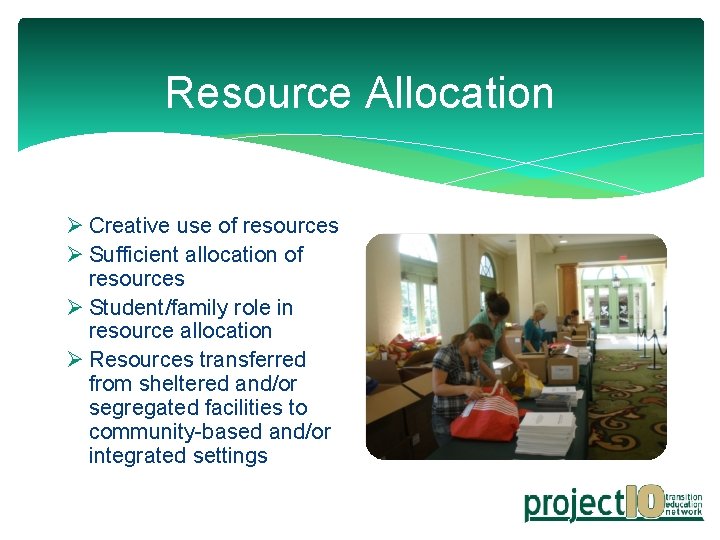
Resource Allocation Ø Creative use of resources Ø Sufficient allocation of resources Ø Student/family role in resource allocation Ø Resources transferred from sheltered and/or segregated facilities to community-based and/or integrated settings
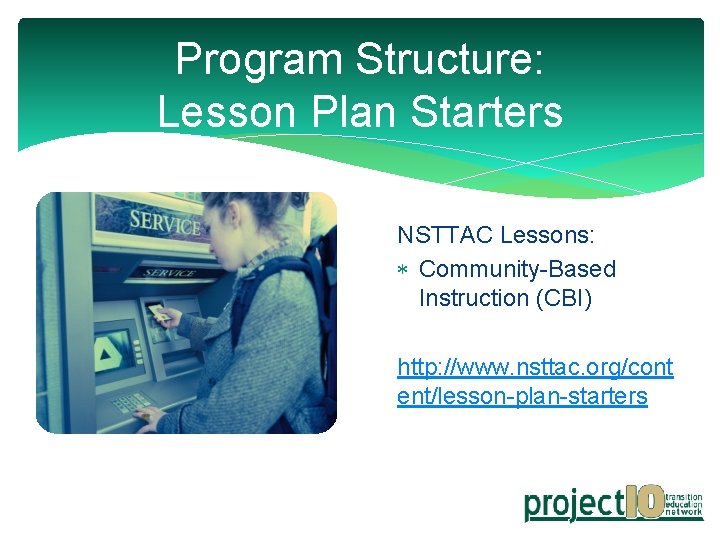
Program Structure: Lesson Plan Starters NSTTAC Lessons: Community-Based Instruction (CBI) http: //www. nsttac. org/cont ent/lesson-plan-starters
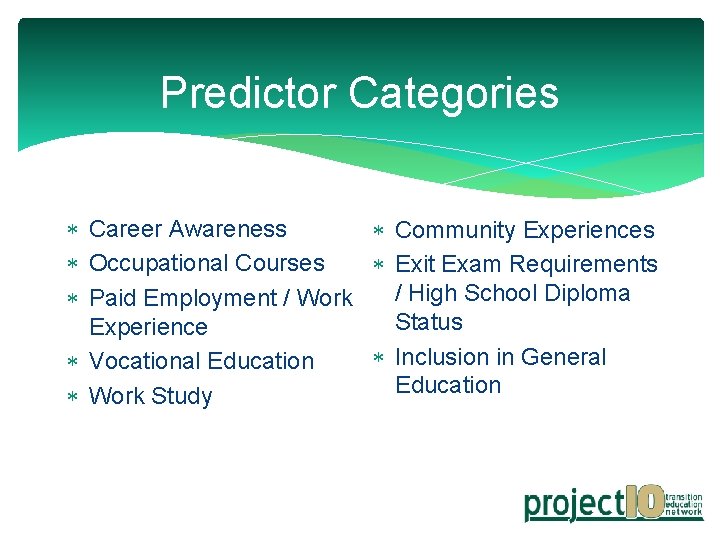
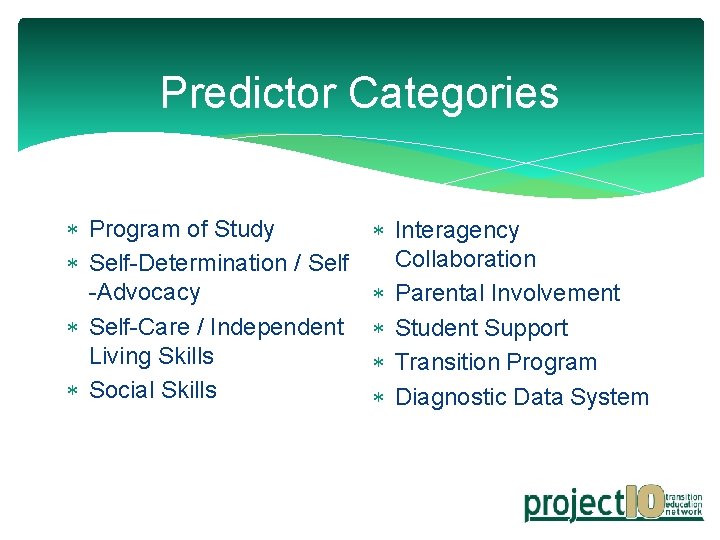
Evidence-Based Predictors of Post-School Success A predictor of post-school success is an in-school experience, typically a program (e. g. , work-based learning experience) correlated with improved post-school outcomes. Predictors are based empirical research and apply to transition planning and instruction in the following ways: Provide practitioners information about secondary transition program characteristics Help develop, expand, and/or evaluate secondary transition programs Help IEP teams develop goals and transition services more likely to help students achieve their stated post-school goals (National Post-School Outcomes Center, Appendix G, p. 1)
Predictor Categories Career Awareness Community Experiences Occupational Courses Exit Exam Requirements / High School Diploma Paid Employment / Work Status Experience Inclusion in General Vocational Education Work Study
Predictor Categories Program of Study Self-Determination / Self -Advocacy Self-Care / Independent Living Skills Social Skills Interagency Collaboration Parental Involvement Student Support Transition Program Diagnostic Data System
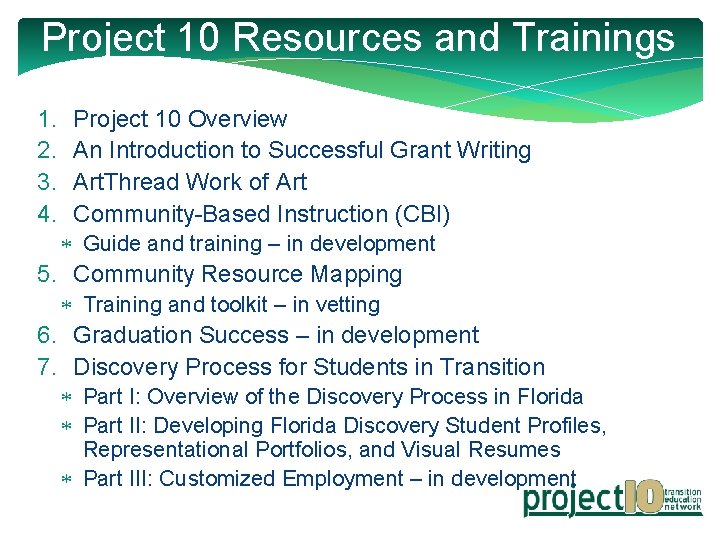
Project 10 Resources and Trainings 1. 2. 3. 4. Project 10 Overview An Introduction to Successful Grant Writing Art. Thread Work of Art Community-Based Instruction (CBI) Guide and training – in development 5. Community Resource Mapping Training and toolkit – in vetting 6. Graduation Success – in development 7. Discovery Process for Students in Transition Part I: Overview of the Discovery Process in Florida Part II: Developing Florida Discovery Student Profiles, Representational Portfolios, and Visual Resumes Part III: Customized Employment – in development
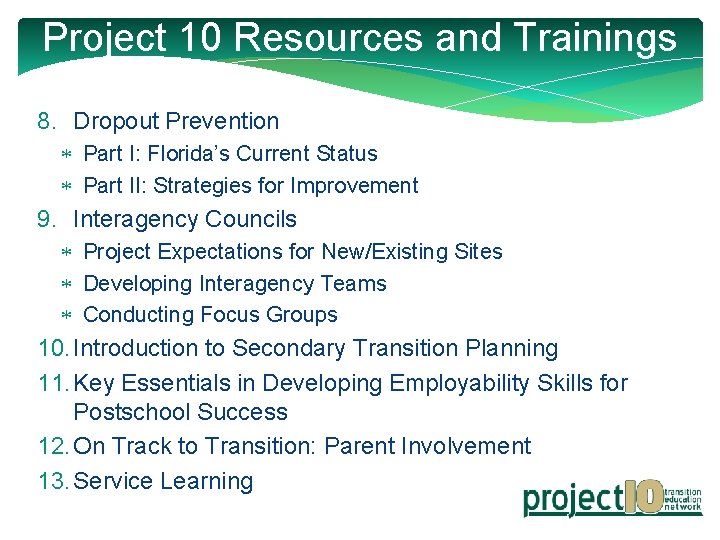
Project 10 Resources and Trainings 8. Dropout Prevention Part I: Florida’s Current Status Part II: Strategies for Improvement 9. Interagency Councils Project Expectations for New/Existing Sites Developing Interagency Teams Conducting Focus Groups 10. Introduction to Secondary Transition Planning 11. Key Essentials in Developing Employability Skills for Postschool Success 12. On Track to Transition: Parent Involvement 13. Service Learning
Project 10 Resources and Trainings 14. School-Based Micro-Enterprise Development: Planning, Implementing, and Evaluating Manual and training – in revision 15. Standing Up For Me (SUFM): Florida’s Self-Determination Curriculum 16. The Florida Summary of Performance: Requirements and Suggested Practice 17. Transition Assessment: Using Data for Transition Planning 18. Transition Basics: A Guide for Families Training – in revision Train-the-Trainer – in development 19. Utilizing Data to Diagnose then Treat: Program Evaluation and Improvement
Project 10 Resources and Trainings 20. Scope and Sequences 7821030: 6 – 8 Career Education and Planning 7960010: Transition Planning 7963010: Preparation for Adult Living – in development 7963140: Self-Determination – in development 7980040: Preparation for Entrepreneurship/Self-Employment 7980110: Career Preparation 7980120: Career Experiences 7980130: Career Placement 7980150: Supported Competitive Employment
Project 10 Resources and Trainings Online training modules include: 1. 2. 3. 4. 5. Secondary Transition Compliance (STC) Transition Assessment Summary of Performance Job Development – available later this year Self-Determination – available later this year Please Note: All Project 10 trainings and information will be reviewed and revised, as needed and with FDOE/BEESS guidance, to reflect the most current legislation.
Additional Training Resources Access Points / Access Project Director, Randy La. Russo. Randy@Brevardschools. org; 321 -242 -6400 ext. 5115 Developing Quality Individual Educational Plans: A Guide for Instructional Personnel and Families, Manual, http: //www. fldoe. org/ese/pdf/Quality. IEPs. pdf Workshop Materials, http: //www. fdlrs. org/IEPDocs/Developing%20 Quality%20 IEPs%2 0 Training%20 Materials%20 Section%201. 2012. pdf Online Course, www. cpalms. org; login to access professional development FDLRS Professional Development Alternatives (PDA) Transition Online Module, http: //www. pda-ese. org/
State and National Resources Attendance Works: Advancing Student Success by Reducing Chronic Absence, http: //www. attendanceworks. org/ Center for Parent Information and Resources, http: //www. parentcenterhub. org/ Central Florida Parent Center, http: //www. cflparents. org/ Check and Connect Florida, http: //project 10. info/Detail. Page. php? Main. Page. ID=279 College and Career Readiness and Success Center, American Institutes for Research, http: //www. ccrscenter. org/ Family Network on Disabilities (FND) Statewide Parent Center, http: //fndusa. org/ Florida Consortium on Postsecondary Education and Intellectual Disabilities Florida Department of Education, Bureau of Exceptional Education and Student Services, http: //www. fldoe. org/ese/ Florida Department of Education, College and Career Readiness, http: //www. fldoe. org/fcs/collegecareerreadiness. asp Florida Developmental Disabilities Council (FDDC), http: //www. fddc. org/
State and National Resources Florida’s Discretionary Projects, http: //www. fldoe. org/ese/pdf/Projects. Listing. pdf Florida Division of Vocational Rehabilitation, http: //www. rehabworks. org/ Graduate First, http: //www. gaspdg. org/graduate-first Hughes, C. , & Carter, E. W. (2012). The new transition handbook: Strategies that high school teachers use that work! Baltimore, MD: Paul H. Brookes Publishing Co. , Inc. National Alliance for Secondary Education and Transition (NASET), http: //www. nasetalliance. org/ National Center on Secondary Education and Transition (NCSET), http: //www. ncset. org/ National Center for Learning Disabilities (NCLD), http: //www. ncld. org/ National Collaborative on Workforce and Disability for Youth (NCWD for Youth), http: //www. ncwd-youth. info/ National Consortium on Leadership and Disability for Youth (NCLD Youth), http: //www. ncld-youth. info/index. php? id=01 National Secondary Transition Technical Assistance Center (NSTTAC), http: //www. nsttac. org/
State and National Resources National Dropout Prevention Center/Network, http: //www. dropoutprevention. org National Dropout Prevention Center for Students with Disabilities, http: //www. ndpcsd. org National Post-School Outcomes Center (NPSO), http: //www. psocenter. org/ Parent to Parent of Miami, http: //www. ptopmiami. org/ Project 10 Transition Education Network, http: //project 10. info/ Soft Skills to Pay the Bills: Mastering Soft Skills for Workplace Success, http: //www. dol. gov/odep/topics/youth/softskills/ Strategic Instruction Model (SIM) Florida, http: //www. fdlrs. org/statewidepd/sim. html U. S. Department of Education. (2007). Transition of students with disabilities to postsecondary education: A guide for high school educators. Retrieved from http: //www 2. ed. gov/about/offices/list/ocr/transitionguide. html Wehman, P. (2013). Life beyond the classroom: Transition strategies for young people with disabilities (5 th ed. ). Baltimore, MD: Paul H. Brookes Publishing Co. , Inc Youth to Work Coalition, http: //www. nsttac. org/ytw/home
References Florida Administrative Code & Florida Administrative Register. (2014). 6 A 6. 03028 (h). Retrieved from https: //www. flrules. org/ Kohler, P. (1996). Taxonomy for transition programming: A model for planning, organizing, and evaluating transition education, services, and programs. Retrieved from http: //homepages. wmich. edu/~kohlerp/pdf/Taxonomy. pdf National Post-School Outcomes Center. (n. d. ). STEPSS: State toolkit for examining post-school success. Retrieved from http: //psocenter. org/content_pages/59 National Secondary Transition Technical Assistance Center (NSTTAC). (2014). Lesson Plan Starters. Retrieved from http: //www. nsttac. org/content/lesson-plan-starters U. S. Department of Education. (2004). Sec. 300. 43 Transition services. Retrieved from http: //idea. ed. gov/explore/view/p/, root, regs, 300, A, 300%252 E 43
Questions and Thank You! Questions, concerns, or recommendations? Thank you for your attendance and input today!
Presenter Contact Information (RTR Name) Project 10: Transition Education Network Region ( ) Transition Representative Email: Office: