
Introduction to SEAMCAT European Communications Office JeanPhilippe Kermoal
- Slides: 18
Introduction to SEAMCAT European Communications Office Jean-Philippe Kermoal - SEAMCAT Manager (ECO) 3 June 2014 (Jean-Philippe. Kermoal@eco. cept. org) EUROPEAN COMMUNICATIONS OFFICE Nansensgade 19 DK-1366 Copenhagen Denmark Telephone: Telefax: + 45 33 89 63 00 + 45 33 89 63 30 E-mail: eco@eco. cept. org Web Site: http: //www. cept. org/eco
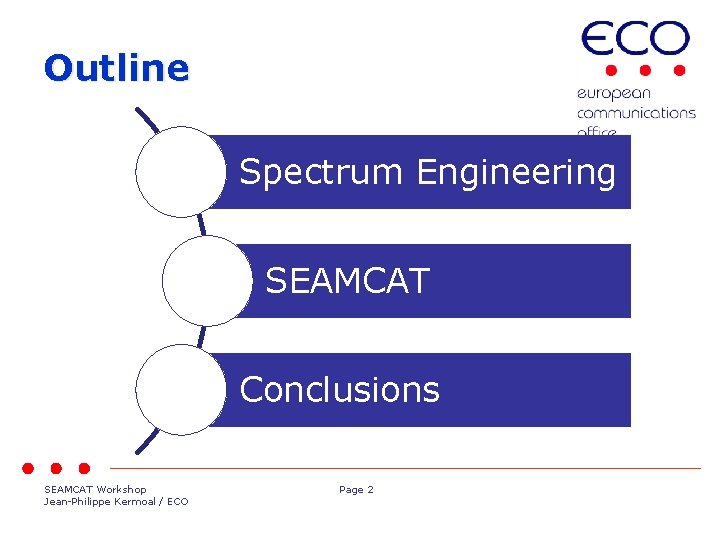
Outline Spectrum Engineering SEAMCAT Conclusions SEAMCAT Workshop Jean-Philippe Kermoal / ECO Page 2
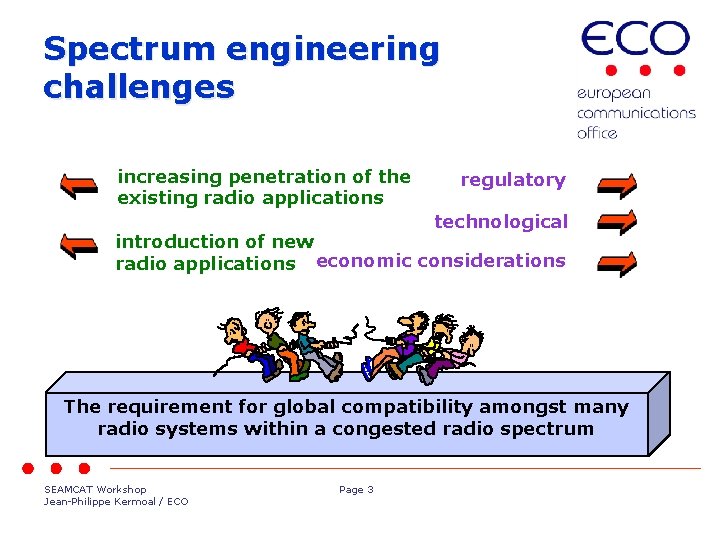
Spectrum engineering challenges increasing penetration of the existing radio applications regulatory technological introduction of new radio applications economic considerations The requirement for global compatibility amongst many radio systems within a congested radio spectrum SEAMCAT Workshop Jean-Philippe Kermoal / ECO Page 3
Need for spectrum sharing • There are no more “empty” spectrum • Proposed new systems have to find way of “sharing” with some of existing systems • Thus the need for spectrum engineering and optimisation: – to find which existing radio systems are easiest to share with, and then – determine the “sharing rules” SEAMCAT Workshop Jean-Philippe Kermoal / ECO Page 4
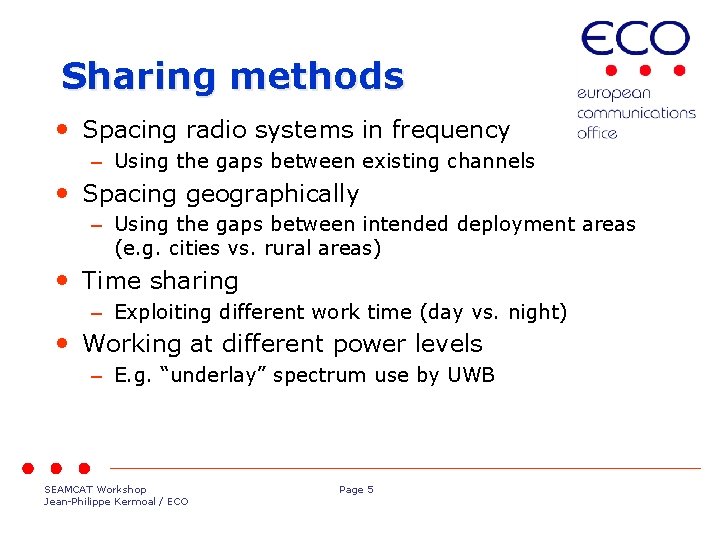
Sharing methods • Spacing radio systems in frequency – Using the gaps between existing channels • Spacing geographically – Using the gaps between intended deployment areas (e. g. cities vs. rural areas) • Time sharing – Exploiting different work time (day vs. night) • Working at different power levels – E. g. “underlay” spectrum use by UWB SEAMCAT Workshop Jean-Philippe Kermoal / ECO Page 5
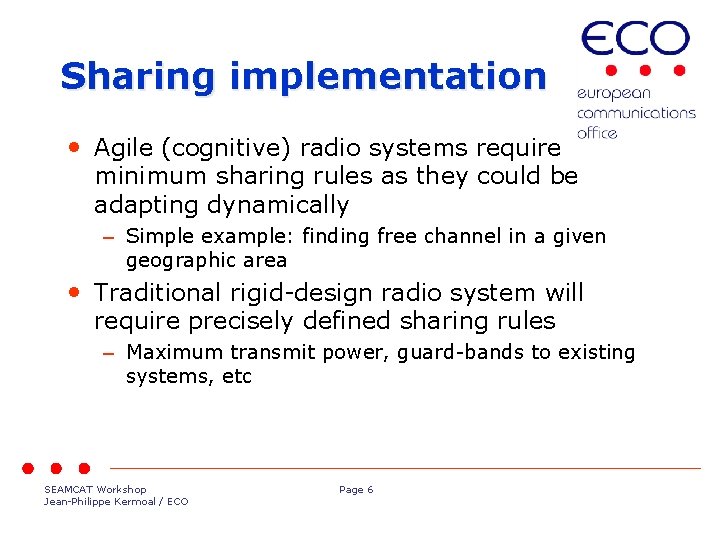
Sharing implementation • Agile (cognitive) radio systems require minimum sharing rules as they could be adapting dynamically – Simple example: finding free channel in a given geographic area • Traditional rigid-design radio system will require precisely defined sharing rules – Maximum transmit power, guard-bands to existing systems, etc SEAMCAT Workshop Jean-Philippe Kermoal / ECO Page 6
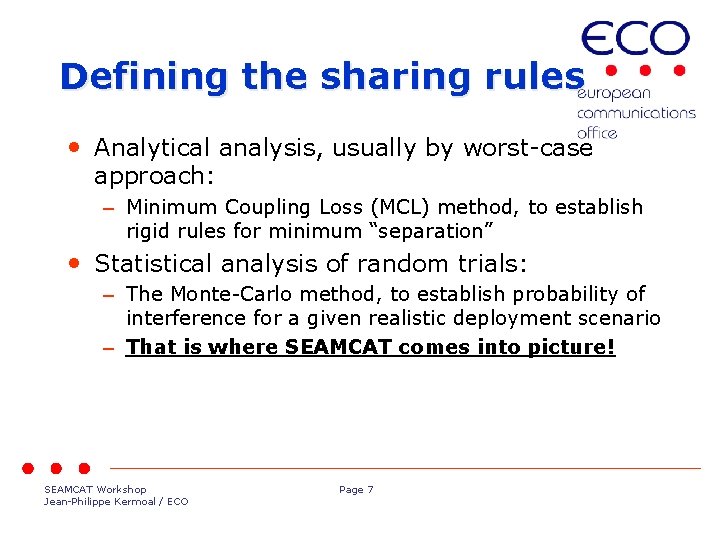
Defining the sharing rules • Analytical analysis, usually by worst-case approach: – Minimum Coupling Loss (MCL) method, to establish rigid rules for minimum “separation” • Statistical analysis of random trials: – The Monte-Carlo method, to establish probability of interference for a given realistic deployment scenario – That is where SEAMCAT comes into picture! SEAMCAT Workshop Jean-Philippe Kermoal / ECO Page 7
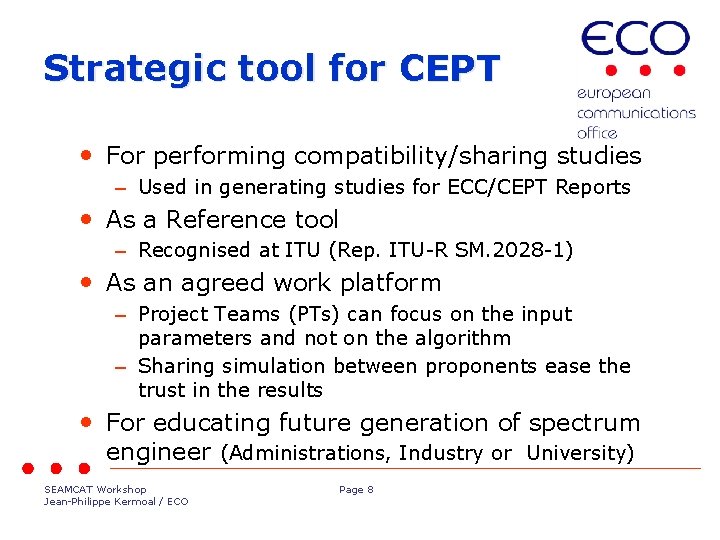
Strategic tool for CEPT • For performing compatibility/sharing studies – Used in generating studies for ECC/CEPT Reports • As a Reference tool – Recognised at ITU (Rep. ITU-R SM. 2028 -1) • As an agreed work platform – Project Teams (PTs) can focus on the input parameters and not on the algorithm – Sharing simulation between proponents ease the trust in the results • For educating future generation of spectrum engineer (Administrations, Industry or University) SEAMCAT Workshop Jean-Philippe Kermoal / ECO Page 8
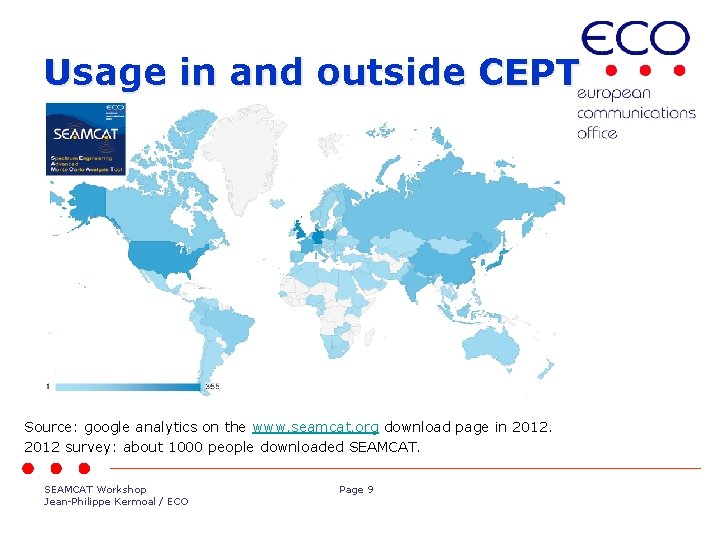
Usage in and outside CEPT Source: google analytics on the www. seamcat. org download page in 2012 survey: about 1000 people downloaded SEAMCAT Workshop Jean-Philippe Kermoal / ECO Page 9
SEAMCAT-4 Software tool SEAMCAT is not a CAT SEAMCAT Workshop Jean-Philippe Kermoal / ECO Page 10
History • Developed in CEPT as a co-operation between National Regulatory Administrations, ECO and industry • First released in Jan-2000, then gradually developed in several phases • Latest version 4. 1. 0 (October 2013) • Freely downloadable from ECO website (www. seamcat. org) SEAMCAT Workshop Jean-Philippe Kermoal / ECO Page 11
Purpose • SEAMCAT is designed for: – Co-existence studies between different radio systems operating in same or adjacent frequency bands – Any type of radio systems in terrestrial scenarios – Extended to cellular system like CDMA and OFDMA – Quantification of probability of interference between various radio systems • Not designed for system planning purposes • Based on Monte-Carlo generation SEAMCAT Workshop Jean-Philippe Kermoal / ECO Page 12
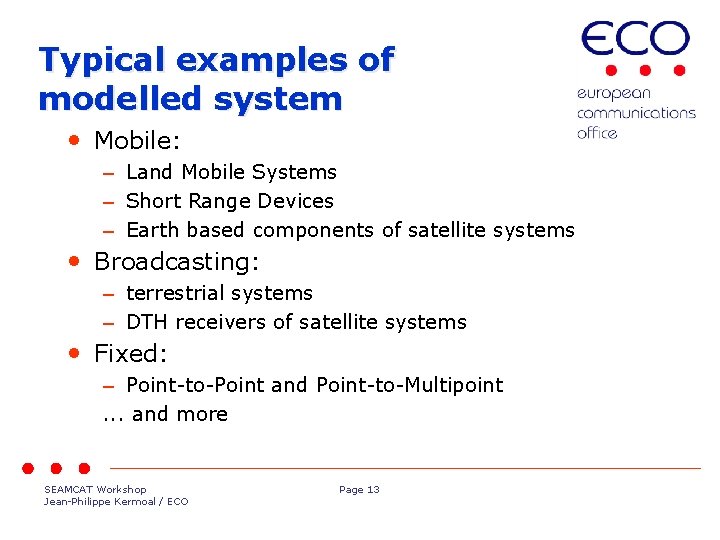
Typical examples of modelled system • Mobile: – Land Mobile Systems – Short Range Devices – Earth based components of satellite systems • Broadcasting: – terrestrial systems – DTH receivers of satellite systems • Fixed: – Point-to-Point and Point-to-Multipoint. . . and more SEAMCAT Workshop Jean-Philippe Kermoal / ECO Page 13
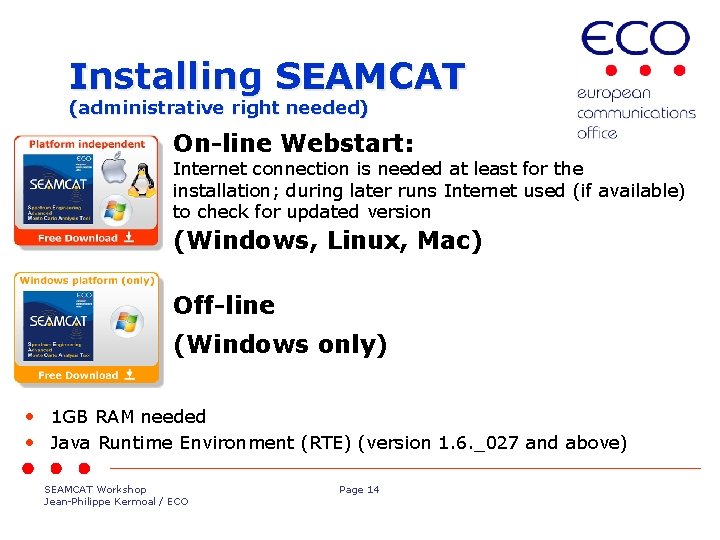
Installing SEAMCAT (administrative right needed) On-line Webstart: Internet connection is needed at least for the installation; during later runs Internet used (if available) to check for updated version (Windows, Linux, Mac) Off-line (Windows only) • 1 GB RAM needed • Java Runtime Environment (RTE) (version 1. 6. _027 and above) SEAMCAT Workshop Jean-Philippe Kermoal / ECO Page 14
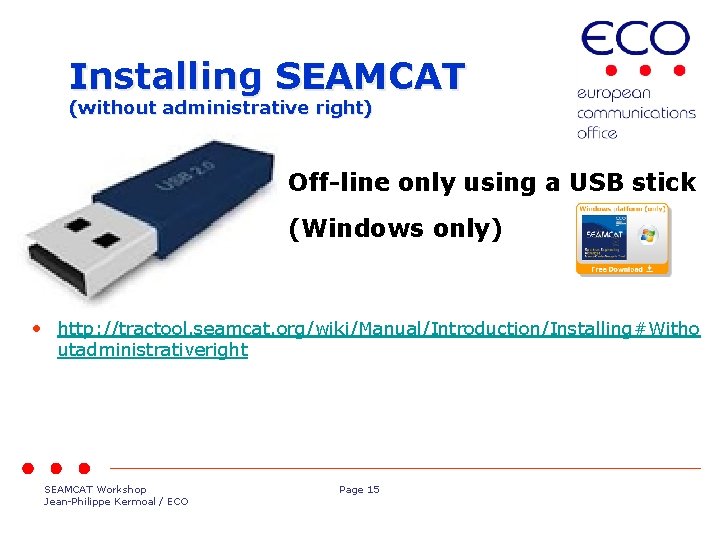
Installing SEAMCAT (without administrative right) Off-line only using a USB stick (Windows only) • http: //tractool. seamcat. org/wiki/Manual/Introduction/Installing#Witho utadministrativeright SEAMCAT Workshop Jean-Philippe Kermoal / ECO Page 15
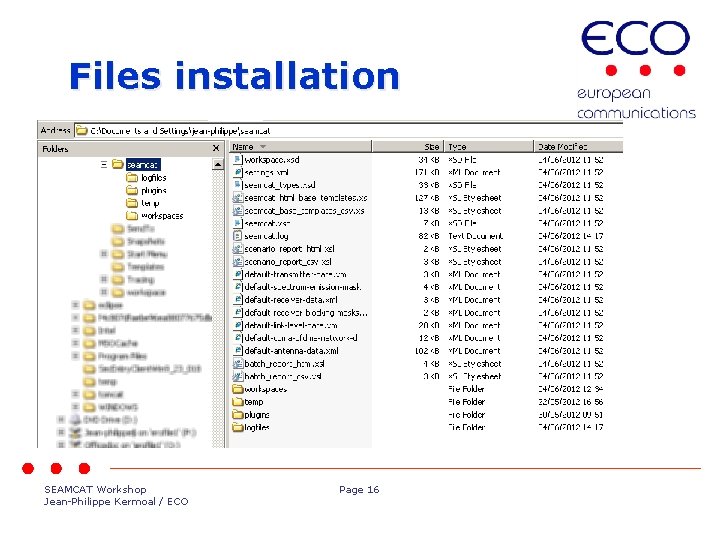
Files installation SEAMCAT Workshop Jean-Philippe Kermoal / ECO Page 16
Conclusions • Sharing rules are important element of spectrum • • • optimisation process Unless some intelligent interference avoidance is implemented in radio systems, the careful choice of sharing conditions is the only means for achieving successful co-existence and optimal spectrum use Statistical tool SEAMCAT is a powerful tool for such analysis Strategic tool for the CEPT Reference tool – recognised at ITU World wide usage Free tool to run on any operating system platform SEAMCAT Workshop Jean-Philippe Kermoal / ECO Page 17
Thank you - Any questions? SEAMCAT Workshop Jean-Philippe Kermoal / ECO Page