
Introduction to Scientific Method Observation and Data AP
Introduction to Scientific Method: Observation and Data AP Biology Ms. Day
• Observation: Observation using your 5 senses to collect information • Data: Data scientific information (evidence) • Inference: Inference a logical conclusion or assumption based on your observations
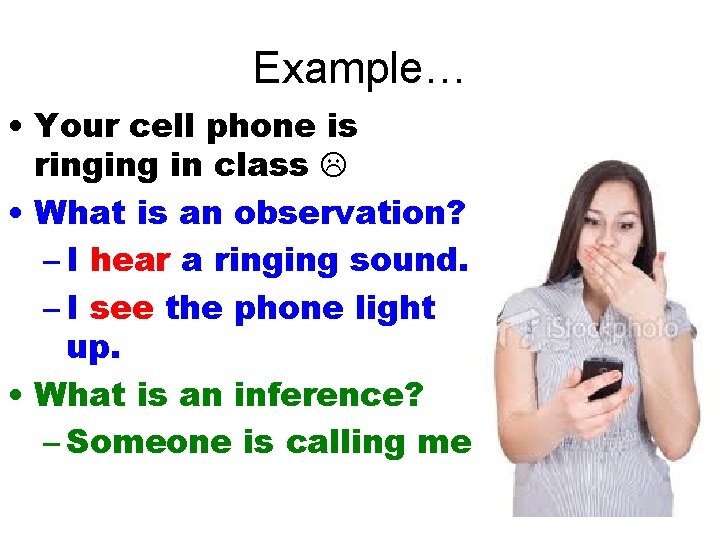
Example… • Your cell phone is ringing in class • What is an observation? – I hear a ringing sound. – I see the phone light up. • What is an inference? – Someone is calling me.
2 TYPES: DATA • Quantitative: includes observations or data that involves numbers (#’s), amounts or quantities • Qualitative: includes observations that DO NOT involve numbers; Observations or data that is descriptive.
Scientific Method
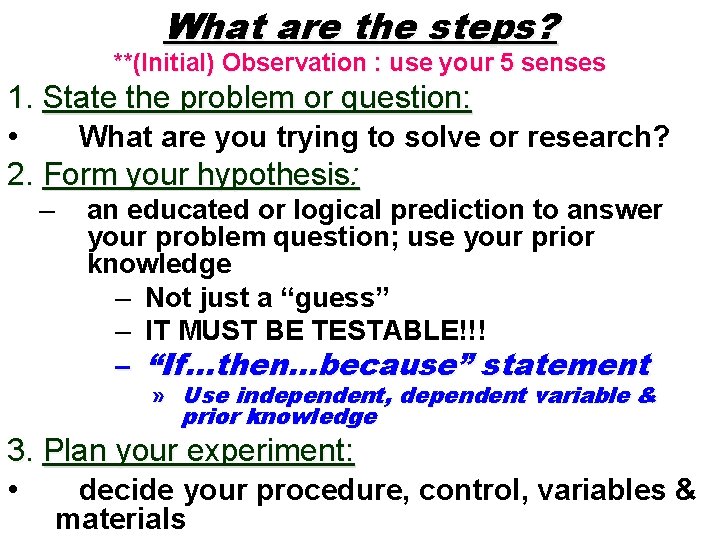
What are the steps? **(Initial) Observation : use your 5 senses 1. State the problem or question: • What are you trying to solve or research? 2. Form your hypothesis: – an educated or logical prediction to answer your problem question; use your prior knowledge – Not just a “guess” – IT MUST BE TESTABLE!!! – “If…then…because” statement » Use independent, dependent variable & prior knowledge 3. Plan your experiment: • decide your procedure, control, variables & materials
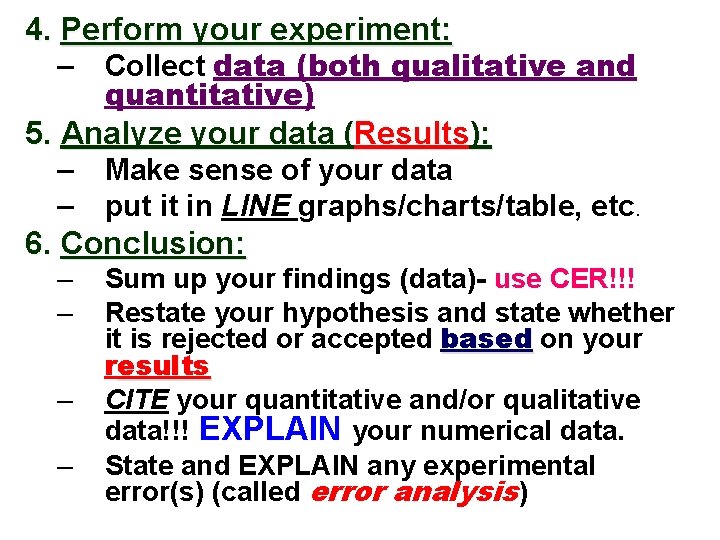
4. Perform your experiment: – Collect data (both qualitative and quantitative) 5. Analyze your data (Results): – Make sense of your data – put it in LINE graphs/charts/table, etc. 6. Conclusion: – – Sum up your findings (data)- use CER!!! Restate your hypothesis and state whether it is rejected or accepted based on your results CITE your quantitative and/or qualitative data!!! EXPLAIN your numerical data. State and EXPLAIN any experimental error(s) (called error analysis)
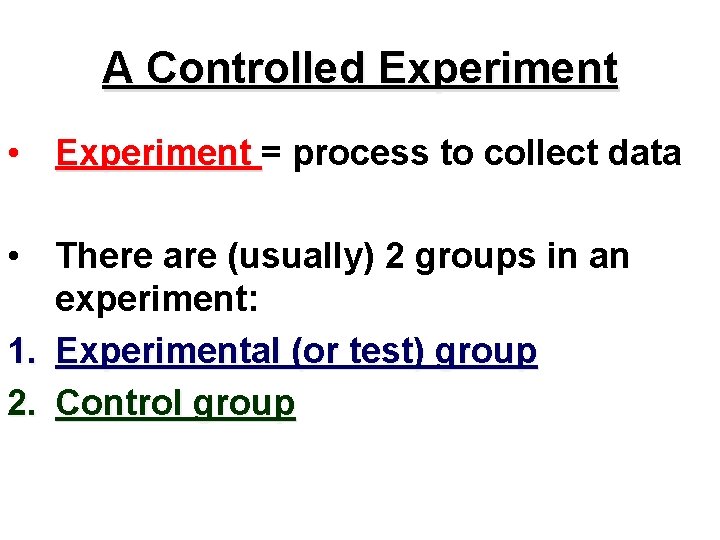
A Controlled Experiment • Experiment = process to collect data • There are (usually) 2 groups in an experiment: 1. Experimental (or test) group 2. Control group
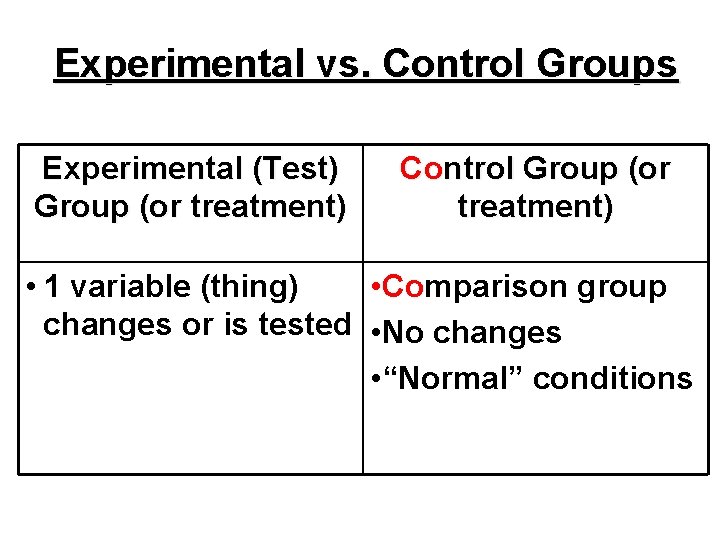
Experimental vs. Control Groups Experimental (Test) Group (or treatment) Control Group (or treatment) • 1 variable (thing) • Comparison group changes or is tested • No changes • “Normal” conditions
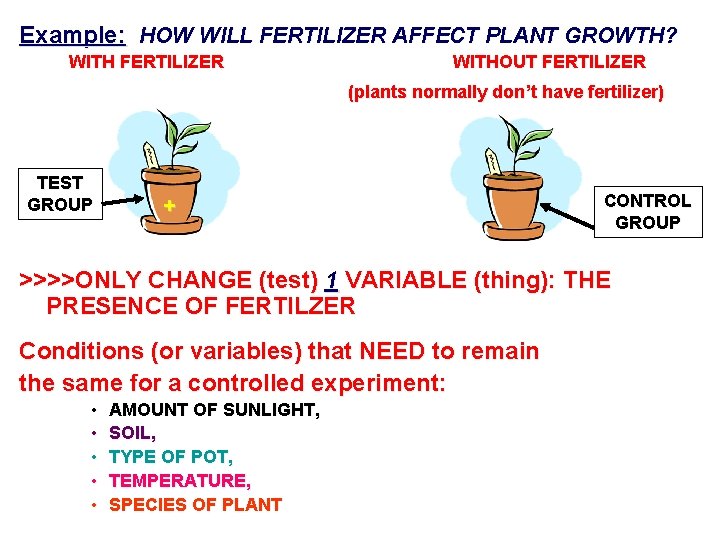
Example: HOW WILL FERTILIZER AFFECT PLANT GROWTH? WITH FERTILIZER WITHOUT FERTILIZER (plants normally don ’t have fertilizer) TEST GROUP ++ CONTROL GROUP >>>>ONLY CHANGE (test) 1 VARIABLE (thing): THE PRESENCE OF FERTILZER Conditions (or variables) that NEED to remain the same for a controlled experiment: • • • AMOUNT OF SUNLIGHT, SOIL, TYPE OF POT, TEMPERATURE, SPECIES OF PLANT
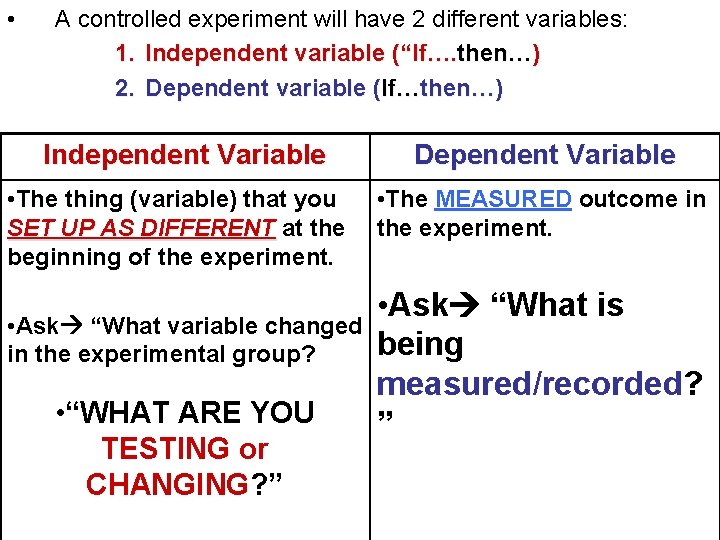
• A controlled experiment will have 2 different variables: 1. Independent variable (“If…. then…) 2. Dependent variable (If…then…) Independent Variable • The thing (variable) that you SET UP AS DIFFERENT at the beginning of the experiment. • Ask “What variable changed in the experimental group? • “WHAT ARE YOU TESTING or CHANGING? ” Dependent Variable • The MEASURED outcome in the experiment. • Ask “What is being measured/recorded? ”
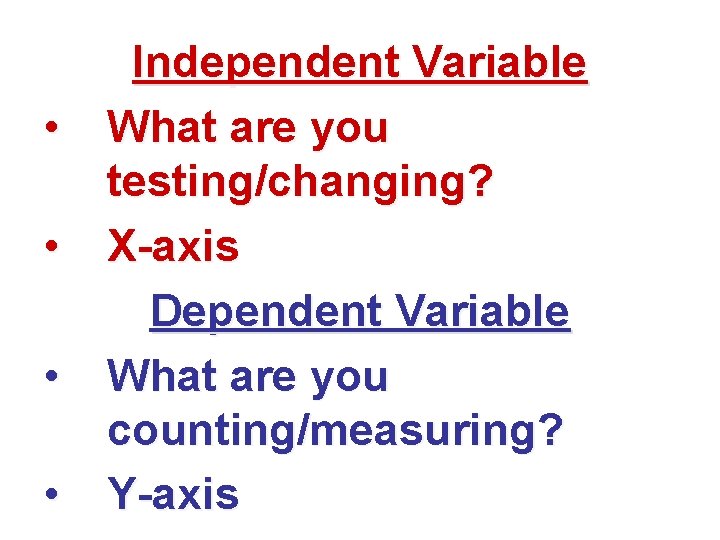
• • Independent Variable What are you testing/changing? X-axis Dependent Variable What are you counting/measuring? Y-axis
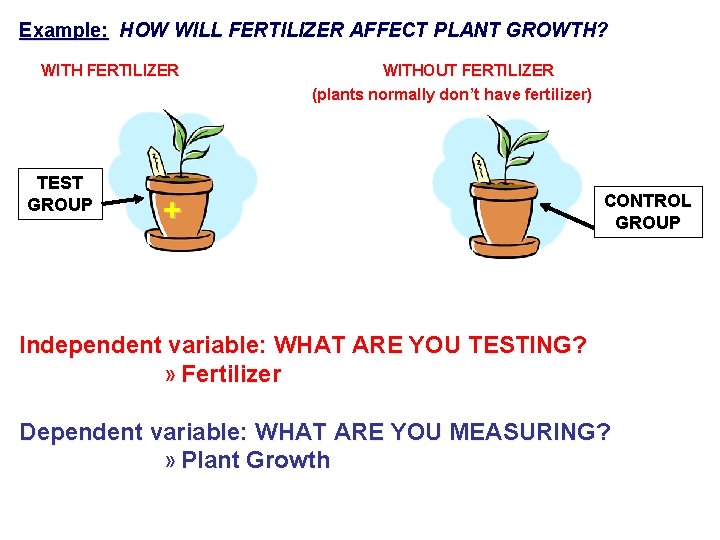
Example: HOW WILL FERTILIZER AFFECT PLANT GROWTH? WITH FERTILIZER TEST GROUP WITHOUT FERTILIZER (plants normally don ’t have fertilizer) ++ CONTROL GROUP Independent variable: WHAT ARE YOU TESTING? » Fertilizer Dependent variable: WHAT ARE YOU MEASURING? » Plant Growth
• • Standard (constant or controlled) Variables Things that are kept EQUAL in all treatments (groups) Aka-control variables or constants • **NOTE: Different than CONTROL GROUP
Theory vs. Models • Scientists test hypotheses MANY times in different ways! (i. e. - w/ new research tools, equipment, etc) • Many “types” of knowing…science-based knowledge based on careful, repeated observations/testable hypotheses. • THEORY = a well-tested explanation that is supported by A LOT of evidence (data) – Much broader than a hypothesis • MODEL = physical, mental or mathematical representations of how people understand a process or idea
Additional Information… • Essential to ALL experiments is: 1)Replication!!! • You NEED to consider your number of trials – Use the EXACT same conditions in EACH trial – Why? • To determine if the results are consistent this INCREASES our confidence in the resulting data • BUT… – A certain amount of variation is NORMAL! – Increasing trial # allows us to obtain an AVERAGE RESULT from different trials.
Additional Information… • Essential to ALL experiments is: 2) Sample size – You NEED to consider your sample size when drawing conclusions – For example… – You are working with plants and decide to plant 2 control plants and 2 test plants. – 1 test plant and 2 control plants die during the experiment – WHAT HAPPENS NOW?
Additional Information… • Essential to ALL experiments is: 3) Clear procedure – Do NOT use pronouns! – Use “directional” language • Example: – Place ______ in _____. – Fill 20 ml of water in a 50 ml graduated cylinder – Someone MUST be able to REPEAT your procedure over and over to produce similar results!!
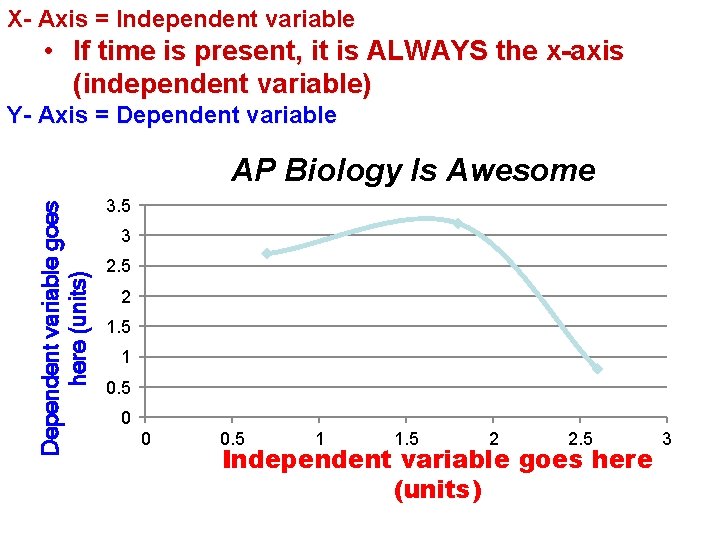
X- Axis = Independent variable • If time is present, it is ALWAYS the x-axis (independent variable) Y- Axis = Dependent variable goes here (units) AP Biology Is Awesome 3. 5 3 2. 5 2 1. 5 1 0. 5 0 0 0. 5 1 1. 5 2 2. 5 Independent variable goes here (units) 3
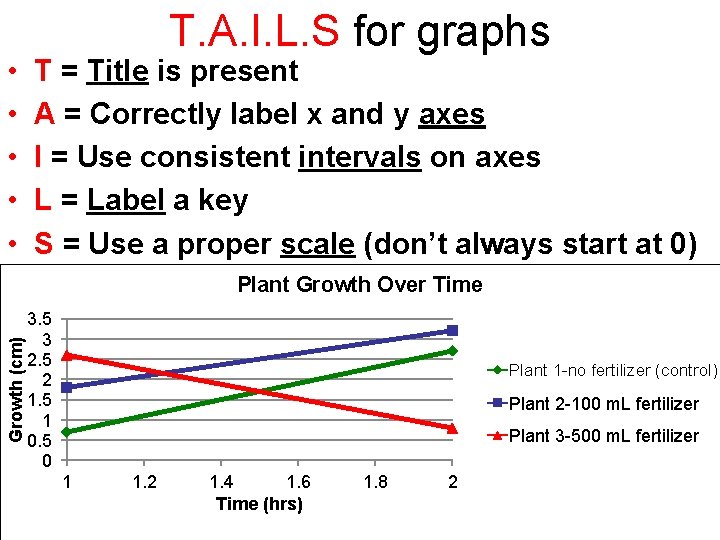
• • • T. A. I. L. S for graphs T = Title is present A = Correctly label x and y axes I = Use consistent intervals on axes L = Label a key S = Use a proper scale (don’t always start at 0) Growth (cm) Plant Growth Over Time 3. 5 3 2. 5 2 1. 5 1 0. 5 0 Plant 1 -no fertilizer (control) Plant 2 -100 m. L fertilizer Plant 3 -500 m. L fertilizer 1 1. 2 1. 4 1. 6 Time (hrs) 1. 8 2
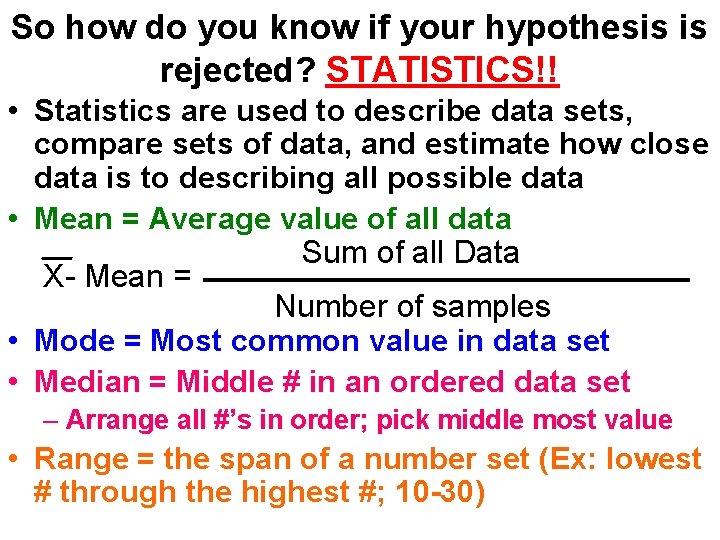
So how do you know if your hypothesis is rejected? STATISTICS!! • Statistics are used to describe data sets, compare sets of data, and estimate how close data is to describing all possible data • Mean = Average value of all data Sum of all Data X- Mean = Number of samples • Mode = Most common value in data set • Median = Middle # in an ordered data set – Arrange all #’s in order; pick middle most value • Range = the span of a number set (Ex: lowest # through the highest #; 10 -30)
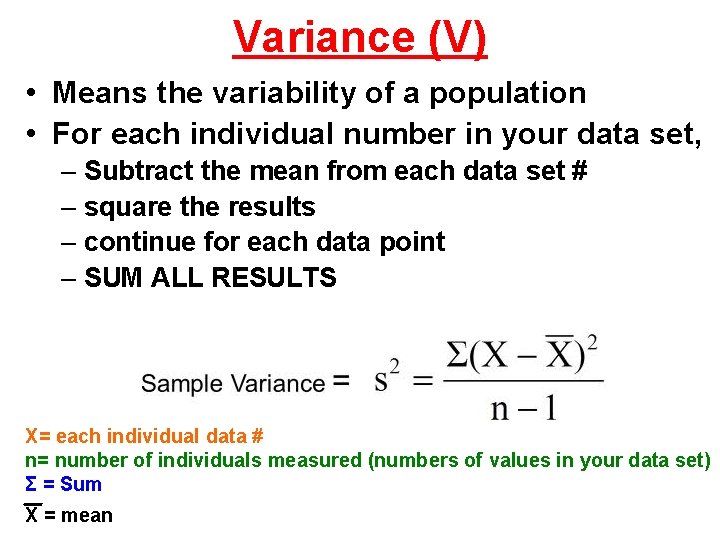
Variance (V) • Means the variability of a population • For each individual number in your data set, – Subtract the mean from each data set # – square the results – continue for each data point – SUM ALL RESULTS X= each individual data # n= number of individuals measured (numbers of values in your data set) Σ = Sum X = mean
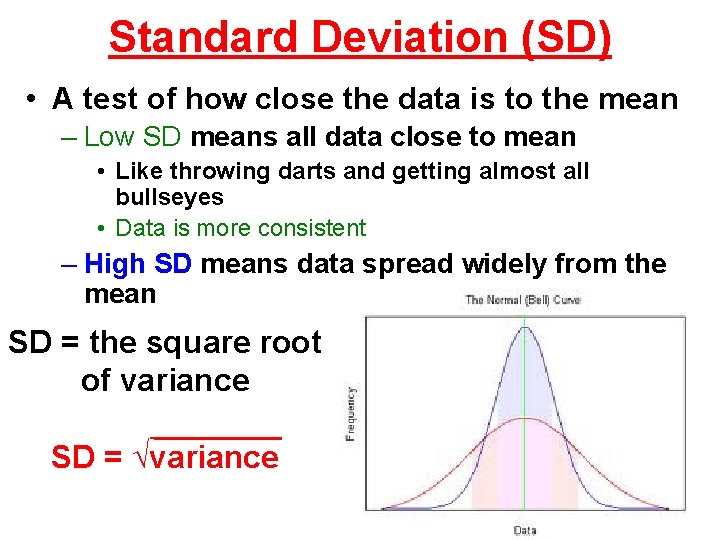
Standard Deviation (SD) • A test of how close the data is to the mean – Low SD means all data close to mean • Like throwing darts and getting almost all bullseyes • Data is more consistent – High SD means data spread widely from the mean SD = the square root of variance SD = √variance
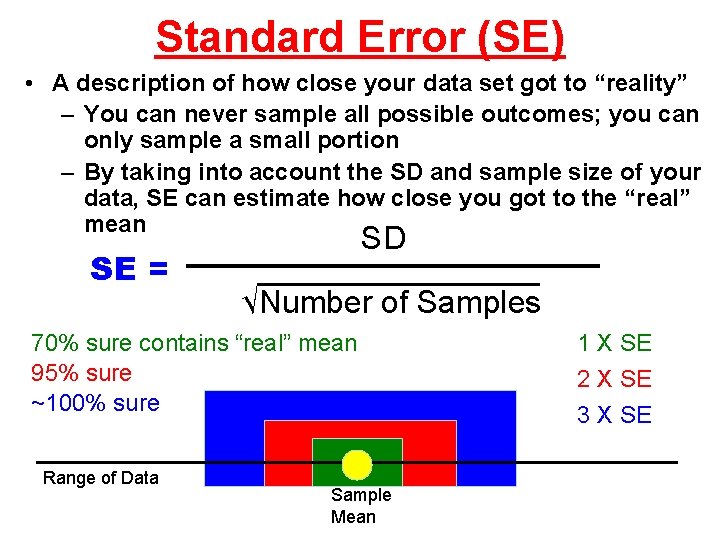
Standard Error (SE) • A description of how close your data set got to “reality” – You can never sample all possible outcomes; you can only sample a small portion – By taking into account the SD and sample size of your data, SE can estimate how close you got to the “real” mean SE = SD √Number of Samples 70% sure contains “real” mean 95% sure ~100% sure Range of Data Sample Mean 1 X SE 2 X SE 3 X SE
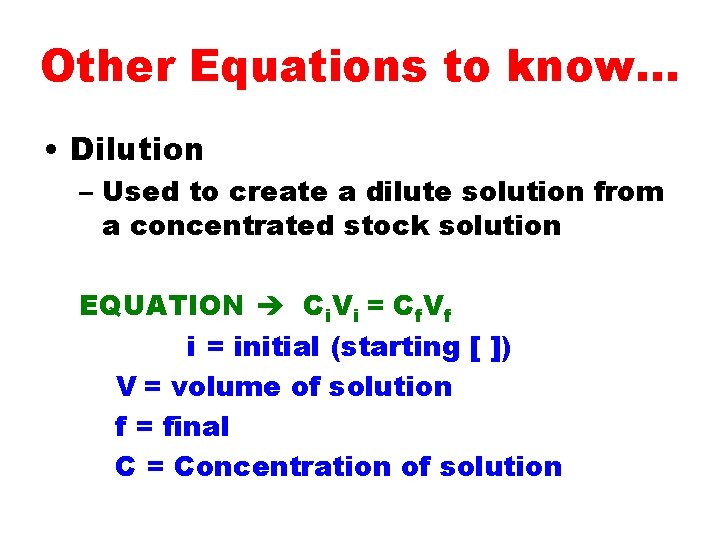
Other Equations to know. . . • Dilution – Used to create a dilute solution from a concentrated stock solution EQUATION Ci. Vi = Cf. Vf i = initial (starting [ ]) V = volume of solution f = final C = Concentration of solution
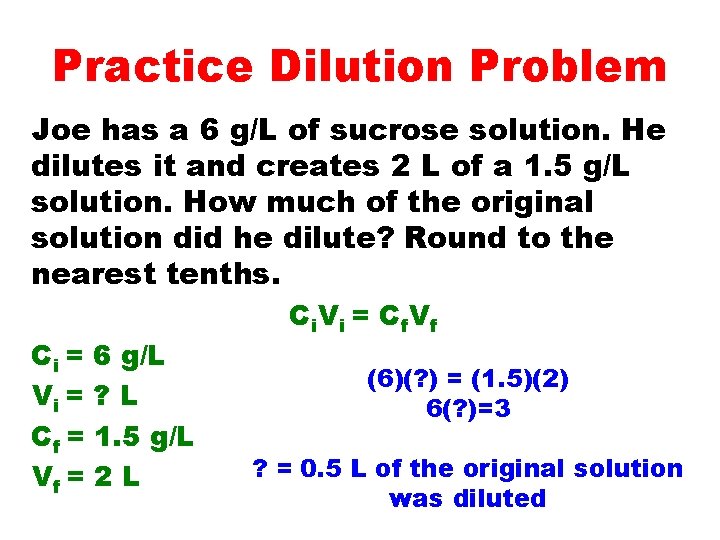
Practice Dilution Problem Joe has a 6 g/L of sucrose solution. He dilutes it and creates 2 L of a 1. 5 g/L solution. How much of the original solution did he dilute? Round to the nearest tenths. Ci = 6 g/L Vi = ? L Cf = 1. 5 g/L Vf = 2 L C i. V i = C f V f (6)(? ) = (1. 5)(2) 6(? )=3 ? = 0. 5 L of the original solution was diluted
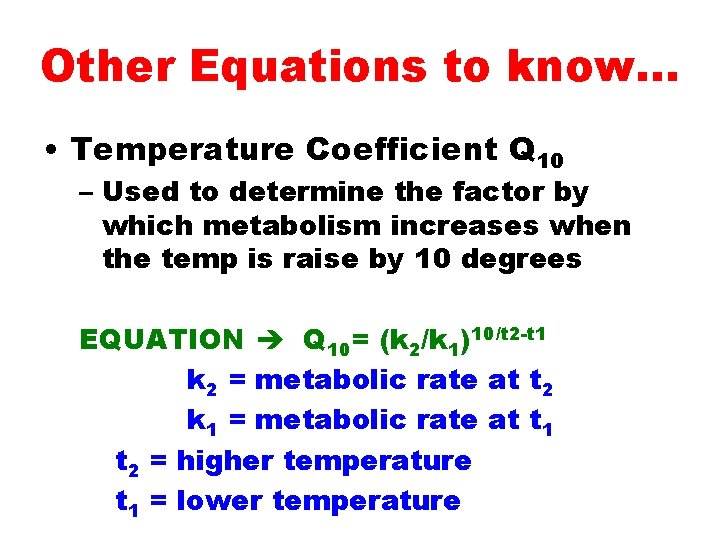
Other Equations to know. . . • Temperature Coefficient Q 10 – Used to determine the factor by which metabolism increases when the temp is raise by 10 degrees EQUATION Q 10= (k 2/k 1)10/t 2 -t 1 k 2 = metabolic rate at t 2 k 1 = metabolic rate at t 1 t 2 = higher temperature t 1 = lower temperature
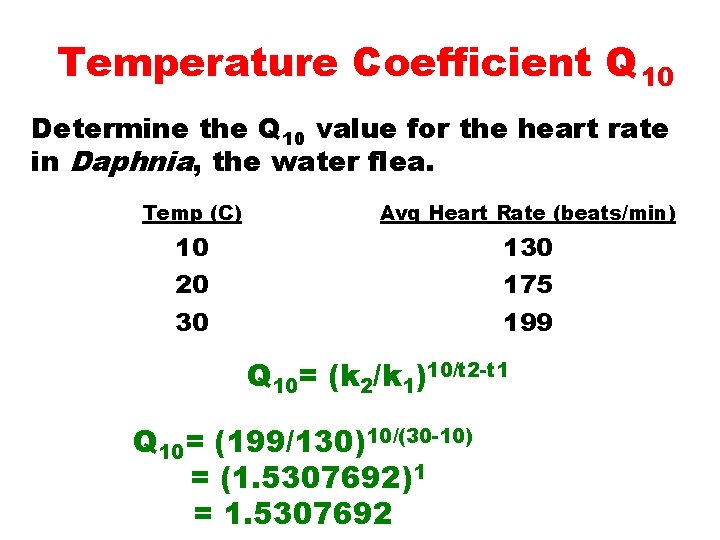
Temperature Coefficient Q 10 Determine the Q 10 value for the heart rate in Daphnia, the water flea. Temp (C) Avg Heart Rate (beats/min) 10 20 30 175 199 Q 10= (k 2/k 1)10/t 2 -t 1 Q 10= (199/130)10/(30 -10) = (1. 5307692)1 = 1. 5307692
- Slides: 28