
INTRODUCTION TO SCIENCE AND THE SCIENTIFIC METHOD Amy
- Slides: 42
INTRODUCTION TO SCIENCE AND THE SCIENTIFIC METHOD © Amy Brown – Science Stuff Page 1
What is Science? • Science is observing, studying, and experimenting to find the nature of things. • An organized way of using evidence to learn about the natural world. Page 2
Goals of Science 1. Investigate and understand the natural world around us. 2. Explain events in the natural world; look for patterns and connect them. 3. Use those explanations to make useful predictions. Page 3
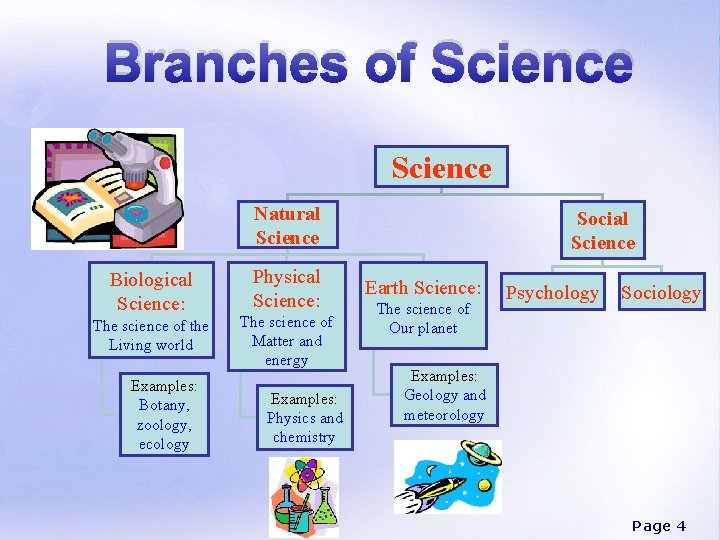
Branches of Science Natural Science Biological Science: The science of the Living world Examples: Botany, zoology, ecology Physical Science: The science of Matter and energy Examples: Physics and chemistry Social Science Earth Science: The science of Our planet Psychology Sociology Examples: Geology and meteorology Page 4
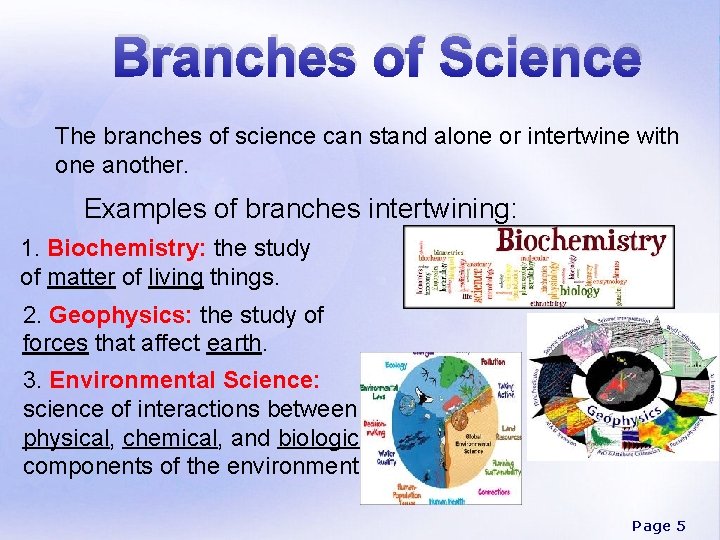
Branches of Science The branches of science can stand alone or intertwine with one another. Examples of branches intertwining: 1. Biochemistry: the study of matter of living things. 2. Geophysics: the study of forces that affect earth. 3. Environmental Science: science of interactions between physical, chemical, and biological components of the environment. Page 5
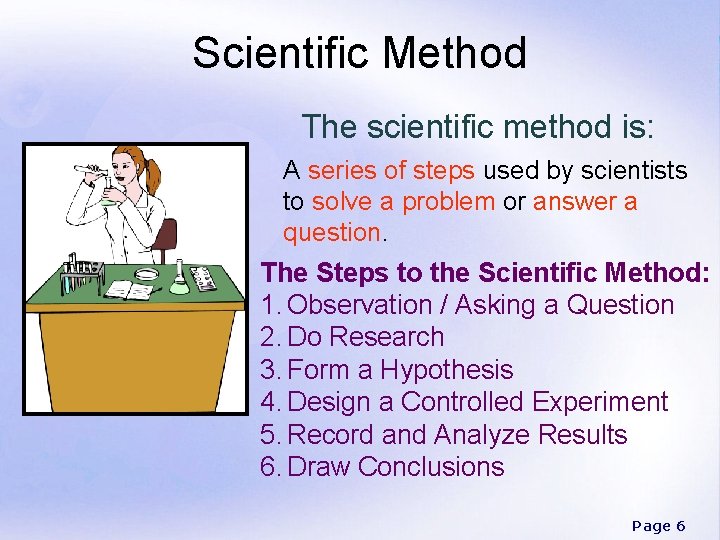
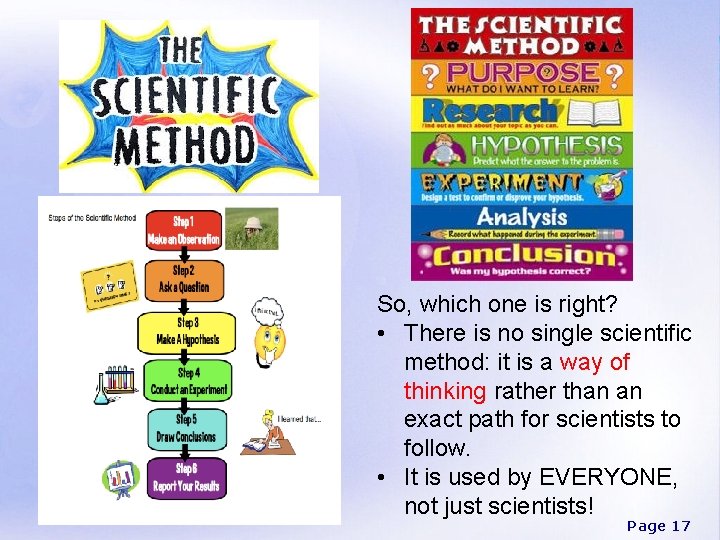
Scientific Method The scientific method is: A series of steps used by scientists to solve a problem or answer a question. The Steps to the Scientific Method: 1. Observation / Asking a Question 2. Do Research 3. Form a Hypothesis 4. Design a Controlled Experiment 5. Record and Analyze Results 6. Draw Conclusions Page 6
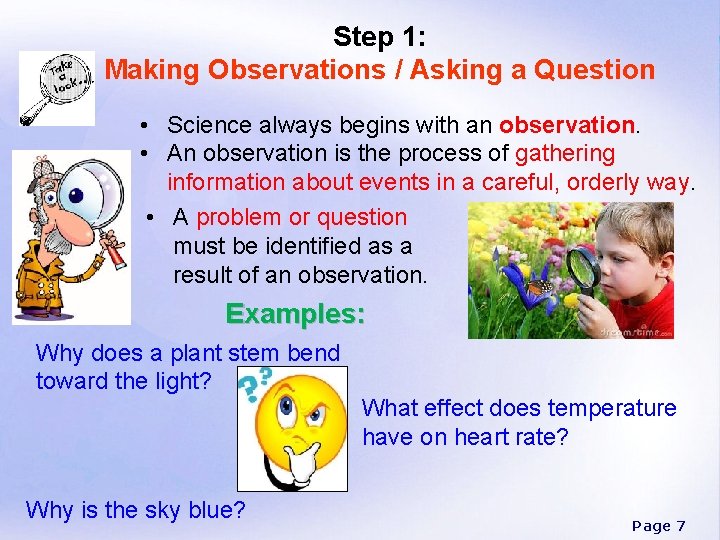
Step 1: Making Observations / Asking a Question • Science always begins with an observation. • An observation is the process of gathering information about events in a careful, orderly way. • A problem or question must be identified as a result of an observation. Examples: Why does a plant stem bend toward the light? Why is the sky blue? What effect does temperature have on heart rate? Page 7
Step 2: Do Research Page 8
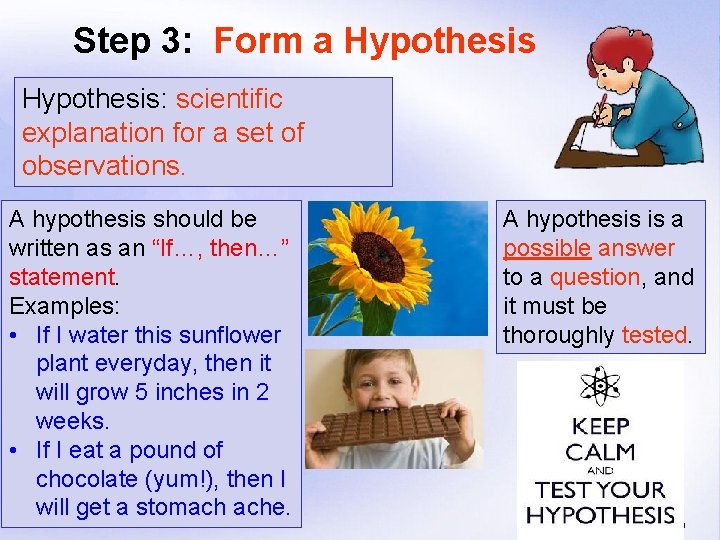
Step 3: Form a Hypothesis: scientific explanation for a set of observations. A hypothesis should be written as an “If…, then…” statement. Examples: • If I water this sunflower plant everyday, then it will grow 5 inches in 2 weeks. • If I eat a pound of chocolate (yum!), then I will get a stomach ache. A hypothesis is a possible answer to a question, and it must be thoroughly tested. Page 9
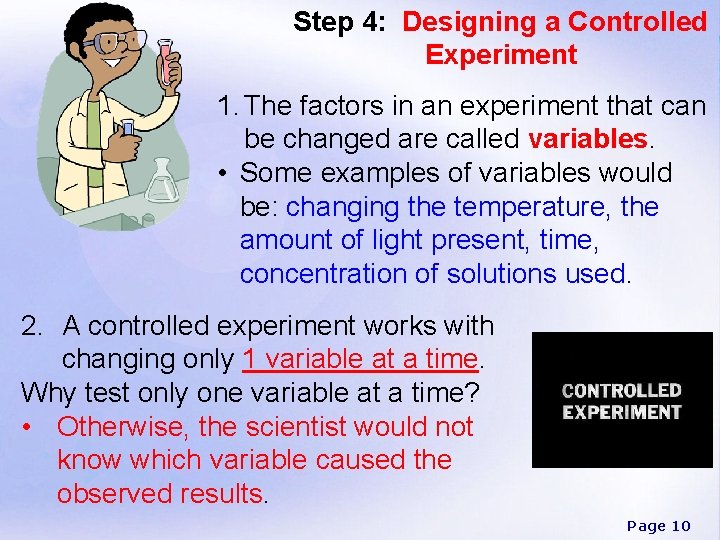
Step 4: Designing a Controlled Experiment 1. The factors in an experiment that can be changed are called variables. • Some examples of variables would be: changing the temperature, the amount of light present, time, concentration of solutions used. 2. A controlled experiment works with changing only 1 variable at a time. Why test only one variable at a time? • Otherwise, the scientist would not know which variable caused the observed results. Page 10
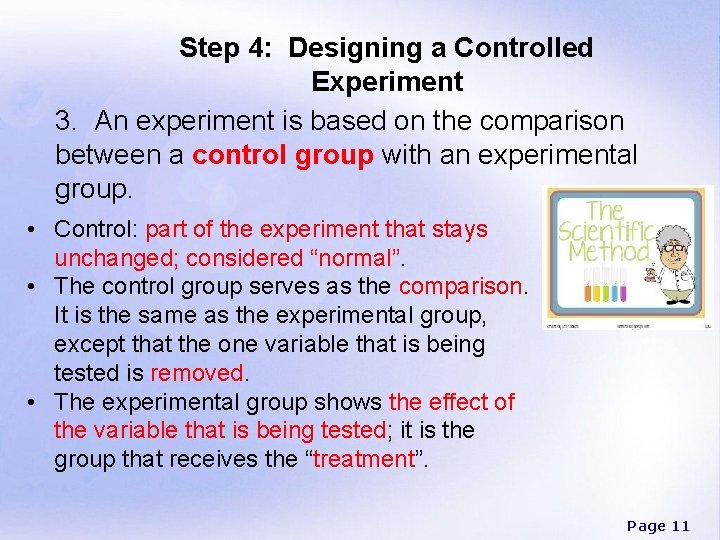
Step 4: Designing a Controlled Experiment 3. An experiment is based on the comparison between a control group with an experimental group. • Control: part of the experiment that stays unchanged; considered “normal”. • The control group serves as the comparison. It is the same as the experimental group, except that the one variable that is being tested is removed. • The experimental group shows the effect of the variable that is being tested; it is the group that receives the “treatment”. Page 11
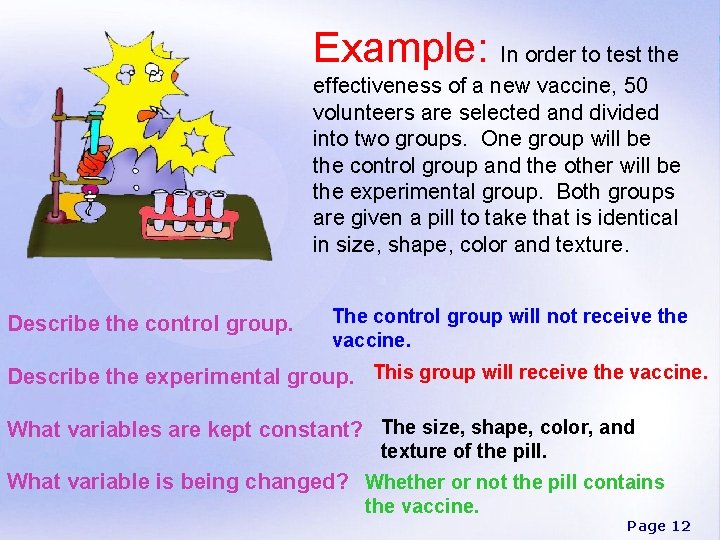
Example: In order to test the effectiveness of a new vaccine, 50 volunteers are selected and divided into two groups. One group will be the control group and the other will be the experimental group. Both groups are given a pill to take that is identical in size, shape, color and texture. Describe the control group. The control group will not receive the vaccine. Describe the experimental group. This group will receive the vaccine. What variables are kept constant? The size, shape, color, and texture of the pill. What variable is being changed? Whether or not the pill contains the vaccine. Page 12
There are two variables in an experiment: • In the above example, what is the independent variable? It is the addition of the vaccine to the pills that were given to the volunteers. • In the above example, what is b) The dependent variable is the dependent the one observed during the variable? experiment. The dependent variable changes because The observed of the independent variable. health of the people receiving the pills. a) The independent variable is the variable that is deliberately changed or manipulated by the scientist to see what happens. Page 13
Step 5: Recording and Analyzing Results • The data that has been collected must be organized (into a chart or graph) and analyzed to determine whether the data are reliable. • Ask: Does the data support or not support the hypothesis? Page 14
There are two types of data: Quantitative data are: numbers and are obtained by counting or measuring. Qualitative data are: descriptions and involve characteristics that cannot be counted. Page 15
Step 6: Drawing Conclusions The evidence from the experiment is used to determine if the hypothesis is proven or disproven. Experiments must be repeated over and over. When repeated, the results should always be the same before a valid conclusion can be reached. Page 16
So, which one is right? • There is no single scientific method: it is a way of thinking rather than an exact path for scientists to follow. • It is used by EVERYONE, not just scientists! Page 17
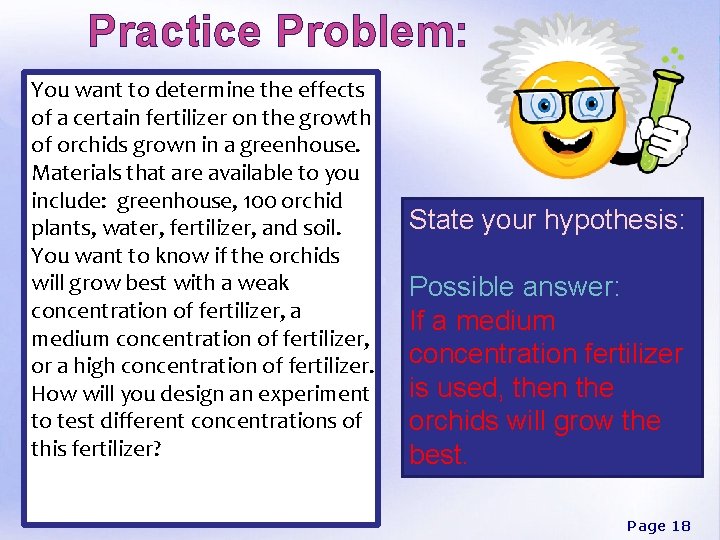
Practice Problem: You want to determine the effects of a certain fertilizer on the growth of orchids grown in a greenhouse. Materials that are available to you include: greenhouse, 100 orchid plants, water, fertilizer, and soil. You want to know if the orchids will grow best with a weak concentration of fertilizer, a medium concentration of fertilizer, or a high concentration of fertilizer. How will you design an experiment to test different concentrations of this fertilizer? State your hypothesis: Possible answer: If a medium concentration fertilizer is used, then the orchids will grow the best. Page 18
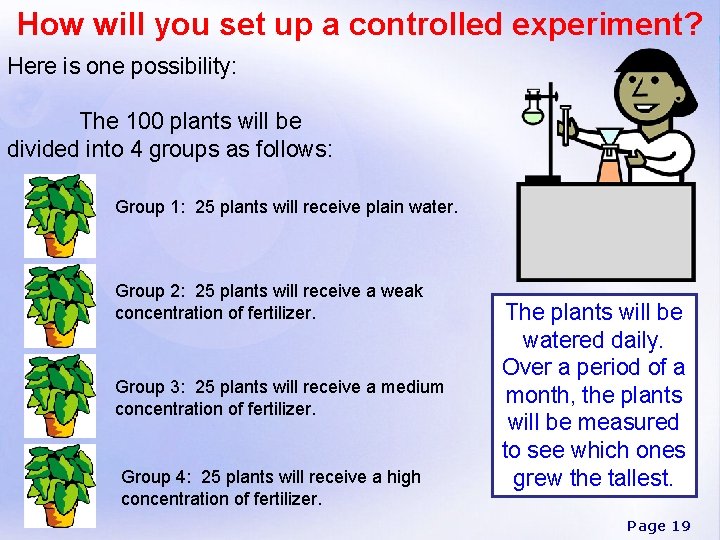
How will you set up a controlled experiment? Here is one possibility: The 100 plants will be divided into 4 groups as follows: Group 1: 25 plants will receive plain water. Group 2: 25 plants will receive a weak concentration of fertilizer. Group 3: 25 plants will receive a medium concentration of fertilizer. Group 4: 25 plants will receive a high concentration of fertilizer. The plants will be watered daily. Over a period of a month, the plants will be measured to see which ones grew the tallest. Page 19
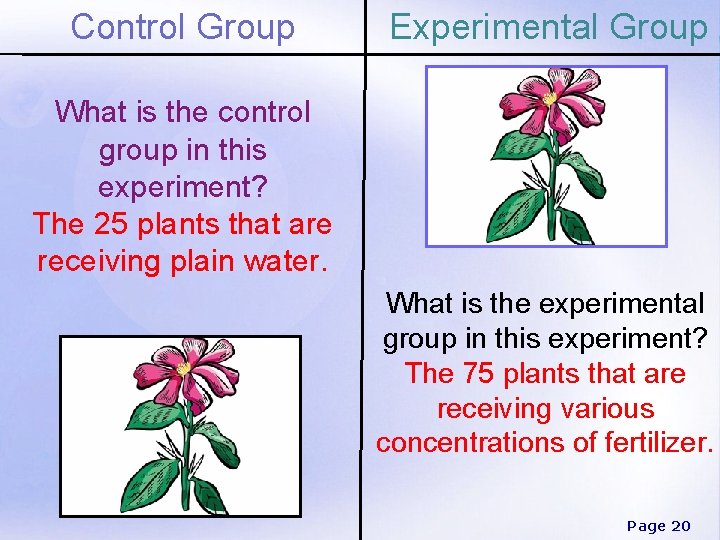
Control Group Experimental Group What is the control group in this experiment? The 25 plants that are receiving plain water. What is the experimental group in this experiment? The 75 plants that are receiving various concentrations of fertilizer. Page 20
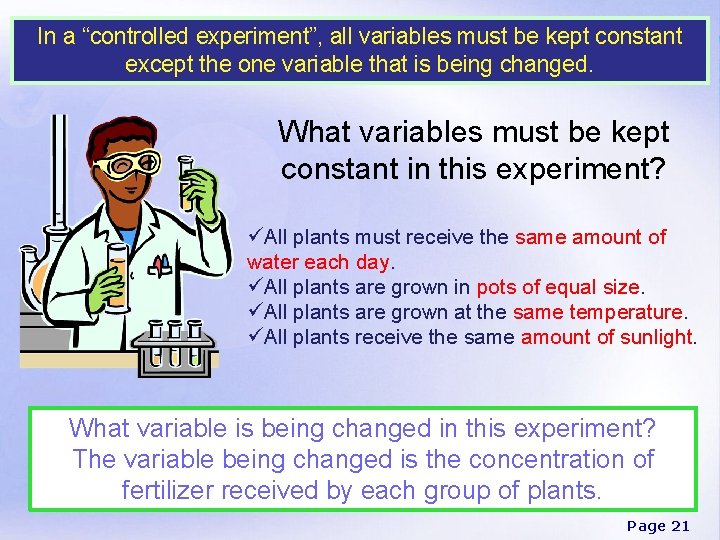
In a “controlled experiment”, all variables must be kept constant except the one variable that is being changed. What variables must be kept constant in this experiment? üAll plants must receive the same amount of water each day. üAll plants are grown in pots of equal size. üAll plants are grown at the same temperature. üAll plants receive the same amount of sunlight. What variable is being changed in this experiment? The variable being changed is the concentration of fertilizer received by each group of plants. Page 21
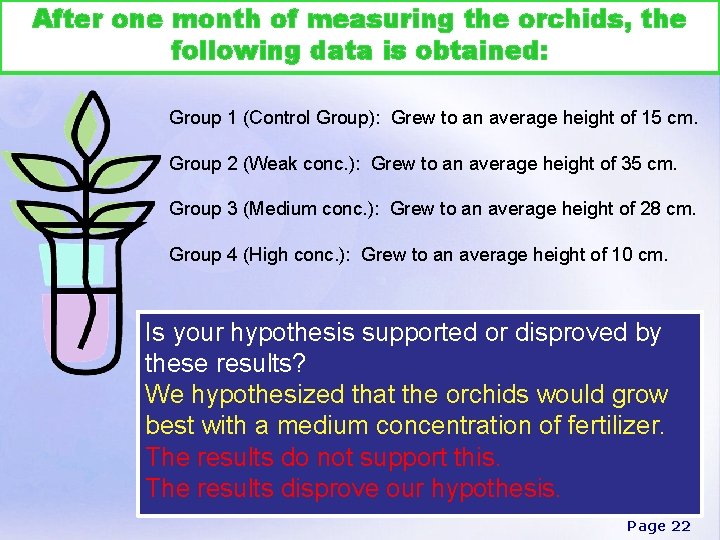
After one month of measuring the orchids, the following data is obtained: Group 1 (Control Group): Grew to an average height of 15 cm. Group 2 (Weak conc. ): Grew to an average height of 35 cm. Group 3 (Medium conc. ): Grew to an average height of 28 cm. Group 4 (High conc. ): Grew to an average height of 10 cm. Is your hypothesis supported or disproved by these results? We hypothesized that the orchids would grow best with a medium concentration of fertilizer. The results do not support this. The results disprove our hypothesis. Page 22
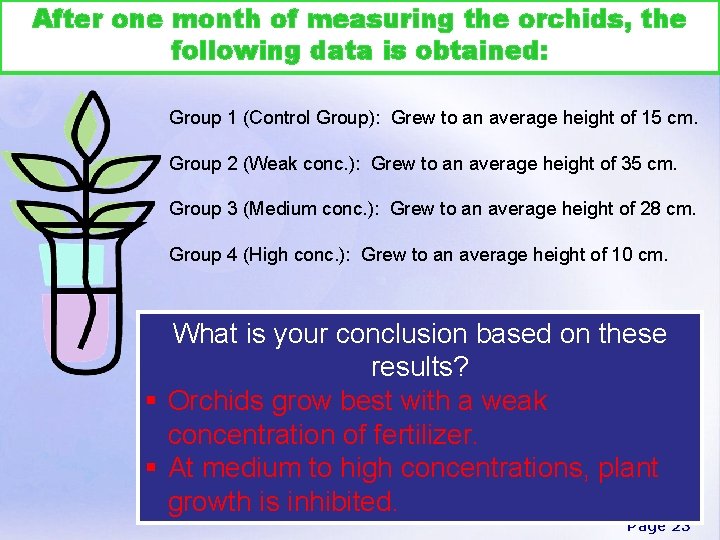
After one month of measuring the orchids, the following data is obtained: Group 1 (Control Group): Grew to an average height of 15 cm. Group 2 (Weak conc. ): Grew to an average height of 35 cm. Group 3 (Medium conc. ): Grew to an average height of 28 cm. Group 4 (High conc. ): Grew to an average height of 10 cm. What is your conclusion based on these results? § Orchids grow best with a weak concentration of fertilizer. § At medium to high concentrations, plant growth is inhibited. Page 23
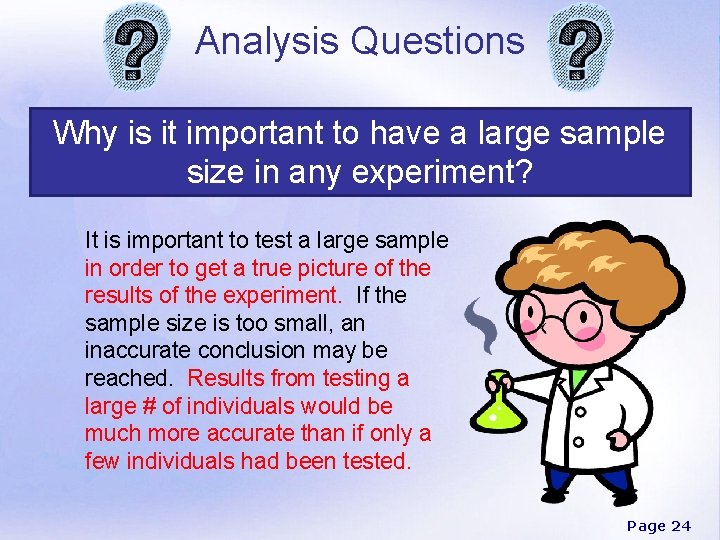
Analysis Questions Why is it important to have a large sample size in any experiment? It is important to test a large sample in order to get a true picture of the results of the experiment. If the sample size is too small, an inaccurate conclusion may be reached. Results from testing a large # of individuals would be much more accurate than if only a few individuals had been tested. Page 24
Analysis Questions Why is it important to repeat the experiment many times? To see if the same results are obtained each time; this gives validity to the test results. Page 25
Analysis Questions What is the importance of the control? The control shows what will happen when the experimental factor is omitted (left out). Without the control, there would be no basis for comparison and you would not know how the experimental factor affected the results. Page 26
Analysis Questions Why is it so important that a scientist accurately describes the procedure used in the experiment? It allows other scientists to repeat the experiment and verify the results. Page 27
Analysis Questions What is the difference between the independent and the dependent variables in an experiment? Independent Variable is the variable that is deliberately changed by the scientist. The dependent variable is the one observed during the experiment. The dependent variable is the data we collect during the experiment. Page 28
Analysis Questions In a “controlled experiment”, why must all of the variables, except one, be kept constant throughout the experiment? If several variables were changed at the same time, the scientist would not know which variable was responsible for the observed results. Page 29
Scientific Theories In everyday language, “theory” might mean a hunch or a guess. For scientists, “theory” refers to a well-supported explanation. • Theory: Explains observations and is supported by considerable scientific evidence. Example: The Kinetic Theory states WHY a saw blade gets hot when it is used. Page 30
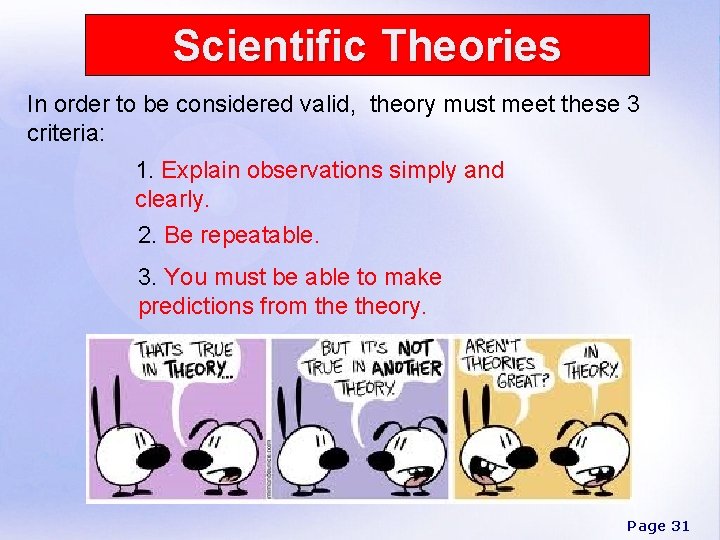
Scientific Theories In order to be considered valid, theory must meet these 3 criteria: 1. Explain observations simply and clearly. 2. Be repeatable. 3. You must be able to make predictions from theory. Page 31
S n e ci w a L c i f ti Scientific Law: a repeated observation about nature • Does not explain why or how something happens. Scientific theories and laws are NOT absolute; they may change as new discoveries are made. Example: People thought the world was flat for thousands of years. Page 32
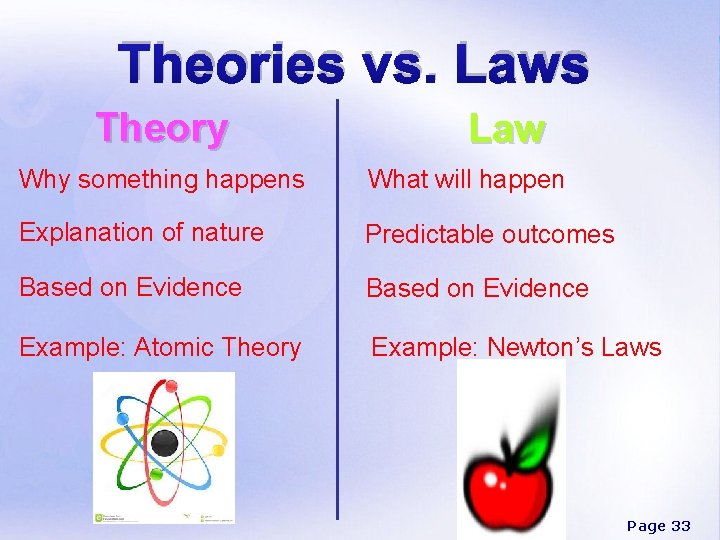
Theories vs. Laws Theory Law Why something happens What will happen Explanation of nature Predictable outcomes Based on Evidence Example: Atomic Theory Example: Newton’s Laws Page 33
Analysis Questions How is a theory different than a hypothesis? A hypothesis is an “educated guess” that is testable through observations and experimentation. A theory is a broad statement of what is believed to be true based on many experiments and considerable amounts of data. Page 34
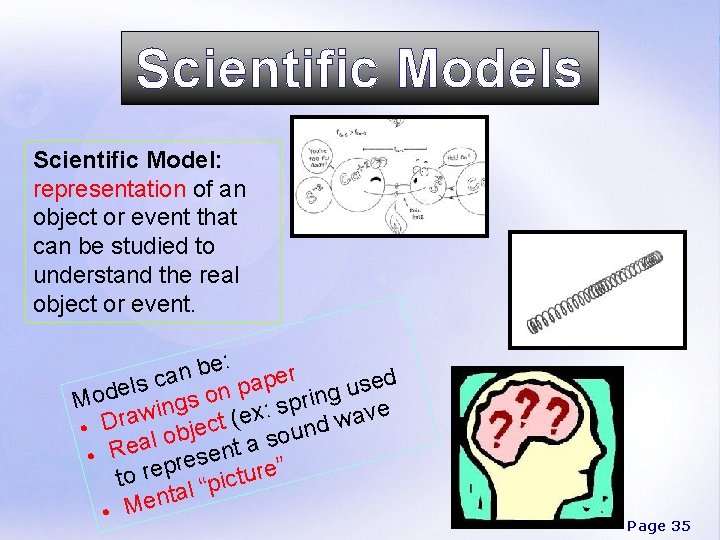
Scientific Models Scientific Model: representation of an object or event that can be studied to understand the real object or event. : e b n r a e d c p e a s s l p u e on ng i r s Mod p g s n ve a awi ect (ex: r w D • nd j u b o o s l a e ta R n e • s re ” p e e r r u t to pic “ l a t n e M • Page 35
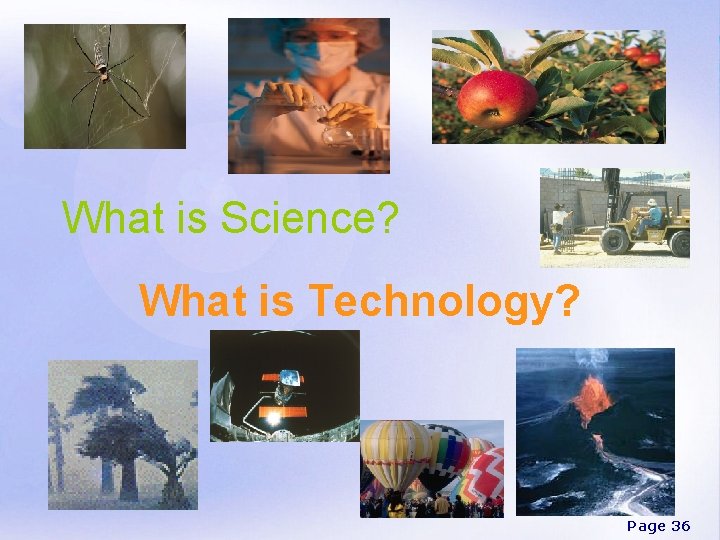
What is Science? What is Technology? Page 36
Science seeks to understand the natural world. National Science Education Standards, National Research Council, 1996. Page 37
Technology is the process by which humans modify nature to meet their needs and wants. (Technically Speaking: Why All Americans Need to Know More About Technology, NAE/NRC, 2002) Page 38
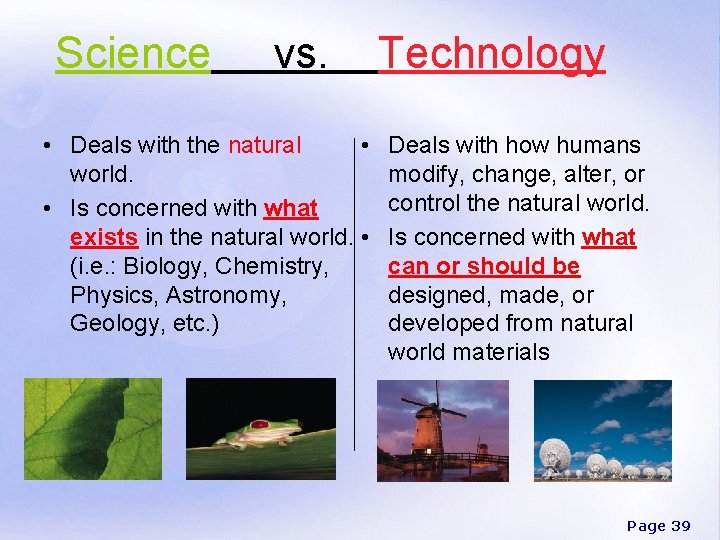
Science vs. • Deals with the natural • world. • Is concerned with what exists in the natural world. • (i. e. : Biology, Chemistry, Physics, Astronomy, Geology, etc. ) Technology Deals with how humans modify, change, alter, or control the natural world. Is concerned with what can or should be designed, made, or developed from natural world materials Page 39
Science vs. Technology (Continued) • Is concerned with processes that seek such processes that out the meaning of the we use to natural world by: alter/change the inquiry, discovering natural world such as what is, exploring, and Invention, Innovation, using the Scientific Practical Problem Method. Solving, and Design. Page 40
What is the relatio techn nship ology? betwe en sci ence and ry e v o c s i d gh u o r r e h t t t e e b c. n d e e n c i a c n s , e i y f c g o s o l s r s o e t e n t c h e o c b r te p o t r e s e h t d t T a e e b l o n t r s u t d a n i e l y g o l o n h c e t Page 41
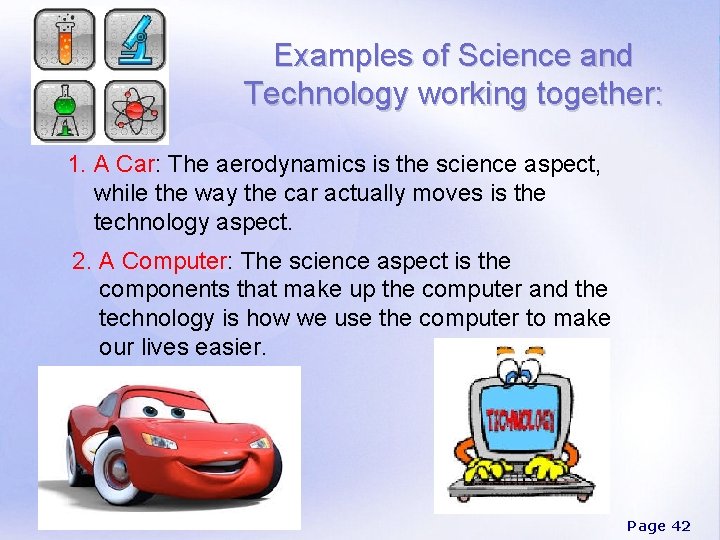
Examples of Science and Technology working together: 1. A Car: The aerodynamics is the science aspect, while the way the car actually moves is the technology aspect. 2. A Computer: The science aspect is the components that make up the computer and the technology is how we use the computer to make our lives easier. Page 42