
Introduction to Science and its methods PART 2
![Misconduct in Science Examples: • Fraud Fabrication [make up data results] Falsification [change data](https://slidetodoc.com/presentation_image_h2/3990a3b2fa3fbe90a509487dd70782e6/image-19.jpg "Misconduct in Science Examples: • Fraud Fabrication [make up data results] Falsification [change data")
- Slides: 29
Introduction to Science and its methods – PART 2 Fausto Giunchiglia Thanks to R. Brandtweiner Literature: Robert V. Smith. Graduate Research, 1998 Jeffrey A. Lee. The scientific endeavor, 2000
Index: 1. 2. 3. 4. Science … and Engineering Tasks of Science Languages and Models The philosophy of Science 4. 1 Scientific methods 4. 2 Syllogism 4. 3 Empiricism 4. 4 Positivism 4. 5 Popper: Principle of Falsification 4. 6 Beyond positivism and Falsification 4. 7 Kuhn: scientific paradigms 5. The Comunity of scientists 6. Misconduct in Science
5. The Comunity of scientists
The Community of Scientists “A Goal of science is to achieve consensus over the widest possible field”
The Community of Scientists Science as a social institution. The goal of science is a consensus of rational opinion over the widest possible field. But there are constraints • Education • Tradition • Sequence of gaining knowledge – existing theories (paradigm) may limit perception
Scientific norms • Communism • Universalism • Disinterestedness • Originality • Skepticism
Scientific norms Communism: • scientific knowledge is the property of everyone • scientists have to publish their results
Scientific norms Universalism: • no privileged sources of scientific knowledge • the only criterion is competence
Scientific norms Disinterestedness: • refers to a lack of bias or a lack of self-interest • is not the same as being uninterested
Scientific norms Originality: • work should be original
Scientific norms Skepticism: • Scientists are critical • Skepticism as peer review
Instruments • Invisible colleges • Peer review • Reward System
Instruments Invisible Colleges (communication networks): • Journals • Conferences • Projects • …
Instruments Peer Review: • independent peers review the paper • accept or reject it … almost never a perfect process
Instruments Reward System: • Recognition among peers • Invited Talks • Program Chair of Conferences • Community Prizes • Top Prizes • Salary • Contract money
6. Misconduct in Science
Misconduct in Science In Science integrity is the most important thing • Easy to say • Hard to do • Science punishes misconduct
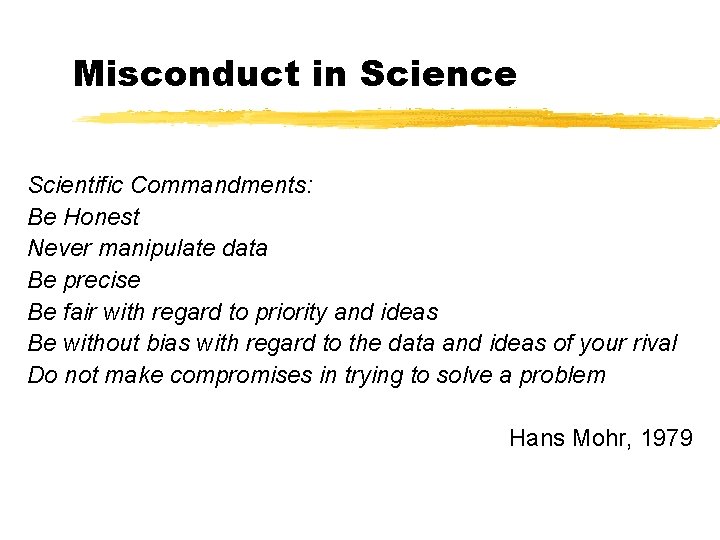
Misconduct in Science Scientific Commandments: Be Honest Never manipulate data Be precise Be fair with regard to priority and ideas Be without bias with regard to the data and ideas of your rival Do not make compromises in trying to solve a problem Hans Mohr, 1979
Misconduct in Science Examples: • Fraud Fabrication [make up data results] Falsification [change data results]
Misconduct in Science • Plagiarism: use of someone’s else words (ideas, pictures, …) without giving proper credit
Misconduct in Science • Conflict of Interest: avoid personal issues • Paper of a friend • Paper of a competing group
Questionable Research Practices • • • Failing to retain research data for a reasonable period Maintaining inadequate research records Refusing to give peers access to research materials Inappropriate statistic to enhance the significance of research findings Inadequately supervising research subordinates Misrepresenting speculations as fact Releasing results without providing sufficient data Selective reporting of research Interference Self-plagiarism
Misconduct in Science In Science the Honesty is the key issue… … otherwise … … we loose the game badly
How to do research Fausto Giunchiglia Literature: Robert V. Smith. Graduate Research, 1998 Jeffrey A. Lee. The scientific endeavor, 2000 By Fausto Giunchiglia and Alessandro Tomasi
Index: 1. Research and Scholarship 2. Factors for success 2. 1 Attitude 2. 2 Commitment 2. 3 Creativity 3. Making Choices 3. 1 Types of research 3. 2 Advisor 3. 3 Programs of Study 3. 4 Disciplinary vs. Interdisciplinary 4. Time Management 4. 1 Set Goals 4. 2 Make a todo list 4. 3 Time Wasters 5. PHD Thesis 5. 1 Choosing a scientific problem 5. 2 Timing of PHD
1. Research and Scholarship
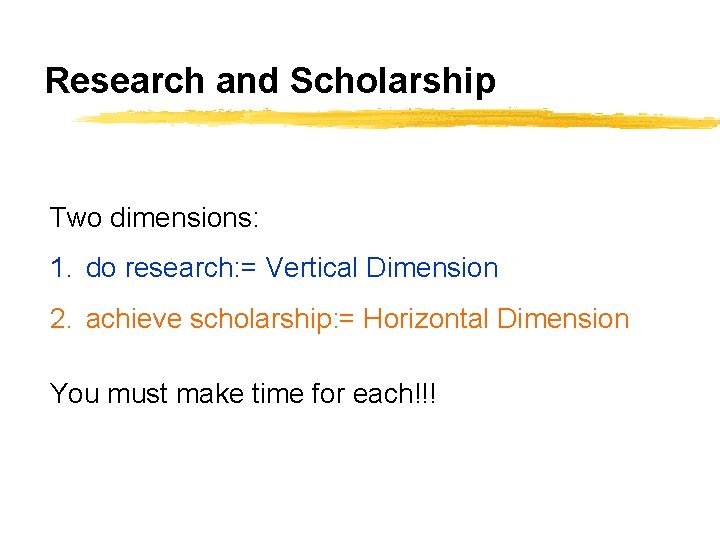
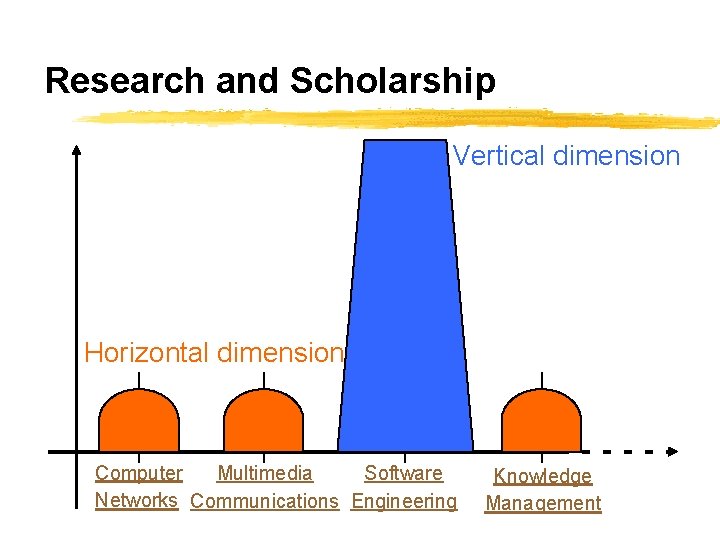
Research and Scholarship Two dimensions: 1. do research: = Vertical Dimension 2. achieve scholarship: = Horizontal Dimension You must make time for each!!!
Research and Scholarship Vertical dimension Horizontal dimension Computer Multimedia Software Networks Communications Engineering Knowledge Management
Research and Scholarship New ideas may come from boundary between areas