
Introduction to Safeguarding for Education Train the trainer

- Slides: 38
Introduction to Safeguarding for Education Train the trainer July 2017 Insert Setting Logo Here
HOUSEKEEPING/ GROUND RULES
Learning Agreement
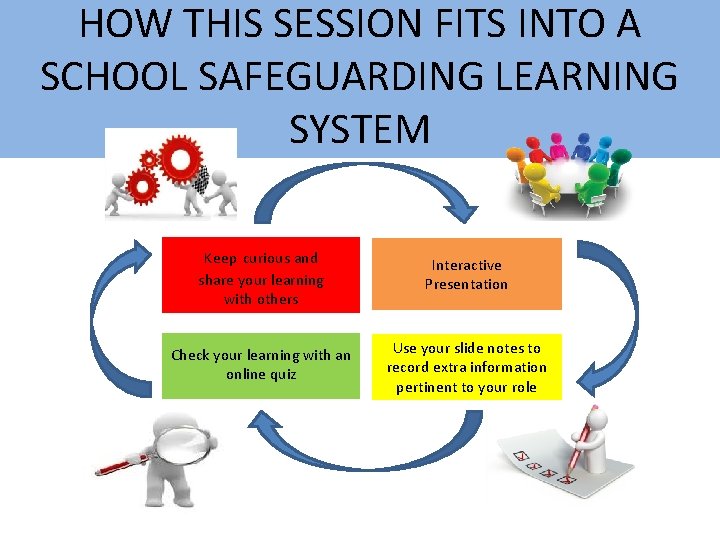
HOW THIS SESSION FITS INTO A SCHOOL SAFEGUARDING LEARNING SYSTEM Keep curious and share your learning with others Interactive Presentation Check your learning with an online quiz Use your slide notes to record extra information pertinent to your role
Introduction to Safeguarding in Education - content • Right Service, Right Time (RSRT) • Overview of Early Help • Birmingham Children`s Safeguarding board Training level 1 &2
Session Aim At the end of this session all staff will; • Be able to identify the difference between Safeguarding and Child Protection • Be able to identify and apply the Birmingham Children`s Safeguarding threshold document (RSRT) in their role • Identify children and young people who maybe at risk of harm • Know how to raise concerns within the Educational setting to ensure that children and young people are appropriately supported. • Understand the personal responsibility that you have to ensure that children`s development and wellbeing is promoted and children and young people are protected from significant harm
What is the difference between Safeguarding and Child Protection?
Legislation and policies that support us in our decision making • Working Together 2015 • Right Service, Right Time (RSRT) • Keeping Children Safe in Education 2016 • United Nations Convention on the • Children Act 2004 rights of the child (rights respecting) • PREVENT duty 2015 • Schools Safeguarding policy
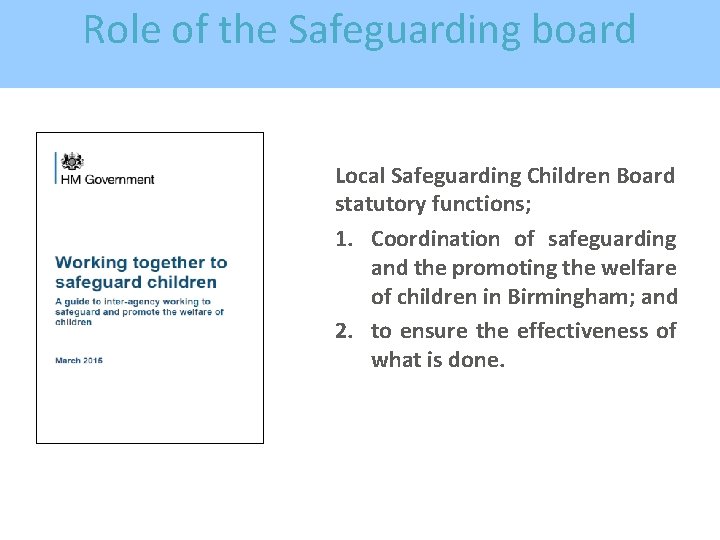
Role of the Safeguarding board Local Safeguarding Children Board statutory functions; 1. Coordination of safeguarding and the promoting the welfare of children in Birmingham; and 2. to ensure the effectiveness of what is done.
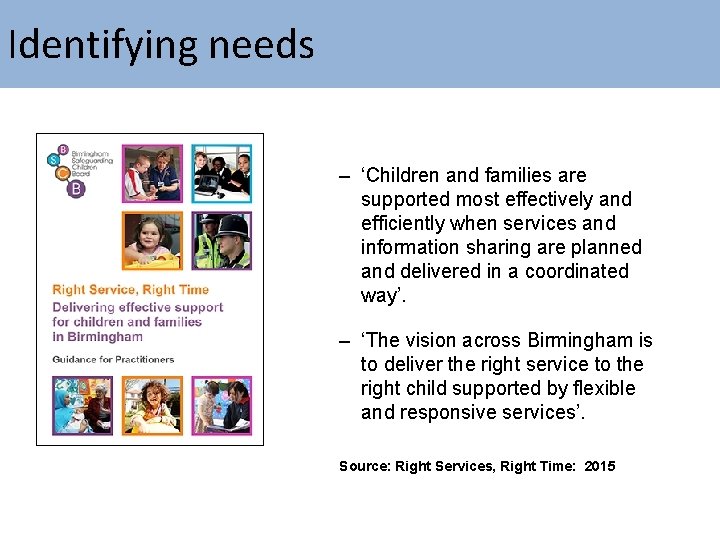
Identifying needs – ‘Children and families are supported most effectively and efficiently when services and information sharing are planned and delivered in a coordinated way’. – ‘The vision across Birmingham is to deliver the right service to the right child supported by flexible and responsive services’. Source: Right Services, Right Time: 2015
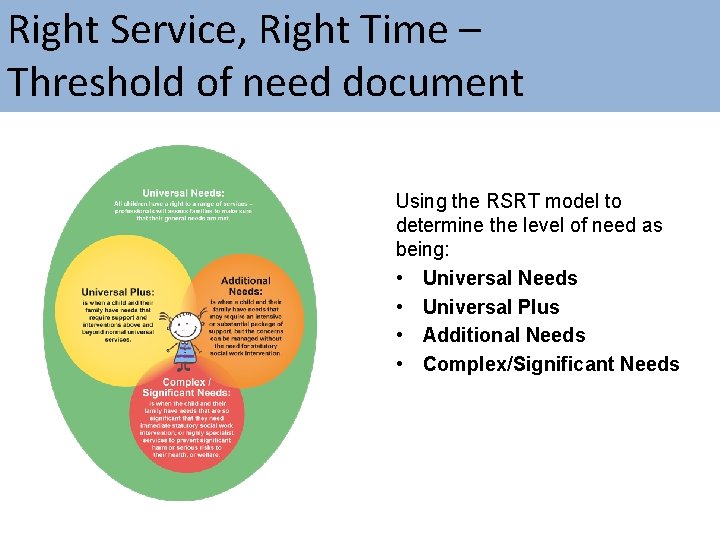
Right Service, Right Time – Threshold of need document Using the RSRT model to determine the level of need as being: • Universal Needs • Universal Plus • Additional Needs • Complex/Significant Needs
What is Early Help ?
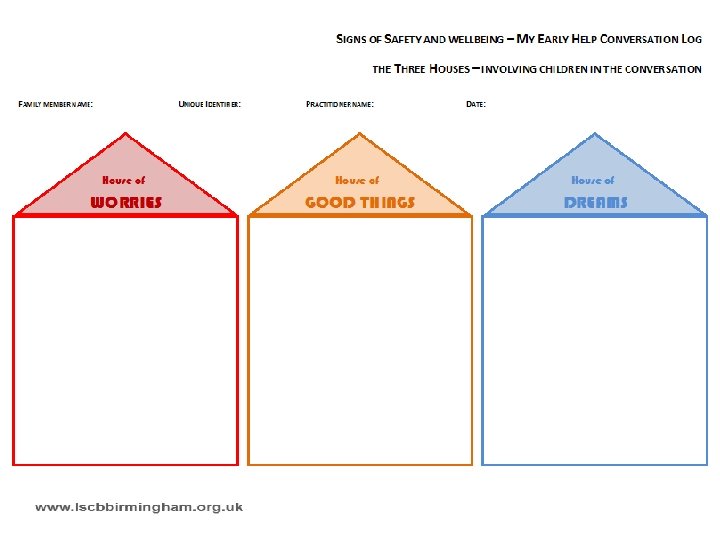
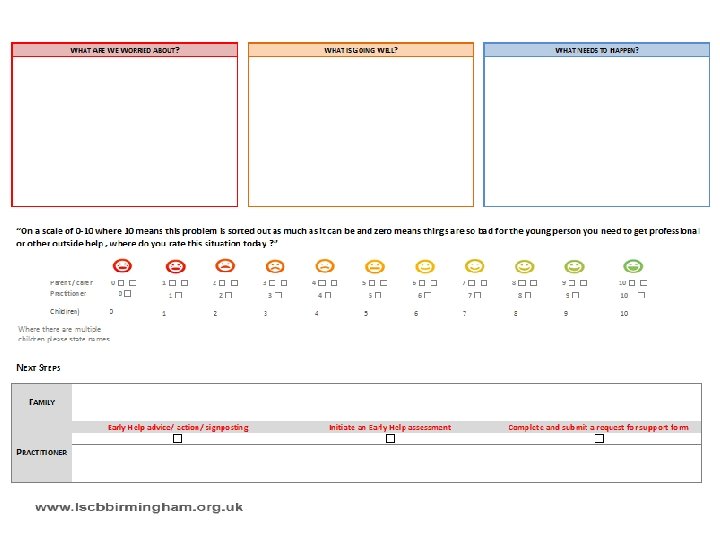
Delivering Early Help in our School • What does great Early Help look like ? • Who delivers Early Help in our school? • How is this work recorded?
Consent § Early Help is based on a partnership approach between families and professionals § Think “do with, not to” § Consent from families to participate in Early Help processes must always be present § The child centred approach as described in Working Together is supported by the strength based Signs of Safety and Wellbeing Practice framework
Safeguarding figures for our school • Percentage of school population identified on the vulnerable children List …. . • Number of children receiving a school based Early Help Intervention…. • Number of children receiving support coordinated through a multi agency Early Help assessment and plan with school acting as a lead professional……. • Number of children receiving local authority family support/ think family services……. • Number of children receiving support from Children`s social care…….
Select a film Primary: Secondary: NSPCC The Sh*t Children say Adams Story: It follows me around https: //www. youtube. com/watch? v=d. Yn. Lz. SUQc 6 U https: //www. youtube. com/watch? v=p. La. Hf. Zg. SOYY
Identifying Complex and Significant need Child Protection is part of safeguarding and promoting welfare. This refers to the activity undertaken to protect children who are suffering, or are likely to suffer, significant harm. Source: Working Together to Safeguard Children ( March 2015 )
What is Child Abuse? - Exercise
Definition of Child Abuse • Abuse and neglect are forms of maltreatment of a child. Somebody may abuse or neglect a child by inflicting harm, or by failing to act to prevent harm. • Children may be abused in a family or in an institutional or community setting, by those known to them or, more rarely, by a stranger for example, via the internet. They may be abused by an adult or adults, or another child or children.
Physical Abuse May involve: • Hitting, shaking, throwing, poisoning, burning or scalding, drowning, suffocating, inducing illness or otherwise causing physical harm to a child. • Violence is pervasive and the physical abuse of children frequently co-exists with domestic violence. Source: Working Together To Safeguard Children 2015
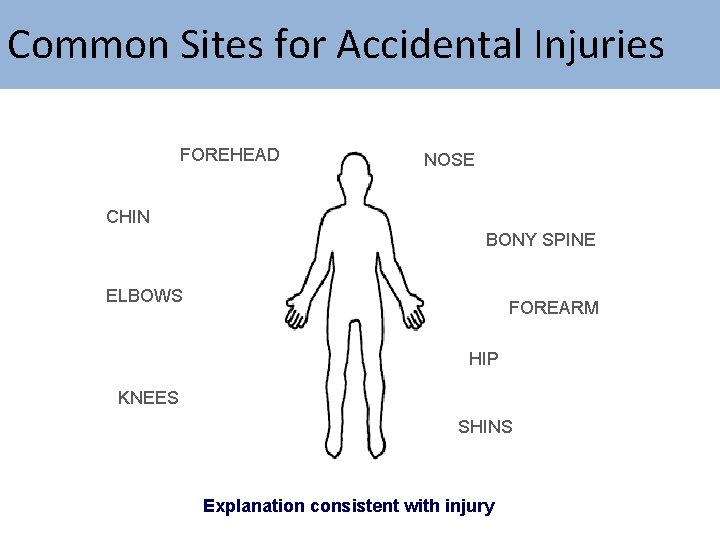
Common Sites for Accidental Injuries FOREHEAD NOSE CHIN BONY SPINE ELBOWS FOREARM HIP KNEES SHINS Explanation consistent with injury
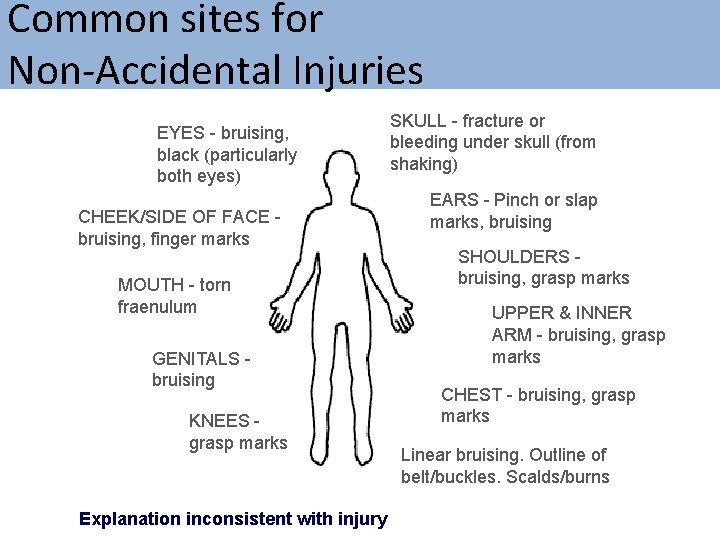
Common sites for Non-Accidental Injuries EYES - bruising, black (particularly both eyes) CHEEK/SIDE OF FACE bruising, finger marks MOUTH - torn fraenulum GENITALS bruising KNEES grasp marks Explanation inconsistent with injury SKULL - fracture or bleeding under skull (from shaking) EARS - Pinch or slap marks, bruising SHOULDERS bruising, grasp marks UPPER & INNER ARM - bruising, grasp marks CHEST - bruising, grasp marks Linear bruising. Outline of belt/buckles. Scalds/burns
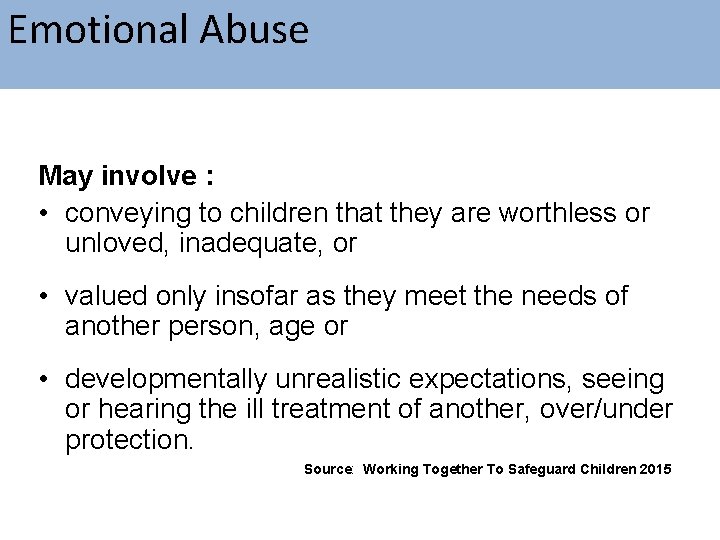
Emotional Abuse May involve : • conveying to children that they are worthless or unloved, inadequate, or • valued only insofar as they meet the needs of another person, age or • developmentally unrealistic expectations, seeing or hearing the ill treatment of another, over/under protection. Source: Working Together To Safeguard Children 2015
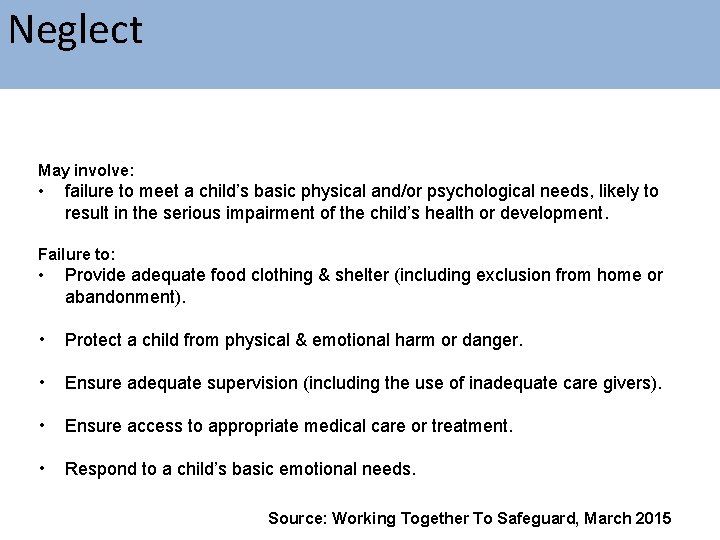
Neglect May involve: • failure to meet a child’s basic physical and/or psychological needs, likely to result in the serious impairment of the child’s health or development. Failure to: • Provide adequate food clothing & shelter (including exclusion from home or abandonment). • Protect a child from physical & emotional harm or danger. • Ensure adequate supervision (including the use of inadequate care givers). • Ensure access to appropriate medical care or treatment. • Respond to a child’s basic emotional needs. Source: Working Together To Safeguard, March 2015
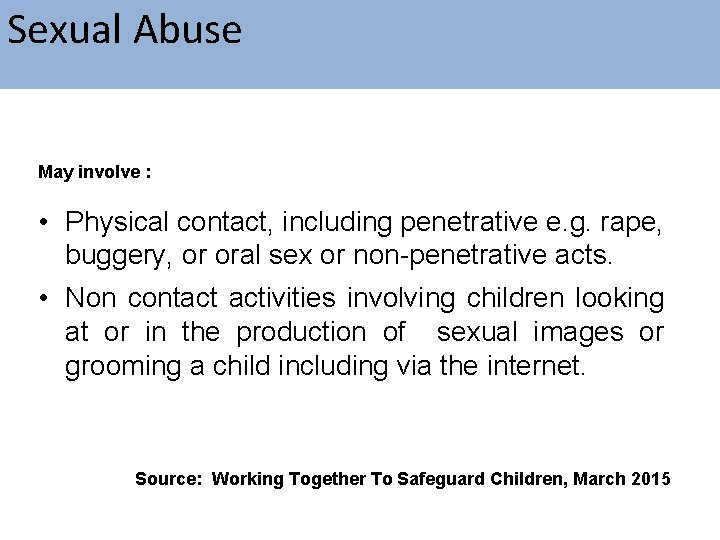
Sexual Abuse May involve : • Physical contact, including penetrative e. g. rape, buggery, or oral sex or non-penetrative acts. • Non contact activities involving children looking at or in the production of sexual images or grooming a child including via the internet. Source: Working Together To Safeguard Children, March 2015
Safeguarding Issues that require additional reporting procedures Female Genital Mutilation (FGM) A health care professional or teacher must make a “FGM Notification” to the police if, in the course of their duties, they discover that an act of FGM appears to have been carried out on a girl under 18. • Discuss with your DSL and then call police on 101 if you have information about FGM, believe a child maybe at risk or feel your child being cut and out of control. In an emergency, dial 999. • Alternatively contact Crimestoppers anonymously on 0800 555 111 or the NSPCC's FGM Helpline on 0800 028 3550 Forced Marriage • In the event the referral to CSC is made outside of work office hours, professionals are to contact the Emergency Duty Team and the Police. Child Sexual Exploitation CSE • CSE affects both Boys and Girls although the behaviours they exhibit in school may look very different.
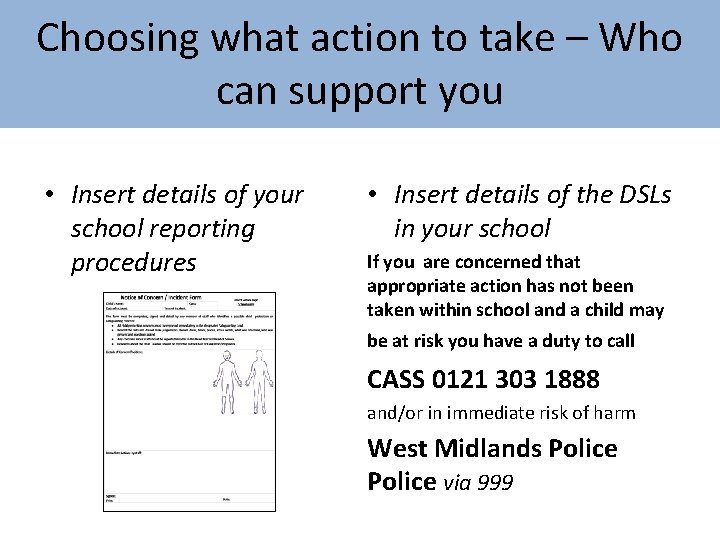
Choosing what action to take – Who can support you • Insert details of your school reporting procedures • Insert details of the DSLs in your school If you are concerned that appropriate action has not been taken within school and a child may be at risk you have a duty to call CASS 0121 303 1888 and/or in immediate risk of harm West Midlands Police via 999
Raising safeguarding concerns about a person in a position of trust (those who work with children or young people, whether in a paid or a voluntary basis) Birmingham City Council have a Local Authority Designated Officer (LADO) Team who will: • • Receive reports about allegations Provide advice and guidance Liaise with the police and other agencies Monitor the progress of cases to ensure that they are dealt with as quickly as possible consistent with a thorough and fair process If you have safeguarding concerns about a person in position of trust: • Staff member – report them to the Head Teacher • Head Teacher – report your concern to the Chair of Governors or the LADO team directly on Tel: 0121 675 1669
3 Key Principles for Information Sharing • 1. In every case we are committed to gaining the informed consent of children/and or parents when we wish to share confidential/ personal information • 2. We will respect the wishes of those who do not give consent expert where safety maybe at risk or when it is inappropriate to seek their agreement • 3. In each case of information sharing we will record the necessity, proportionality, relevance, accuracy, timeliness and security of the information shared. We will take reasonable steps to gain consent, and if it is not given, we will record why we still feel safety maybe at risk or why it was inappropriate to seek their permission.
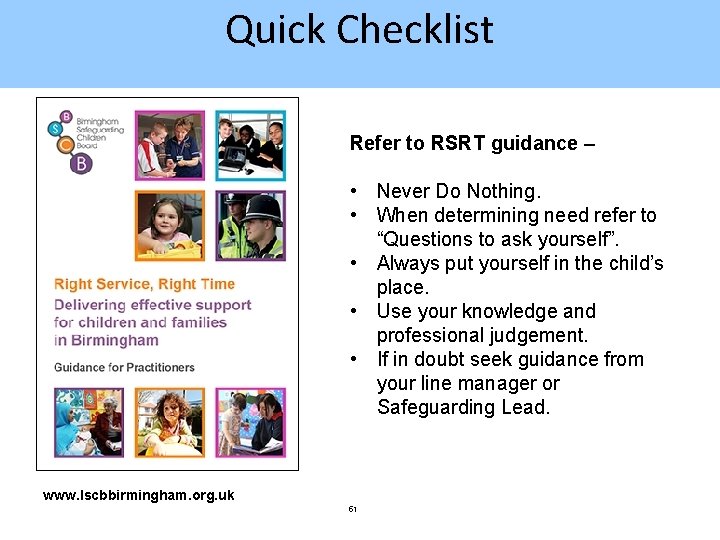
Quick Checklist Refer to RSRT guidance – • Never Do Nothing. • When determining need refer to “Questions to ask yourself”. • Always put yourself in the child’s place. • Use your knowledge and professional judgement. • If in doubt seek guidance from your line manager or Safeguarding Lead. www. lscbbirmingham. org. uk 51
Online Quiz To complete your Introduction to Safeguarding for Education you will need to complete: The Quiz will only contain information from this presentation. Your Safeguarding lead will give you access and confirm your completion.
Complete this statement on a post-it “As a result of attending this session, I recognise it’s my responsibility to ……………. ”
Did we achieve our Aim ? • Be able to identify the difference between Safeguarding and Child Protection • Be able to identify and apply the Birmingham Children`s Safeguarding threshold document (RSRT) in their role • Identify children and young people who maybe at risk of harm • Know how to raise concerns within the Educational setting to ensure that children and young people are appropriately supported. • Understand the personal responsibility that you have to ensure that children`s development and wellbeing is promoted and children and young people are protected from significant harm
Next Steps • Personalise for your setting For example • Think about your new class over the next few weeks – are their children that would benefit from an Early Help intervention – are they already on the Vulnerable children's list • Ensure that the staff in your structure have completed their online quiz