
Introduction to Safe Working for Scientific Research Workers




- Slides: 51
Introduction to Safe Working for Scientific Research Workers and Post Graduate Students Sarah Watson Assistant Safety Officer University Safety Officer. Ext 13301 http: //www. nottingham. ac. uk/safety/docs/SB-PG-Safety. ppt Complete the attendance sheets that will circulate PRINT NAME SIGN SCHOOL & DIVISION University Safety Office - New Researchers Talk
Programme 1. Safety - Why bother ? 2. General Precautions 3. Specific Hazards 4. Emergency Procedures University Safety Office - New Researchers Talk
Safety – why bother? • Legal Duty • Moral Duty • ££££ • Reputation University Safety Office - New Researchers Talk
Legal Duties upon the University Duties towards employees AND people affected by undertaking (students/visitors): – – – Workplace – access, egress, circulation Equipment, tools, substances Procedures Training and supervision Welfare - toilets, washing facilities So far as is reasonably practicable University Safety Office - New Researchers Talk
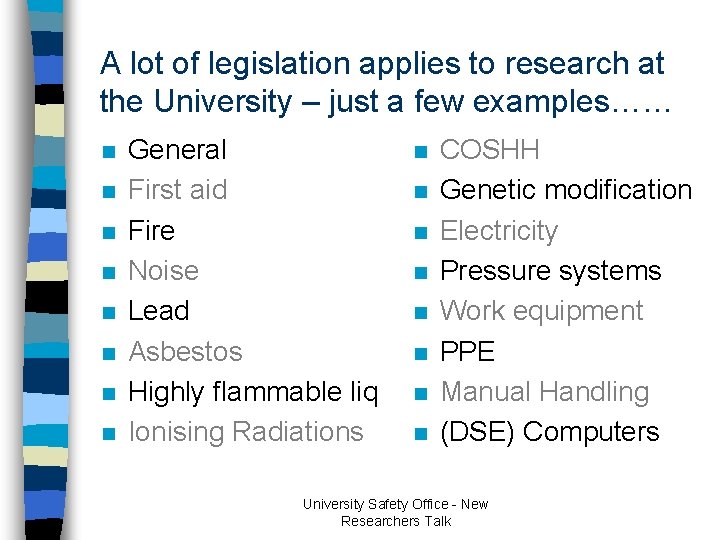
A lot of legislation applies to research at the University – just a few examples…… n n n n General First aid Fire Noise Lead Asbestos Highly flammable liq Ionising Radiations n n n n COSHH Genetic modification Electricity Pressure systems Work equipment PPE Manual Handling (DSE) Computers University Safety Office - New Researchers Talk
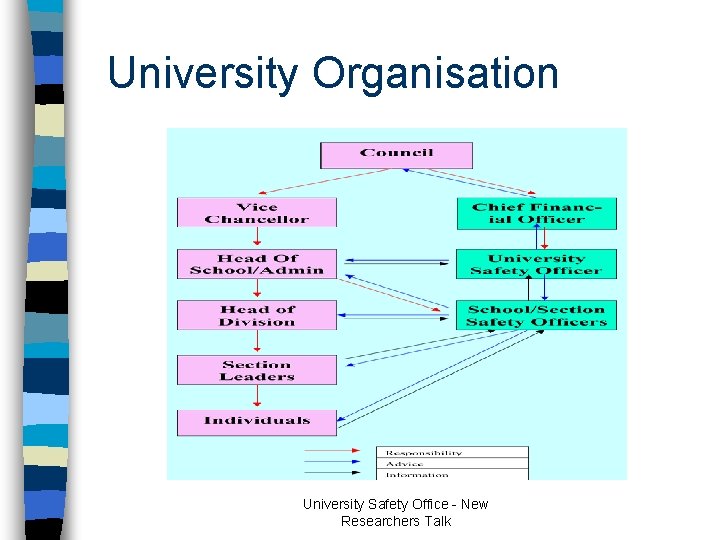
University Organisation University Safety Office - New Researchers Talk
Responsibilities n PIs / Academic Supervisors Identify hazards & risks Written procedures Ensure effective supervision & training to full competency n Demonstrators (employees - paid!) – – Understand the practical Know the hazards/precautions Be ready to intervene Action in case of accidents University Safety Office - New Researchers Talk
Responsibilities INDIVIDUALS – whether staff or student so that includes YOU - Work safely - Follow instructions & rules - Don’t endanger others - Don’t misuse safety equipment - Report problems /unsafe situations /incidents University Safety Office - New Researchers Talk
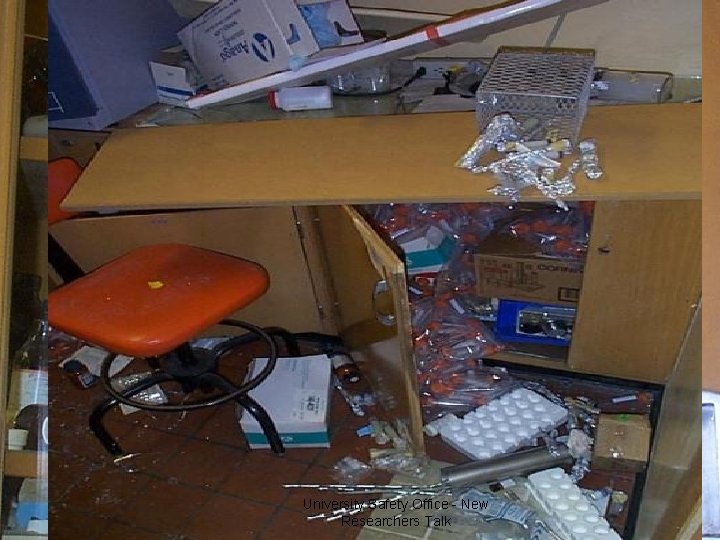
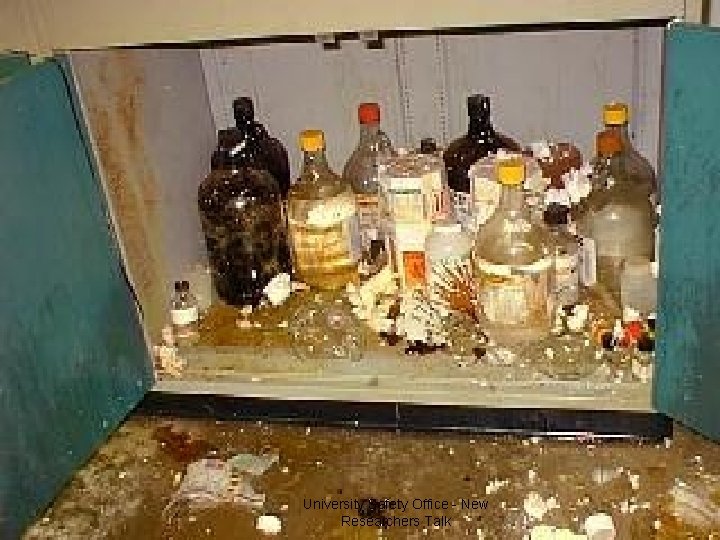
££££££££££££££££££££ WHEN SOMETHING GOES WRONG! University Safety Office - New Researchers Talk
University Safety Office - New Researchers Talk
University Safety Office - New Researchers Talk
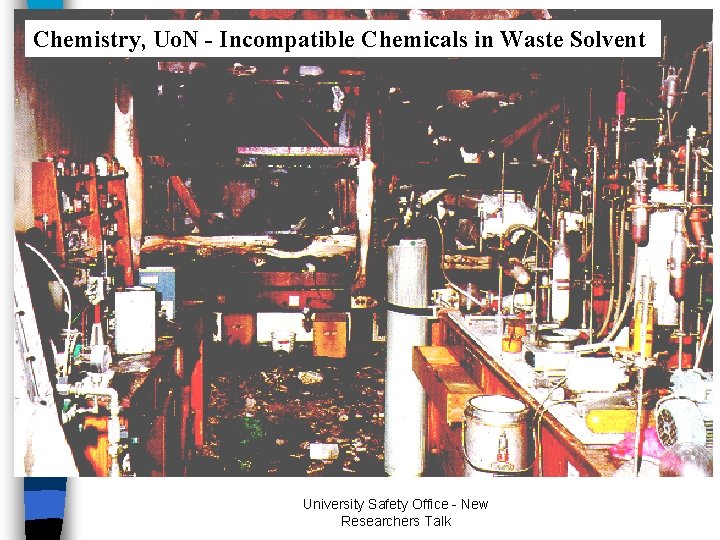
Chemistry, Uo. N - Incompatible Chemicals in Waste Solvent University Safety Office - New Researchers Talk
Postgraduates Incidents n Typically 30 - 40 accidents reported each year n 50% handling sharps Others n – – – chemical exposure slips and knocks hot/cold contact animals manual handling University Safety Office - New Researchers Talk
General Lab / Workshop Safety n n Risk Assessment Training Needs / Competency Specific Hazards Miscellaneous – – – Glassware Safety Housekeeping Late Working Unattended Experiments Emergency Procedures University Safety Office - New Researchers Talk
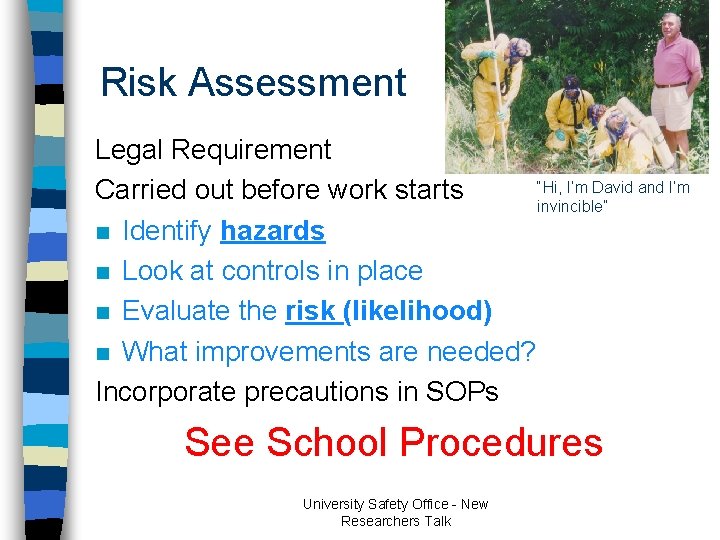
Risk Assessment Legal Requirement “Hi, I’m David and I’m Carried out before work starts invincible” n Identify hazards n Look at controls in place n Evaluate the risk (likelihood) n What improvements are needed? Incorporate precautions in SOPs See School Procedures University Safety Office - New Researchers Talk
Risk Assessment n HAZARD – the potential of something to cause harm n RISK – the likelihood of an event occurring which will allow the hazard to occur Think of an activity outside of the University 1. List the hazards 2. List the control measures that reduce the risk University Safety Office - New Researchers Talk
Training vs Competence n Attending training is one thing, being competent to carry out an activity is another. n You should have evidence of both training and achieving competence – Some schools use postgraduate supervisory requirements form (PSRF) personal to you and confirms what supervision you require – Keep a record of all • External courses • University courses • Lab-specific training (procedures and/or equipment) – Records should show who has trained you and when University Safety Office - New Researchers Talk
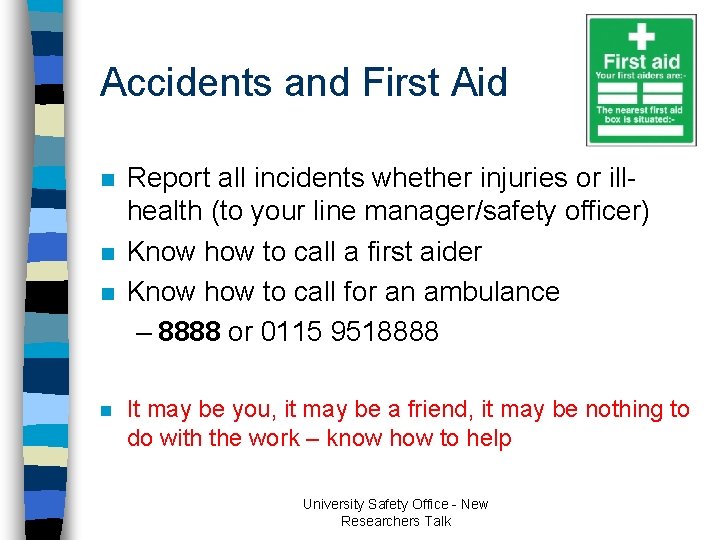
Accidents and First Aid n n Report all incidents whether injuries or illhealth (to your line manager/safety officer) Know how to call a first aider Know how to call for an ambulance – 8888 or 0115 9518888 It may be you, it may be a friend, it may be nothing to do with the work – know how to help University Safety Office - New Researchers Talk
Fire Safety – What you should know • Evacuation Procedure • Call point location • Escape route(s) • Assembly point University Safety Office - New Researchers Talk
Fire Procedure If you discover a fire – Raise the alarm – Dial 8888 (0115 951 8888) – Leave the building by nearest exit • Close doors and windows behind you • Report to assembly point – Only use extinguisher if: • Small, contained fire • Confident • Clear exit route University Safety Office - New Researchers Talk
Fire Procedure On hearing alarm - leave building by nearest exit - closing doors/widows - go to assembly n n Notify if known false alarm – 8888 (Mobile 0115 9518888) University Safety Office - New Researchers Talk
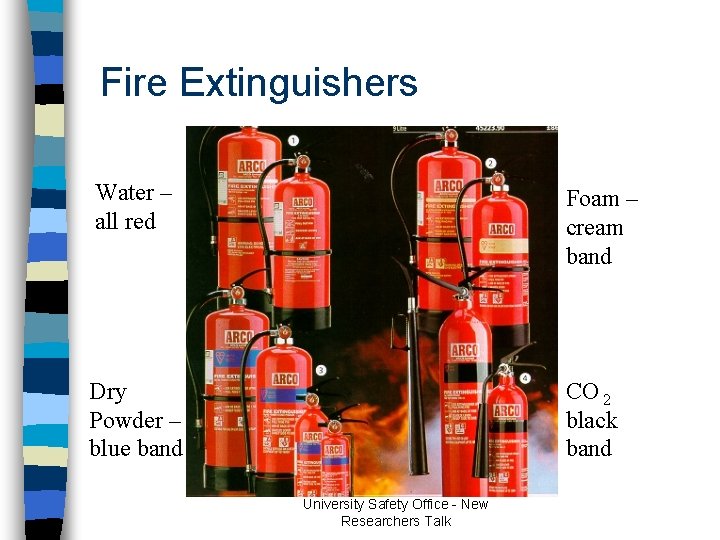
Fire Extinguishers Water – all red Foam – cream band Dry Powder – blue band CO 2 black band University Safety Office - New Researchers Talk
Typical Hazards in the Research Environment n n n substances – toxic/ carcinogens – flammable – biological material – allergens noise vibration radiation electricity machinery n n n n n pressure systems display screen equip manual handling mech. handling transport falls, falling objects slips, trips fire Lasers nanoparticles The following slides give a summary of the key precautions expected to be in place. Further detail, specific to your research, must be obtained locally University Safety Office - New Researchers Talk
Substances related hazards n n n Chemicals Flammables Carcinogens Nanoparticles Poisons University Safety Office - New Researchers Talk
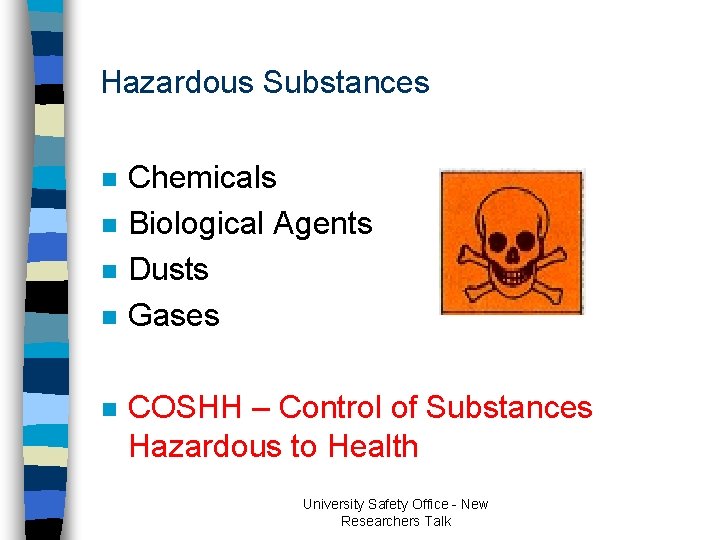
Hazardous Substances n n n Chemicals Biological Agents Dusts Gases COSHH – Control of Substances Hazardous to Health University Safety Office - New Researchers Talk
COSHH Regulations n Look at the nature of hazard - harm that can be caused • • Properties [toxicity, flammability] Quantity to be used Form (solid, liquid, gas) Duration and frequency of use University Safety Office - New Researchers Talk
Routes of exposure n Exposure Routes - how can harm be caused – Inhalation – Ingestion – Skin Contact/penetration • Absorption, • Sharps • Defective skin barrier University Safety Office - New Researchers Talk
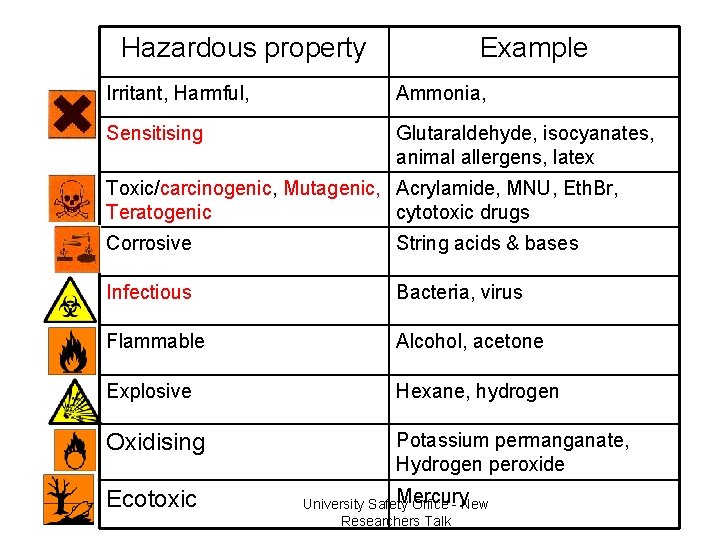
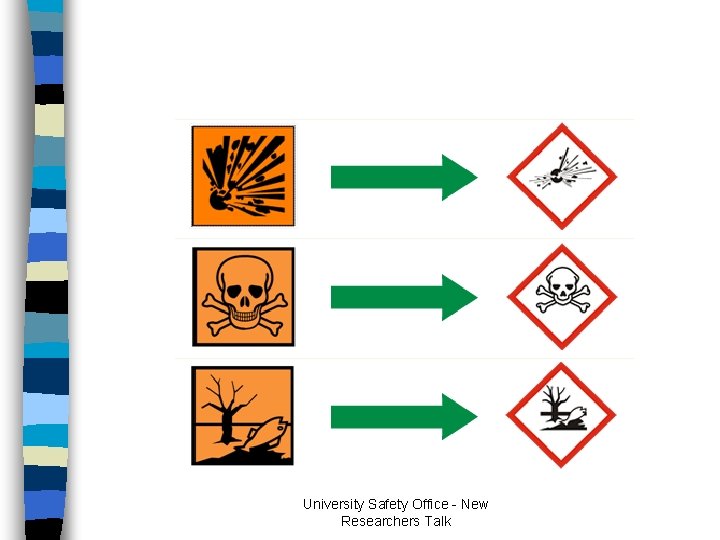
Hazardous property Example Irritant, Harmful, Ammonia, Sensitising Glutaraldehyde, isocyanates, animal allergens, latex Toxic/carcinogenic, Mutagenic, Acrylamide, MNU, Eth. Br, Teratogenic cytotoxic drugs Corrosive String acids & bases Infectious Bacteria, virus Flammable Alcohol, acetone Explosive Hexane, hydrogen Oxidising Potassium permanganate, Hydrogen peroxide Ecotoxic Mercury University Safety Office - New Researchers Talk
University Safety Office - New Researchers Talk
Workplace Exposure Limits • Set for some hazardous substances • Must not be exceeded • Limits given in ppm and mg/m 3 • Time averaged concentration in air • Long term (8 hours) • Short term (15 minutes) - STEL University Safety Office - New Researchers Talk
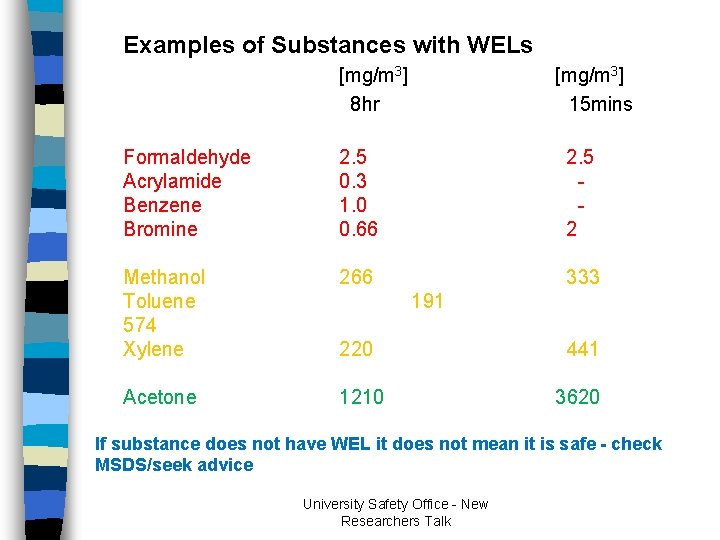
Examples of Substances with WELs [mg/m 3] 8 hr [mg/m 3] 15 mins Formaldehyde Acrylamide Benzene Bromine 2. 5 0. 3 1. 0 0. 66 2. 5 2 Methanol Toluene 574 Xylene 266 333 220 441 Acetone 1210 3620 191 If substance does not have WEL it does not mean it is safe - check MSDS/seek advice University Safety Office - New Researchers Talk
COSHH Assessment Decide on control measures – – – Eliminate or substitute, justify use. Engineering - contain, extract (FCs/MSCs) Personal protection Training, supervision Health surveillance/screening/vaccination Other considerations - Storage - Transport - Disposal - Emergencies – leaks, spills - Nanoparticles University Safety Office - New Researchers Talk
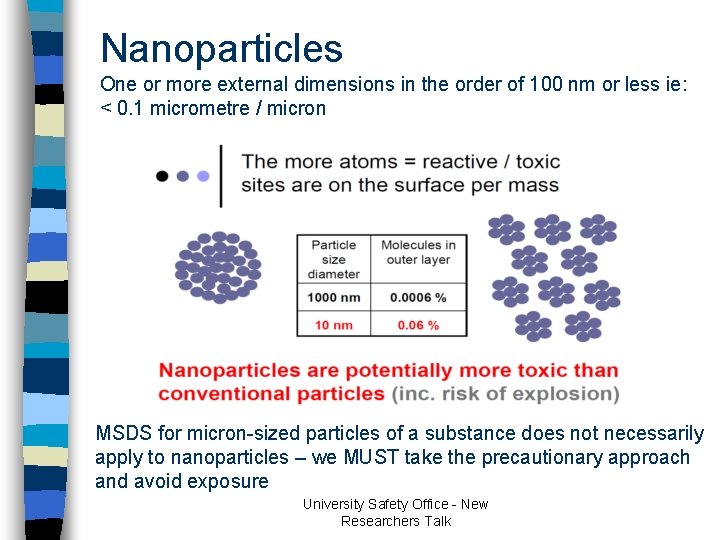
Nanoparticles One or more external dimensions in the order of 100 nm or less ie: < 0. 1 micrometre / micron MSDS for micron-sized particles of a substance does not necessarily apply to nanoparticles – we MUST take the precautionary approach and avoid exposure University Safety Office - New Researchers Talk
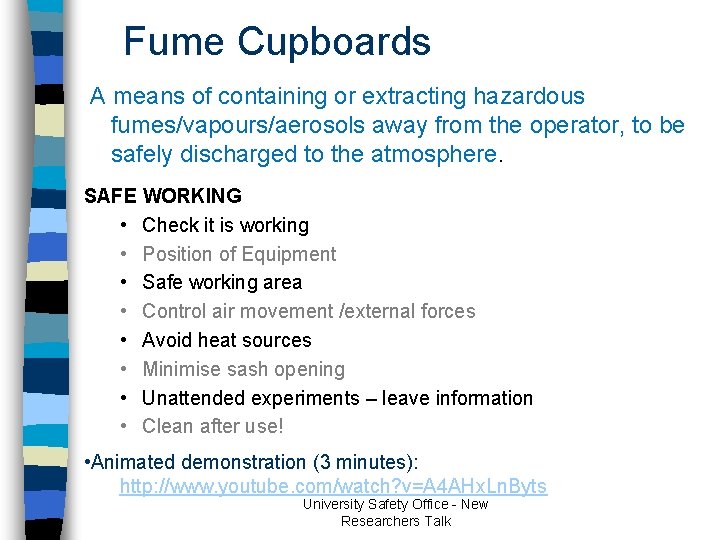
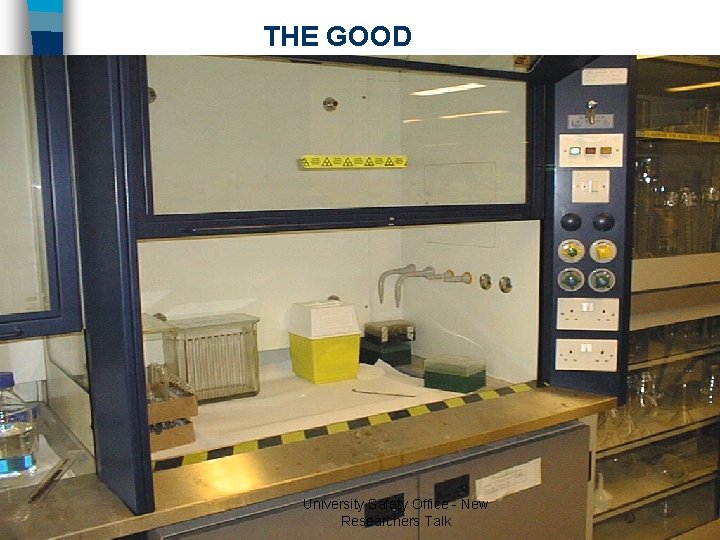
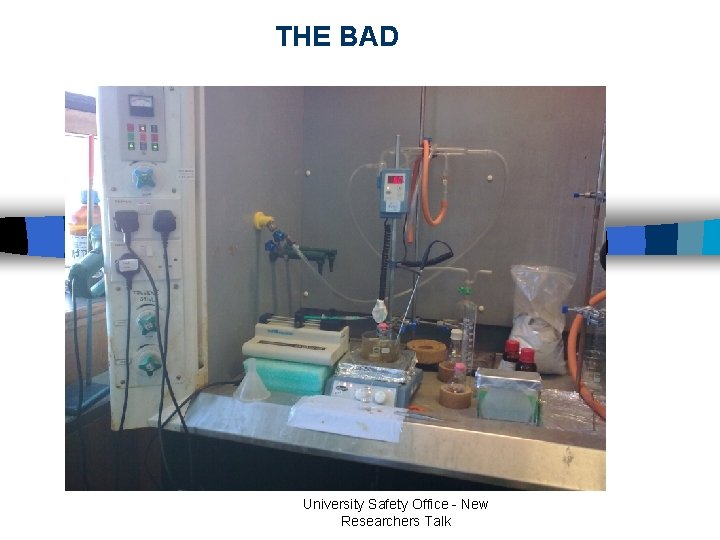
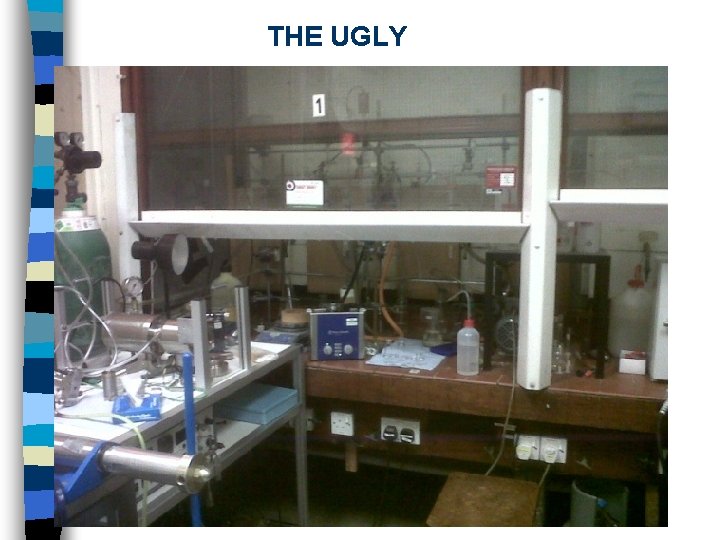
Fume Cupboards A means of containing or extracting hazardous fumes/vapours/aerosols away from the operator, to be safely discharged to the atmosphere. SAFE WORKING • Check it is working • Position of Equipment • Safe working area • Control air movement /external forces • Avoid heat sources • Minimise sash opening • Unattended experiments – leave information • Clean after use! • Animated demonstration (3 minutes): http: //www. youtube. com/watch? v=A 4 AHx. Ln. Byts University Safety Office - New Researchers Talk
THE GOOD University Safety Office - New Researchers Talk
THE BAD University Safety Office - New Researchers Talk
THE UGLY University Safety Office - New Researchers Talk
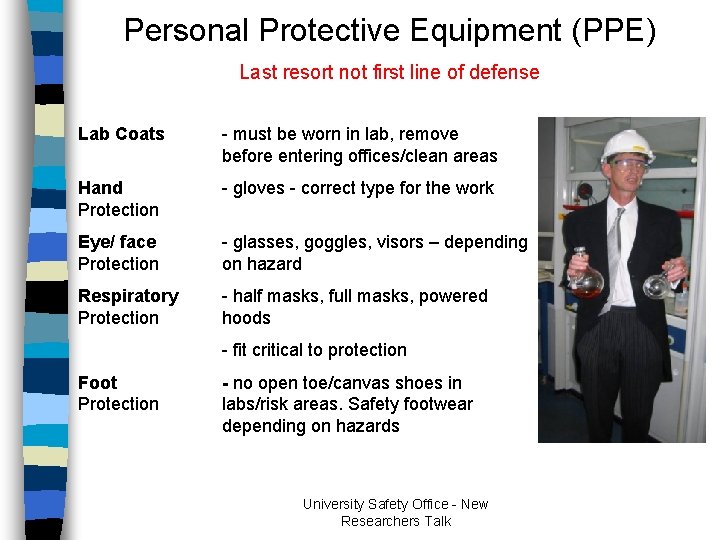
Personal Protective Equipment (PPE) Last resort not first line of defense Lab Coats - must be worn in lab, remove before entering offices/clean areas Hand Protection - gloves - correct type for the work Eye/ face Protection - glasses, goggles, visors – depending on hazard Respiratory Protection - half masks, full masks, powered hoods - fit critical to protection Foot Protection - no open toe/canvas shoes in labs/risk areas. Safety footwear depending on hazards University Safety Office - New Researchers Talk
Flammable Liquids Flash Point – temp to form a flammable atmosphere Precautions – – – – avoid vapour release never store with acids/oxidising agent stoppered labelled containers minimum quantities on bench < 500 ml store in solvent cupboard [50 l max per room] enclosed carriers for Winchesters spark-proof fridges beware of - static build up on large scale decanting - flammable atmospheres /heavy vapours – know spillage procedure - clear up immediately University Safety Office - New Researchers Talk
Cryogenic Liquids n n n HAZARD: Asphyxiation – <18% O 2 (spills > 143 ml LN/m 3 : 1: 700) – confined spaces, DO NOT TRAVEL IN LIFT HAZARD: Cold Burns – eye protection - goggles/visors/specs – hands - non absorbent insulated gloves eg leather. Sleeves over ends/securely banded. – Feet - closed shoes, trousers over – tongs/forceps Ice Plug formation Oxygen enrichment Exploding vials Transport - NOT BY ROAD - very hazardous – Use cardice University Safety Office - New Researchers Talk
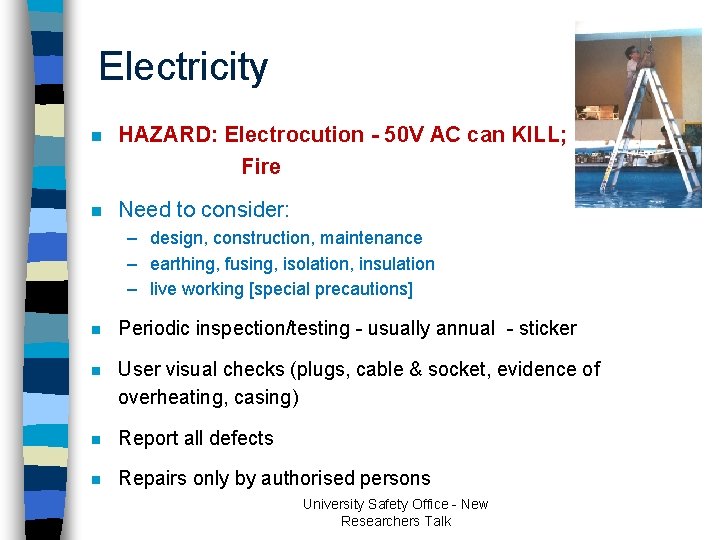
Electricity n HAZARD: Electrocution - 50 V AC can KILL; Fire n Need to consider: – design, construction, maintenance – earthing, fusing, isolation, insulation – live working [special precautions] n Periodic inspection/testing - usually annual - sticker n User visual checks (plugs, cable & socket, evidence of overheating, casing) n Report all defects n Repairs only by authorised persons University Safety Office - New Researchers Talk
Work Equipment n n n n HAZARD: entanglement, entrapment, being struck by, electrocution, hot/cold contact Fit for purpose Maintained Dangerous parts guarded CE marked Certificates of conformity Design in-house subject to approval University Safety Office - New Researchers Talk
Pressure Systems compressed gases, autoclaves n n HAZARD: Explosion as a result of sudden, uncontrolled release of stored energy Consider sources of stored energy – Steam (at any pressure) – Gas or vapours > 0. 5 bar • Boilers, autoclaves, air receivers, reactors n Requirements – – – Design/construction Safe operating limits Written scheme for examinations (externally carried out) Written operating instructions Annual inspection against written scheme University Safety Office - New Researchers Talk
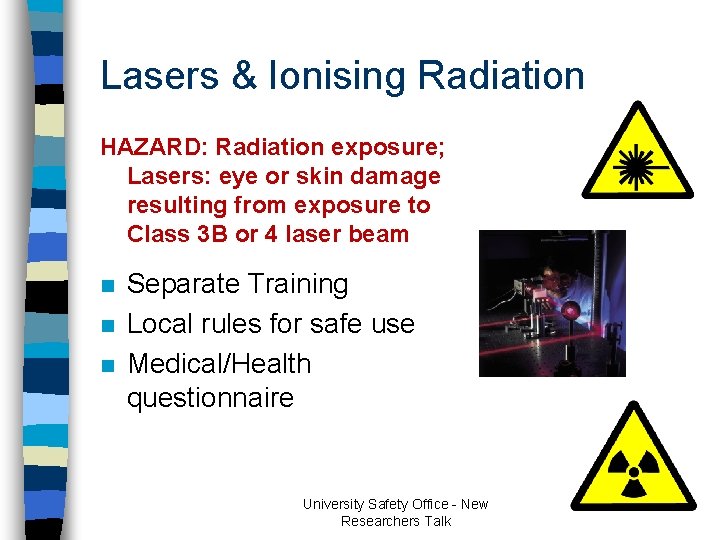
Lasers & Ionising Radiation HAZARD: Radiation exposure; Lasers: eye or skin damage resulting from exposure to Class 3 B or 4 laser beam n n n Separate Training Local rules for safe use Medical/Health questionnaire University Safety Office - New Researchers Talk
Noise n HAZARD: Permanent hearing loss n Control Levels – <85 d. B(A) - negligible risk – 85 - 90 d. B(A) - small risk • inform of risk & HP available on request – >90 d. B(A) - high risk • control at source • compulsory hearing protection • audiometry University Safety Office - New Researchers Talk
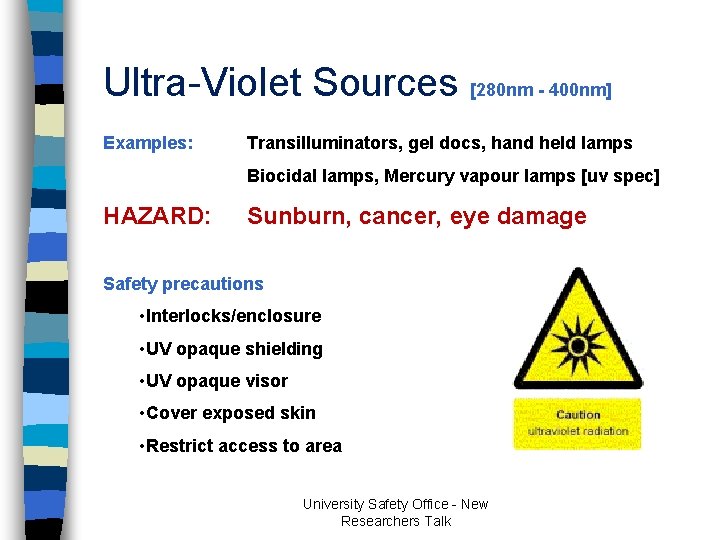
Ultra-Violet Sources [280 nm - 400 nm] Examples: Transilluminators, gel docs, hand held lamps Biocidal lamps, Mercury vapour lamps [uv spec] HAZARD: Sunburn, cancer, eye damage Safety precautions • Interlocks/enclosure • UV opaque shielding • UV opaque visor • Cover exposed skin • Restrict access to area University Safety Office - New Researchers Talk
Latex Allergy HAZARD: can cause skin/respiratory sensitisation. n 1% of population may react. n Likely to affect those with history of asthma, dermatitis, eczema, hayfever n Seek advice from Occ Health if skin/resp symptoms n Use latex alternatives & powder free gloves University Safety Office - New Researchers Talk
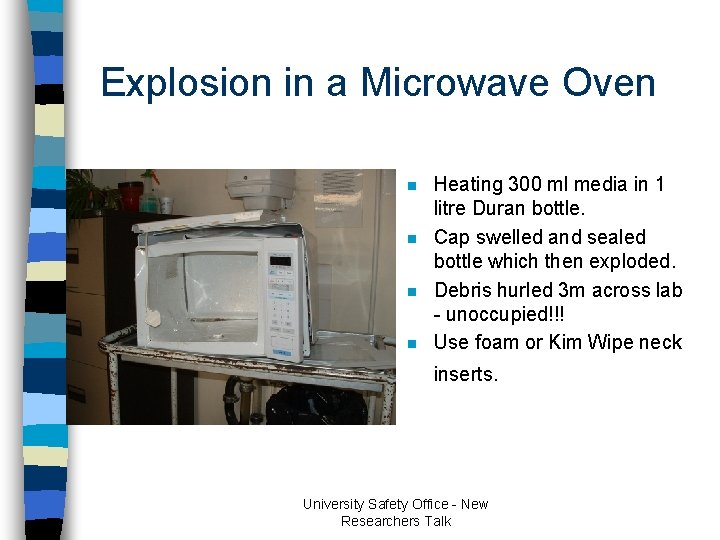
Explosion in a Microwave Oven n n Heating 300 ml media in 1 litre Duran bottle. Cap swelled and sealed bottle which then exploded. Debris hurled 3 m across lab - unoccupied!!! Use foam or Kim Wipe neck inserts. University Safety Office - New Researchers Talk
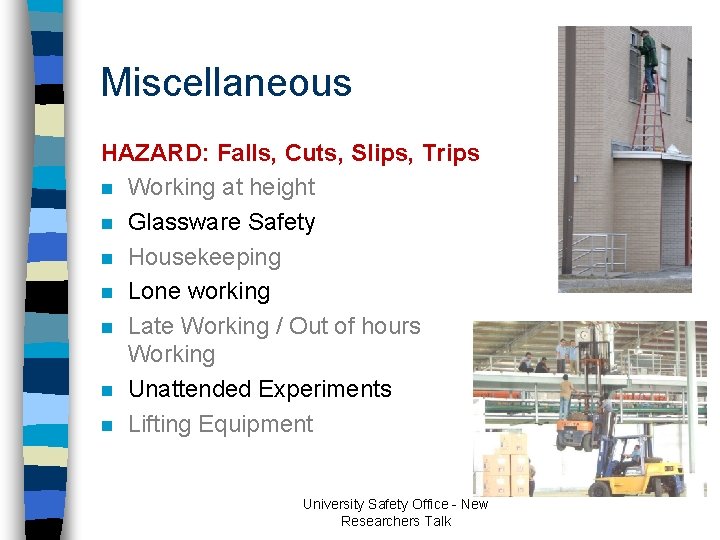
Miscellaneous HAZARD: Falls, Cuts, Slips, Trips n Working at height n Glassware Safety n Housekeeping n Lone working n Late Working / Out of hours Working n Unattended Experiments n Lifting Equipment University Safety Office - New Researchers Talk
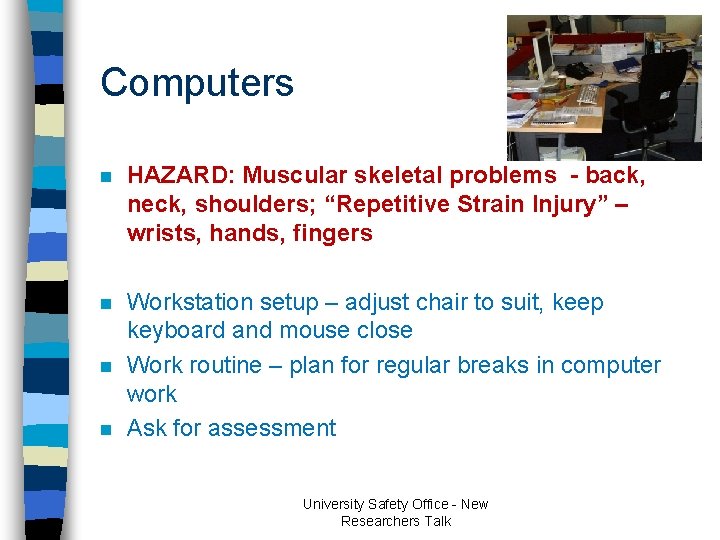
Computers n HAZARD: Muscular skeletal problems - back, neck, shoulders; “Repetitive Strain Injury” – wrists, hands, fingers n Workstation setup – adjust chair to suit, keep keyboard and mouse close Work routine – plan for regular breaks in computer work Ask for assessment n n University Safety Office - New Researchers Talk
Summary n n n Risk Assess your work Check University standards that apply Ensure your supervisor knows what your work involves Avoid lone working for all but low risk tasks Take the appropriate precautions Question anything you are uncertain about University Safety Office - New Researchers Talk