
Introduction to Routing The Routing Problem Apply after
Introduction to Routing
The Routing Problem • Apply after placement • Input: – Netlist – Timing budget for, typically, critical nets – Locations of blocks and locations of pins • Output: – Geometric layouts of all nets • Objective: – Minimize the total wire length, the number of vias, or just completing all connections without increasing the chip area. – Each net meets its timing budget.

Steiner Tree • For a multi-terminal net, we can construct a spanning tree to connect all the terminals together. • But the wire length will be large. • Better use Steiner Tree: A tree connecting all terminals and some additional nodes (Steiner nodes). • Rectilinear Steiner Tree: Steiner tree in which all the edges run horizontally and vertically. Steiner Node
Routing is Hard • Minimum Steiner Tree Problem: – Given a net, find the steiner tree with the minimum length. – This problem is NP-Complete! • May need to route tens of thousands of nets simultaneously without overlapping. • Obstacles may exist in the routing region.
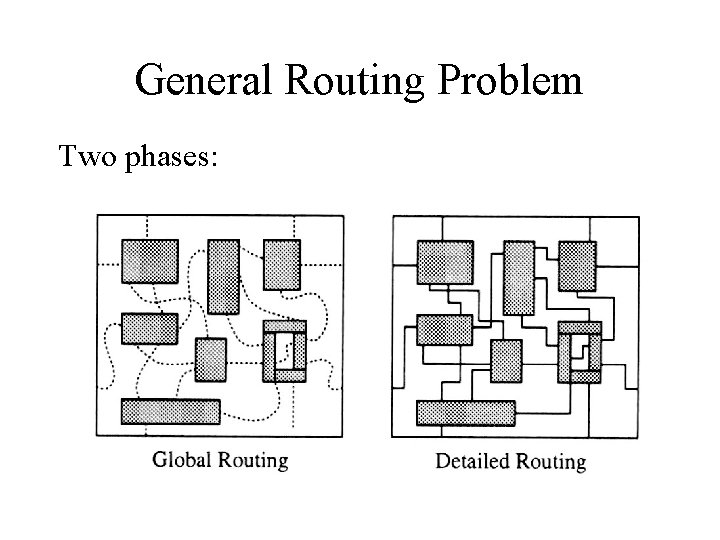
General Routing Problem Two phases:
Global Routing Global routing is divided into 3 phases: 1. Region definition 2. Region assignment 3. Pin assignment to routing regions
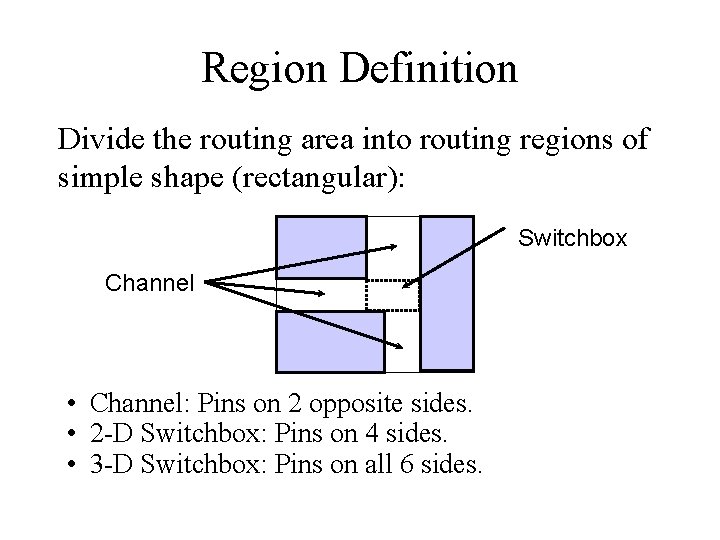
Region Definition Divide the routing area into routing regions of simple shape (rectangular): Switchbox Channel • Channel: Pins on 2 opposite sides. • 2 -D Switchbox: Pins on 4 sides. • 3 -D Switchbox: Pins on all 6 sides.
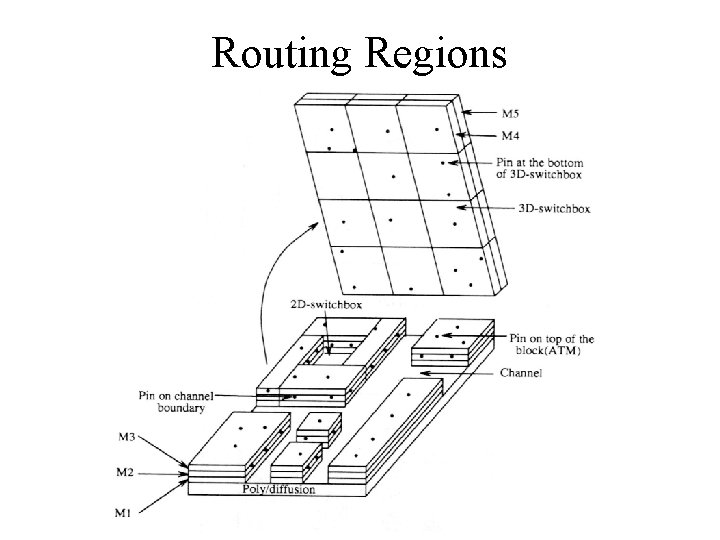
Routing Regions

Routing Regions in Different Design Styles Gate-Array Standard-Cell Full-Custom Feedthrough Cell
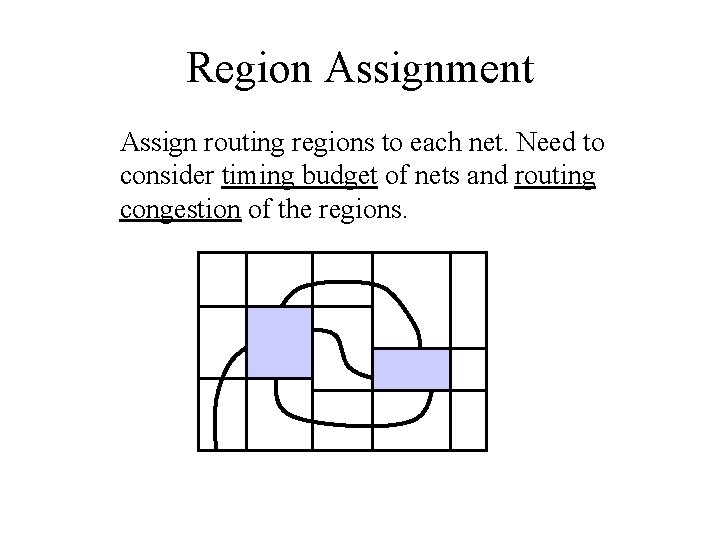
Region Assignment Assign routing regions to each net. Need to consider timing budget of nets and routing congestion of the regions.
Approaches for Global Routing Sequential Approach: – Route the nets one at a time. – Order dependent on factors like criticality, estimated wire length, etc. – If further routing is impossible because some nets are blocked by nets routed earlier, apply Rip-up and Reroute technique. – This approach is much more popular.
Approaches for Global Routing Concurrent Approach: – Consider all nets simultaneously. – Can be formulated as an integer program.
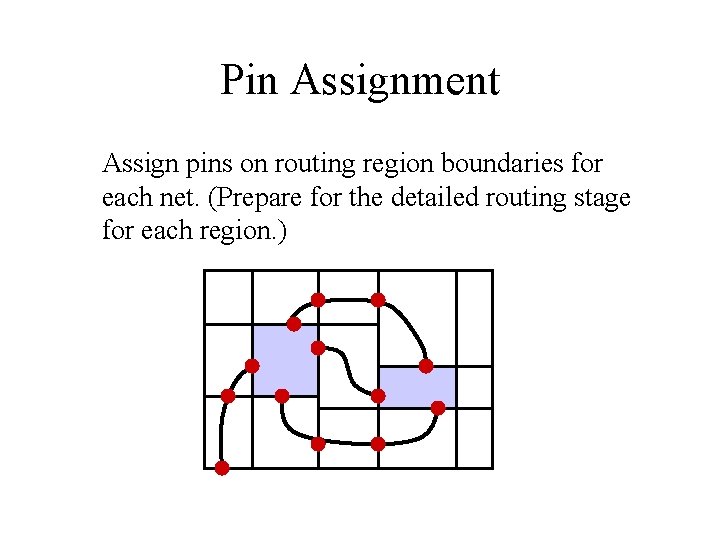
Pin Assignment Assign pins on routing region boundaries for each net. (Prepare for the detailed routing stage for each region. )
Detailed Routing • Three types of detailed routings: • Channel Routing • 2 -D Switchbox Routing • 3 -D Switchbox Routing • Channel routing 2 -D switchbox 3 -D switchbox • If the switchbox or channels are unroutable without a large expansion, global routing needs to be done again.
Extraction and Timing Analysis • After global routing and detailed routing, information of the nets can be extracted and delays can be analyzed. • If some nets fail to meet their timing budget, detailed routing and/or global routing needs to be repeated.
Kinds of Routing • Global Routing • Detailed Routing – Channel – Switchbox • Others: – Maze routing – Over the cell routing – Clock routing
Maze Routing
Maze Routing Problem • Given: – A planar rectangular grid graph. – Two points S and T on the graph. – Obstacles modeled as blocked vertices. • Objective: – Find the shortest path connecting S and T. • This technique can be used in global or detailed routing (switchbox) problems.
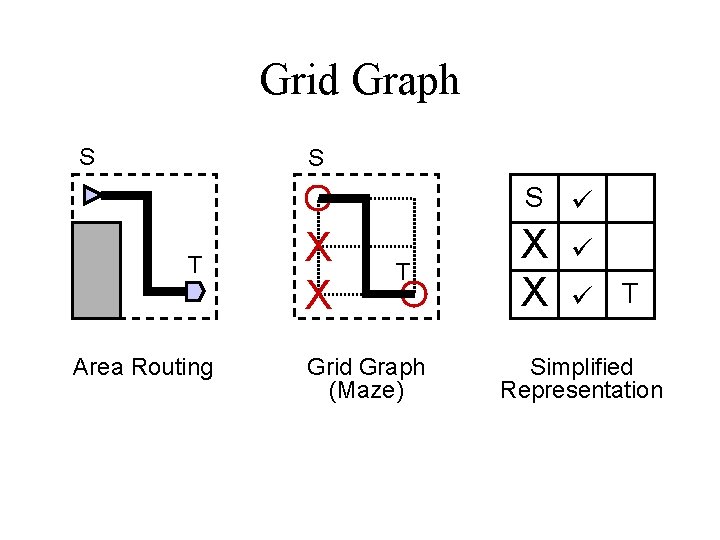
Grid Graph S S S ü T Area Routing X X T Grid Graph (Maze) X X ü ü T Simplified Representation
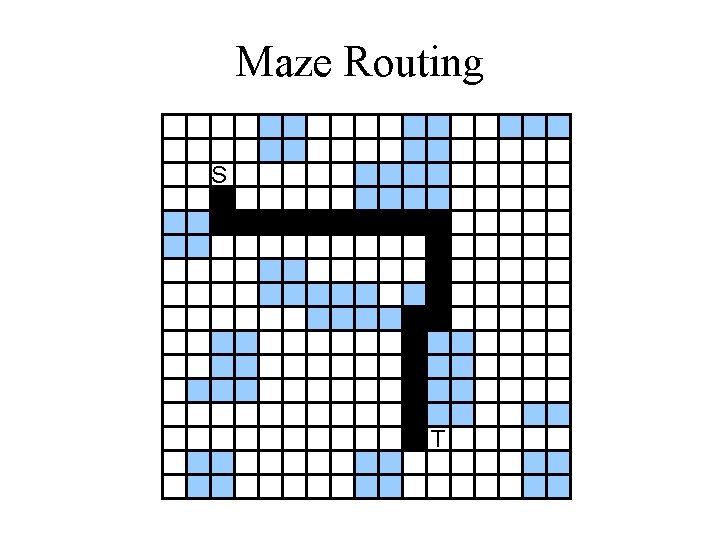
Maze Routing S T
Lee’s Algorithm “An Algorithm for Path Connection and its Application”, C. Y. Lee, IRE Transactions on Electronic Computers, 1961.
Basic Idea • A Breadth-First Search (BFS) of the grid graph. • Always find the shortest path possible. • Consists of two phases: – Wave Propagation – Retrace
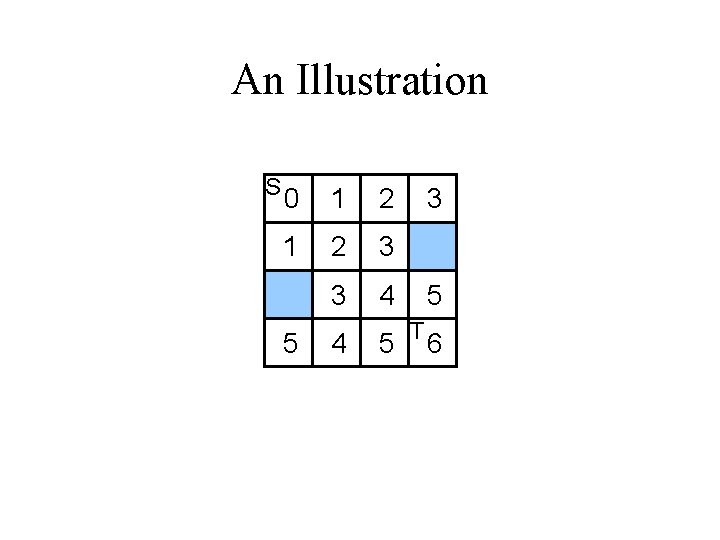
An Illustration S 0 1 2 3 3 4 5 3 5 T 6
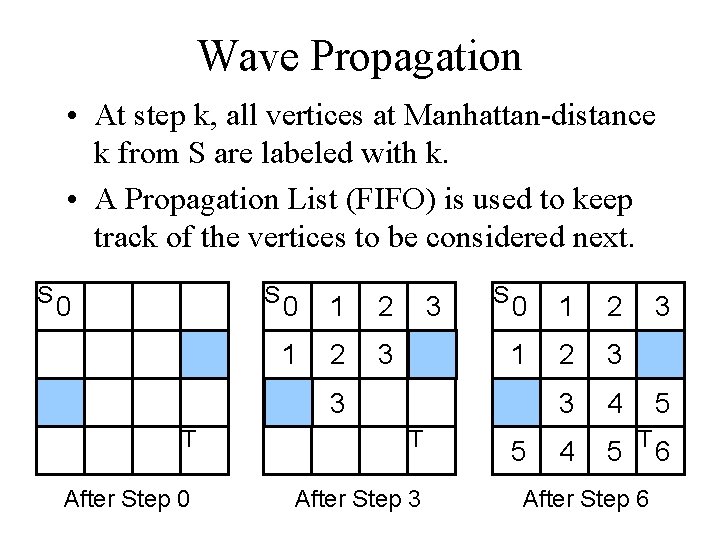
Wave Propagation • At step k, all vertices at Manhattan-distance k from S are labeled with k. • A Propagation List (FIFO) is used to keep track of the vertices to be considered next. S S 0 0 1 2 3 3 S 0 1 2 3 3 4 3 T T After Step 0 After Step 3 5 4 5 3 5 T After Step 6 6
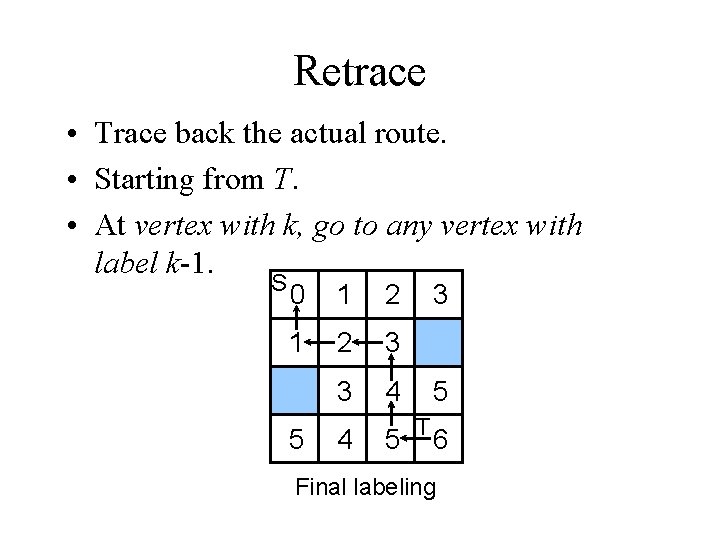
Retrace • Trace back the actual route. • Starting from T. • At vertex with k, go to any vertex with label k-1. S 0 1 2 3 3 4 5 3 5 T 6 Final labeling
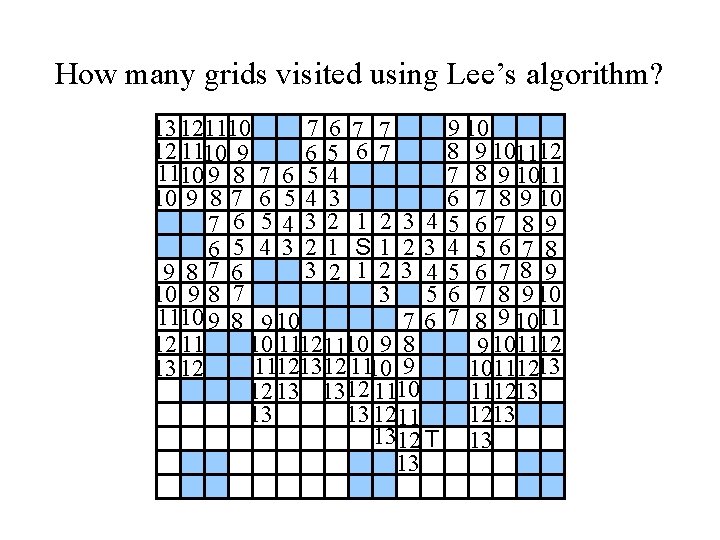
How many grids visited using Lee’s algorithm? 13 121110 7 6 7 7 12 1110 9 6 5 6 7 1110 9 8 7 6 5 4 3 7 6 54 3 2 1 2 3 4 6 5 4 3 2 1 S 1 23 3 2 1 2 3 4 9 8 7 6 10 9 8 7 3 5 1110 9 8 9 10 76 12 11 10 11121110 9 8 11121312 1110 9 13 12 12 13 1312 1110 13 13 1211 1312 T 13 9 10 8 9 101112 7 8 9 1011 6 7 8 9 10 5 67 8 9 4 5 6 7 8 5 6 78 9 6 7 8 9 10111213 111213 13
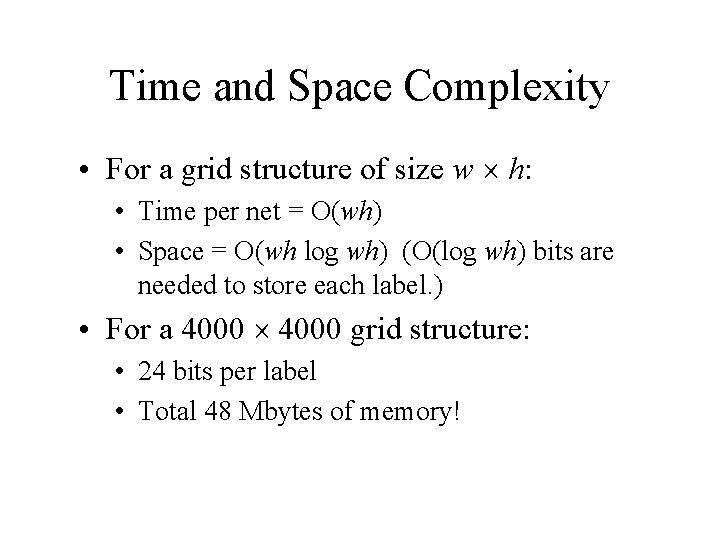
Time and Space Complexity • For a grid structure of size w h: • Time per net = O(wh) • Space = O(wh log wh) (O(log wh) bits are needed to store each label. ) • For a 4000 grid structure: • 24 bits per label • Total 48 Mbytes of memory!

Improvement to Lee’s Algorithm • Improvement on memory: – Aker’s Coding Scheme • Improvement on run time: – – – Starting point selection Double fan-out Framing Hadlock’s Algorithm Soukup’s Algorithm
Aker’s Coding Scheme to Reduce Memory Usage
Aker’s Coding Scheme • For the Lee’s algorithm, labels are needed during the retrace phase. • But there are only two possible labels for neighbors of each vertex labeled i, which are, i-1 and i+1. • So, is there any method to reduce the memory usage?
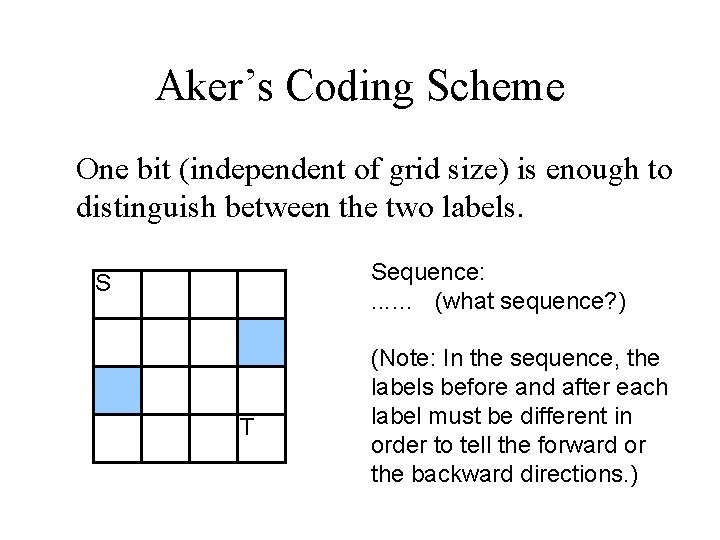
Aker’s Coding Scheme One bit (independent of grid size) is enough to distinguish between the two labels. Sequence: . . . … (what sequence? ) S T (Note: In the sequence, the labels before and after each label must be different in order to tell the forward or the backward directions. )
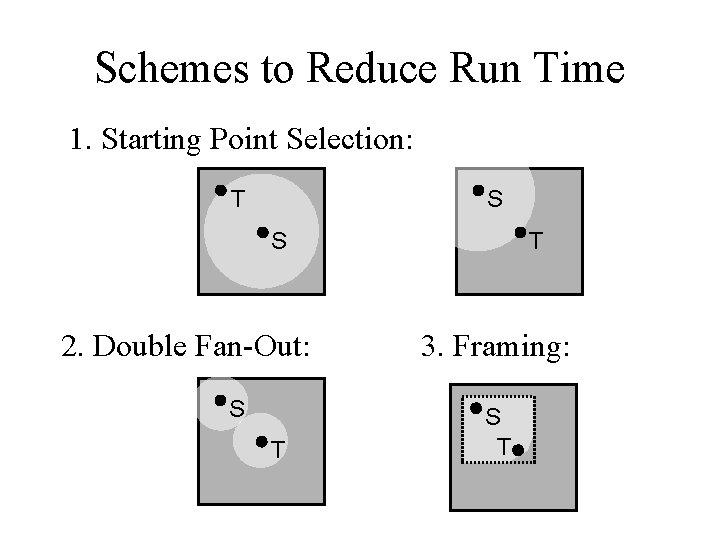
Schemes to Reduce Run Time 1. Starting Point Selection: T S S 2. Double Fan-Out: S T T 3. Framing: S T
Hadlock’s Algorithm to Reduce Run Time
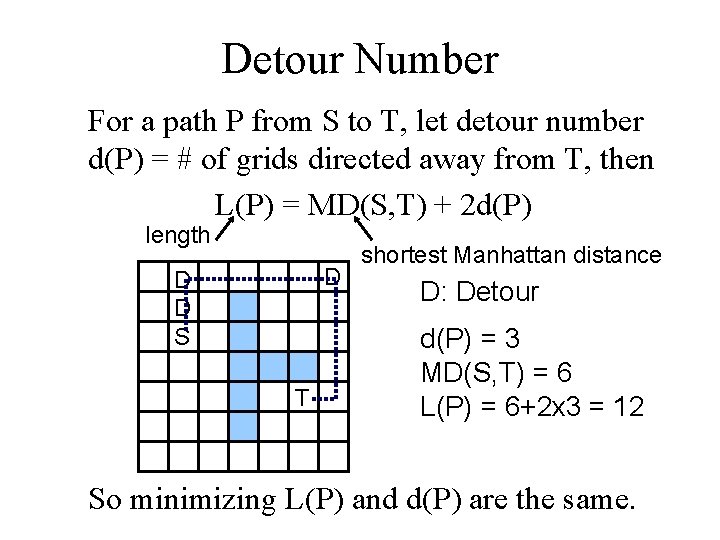
Detour Number For a path P from S to T, let detour number d(P) = # of grids directed away from T, then L(P) = MD(S, T) + 2 d(P) length D D D S T shortest Manhattan distance D: Detour d(P) = 3 MD(S, T) = 6 L(P) = 6+2 x 3 = 12 So minimizing L(P) and d(P) are the same.
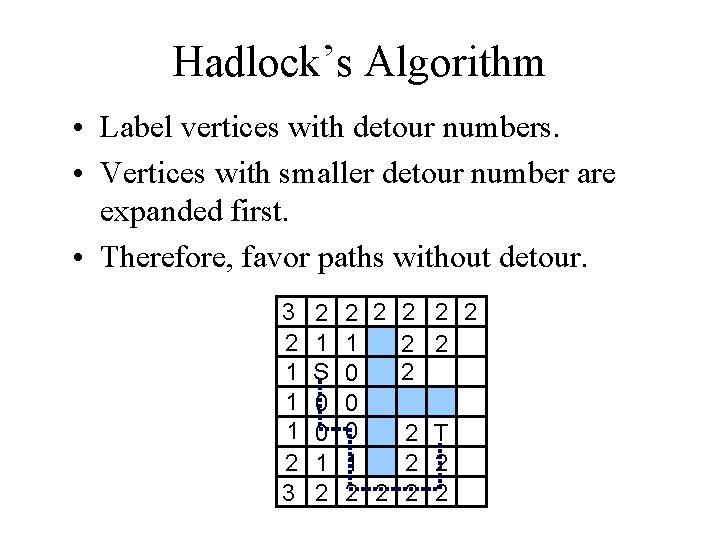
Hadlock’s Algorithm • Label vertices with detour numbers. • Vertices with smaller detour number are expanded first. • Therefore, favor paths without detour. 3 2 1 1 1 2 3 2 1 S 0 0 1 2 2 2 0 0 0 2 T 1 2 2 2
Soukup’s Algorithm to Reduce Run Time
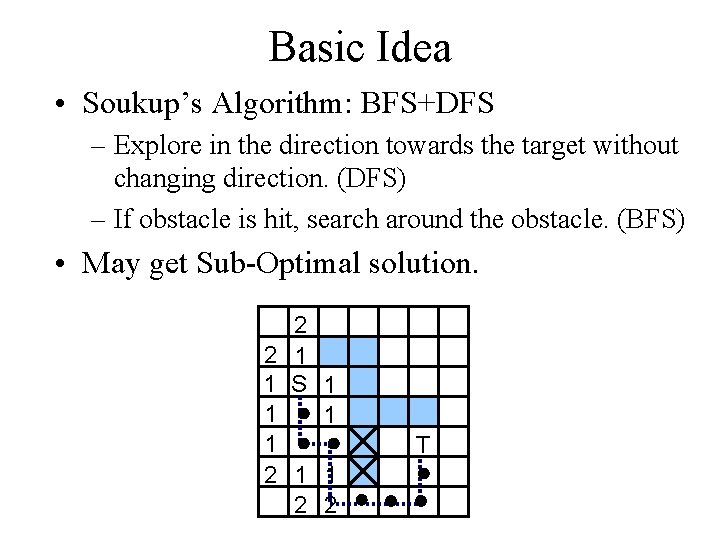
Basic Idea • Soukup’s Algorithm: BFS+DFS – Explore in the direction towards the target without changing direction. (DFS) – If obstacle is hit, search around the obstacle. (BFS) • May get Sub-Optimal solution. 2 2 1 1 S 1 1 2 2 T
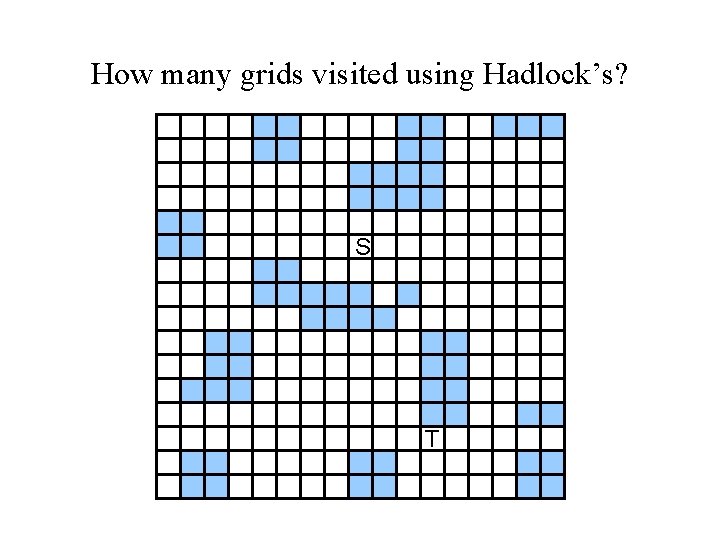
How many grids visited using Hadlock’s? S T
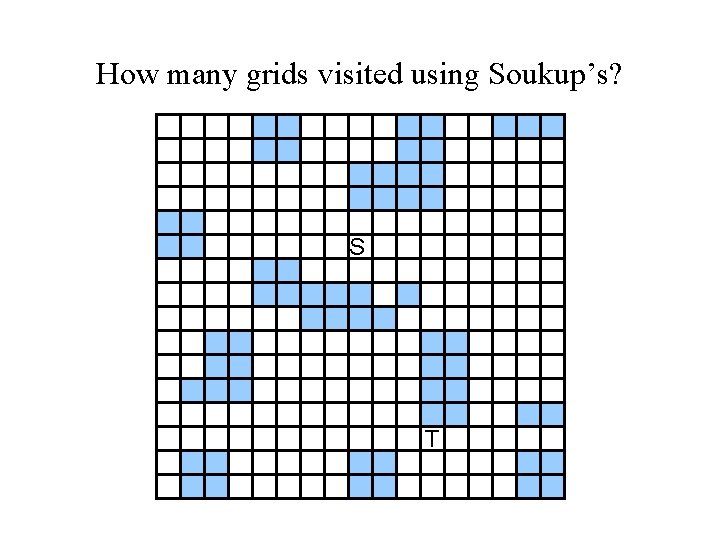
How many grids visited using Soukup’s? S T
Multi-Terminal Nets • For a k-terminal net, connect the k terminals using a rectilinear Steiner tree with the shortest wire length on the maze. • This problem is NP-Complete. • Just want to find some good heuristics.
Multi-Terminal Nets This problem can be solved by extending the Lee’s algorithm: – Connect one terminal at a time, or – Search for several targets simultaneously, or – Propagate wave fronts from several different sources simultaneously.
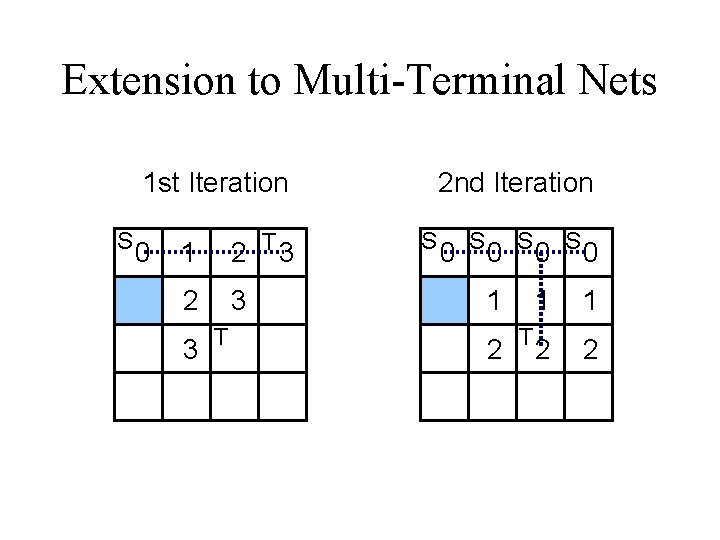
Extension to Multi-Terminal Nets 1 st Iteration S 0 1 2 T 3 2 3 3 T 2 nd Iteration S 0 S 0 1 2 T 1 1 2 2
- Slides: 42