
Introduction to Routine Data Quality Assessment Name Data
- Slides: 6
Introduction to Routine Data Quality Assessment Name, Data for Impact Meeting or event Date
Objectives • Understand the purpose of the RDQA tool. • Describe the components of the RDQA tool. • Define and identify the type of FP data that can be assessed using the RDQA tool.
Purpose of RDQA • Assess five functional areas of a data management and reporting system: o M&E Structure, Functions, and Capabilities o Indicator Definitions and Reporting Guidelines o Data Collection and Reporting Forms and Tools o Data Management Processes o Use of Data for Decision Making • Verify the quality of reported data against data recorded in the primary source documents: o Accuracy o Timeliness o Completeness
Components of the RDQA • Data Verification: o Recount data of selected indicators from source documents. o Compare recounted data with reported data. o Assess time data reported against deadline. o Assess number of available reports against expected reports. o Assess data records against expected data records. • System management: o Assess strengths and weaknesses of core functional areas of: § Data management system § Data reporting system
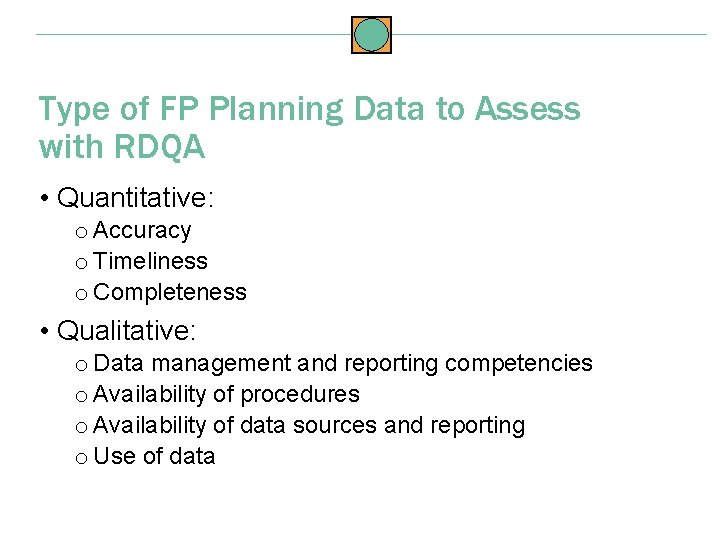
Type of FP Planning Data to Assess with RDQA • Quantitative: o Accuracy o Timeliness o Completeness • Qualitative: o Data management and reporting competencies o Availability of procedures o Availability of data sources and reporting o Use of data
This presentation was produced with the support of the United States Agency for International Development (USAID) under the terms of the Data for Impact (D 4 I) associate award 7200 AA 18 LA 00008, which is implemented by the Carolina Population Center at the University of North Carolina at Chapel Hill, in partnership with Palladium International, LLC; ICF Macro, Inc. ; John Snow, Inc. ; and Tulane University. The views expressed in this publication do not necessarily reflect the views of USAID or the United States government. www. data 4 impactproject. org