
Introduction to Risk Factors Measures of Effect Meg

- Slides: 29
Introduction to Risk Factors & Measures of Effect Meg Mc. Carron, CDC
Introduction to Risk Analysis 2
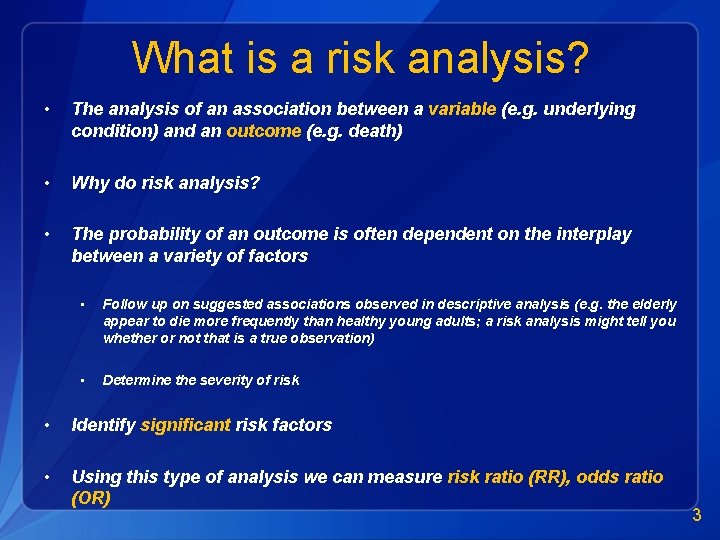
What is a risk analysis? • The analysis of an association between a variable (e. g. underlying condition) and an outcome (e. g. death) • Why do risk analysis? • The probability of an outcome is often dependent on the interplay between a variety of factors • Follow up on suggested associations observed in descriptive analysis (e. g. the elderly appear to die more frequently than healthy young adults; a risk analysis might tell you whether or not that is a true observation) • Determine the severity of risk • Identify significant risk factors • Using this type of analysis we can measure risk ratio (RR), odds ratio (OR) 3
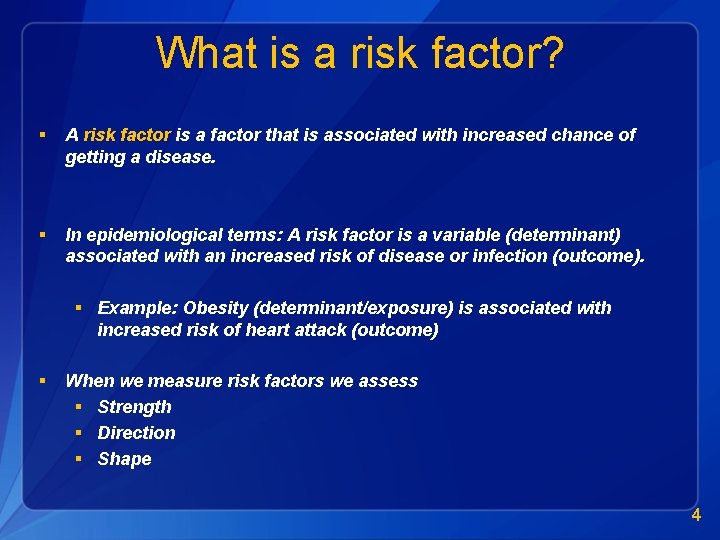
What is a risk factor? § A risk factor is a factor that is associated with increased chance of getting a disease. § In epidemiological terms: A risk factor is a variable (determinant) associated with an increased risk of disease or infection (outcome). § Example: Obesity (determinant/exposure) is associated with increased risk of heart attack (outcome) § When we measure risk factors we assess § Strength § Direction § Shape 4
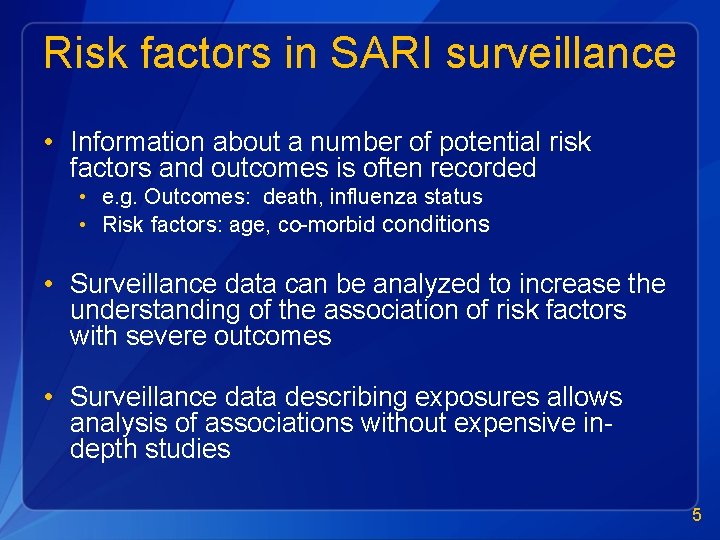
Risk factors in SARI surveillance • Information about a number of potential risk factors and outcomes is often recorded • e. g. Outcomes: death, influenza status • Risk factors: age, co-morbid conditions • Surveillance data can be analyzed to increase the understanding of the association of risk factors with severe outcomes • Surveillance data describing exposures allows analysis of associations without expensive indepth studies 5
Is a risk factor the cause of a disease? § Risk factors are correlational and not necessarily causal § Correlation does not imply causation § The statistical methods used do not consider the direction of effects § For an effect to be causal the exposure must have occurred before the outcome § e. g. young age does not cause measles (Morbillivirus causes measles), but young people are at greater risk because they are less likely to have developed immunity due to previous exposure or vaccination 6
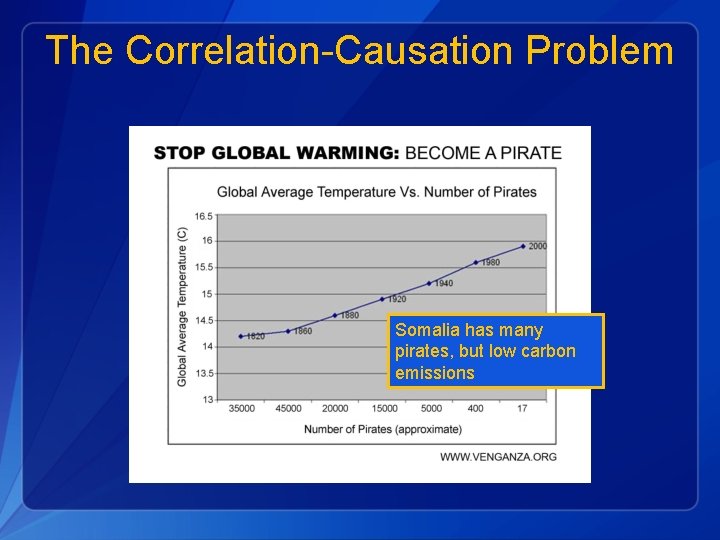
The Correlation-Causation Problem Somalia has many pirates, but low carbon emissions
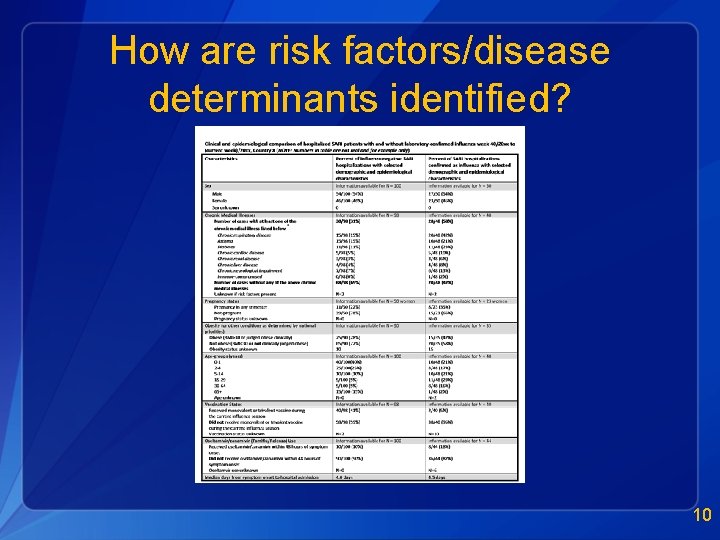
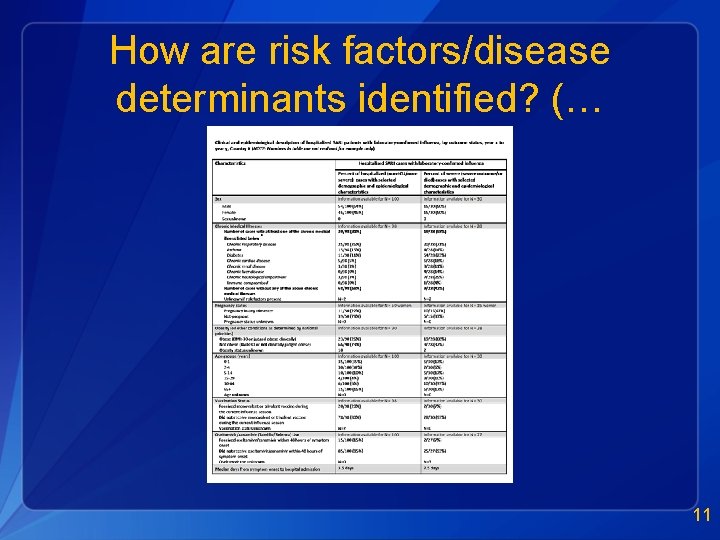
How are risk factors/disease determinants identified? § Individual-level data § Two key variables § Outcome: e. g. influenza § Exposure: e. g. vaccination § Should consider multiple risk factors § Epidemiological study designs used to identify risk factors § Case-control § Cohort § Surveillance data may approximate a cohort study § Biological plausibility § e. g. age and influenza infection § Exposure (risk factor) must occur prior to outcome (disease)
Types of variables § Continuous § E. g. Age § Categorical variables § Binary § E. g. Gender, vaccination status § Ordinal § E. g. Age group, socioeconomic status (SES) § Nominal/Categorical § E. g. Geographic region § Count § E. g. number of ILI symptoms
How are risk factors/disease determinants identified? 10
How are risk factors/disease determinants identified? (… continue …) 11
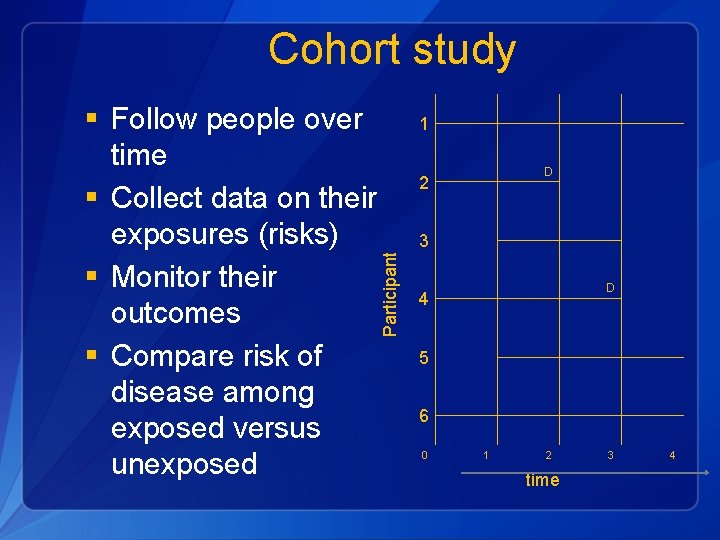
Cohort study 1 D 2 3 Participant § Follow people over time § Collect data on their exposures (risks) § Monitor their outcomes § Compare risk of disease among exposed versus unexposed D 4 5 6 0 1 2 time 3 4
Example: cohort study § e. g. Risk of death among SARI admissions § Outcome: death § Risk factors: age, underlying conditions, influenza-positive § Source population: all patients admitted with SARI, followed until death or discharge 13
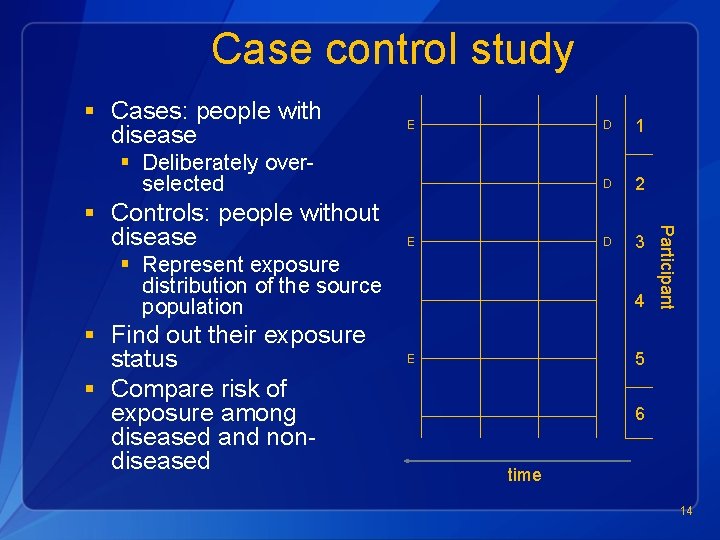
Case control study § Cases: people with disease E § Deliberately overselected E § Represent exposure distribution of the source population § Find out their exposure status § Compare risk of exposure among diseased and nondiseased 1 D 2 D 3 4 Participant § Controls: people without disease D 5 E 6 time 14
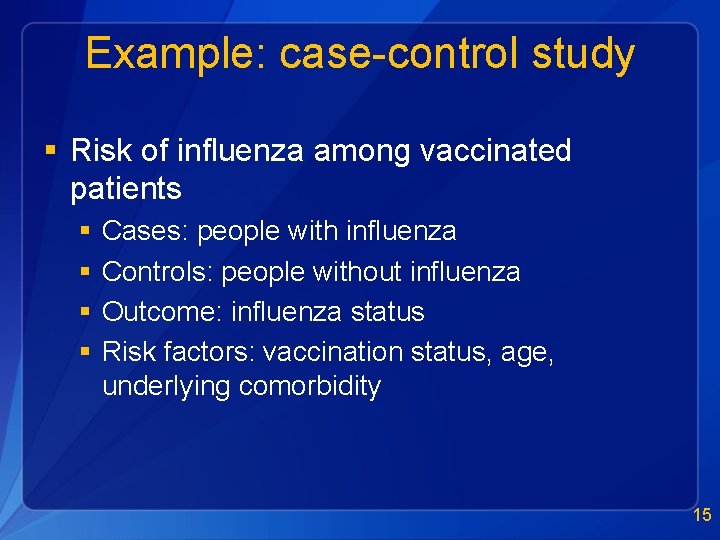
Example: case-control study § Risk of influenza among vaccinated patients § § Cases: people with influenza Controls: people without influenza Outcome: influenza status Risk factors: vaccination status, age, underlying comorbidity 15
Statistical significance: is the association due to chance alone? § A statistical test is used to assess if an association may be due to chance alone (random error) § In statistics, a result is called statistically significant if it is unlikely to have occurred by chance alone, according to a pre-determined threshold probability, the significance level (e. g. α: 0. 05). 16
Common statistical tests § Categorical data: § Chi-square ( 2) test, § Fisher’s test § Mc. Nemar’s test § Continuous data: § T-test § Wilcoxon rank-sum test § ANOVA § These tests can tell if there’s a difference between groups but do not convey the size or direction of effects
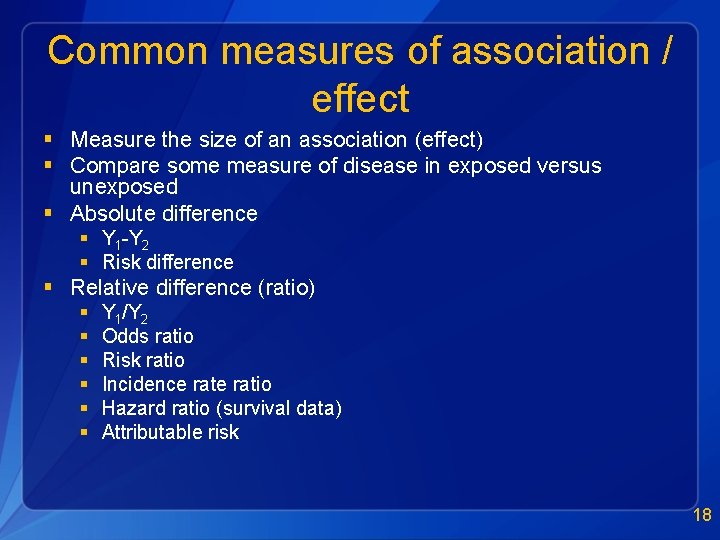
Common measures of association / effect § Measure the size of an association (effect) § Compare some measure of disease in exposed versus unexposed § Absolute difference § Y 1 -Y 2 § Risk difference § Relative difference (ratio) § § § Y 1/Y 2 Odds ratio Risk ratio Incidence ratio Hazard ratio (survival data) Attributable risk 18
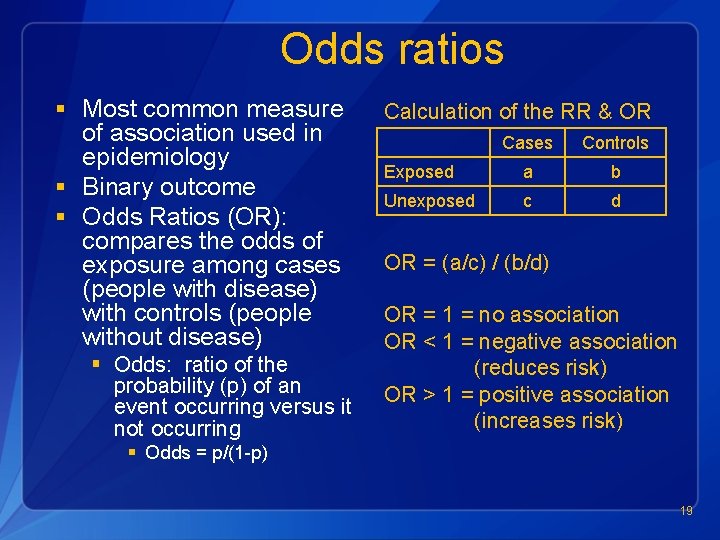
Odds ratios § Most common measure of association used in epidemiology § Binary outcome § Odds Ratios (OR): compares the odds of exposure among cases (people with disease) with controls (people without disease) § Odds: ratio of the probability (p) of an event occurring versus it not occurring Calculation of the RR & OR Cases Controls Exposed a b Unexposed c d OR = (a/c) / (b/d) OR = 1 = no association OR < 1 = negative association (reduces risk) OR > 1 = positive association (increases risk) § Odds = p/(1 -p) 19
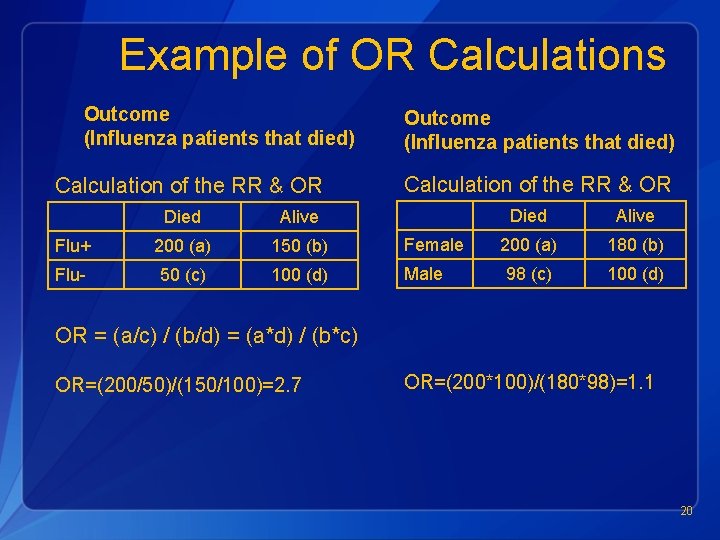
Example of OR Calculations Outcome (Influenza patients that died) Calculation of the RR & OR Died Alive Flu+ 200 (a) 150 (b) Female Flu- 50 (c) 100 (d) Male Died Alive 200 (a) 180 (b) 98 (c) 100 (d) OR = (a/c) / (b/d) = (a*d) / (b*c) OR=(200/50)/(150/100)=2. 7 OR=(200*100)/(180*98)=1. 1 20
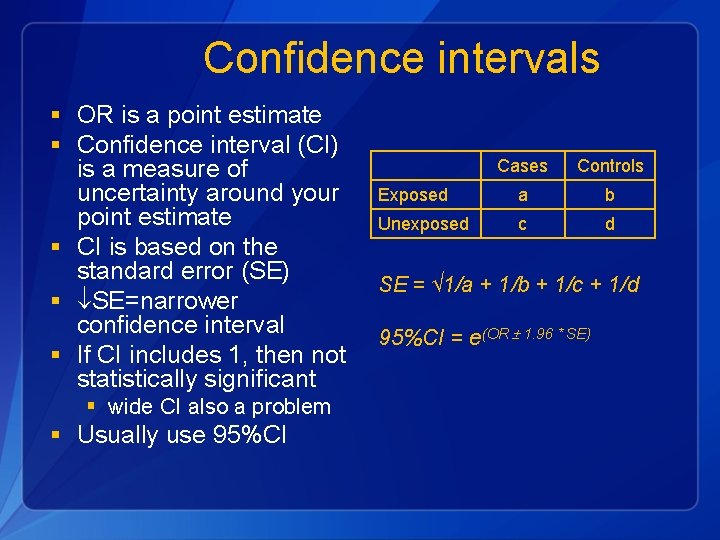
Confidence intervals § OR is a point estimate § Confidence interval (CI) is a measure of uncertainty around your point estimate § CI is based on the standard error (SE) § SE=narrower confidence interval § If CI includes 1, then not statistically significant § wide CI also a problem § Usually use 95%CI Cases Controls Exposed a b Unexposed c d SE = √ 1/a + 1/b + 1/c + 1/d 95%CI = e(OR 1. 96 * SE)
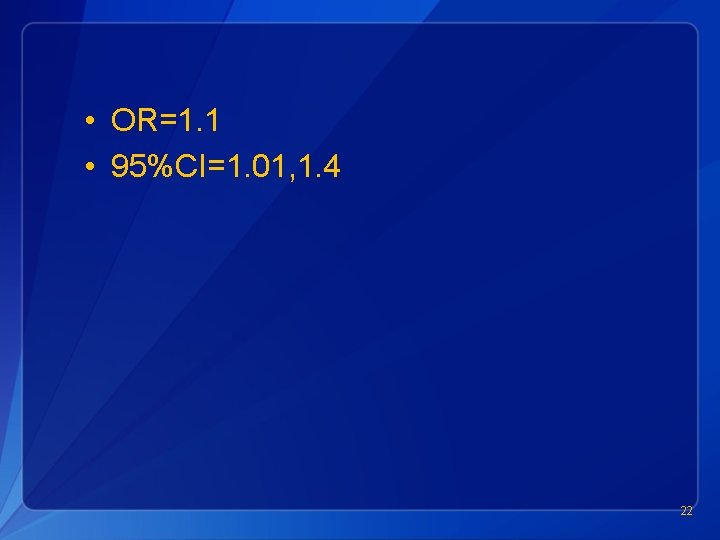
• OR=1. 1 • 95%CI=1. 01, 1. 4 22
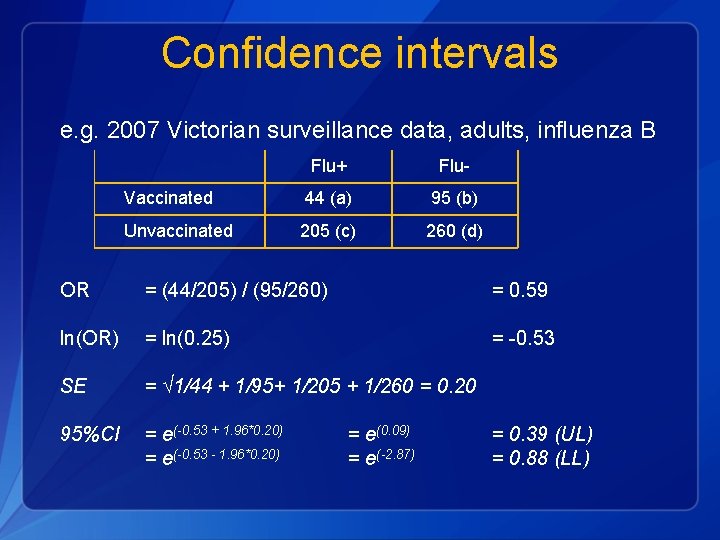
Confidence intervals e. g. 2007 Victorian surveillance data, adults, influenza B Flu+ Flu- Vaccinated 44 (a) 95 (b) Unvaccinated 205 (c) 260 (d) OR = (44/205) / (95/260) = 0. 59 ln(OR) = ln(0. 25) = -0. 53 SE = √ 1/44 + 1/95+ 1/205 + 1/260 = 0. 20 95%CI = e(-0. 53 + 1. 96*0. 20) = e(-0. 53 - 1. 96*0. 20) = e(0. 09) = e(-2. 87) = 0. 39 (UL) = 0. 88 (LL)
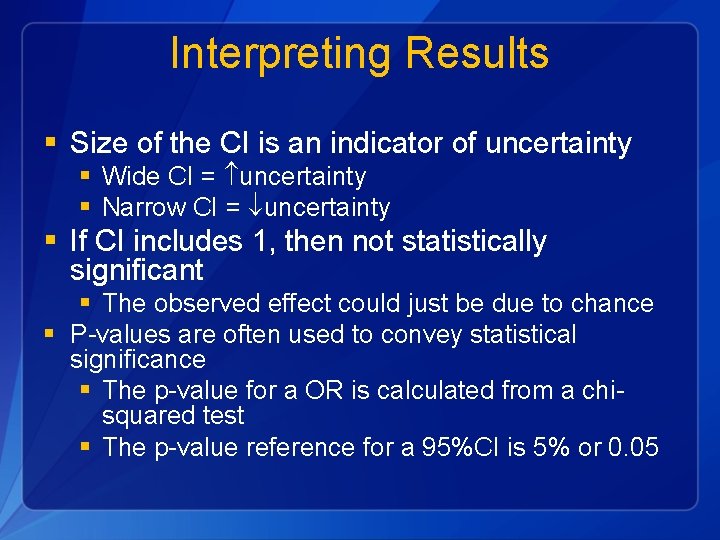
Interpreting Results § Size of the CI is an indicator of uncertainty § Wide CI = uncertainty § Narrow CI = uncertainty § If CI includes 1, then not statistically significant § The observed effect could just be due to chance § P-values are often used to convey statistical significance § The p-value for a OR is calculated from a chisquared test § The p-value reference for a 95%CI is 5% or 0. 05
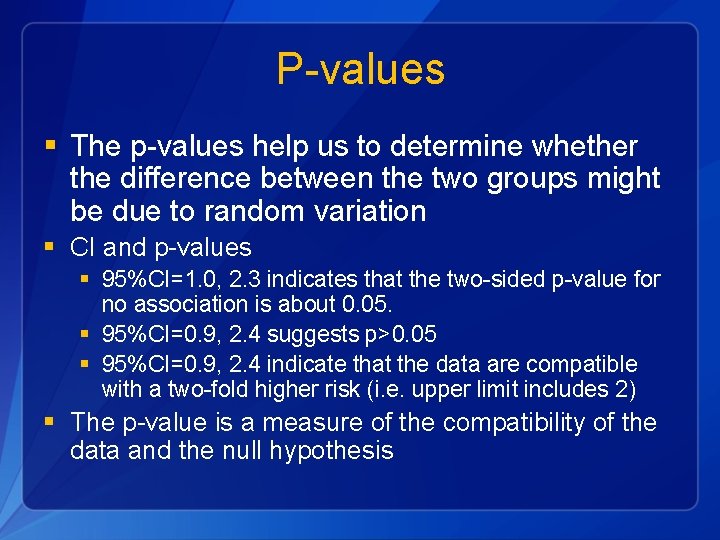
P-values § The p-values help us to determine whether the difference between the two groups might be due to random variation § CI and p-values § 95%CI=1. 0, 2. 3 indicates that the two-sided p-value for no association is about 0. 05. § 95%CI=0. 9, 2. 4 suggests p>0. 05 § 95%CI=0. 9, 2. 4 indicate that the data are compatible with a two-fold higher risk (i. e. upper limit includes 2) § The p-value is a measure of the compatibility of the data and the null hypothesis
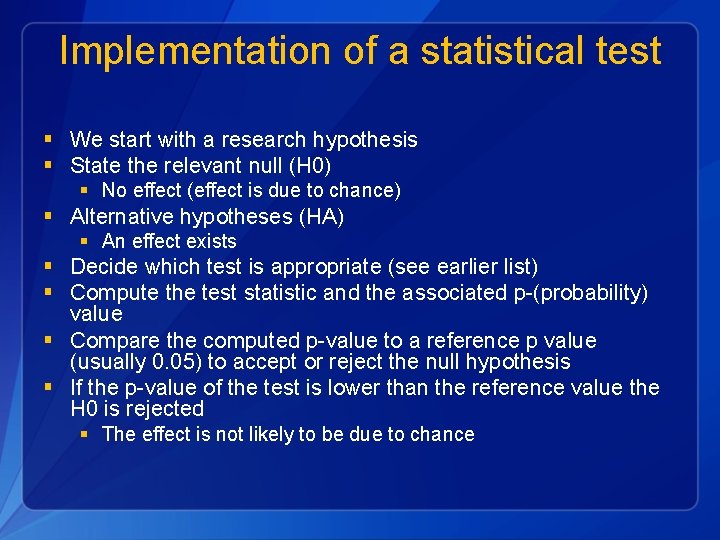
Implementation of a statistical test § We start with a research hypothesis § State the relevant null (H 0) § No effect (effect is due to chance) § Alternative hypotheses (HA) § An effect exists § Decide which test is appropriate (see earlier list) § Compute the test statistic and the associated p-(probability) value § Compare the computed p-value to a reference p value (usually 0. 05) to accept or reject the null hypothesis § If the p-value of the test is lower than the reference value the H 0 is rejected § The effect is not likely to be due to chance
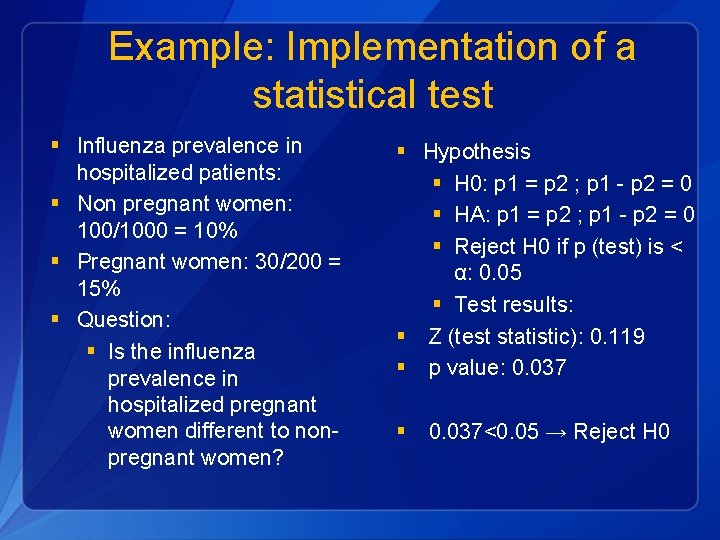
Example: Implementation of a statistical test § Influenza prevalence in hospitalized patients: § Non pregnant women: 100/1000 = 10% § Pregnant women: 30/200 = 15% § Question: § Is the influenza prevalence in hospitalized pregnant women different to nonpregnant women? § Hypothesis § H 0: p 1 = p 2 ; p 1 - p 2 = 0 § HA: p 1 = p 2 ; p 1 - p 2 = 0 § Reject H 0 if p (test) is < α: 0. 05 § Test results: § Z (test statistic): 0. 119 § p value: 0. 037 § 0. 037<0. 05 → Reject H 0
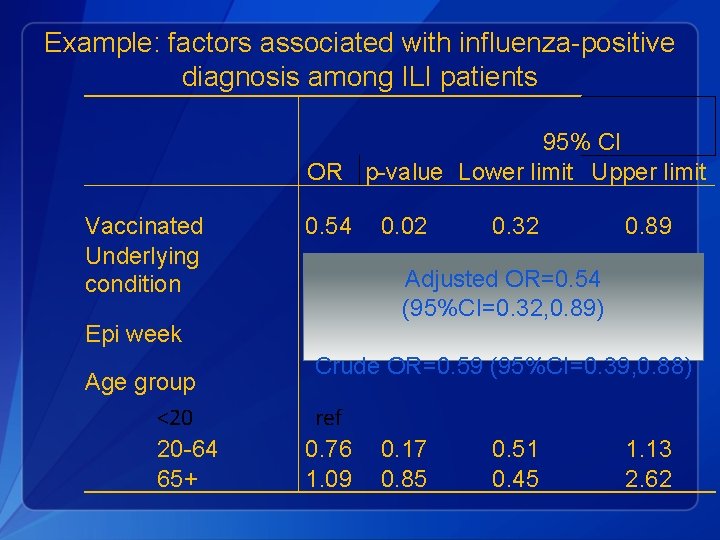
Example: factors associated with influenza-positive diagnosis among ILI patients 95% CI OR p-value Lower limit Upper limit Vaccinated Underlying condition Epi week Age group <20 20 -64 65+ 0. 54 0. 02 0. 32 0. 89 Adjusted 0. 72 OR=0. 54 2. 00 0. 47 (95%CI=0. 32, 0. 89) 1. 04 0. 01 1. 08 Crude OR=0. 59 (95%CI=0. 39, 0. 88) 1. 20 ref 0. 76 1. 09 0. 17 0. 85 0. 51 0. 45 1. 13 2. 62
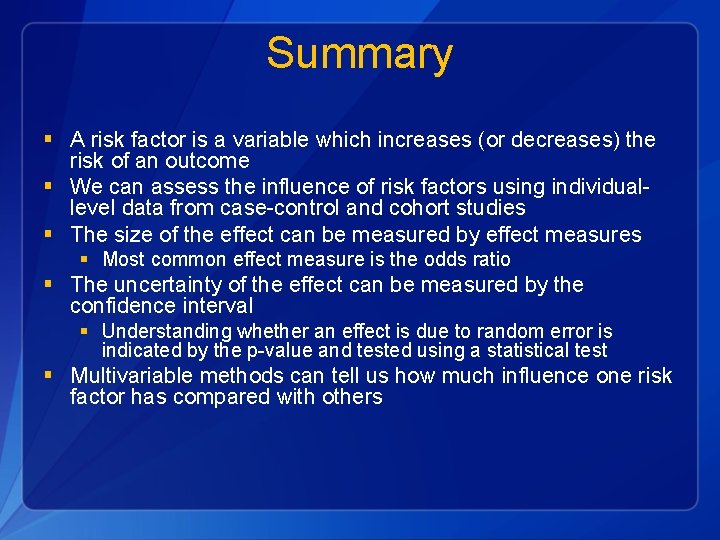
Summary § A risk factor is a variable which increases (or decreases) the risk of an outcome § We can assess the influence of risk factors using individuallevel data from case-control and cohort studies § The size of the effect can be measured by effect measures § Most common effect measure is the odds ratio § The uncertainty of the effect can be measured by the confidence interval § Understanding whether an effect is due to random error is indicated by the p-value and tested using a statistical test § Multivariable methods can tell us how much influence one risk factor has compared with others