
Introduction to Risk Communication for Public Health Emergencies
Introduction to Risk Communication for Public Health Emergencies International Health Regulations(2005)
Pan American Health Organization World Health Organization International Health Regulations The new IHR entered into force on 15 June 2007 194 State Parties have signed on Apply to public health emergency of international concern The IHRs call for: q Prevention, alert and response q Global partnership and international collaboration q Rights, obligations, procedures, progress monitoring q Strengthened national capacity
Pan American Health Organization World Health Organization Role of Communication in Public Health Emergencies International Health Regulations(2005): Prevent and respond to acute public health risks that have the potential to cross borders and threaten people worldwide. Public Health Emergencies of International Concern: i) constitute a public health risk to other States, and ii) potentially require a coordinated international response
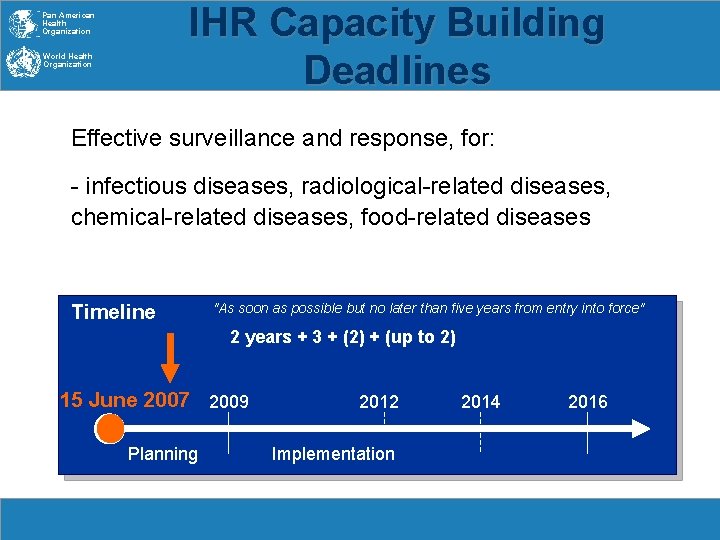
IHR Capacity Building Deadlines Pan American Health Organization World Health Organization Effective surveillance and response, for: - infectious diseases, radiological-related diseases, chemical-related diseases, food-related diseases Timeline "As soon as possible but no later than five years from entry into force" 2 years + 3 + (2) + (up to 2) 15 June 2007 2009 Planning 2012 Implementation 2014 2016

Pan American Health Organization World Health Organization Core Capacities required under the IHR 1. National Legislation 2. Policy and Coordination 3. Surveillance Capacity 4. Preparedness 5. Response 6. Risk Communication 7. Laboratory 8. Human Resource Capacity for Surveillance and Response Challenge: • Very new field of study • Western bias • Disagreement even among experts
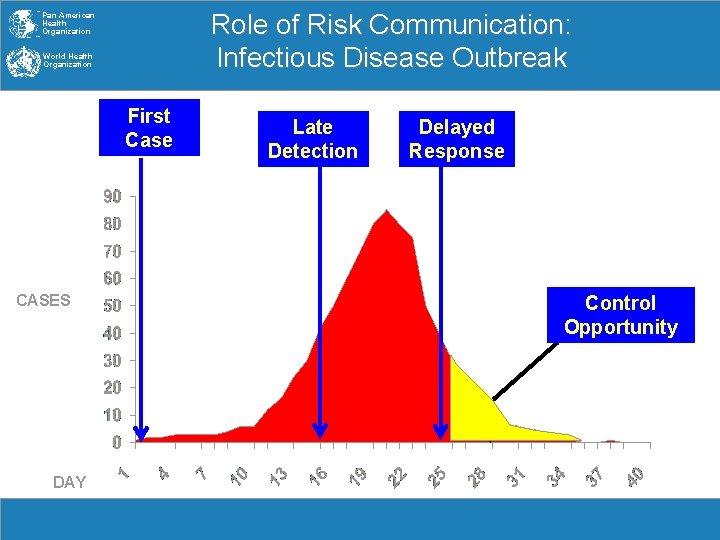
Role of Risk Communication: Infectious Disease Outbreak Pan American Health Organization World Health Organization First Case CASES DAY Late Detection Delayed Response Control Opportunity
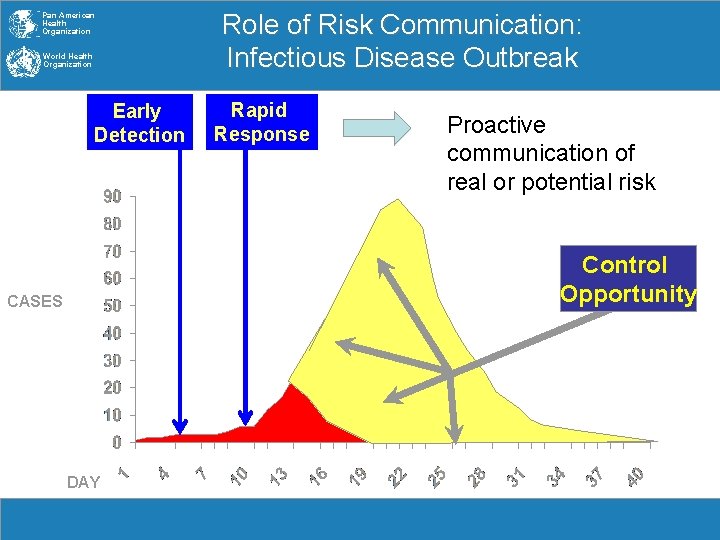
Pan American Health Organization World Health Organization Early Detection Role of Risk Communication: Infectious Disease Outbreak Rapid Response Proactive communication of real or potential risk Control Opportunity CASES DAY
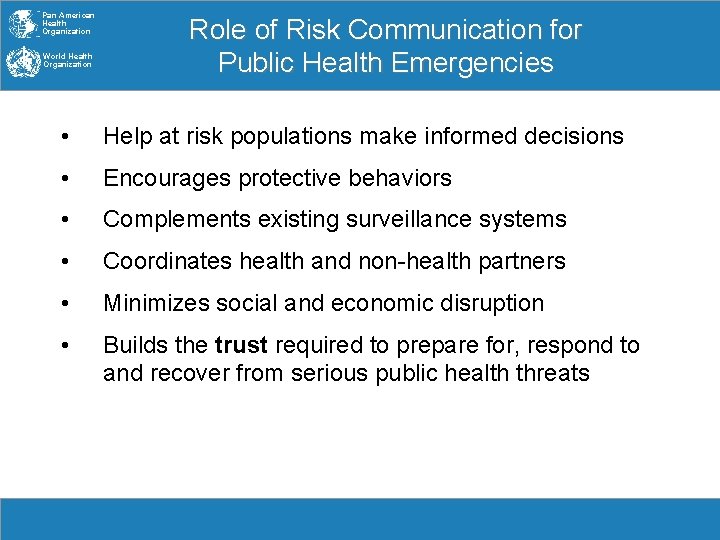
Pan American Health Organization World Health Organization Role of Risk Communication for Public Health Emergencies • Help at risk populations make informed decisions • Encourages protective behaviors • Complements existing surveillance systems • Coordinates health and non-health partners • Minimizes social and economic disruption • Builds the trust required to prepare for, respond to and recover from serious public health threats
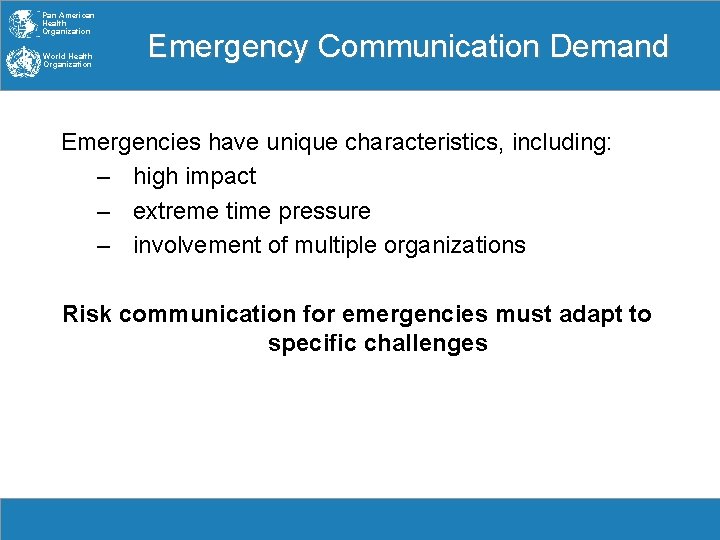
Pan American Health Organization World Health Organization Emergency Communication Demand Emergencies have unique characteristics, including: – high impact – extreme time pressure – involvement of multiple organizations Risk communication for emergencies must adapt to specific challenges
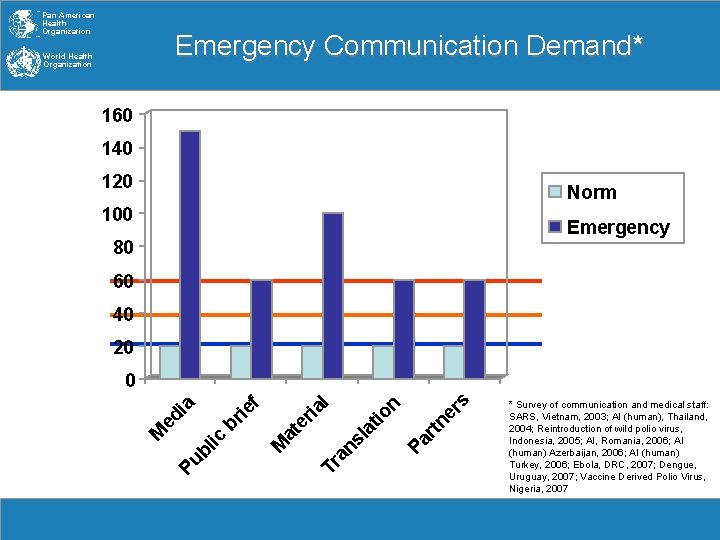
Pan American Health Organization Emergency Communication Demand* World Health Organization 160 140 120 Norm 100 Emergency 80 60 40 20 Tr rs ne rt Pa an sl a tio n l at er ia M br ic bl Pu M ed i ie a f 0 * Survey of communication and medical staff: SARS, Vietnam, 2003; AI (human), Thailand, 2004; Reintroduction of wild polio virus, Indonesia, 2005; AI, Romania, 2006; AI (human) Azerbaijan, 2006; AI (human) Turkey, 2006; Ebola, DRC, 2007; Dengue, Uruguay, 2007; Vaccine Derived Polio Virus, Nigeria, 2007
Pan American Health Organization World Health Organization Emergency Communication Demand • Analysis further suggests it is not only workload that increases • Emergency communication typically has unique characteristics: – Shift from national to international interest – Non-health media involvement – Economic consequences – Direct involvement of senior political actors
Pan American Health Organization World Health Organization Core Capacities required under the IHR 1. National Legislation 2. Policy and Coordination 3. Surveillance Capacity 4. Preparedness 5. Response 6. Risk Communication 7. Laboratory 8. Human Resource Capacity for Surveillance and Response What is Risk Communication for Public Health Emergencies?

Pan American Health Organization World Health Organization Risk Communication for Public Health Emergencies Social Mobilization Media Relations Risk Management
Pan American Health Organization World Health Organization Core Capacities required under the IHR 1. National Legislation 2. Policy and Coordination 3. Surveillance Capacity 4. Preparedness 5. Response 6. Risk Communication 7. Laboratory 8. Human Resource Capacity for Surveillance and Response What is Risk Communication for public health emergencies under the IHR?
Pan American Health Organization World Health Organization Core Capacities in Risk Communication for Public Health Emergencies Global Health Security Communication Network, Lyon, France 2009, recommended: • Transparency and first announcement of a real or potential risk • Public Communication Coordination • Information dissemination including media relations • Listening through Dialogue • Emergency Communication Plan
Pan American Health Organization World Health Organization Core Capacities in Risk Communication for Public Health Emergencies Transparency and first announcement of a real/potential risk: • • • rapidly approve warnings and advisories effectively issue in non-business hours ensure hard to reach/minority populations are informed adhere to decision making principles ensure transparency evaluated against principles engage decision makers and communication partners in pre-event exercises concentrating on emergency risk communication decision making • conduct ongoing assessments of transparency capacity
Pan American Health Organization World Health Organization Core Capacities in Risk Communication for Public Health Emergencies Public Communication Coordination • • identify focal points among emergency partners share public messages and strategies define and apply public communication roles and responsibilities among likely emergency partners access communication capacity among partners engage other existing information sharing networks consult partners on key public communication strategies adapt public communication coordination mechanisms, roles and responsibilities according to emergency share sensitive communication information with partners
Pan American Health Organization World Health Organization Core Capacities in Risk Communication for Public Health Emergencies Information dissemination incl media relations • • ensure qualified/trained public spokespersons are available respond to demands of emergency media relations efficiently/effectively access other dissemination channels reach vulnerable, “hard to reach”, minority -populations with accessible emergency information ensure basic IEC materials and messages on common emergency response elements brief media in advance of an emergency quickly measure reach and impact of communication
Pan American Health Organization World Health Organization Core Capacities in Risk Communication for Public Health Emergencies Listening through Dialogue • • • gather perceptions of individuals, partners and communities and adapt strategies as required monitor traditional and non-traditional media for questions, information needs, points of confusion and rumors access existing vulnerability/needs assessments for different communities and groups within communities access culture, language and socio-economic profiles use emergency information gathering templates reflect findings of the listening processes back into emergency management decision making
Pan American Health Organization World Health Organization Core Capacities in Risk Communication for Public Health Emergencies Emergency Communication Plan • • • Develop a simple public health emergency plan which builds from day to day approaches Ensure key functions such as media relations, material production and internet communication are planned for Integrate into the broader public health emergency plan
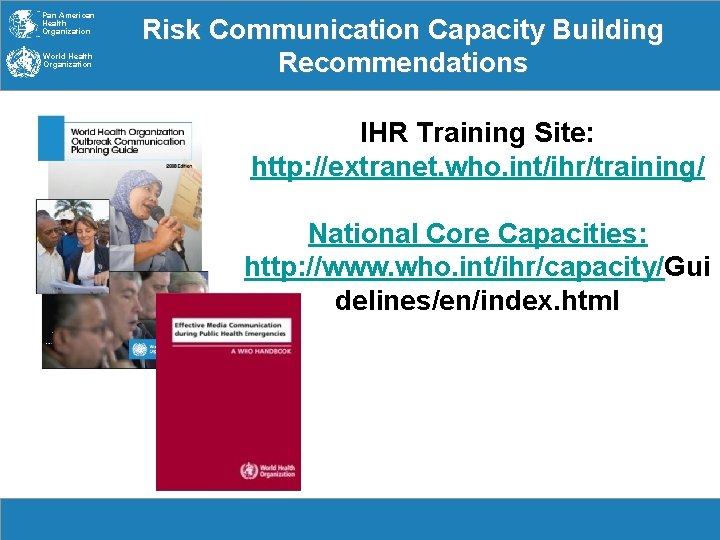
Pan American Health Organization World Health Organization Risk Communication Capacity Building Recommendations IHR Training Site: http: //extranet. who. int/ihr/training/ National Core Capacities: http: //www. who. int/ihr/capacity/Gui delines/en/index. html
- Slides: 21