
INTRODUCTION TO RISK ASSESSMENT What is Risk Conceptual
- Slides: 1
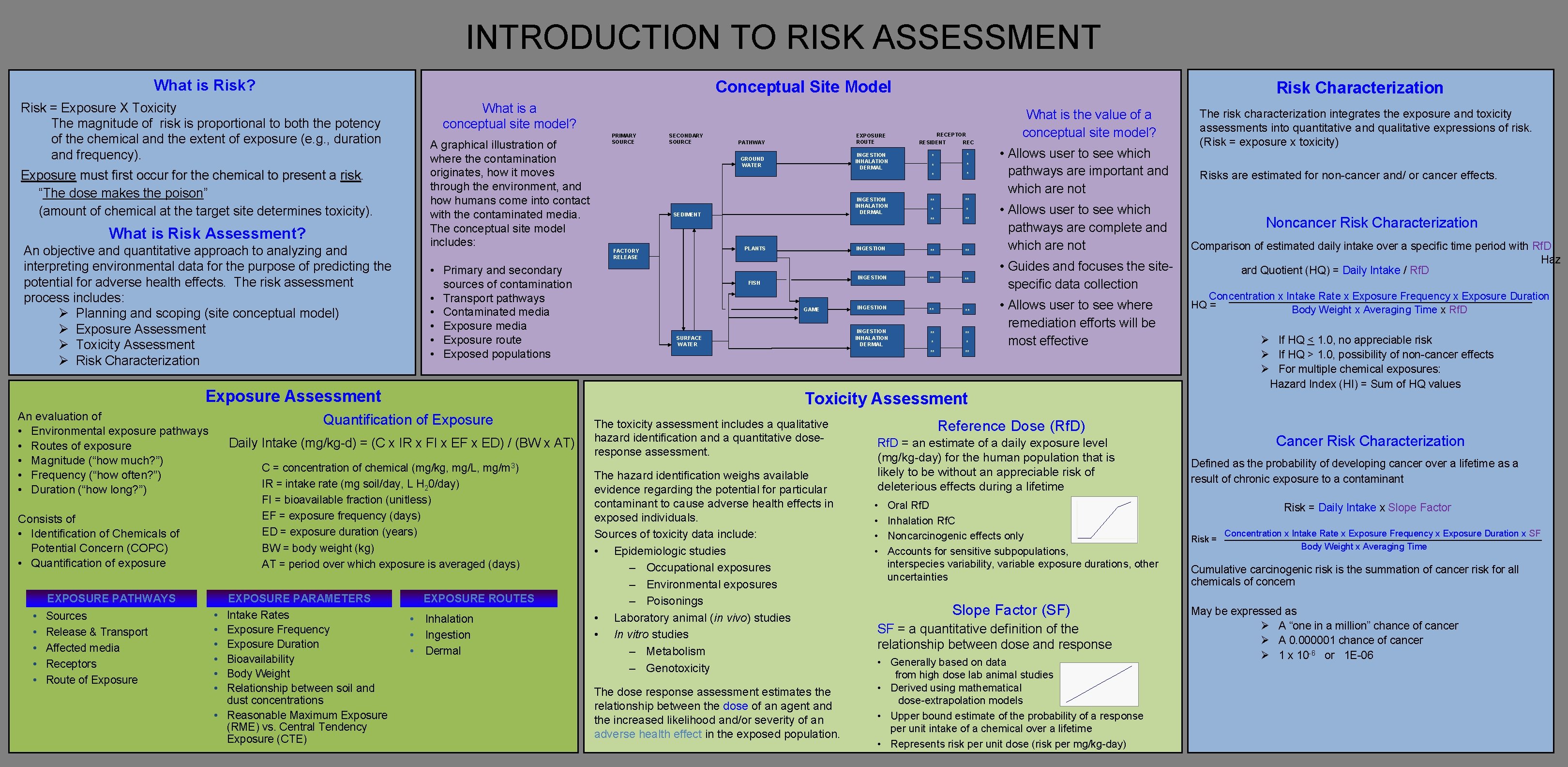
INTRODUCTION TO RISK ASSESSMENT What is Risk? Conceptual Site Model Risk = Exposure X Toxicity The magnitude of risk is proportional to both the potency of the chemical and the extent of exposure (e. g. , duration and frequency). What is a conceptual site model? A graphical illustration of where the contamination originates, how it moves through the environment, and how humans come into contact with the contaminated media. The conceptual site model includes: Exposure must first occur for the chemical to present a risk. “The dose makes the poison” (amount of chemical at the target site determines toxicity). What is Risk Assessment? An objective and quantitative approach to analyzing and interpreting environmental data for the purpose of predicting the potential for adverse health effects. The risk assessment process includes: Ø Planning and scoping (site conceptual model) Ø Exposure Assessment Ø Toxicity Assessment Ø Risk Characterization • Primary and secondary sources of contamination • Transport pathways • Contaminated media • Exposure route • Exposed populations Exposure Assessment An evaluation of • Environmental exposure pathways • Routes of exposure • Magnitude (“how much? ”) • Frequency (“how often? ”) • Duration (“how long? ”) Daily Intake (mg/kg-d) = (C x IR x FI x EF x ED) / (BW x AT) C = concentration of chemical (mg/kg, mg/L, mg/m 3) IR = intake rate (mg soil/day, L H 20/day) FI = bioavailable fraction (unitless) EF = exposure frequency (days) ED = exposure duration (years) BW = body weight (kg) AT = period over which exposure is averaged (days) EXPOSURE PATHWAYS • • • Sources Release & Transport Affected media Receptors Route of Exposure • • EXPOSURE PARAMETERS Intake Rates Exposure Frequency Exposure Duration Bioavailability Body Weight Relationship between soil and dust concentrations Reasonable Maximum Exposure (RME) vs. Central Tendency Exposure (CTE) PRIMARY SOURCE SECONDARY SOURCE PATHWAY GROUND WATER INGESTION INHALATION DERMAL SEDIMENT PLANTS FACTORY RELEASE RECEPTOR RESIDENT REC EXPOSURE ROUTE INGESTION FISH GAME SURFACE WATER * * * ** ** ** INGESTION ** ** INGESTION INHALATION DERMAL ** ** ** What is the value of a conceptual site model? • Allows user to see which pathways are important and which are not • Allows user to see which pathways are complete and which are not • Guides and focuses the sitespecific data collection • Allows user to see where remediation efforts will be most effective The risk characterization integrates the exposure and toxicity assessments into quantitative and qualitative expressions of risk. (Risk = exposure x toxicity) Risks are estimated for non-cancer and/ or cancer effects. Noncancer Risk Characterization Comparison of estimated daily intake over a specific time period with Rf. D Haz ard Quotient (HQ) = Daily Intake / Rf. D Concentration x Intake Rate x Exposure Frequency x Exposure Duration HQ = Body Weight x Averaging Time x Rf. D Ø If HQ < 1. 0, no appreciable risk Ø If HQ > 1. 0, possibility of non-cancer effects Ø For multiple chemical exposures: Hazard Index (HI) = Sum of HQ values Toxicity Assessment Quantification of Exposure Consists of • Identification of Chemicals of Potential Concern (COPC) • Quantification of exposure Risk Characterization EXPOSURE ROUTES • • • Inhalation Ingestion Dermal The toxicity assessment includes a qualitative hazard identification and a quantitative doseresponse assessment. The hazard identification weighs available evidence regarding the potential for particular contaminant to cause adverse health effects in exposed individuals. Sources of toxicity data include: • Epidemiologic studies – Occupational exposures – Environmental exposures – Poisonings • Laboratory animal (in vivo) studies • In vitro studies – Metabolism – Genotoxicity The dose response assessment estimates the relationship between the dose of an agent and the increased likelihood and/or severity of an adverse health effect in the exposed population. Reference Dose (Rf. D) Rf. D = an estimate of a daily exposure level (mg/kg-day) for the human population that is likely to be without an appreciable risk of deleterious effects during a lifetime • • Oral Rf. D Inhalation Rf. C Noncarcinogenic effects only Accounts for sensitive subpopulations, interspecies variability, variable exposure durations, other uncertainties Slope Factor (SF) SF = a quantitative definition of the relationship between dose and response • Generally based on data from high dose lab animal studies • Derived using mathematical dose-extrapolation models • Upper bound estimate of the probability of a response per unit intake of a chemical over a lifetime • Represents risk per unit dose (risk per mg/kg-day) Cancer Risk Characterization Defined as the probability of developing cancer over a lifetime as a result of chronic exposure to a contaminant Risk = Daily Intake x Slope Factor Risk = Concentration x Intake Rate x Exposure Frequency x Exposure Duration x SF Body Weight x Averaging Time Cumulative carcinogenic risk is the summation of cancer risk for all chemicals of concern May be expressed as Ø A “one in a million” chance of cancer Ø A 0. 000001 chance of cancer Ø 1 x 10 -6 or 1 E-06