
Introduction to Rheology Part 1 Introduction to the





- Slides: 27
Introduction to Rheology Part 1 Introduction to the Rheology of Complex Fluids Dr. Aldo Acevedo - ERC SOPS 1
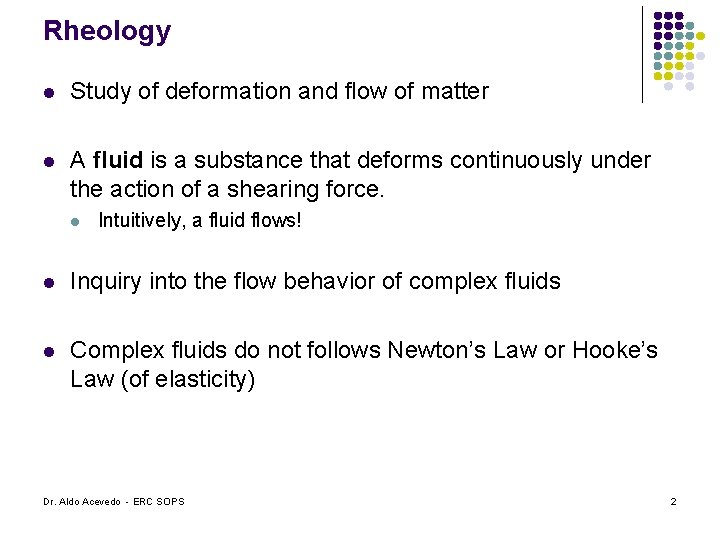
Rheology l Study of deformation and flow of matter l A fluid is a substance that deforms continuously under the action of a shearing force. l Intuitively, a fluid flows! l Inquiry into the flow behavior of complex fluids l Complex fluids do not follows Newton’s Law or Hooke’s Law (of elasticity) Dr. Aldo Acevedo - ERC SOPS 2
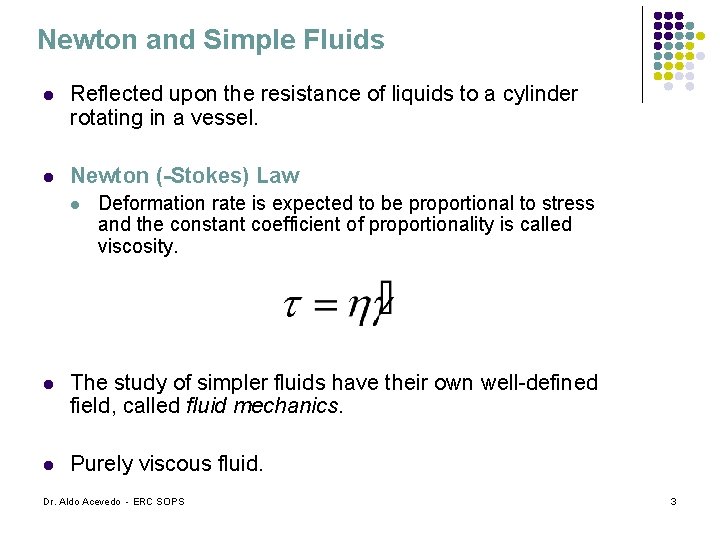
Newton and Simple Fluids l Reflected upon the resistance of liquids to a cylinder rotating in a vessel. l Newton (-Stokes) Law l Deformation rate is expected to be proportional to stress and the constant coefficient of proportionality is called viscosity. l The study of simpler fluids have their own well-defined field, called fluid mechanics. l Purely viscous fluid. Dr. Aldo Acevedo - ERC SOPS 3
What is Rheology Anyway? An answer for your baffled family and friends. * l “Rheology is the study of the flow of materials that behave in an interesting or unusual manner. Oil and water flow in familiar, normal ways, whereas mayonnaise, peanut butter, chocolate, bread dough, and silly putty flow in complex and unusual ways. In rheology, we study the flows of unusual materials. ” l “… all normal or Newtonian fluids (air, water, oil, honey) follow the same scientific laws. On the other hand, there also fluids that do not follow the Newtonian flow laws. These non-Newtonian fluids, for example mayo, paint, molten plastics, foams, clays, and many other fluids, behave in a wide variety of ways. The science of studying these types of unusual materials is called rheology” *Faith Morrison, “The News and Information Publication of The Society of Rheology”, Vol 73(1) Jan 2004, pp 8 -10 4 Dr. Aldo Acevedo - ERC SOPS
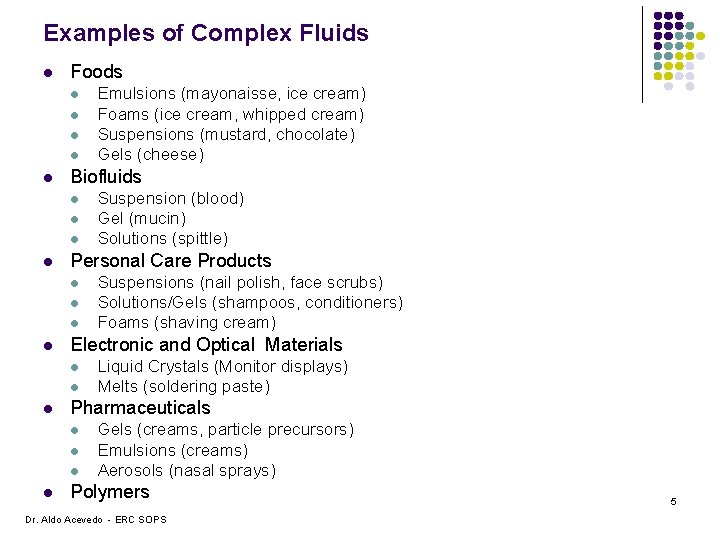
Examples of Complex Fluids l Foods l l l Biofluids l l l l Liquid Crystals (Monitor displays) Melts (soldering paste) Pharmaceuticals l l Suspensions (nail polish, face scrubs) Solutions/Gels (shampoos, conditioners) Foams (shaving cream) Electronic and Optical Materials l l Suspension (blood) Gel (mucin) Solutions (spittle) Personal Care Products l l Emulsions (mayonaisse, ice cream) Foams (ice cream, whipped cream) Suspensions (mustard, chocolate) Gels (cheese) Gels (creams, particle precursors) Emulsions (creams) Aerosols (nasal sprays) Polymers Dr. Aldo Acevedo - ERC SOPS 5
Rheology’s Goals Establishing the relationship between applied forces and geometrical effects induced by these forces at a point (in a fluid). 1. l l l The mathematical form of this relationship is called the rheological equation of state, or the constitutive equation. The constitutive equations are used to solve macroscopic problems related to continuum mechanics of these materials. Any equation is just a model of physical reality. Dr. Aldo Acevedo - ERC SOPS 6
Rheology’s Goals Establishing the relationship between rheological properties of material and its molecular structure (composition). 1. Related to: l l l Estimating quality of materials Understanding laws of molecular movements Intermolecular interactions Interested in what happens inside a point during deformation of the medium. What happens inside a point? Dr. Aldo Acevedo - ERC SOPS 7
(Material) Structure l More or less well-organized and regularly spaced shapes l Arrangements, organization or intermolecular interactions l Structured Materials – properties change due to the influence of applied forces on the structure of matter l Rheology sometimes is referred to as mechanical spectroscopy. l “Structure Mechanisms” are usually proposed, analogous to reaction mechanisms in reaction kinetics l Structural probes are used to support rheological studies and proposed mechanisms. Does Newtonian fluids suffer structural changes? Dr. Aldo Acevedo - ERC SOPS 8
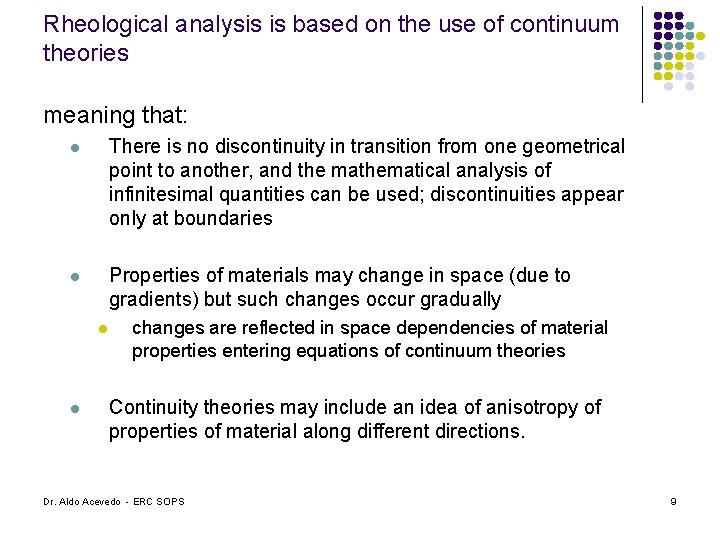
Rheological analysis is based on the use of continuum theories meaning that: l There is no discontinuity in transition from one geometrical point to another, and the mathematical analysis of infinitesimal quantities can be used; discontinuities appear only at boundaries l Properties of materials may change in space (due to gradients) but such changes occur gradually l l changes are reflected in space dependencies of material properties entering equations of continuum theories Continuity theories may include an idea of anisotropy of properties of material along different directions. Dr. Aldo Acevedo - ERC SOPS 9
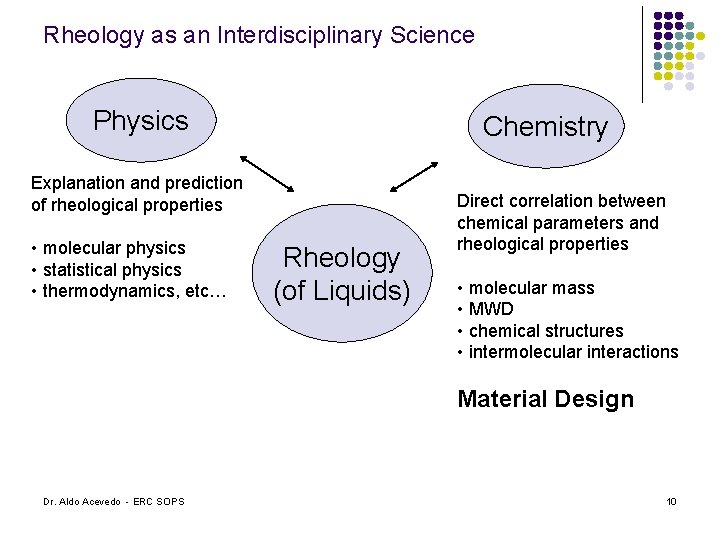
Rheology as an Interdisciplinary Science Physics Chemistry Explanation and prediction of rheological properties • molecular physics • statistical physics • thermodynamics, etc… Rheology (of Liquids) Direct correlation between chemical parameters and rheological properties • molecular mass • MWD • chemical structures • intermolecular interactions Material Design Dr. Aldo Acevedo - ERC SOPS 10
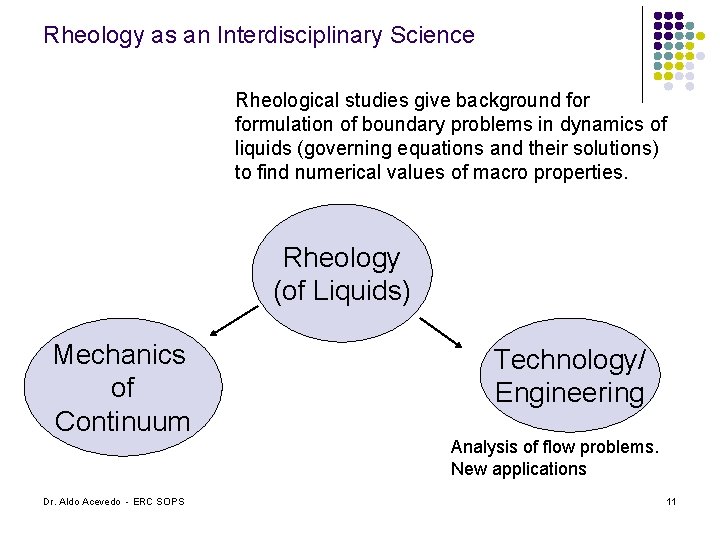
Rheology as an Interdisciplinary Science Rheological studies give background formulation of boundary problems in dynamics of liquids (governing equations and their solutions) to find numerical values of macro properties. Rheology (of Liquids) Mechanics of Continuum Dr. Aldo Acevedo - ERC SOPS Technology/ Engineering Analysis of flow problems. New applications 11
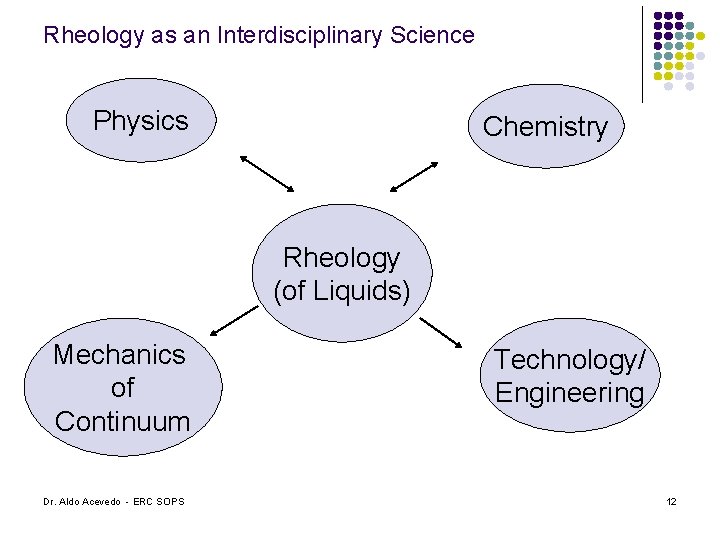
Rheology as an Interdisciplinary Science Physics Chemistry Rheology (of Liquids) Mechanics of Continuum Dr. Aldo Acevedo - ERC SOPS Technology/ Engineering 12
Rheological Properties l l l Stress l Shear stress l Normal Stress differences Viscosity l Steady-state (i. e. shear) l Extensional l Complex Viscoelastic Modulus l G’ – storage modulus l G” – loss modulus Creep, Compliance, Decay Relaxation times and many more … Dr. Aldo Acevedo - ERC SOPS most commonly sought rheological quantity 13
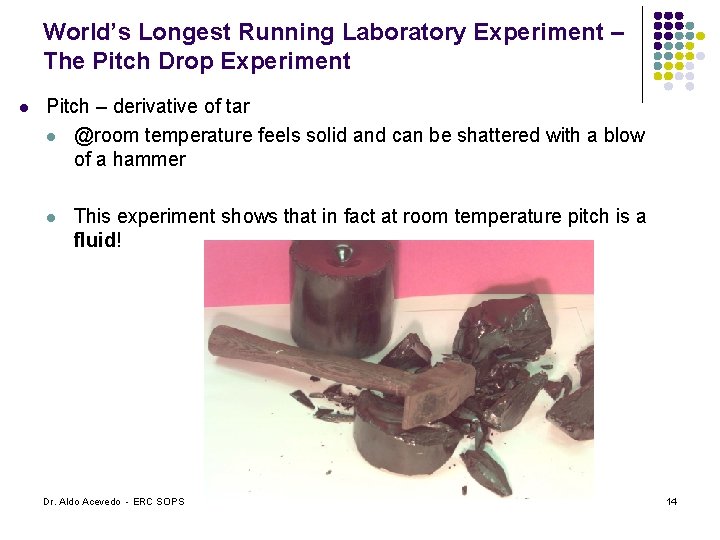
World’s Longest Running Laboratory Experiment – The Pitch Drop Experiment l Pitch – derivative of tar l @room temperature feels solid and can be shattered with a blow of a hammer l This experiment shows that in fact at room temperature pitch is a fluid! Dr. Aldo Acevedo - ERC SOPS 14
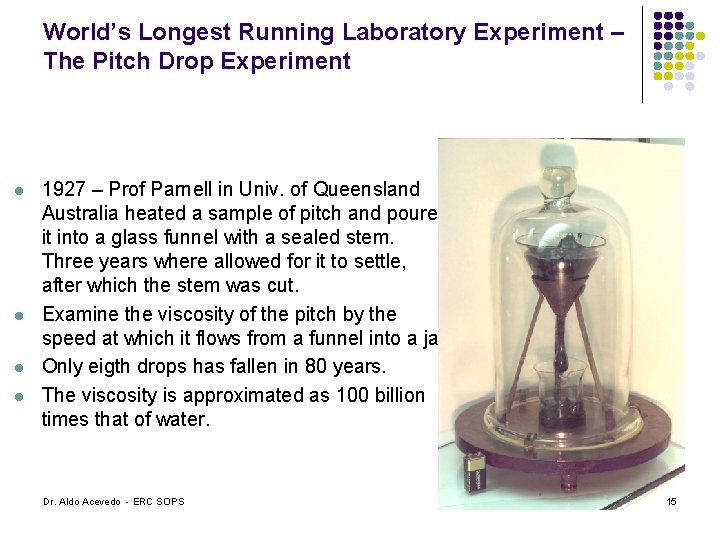
World’s Longest Running Laboratory Experiment – The Pitch Drop Experiment l l 1927 – Prof Parnell in Univ. of Queensland Australia heated a sample of pitch and poured it into a glass funnel with a sealed stem. Three years where allowed for it to settle, after which the stem was cut. Examine the viscosity of the pitch by the speed at which it flows from a funnel into a jar. Only eigth drops has fallen in 80 years. The viscosity is approximated as 100 billion times that of water. Dr. Aldo Acevedo - ERC SOPS 15
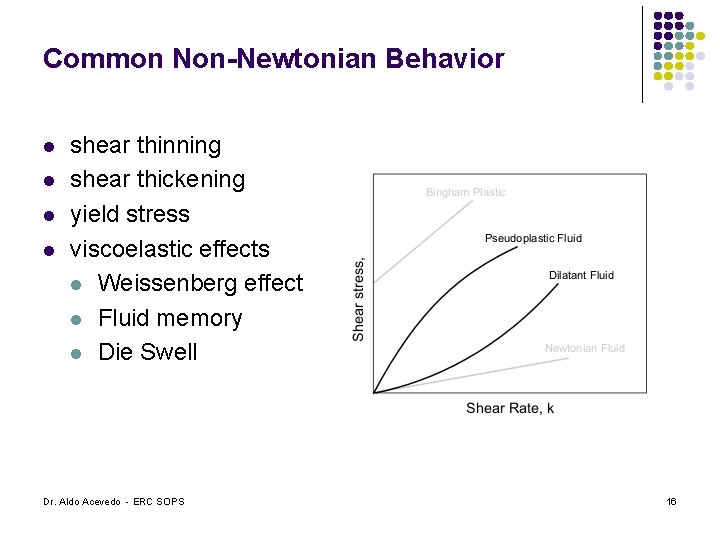
Common Non-Newtonian Behavior l l shear thinning shear thickening yield stress viscoelastic effects l Weissenberg effect l Fluid memory l Die Swell Dr. Aldo Acevedo - ERC SOPS 16
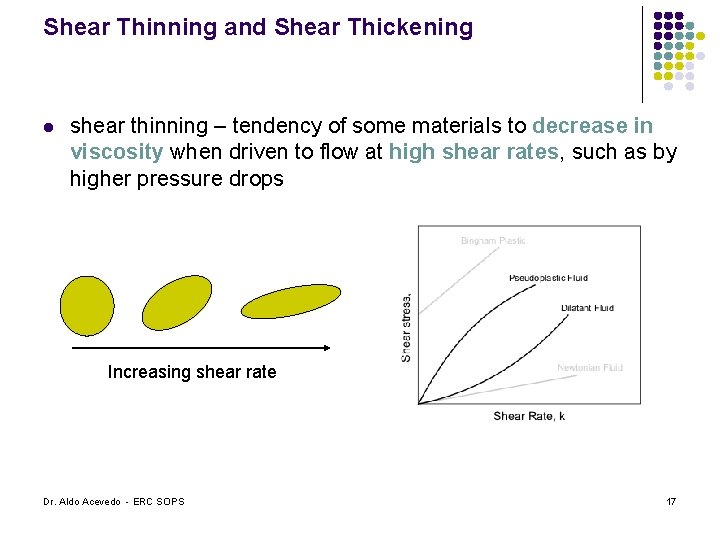
Shear Thinning and Shear Thickening l shear thinning – tendency of some materials to decrease in viscosity when driven to flow at high shear rates, such as by higher pressure drops Increasing shear rate Dr. Aldo Acevedo - ERC SOPS 17
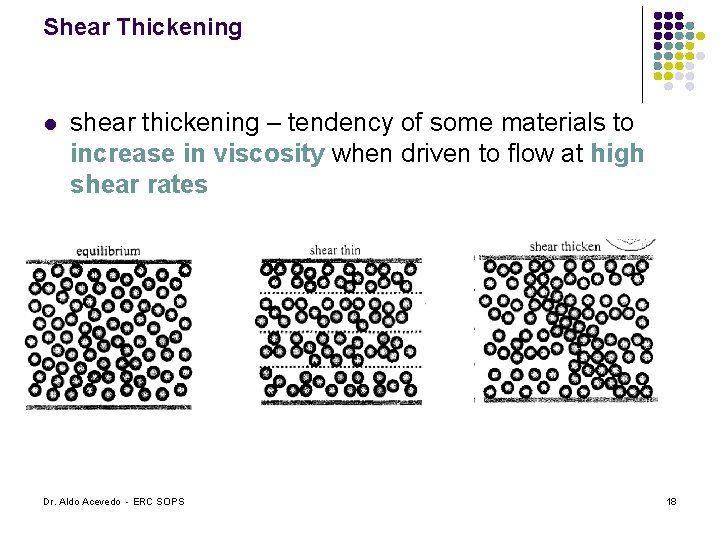
Shear Thickening l shear thickening – tendency of some materials to increase in viscosity when driven to flow at high shear rates Dr. Aldo Acevedo - ERC SOPS 18
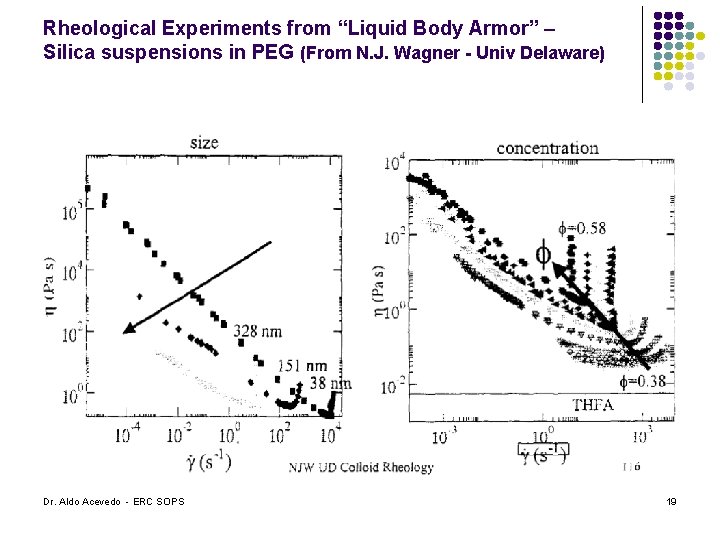
Rheological Experiments from “Liquid Body Armor” – Silica suspensions in PEG (From N. J. Wagner - Univ Delaware) Dr. Aldo Acevedo - ERC SOPS 19
Quicksand – A Non-Newtonian Fluid l Quicksand is a colloid hydrogel (sand, clay and salt water). l When undisturbed behaves as a solid gel, but minor changes in the stress will cause a sudden decrease in its viscosity l After the initial perturbation, water and separate and dense regions of sand sediment l High volume fraction regions -> viscosity increases l Sufficient pressure must be applied to reintroduced water into the compacted sand. l The forces required to remove a foot from quicksand at a speed of 1 cm/s are about the same as “that needed to lift a medium-sized car. ” ** ** Khaldoun, A. , E. Eiser, G. H. Wegdam and D. Bonn, “Rheology: Liquefaction of Quicksand Under Stress”, Nature 437 pp 635 (2005) 20 Dr. Aldo Acevedo - ERC SOPS
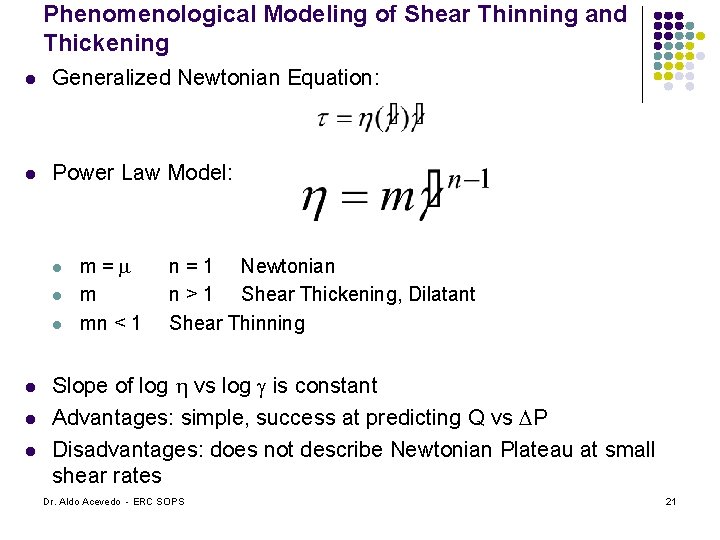
Phenomenological Modeling of Shear Thinning and Thickening l Generalized Newtonian Equation: l Power Law Model: l l l m=m m mn < 1 n = 1 Newtonian n > 1 Shear Thickening, Dilatant Shear Thinning Slope of log h vs log g is constant Advantages: simple, success at predicting Q vs DP Disadvantages: does not describe Newtonian Plateau at small shear rates Dr. Aldo Acevedo - ERC SOPS 21
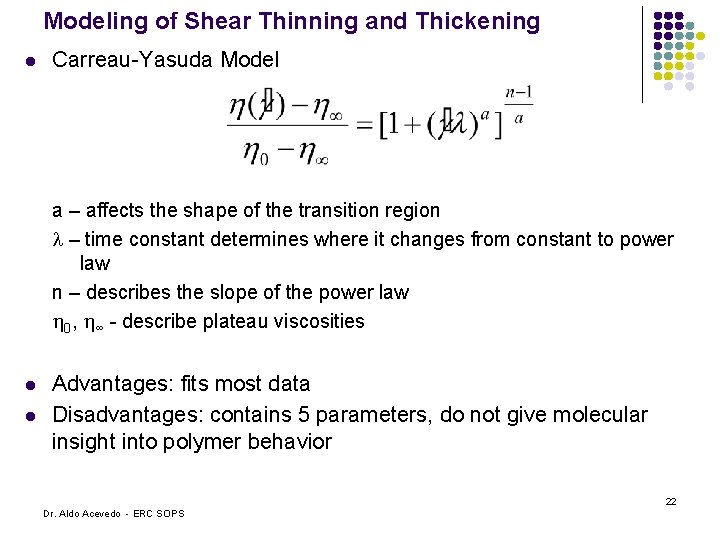
Modeling of Shear Thinning and Thickening l Carreau-Yasuda Model a – affects the shape of the transition region l – time constant determines where it changes from constant to power law n – describes the slope of the power law h 0, h∞ - describe plateau viscosities l l Advantages: fits most data Disadvantages: contains 5 parameters, do not give molecular insight into polymer behavior 22 Dr. Aldo Acevedo - ERC SOPS
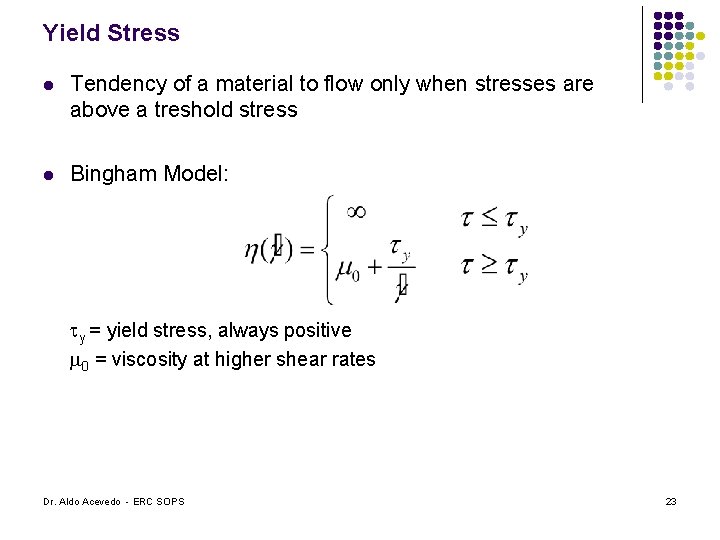
Yield Stress l Tendency of a material to flow only when stresses are above a treshold stress l Bingham Model: ty = yield stress, always positive m 0 = viscosity at higher shear rates Dr. Aldo Acevedo - ERC SOPS 23
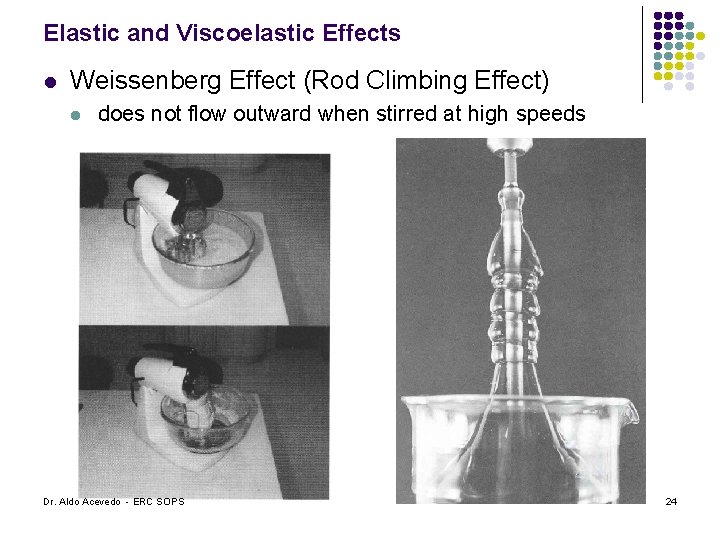
Elastic and Viscoelastic Effects l Weissenberg Effect (Rod Climbing Effect) l does not flow outward when stirred at high speeds Dr. Aldo Acevedo - ERC SOPS 24
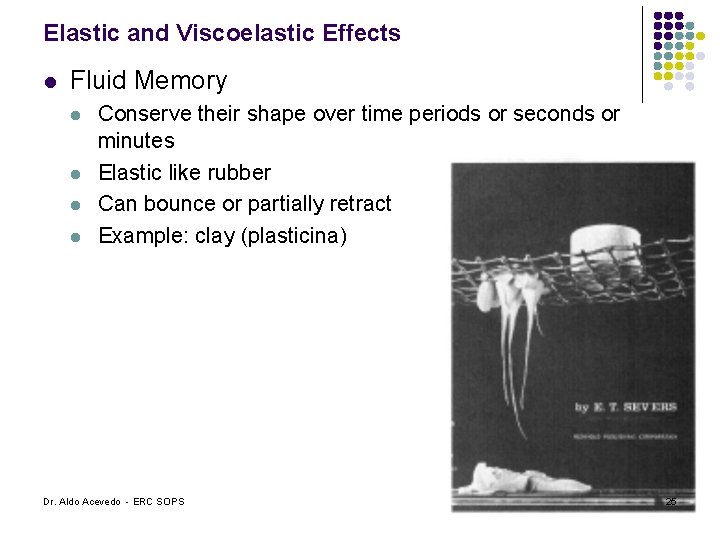
Elastic and Viscoelastic Effects l Fluid Memory l l Conserve their shape over time periods or seconds or minutes Elastic like rubber Can bounce or partially retract Example: clay (plasticina) Dr. Aldo Acevedo - ERC SOPS 25
Elastic and Viscoelastic Effects l Viscoelastic fluids subjected to a stress deform l l l when the stress is removed, it does not instantly vanish internal structure of material can sustain stress for some time this time is known as the relaxation time, varies with materials due to the internal stress, the fluid will deform on its own, even when external stresses are removed important for processing of polymer melts, casting, etc. . Dr. Aldo Acevedo - ERC SOPS 26
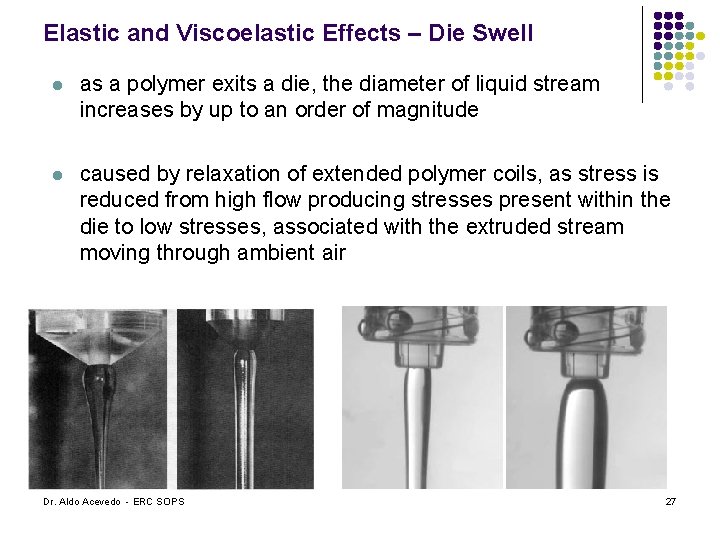
Elastic and Viscoelastic Effects – Die Swell l as a polymer exits a die, the diameter of liquid stream increases by up to an order of magnitude l caused by relaxation of extended polymer coils, as stress is reduced from high flow producing stresses present within the die to low stresses, associated with the extruded stream moving through ambient air Dr. Aldo Acevedo - ERC SOPS 27