
Introduction to RF Linear Accelerators Maurizio Vretenar CERN
![Other superconducting structures for linacs Spoke (low beta) [FZJ, Orsay] HWR (low beta) [FZJ,](https://slidetodoc.com/presentation_image_h/0d01d8c05b28a5abd5e3846546974340/image-29.jpg "Other superconducting structures for linacs Spoke (low beta) [FZJ, Orsay] HWR (low beta) [FZJ,")
- Slides: 66
Introduction to RF Linear Accelerators Maurizio Vretenar – CERN BE/RF Divonne 2009 1. Why linear accelerators - basic concepts 2. Acceleration in Periodic Structures 3. Overview of linac structures 4. Basics of linac beam dynamics 5. More on periodic structures 6. The Radio Frequency Quadrupole (RFQ) 7. Linac Technology 1
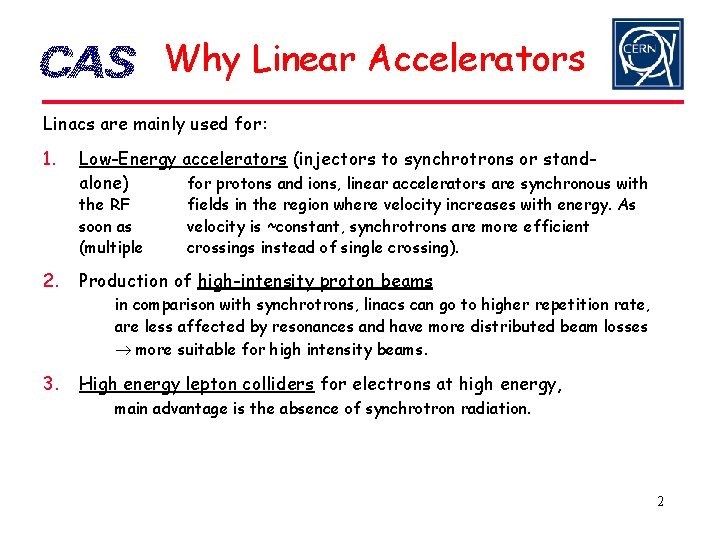
Why Linear Accelerators Linacs are mainly used for: 1. Low-Energy accelerators (injectors to synchrotrons or standalone) for protons and ions, linear accelerators are synchronous with the RF soon as (multiple 2. fields in the region where velocity increases with energy. As velocity is ~constant, synchrotrons are more efficient crossings instead of single crossing). Production of high-intensity proton beams in comparison with synchrotrons, linacs can go to higher repetition rate, are less affected by resonances and have more distributed beam losses more suitable for high intensity beams. 3. High energy lepton colliders for electrons at high energy, main advantage is the absence of synchrotron radiation. 2
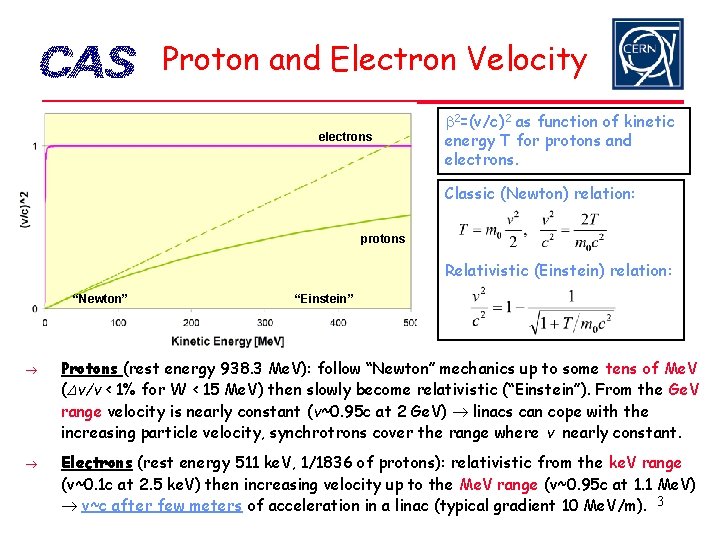
Proton and Electron Velocity electrons b 2=(v/c)2 as function of kinetic energy T for protons and electrons. Classic (Newton) relation: protons Relativistic (Einstein) relation: “Newton” “Einstein” Protons (rest energy 938. 3 Me. V): follow “Newton” mechanics up to some tens of Me. V (Dv/v < 1% for W < 15 Me. V) then slowly become relativistic (“Einstein”). From the Ge. V range velocity is nearly constant (v~0. 95 c at 2 Ge. V) linacs can cope with the increasing particle velocity, synchrotrons cover the range where v nearly constant. Electrons (rest energy 511 ke. V, 1/1836 of protons): relativistic from the ke. V range (v~0. 1 c at 2. 5 ke. V) then increasing velocity up to the Me. V range (v~0. 95 c at 1. 1 Me. V) v~c after few meters of acceleration in a linac (typical gradient 10 Me. V/m). 3
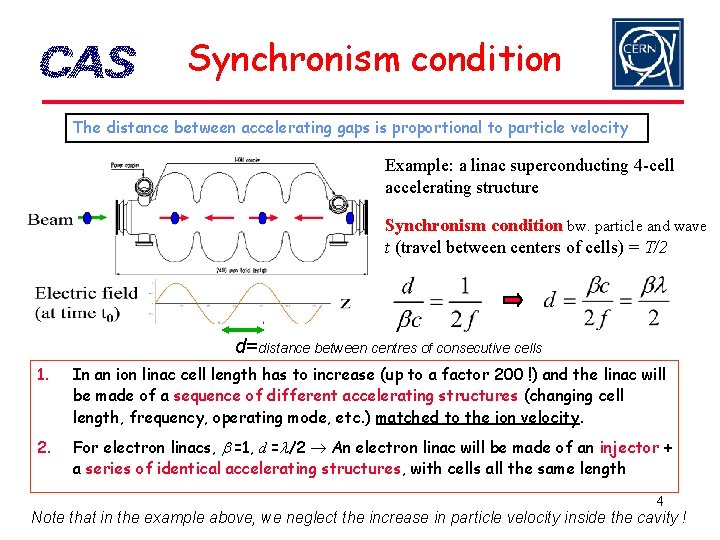
Synchronism condition The distance between accelerating gaps is proportional to particle velocity Example: a linac superconducting 4 -cell accelerating structure Synchronism condition bw. particle and wave t (travel between centers of cells) = T/2 d=distance between centres of consecutive cells 1. In an ion linac cell length has to increase (up to a factor 200 !) and the linac will be made of a sequence of different accelerating structures (changing cell length, frequency, operating mode, etc. ) matched to the ion velocity. 2. For electron linacs, b =1, d =l/2 An electron linac will be made of an injector + a series of identical accelerating structures, with cells all the same length 4 Note that in the example above, we neglect the increase in particle velocity inside the cavity !
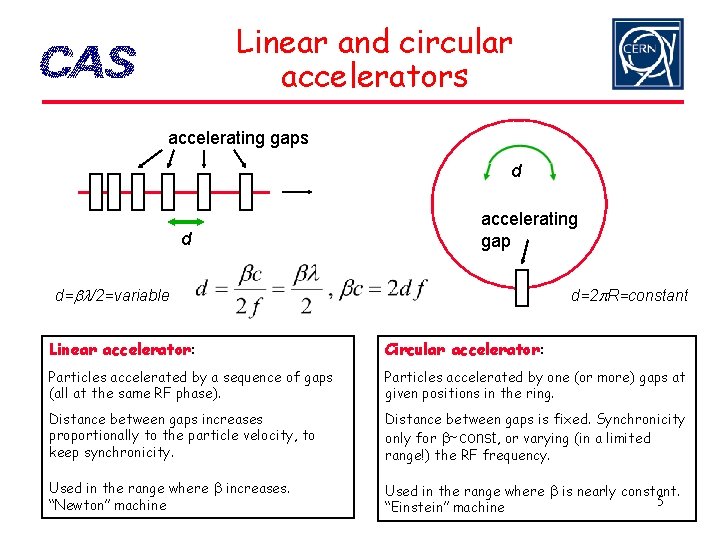
Linear and circular accelerators accelerating gaps d d accelerating gap d=bl/2=variable d=2 p. R=constant Linear accelerator: Circular accelerator: Particles accelerated by a sequence of gaps (all at the same RF phase). Particles accelerated by one (or more) gaps at given positions in the ring. Distance between gaps increases proportionally to the particle velocity, to keep synchronicity. Distance between gaps is fixed. Synchronicity only for b~const, or varying (in a limited range!) the RF frequency. Used in the range where b increases. “Newton” machine Used in the range where b is nearly constant. 5 “Einstein” machine
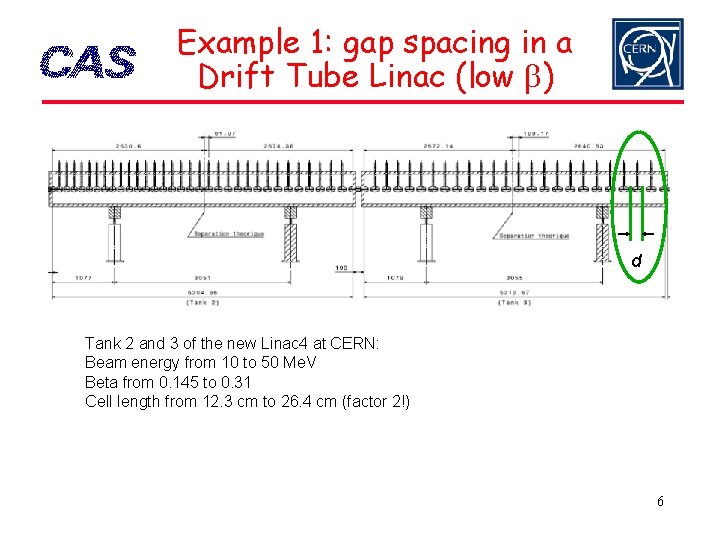
Example 1: gap spacing in a Drift Tube Linac (low b) d Tank 2 and 3 of the new Linac 4 at CERN: Beam energy from 10 to 50 Me. V Beta from 0. 145 to 0. 31 Cell length from 12. 3 cm to 26. 4 cm (factor 2!) 6
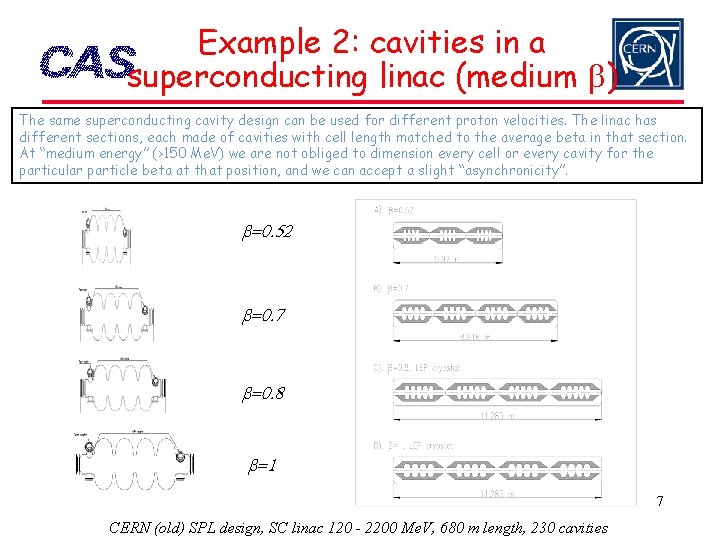
Example 2: cavities in a superconducting linac (medium b) The same superconducting cavity design can be used for different proton velocities. The linac has different sections, each made of cavities with cell length matched to the average beta in that section. At “medium energy” (>150 Me. V) we are not obliged to dimension every cell or every cavity for the particular particle beta at that position, and we can accept a slight “asynchronicity”. b=0. 52 b=0. 7 b=0. 8 b=1 7 CERN (old) SPL design, SC linac 120 - 2200 Me. V, 680 m length, 230 cavities
2 – Acceleration in Periodic Structures 8
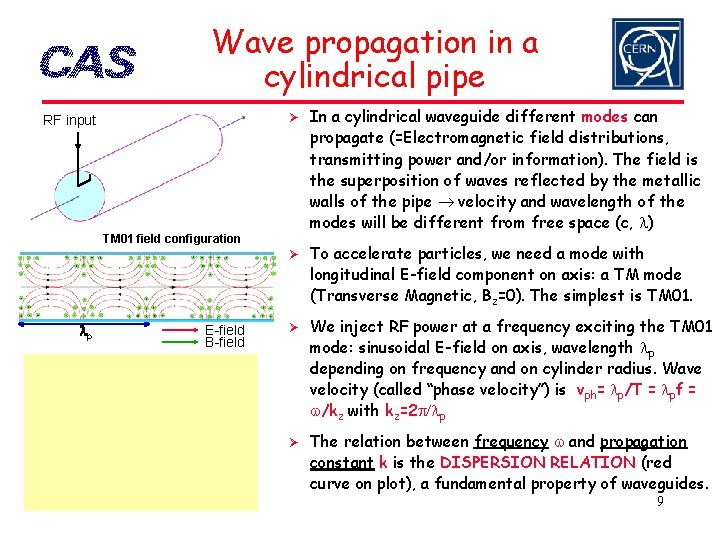
Wave propagation in a cylindrical pipe Ø RF input TM 01 field configuration Ø lp E-field B-field Ø Ø In a cylindrical waveguide different modes can propagate (=Electromagnetic field distributions, transmitting power and/or information). The field is the superposition of waves reflected by the metallic walls of the pipe velocity and wavelength of the modes will be different from free space (c, l) To accelerate particles, we need a mode with longitudinal E-field component on axis: a TM mode (Transverse Magnetic, Bz=0). The simplest is TM 01. We inject RF power at a frequency exciting the TM 01 mode: sinusoidal E-field on axis, wavelength lp depending on frequency and on cylinder radius. Wave velocity (called “phase velocity”) is vph= lp/T = lpf = w/kz with kz=2 p/lp The relation between frequency w and propagation constant k is the DISPERSION RELATION (red curve on plot), a fundamental property of waveguides. 9
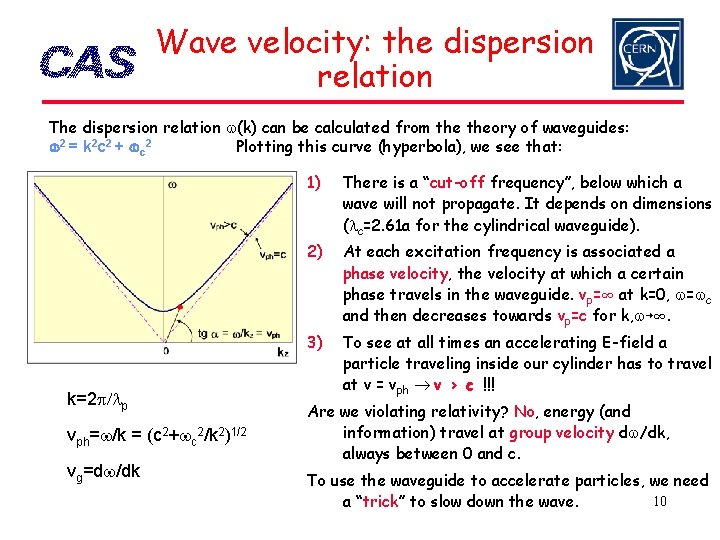
Wave velocity: the dispersion relation The dispersion relation w(k) can be calculated from theory of waveguides: w 2 = k 2 c 2 + wc 2 Plotting this curve (hyperbola), we see that: k=2 p/lp vph=w/k = (c 2+wc 2/k 2)1/2 vg=dw/dk 1) There is a “cut-off frequency”, below which a wave will not propagate. It depends on dimensions (lc=2. 61 a for the cylindrical waveguide). 2) At each excitation frequency is associated a phase velocity, the velocity at which a certain phase travels in the waveguide. vp=∞ at k=0, w=wc and then decreases towards vp=c for k, w→∞. 3) To see at all times an accelerating E-field a particle traveling inside our cylinder has to travel at v = vph v > c !!! Are we violating relativity? No, energy (and information) travel at group velocity dw/dk, always between 0 and c. To use the waveguide to accelerate particles, we need 10 a “trick” to slow down the wave.
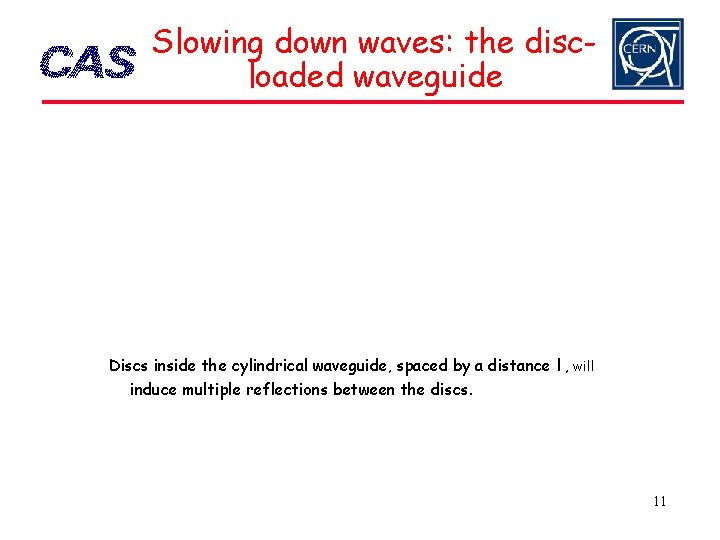
Slowing down waves: the discloaded waveguide Discs inside the cylindrical waveguide, spaced by a distance l , will induce multiple reflections between the discs. 11
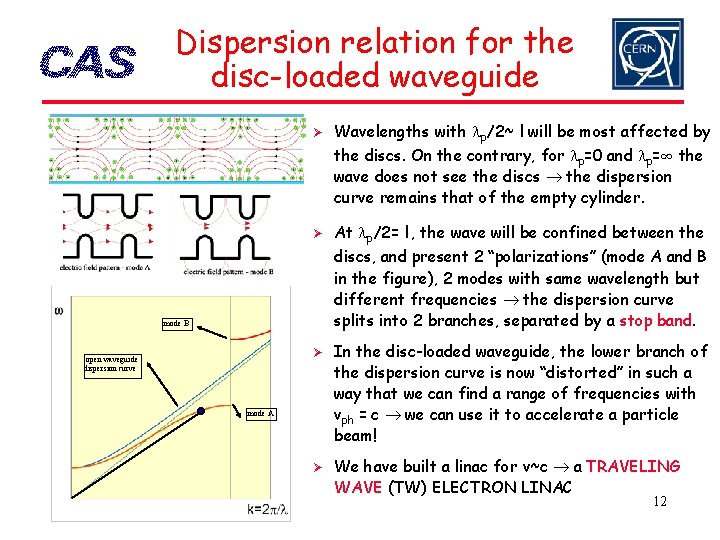
Dispersion relation for the disc-loaded waveguide Ø Wavelengths with lp/2~ l will be most affected by the discs. On the contrary, for lp=0 and lp=∞ the wave does not see the discs the dispersion curve remains that of the empty cylinder. Ø At lp/2= l , the wave will be confined between the discs, and present 2 “polarizations” (mode A and B in the figure), 2 modes with same wavelength but different frequencies the dispersion curve splits into 2 branches, separated by a stop band. mode B open waveguide dispersion curve Ø In the disc-loaded waveguide, the lower branch of the dispersion curve is now “distorted” in such a way that we can find a range of frequencies with vph = c we can use it to accelerate a particle beam! Ø We have built a linac for v~c a TRAVELING WAVE (TW) ELECTRON LINAC mode A 12
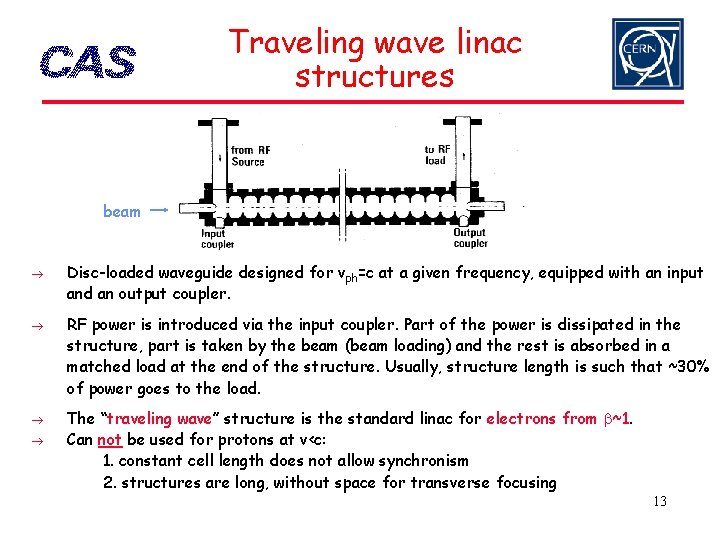
Traveling wave linac structures beam Disc-loaded waveguide designed for vph=c at a given frequency, equipped with an input and an output coupler. RF power is introduced via the input coupler. Part of the power is dissipated in the structure, part is taken by the beam (beam loading) and the rest is absorbed in a matched load at the end of the structure. Usually, structure length is such that ~30% of power goes to the load. The “traveling wave” structure is the standard linac for electrons from b~1. Can not be used for protons at v<c: 1. constant cell length does not allow synchronism 2. structures are long, without space for transverse focusing 13
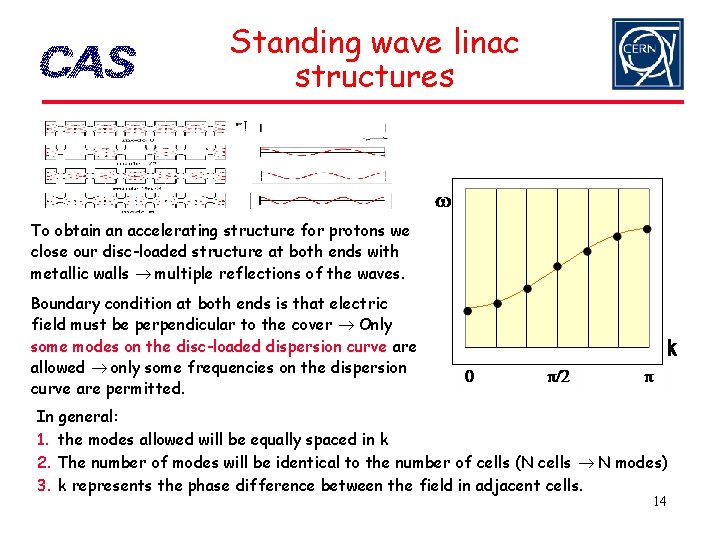
Standing wave linac structures To obtain an accelerating structure for protons we close our disc-loaded structure at both ends with metallic walls multiple reflections of the waves. Boundary condition at both ends is that electric field must be perpendicular to the cover Only some modes on the disc-loaded dispersion curve are allowed only some frequencies on the dispersion curve are permitted. In general: 1. the modes allowed will be equally spaced in k 2. The number of modes will be identical to the number of cells (N cells N modes) 3. k represents the phase difference between the field in adjacent cells. 14
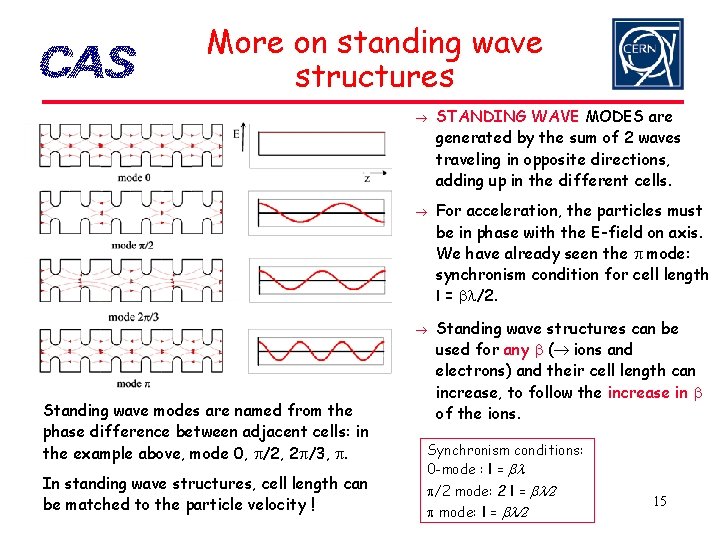
More on standing wave structures Standing wave modes are named from the phase difference between adjacent cells: in the example above, mode 0, p/2, 2 p/3, p. In standing wave structures, cell length can be matched to the particle velocity ! STANDING WAVE MODES are generated by the sum of 2 waves traveling in opposite directions, adding up in the different cells. For acceleration, the particles must be in phase with the E-field on axis. We have already seen the p mode: synchronism condition for cell length l = bl/2. Standing wave structures can be used for any b ( ions and electrons) and their cell length can increase, to follow the increase in b of the ions. Synchronism conditions: 0 -mode : l = bl p/2 mode: 2 l = bl/2 p mode: l = bl/2 15
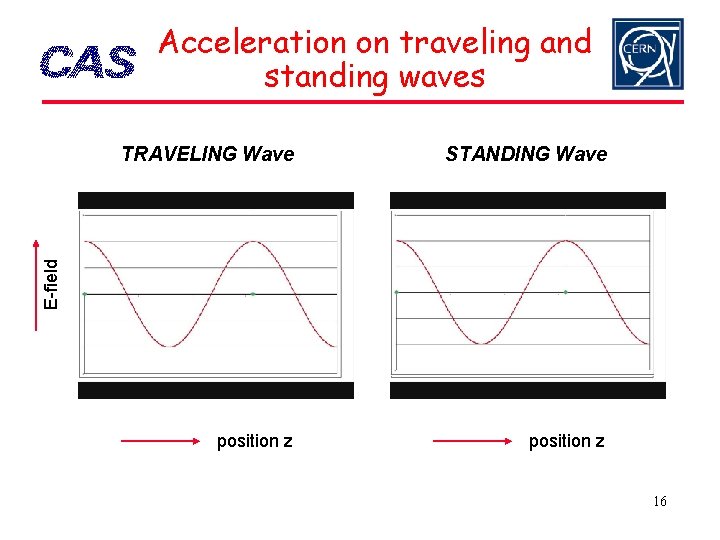
Acceleration on traveling and standing waves STANDING Wave position z E-field TRAVELING Wave 16
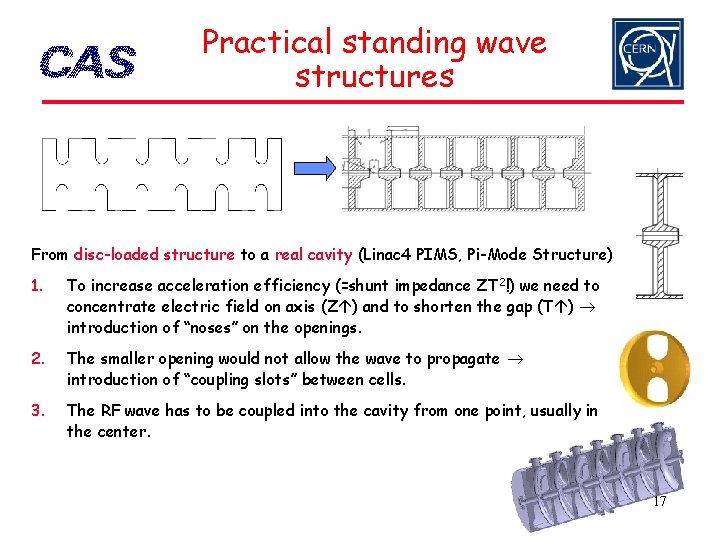
Practical standing wave structures From disc-loaded structure to a real cavity (Linac 4 PIMS, Pi-Mode Structure) 1. To increase acceleration efficiency (=shunt impedance ZT 2!) we need to concentrate electric field on axis (Z ) and to shorten the gap (T ) introduction of “noses” on the openings. 2. The smaller opening would not allow the wave to propagate introduction of “coupling slots” between cells. 3. The RF wave has to be coupled into the cavity from one point, usually in the center. 17
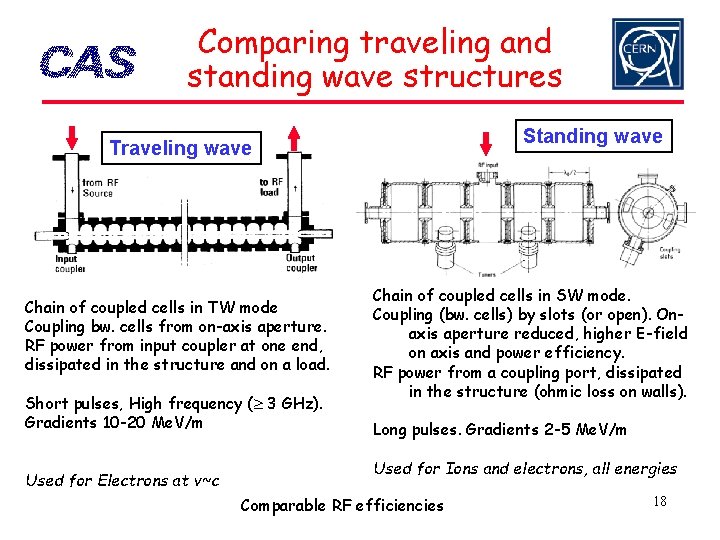
Comparing traveling and standing wave structures Standing wave Traveling wave Chain of coupled cells in TW mode Coupling bw. cells from on-axis aperture. RF power from input coupler at one end, dissipated in the structure and on a load. Short pulses, High frequency ( 3 GHz). Gradients 10 -20 Me. V/m Used for Electrons at v~c Chain of coupled cells in SW mode. Coupling (bw. cells) by slots (or open). Onaxis aperture reduced, higher E-field on axis and power efficiency. RF power from a coupling port, dissipated in the structure (ohmic loss on walls). Long pulses. Gradients 2 -5 Me. V/m Used for Ions and electrons, all energies Comparable RF efficiencies 18
3 – Examples of linac accelerating structures: a. protons, b. electrons, c. heavy ions 19
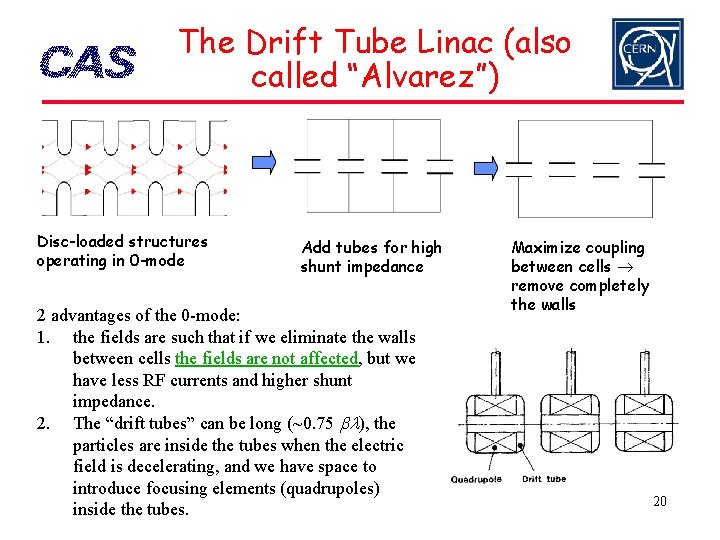
The Drift Tube Linac (also called “Alvarez”) Disc-loaded structures operating in 0 -mode Add tubes for high shunt impedance 2 advantages of the 0 -mode: 1. the fields are such that if we eliminate the walls between cells the fields are not affected, but we have less RF currents and higher shunt impedance. 2. The “drift tubes” can be long (~0. 75 bl), the particles are inside the tubes when the electric field is decelerating, and we have space to introduce focusing elements (quadrupoles) inside the tubes. Maximize coupling between cells remove completely the walls 20
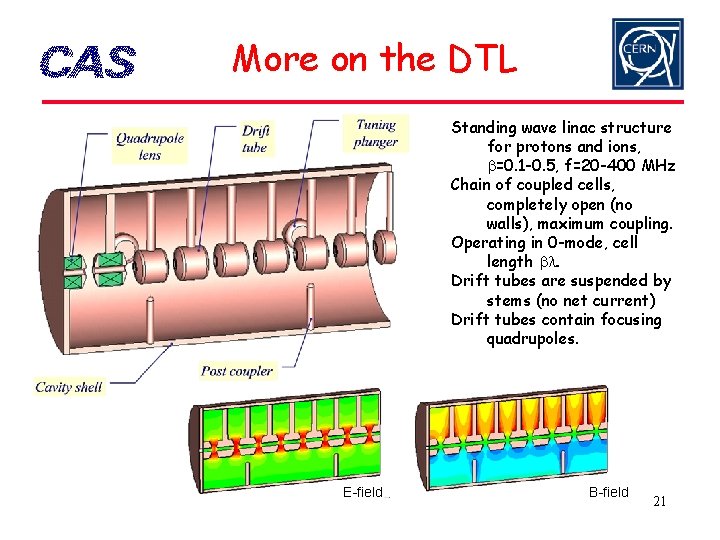
More on the DTL Standing wave linac structure for protons and ions, b=0. 1 -0. 5, f=20 -400 MHz Chain of coupled cells, completely open (no walls), maximum coupling. Operating in 0 -mode, cell length bl. Drift tubes are suspended by stems (no net current) Drift tubes contain focusing quadrupoles. E-field B-field 21
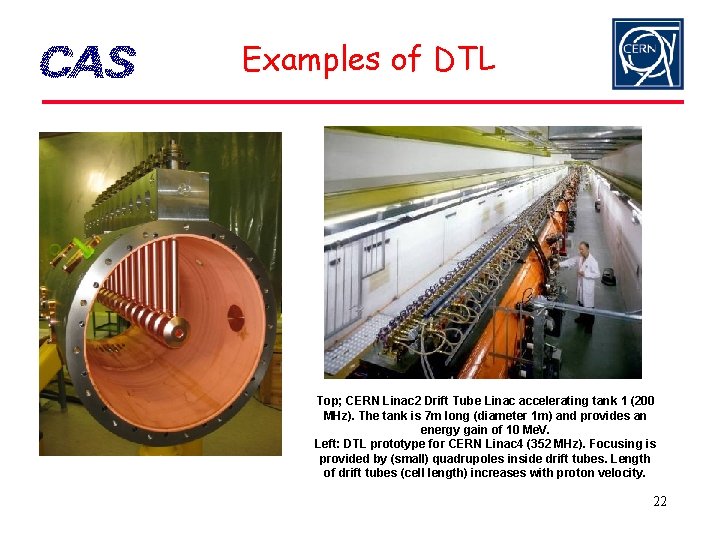
Examples of DTL Top; CERN Linac 2 Drift Tube Linac accelerating tank 1 (200 MHz). The tank is 7 m long (diameter 1 m) and provides an energy gain of 10 Me. V. Left: DTL prototype for CERN Linac 4 (352 MHz). Focusing is provided by (small) quadrupoles inside drift tubes. Length of drift tubes (cell length) increases with proton velocity. 22
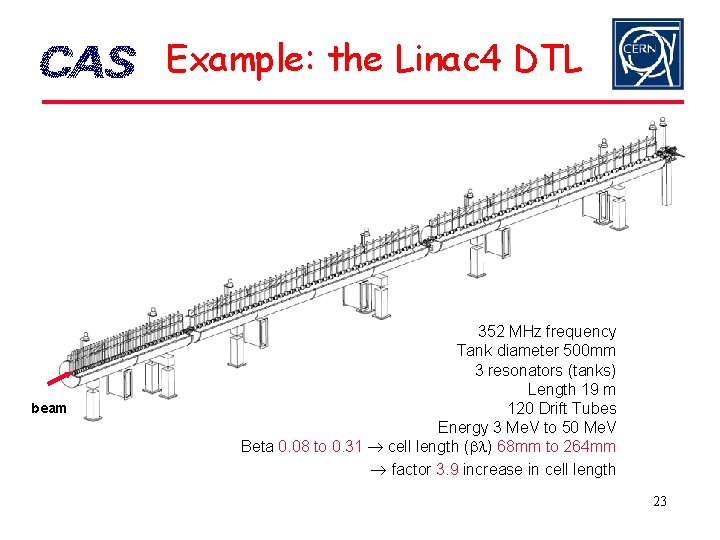
Example: the Linac 4 DTL beam 352 MHz frequency Tank diameter 500 mm 3 resonators (tanks) Length 19 m 120 Drift Tubes Energy 3 Me. V to 50 Me. V Beta 0. 08 to 0. 31 cell length (bl) 68 mm to 264 mm factor 3. 9 increase in cell length 23
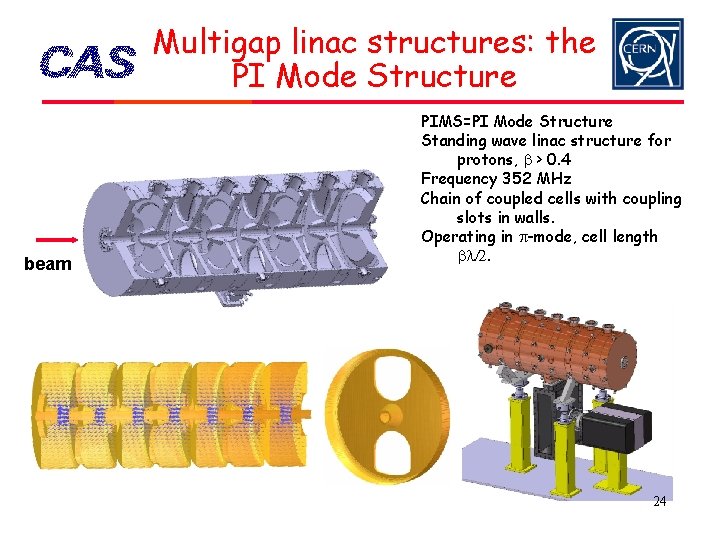
Multigap linac structures: the PI Mode Structure beam PIMS=PI Mode Structure Standing wave linac structure for protons, b > 0. 4 Frequency 352 MHz Chain of coupled cells with coupling slots in walls. Operating in p-mode, cell length bl/2. 24
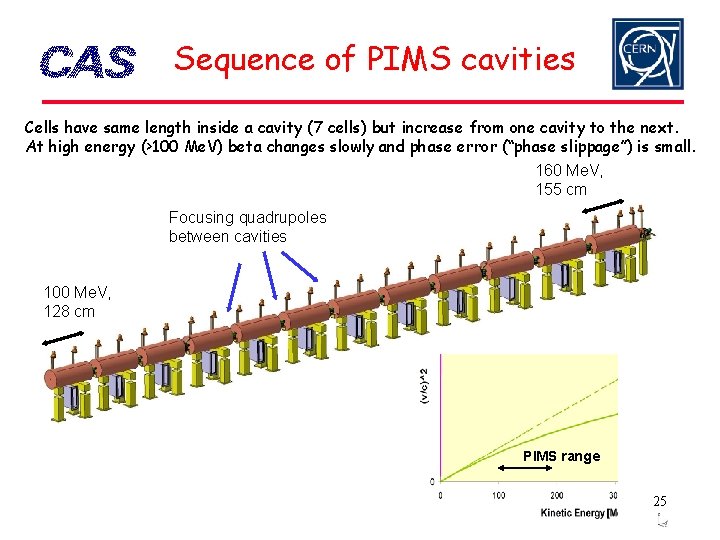
Sequence of PIMS cavities Cells have same length inside a cavity (7 cells) but increase from one cavity to the next. At high energy (>100 Me. V) beta changes slowly and phase error (“phase slippage”) is small. 160 Me. V, 155 cm Focusing quadrupoles between cavities 100 Me. V, 128 cm PIMS range 25
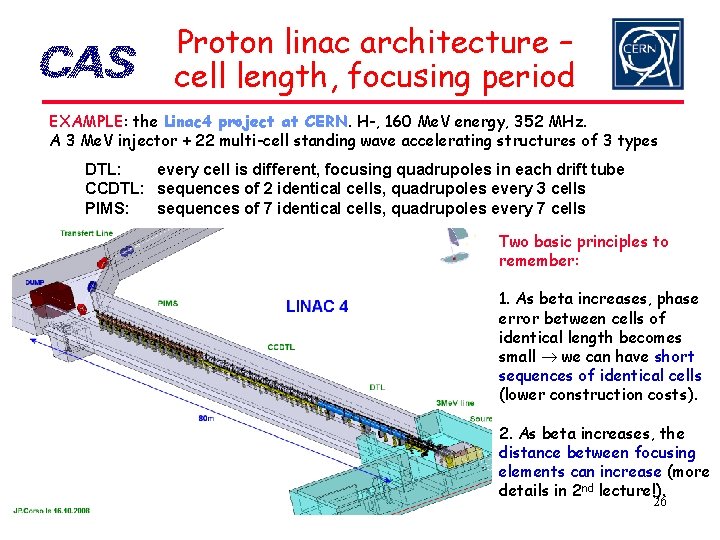
Proton linac architecture – cell length, focusing period EXAMPLE: the Linac 4 project at CERN. H-, 160 Me. V energy, 352 MHz. A 3 Me. V injector + 22 multi-cell standing wave accelerating structures of 3 types DTL: every cell is different, focusing quadrupoles in each drift tube CCDTL: sequences of 2 identical cells, quadrupoles every 3 cells PIMS: sequences of 7 identical cells, quadrupoles every 7 cells Two basic principles to remember: Injector 1. As beta increases, phase error between cells of identical length becomes small we can have short sequences of identical cells (lower construction costs). 2. As beta increases, the distance between focusing elements can increase (more details in 2 nd lecture!). 26
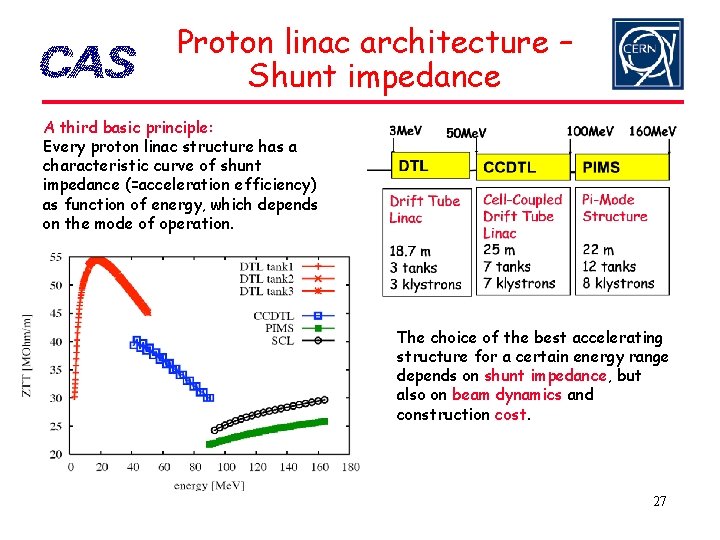
Proton linac architecture – Shunt impedance A third basic principle: Every proton linac structure has a characteristic curve of shunt impedance (=acceleration efficiency) as function of energy, which depends on the mode of operation. The choice of the best accelerating structure for a certain energy range depends on shunt impedance, but also on beam dynamics and construction cost. 27
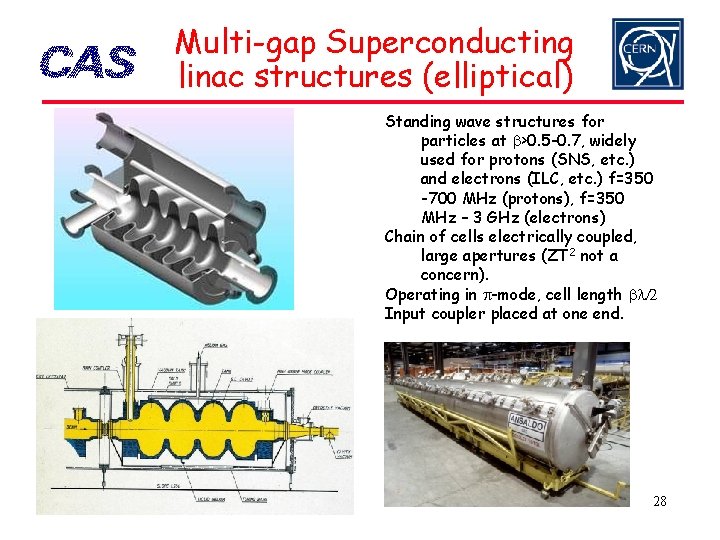
Multi-gap Superconducting linac structures (elliptical) Standing wave structures for particles at b>0. 5 -0. 7, widely used for protons (SNS, etc. ) and electrons (ILC, etc. ) f=350 -700 MHz (protons), f=350 MHz – 3 GHz (electrons) Chain of cells electrically coupled, large apertures (ZT 2 not a concern). Operating in p-mode, cell length bl/2 Input coupler placed at one end. 28
Other superconducting structures for linacs Spoke (low beta) [FZJ, Orsay] HWR (low beta) [FZJ, LNL, Orsay] CH (low/medium beta) [IAP-FU] QWR (low beta) [LNL, etc. ] Reentrant [LNL] Superconducting linacs for low and medium beta ions are made of multigap (1 to 4) individual cavities, spaced by focusing elements. Advantages: can be individually phased linac can accept different ions Allow more space for focusing ideal for low b CW proton linacs 29
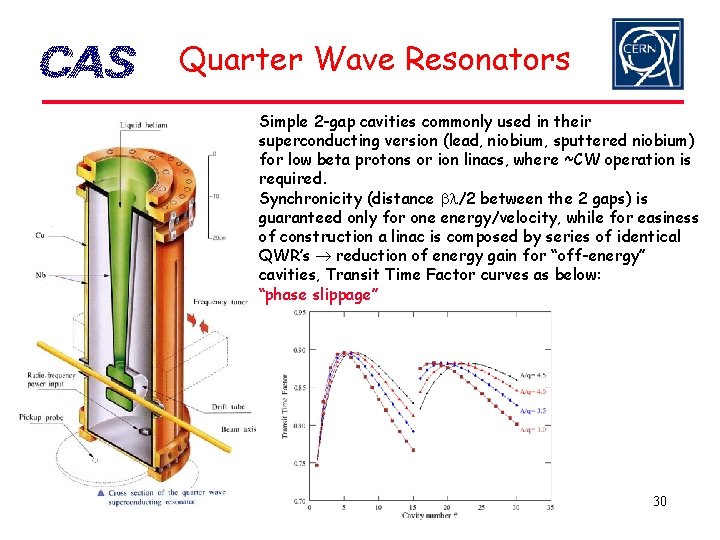
Quarter Wave Resonators Simple 2 -gap cavities commonly used in their superconducting version (lead, niobium, sputtered niobium) for low beta protons or ion linacs, where ~CW operation is required. Synchronicity (distance bl/2 between the 2 gaps) is guaranteed only for one energy/velocity, while for easiness of construction a linac is composed by series of identical QWR’s reduction of energy gain for “off-energy” cavities, Transit Time Factor curves as below: “phase slippage” 30
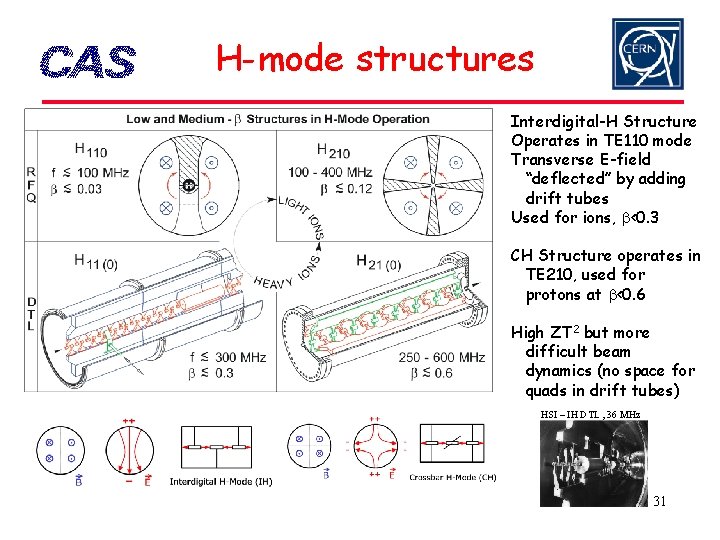
H-mode structures Interdigital-H Structure Operates in TE 110 mode Transverse E-field “deflected” by adding drift tubes Used for ions, b<0. 3 CH Structure operates in TE 210, used for protons at b<0. 6 High ZT 2 but more difficult beam dynamics (no space for quads in drift tubes) HSI – IH DTL , 36 MHz 31
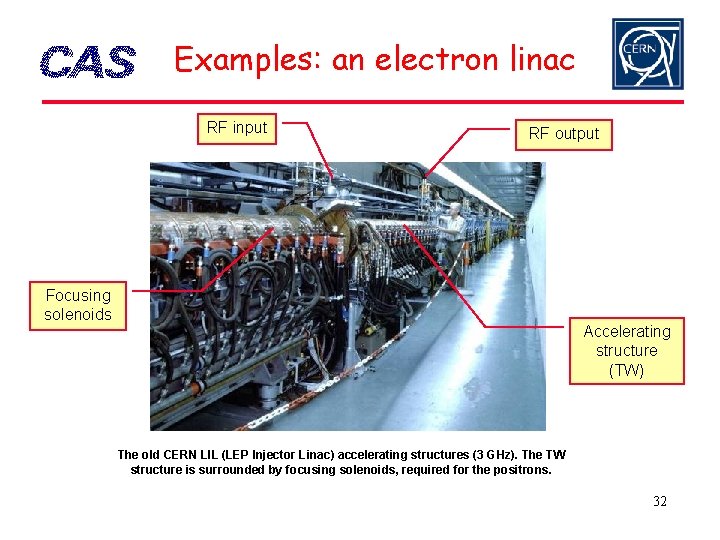
Examples: an electron linac RF input RF output Focusing solenoids Accelerating structure (TW) The old CERN LIL (LEP Injector Linac) accelerating structures (3 GHz). The TW structure is surrounded by focusing solenoids, required for the positrons. 32
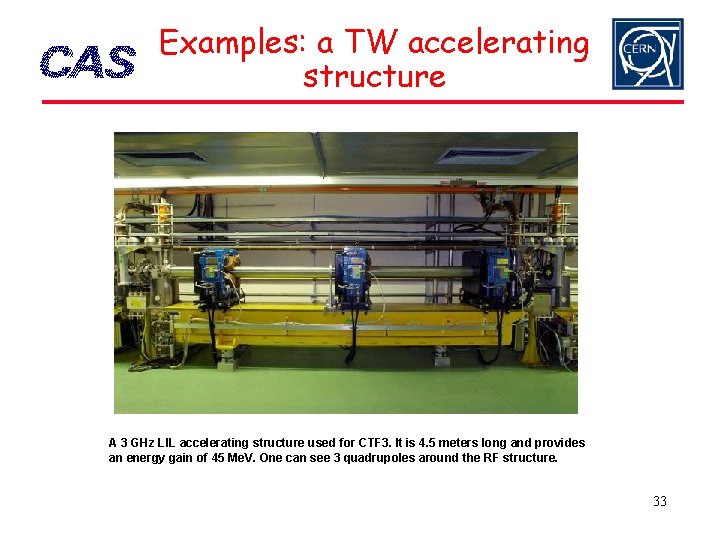
Examples: a TW accelerating structure A 3 GHz LIL accelerating structure used for CTF 3. It is 4. 5 meters long and provides an energy gain of 45 Me. V. One can see 3 quadrupoles around the RF structure. 33
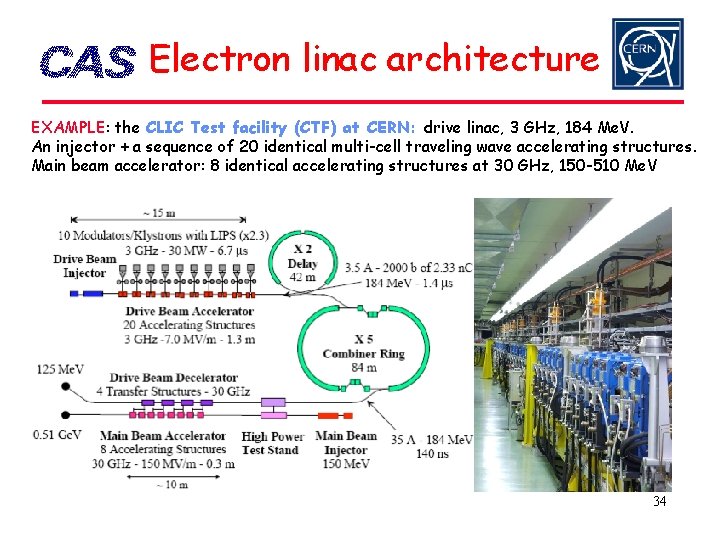
Electron linac architecture EXAMPLE: the CLIC Test facility (CTF) at CERN: drive linac, 3 GHz, 184 Me. V. An injector + a sequence of 20 identical multi-cell traveling wave accelerating structures. Main beam accelerator: 8 identical accelerating structures at 30 GHz, 150 -510 Me. V 34
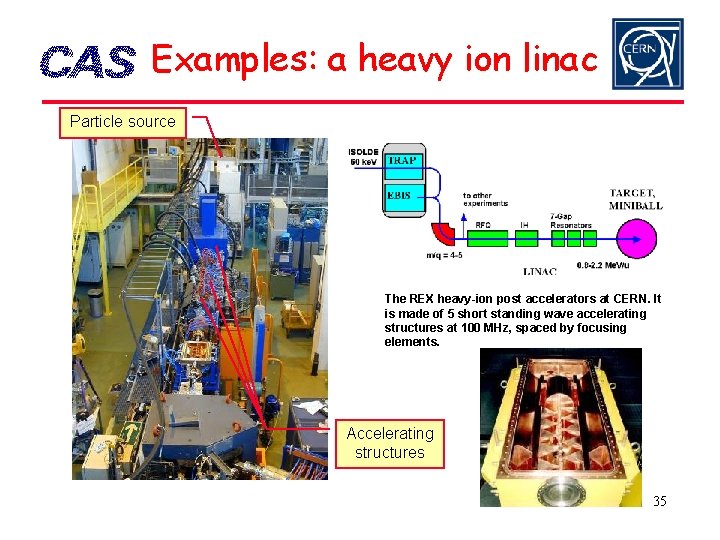
Examples: a heavy ion linac Particle source The REX heavy-ion post accelerators at CERN. It is made of 5 short standing wave accelerating structures at 100 MHz, spaced by focusing elements. Accelerating structures 35
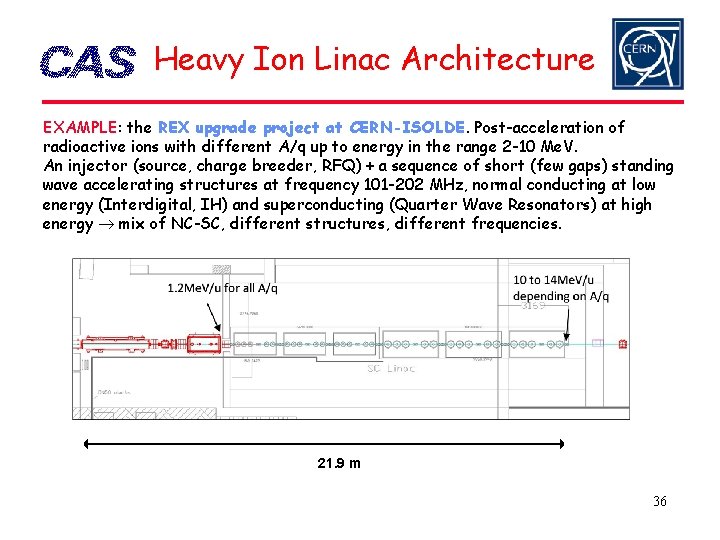
Heavy Ion Linac Architecture EXAMPLE: the REX upgrade project at CERN-ISOLDE. Post-acceleration of radioactive ions with different A/q up to energy in the range 2 -10 Me. V. An injector (source, charge breeder, RFQ) + a sequence of short (few gaps) standing wave accelerating structures at frequency 101 -202 MHz, normal conducting at low energy (Interdigital, IH) and superconducting (Quarter Wave Resonators) at high energy mix of NC-SC, different structures, different frequencies. 21. 9 m 36
4 – Beam Dynamics of Ion and Electron Linacs 37
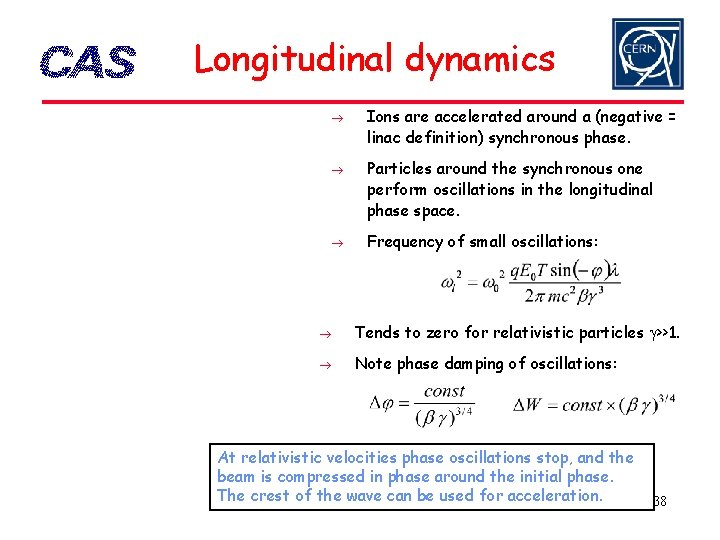
Longitudinal dynamics Ions are accelerated around a (negative = linac definition) synchronous phase. Particles around the synchronous one perform oscillations in the longitudinal phase space. Frequency of small oscillations: Tends to zero for relativistic particles g>>1. Note phase damping of oscillations: At relativistic velocities phase oscillations stop, and the beam is compressed in phase around the initial phase. The crest of the wave can be used for acceleration. 38
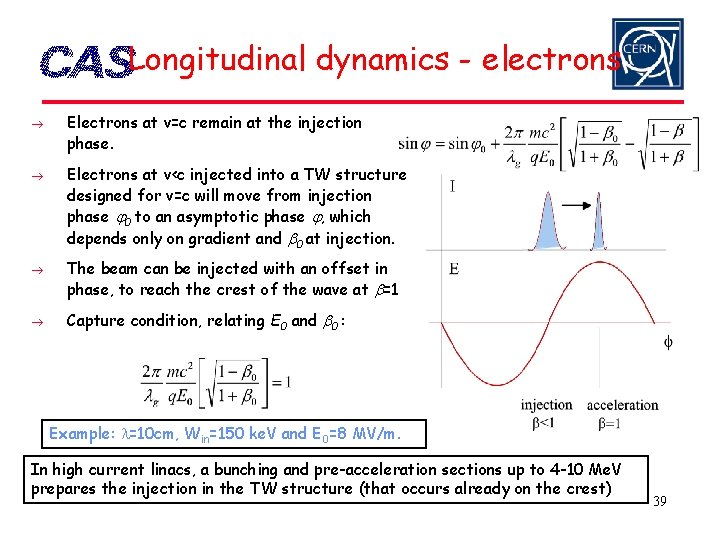
Longitudinal dynamics - electrons Electrons at v=c remain at the injection phase. Electrons at v<c injected into a TW structure designed for v=c will move from injection phase j 0 to an asymptotic phase j, which depends only on gradient and b 0 at injection. The beam can be injected with an offset in phase, to reach the crest of the wave at b=1 Capture condition, relating E 0 and b 0 : Example: l=10 cm, Win=150 ke. V and E 0=8 MV/m. In high current linacs, a bunching and pre-acceleration sections up to 4 -10 Me. V prepares the injection in the TW structure (that occurs already on the crest) 39
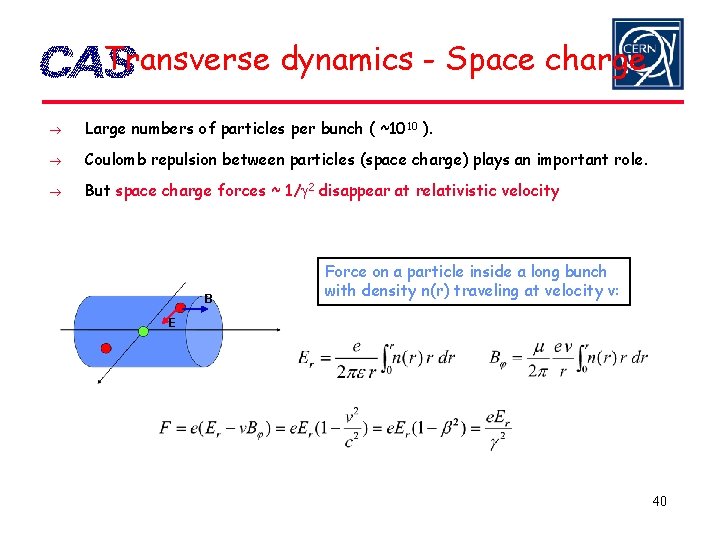
Transverse dynamics - Space charge Large numbers of particles per bunch ( ~1010 ). Coulomb repulsion between particles (space charge) plays an important role. But space charge forces ~ 1/g 2 disappear at relativistic velocity B Force on a particle inside a long bunch with density n(r) traveling at velocity v: E 40
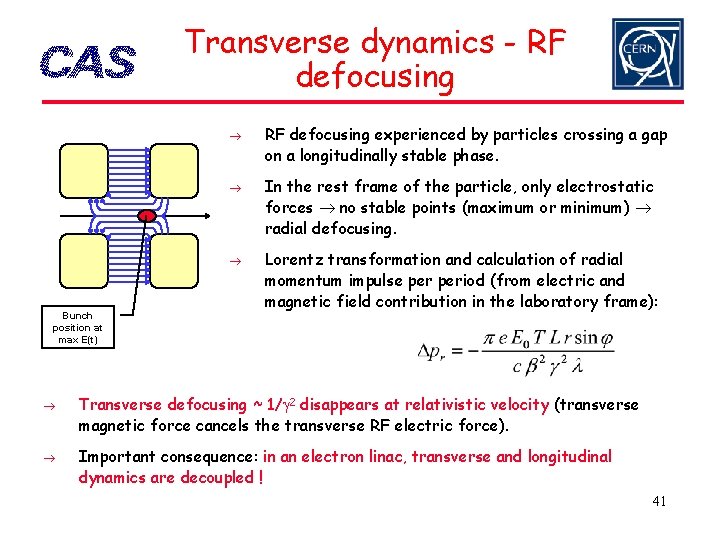
Transverse dynamics - RF defocusing Bunch position at max E(t) RF defocusing experienced by particles crossing a gap on a longitudinally stable phase. In the rest frame of the particle, only electrostatic forces no stable points (maximum or minimum) radial defocusing. Lorentz transformation and calculation of radial momentum impulse period (from electric and magnetic field contribution in the laboratory frame): Transverse defocusing ~ 1/g 2 disappears at relativistic velocity (transverse magnetic force cancels the transverse RF electric force). Important consequence: in an electron linac, transverse and longitudinal dynamics are decoupled ! 41
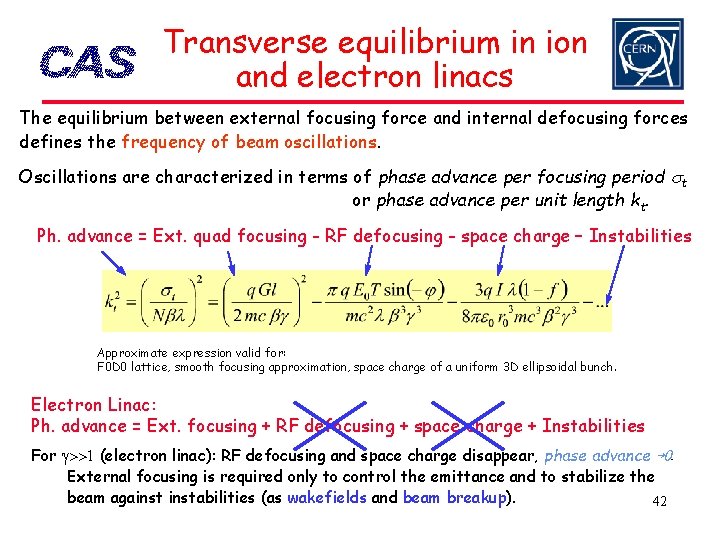
Transverse equilibrium in ion and electron linacs The equilibrium between external focusing force and internal defocusing forces defines the frequency of beam oscillations. Oscillations are characterized in terms of phase advance per focusing period st or phase advance per unit length kt. Ph. advance = Ext. quad focusing - RF defocusing - space charge – Instabilities Approximate expression valid for: F 0 D 0 lattice, smooth focusing approximation, space charge of a uniform 3 D ellipsoidal bunch. Electron Linac: Ph. advance = Ext. focusing + RF defocusing + space charge + Instabilities For g>>1 (electron linac): RF defocusing and space charge disappear, phase advance → 0. External focusing is required only to control the emittance and to stabilize the beam againstabilities (as wakefields and beam breakup). 42
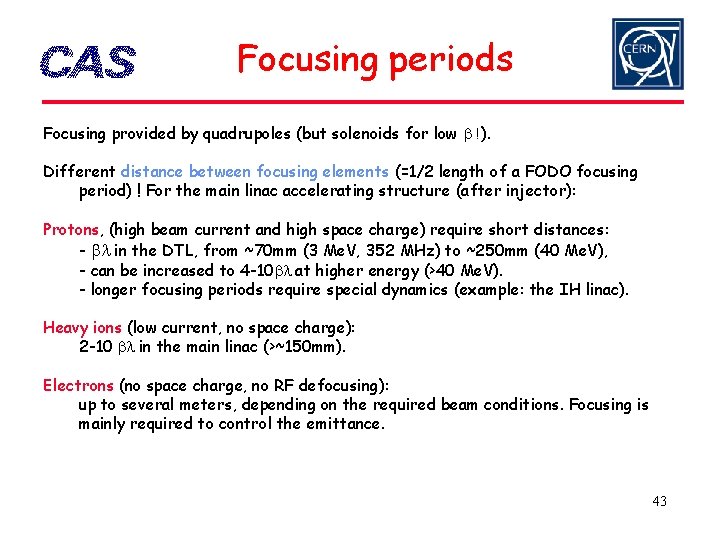
Focusing periods Focusing provided by quadrupoles (but solenoids for low b !). Different distance between focusing elements (=1/2 length of a FODO focusing period) ! For the main linac accelerating structure (after injector): Protons, (high beam current and high space charge) require short distances: - bl in the DTL, from ~70 mm (3 Me. V, 352 MHz) to ~250 mm (40 Me. V), - can be increased to 4 -10 bl at higher energy (>40 Me. V). - longer focusing periods require special dynamics (example: the IH linac). Heavy ions (low current, no space charge): 2 -10 bl in the main linac (>~150 mm). Electrons (no space charge, no RF defocusing): up to several meters, depending on the required beam conditions. Focusing is mainly required to control the emittance. 43
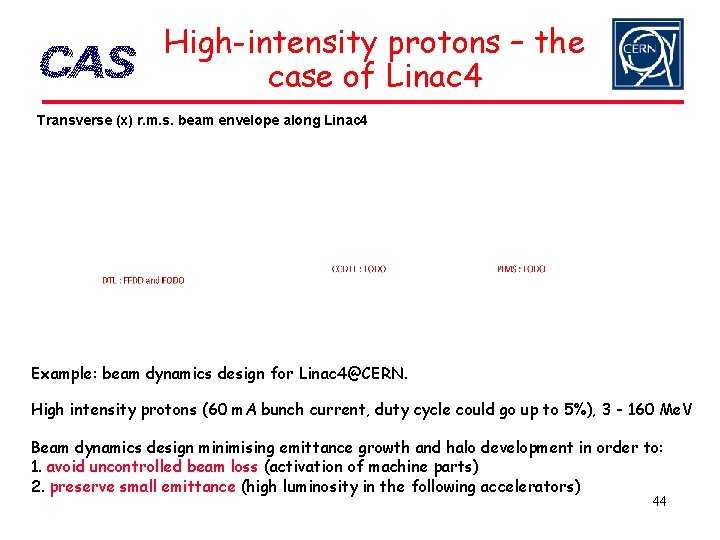
High-intensity protons – the case of Linac 4 Transverse (x) r. m. s. beam envelope along Linac 4 Example: beam dynamics design for Linac 4@CERN. High intensity protons (60 m. A bunch current, duty cycle could go up to 5%), 3 - 160 Me. V Beam dynamics design minimising emittance growth and halo development in order to: 1. avoid uncontrolled beam loss (activation of machine parts) 2. preserve small emittance (high luminosity in the following accelerators) 44
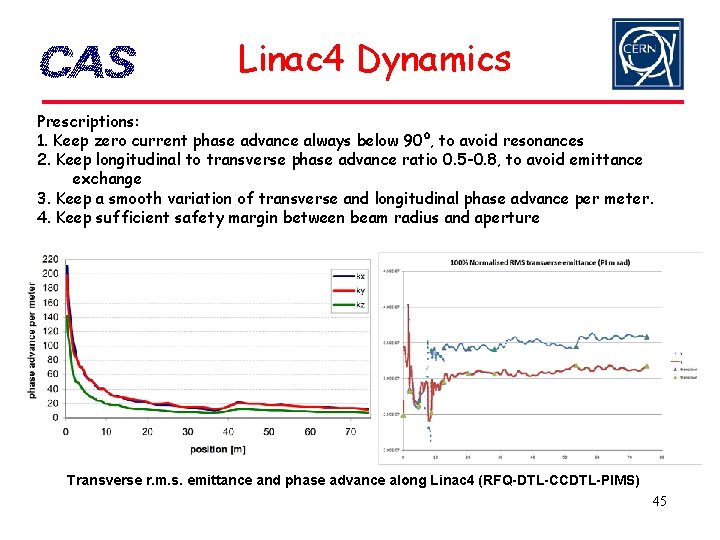
Linac 4 Dynamics Prescriptions: 1. Keep zero current phase advance always below 90º, to avoid resonances 2. Keep longitudinal to transverse phase advance ratio 0. 5 -0. 8, to avoid emittance exchange 3. Keep a smooth variation of transverse and longitudinal phase advance per meter. 4. Keep sufficient safety margin between beam radius and aperture Transverse r. m. s. emittance and phase advance along Linac 4 (RFQ-DTL-CCDTL-PIMS) 45
5. Double periodic accelerating structures 46
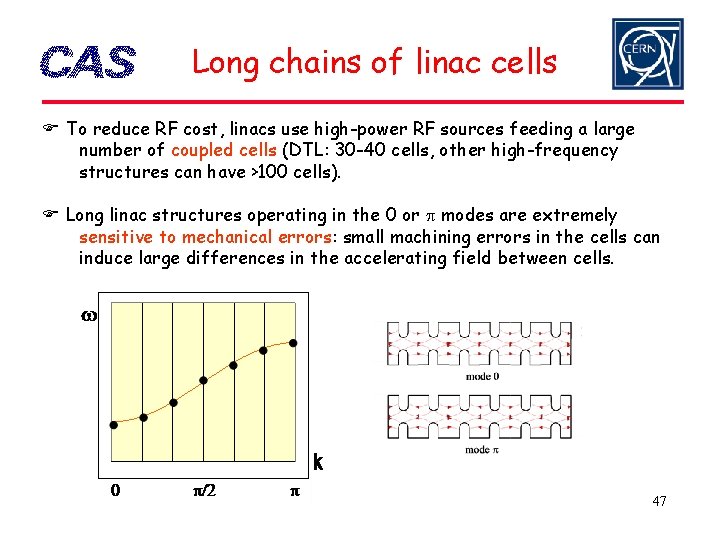
Long chains of linac cells To reduce RF cost, linacs use high-power RF sources feeding a large number of coupled cells (DTL: 30 -40 cells, other high-frequency structures can have >100 cells). Long linac structures operating in the 0 or p modes are extremely sensitive to mechanical errors: small machining errors in the cells can induce large differences in the accelerating field between cells. 47
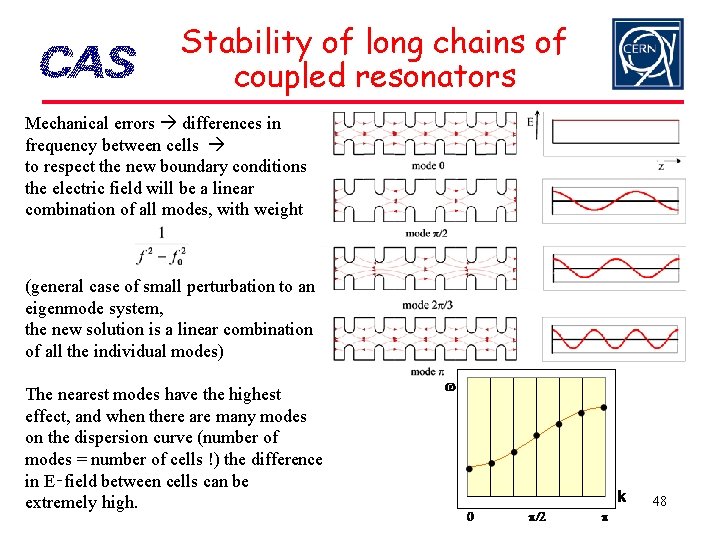
Stability of long chains of coupled resonators Mechanical errors differences in frequency between cells to respect the new boundary conditions the electric field will be a linear combination of all modes, with weight (general case of small perturbation to an eigenmode system, the new solution is a linear combination of all the individual modes) The nearest modes have the highest effect, and when there are many modes on the dispersion curve (number of modes = number of cells !) the difference in E‑field between cells can be extremely high. 48
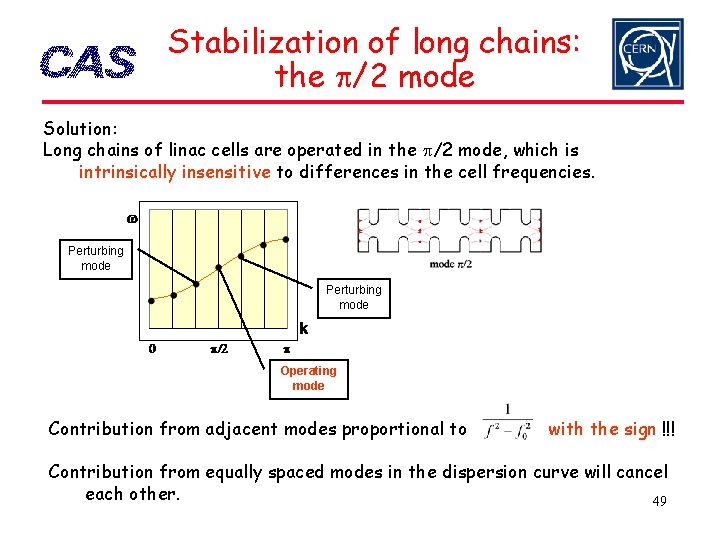
Stabilization of long chains: the p/2 mode Solution: Long chains of linac cells are operated in the p/2 mode, which is intrinsically insensitive to differences in the cell frequencies. Perturbing mode Operating mode Contribution from adjacent modes proportional to with the sign !!! Contribution from equally spaced modes in the dispersion curve will cancel each other. 49
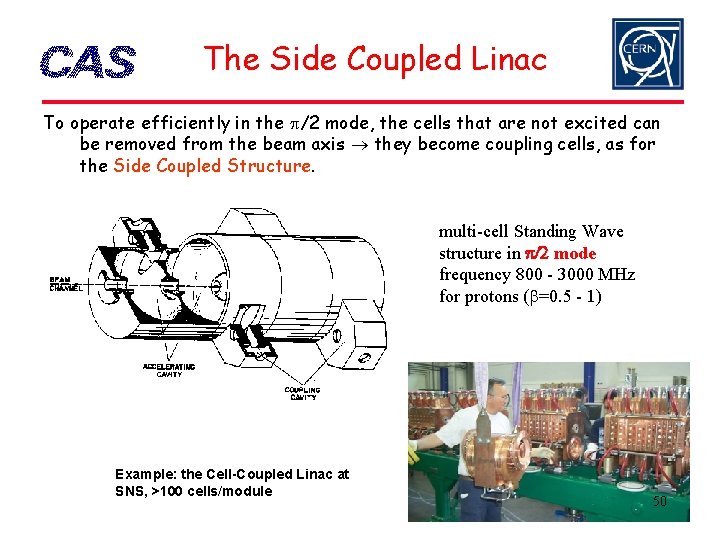
The Side Coupled Linac To operate efficiently in the p/2 mode, the cells that are not excited can be removed from the beam axis they become coupling cells, as for the Side Coupled Structure. multi-cell Standing Wave structure in p/2 mode frequency 800 - 3000 MHz for protons (b=0. 5 - 1) Example: the Cell-Coupled Linac at SNS, >100 cells/module 50
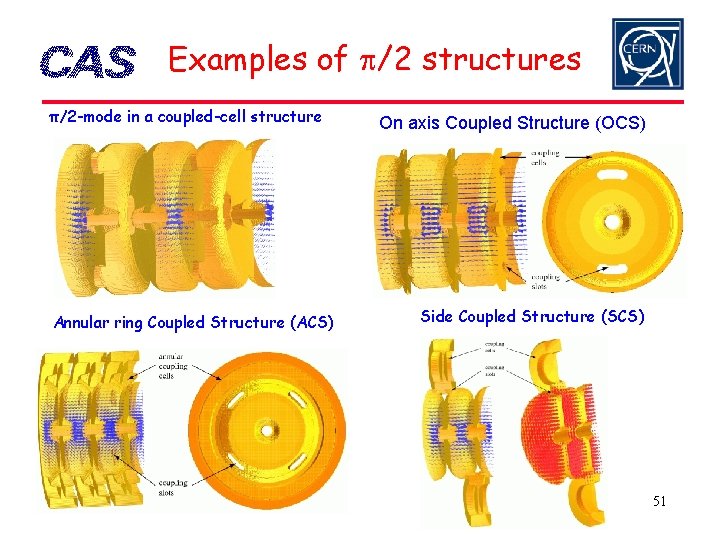
Examples of p/2 structures π/2 -mode in a coupled-cell structure Annular ring Coupled Structure (ACS) On axis Coupled Structure (OCS) Side Coupled Structure (SCS) 51
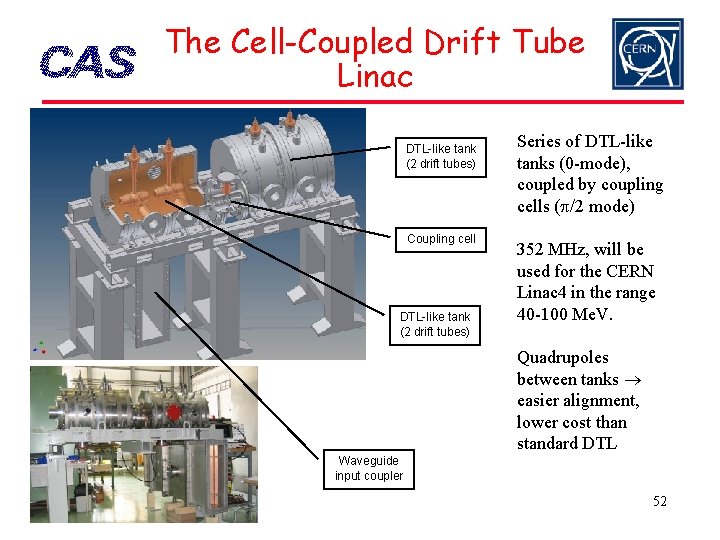
The Cell-Coupled Drift Tube Linac DTL-like tank (2 drift tubes) Coupling cell DTL-like tank (2 drift tubes) Series of DTL-like tanks (0 -mode), coupled by coupling cells (p/2 mode) 352 MHz, will be used for the CERN Linac 4 in the range 40 -100 Me. V. Quadrupoles between tanks easier alignment, lower cost than standard DTL Waveguide input coupler 52
6. The Radio Frequency Quadrupole 53
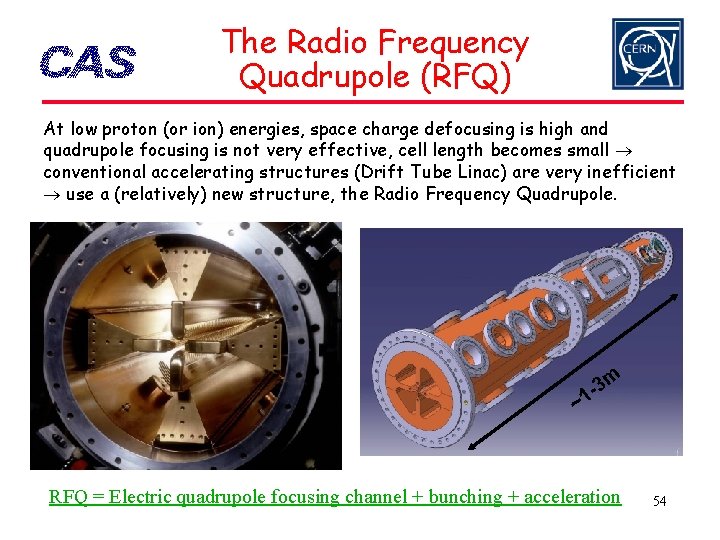
The Radio Frequency Quadrupole (RFQ) At low proton (or ion) energies, space charge defocusing is high and quadrupole focusing is not very effective, cell length becomes small conventional accelerating structures (Drift Tube Linac) are very inefficient use a (relatively) new structure, the Radio Frequency Quadrupole. m 3 1 - ~ RFQ = Electric quadrupole focusing channel + bunching + acceleration 54
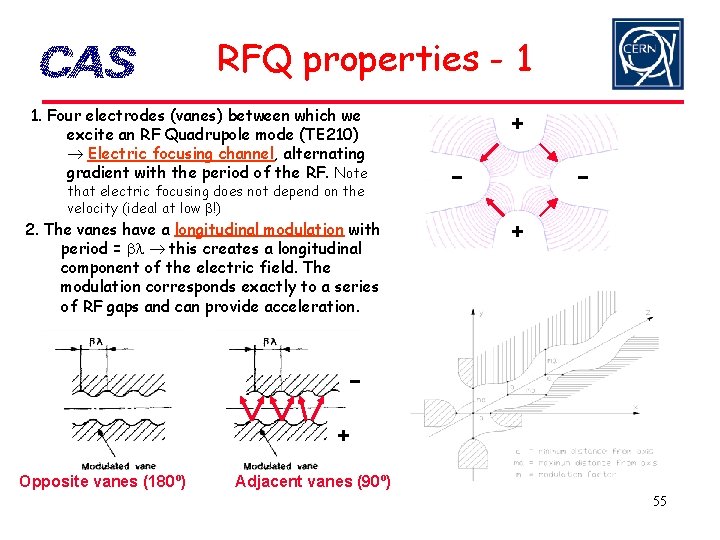
RFQ properties - 1 1. Four electrodes (vanes) between which we excite an RF Quadrupole mode (TE 210) Electric focusing channel, alternating gradient with the period of the RF. Note that electric focusing does not depend on the velocity (ideal at low b!) 2. The vanes have a longitudinal modulation with period = bl this creates a longitudinal component of the electric field. The modulation corresponds exactly to a series of RF gaps and can provide acceleration. + − − + Opposite vanes (180º) Adjacent vanes (90º) 55
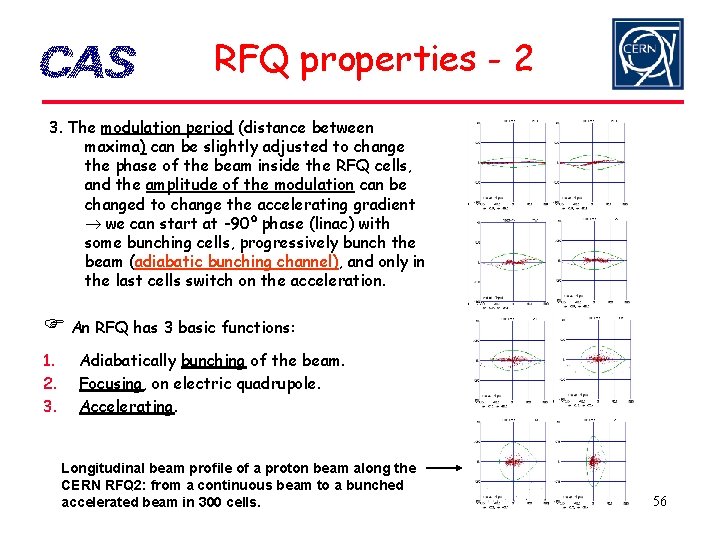
RFQ properties - 2 3. The modulation period (distance between maxima) can be slightly adjusted to change the phase of the beam inside the RFQ cells, and the amplitude of the modulation can be changed to change the accelerating gradient we can start at -90º phase (linac) with some bunching cells, progressively bunch the beam (adiabatic bunching channel), and only in the last cells switch on the acceleration. An RFQ has 3 basic functions: 1. 2. 3. Adiabatically bunching of the beam. Focusing, on electric quadrupole. Accelerating. Longitudinal beam profile of a proton beam along the CERN RFQ 2: from a continuous beam to a bunched accelerated beam in 300 cells. 56
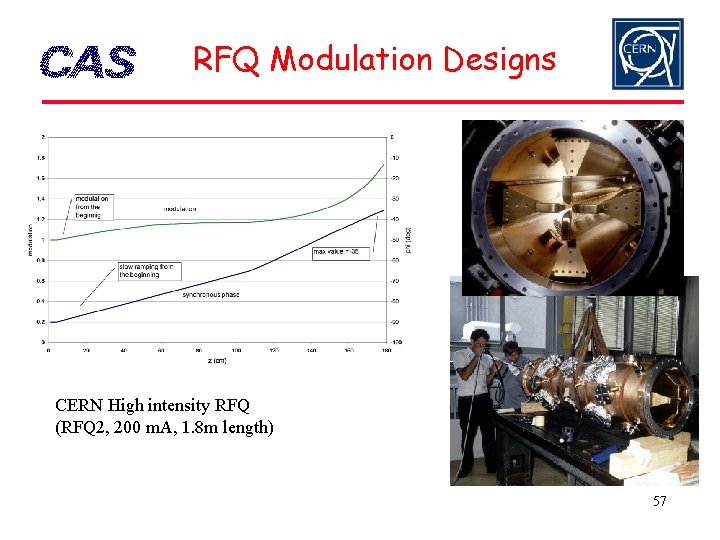
RFQ Modulation Designs CERN High intensity RFQ (RFQ 2, 200 m. A, 1. 8 m length) 57
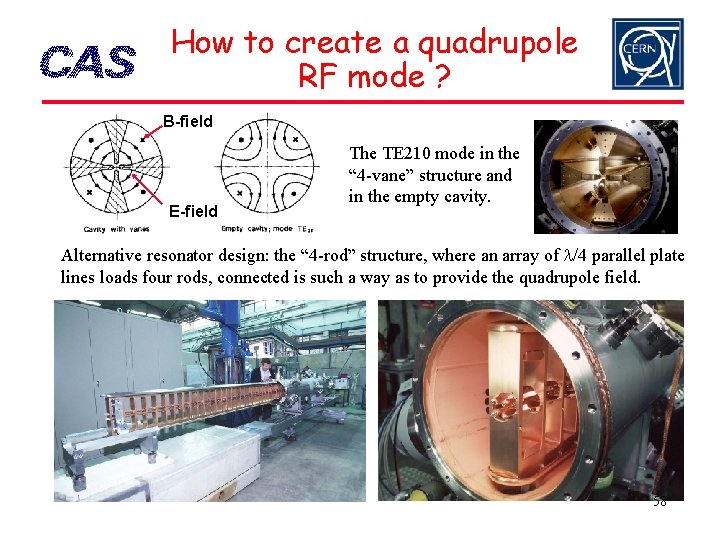
How to create a quadrupole RF mode ? B-field E-field The TE 210 mode in the “ 4 -vane” structure and in the empty cavity. Alternative resonator design: the “ 4 -rod” structure, where an array of l/4 parallel plate lines loads four rods, connected is such a way as to provide the quadrupole field. 58
7. Linac Technologies 59
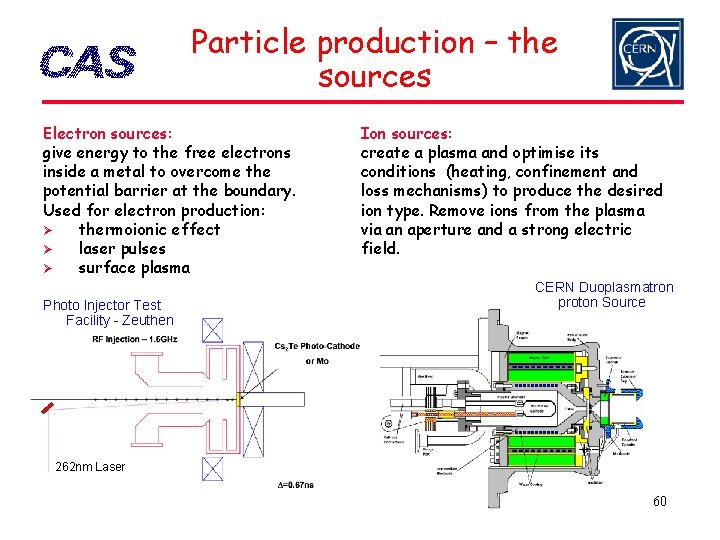
Particle production – the sources Electron sources: give energy to the free electrons inside a metal to overcome the potential barrier at the boundary. Used for electron production: Ø thermoionic effect Ø laser pulses Ø surface plasma Photo Injector Test Facility - Zeuthen Ion sources: create a plasma and optimise its conditions (heating, confinement and loss mechanisms) to produce the desired ion type. Remove ions from the plasma via an aperture and a strong electric field. CERN Duoplasmatron proton Source 262 nm Laser 60
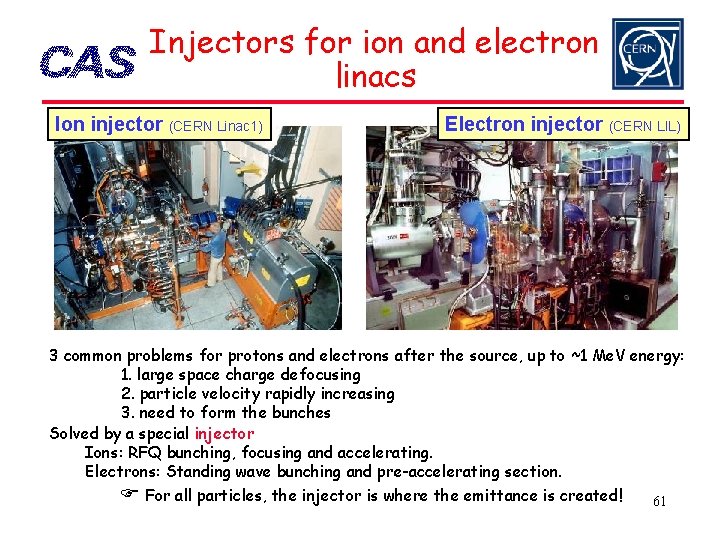
Injectors for ion and electron linacs Ion injector (CERN Linac 1) Electron injector (CERN LIL) 3 common problems for protons and electrons after the source, up to ~1 Me. V energy: 1. large space charge defocusing 2. particle velocity rapidly increasing 3. need to form the bunches Solved by a special injector Ions: RFQ bunching, focusing and accelerating. Electrons: Standing wave bunching and pre-accelerating section. For all particles, the injector is where the emittance is created! 61
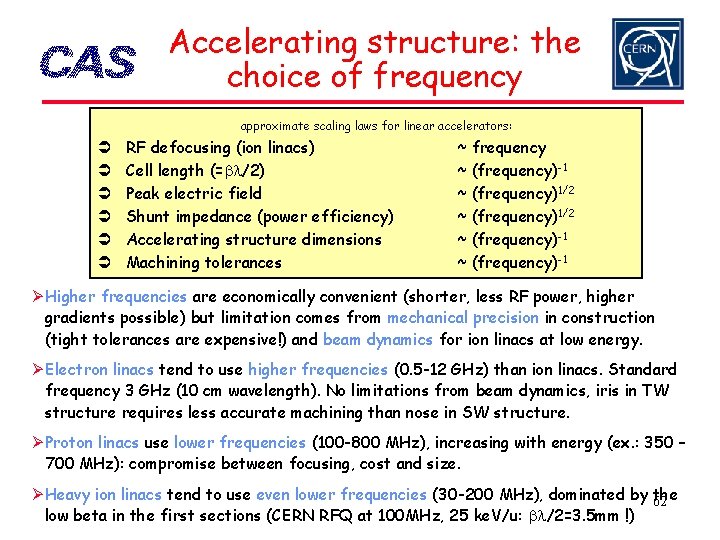
Accelerating structure: the choice of frequency approximate scaling laws for linear accelerators: Ü Ü Ü RF defocusing (ion linacs) Cell length (=bl/2) Peak electric field Shunt impedance (power efficiency) Accelerating structure dimensions Machining tolerances ~ frequency ~ (frequency)-1 ~ (frequency)1/2 ~ (frequency)-1 Ø Higher frequencies are economically convenient (shorter, less RF power, higher gradients possible) but limitation comes from mechanical precision in construction (tight tolerances are expensive!) and beam dynamics for ion linacs at low energy. Ø Electron linacs tend to use higher frequencies (0. 5 -12 GHz) than ion linacs. Standard frequency 3 GHz (10 cm wavelength). No limitations from beam dynamics, iris in TW structure requires less accurate machining than nose in SW structure. Ø Proton linacs use lower frequencies (100 -800 MHz), increasing with energy (ex. : 350 – 700 MHz): compromise between focusing, cost and size. Ø Heavy ion linacs tend to use even lower frequencies (30 -200 MHz), dominated by the 62 low beta in the first sections (CERN RFQ at 100 MHz, 25 ke. V/u: bl/2=3. 5 mm !)
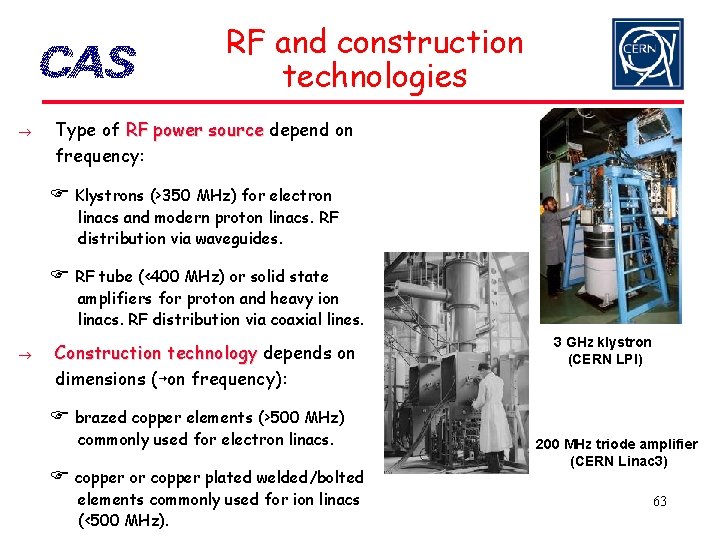
RF and construction technologies Type of RF power source depend on frequency: Klystrons (>350 MHz) for electron linacs and modern proton linacs. RF distribution via waveguides. RF tube (<400 MHz) or solid state amplifiers for proton and heavy ion linacs. RF distribution via coaxial lines. Construction technology depends on dimensions (→on frequency): 3 GHz klystron (CERN LPI) brazed copper elements (>500 MHz) commonly used for electron linacs. copper or copper plated welded/bolted elements commonly used for ion linacs (<500 MHz). 200 MHz triode amplifier (CERN Linac 3) 63
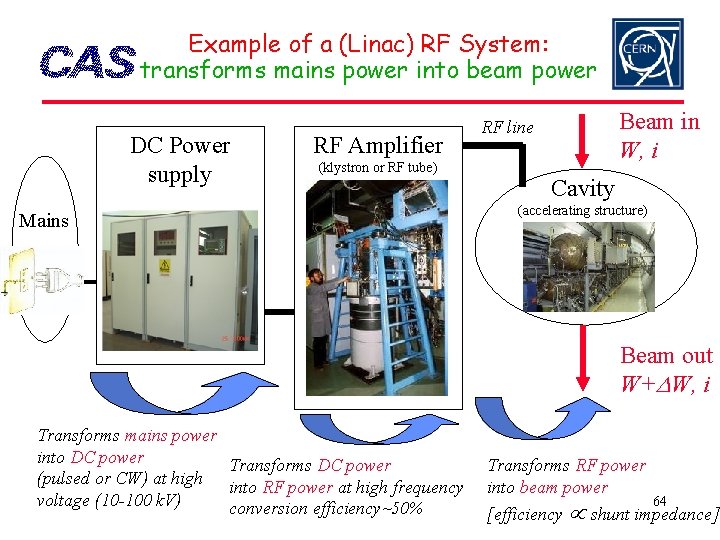
Example of a (Linac) RF System: transforms mains power into beam power DC Power supply RF Amplifier (klystron or RF tube) Mains Beam in W, i RF line Cavity (accelerating structure) Beam out W+DW, i Transforms mains power into DC power Transforms DC power (pulsed or CW) at high into RF power at high frequency voltage (10 -100 k. V) conversion efficiency~50% Transforms RF power into beam power 64 [efficiency shunt impedance]
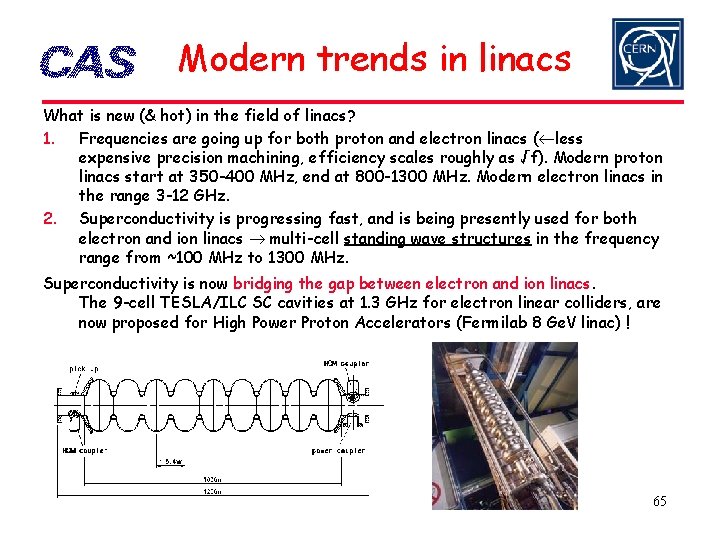
Modern trends in linacs What is new (& hot) in the field of linacs? 1. Frequencies are going up for both proton and electron linacs ( less expensive precision machining, efficiency scales roughly as √f). Modern proton linacs start at 350 -400 MHz, end at 800 -1300 MHz. Modern electron linacs in the range 3 -12 GHz. 2. Superconductivity is progressing fast, and is being presently used for both electron and ion linacs multi-cell standing wave structures in the frequency range from ~100 MHz to 1300 MHz. Superconductivity is now bridging the gap between electron and ion linacs. The 9 -cell TESLA/ILC SC cavities at 1. 3 GHz for electron linear colliders, are now proposed for High Power Proton Accelerators (Fermilab 8 Ge. V linac) ! 65
Bibliography 1. Reference Books: T. Wangler, Principles of RF Linear Accelerators (Wiley, New York, 1998). P. Lapostolle, A. Septier (editors), Linear Accelerators (Amsterdam, North Holland, 1970). I. M. Kapchinskii, Theory of resonance linear accelerators (Harwood, Chur, 1985). 2. General Introductions to linear accelerators M. Puglisi, The Linear Accelerator, in E. Persico, E. Ferrari, S. E. Segré, Principles of Particle Accelerators (W. A. Benjamin, New York, 1968). P. Lapostolle, Proton Linear Accelerators: A theoretical and Historical Introduction, LA-11601 -MS, 1989. P. Lapostolle, M. Weiss, Formulae and Procedures useful for the Design of Linear Accelerators, CERNPS-2000 -001 (DR), 2000. P. Lapostolle, R. Jameson, Linear Accelerators, in Encyclopaedia of Applied Physics (VCH Publishers, New York, 1991). 3. CAS Schools S. Turner (ed. ), CAS School: Cyclotrons, Linacs and their applications, CERN 96 -02 (1996). M. Weiss, Introduction to RF Linear Accelerators, in CAS School: Fifth General Accelerator Physics Course, CERN-94 -01 (1994), p. 913. N. Pichoff, Introduction to RF Linear Accelerators, in CAS School: Basic Course on General Accelerator Physics, CERN-2005 -04 (2005). M. Vretenar, Differences between electron and ion linacs, in CAS School: Small Accelerators, CERN 2006 -012. 66