
Introduction to RF for Particle Accelerators Part 3
- Slides: 44
Introduction to RF for Particle Accelerators Part 3: Beam Signals Dave Mc. Ginnis
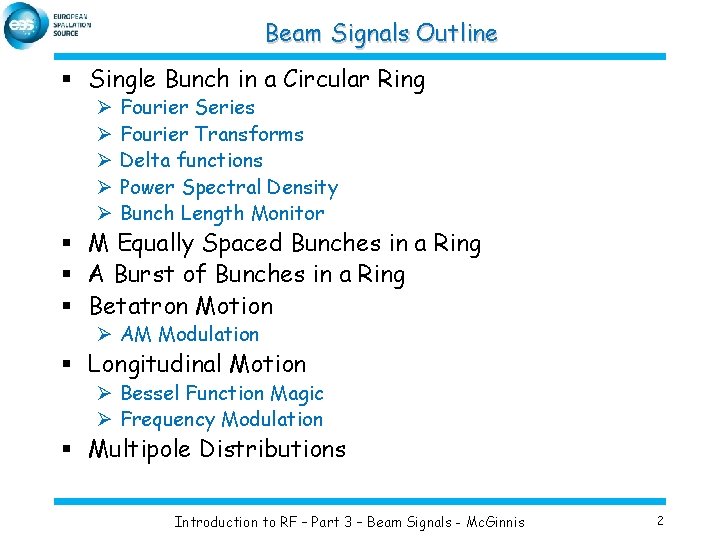
Beam Signals Outline § Single Bunch in a Circular Ring Ø Ø Ø Fourier Series Fourier Transforms Delta functions Power Spectral Density Bunch Length Monitor § M Equally Spaced Bunches in a Ring § A Burst of Bunches in a Ring § Betatron Motion Ø AM Modulation § Longitudinal Motion Ø Bessel Function Magic Ø Frequency Modulation § Multipole Distributions Introduction to RF – Part 3 – Beam Signals - Mc. Ginnis 2
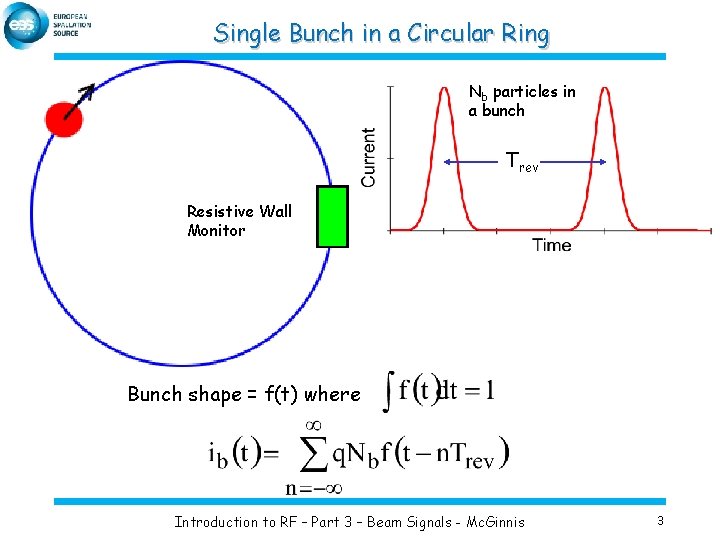
Single Bunch in a Circular Ring Nb particles in a bunch Trev Resistive Wall Monitor Bunch shape = f(t) where Introduction to RF – Part 3 – Beam Signals - Mc. Ginnis 3
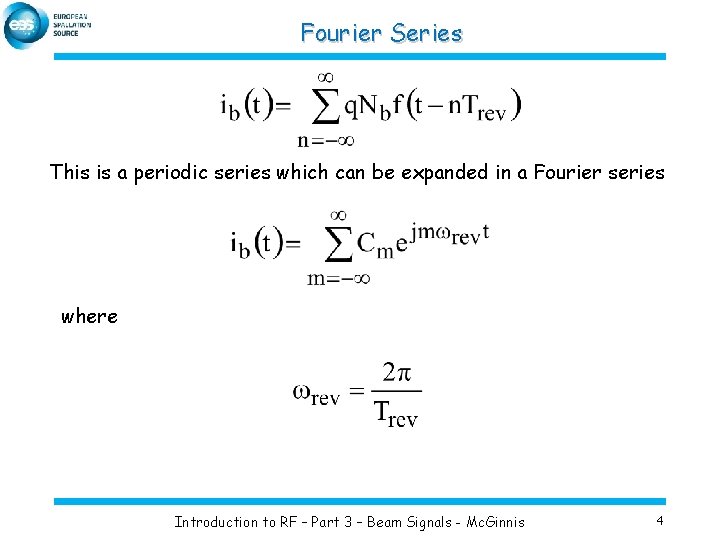
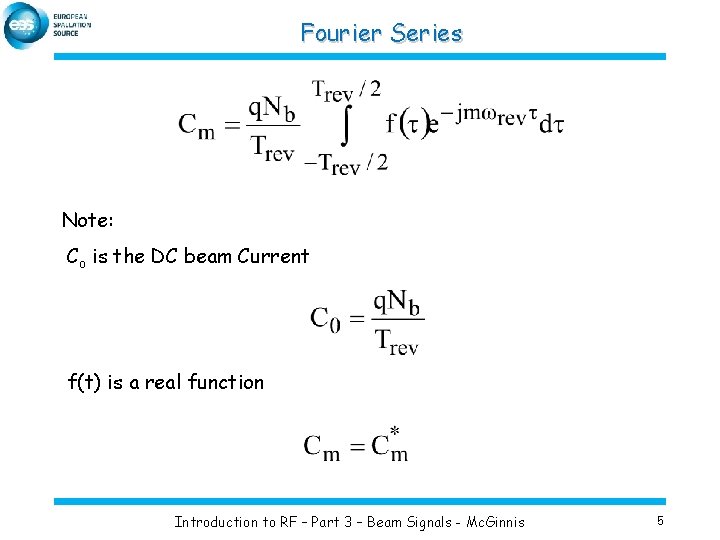
Fourier Series This is a periodic series which can be expanded in a Fourier series where Introduction to RF – Part 3 – Beam Signals - Mc. Ginnis 4
Fourier Series Note: Co is the DC beam Current f(t) is a real function Introduction to RF – Part 3 – Beam Signals - Mc. Ginnis 5
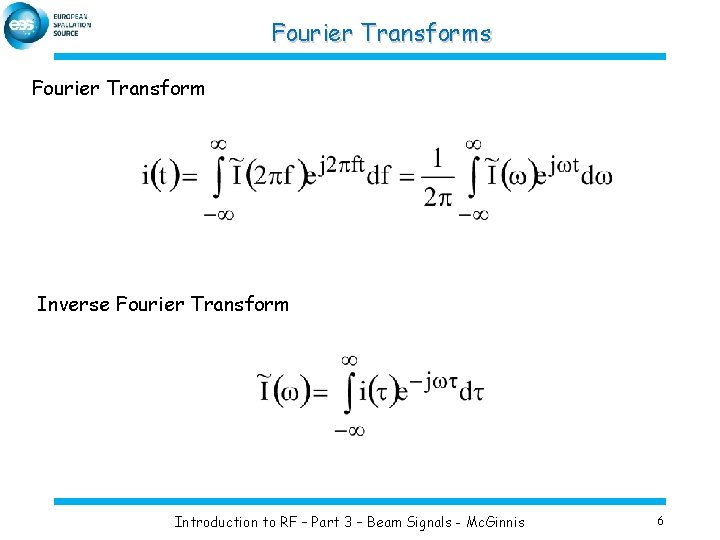
Fourier Transforms Fourier Transform Inverse Fourier Transform Introduction to RF – Part 3 – Beam Signals - Mc. Ginnis 6
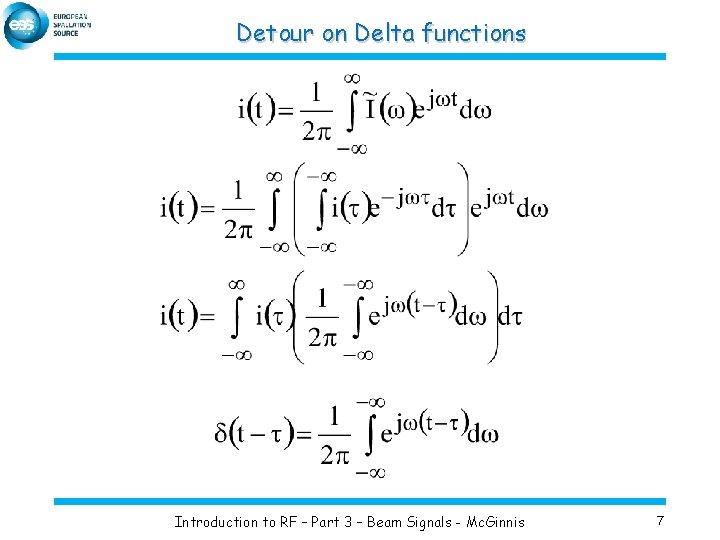
Detour on Delta functions Introduction to RF – Part 3 – Beam Signals - Mc. Ginnis 7
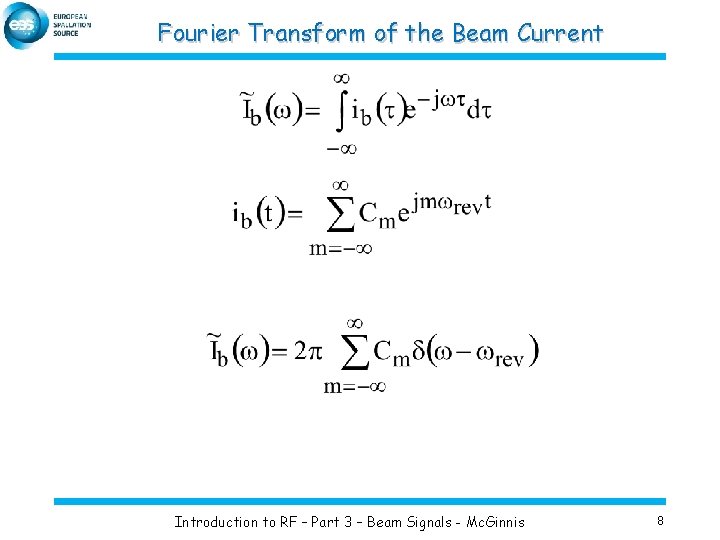
Fourier Transform of the Beam Current Introduction to RF – Part 3 – Beam Signals - Mc. Ginnis 8
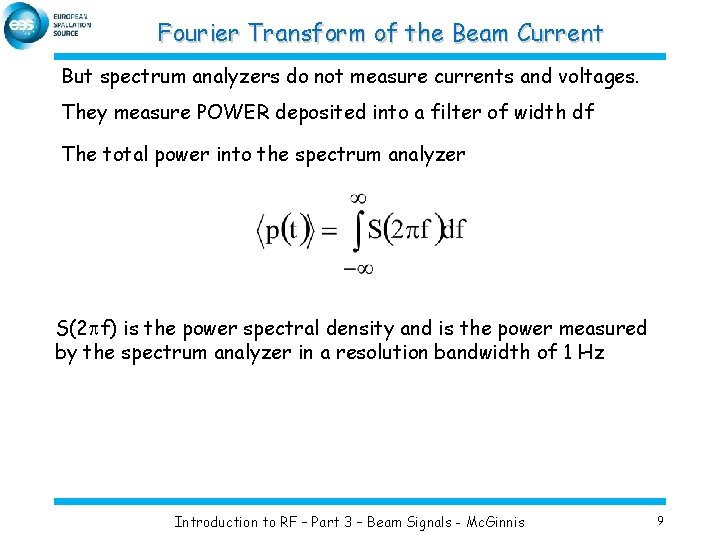
Fourier Transform of the Beam Current But spectrum analyzers do not measure currents and voltages. They measure POWER deposited into a filter of width df The total power into the spectrum analyzer S(2 pf) is the power spectral density and is the power measured by the spectrum analyzer in a resolution bandwidth of 1 Hz Introduction to RF – Part 3 – Beam Signals - Mc. Ginnis 9
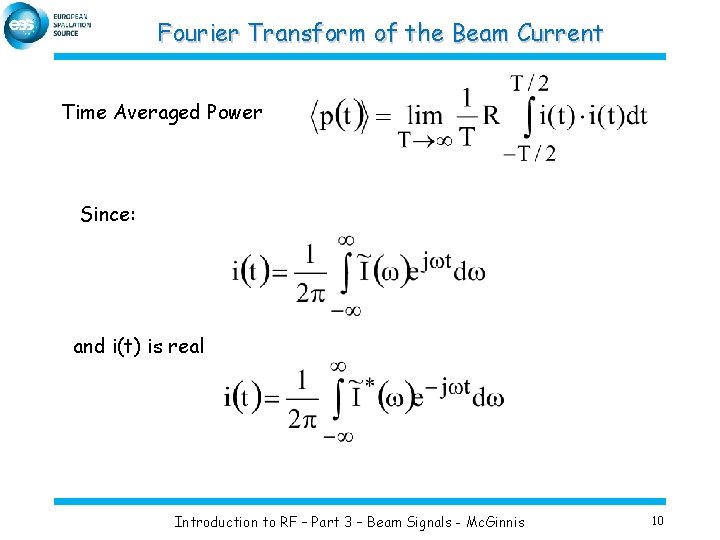
Fourier Transform of the Beam Current Time Averaged Power Since: and i(t) is real Introduction to RF – Part 3 – Beam Signals - Mc. Ginnis 10
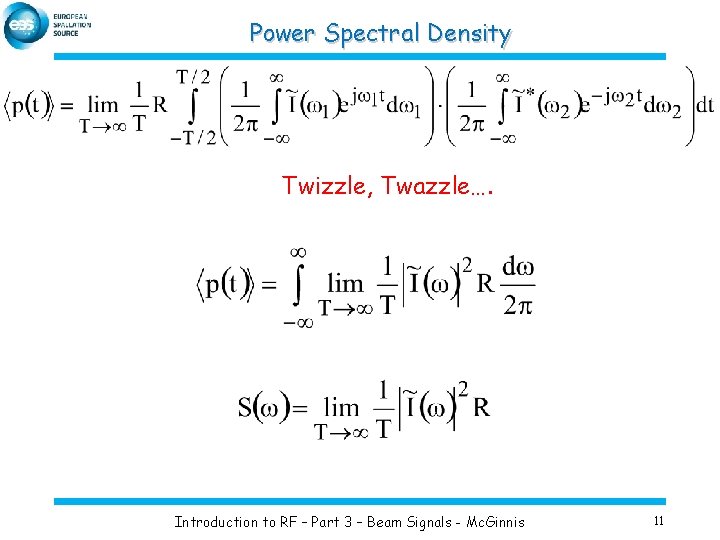
Power Spectral Density Twizzle, Twazzle…. Introduction to RF – Part 3 – Beam Signals - Mc. Ginnis 11
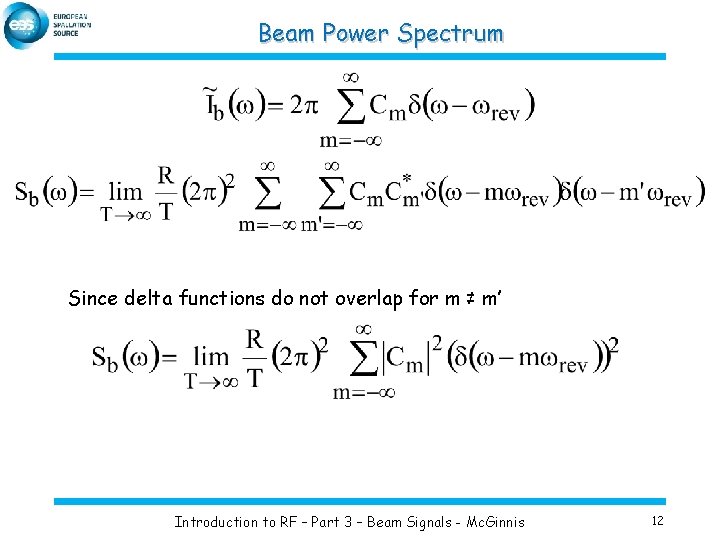
Beam Power Spectrum Since delta functions do not overlap for m ≠ m’ Introduction to RF – Part 3 – Beam Signals - Mc. Ginnis 12
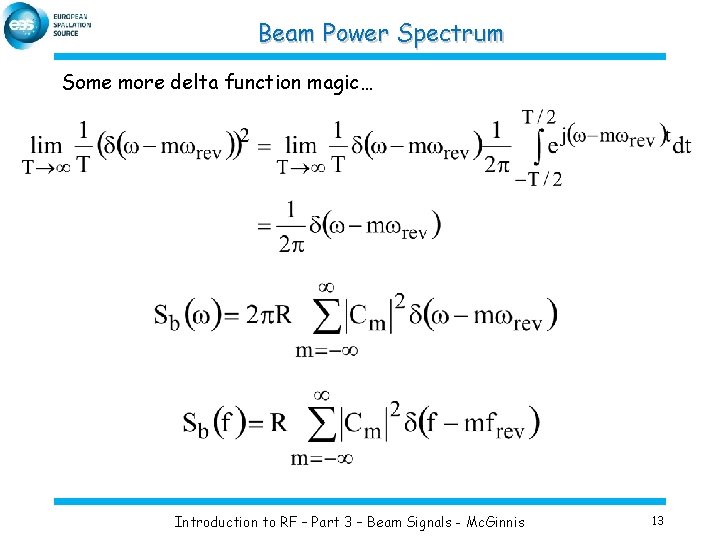
Beam Power Spectrum Some more delta function magic… Introduction to RF – Part 3 – Beam Signals - Mc. Ginnis 13
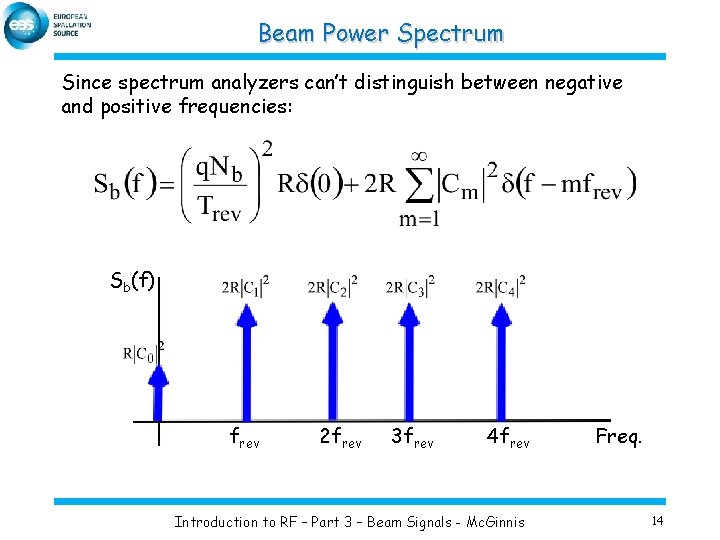
Beam Power Spectrum Since spectrum analyzers can’t distinguish between negative and positive frequencies: Sb(f) frev 2 frev 3 frev 4 frev Introduction to RF – Part 3 – Beam Signals - Mc. Ginnis Freq. 14
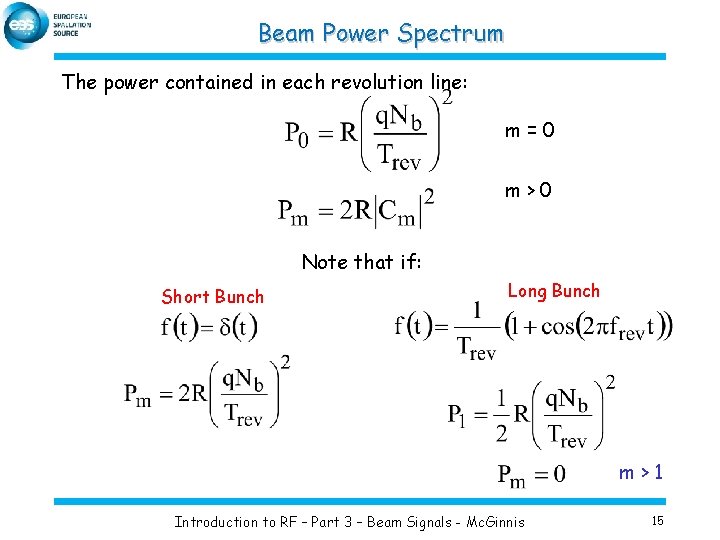
Beam Power Spectrum The power contained in each revolution line: m=0 m>0 Note that if: Short Bunch Long Bunch m>1 Introduction to RF – Part 3 – Beam Signals - Mc. Ginnis 15
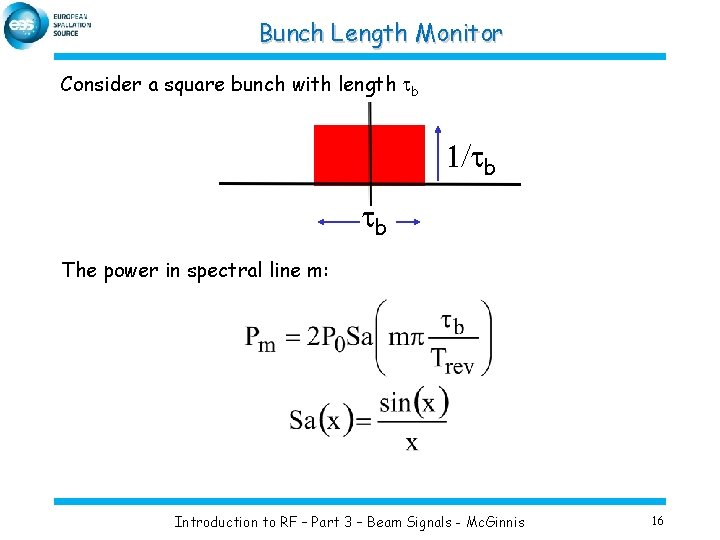
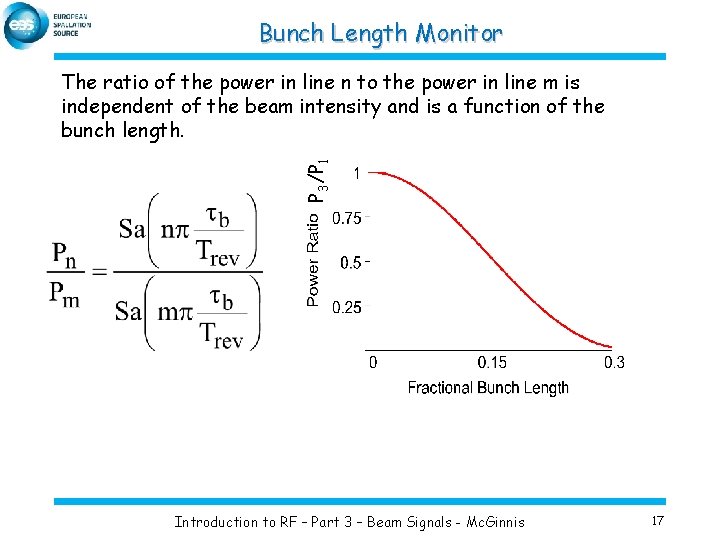
Bunch Length Monitor Consider a square bunch with length tb 1/tb tb The power in spectral line m: Introduction to RF – Part 3 – Beam Signals - Mc. Ginnis 16
Bunch Length Monitor P 3/P 1 The ratio of the power in line n to the power in line m is independent of the beam intensity and is a function of the bunch length. Introduction to RF – Part 3 – Beam Signals - Mc. Ginnis 17
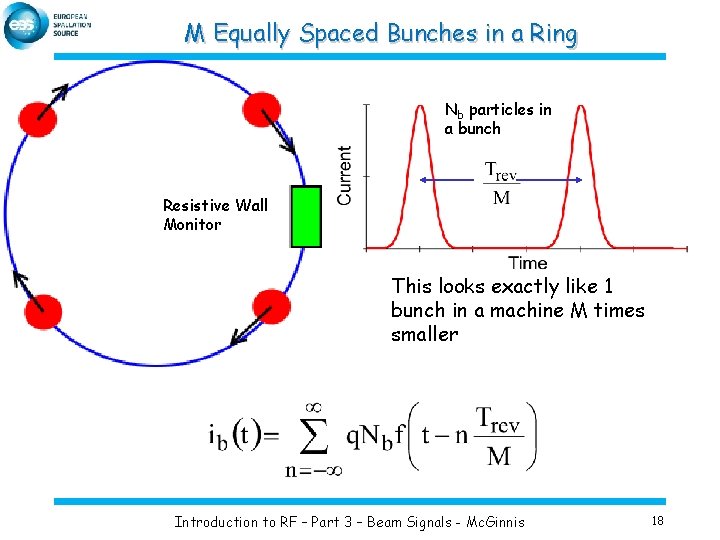
M Equally Spaced Bunches in a Ring Nb particles in a bunch Resistive Wall Monitor This looks exactly like 1 bunch in a machine M times smaller Introduction to RF – Part 3 – Beam Signals - Mc. Ginnis 18
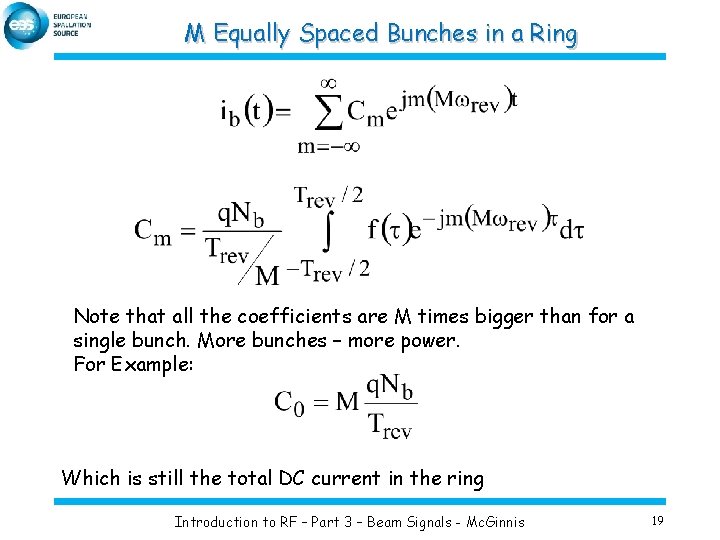
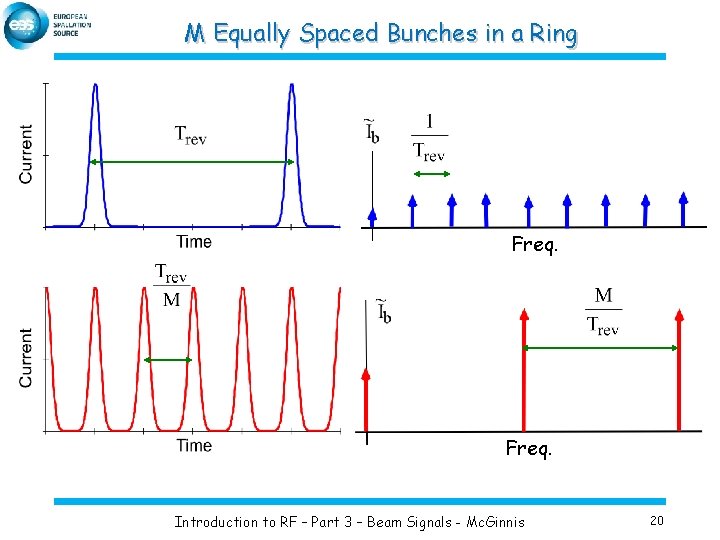
M Equally Spaced Bunches in a Ring Note that all the coefficients are M times bigger than for a single bunch. More bunches – more power. For Example: Which is still the total DC current in the ring Introduction to RF – Part 3 – Beam Signals - Mc. Ginnis 19
M Equally Spaced Bunches in a Ring Freq. Introduction to RF – Part 3 – Beam Signals - Mc. Ginnis 20
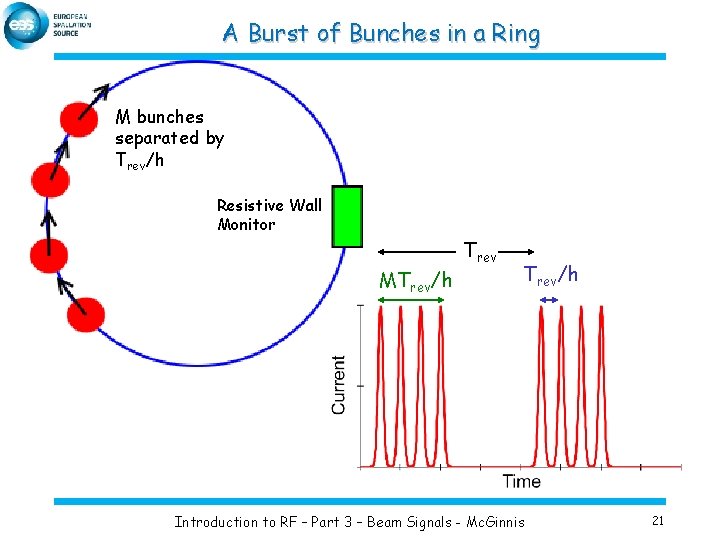
A Burst of Bunches in a Ring M bunches separated by Trev/h Resistive Wall Monitor MTrev/h Introduction to RF – Part 3 – Beam Signals - Mc. Ginnis 21
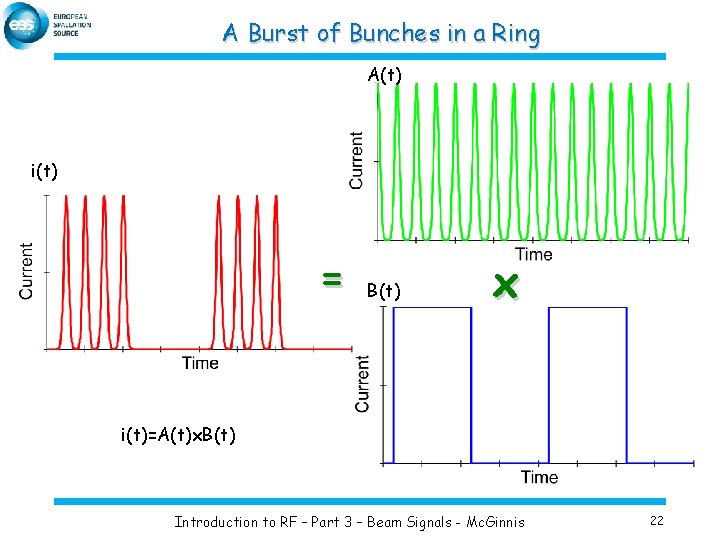
A Burst of Bunches in a Ring A(t) i(t) = B(t) x i(t)=A(t)x. B(t) Introduction to RF – Part 3 – Beam Signals - Mc. Ginnis 22
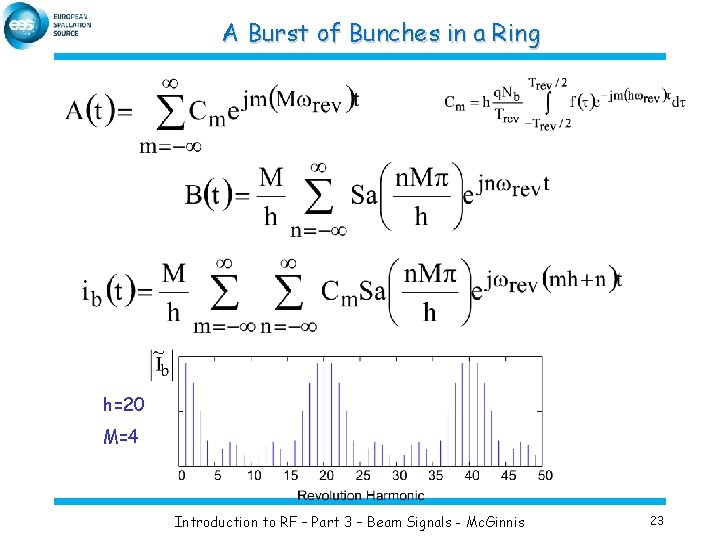
A Burst of Bunches in a Ring h=20 M=4 Introduction to RF – Part 3 – Beam Signals - Mc. Ginnis 23
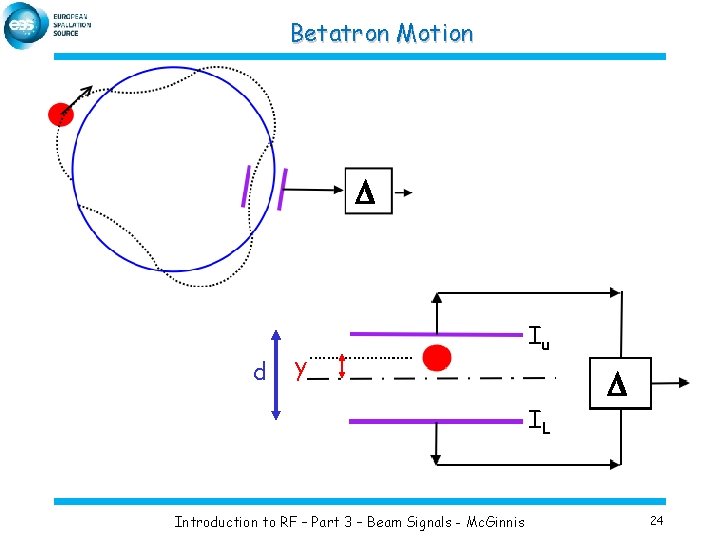
Betatron Motion D d y Iu IL Introduction to RF – Part 3 – Beam Signals - Mc. Ginnis D 24
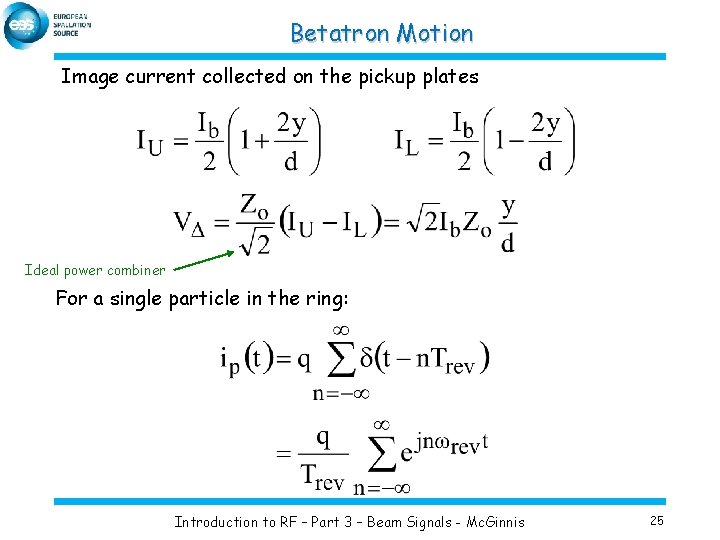
Betatron Motion Image current collected on the pickup plates Ideal power combiner For a single particle in the ring: Introduction to RF – Part 3 – Beam Signals - Mc. Ginnis 25
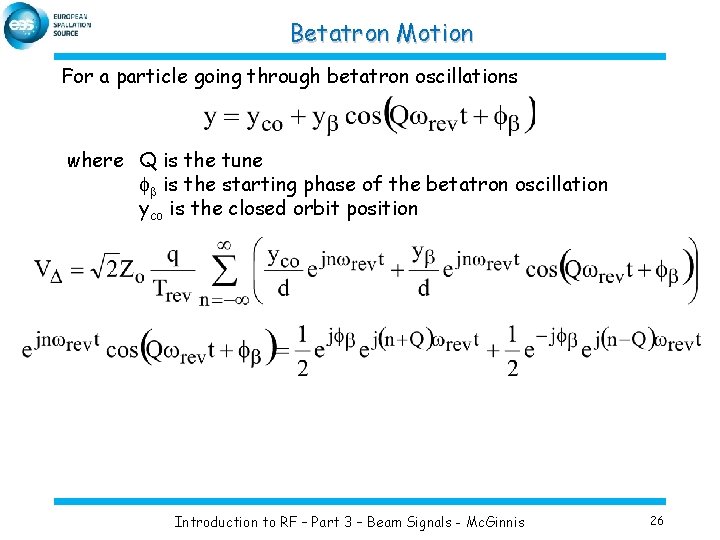
Betatron Motion For a particle going through betatron oscillations where Q is the tune fb is the starting phase of the betatron oscillation yco is the closed orbit position Introduction to RF – Part 3 – Beam Signals - Mc. Ginnis 26
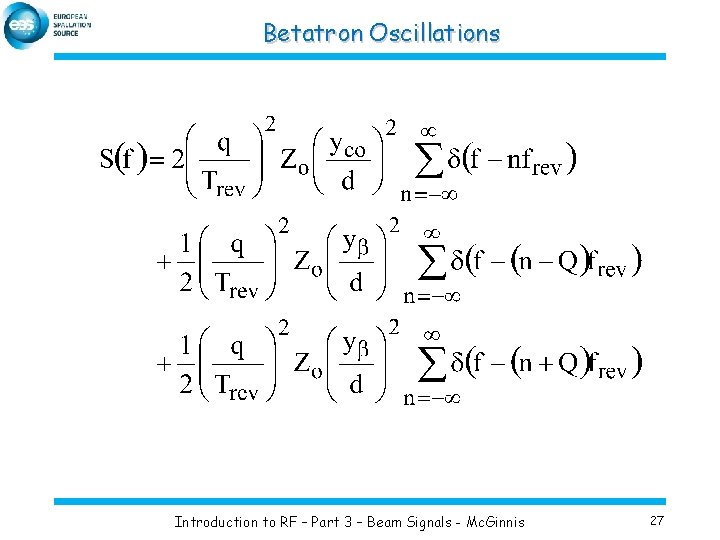
Betatron Oscillations Introduction to RF – Part 3 – Beam Signals - Mc. Ginnis 27
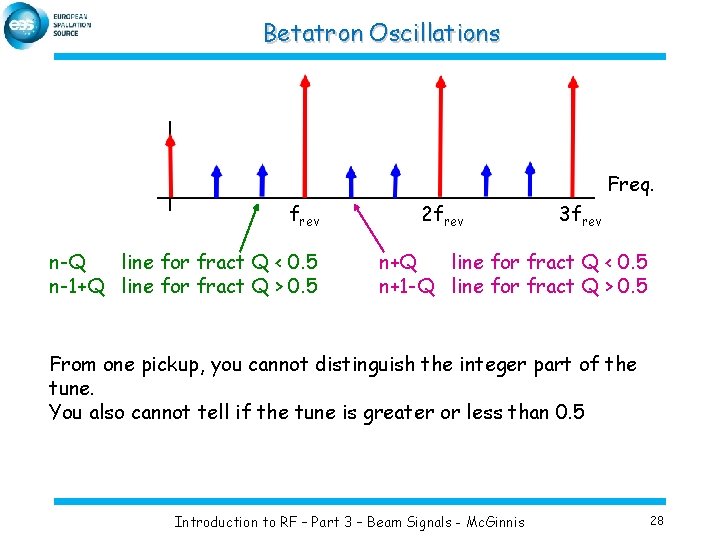
Betatron Oscillations Freq. frev n-Q line for fract Q < 0. 5 n-1+Q line for fract Q > 0. 5 2 frev 3 frev n+Q line for fract Q < 0. 5 n+1 -Q line for fract Q > 0. 5 From one pickup, you cannot distinguish the integer part of the tune. You also cannot tell if the tune is greater or less than 0. 5 Introduction to RF – Part 3 – Beam Signals - Mc. Ginnis 28
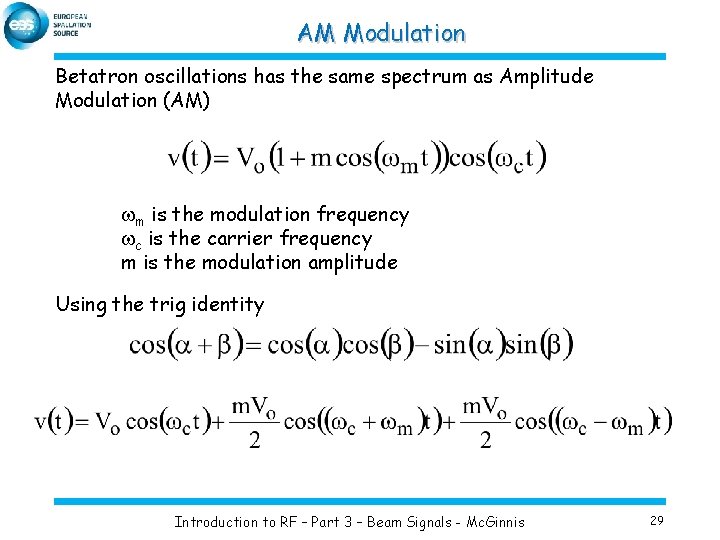
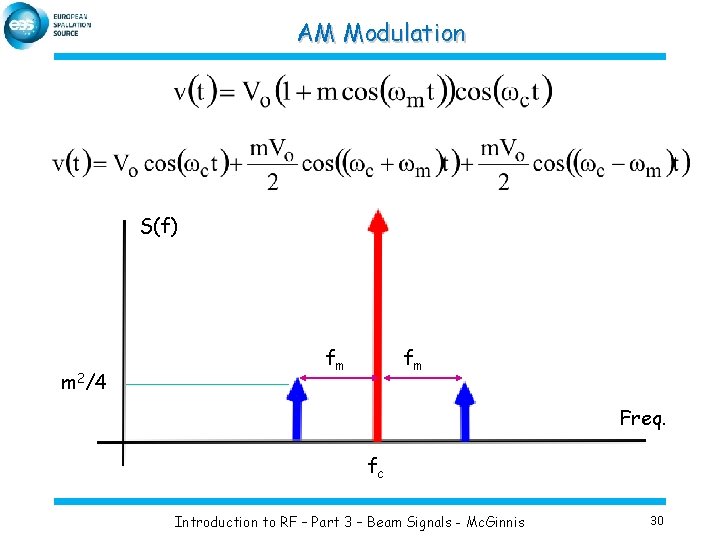
AM Modulation Betatron oscillations has the same spectrum as Amplitude Modulation (AM) wm is the modulation frequency wc is the carrier frequency m is the modulation amplitude Using the trig identity Introduction to RF – Part 3 – Beam Signals - Mc. Ginnis 29
AM Modulation S(f) m 2/4 fm fm Freq. fc Introduction to RF – Part 3 – Beam Signals - Mc. Ginnis 30
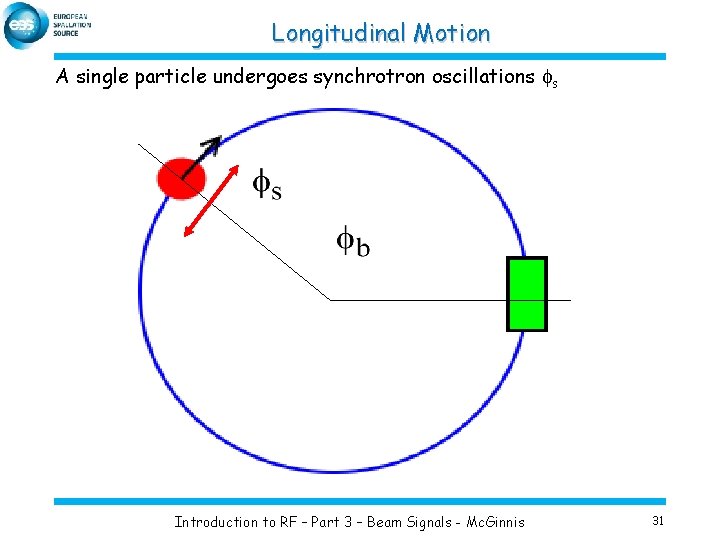
Longitudinal Motion A single particle undergoes synchrotron oscillations fs Introduction to RF – Part 3 – Beam Signals - Mc. Ginnis 31
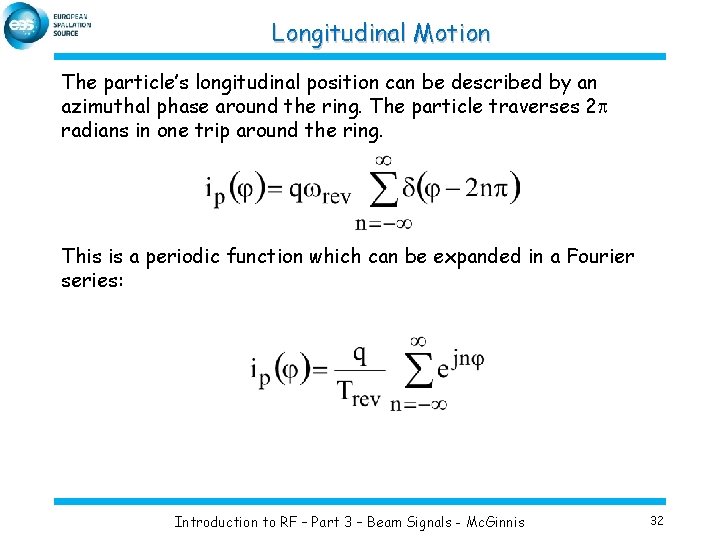
Longitudinal Motion The particle’s longitudinal position can be described by an azimuthal phase around the ring. The particle traverses 2 p radians in one trip around the ring. This is a periodic function which can be expanded in a Fourier series: Introduction to RF – Part 3 – Beam Signals - Mc. Ginnis 32
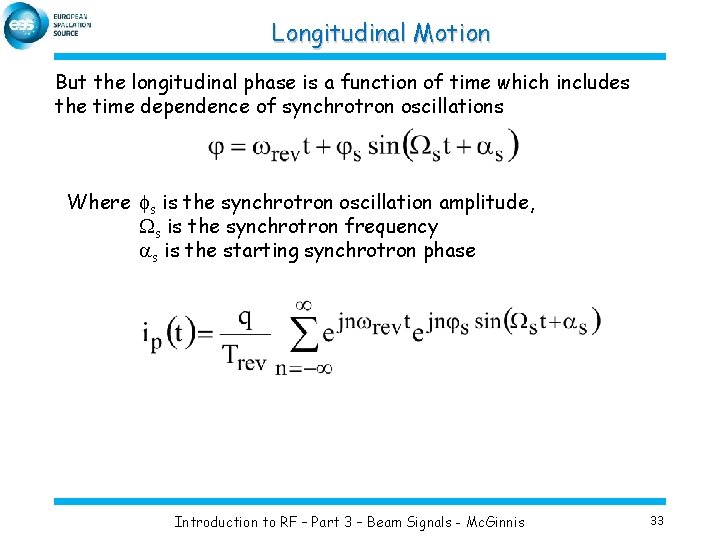
Longitudinal Motion But the longitudinal phase is a function of time which includes the time dependence of synchrotron oscillations Where fs is the synchrotron oscillation amplitude, Ws is the synchrotron frequency as is the starting synchrotron phase Introduction to RF – Part 3 – Beam Signals - Mc. Ginnis 33
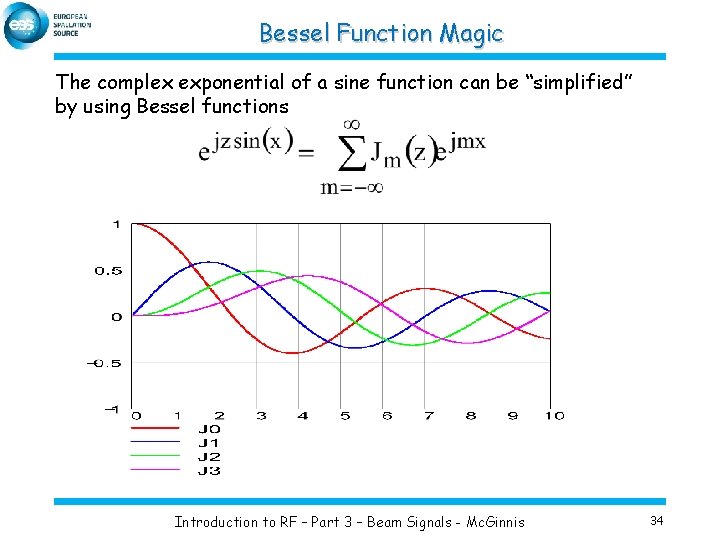
Bessel Function Magic The complex exponential of a sine function can be “simplified” by using Bessel functions Introduction to RF – Part 3 – Beam Signals - Mc. Ginnis 34
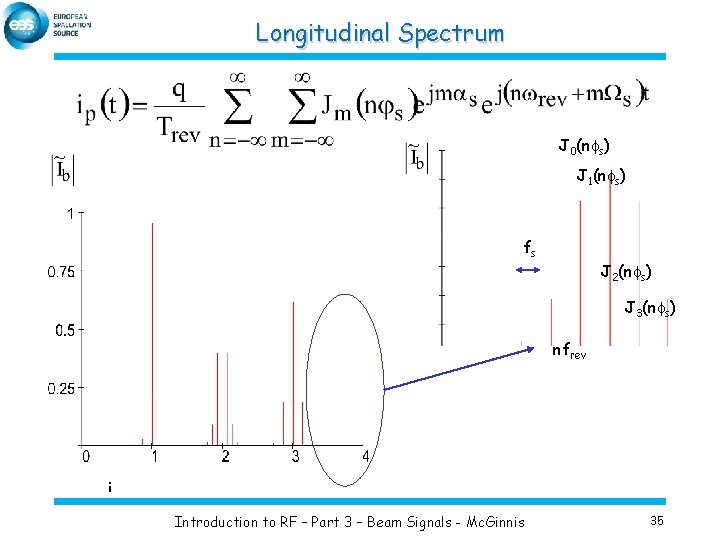
Longitudinal Spectrum J 0(nfs) J 1(nfs) fs J 2(nfs) J 3(nfs) nfrev Introduction to RF – Part 3 – Beam Signals - Mc. Ginnis 35
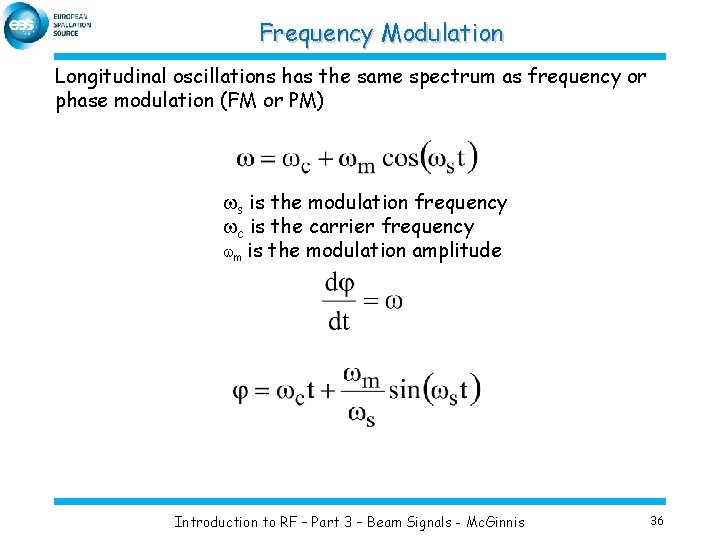
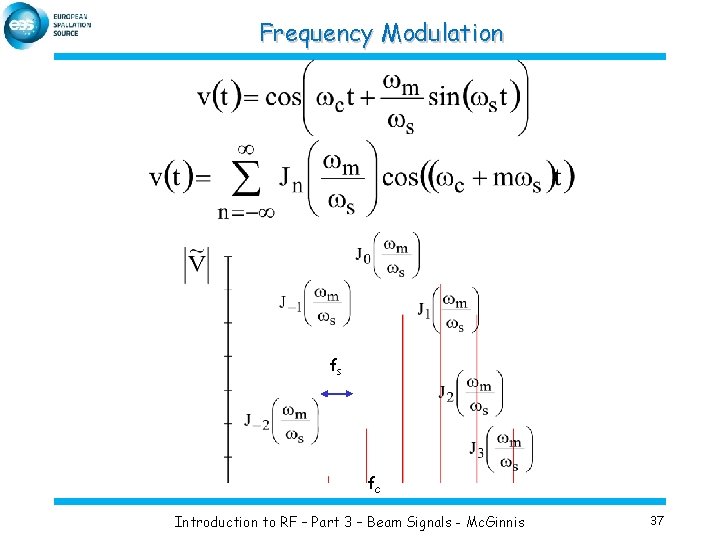
Frequency Modulation Longitudinal oscillations has the same spectrum as frequency or phase modulation (FM or PM) ws is the modulation frequency wc is the carrier frequency wm is the modulation amplitude Introduction to RF – Part 3 – Beam Signals - Mc. Ginnis 36
Frequency Modulation fs fc Introduction to RF – Part 3 – Beam Signals - Mc. Ginnis 37
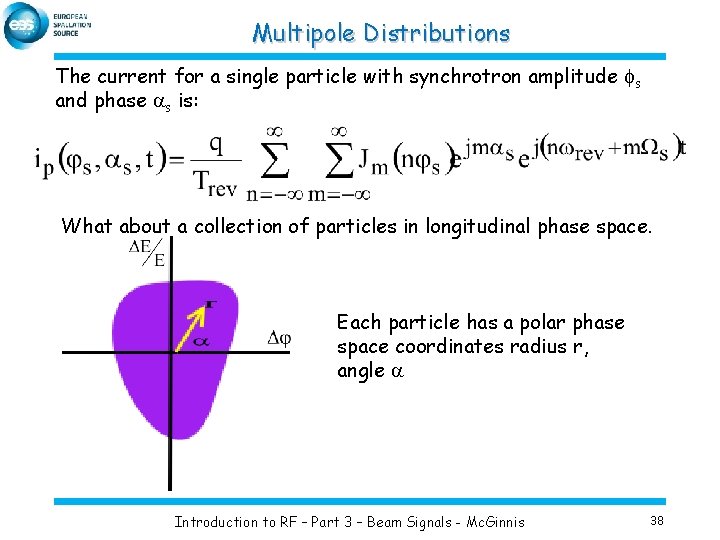
Multipole Distributions The current for a single particle with synchrotron amplitude fs and phase as is: What about a collection of particles in longitudinal phase space. Each particle has a polar phase space coordinates radius r, angle a Introduction to RF – Part 3 – Beam Signals - Mc. Ginnis 38
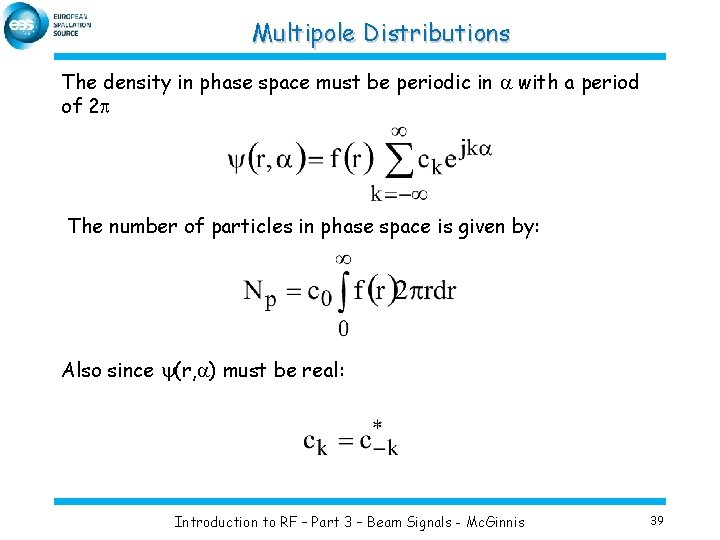
Multipole Distributions The density in phase space must be periodic in a with a period of 2 p The number of particles in phase space is given by: Also since y(r, a) must be real: Introduction to RF – Part 3 – Beam Signals - Mc. Ginnis 39
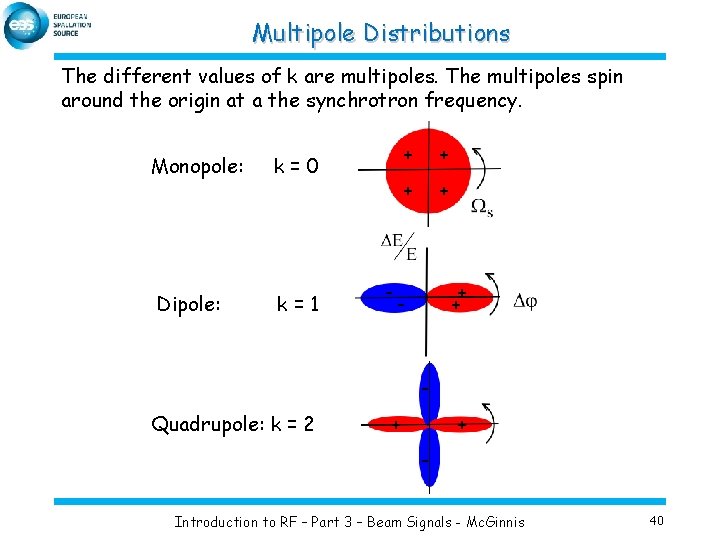
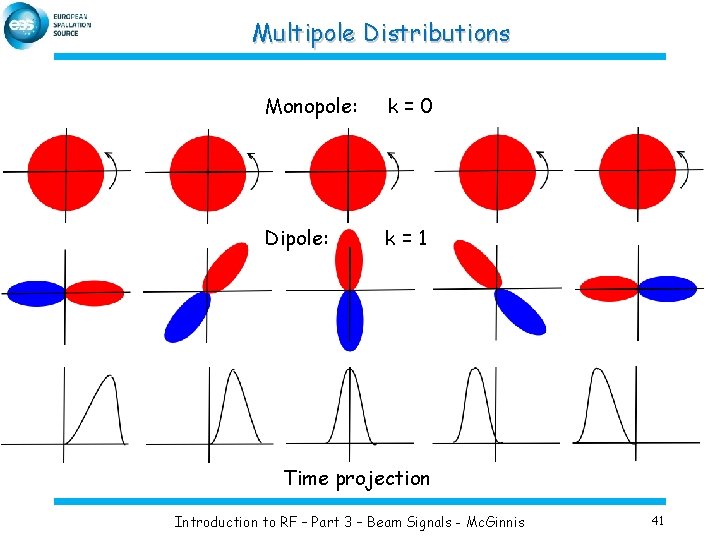
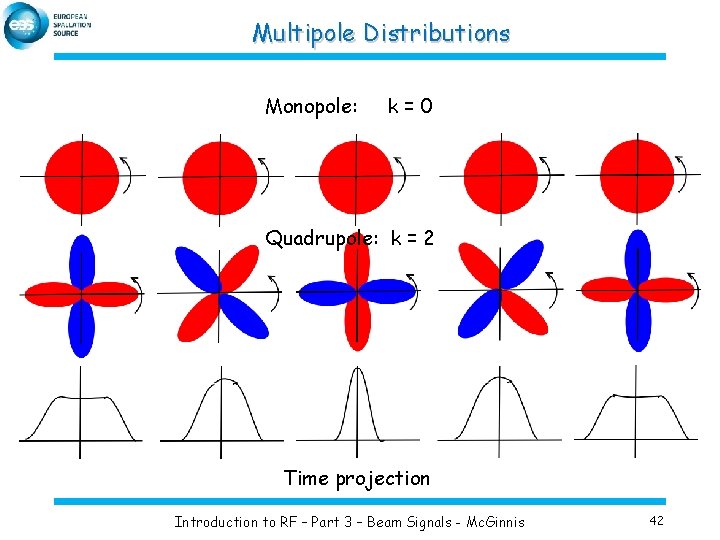
Multipole Distributions The different values of k are multipoles. The multipoles spin around the origin at a the synchrotron frequency. Monopole: k=0 Dipole: k=1 - + + + - Quadrupole: k = 2 + + - Introduction to RF – Part 3 – Beam Signals - Mc. Ginnis 40
Multipole Distributions Monopole: k=0 Dipole: k=1 Time projection Introduction to RF – Part 3 – Beam Signals - Mc. Ginnis 41
Multipole Distributions Monopole: k=0 Quadrupole: k = 2 Time projection Introduction to RF – Part 3 – Beam Signals - Mc. Ginnis 42
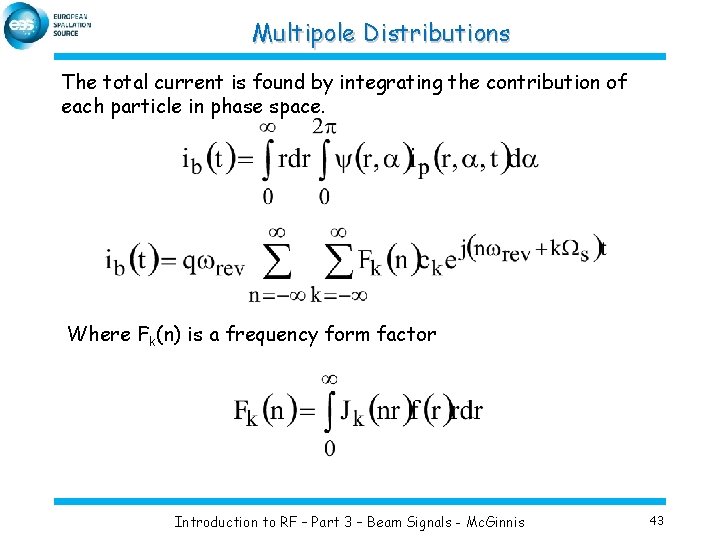
Multipole Distributions The total current is found by integrating the contribution of each particle in phase space. Where Fk(n) is a frequency form factor Introduction to RF – Part 3 – Beam Signals - Mc. Ginnis 43
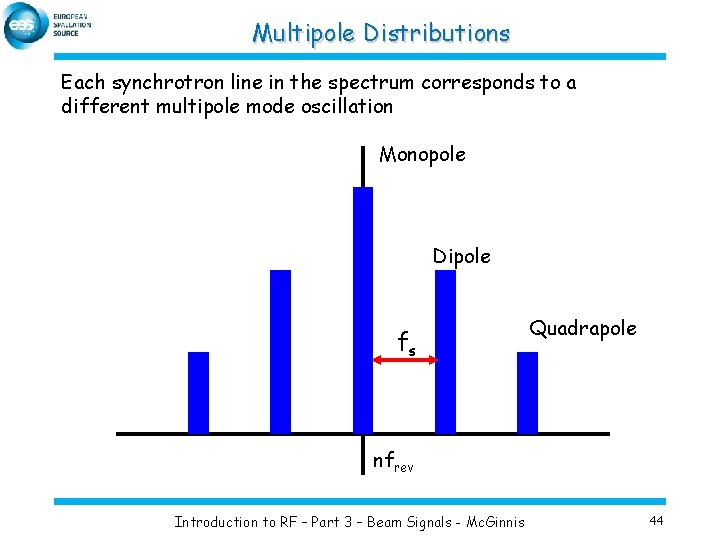
Multipole Distributions Each synchrotron line in the spectrum corresponds to a different multipole mode oscillation Monopole Dipole fs Quadrapole nfrev Introduction to RF – Part 3 – Beam Signals - Mc. Ginnis 44