
Introduction to RF for Particle Accelerators Part 1
- Slides: 76
Introduction to RF for Particle Accelerators Part 1: Transmission Lines Dave Mc. Ginnis
Motivation § These lectures are intended as an introduction to RF terminology and techniques § Lectures are based on the notes for the Microwave Measurement Class that is taught at the US Particle Accelerator School Introduction to RF – Part 1 – Transmission Lines - Mc. Ginnis 2
Part 1 - Transmission Lines § § § § Phasors Traveling Waves Characteristic Impedance Reflection Coefficient Standing Waves Impedance and Reflection Incident and Reflected Power § § § § Smith Charts Load Matching Single Stub Tuners d. B and d. Bm Z and S parameters Lorentz Reciprocity Network Analysis Phase and Group Delay Introduction to RF – Part 1 – Transmission Lines - Mc. Ginnis 3
Part 2 - RF Cavities § Modes § Impedance Measurements Ø Symmetry Ø Boundaries Ø Degeneracy § RLC model § Coupling Ø Inductive Ø Capacitive Ø Measuring § Q Ø Unloaded Q Ø Loaded Q Ø Q Measurements Ø Bead Pulls Ø Stretched wire § Beam Loading Ø De-tuning Ø Fundamental Ø Transient § Power Amplifiers Ø Class of operation Ø Tetrodes Ø Klystrons Introduction to RF – Part 1 – Transmission Lines - Mc. Ginnis 4
Part 3 - Beam Signals § § § § Power Spectral Density Spectra of bunch loading patterns Betatron motion AM modulation Longitudinal motion FM and PM modulation Multipole distributions Introduction to RF – Part 1 – Transmission Lines - Mc. Ginnis 5
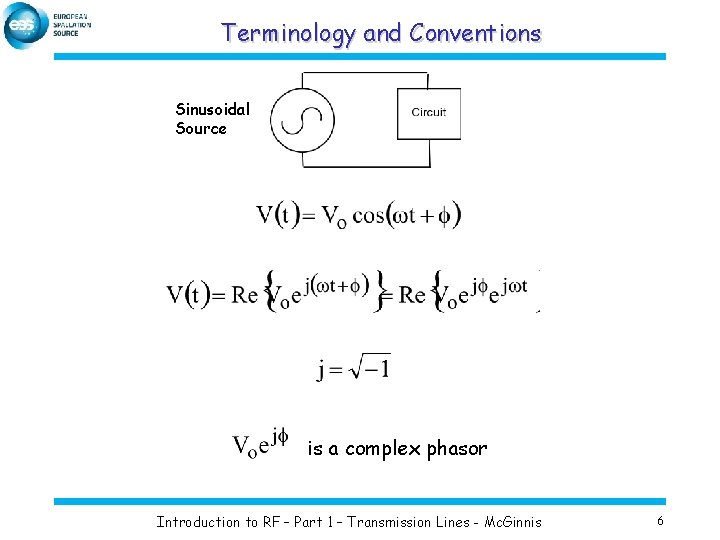
Terminology and Conventions Sinusoidal Source is a complex phasor Introduction to RF – Part 1 – Transmission Lines - Mc. Ginnis 6
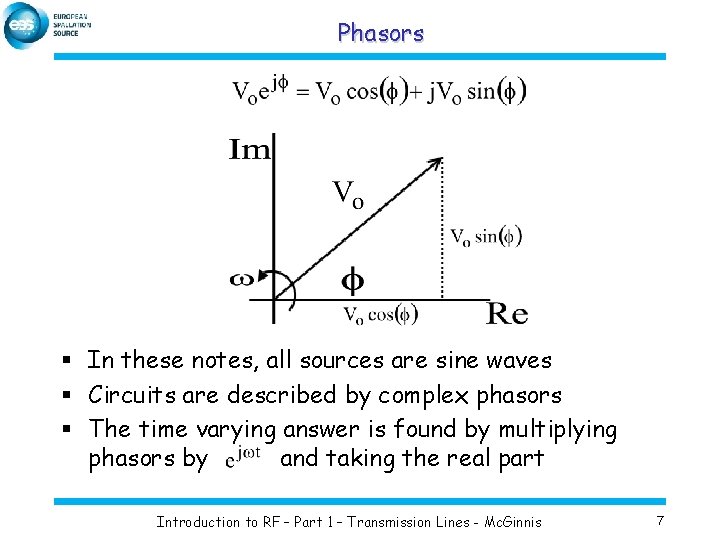
Phasors § In these notes, all sources are sine waves § Circuits are described by complex phasors § The time varying answer is found by multiplying phasors by and taking the real part Introduction to RF – Part 1 – Transmission Lines - Mc. Ginnis 7
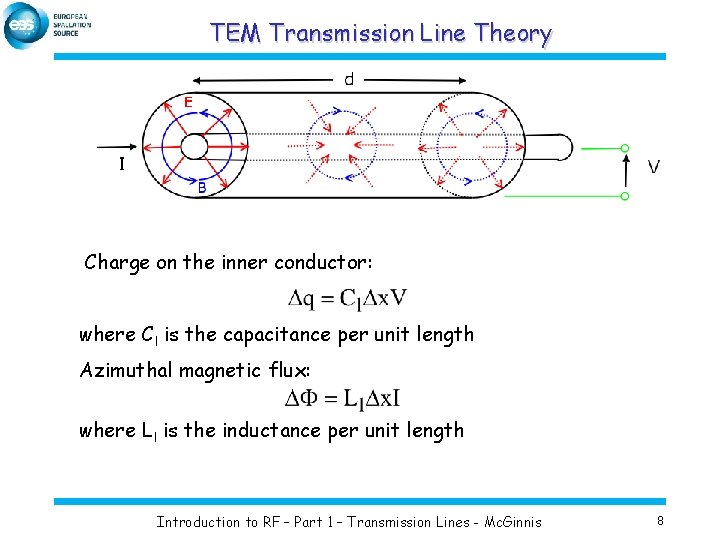
TEM Transmission Line Theory Charge on the inner conductor: where Cl is the capacitance per unit length Azimuthal magnetic flux: where Ll is the inductance per unit length Introduction to RF – Part 1 – Transmission Lines - Mc. Ginnis 8
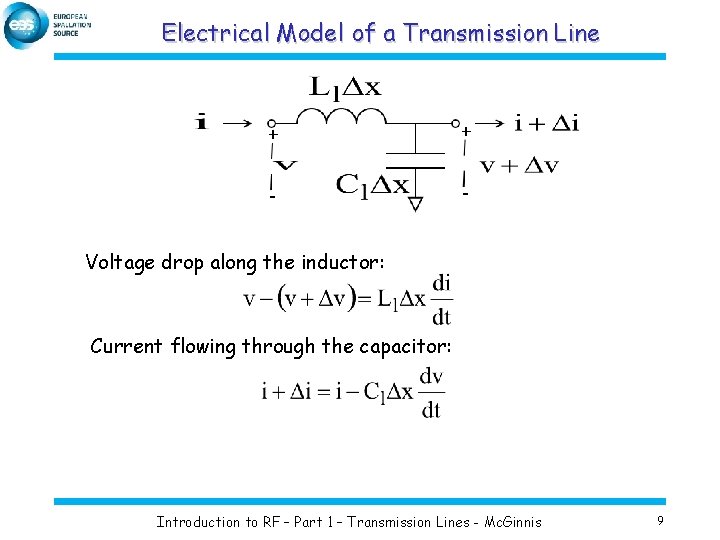
Electrical Model of a Transmission Line Voltage drop along the inductor: Current flowing through the capacitor: Introduction to RF – Part 1 – Transmission Lines - Mc. Ginnis 9
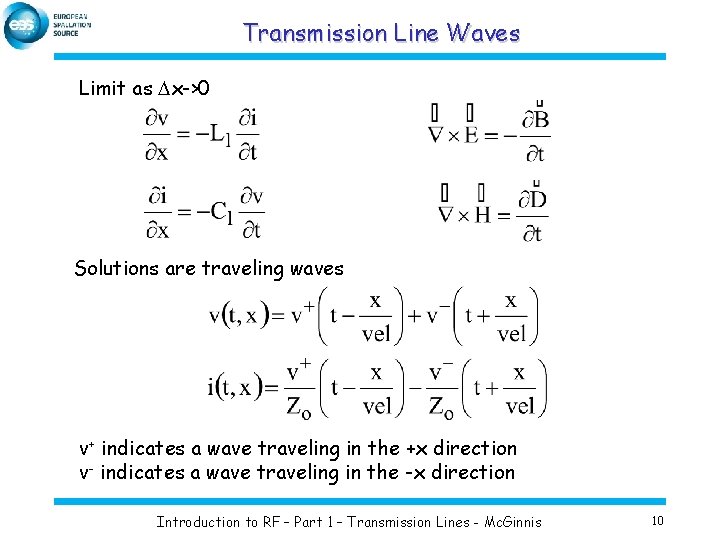
Transmission Line Waves Limit as Dx->0 Solutions are traveling waves v+ indicates a wave traveling in the +x direction v- indicates a wave traveling in the -x direction Introduction to RF – Part 1 – Transmission Lines - Mc. Ginnis 10
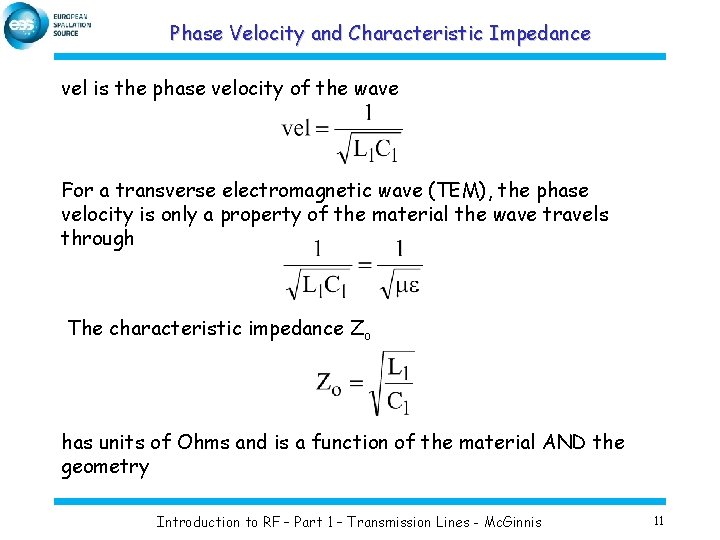
Phase Velocity and Characteristic Impedance vel is the phase velocity of the wave For a transverse electromagnetic wave (TEM), the phase velocity is only a property of the material the wave travels through The characteristic impedance Zo has units of Ohms and is a function of the material AND the geometry Introduction to RF – Part 1 – Transmission Lines - Mc. Ginnis 11
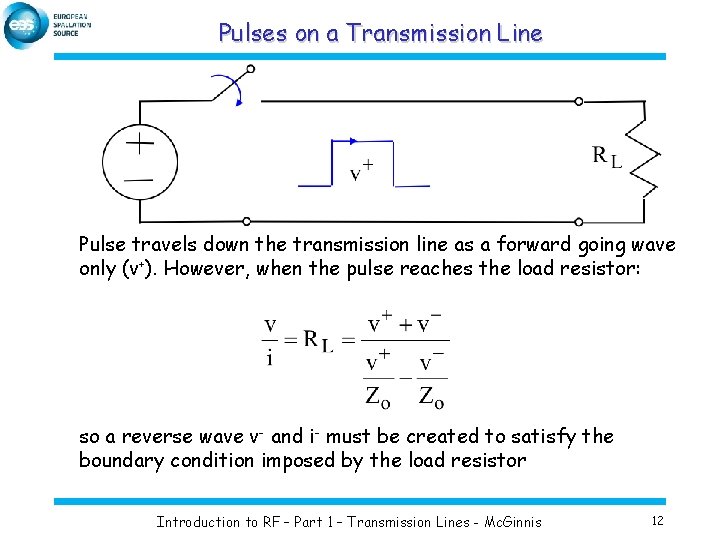
Pulses on a Transmission Line Pulse travels down the transmission line as a forward going wave only (v+). However, when the pulse reaches the load resistor: so a reverse wave v- and i- must be created to satisfy the boundary condition imposed by the load resistor Introduction to RF – Part 1 – Transmission Lines - Mc. Ginnis 12
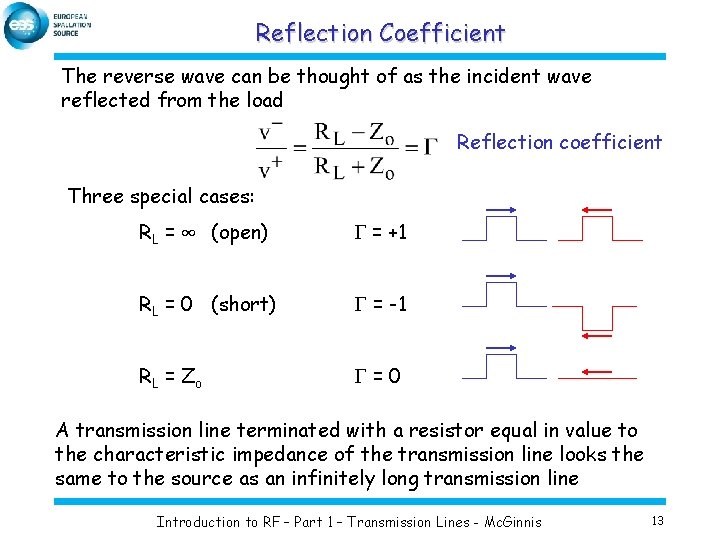
Reflection Coefficient The reverse wave can be thought of as the incident wave reflected from the load Reflection coefficient Three special cases: RL = ∞ (open) G = +1 RL = 0 (short) G = -1 RL = Z o G=0 A transmission line terminated with a resistor equal in value to the characteristic impedance of the transmission line looks the same to the source as an infinitely long transmission line Introduction to RF – Part 1 – Transmission Lines - Mc. Ginnis 13
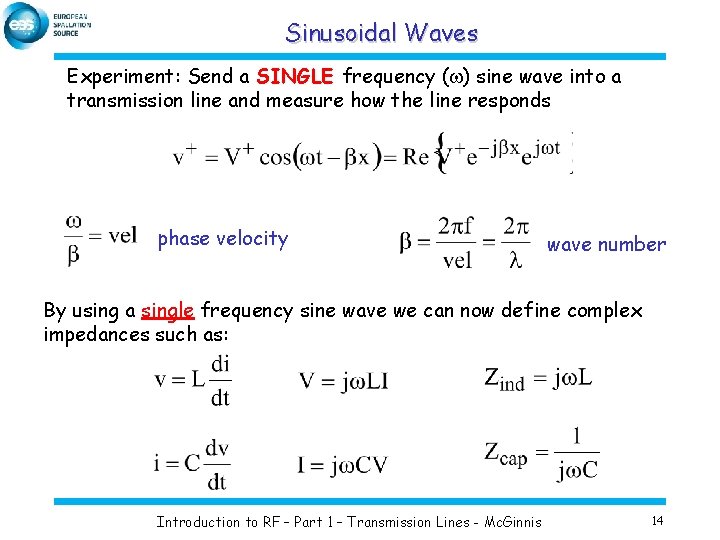
Sinusoidal Waves Experiment: Send a SINGLE frequency (w) sine wave into a transmission line and measure how the line responds phase velocity wave number By using a single frequency sine wave we can now define complex impedances such as: Introduction to RF – Part 1 – Transmission Lines - Mc. Ginnis 14
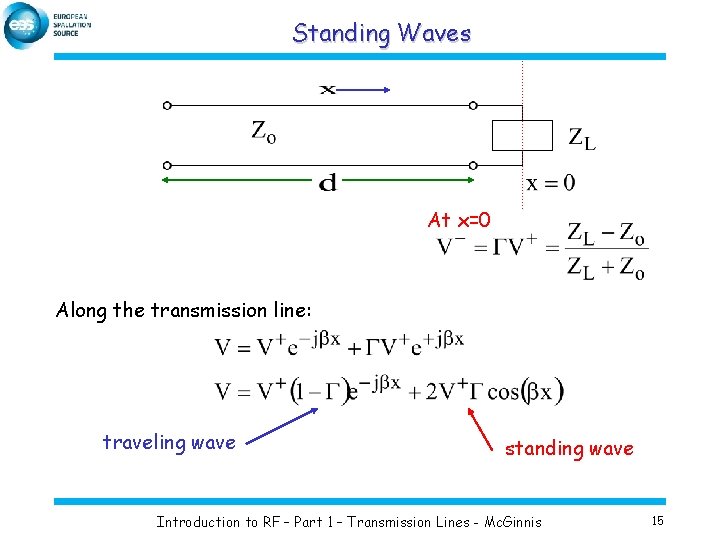
Standing Waves At x=0 Along the transmission line: traveling wave standing wave Introduction to RF – Part 1 – Transmission Lines - Mc. Ginnis 15
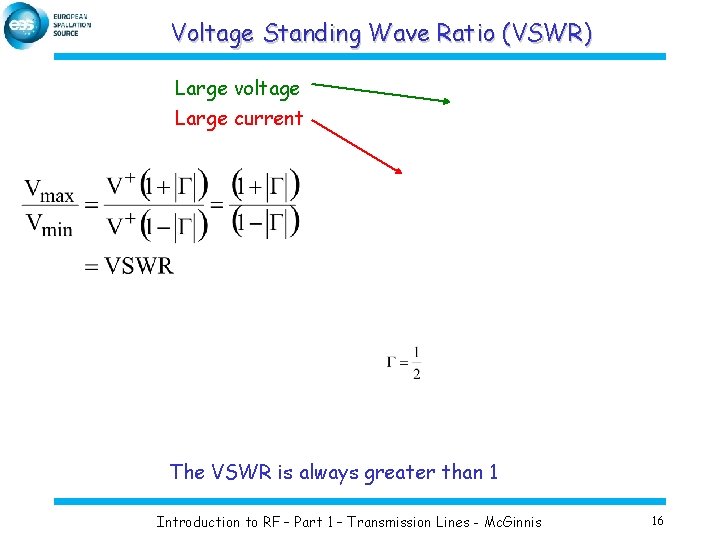
Voltage Standing Wave Ratio (VSWR) Large voltage Large current The VSWR is always greater than 1 Introduction to RF – Part 1 – Transmission Lines - Mc. Ginnis 16
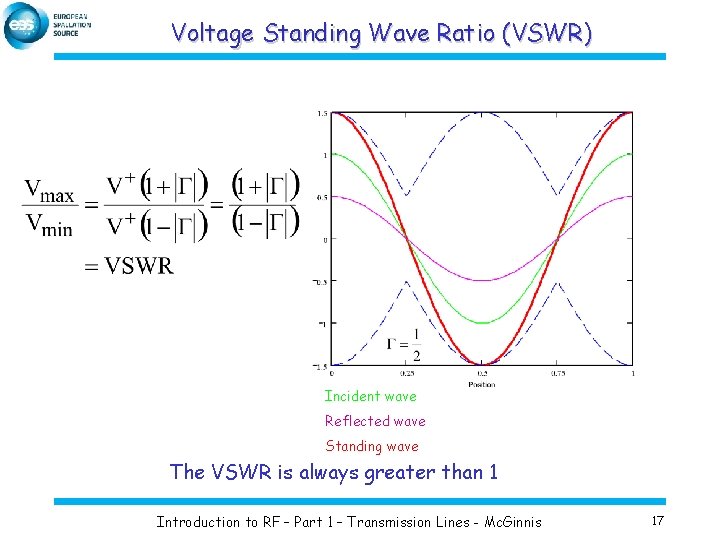
Voltage Standing Wave Ratio (VSWR) Incident wave Reflected wave Standing wave The VSWR is always greater than 1 Introduction to RF – Part 1 – Transmission Lines - Mc. Ginnis 17
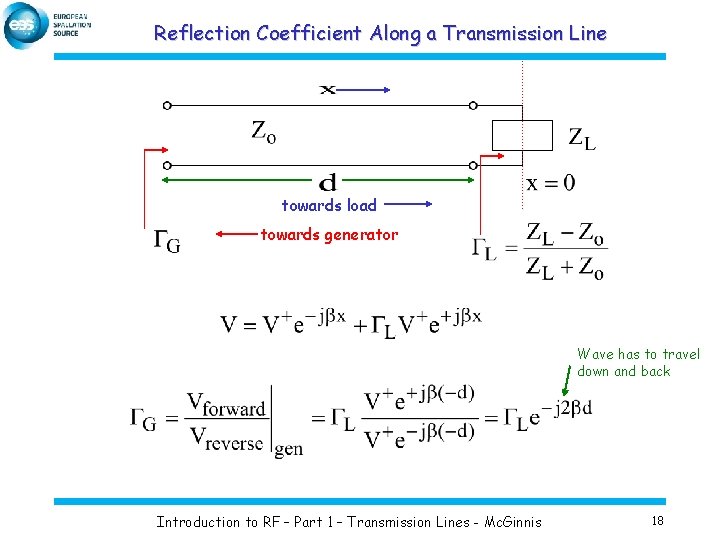
Reflection Coefficient Along a Transmission Line towards load towards generator Wave has to travel down and back Introduction to RF – Part 1 – Transmission Lines - Mc. Ginnis 18
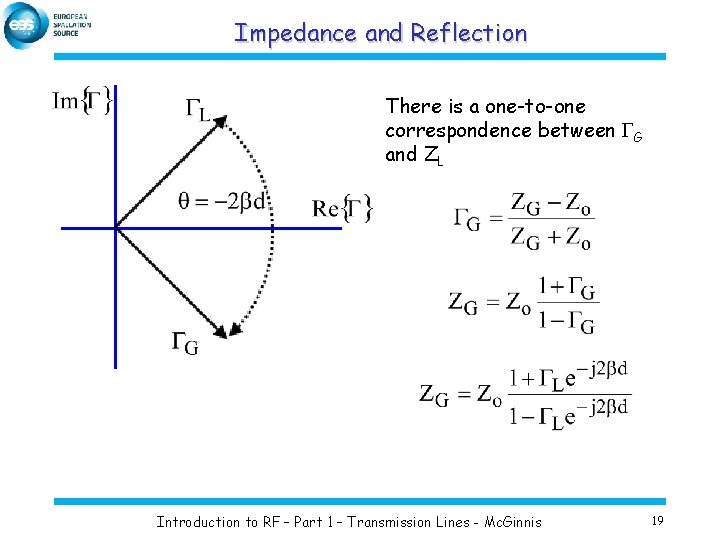
Impedance and Reflection There is a one-to-one correspondence between GG and ZL Introduction to RF – Part 1 – Transmission Lines - Mc. Ginnis 19
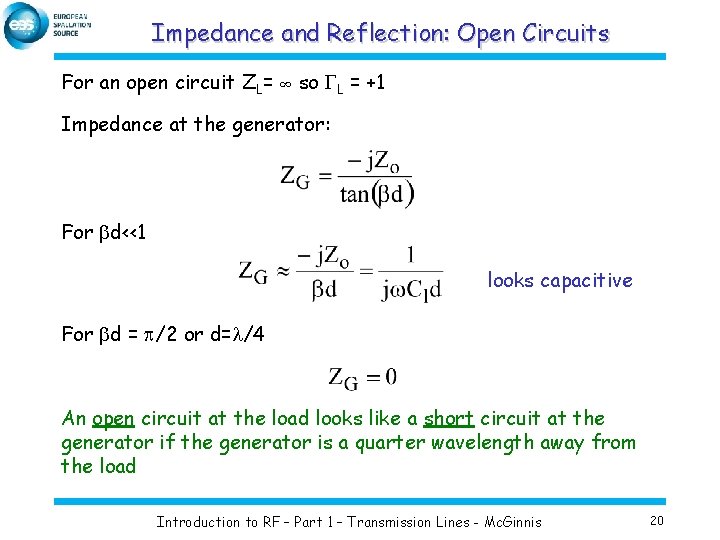
Impedance and Reflection: Open Circuits For an open circuit ZL= ∞ so GL = +1 Impedance at the generator: For bd<<1 looks capacitive For bd = p/2 or d=l/4 An open circuit at the load looks like a short circuit at the generator if the generator is a quarter wavelength away from the load Introduction to RF – Part 1 – Transmission Lines - Mc. Ginnis 20
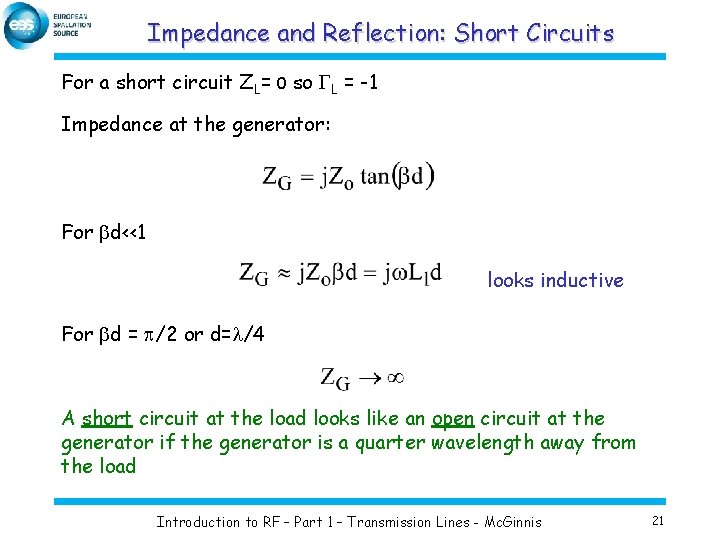
Impedance and Reflection: Short Circuits For a short circuit ZL= 0 so GL = -1 Impedance at the generator: For bd<<1 looks inductive For bd = p/2 or d=l/4 A short circuit at the load looks like an open circuit at the generator if the generator is a quarter wavelength away from the load Introduction to RF – Part 1 – Transmission Lines - Mc. Ginnis 21
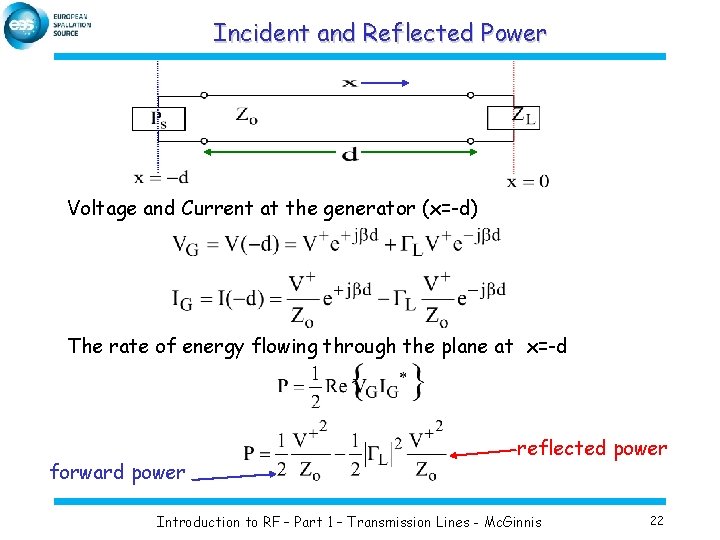
Incident and Reflected Power Voltage and Current at the generator (x=-d) The rate of energy flowing through the plane at x=-d forward power reflected power Introduction to RF – Part 1 – Transmission Lines - Mc. Ginnis 22
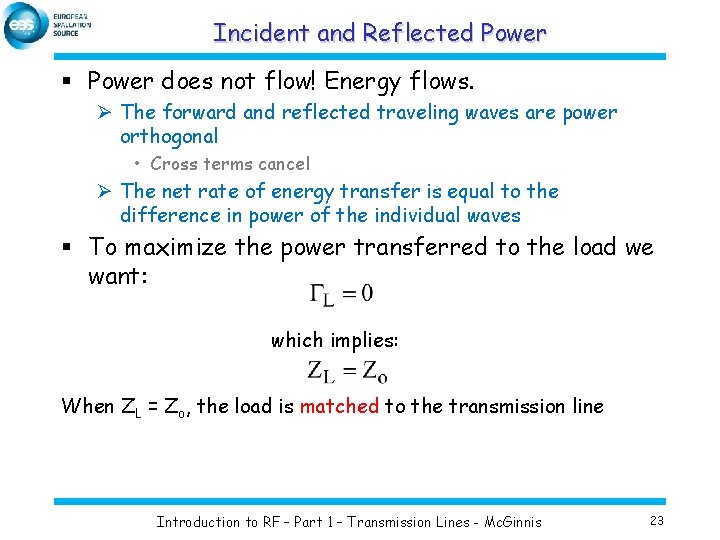
Incident and Reflected Power § Power does not flow! Energy flows. Ø The forward and reflected traveling waves are power orthogonal • Cross terms cancel Ø The net rate of energy transfer is equal to the difference in power of the individual waves § To maximize the power transferred to the load we want: which implies: When ZL = Zo, the load is matched to the transmission line Introduction to RF – Part 1 – Transmission Lines - Mc. Ginnis 23
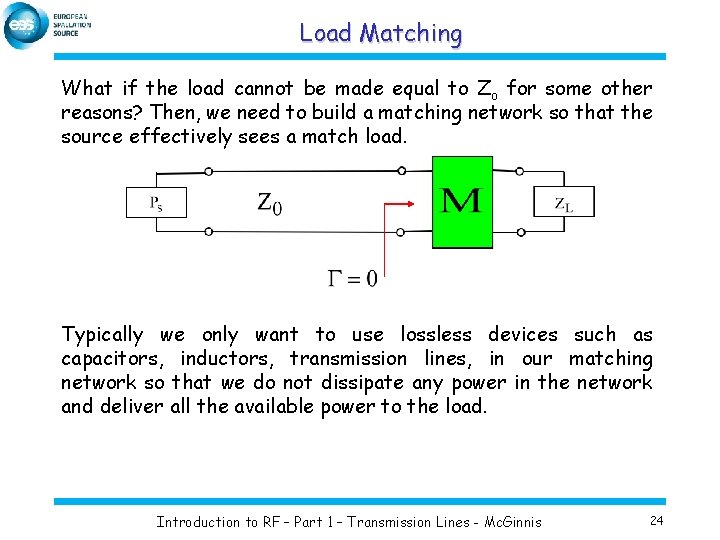
Load Matching What if the load cannot be made equal to Zo for some other reasons? Then, we need to build a matching network so that the source effectively sees a match load. Typically we only want to use lossless devices such as capacitors, inductors, transmission lines, in our matching network so that we do not dissipate any power in the network and deliver all the available power to the load. Introduction to RF – Part 1 – Transmission Lines - Mc. Ginnis 24
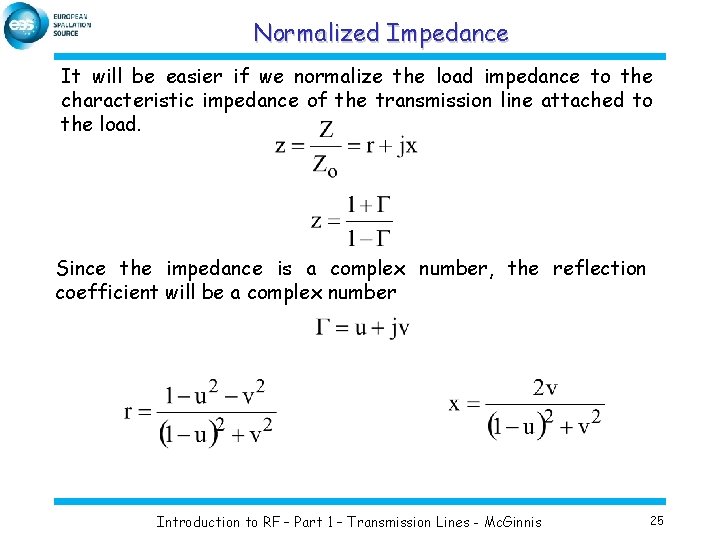
Normalized Impedance It will be easier if we normalize the load impedance to the characteristic impedance of the transmission line attached to the load. Since the impedance is a complex number, the reflection coefficient will be a complex number Introduction to RF – Part 1 – Transmission Lines - Mc. Ginnis 25
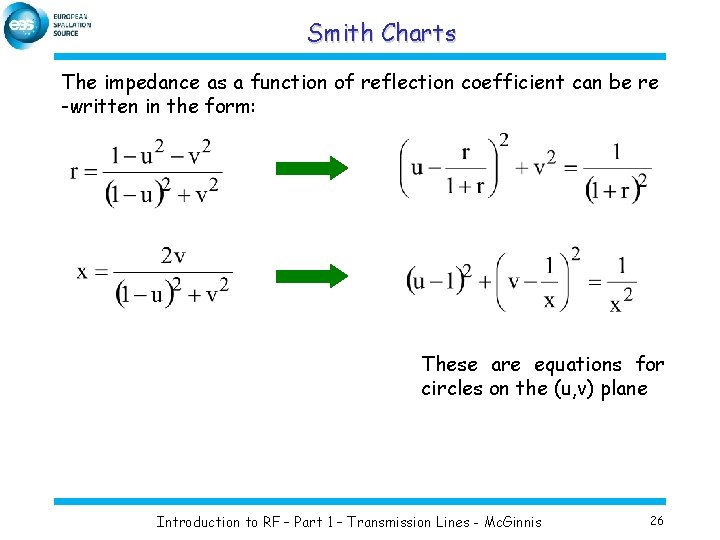
Smith Charts The impedance as a function of reflection coefficient can be re -written in the form: These are equations for circles on the (u, v) plane Introduction to RF – Part 1 – Transmission Lines - Mc. Ginnis 26
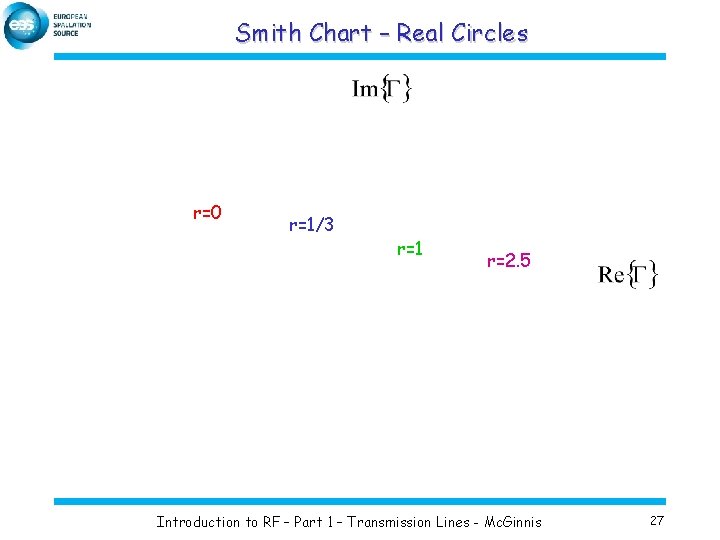
Smith Chart – Real Circles r=0 r=1/3 r=1 r=2. 5 Introduction to RF – Part 1 – Transmission Lines - Mc. Ginnis 27
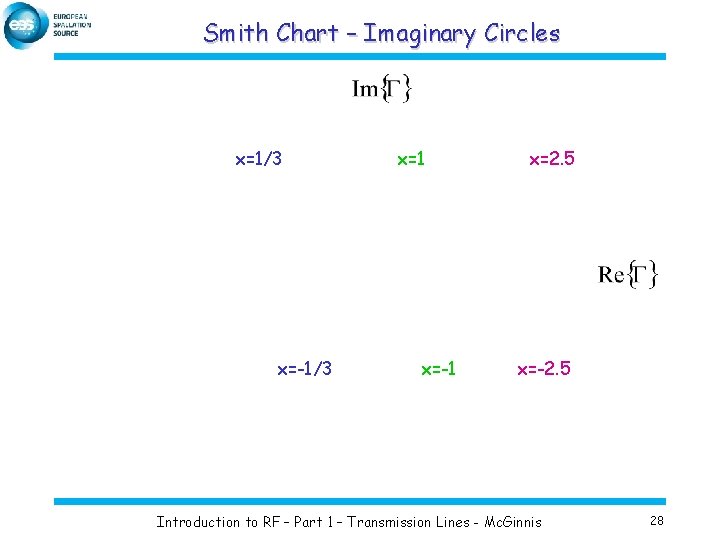
Smith Chart – Imaginary Circles x=1/3 x=-1/3 x=1 x=-1 x=2. 5 x=-2. 5 Introduction to RF – Part 1 – Transmission Lines - Mc. Ginnis 28
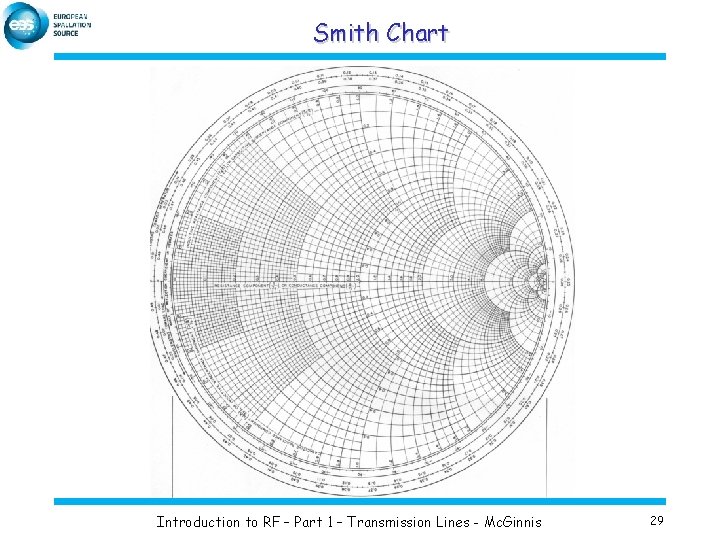
Smith Chart Introduction to RF – Part 1 – Transmission Lines - Mc. Ginnis 29
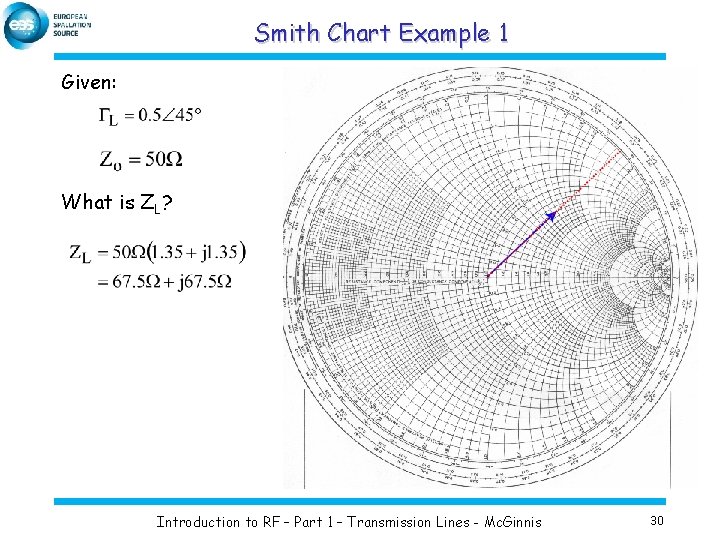
Smith Chart Example 1 Given: What is ZL? Introduction to RF – Part 1 – Transmission Lines - Mc. Ginnis 30
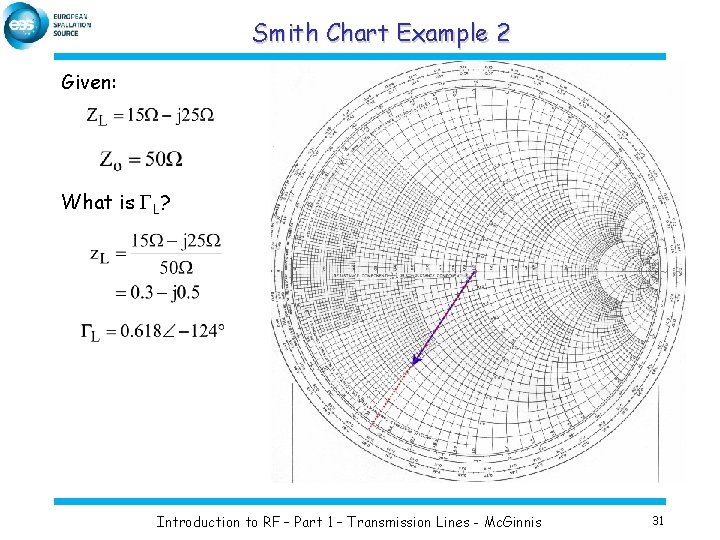
Smith Chart Example 2 Given: What is GL? Introduction to RF – Part 1 – Transmission Lines - Mc. Ginnis 31
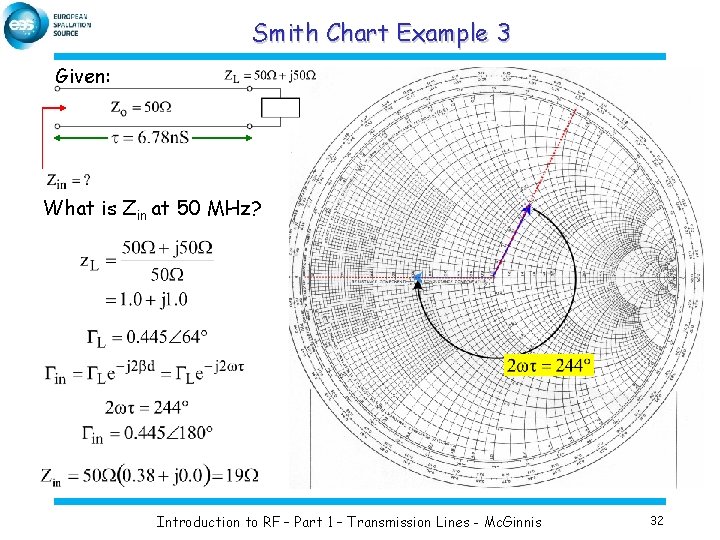
Smith Chart Example 3 Given: What is Zin at 50 MHz? Introduction to RF – Part 1 – Transmission Lines - Mc. Ginnis 32
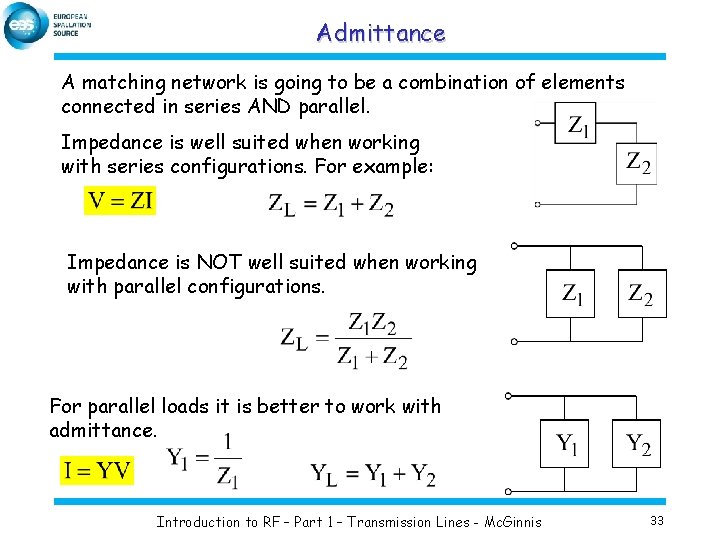
Admittance A matching network is going to be a combination of elements connected in series AND parallel. Impedance is well suited when working with series configurations. For example: Impedance is NOT well suited when working with parallel configurations. For parallel loads it is better to work with admittance. Introduction to RF – Part 1 – Transmission Lines - Mc. Ginnis 33
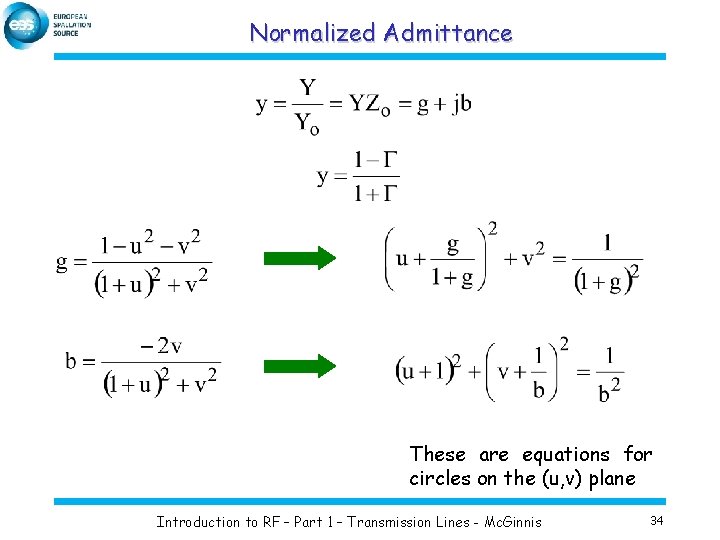
Normalized Admittance These are equations for circles on the (u, v) plane Introduction to RF – Part 1 – Transmission Lines - Mc. Ginnis 34
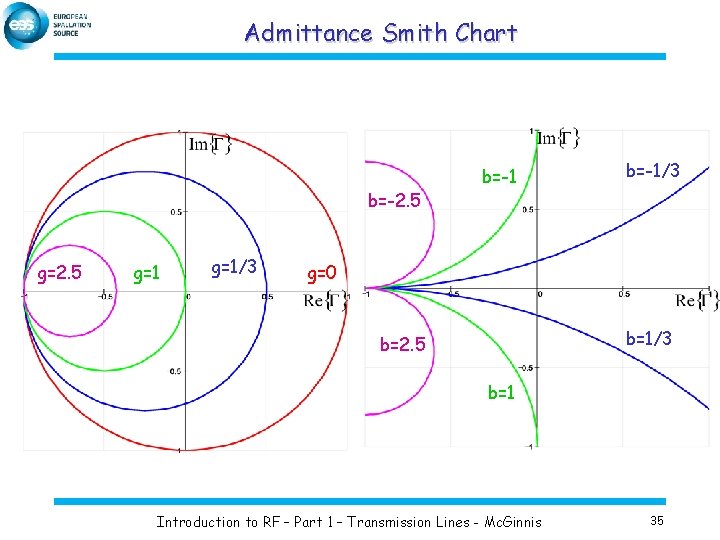
Admittance Smith Chart b=-2. 5 g=1 g=1/3 b=-1/3 g=0 b=1/3 b=2. 5 b=1 Introduction to RF – Part 1 – Transmission Lines - Mc. Ginnis 35
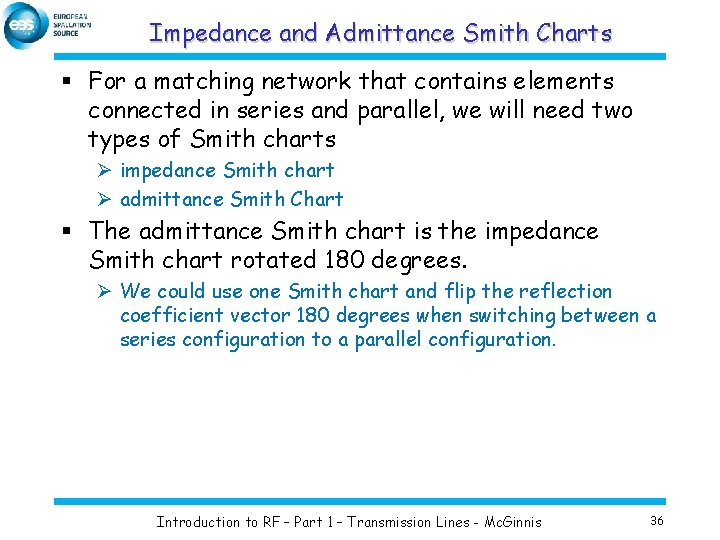
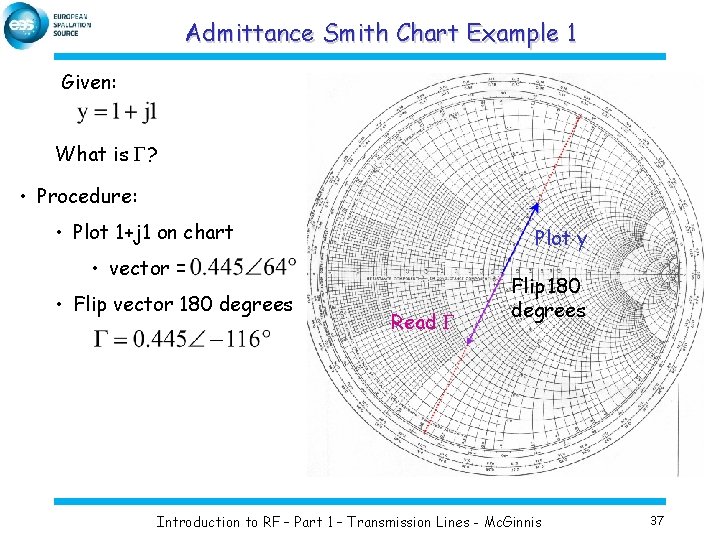
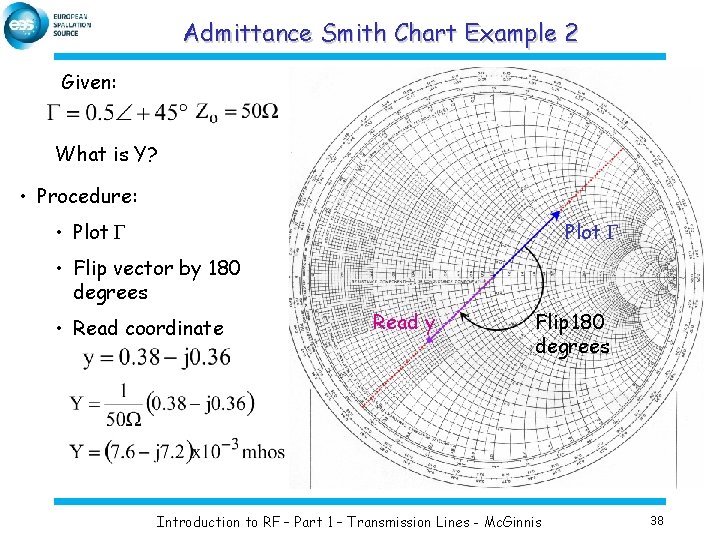
Impedance and Admittance Smith Charts § For a matching network that contains elements connected in series and parallel, we will need two types of Smith charts Ø impedance Smith chart Ø admittance Smith Chart § The admittance Smith chart is the impedance Smith chart rotated 180 degrees. Ø We could use one Smith chart and flip the reflection coefficient vector 180 degrees when switching between a series configuration to a parallel configuration. Introduction to RF – Part 1 – Transmission Lines - Mc. Ginnis 36
Admittance Smith Chart Example 1 Given: What is G? • Procedure: • Plot 1+j 1 on chart Plot y • vector = • Flip vector 180 degrees Read G Flip 180 degrees Introduction to RF – Part 1 – Transmission Lines - Mc. Ginnis 37
Admittance Smith Chart Example 2 Given: What is Y? • Procedure: • Plot G • Flip vector by 180 degrees • Read coordinate Read y Flip 180 degrees Introduction to RF – Part 1 – Transmission Lines - Mc. Ginnis 38
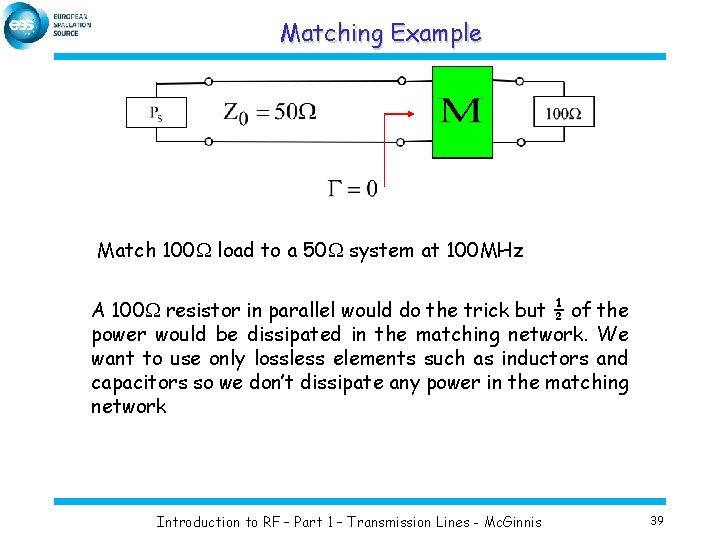
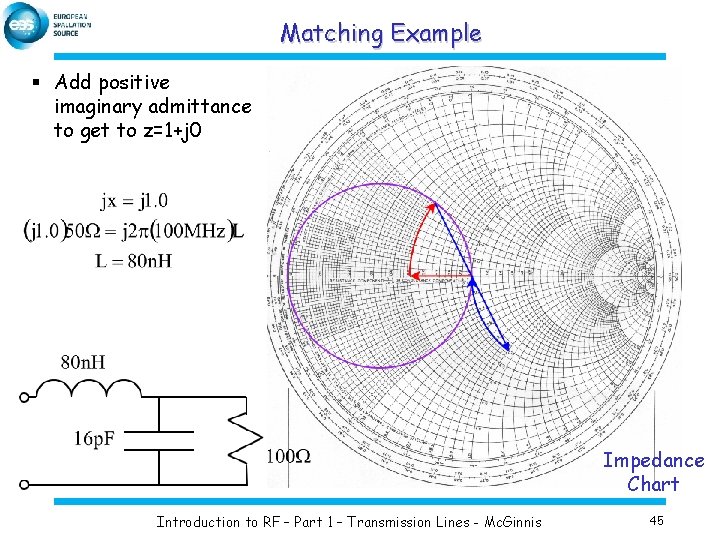
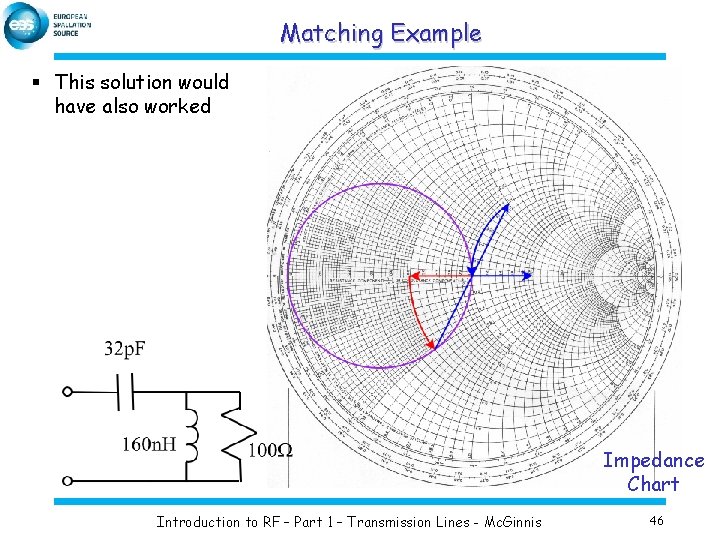
Matching Example Match 100 W load to a 50 W system at 100 MHz A 100 W resistor in parallel would do the trick but ½ of the power would be dissipated in the matching network. We want to use only lossless elements such as inductors and capacitors so we don’t dissipate any power in the matching network Introduction to RF – Part 1 – Transmission Lines - Mc. Ginnis 39
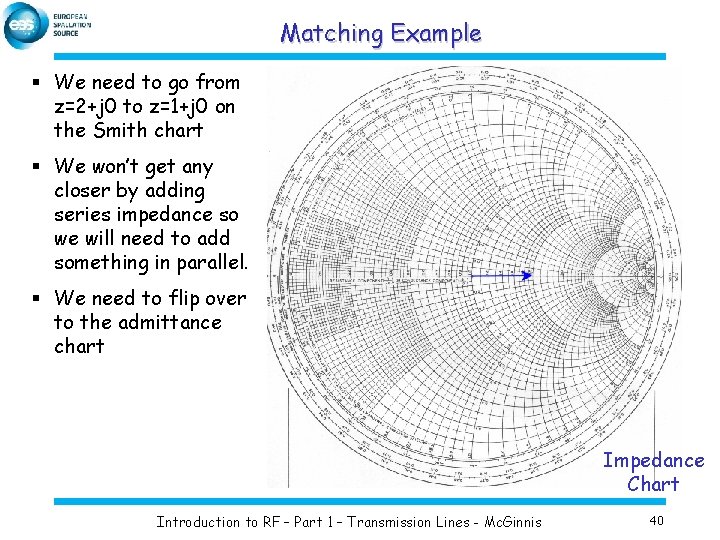
Matching Example § We need to go from z=2+j 0 to z=1+j 0 on the Smith chart § We won’t get any closer by adding series impedance so we will need to add something in parallel. § We need to flip over to the admittance chart Impedance Chart Introduction to RF – Part 1 – Transmission Lines - Mc. Ginnis 40
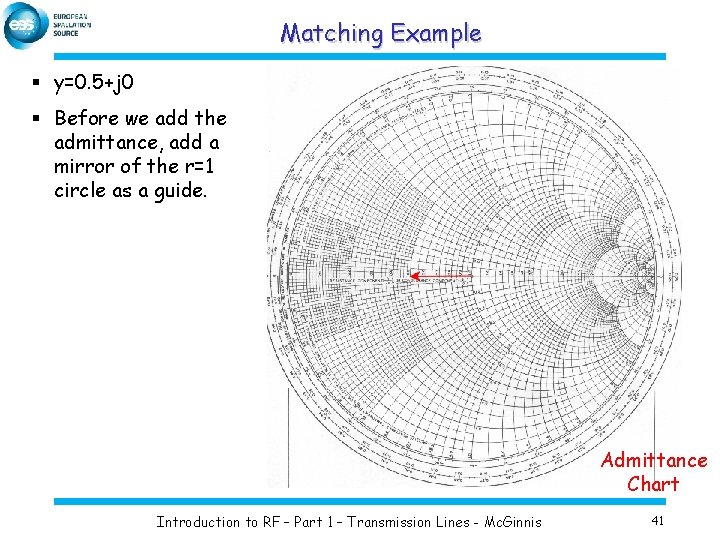
Matching Example § y=0. 5+j 0 § Before we add the admittance, add a mirror of the r=1 circle as a guide. Admittance Chart Introduction to RF – Part 1 – Transmission Lines - Mc. Ginnis 41
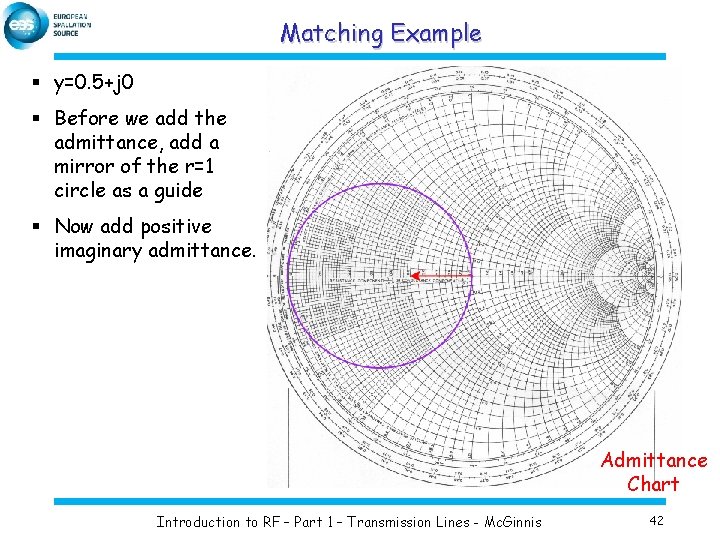
Matching Example § y=0. 5+j 0 § Before we add the admittance, add a mirror of the r=1 circle as a guide § Now add positive imaginary admittance. Admittance Chart Introduction to RF – Part 1 – Transmission Lines - Mc. Ginnis 42
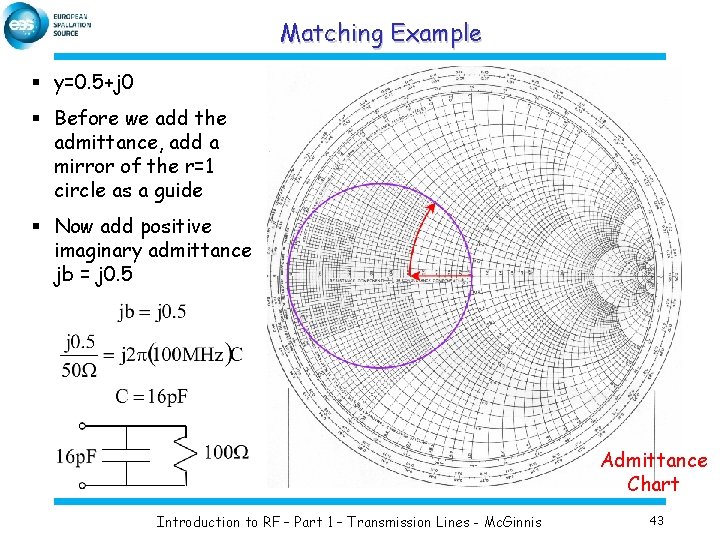
Matching Example § y=0. 5+j 0 § Before we add the admittance, add a mirror of the r=1 circle as a guide § Now add positive imaginary admittance jb = j 0. 5 Admittance Chart Introduction to RF – Part 1 – Transmission Lines - Mc. Ginnis 43
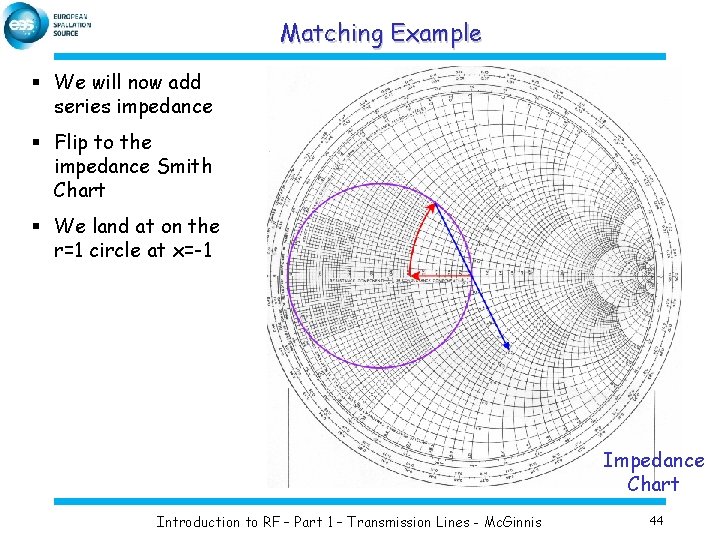
Matching Example § We will now add series impedance § Flip to the impedance Smith Chart § We land at on the r=1 circle at x=-1 Impedance Chart Introduction to RF – Part 1 – Transmission Lines - Mc. Ginnis 44
Matching Example § Add positive imaginary admittance to get to z=1+j 0 Impedance Chart Introduction to RF – Part 1 – Transmission Lines - Mc. Ginnis 45
Matching Example § This solution would have also worked Impedance Chart Introduction to RF – Part 1 – Transmission Lines - Mc. Ginnis 46
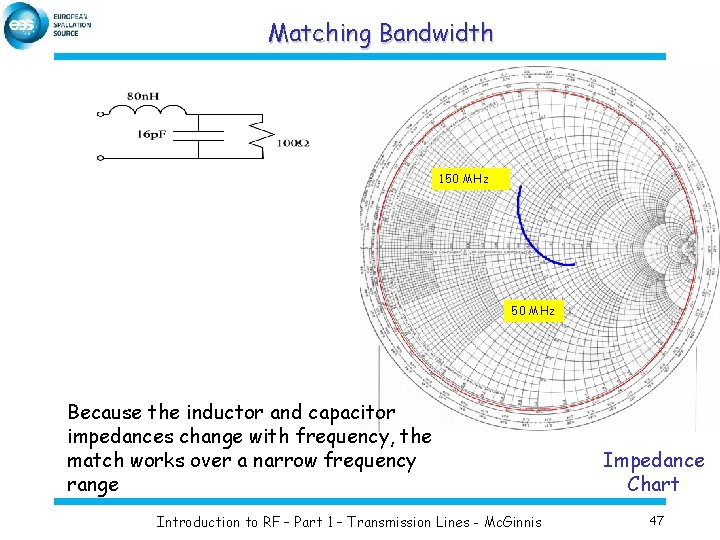
Matching Bandwidth 150 MHz Because the inductor and capacitor impedances change with frequency, the match works over a narrow frequency range Introduction to RF – Part 1 – Transmission Lines - Mc. Ginnis Impedance Chart 47
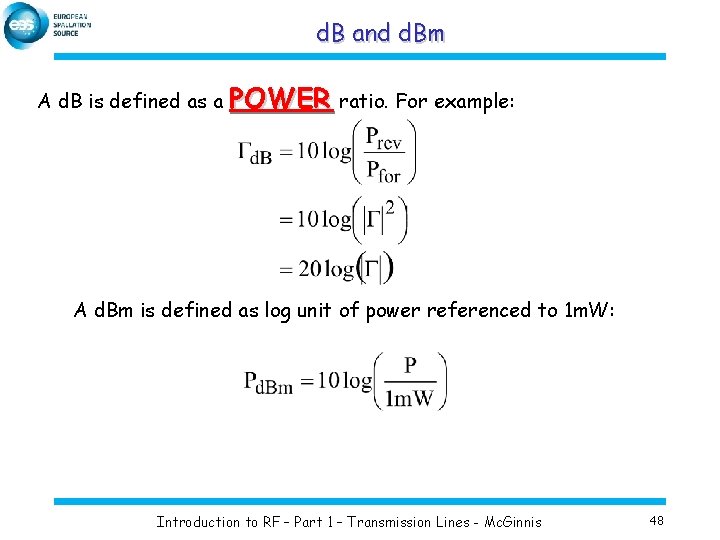
d. B and d. Bm A d. B is defined as a POWER ratio. For example: A d. Bm is defined as log unit of power referenced to 1 m. W: Introduction to RF – Part 1 – Transmission Lines - Mc. Ginnis 48
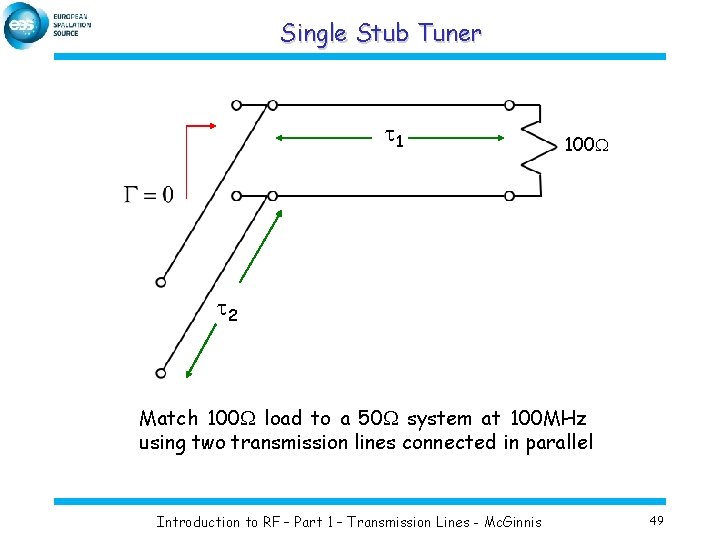
Single Stub Tuner t 1 100 W t 2 Match 100 W load to a 50 W system at 100 MHz using two transmission lines connected in parallel Introduction to RF – Part 1 – Transmission Lines - Mc. Ginnis 49
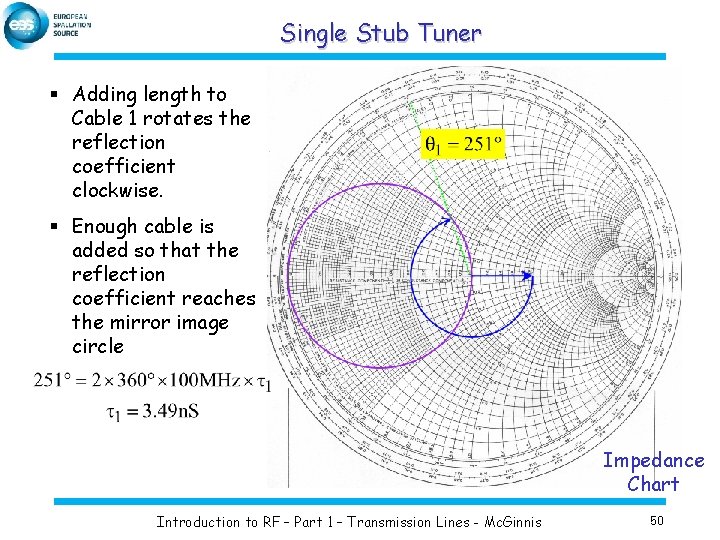
Single Stub Tuner § Adding length to Cable 1 rotates the reflection coefficient clockwise. § Enough cable is added so that the reflection coefficient reaches the mirror image circle Impedance Chart Introduction to RF – Part 1 – Transmission Lines - Mc. Ginnis 50
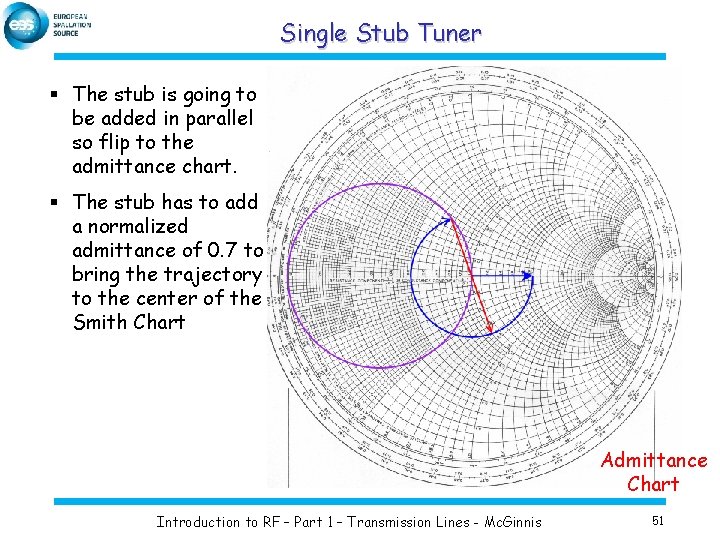
Single Stub Tuner § The stub is going to be added in parallel so flip to the admittance chart. § The stub has to add a normalized admittance of 0. 7 to bring the trajectory to the center of the Smith Chart Admittance Chart Introduction to RF – Part 1 – Transmission Lines - Mc. Ginnis 51
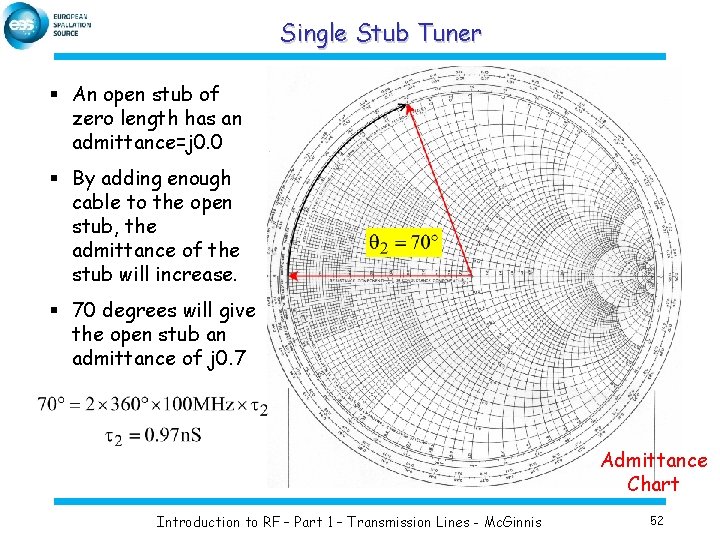
Single Stub Tuner § An open stub of zero length has an admittance=j 0. 0 § By adding enough cable to the open stub, the admittance of the stub will increase. § 70 degrees will give the open stub an admittance of j 0. 7 Admittance Chart Introduction to RF – Part 1 – Transmission Lines - Mc. Ginnis 52
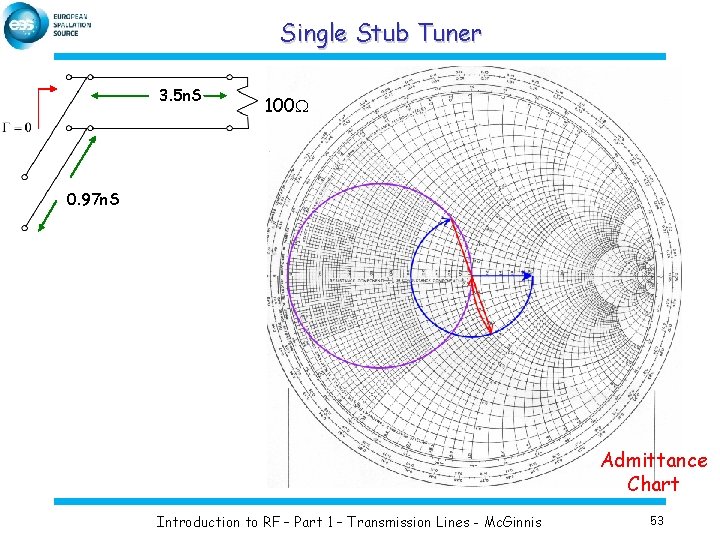
Single Stub Tuner 3. 5 n. S 100 W 0. 97 n. S Admittance Chart Introduction to RF – Part 1 – Transmission Lines - Mc. Ginnis 53
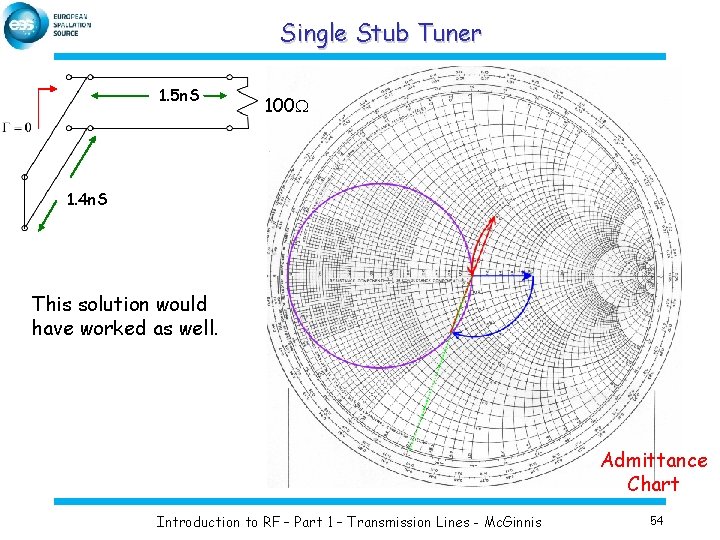
Single Stub Tuner 1. 5 n. S 100 W 1. 4 n. S This solution would have worked as well. Admittance Chart Introduction to RF – Part 1 – Transmission Lines - Mc. Ginnis 54
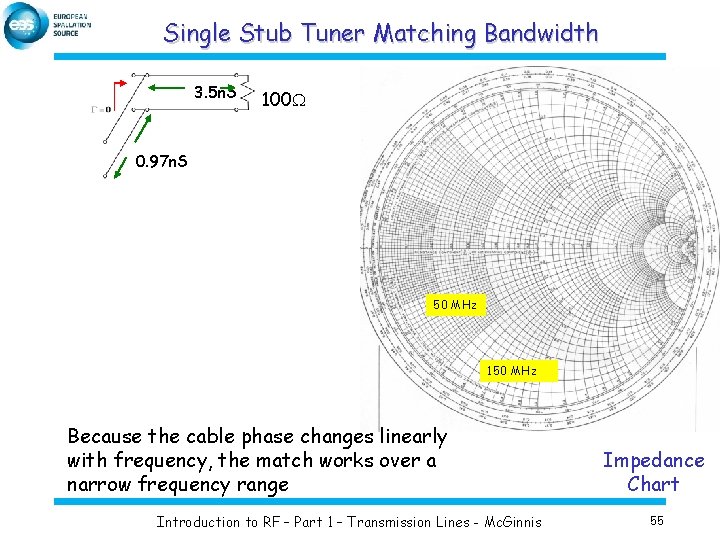
Single Stub Tuner Matching Bandwidth 3. 5 n. S 100 W 0. 97 n. S 50 MHz 150 MHz Because the cable phase changes linearly with frequency, the match works over a narrow frequency range Introduction to RF – Part 1 – Transmission Lines - Mc. Ginnis Impedance Chart 55
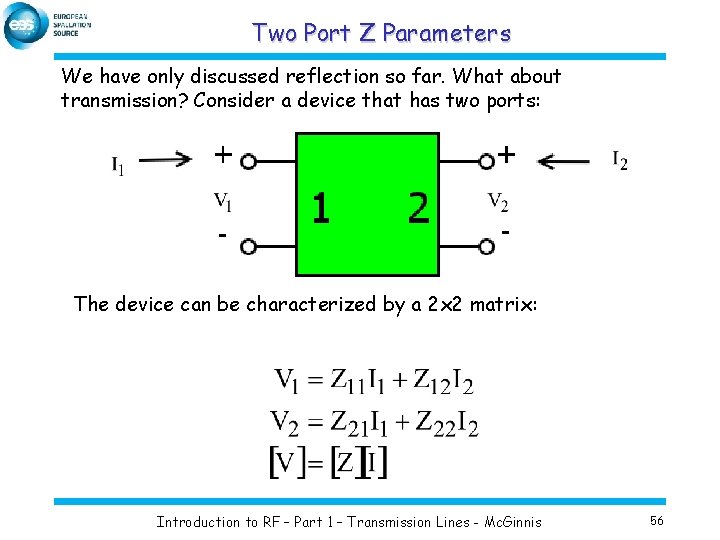
Two Port Z Parameters We have only discussed reflection so far. What about transmission? Consider a device that has two ports: The device can be characterized by a 2 x 2 matrix: Introduction to RF – Part 1 – Transmission Lines - Mc. Ginnis 56
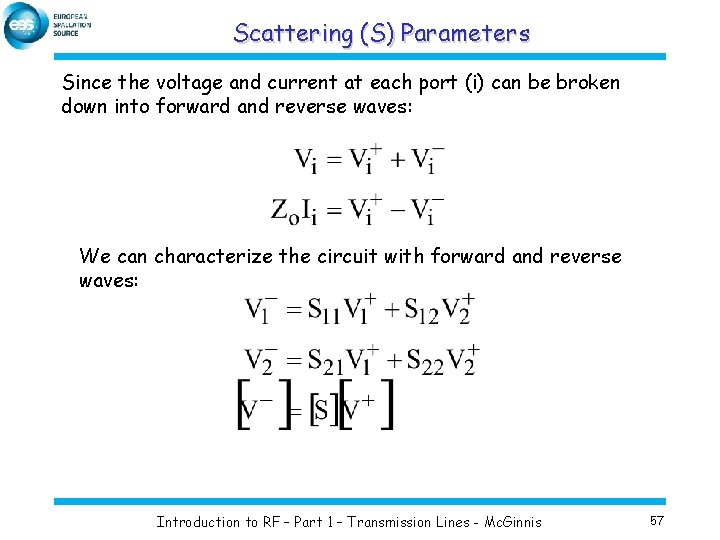
Scattering (S) Parameters Since the voltage and current at each port (i) can be broken down into forward and reverse waves: We can characterize the circuit with forward and reverse waves: Introduction to RF – Part 1 – Transmission Lines - Mc. Ginnis 57
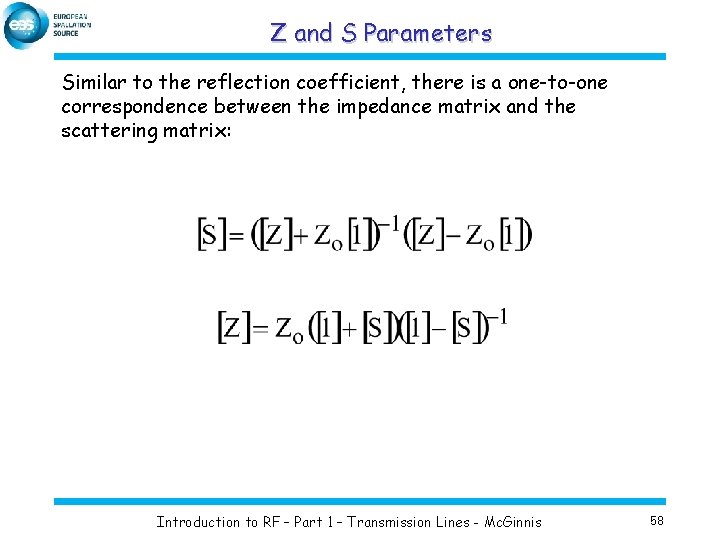
Z and S Parameters Similar to the reflection coefficient, there is a one-to-one correspondence between the impedance matrix and the scattering matrix: Introduction to RF – Part 1 – Transmission Lines - Mc. Ginnis 58
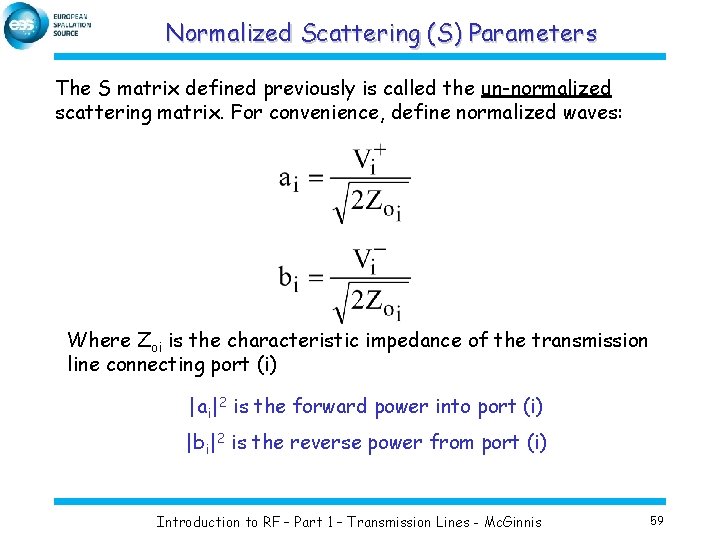
Normalized Scattering (S) Parameters The S matrix defined previously is called the un-normalized scattering matrix. For convenience, define normalized waves: Where Zoi is the characteristic impedance of the transmission line connecting port (i) |ai|2 is the forward power into port (i) |bi|2 is the reverse power from port (i) Introduction to RF – Part 1 – Transmission Lines - Mc. Ginnis 59
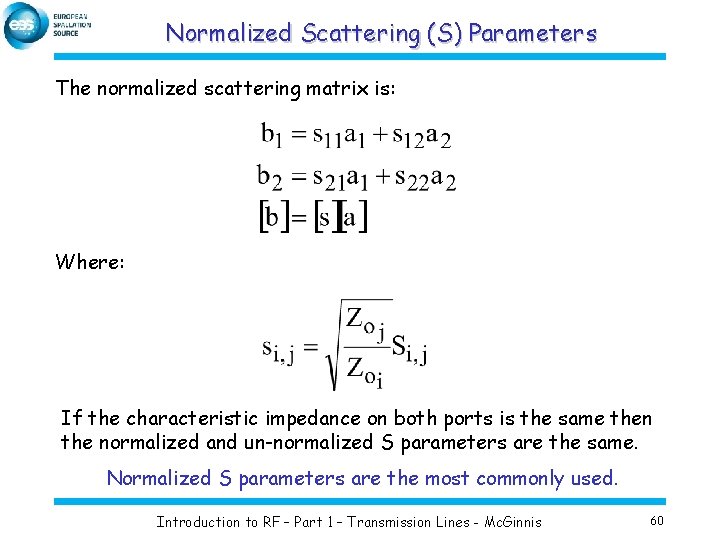
Normalized Scattering (S) Parameters The normalized scattering matrix is: Where: If the characteristic impedance on both ports is the same then the normalized and un-normalized S parameters are the same. Normalized S parameters are the most commonly used. Introduction to RF – Part 1 – Transmission Lines - Mc. Ginnis 60
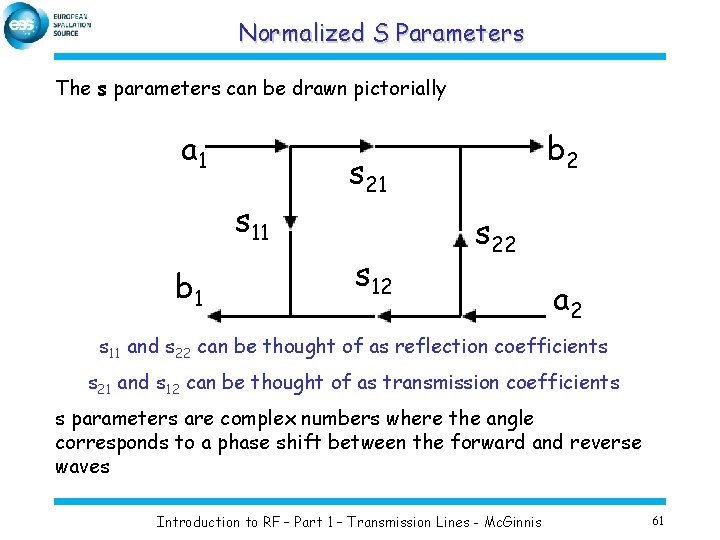
Normalized S Parameters The s parameters can be drawn pictorially a 1 s 11 b 2 s 21 s 12 s 22 a 2 s 11 and s 22 can be thought of as reflection coefficients s 21 and s 12 can be thought of as transmission coefficients s parameters are complex numbers where the angle corresponds to a phase shift between the forward and reverse waves Introduction to RF – Part 1 – Transmission Lines - Mc. Ginnis 61
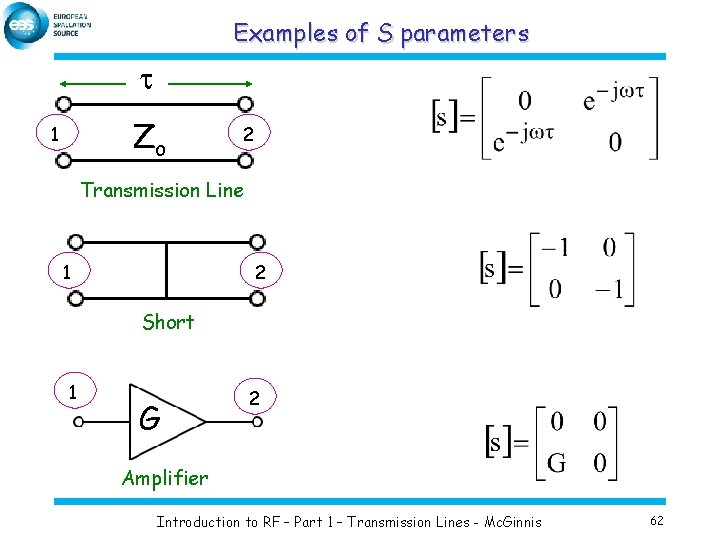
Examples of S parameters t Zo 1 2 Transmission Line 1 2 Short 1 G 2 Amplifier Introduction to RF – Part 1 – Transmission Lines - Mc. Ginnis 62
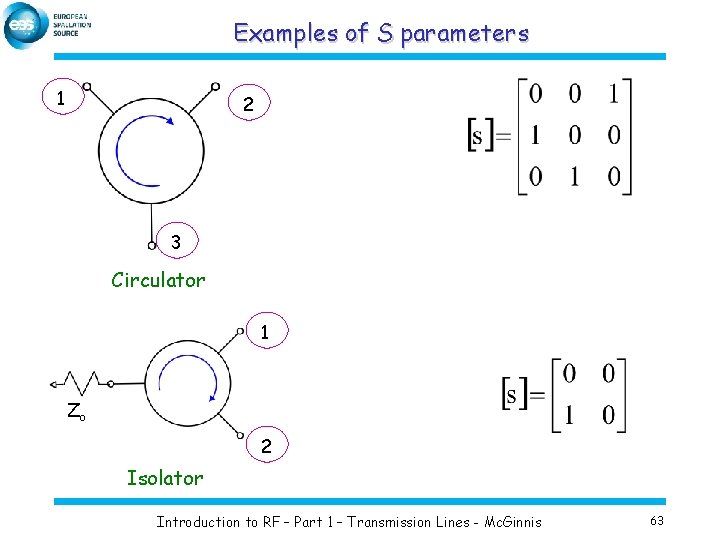
Examples of S parameters 1 2 3 Circulator 1 Zo 2 Isolator Introduction to RF – Part 1 – Transmission Lines - Mc. Ginnis 63
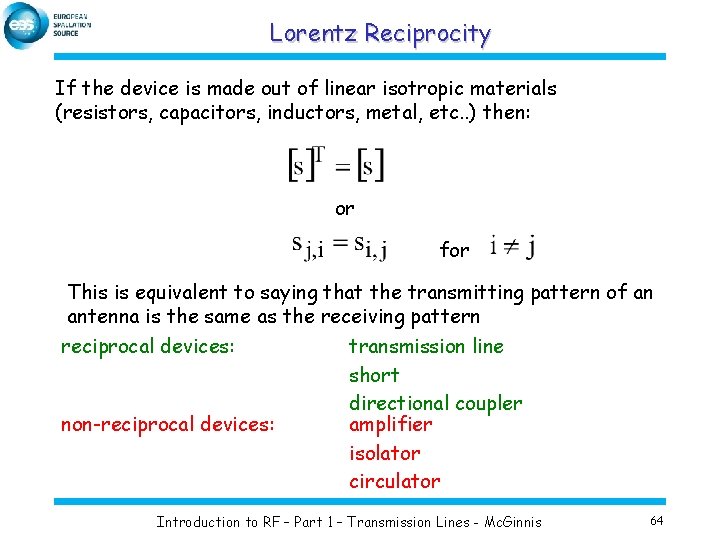
Lorentz Reciprocity If the device is made out of linear isotropic materials (resistors, capacitors, inductors, metal, etc. . ) then: or for This is equivalent to saying that the transmitting pattern of an antenna is the same as the receiving pattern reciprocal devices: non-reciprocal devices: transmission line short directional coupler amplifier isolator circulator Introduction to RF – Part 1 – Transmission Lines - Mc. Ginnis 64
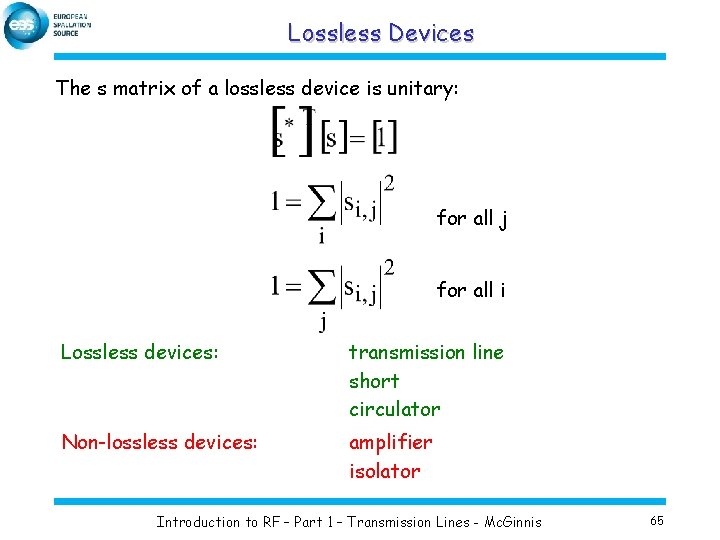
Lossless Devices The s matrix of a lossless device is unitary: for all j for all i Lossless devices: transmission line short circulator Non-lossless devices: amplifier isolator Introduction to RF – Part 1 – Transmission Lines - Mc. Ginnis 65
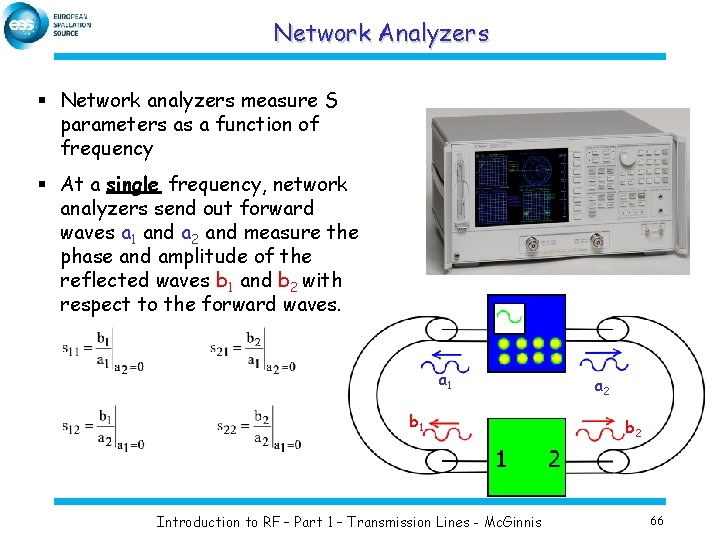
Network Analyzers § Network analyzers measure S parameters as a function of frequency § At a single frequency, network analyzers send out forward waves a 1 and a 2 and measure the phase and amplitude of the reflected waves b 1 and b 2 with respect to the forward waves. a 1 b 1 Introduction to RF – Part 1 – Transmission Lines - Mc. Ginnis a 2 b 2 66
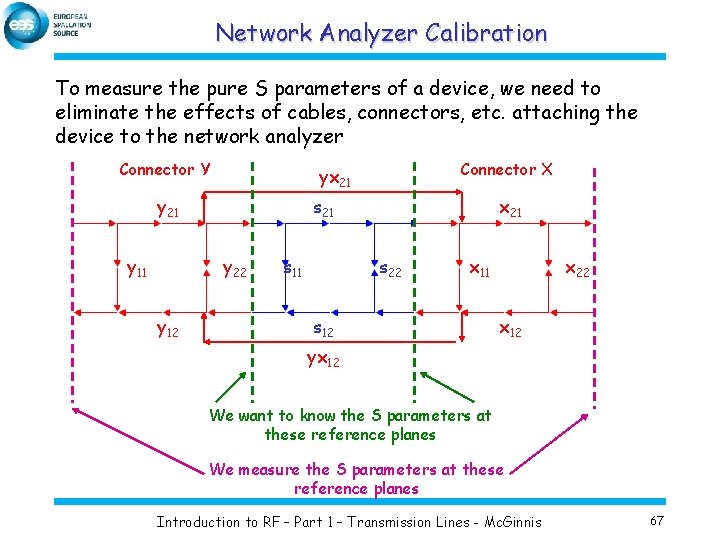
Network Analyzer Calibration To measure the pure S parameters of a device, we need to eliminate the effects of cables, connectors, etc. attaching the device to the network analyzer Connector Y y 21 y 11 s 21 y 22 y 12 Connector X yx 21 s 11 x 21 s 22 x 11 s 12 x 22 x 12 yx 12 We want to know the S parameters at these reference planes We measure the S parameters at these reference planes Introduction to RF – Part 1 – Transmission Lines - Mc. Ginnis 67
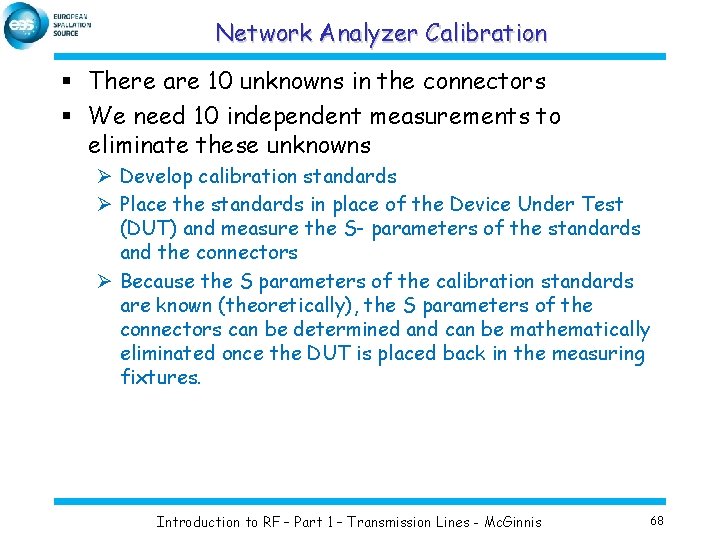
Network Analyzer Calibration § There are 10 unknowns in the connectors § We need 10 independent measurements to eliminate these unknowns Ø Develop calibration standards Ø Place the standards in place of the Device Under Test (DUT) and measure the S- parameters of the standards and the connectors Ø Because the S parameters of the calibration standards are known (theoretically), the S parameters of the connectors can be determined and can be mathematically eliminated once the DUT is placed back in the measuring fixtures. Introduction to RF – Part 1 – Transmission Lines - Mc. Ginnis 68
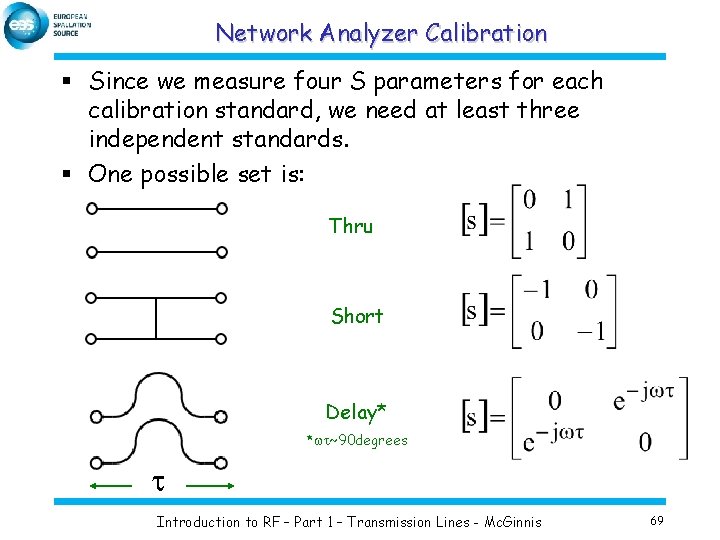
Network Analyzer Calibration § Since we measure four S parameters for each calibration standard, we need at least three independent standards. § One possible set is: Thru Short Delay* *wt~90 degrees t Introduction to RF – Part 1 – Transmission Lines - Mc. Ginnis 69
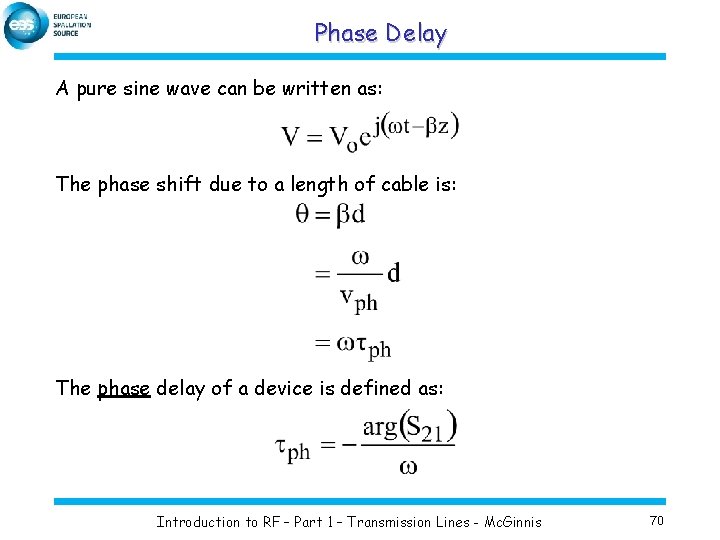
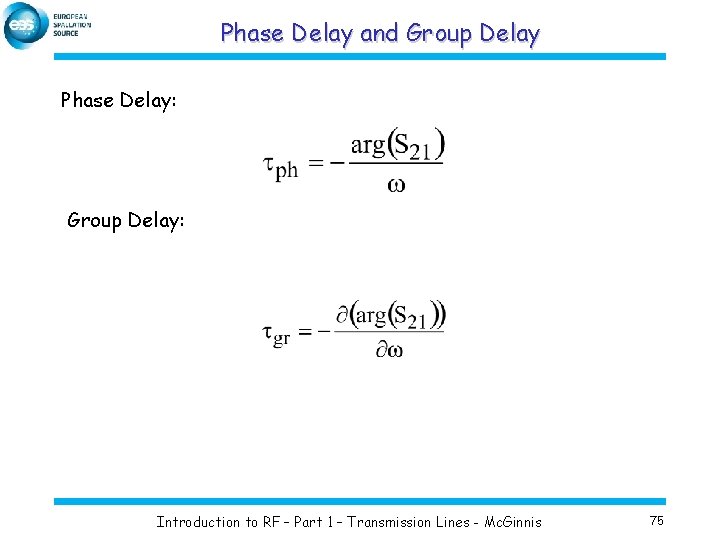
Phase Delay A pure sine wave can be written as: The phase shift due to a length of cable is: The phase delay of a device is defined as: Introduction to RF – Part 1 – Transmission Lines - Mc. Ginnis 70
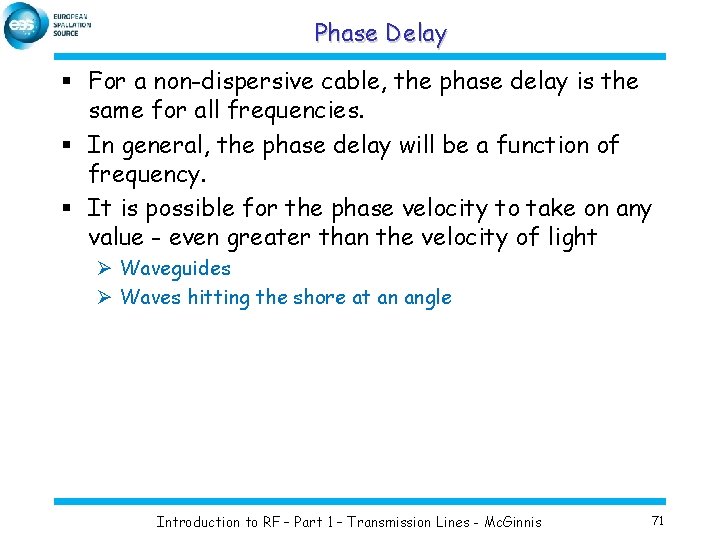
Phase Delay § For a non-dispersive cable, the phase delay is the same for all frequencies. § In general, the phase delay will be a function of frequency. § It is possible for the phase velocity to take on any value - even greater than the velocity of light Ø Waveguides Ø Waves hitting the shore at an angle Introduction to RF – Part 1 – Transmission Lines - Mc. Ginnis 71
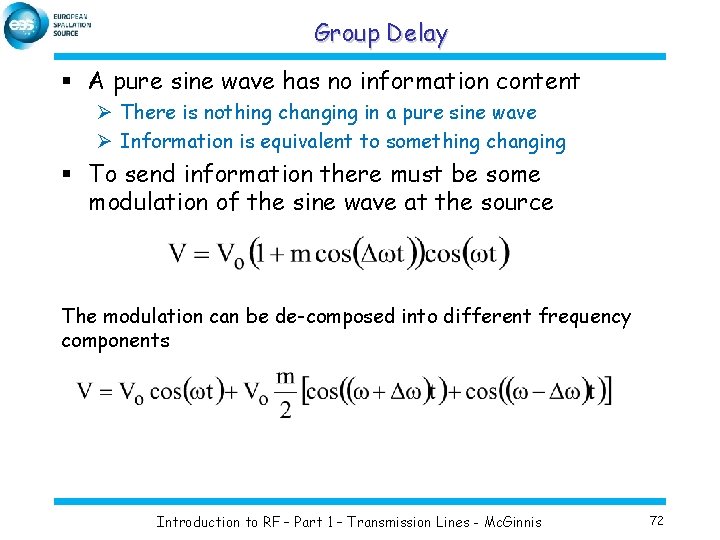
Group Delay § A pure sine wave has no information content Ø There is nothing changing in a pure sine wave Ø Information is equivalent to something changing § To send information there must be some modulation of the sine wave at the source The modulation can be de-composed into different frequency components Introduction to RF – Part 1 – Transmission Lines - Mc. Ginnis 72
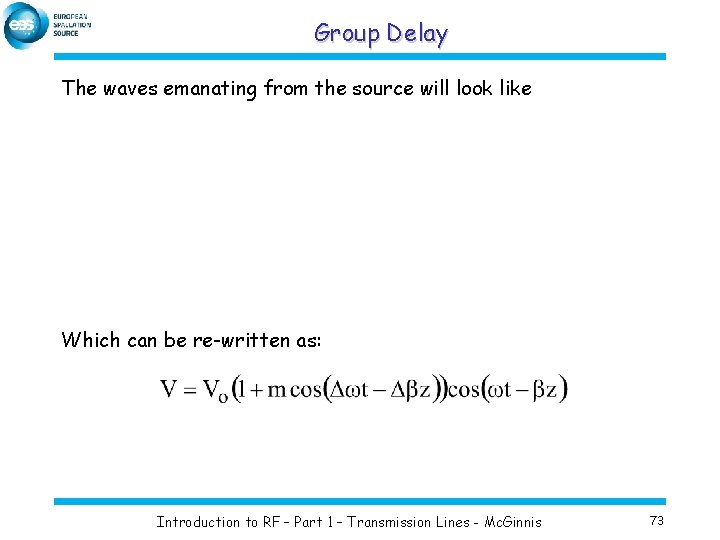
Group Delay The waves emanating from the source will look like Which can be re-written as: Introduction to RF – Part 1 – Transmission Lines - Mc. Ginnis 73
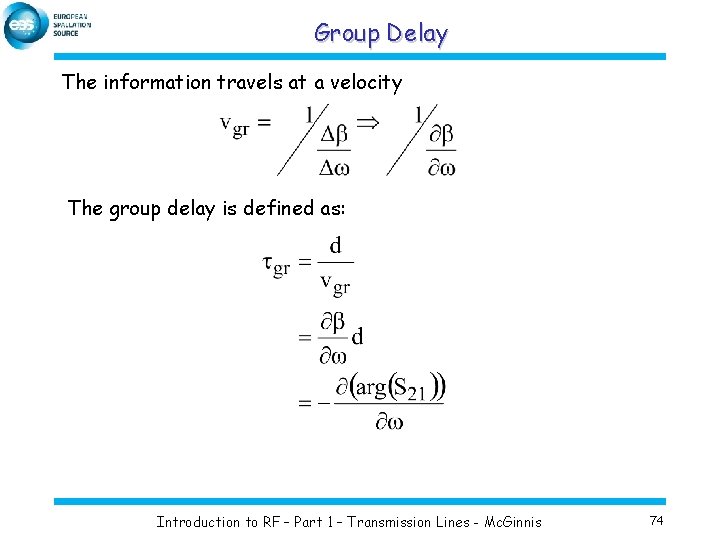
Group Delay The information travels at a velocity The group delay is defined as: Introduction to RF – Part 1 – Transmission Lines - Mc. Ginnis 74
Phase Delay and Group Delay Phase Delay: Group Delay: Introduction to RF – Part 1 – Transmission Lines - Mc. Ginnis 75
Transmission Line Topics § § § § Phasors Traveling Waves Characteristic Impedance Reflection Coefficient Standing Waves Impedance and Reflection Incident and Reflected Power § § § § Smith Charts Load Matching Single Stub Tuners d. B and d. Bm Z and S parameters Lorentz Reciprocity Network Analysis Phase and Group Delay Introduction to RF – Part 1 – Transmission Lines - Mc. Ginnis 76