
INTRODUCTION TO REINSURANCE January 2017 CII u slide



- Slides: 75
INTRODUCTION TO REINSURANCE January 2017 © CII u slide 1
Agenda (1) Purpose of and the parties involved in reinsurance (2) Features and operation of proportional treaties (3) Features and operation of non-proportional treaties (4) Features and operation of facultative reinsurance (5) Uses of reinsurance © CII u slide 2
(1) Purpose of and the parties involved in reinsurance © CII u slide 3
Purpose of and the parties involved in reinsurance PURPOSE OF REINSURANCE ü Spreads risk ü Increases capacity ü Provides security © CII u slide 4
Purpose of and the parties involved in reinsurance PURPOSE OF REINSURANCE (cont. ) ü Increases stability in results ü Increases confidence ü Portfolio and asset management © CII u slide 5
Purpose of and the parties involved in reinsurance PURPOSE OF REINSURANCE (cont. ) ü Taxation advantages ü Cash flow advantages ü Corporate strategy © CII u slide 6
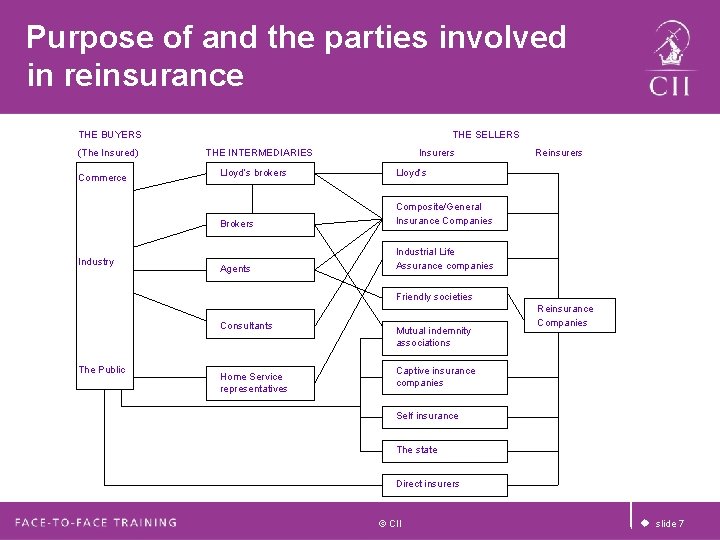
Purpose of and the parties involved in reinsurance THE BUYERS (The Insured) Commerce Industry THE SELLERS THE INTERMEDIARIES Insurers Lloyd’s brokers Lloyd’s Brokers Composite/General Insurance Companies Agents Industrial Life Assurance companies Reinsurers Friendly societies Consultants The Public Home Service representatives Mutual indemnity associations Reinsurance Companies Captive insurance companies Self insurance The state Direct insurers © CII u slide 7
Purpose of and the parties involved in reinsurance BUYERS OF REINSURANCE Ø Insurance companies Ø Lloyd’s syndicates Ø State-owned insurance corporations © CII u slide 8
Purpose of and the parties involved in reinsurance BUYERS OF REINSURANCE (cont. ) Ø Regional insurance corporations Ø Captive insurance companies Ø Mutual insurance companies © CII u slide 9
Purpose of and the parties involved in reinsurance BUYERS OF REINSURANCE (cont. ) Ø Reinsurance companies Ø Reinsurance pools Typically, reinsurance purchased via brokers © CII u slide 10
Purpose of and the parties involved in reinsurance SELLERS OF REINSURANCE Ø Ø Ø Reinsurance companies Lloyd’s syndicates Direct insurance companies State reinsurance companies Reinsurance pools © CII u slide 11
Purpose of and the parties involved in reinsurance MOTIVATION FOR SELLING REINSURANCE ü ü ü Profit Investment income Spread of risk Reciprocity National retention of premiums Core business © CII u slide 12
(2) Features and operation of proportional treaties © CII u slide 13
Features and operation of proportional treaties © CII u slide 14
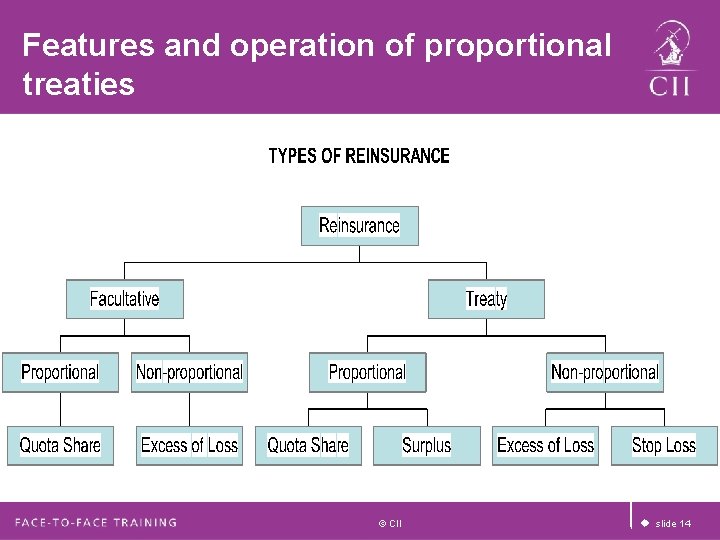
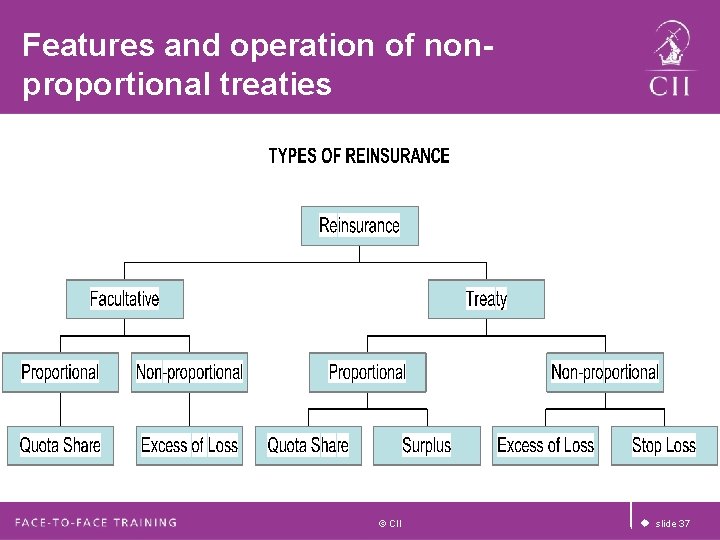
Features and operation of proportional treaties TYPES OF PROPORTIONAL TREATIES • Quota Share • Surplus Treaty © CII u slide 15
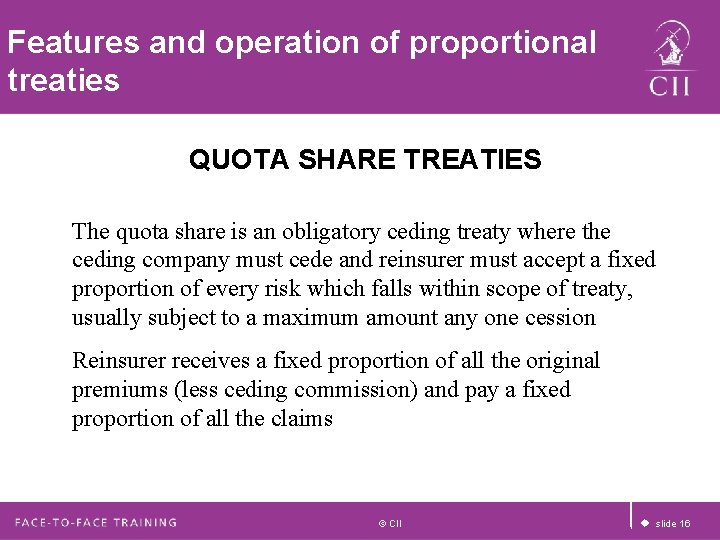
Features and operation of proportional treaties QUOTA SHARE TREATIES The quota share is an obligatory ceding treaty where the ceding company must cede and reinsurer must accept a fixed proportion of every risk which falls within scope of treaty, usually subject to a maximum amount any one cession Reinsurer receives a fixed proportion of all the original premiums (less ceding commission) and pay a fixed proportion of all the claims © CII u slide 16
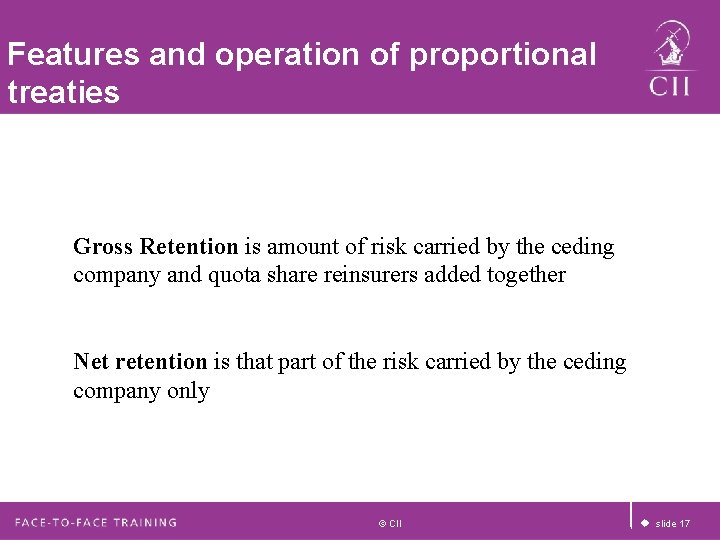
Features and operation of proportional treaties Gross Retention is amount of risk carried by the ceding company and quota share reinsurers added together Net retention is that part of the risk carried by the ceding company only © CII u slide 17
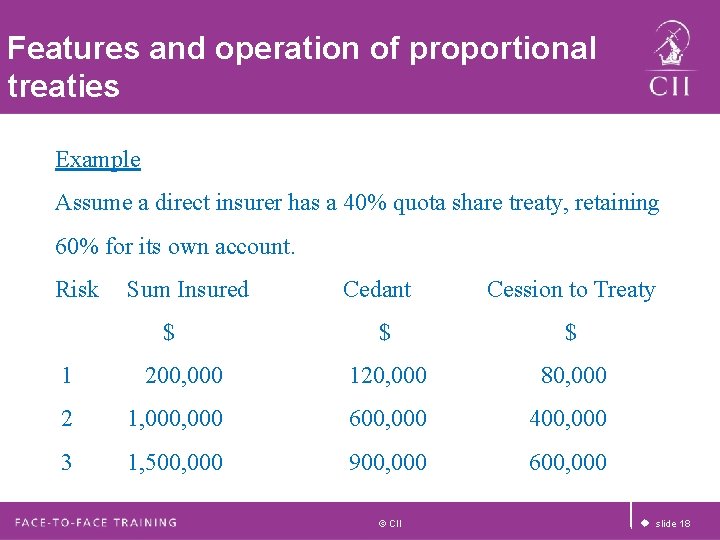
Features and operation of proportional treaties Example Assume a direct insurer has a 40% quota share treaty, retaining 60% for its own account. Risk Sum Insured $ Cedant Cession to Treaty $ $ 1 200, 000 120, 000 80, 000 2 1, 000 600, 000 400, 000 3 1, 500, 000 900, 000 600, 000 © CII u slide 18
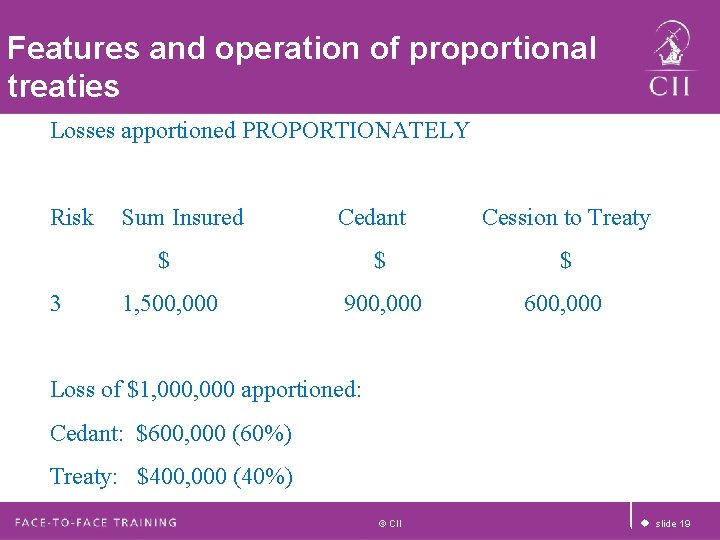
Features and operation of proportional treaties Losses apportioned PROPORTIONATELY Risk 3 Sum Insured Cedant Cession to Treaty $ $ $ 1, 500, 000 900, 000 600, 000 Loss of $1, 000 apportioned: Cedant: $600, 000 (60%) Treaty: $400, 000 (40%) © CII u slide 19
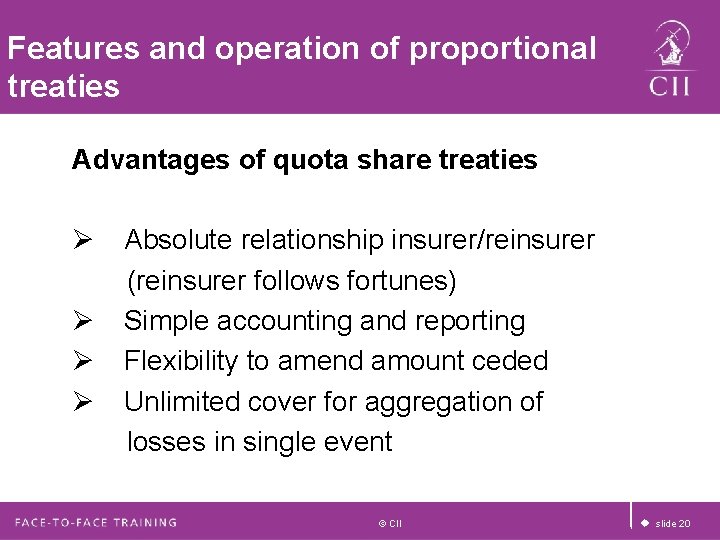
Features and operation of proportional treaties Advantages of quota share treaties Ø Ø Absolute relationship insurer/reinsurer (reinsurer follows fortunes) Simple accounting and reporting Flexibility to amend amount ceded Unlimited cover for aggregation of losses in single event © CII u slide 20
Features and operation of proportional treaties Disadvantages of quota share treaties Ø Ø Ø Unnecessary premium may be ceded Inflexible retention Treaty terms fixed Treaty terms restrictive Loss aggregation not fully protected © CII u slide 21
Features and operation of proportional treaties SURPLUS TREATIES Reinsurers must accept an amount of risk, which falls within the scope of the treaty and which is surplus to a cedant’s retention or “line” Reinsurers’ total retention is specified as a multiple number of “lines” No direct relationship between the number of lines and the number of reinsurers © CII u slide 22
Features and operation of proportional treaties SURPLUS TREATIES (cont. ) May specify different levels of maximum retention (“lines”) for different classes of business Cedant can choose whether to write the stated maximum retention for a specific class or some lower amount Both premiums and claims are proportionately shared between cedant and reinsurer © CII u slide 23
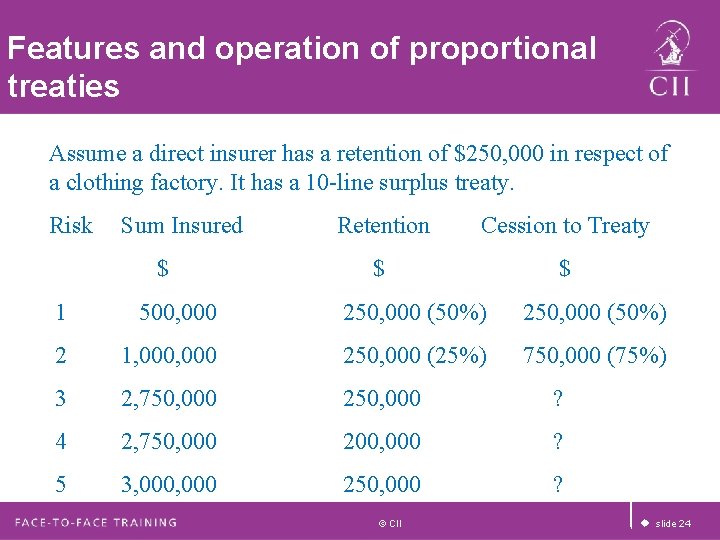
Features and operation of proportional treaties Assume a direct insurer has a retention of $250, 000 in respect of a clothing factory. It has a 10 -line surplus treaty. Risk Sum Insured $ Retention Cession to Treaty $ $ 1 500, 000 250, 000 (50%) 2 1, 000 250, 000 (25%) 750, 000 (75%) 3 2, 750, 000 250, 000 ? 4 2, 750, 000 200, 000 ? 5 3, 000 250, 000 ? © CII u slide 24
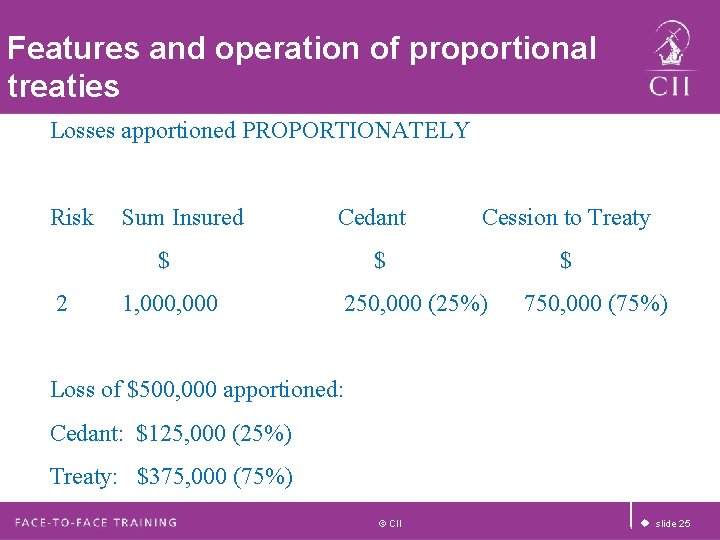
Features and operation of proportional treaties Losses apportioned PROPORTIONATELY Risk Sum Insured Cedant $ 2 1, 000 Cession to Treaty $ 250, 000 (25%) $ 750, 000 (75%) Loss of $500, 000 apportioned: Cedant: $125, 000 (25%) Treaty: $375, 000 (75%) © CII u slide 25
Features and operation of proportional treaties It is possible to arrange a second surplus treaty whereby another group of reinsurers will write a certain number of lines in addition to those written under the first surplus treaty © CII u slide 26
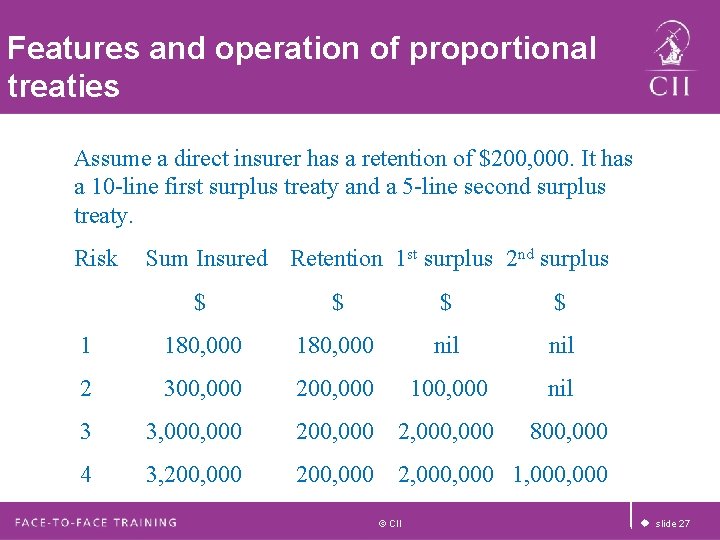
Features and operation of proportional treaties Assume a direct insurer has a retention of $200, 000. It has a 10 -line first surplus treaty and a 5 -line second surplus treaty. Risk Sum Insured Retention 1 st surplus 2 nd surplus $ $ 1 180, 000 nil 2 300, 000 200, 000 100, 000 nil 3 3, 000 200, 000 2, 000 4 3, 200, 000 2, 000 1, 000 © CII 800, 000 u slide 27
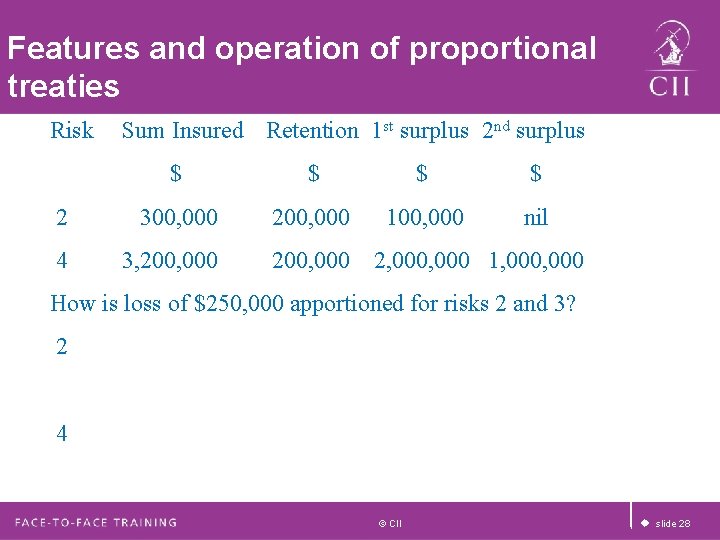
Features and operation of proportional treaties Risk Sum Insured Retention 1 st surplus 2 nd surplus $ $ 2 300, 000 200, 000 100, 000 nil 4 3, 200, 000 2, 000 1, 000 How is loss of $250, 000 apportioned for risks 2 and 3? 2 4 © CII u slide 28
Features and operation of proportional treaties Advantages of surplus treaties Ø Ø Ø Cedant can vary retention Automatic capacity Cedant can retain more premium Ceding/profit commission Unlimited cover for aggregation of losses in single loss event © CII u slide 29
Features and operation of proportional treaties Disadvantages of surplus treaties Ø Ø Ø Ø Optimal retention important Results of insurer and reinsurer differ Treaty terms fixed Treaty terms restrictive Reinsurer’s loss experience can vary Ceding commission lower than QS Loss aggregation not fully protected © CII u slide 30
Features and operation of proportional treaties PROPORTIONAL PRICING Pricing in proportion to reinsurer’s share Reinsurance commission/brokerage deducted © CII u slide 31
Features and operation of proportional treaties PROPORTIONAL COMMISSIONS AND DEDUCTIONS Reinsurance/ceding commission is paid by reinsurer to a cedant. It is usually a percentage of the reinsurance premium due to the reinsurer on a “flat rate” basis and influenced by: • • • type of reinsurance history of profitability state of reinsurance market original broker’s commission cedant’s administrative costs © CII u slide 32
Features and operation of proportional treaties PROPORTIONAL Profit commission (flat-rate basis) An extra commission payable to a cedant over and above the flat rate commission, based on the net profit made by the reinsurer from the treaty © CII u slide 33
Features and operation of proportional treaties PROPORTIONAL Sliding scale commission The ceding commission is varied according to the loss ratio experience of the treaty: High loss ratio = Low commission Low loss ratio = High commission © CII u slide 34
Features and operation of proportional treaties PROPORTIONAL Loss participation A share of losses under a proportional treaty must be borne by the cedant if loss ratio exceeds an agreed percentage. Acts as a form of reverse profit commission. © CII u slide 35
(3) Features and operation of non-proportional treaties © CII u slide 36
Features and operation of nonproportional treaties © CII u slide 37
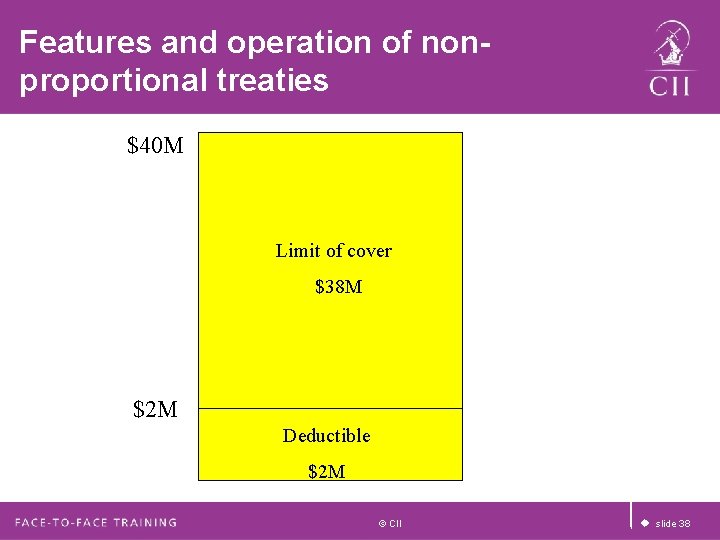
Features and operation of nonproportional treaties $40 M Limit of cover $38 M $2 M Deductible $2 M © CII u slide 38
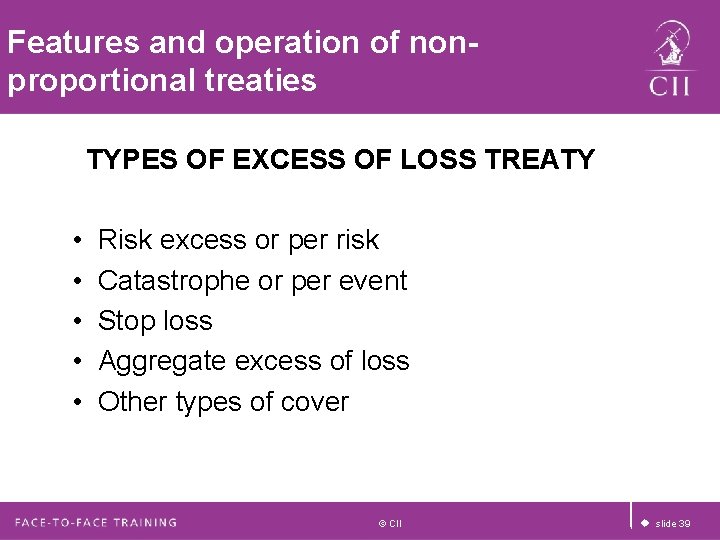
Features and operation of nonproportional treaties TYPES OF EXCESS OF LOSS TREATY • • • Risk excess or per risk Catastrophe or per event Stop loss Aggregate excess of loss Other types of cover © CII u slide 39
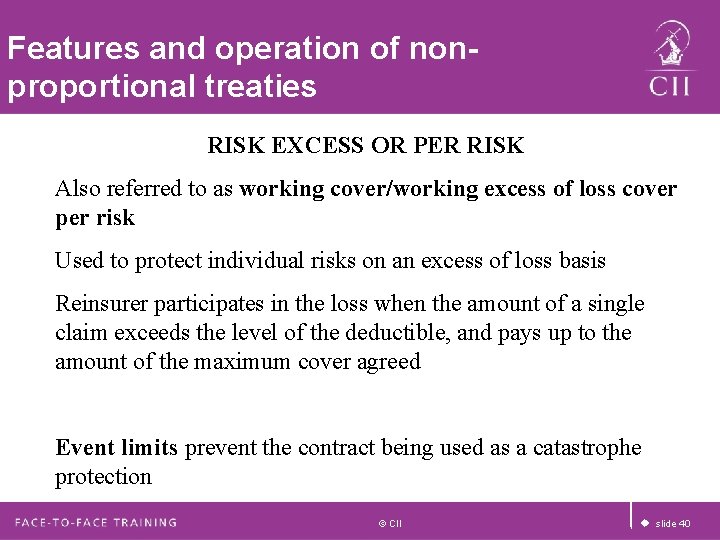
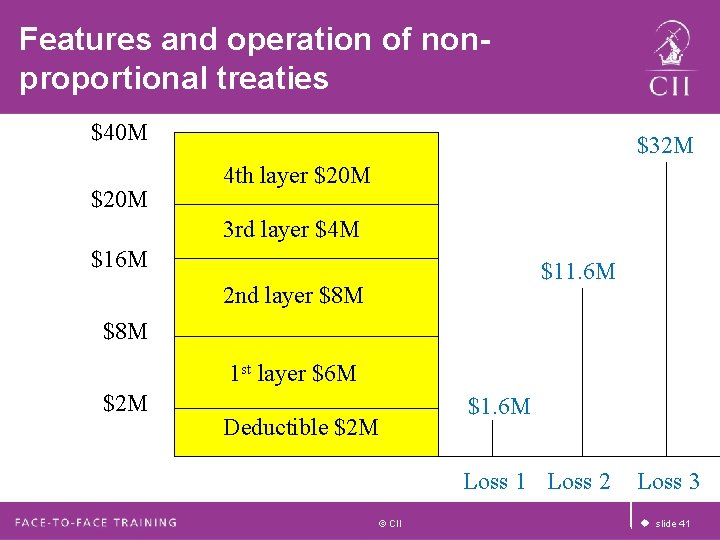
Features and operation of nonproportional treaties RISK EXCESS OR PER RISK Also referred to as working cover/working excess of loss cover per risk Used to protect individual risks on an excess of loss basis Reinsurer participates in the loss when the amount of a single claim exceeds the level of the deductible, and pays up to the amount of the maximum cover agreed Event limits prevent the contract being used as a catastrophe protection © CII u slide 40
Features and operation of nonproportional treaties $40 M $20 M $32 M 4 th layer $20 M 3 rd layer $4 M $16 M $11. 6 M 2 nd layer $8 M 1 st layer $6 M $2 M Deductible $2 M $1. 6 M Loss 1 Loss 2 © CII Loss 3 u slide 41
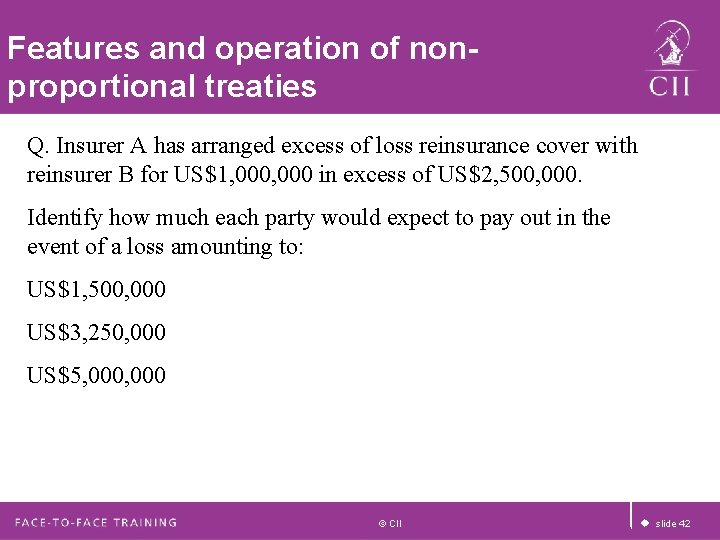
Features and operation of nonproportional treaties Q. Insurer A has arranged excess of loss reinsurance cover with reinsurer B for US$1, 000 in excess of US$2, 500, 000. Identify how much each party would expect to pay out in the event of a loss amounting to: US$1, 500, 000 US$3, 250, 000 US$5, 000 © CII u slide 42
Features and operation of nonproportional treaties CATASTROPHE OR PER EVENT Per event also known as “Working excess of loss cover per event” (WXL/E) Catastrophe cover used to protect against the consequences of a catastrophe when exposed to the problems of accumulation of risk and catastrophe perils Catastrophic loss = a specific, sudden, unexpected, shocking and external happening that can be located in time and place © CII u slide 43
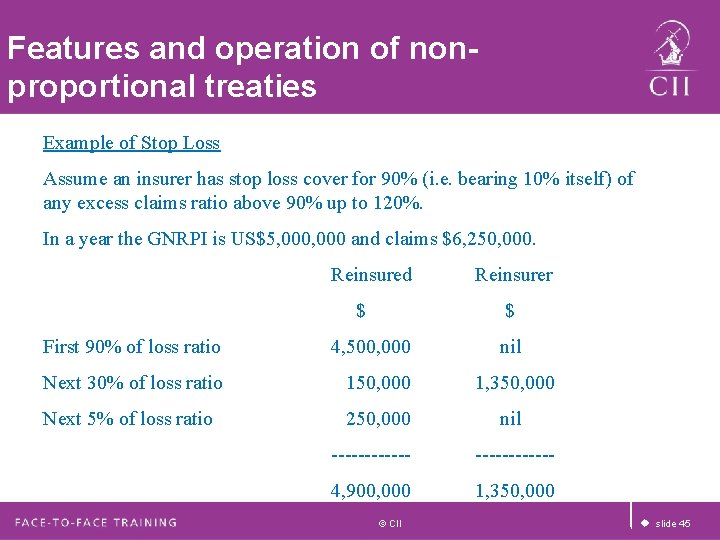
Features and operation of nonproportional treaties STOP LOSS (EXCESS OF LOSS RATIO) Used for aggregate losses arising in respect of a specific class or classes of business Loss/claims ratio = Losses or Claims * 100 Premiums (GNRPI) Note (1) Reinsured may be obliged to retain a proportion of the reinsured amount e. g. 10% (co-reinsurance) (2) GNRPI subject to maximum and minimum criteria © CII u slide 44
Features and operation of nonproportional treaties Example of Stop Loss Assume an insurer has stop loss cover for 90% (i. e. bearing 10% itself) of any excess claims ratio above 90% up to 120%. In a year the GNRPI is US$5, 000 and claims $6, 250, 000. Reinsured $ Reinsurer $ First 90% of loss ratio 4, 500, 000 nil Next 30% of loss ratio 150, 000 1, 350, 000 Next 5% of loss ratio 250, 000 nil ------------ 4, 900, 000 1, 350, 000 © CII u slide 45
Features and operation of nonproportional treaties AGGREGATE EXCESS OF LOSS Similar to stop loss reinsurance except that coverage is expressed in actual monetary amounts, not percentages © CII u slide 46
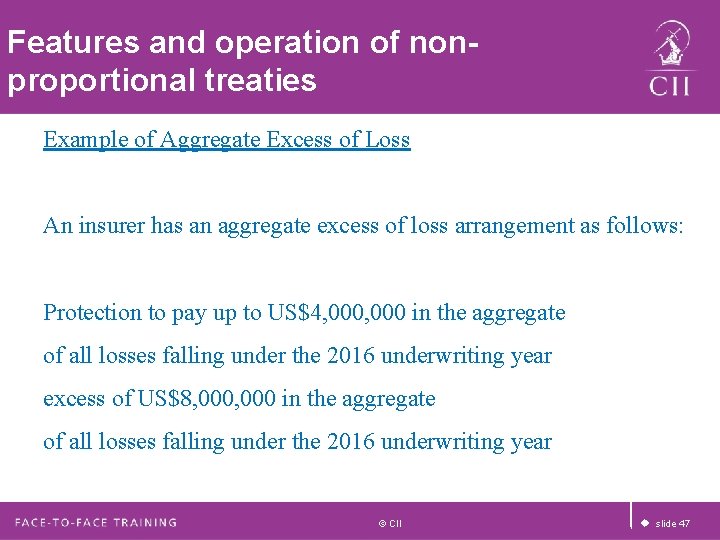
Features and operation of nonproportional treaties Example of Aggregate Excess of Loss An insurer has an aggregate excess of loss arrangement as follows: Protection to pay up to US$4, 000 in the aggregate of all losses falling under the 2016 underwriting year excess of US$8, 000 in the aggregate of all losses falling under the 2016 underwriting year © CII u slide 47
Features and operation of nonproportional treaties OTHER TYPES OF COVER • Clash excess of loss • Umbrella excess of loss • Buffer excess of loss • Back-up covers • Reinstatement premium protections • “Top & drop” and “cascade” protections © CII u slide 48
Features and operation of nonproportional treaties Advantages of excess of loss treaties Ø Ø Ø Accounting procedures simplified Administration costs reduced Reinsurance premium is all-inclusive Reinsurance premium is predetermined Usually no profit commission Reinsurer does not deposit technical reserves © CII u slide 49
Features and operation of nonproportional treaties Disadvantages of excess of loss treaties Ø Calculation of business is more complex Ø Cost of reinsurance can vary © CII u slide 50
Features and operation of nonproportional treaties NON-PROPORTIONAL PREMIUM/RATING FACTORS • Original underwriting limits • Basis of these limits (Sum Insured or EML) • Claims experience • Nature of the account • Risk profiles • Catastrophe perils • Underlying protections © CII u slide 51
Features and operation of nonproportional treaties NON-PROPORTIONAL PREMIUM/RATING FACTORS (cont. ) • Number of reinstatements • Amount of cover requested • Effect of inflation • Currency fluctuations • Relationship with the insurer • Quality of the business © CII u slide 52
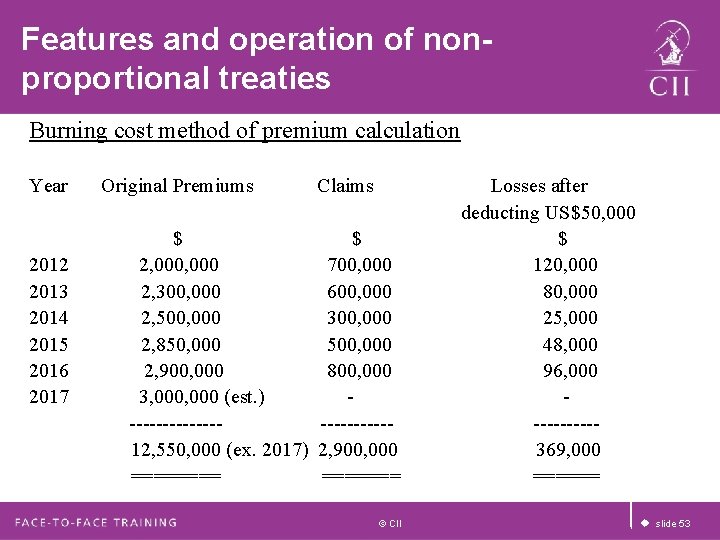
Features and operation of nonproportional treaties Burning cost method of premium calculation Year 2012 2013 2014 2015 2016 2017 Original Premiums $ 2, 000 2, 300, 000 2, 500, 000 2, 850, 000 2, 900, 000 3, 000 (est. ) -------12, 550, 000 (ex. 2017) ==== Claims $ 700, 000 600, 000 300, 000 500, 000 800, 000 -----2, 900, 000 ======= © CII Losses after deducting US$50, 000 $ 120, 000 80, 000 25, 000 48, 000 96, 000 -----369, 000 ====== u slide 53
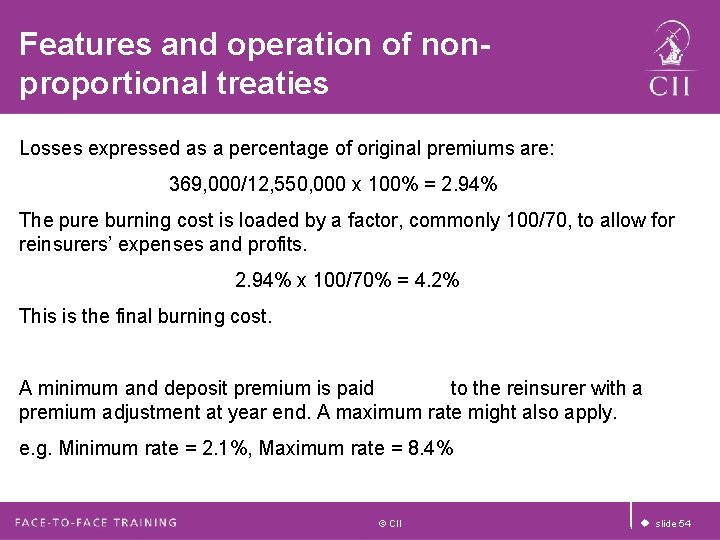
Features and operation of nonproportional treaties Losses expressed as a percentage of original premiums are: 369, 000/12, 550, 000 x 100% = 2. 94% The pure burning cost is loaded by a factor, commonly 100/70, to allow for reinsurers’ expenses and profits. 2. 94% x 100/70% = 4. 2% This is the final burning cost. A minimum and deposit premium is paid to the reinsurer with a premium adjustment at year end. A maximum rate might also apply. e. g. Minimum rate = 2. 1%, Maximum rate = 8. 4% © CII u slide 54
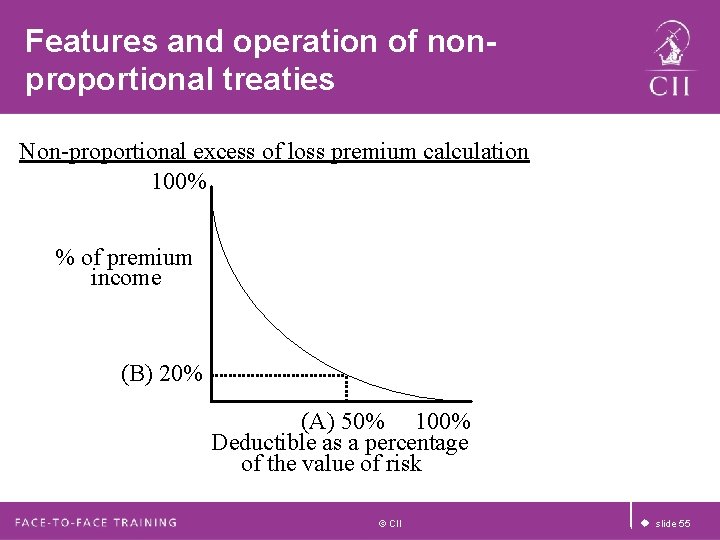
Features and operation of nonproportional treaties Non-proportional excess of loss premium calculation 100% % of premium income (B) 20% (A) 50% 100% Deductible as a percentage of the value of risk © CII u slide 55
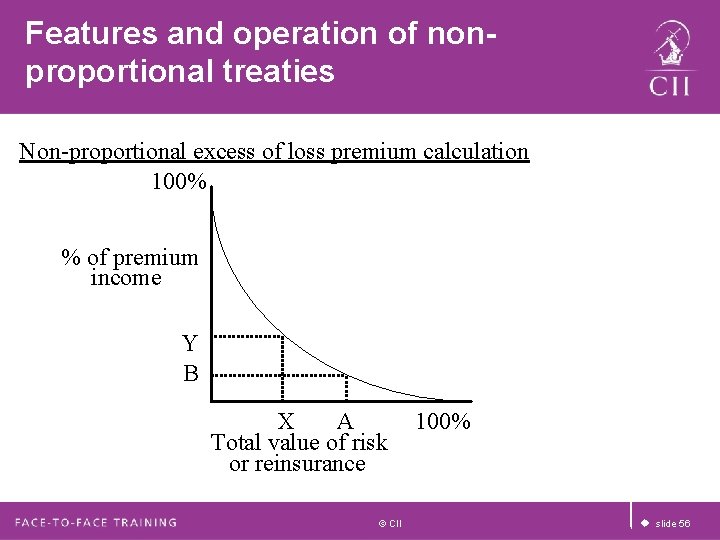
Features and operation of nonproportional treaties Non-proportional excess of loss premium calculation 100% % of premium income Y B X A Total value of risk or reinsurance © CII 100% u slide 56
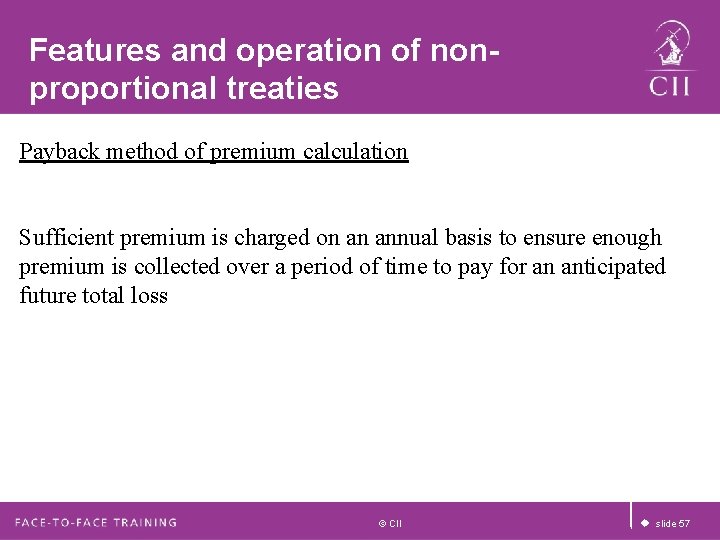
Features and operation of nonproportional treaties Payback method of premium calculation Sufficient premium is charged on an annual basis to ensure enough premium is collected over a period of time to pay for an anticipated future total loss © CII u slide 57
(4) Features and operation of facultative reinsurance © CII u slide 58
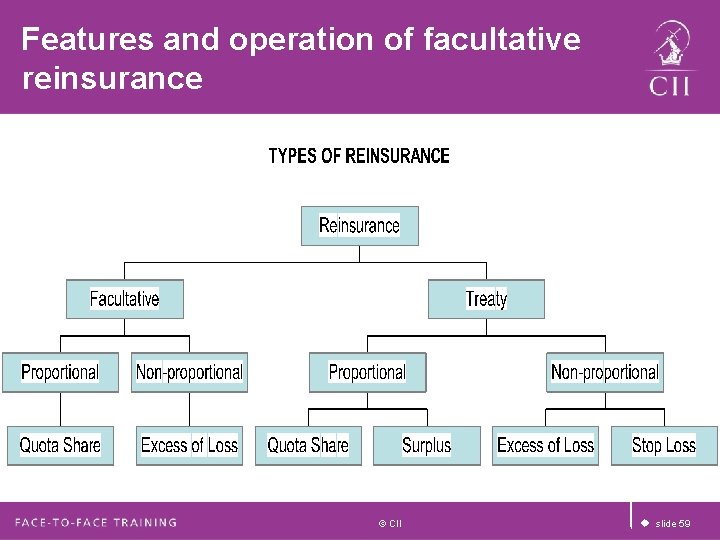
Features and operation of facultative reinsurance © CII u slide 59
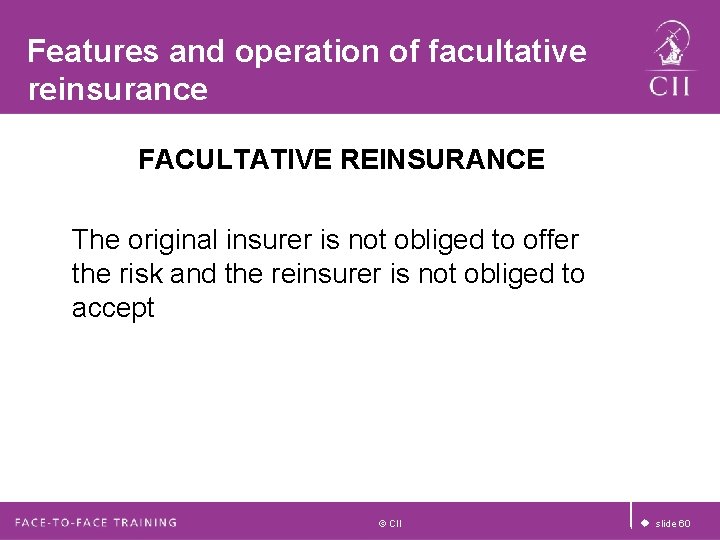
Features and operation of facultative reinsurance FACULTATIVE REINSURANCE The original insurer is not obliged to offer the risk and the reinsurer is not obliged to accept © CII u slide 60
Features and operation of facultative reinsurance FACULTATIVE PROPORTIONAL REINSURANCE • Quota Share • Facultative Obligatory © CII u slide 61
Features and operation of facultative reinsurance FACULTATIVE OBLIGATORY REINSURANCE The original insurer is not obliged to offer the risk (therefore like facultative cover) but the reinsurer is obliged to accept (therefore like obligatory treaty) © CII u slide 62
Features and operation of facultative reinsurance FACULTATIVE NON-PROPORTIONAL REINSURANCE Excess of loss (a) excess of reinsured’s own retention (b) excess of (reinsured’s own retention + treaty reinsurer’s retention) Referred to as “common account basis” © CII u slide 63
Features and operation of facultative reinsurance Factors affecting retention • Estimated Maximum Loss • Class of risk and vulnerability to loss • Other commitments on risk • Exposures from nearby risks • Particular features of risk – good/bad © CII u slide 64
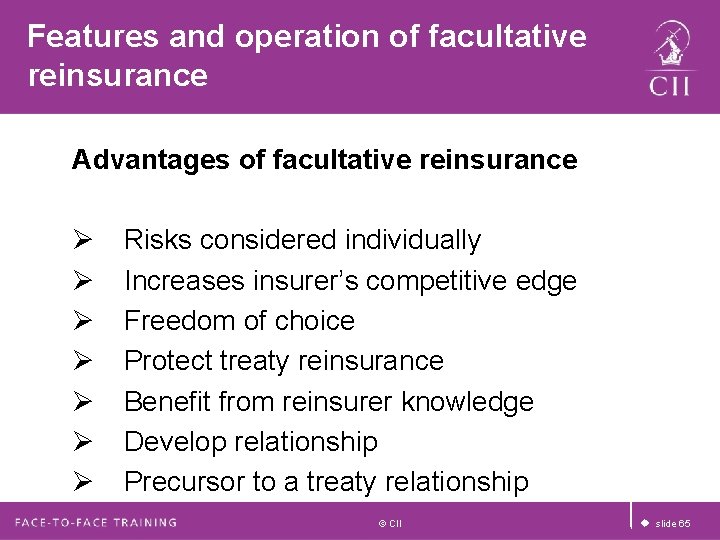
Features and operation of facultative reinsurance Advantages of facultative reinsurance Ø Ø Ø Ø Risks considered individually Increases insurer’s competitive edge Freedom of choice Protect treaty reinsurance Benefit from reinsurer knowledge Develop relationship Precursor to a treaty relationship © CII u slide 65
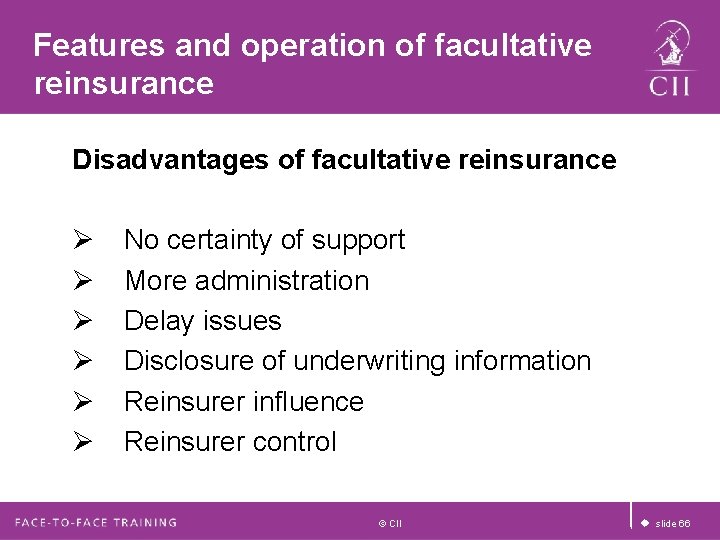
Features and operation of facultative reinsurance Disadvantages of facultative reinsurance Ø Ø Ø No certainty of support More administration Delay issues Disclosure of underwriting information Reinsurer influence Reinsurer control © CII u slide 66
(5) Uses of reinsurance © CII u slide 67
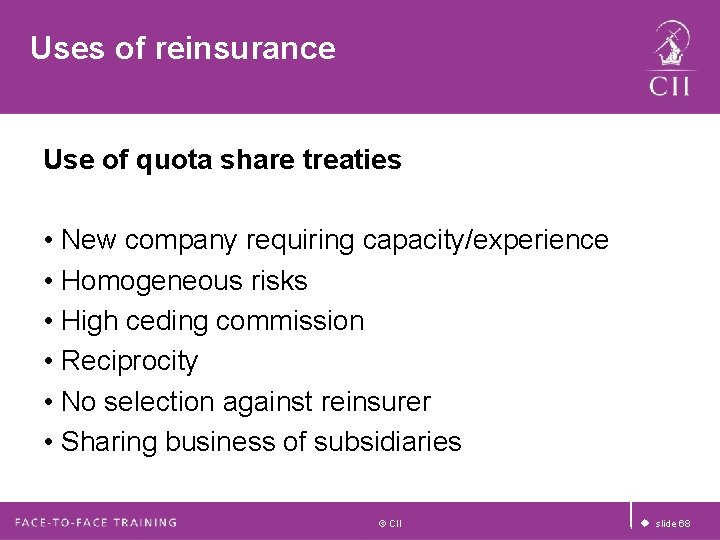
Uses of reinsurance Use of quota share treaties • New company requiring capacity/experience • Homogeneous risks • High ceding commission • Reciprocity • No selection against reinsurer • Sharing business of subsidiaries © CII u slide 68
Uses of reinsurance Use of quota share treaties (cont. ) • Spread of risk provides catastrophe capacity • Financing • Balanced portfolio for reinsurer • Solvency requirements • Risks subject to abrupt loss ratio variations © CII u slide 69
Uses of reinsurance Use of surplus treaties • Additional capacity • Retain more premium for smaller/better risks • Retain more consistent portfolio of business © CII u slide 70
Uses of reinsurance Use of facultative reinsurance • • • Automatic underwriting capacity full Risk excluded from treaty Protect treaty Original risk hazardous Commercial/financial/strategic reasons © CII u slide 71
Uses of reinsurance Uses of facultative obligatory reinsurance • Additional capacity • Accumulation problems • Protect against hazardous risk Open covers/Line slips/Binders/Delegated authority schemes are adaptations of fac oblig reinsurance © CII u slide 72
Uses of reinsurance Use of treaty excess of loss • • Nature of risk Exposure to large losses Ease of use Level of protection and retention © CII u slide 73
Uses of reinsurance Altering reinsurance arrangements Consider: (1) Retained premium (2) Capacity (3) Limit selection (4) Payment of losses (5) Protection © CII u slide 74
Uses of reinsurance (6) Catastrophe protection (7) Reinstatement (8) Reinsurance commission (9) Cash flow (10) Results © CII u slide 75