
Introduction to Rearrangement Reactions The previous four posts

- Slides: 10
Introduction to Rearrangement Reactions
The previous four posts on acidbase, substitution, addition, and elimination covered the 4 main reactions in organic chemistry I. Now it’s time to go beyond those mainstays to introduce a few of the less common (but still important) reactions you learn in organic chemistry 1. They will be rearrangements, radical substitution, and cleavage (oxidative cleavage).
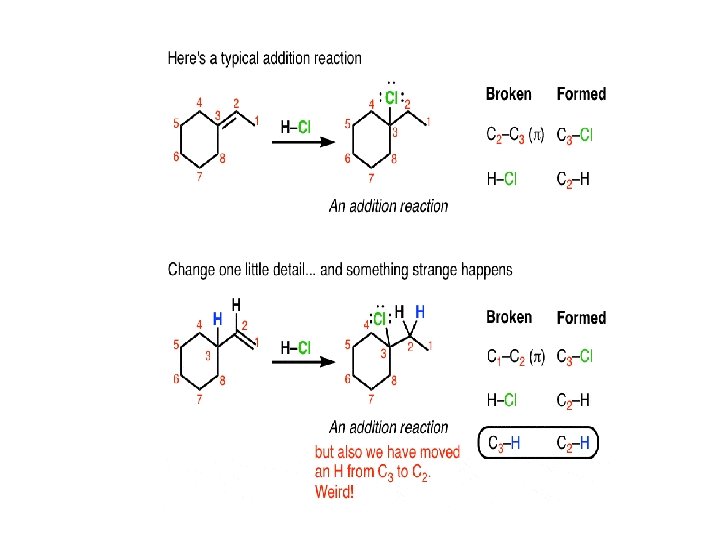
Rearrangement reactions are really interesting. They can accompany many of the reactions we’ve previously covered such as substitution, addition, and elimination reactions. In fact, if you don’t look closely, sometimes you can miss the fact that a rearrangement reaction has occurred. Let’s look at a substitution reaction first.
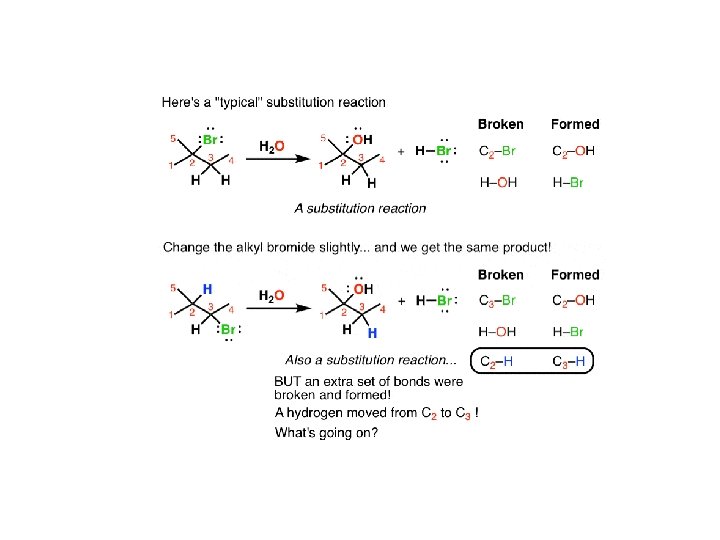
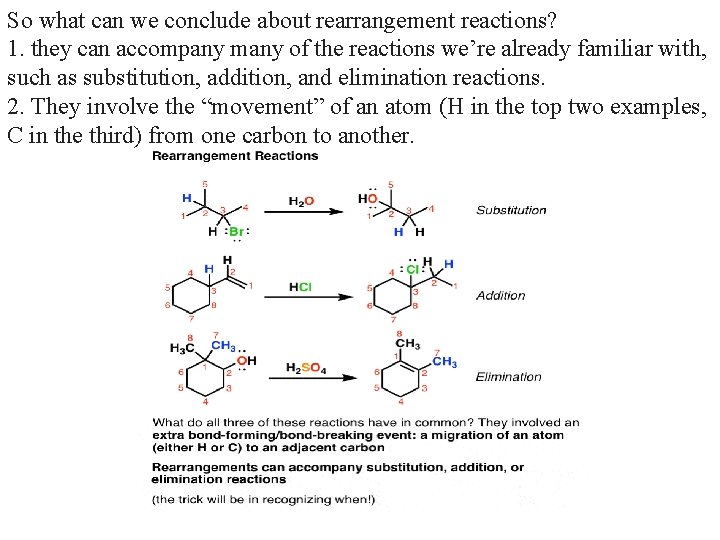
On the top is a “typical” substitution reaction: we’re taking an alkyl halide and adding water. The C-Br bond is broken and a C-OH bond is formed. If you look at the table on the right you’ll see this follows the typical pattern of substitution reactions. However if we change one thing about this alkyl halide – move the bromine to C-3 instead of C-2 – now when we run this reaction we see a different product emerge. It is also a substitution reaction (we’re replacing Br with OH) but it’s on a different carbon. That’s because if you look closely, you can see there actually 3 bonds broken and 3 bonds formed. The C 2 -H bond broke and the C 3 -H bond formed.
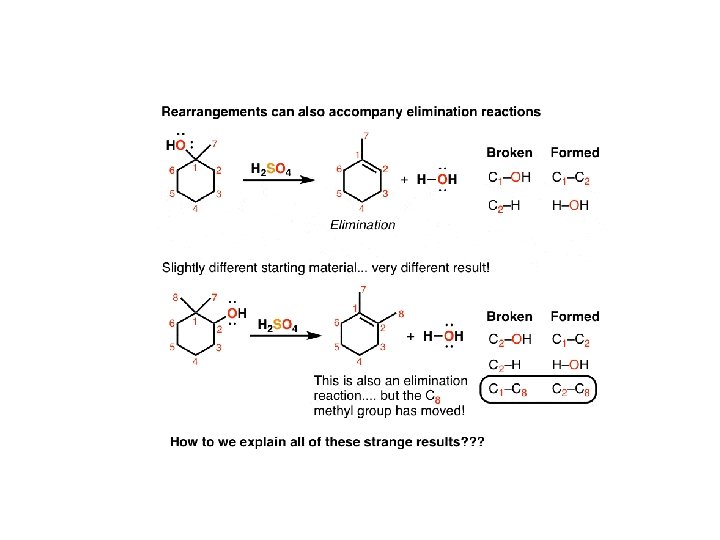
Finally, let’s look at an elimination reaction. If you take an alcohol like the one below and add an acid (like H 2 SO 4, pictured) and help the reaction along with some heat, you break the C 1 -OH and C 2 -H bonds, and form a new double bond between C 1 -C 2. This is, in other words, a typical elimination reaction. But if you take a slightly modified alcohol like the bottom example (with an extra methyl group on C 1) and try the same reaction, something strange happens again. Analyzing the bonds broken and formed, there’s an “extra” bond being broken and an “extra” bond being formed here. If you look closely you can see that one of the methyl groups on C 1 (we’ll call it C 8) moved over to C 2.
So what can we conclude about rearrangement reactions? 1. they can accompany many of the reactions we’re already familiar with, such as substitution, addition, and elimination reactions. 2. They involve the “movement” of an atom (H in the top two examples, C in the third) from one carbon to another.