
Introduction to RealTime and Embedded Systems Ch 1
ﻣﻌﺮﻓی ﺩﺭﺱ : • ﻓﻬﺮﺳﺖ ﻣﻄﺎﻟﺐ ﺩﺭﺱ • Introduction to Real-Time and Embedded Systems (Ch. 1) – Hard versus soft real-time (Ch. 2) – Reference Model (Ch. 3) • Job Scheduling (Ch. 4) – Clock driven scheduling algorithms (Ch. 5) – Priority driven scheduling algorithms (Ch. 6) –Scheduling Aperiodic and Sporadic Jobs in Priority. Driven Systems (Ch. 7) • Resources and Resource Access Control (Ch. 8) • Operating Systems (Ch. 12) 2
Real-Time and Embedded Systems • A real-time system must deliver services in a timely manner –Not necessarily fast, but must meet some timing deadline • An embedded system is hidden from view within a larger system • Many real-time and embedded systems exist, often without the awareness of their users –Washing machine, photocopier, mobile phone, car, aircraft, industrial plant, microwave oven, toothbrush, CD player, medical devices, etc. • Must be able to validate real-time systems for correctness –Some embedded real-time systems are safety critical –i. e. if they do not complete on a timely basis, serious consequences result –Bugs in embedded real-time systems are often difficult or expensive to fix 3
Real-Time and Embedded Systems • This module will discuss several representative classes of real time and embedded system: – Digital process control – Higher-level command control – Tracking and signal processing – Real-time databases – Telephony and multimedia • Algorithms for scheduling tasks such that those systems complete in a reliable and timely fashion • Implementation techniques, operating systems and languages for building such systems 4
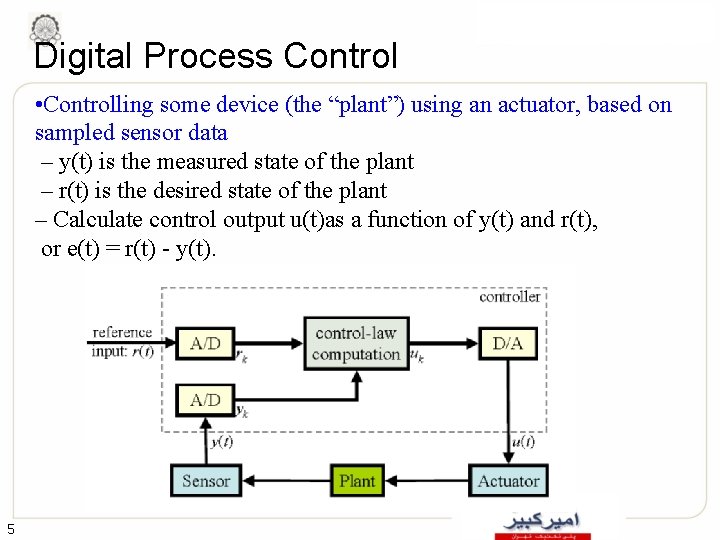
Digital Process Control • Controlling some device (the “plant”) using an actuator, based on sampled sensor data – y(t) is the measured state of the plant – r(t) is the desired state of the plant – Calculate control output u(t)as a function of y(t) and r(t), or e(t) = r(t) - y(t). 5
Digital Process Control • Pseudo-code for the controller as an infinite timed loop: set timer to interrupt periodically with period T; at each timer interrupt, do do analogue-to-digital conversion of y(t)to get yk; compute control output uk based on reference rk and yk; do digital-to-analogue conversion of uk to get u(t); end do; 6
Digital Process Control • Effective control of the plant depends on: –The correct control law computation and reference input – The accuracy of the sensor measurements: • Resolution of the sampled data (i. e. bits per sample) • Timing of the clock interrupts (i. e. samples per second, 1/T) 7
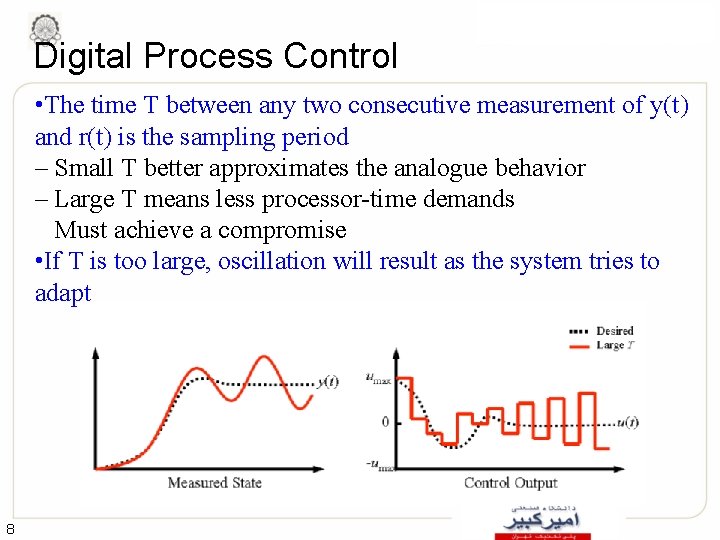
Digital Process Control • The time T between any two consecutive measurement of y(t) and r(t) is the sampling period – Small T better approximates the analogue behavior – Large T means less processor-time demands Must achieve a compromise • If T is too large, oscillation will result as the system tries to adapt 8
Digital Process Control • How to choose sampling period? –Rise time –the amount of time that the plant takes to reach some small neighborhood around the final state in response to a step change in the reference input – If R is the rise time, and T is the period, a good rule of thumb is that the ratio 10 ≤ R/T ≤ 20 • Must be chosen correctly, and accurately implemented to ensure stability • Multi-rate systems –system is composed of multiple sensors and actuators, each of which require different sampling periods – Need to run multiple control loops at once, accurately – Usually best to have the sampling periods for the different degrees of freedom related in a harmonic way 9
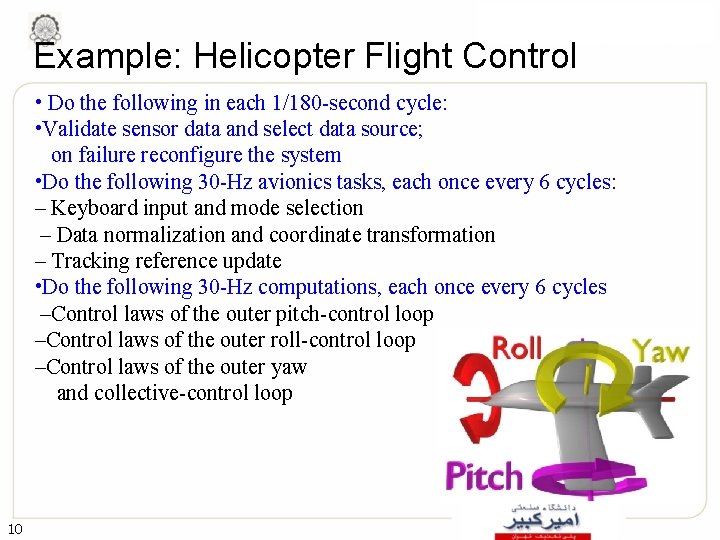
Example: Helicopter Flight Control • Do the following in each 1/180 -second cycle: • Validate sensor data and select data source; on failure reconfigure the system • Do the following 30 -Hz avionics tasks, each once every 6 cycles: – Keyboard input and mode selection – Data normalization and coordinate transformation – Tracking reference update • Do the following 30 -Hz computations, each once every 6 cycles –Control laws of the outer pitch-control loop –Control laws of the outer roll-control loop –Control laws of the outer yaw and collective-control loop 10
Example: Helicopter Flight Control • Do each of the following 90 -Hz computations once every 2 cycles, using outputs produced by the 30 -Hz computations – Control laws of the inner pitch-control loop – Control laws of the inner roll-and collective-control loop • Compute the control laws of the inner yaw-control loop, using outputs from the 90 -Hz computations • Output commands to control surfaces • Carry out built-in-test 11
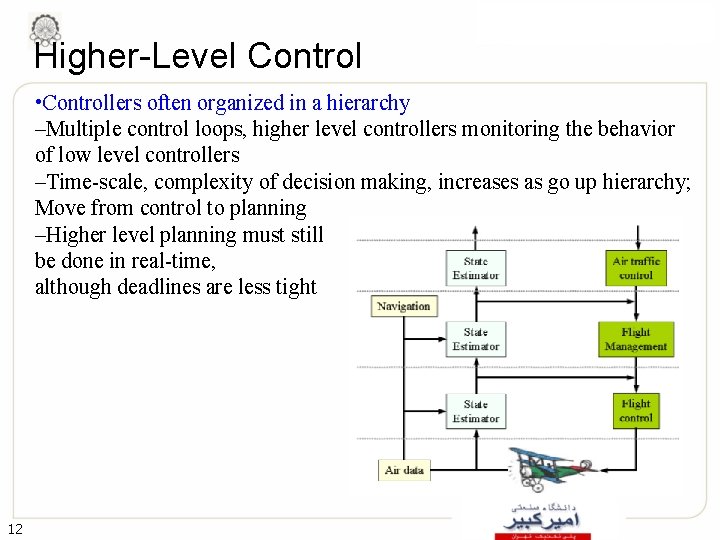
Higher-Level Control • Controllers often organized in a hierarchy –Multiple control loops, higher level controllers monitoring the behavior of low level controllers –Time-scale, complexity of decision making, increases as go up hierarchy; Move from control to planning –Higher level planning must still be done in real-time, although deadlines are less tight 12
Real-Time Communications • Real-time systems are increasingly distributed, including communication networks –Control loop may include a communication step –System may depend on network stimuli • Not only does a system need to run a control law with time constraints, it must also schedule communications, sending and receiving messages according to deadlines 13
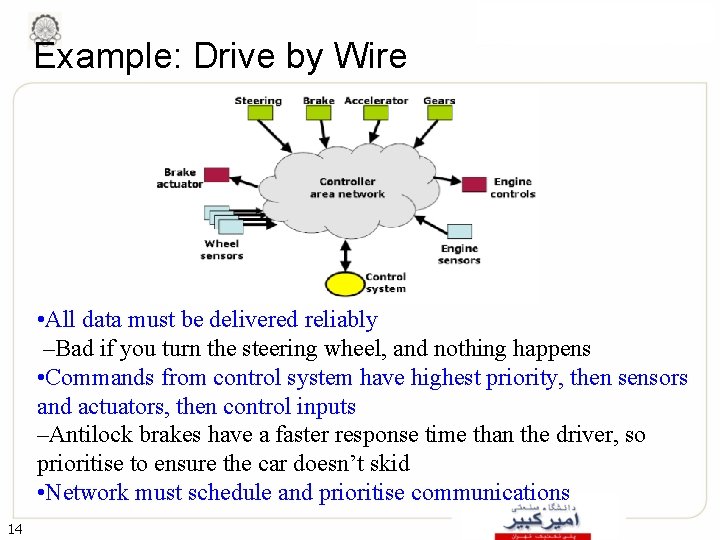
Example: Drive by Wire • All data must be delivered reliably –Bad if you turn the steering wheel, and nothing happens • Commands from control system have highest priority, then sensors and actuators, then control inputs –Antilock brakes have a faster response time than the driver, so prioritise to ensure the car doesn’t skid • Network must schedule and prioritise communications 14

Example: Packet Voice • Voice is digitized and sent as a sequence of packets –Constant spacing, every 10 -30 ms depending on codec • Strict timeliness requirement –Mouth to ear delay needs to be less than approximately 150 ms –Packets must be played out with equal spacing • Relaxed reliability requirement –Some small fraction of packets can be lost, and just sound like crackles on the wire; most need to arrive • Emergency calls may have priority 15
Types of Real-Time Application • Purely cyclic –Every task executes periodically –Demands in (computing, communication, and storage) resources do not vary significantly from period to period – Example: most digital controllers and real-time monitors • Mostly cyclic –Most tasks execute periodically –The system must also respond to some external events (fault recovery and external commands) asynchronously –Example: modern avionics and process control system 16
Types of Real-Time Application • Asynchronous: mostly predictable –Most tasks are not periodic –The time between consecutive executions of a task may vary considerably, or the variations in resource utilization in different periods may be larg –These variations have either bounded ranges or known statistic • Asynchronous: unpredictable –Applications that react to asynchronous events and have tasks with high run-time complexity –Example: intelligent real-time control systems 17
Implementation Considerations • Some real-time embedded systems are complex, implemented on high-performance hardware –Industrial plant control –Civilian flight control • Many must be implemented on hardware chosen to be low cost, low power, light-weight and robust; with performance a distant concern – Military flight control, space craft control – Consumer goods • Often times implemented in C or assembler, fitting within a few kilobytes of memory –Correctness a primary concern, efficiency a close second 18
- Slides: 19