
Introduction to rainforests 04032021 RECAP QUESTIONS 1 What


- Slides: 13
Introduction to rainforests 04/03/2021 RECAP QUESTIONS 1 What is a food chain? 2 Name one type of biome 3 What is an ecosystem How does this link? Rainforests are large scale ecosystems and include many animals and plant species, all of which have adapted to live in this environment.
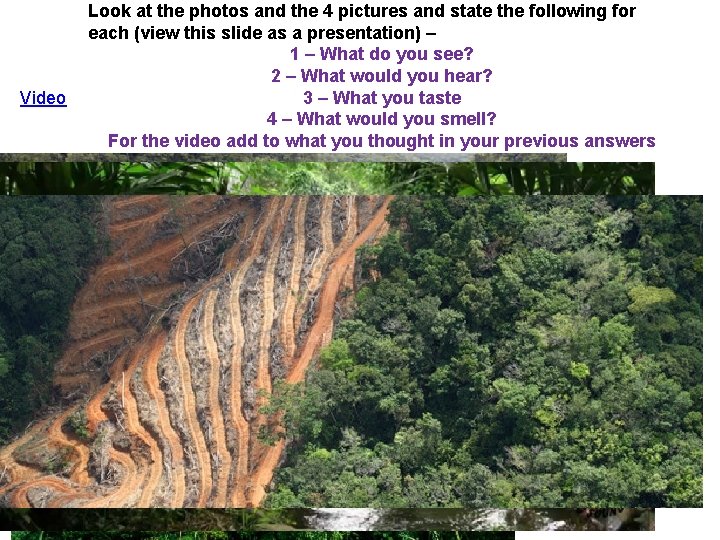
Video Look at the photos and the 4 pictures and state the following for each (view this slide as a presentation) – 1 – What do you see? 2 – What would you hear? 3 – What you taste 4 – What would you smell? For the video add to what you thought in your previous answers
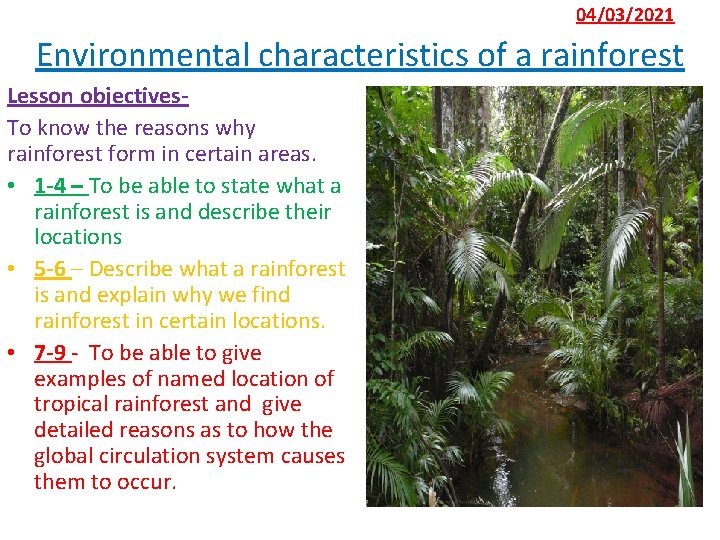
04/03/2021 Environmental characteristics of a rainforest Lesson objectives- To know the reasons why rainforest form in certain areas. • 1 -4 – To be able to state what a rainforest is and describe their locations • 5 -6 – Describe what a rainforest is and explain why we find rainforest in certain locations. • 7 -9 - To be able to give examples of named location of tropical rainforest and give detailed reasons as to how the global circulation system causes them to occur.
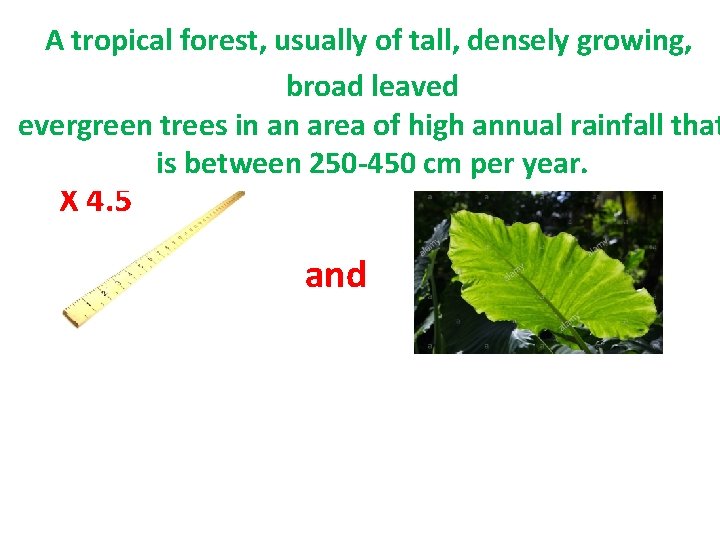
A tropical forest, usually of tall, densely growing, What is a rainforest? broad leaved Thinking about the amount of water that a desert has per year (can evergreen trees in an area of high annual rainfall that any one remember? ), what do we think the definition of a tropical is between 250 -450 cm per year. rainforest might be? X 4. 5 and
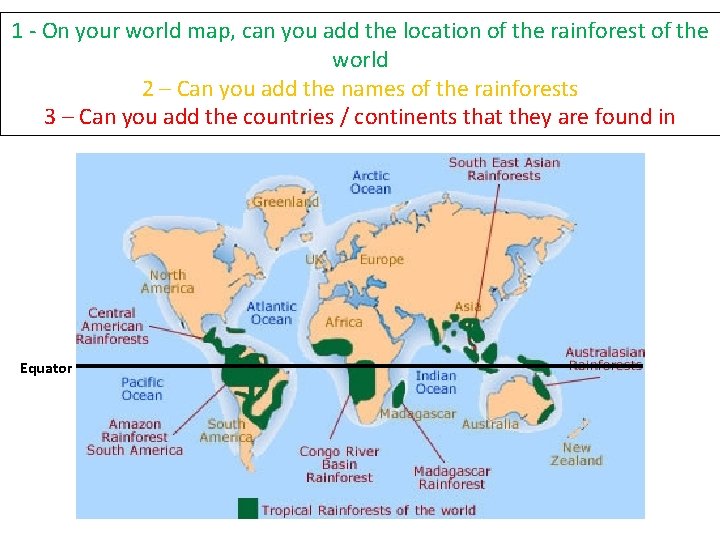
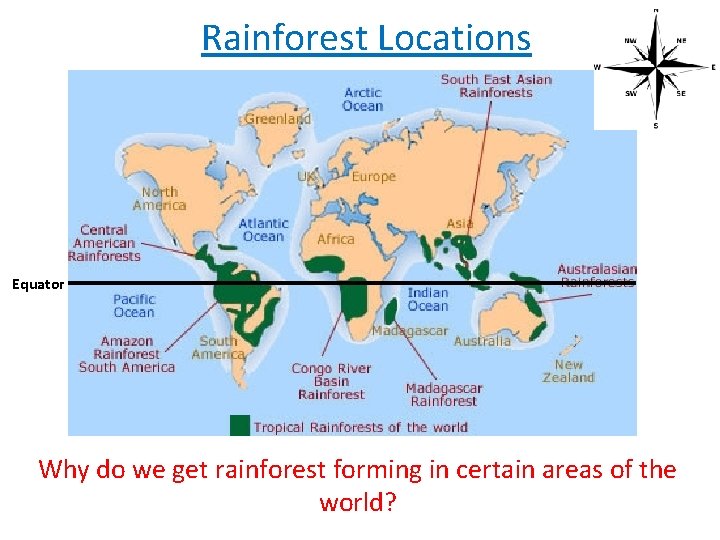
Using figure 1 (below), describe the location of tropical rainforest around the world (2 marks) Equator Rainforest Locations
1 - On your world map, can you add the location of the rainforest of the world 2 – Can you add the names of the rainforests 3 – Can you add the countries / continents that they are found in Equator
Rainforest Locations Equator Why do we get rainforest forming in certain areas of the world?
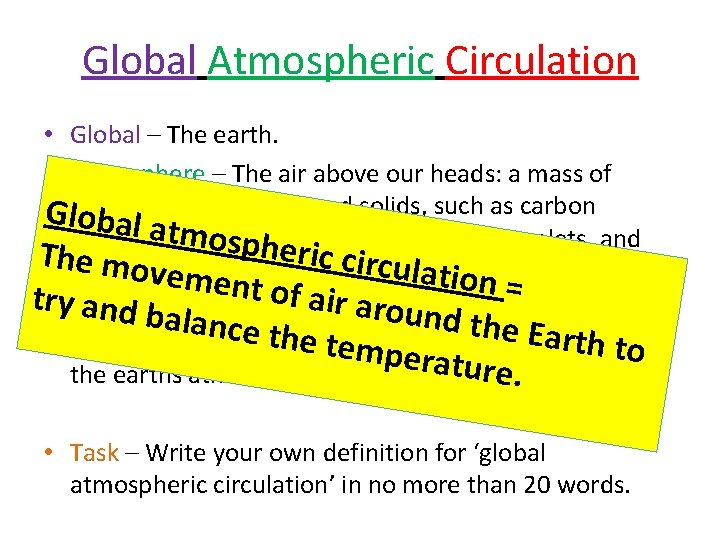
Global Atmospheric Circulation • Global – The earth. • Atmosphere – The air above our heads: a mass of liquids and solids, such as carbon Glswirling obal agases, tmoxygen, dioxide and water vapour and droplets, and o s p h eric circ Thash. e movem u l a t i o n e n = t o f tr • y. Circulation a i and bal – Circular airrmovements around called cells. These a t n hecirculation c e Earth toof t h cells all join togethereto tform the overall empera t ure. the earths atmosphere. • Task – Write your own definition for ‘global atmospheric circulation’ in no more than 20 words.
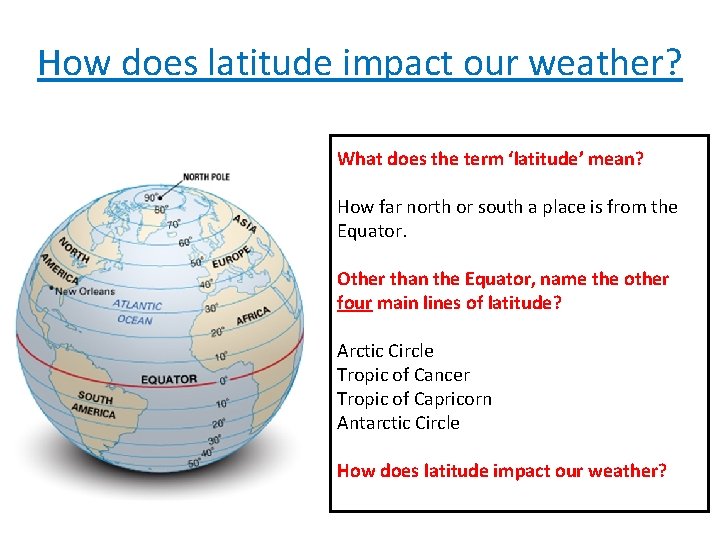
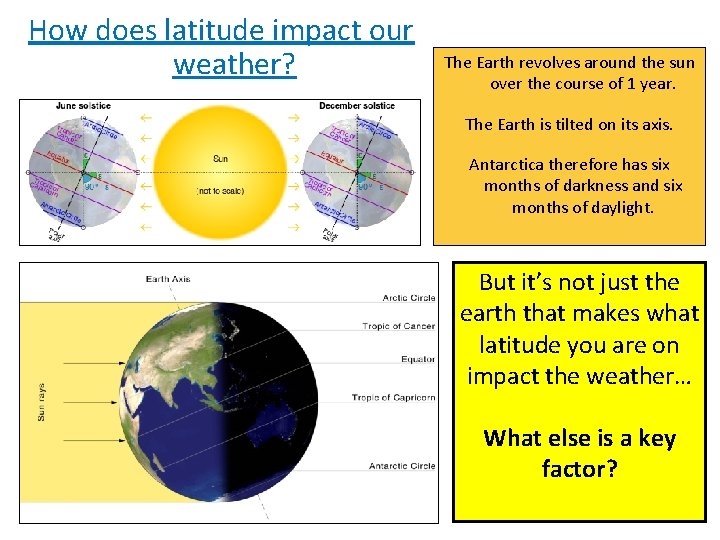
How does latitude impact our weather? What does the term ‘latitude’ mean? How far north or south a place is from the Equator. Other than the Equator, name the other four main lines of latitude? Arctic Circle Tropic of Cancer Tropic of Capricorn Antarctic Circle How does latitude impact our weather?
How does latitude impact our weather? The Earth revolves around the sun over the course of 1 year. The Earth is tilted on its axis. Antarctica therefore has six months of darkness and six months of daylight. But it’s not just the earth that makes what latitude you are on impact the weather… What else is a key factor?
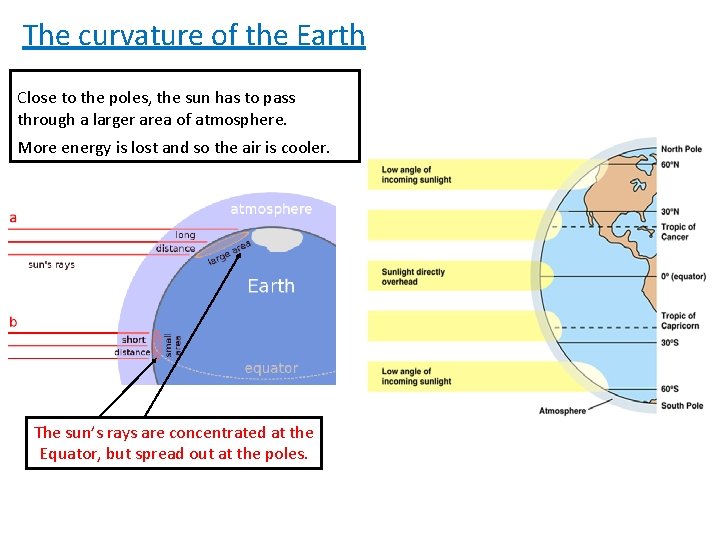
The curvature of the Earth Close to the poles, the sun has to pass through a larger area of atmosphere. More energy is lost and so the air is cooler. The sun’s rays are concentrated at the Equator, but spread out at the poles.
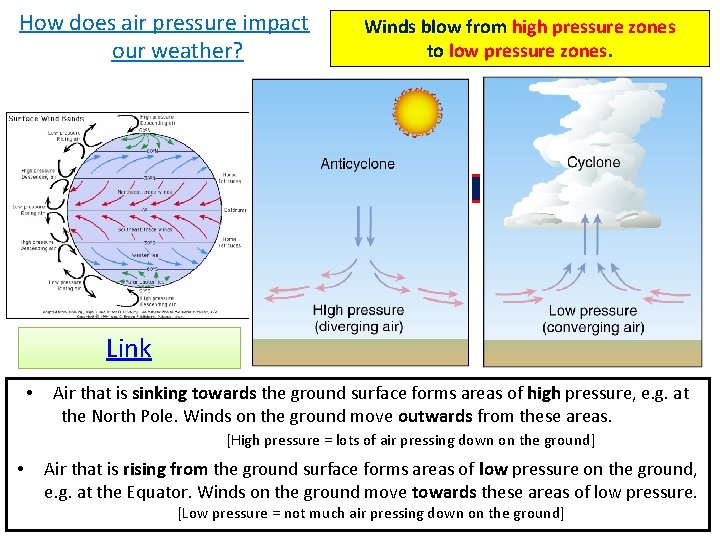
How does air pressure impact our weather? Winds blow from high pressure zones to low pressure zones. Link • Air that is sinking towards the ground surface forms areas of high pressure, e. g. at the North Pole. Winds on the ground move outwards from these areas. [High pressure = lots of air pressing down on the ground] • Air that is rising from the ground surface forms areas of low pressure on the ground, e. g. at the Equator. Winds on the ground move towards these areas of low pressure. [Low pressure = not much air pressing down on the ground]
How are rainforest formed? • Watch this video twice. Do not write any notes just Tropic of watch it twice and try to understand how tropical cancer rainforest form from. Equator Tropic of Capricorn Copy this diagram into your book and add an explanation as to how rainforest are formed.