
Introduction to quantitative research Research and research methods


- Slides: 12
Introduction to quantitative research
Research and research methods • Research methods are split broadly into quantitative and qualitative methods • Which you choose will depend on – your research questions – your underlying philosophy of research – your preferences and skills
Quantitative approaches • Attempts to explain phenomena by collecting and analysing numerical data • Tells you if there is a “difference” but not necessarily why • Data collected are always numerical and analysed using statistical methods • Variables are controlled as much as possible (RCD as the gold standard) so we can eliminate interference and measure the effect of any change • Randomisation to reduce subjective bias • If there are no numbers involved, its not quantitative • Some types of research lend themselves better to quant approaches than others
Quantitative data • Data sources include – Surveys where there a large number of respondents (esp where you have used a Likert scale) – Observations (counts of numbers and/or coding data into numbers) – Secondary data (government data; SATs scores etc) • Analysis techniques include hypothesis testing, correlations and cluster analysis
Analysing quant data • Always good to group and/or visualise the data initially outliers/cleaning data • What average are you looking for? Mean, median or mode? • Spread of data: – skewness/distribution – range, variance and standard deviation
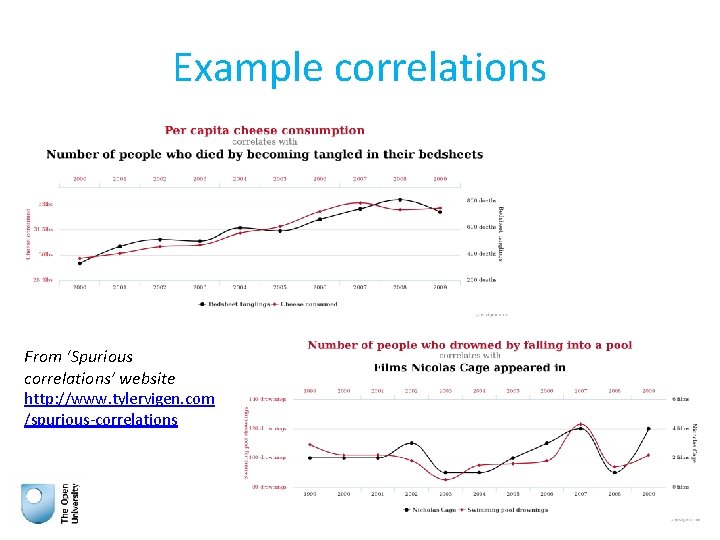
Example correlations From ‘Spurious correlations’ website http: //www. tylervigen. com /spurious-correlations
Interpreting test statistics • Significance level – a fixed probability of wrongly rejecting the null hypothesis H 0, if it is in fact true. Usually set to 0. 05 (5%). • p value - probability of getting a value of the test statistic as extreme as or more extreme than that observed by chance alone, if the null hypothesis H 0, is true. • Power – ability to detect a difference if there is one • Effect size – numerical way of expressing the strength or magnitude of a reported relationship, be it causal or not
Things to Consider while doing Quantitative Research • Is my sample size big enough? • Have I used the correct statistical test? • have I reduced the likelihood of making Type I and/or Type II errors? • Are my results generalisable? • Are my results/methods/results reproducible? • Am I measuring things the right way?
The drawback of quant research • Some things can’t be measured – or measured accurately • Doesn’t tell you why • Can be impersonal – no engagement with human behaviours or individuals • Data can be static – snapshots of a point in time • Can tell a version of the truth (or a lie? ) “Lies, damned lies and statistics” – persuasive power of numbers
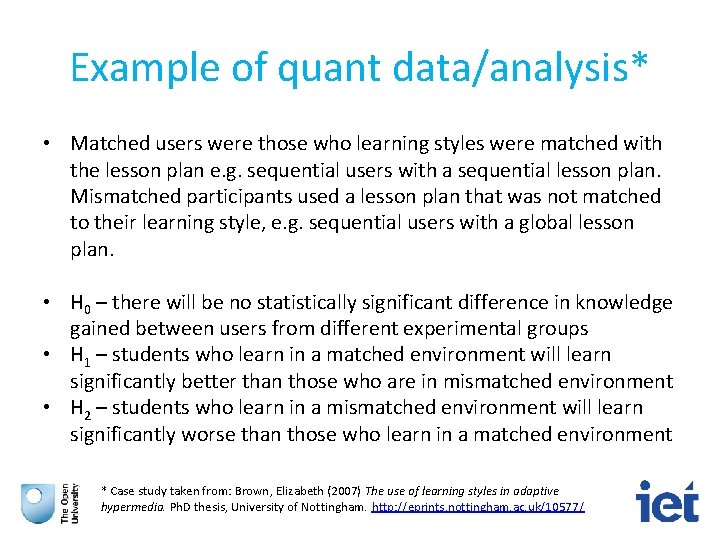
Example of quant data/analysis* • Matched users were those who learning styles were matched with the lesson plan e. g. sequential users with a sequential lesson plan. Mismatched participants used a lesson plan that was not matched to their learning style, e. g. sequential users with a global lesson plan. • H 0 – there will be no statistically significant difference in knowledge gained between users from different experimental groups • H 1 – students who learn in a matched environment will learn significantly better than those who are in mismatched environment • H 2 – students who learn in a mismatched environment will learn significantly worse than those who learn in a matched environment * Case study taken from: Brown, Elizabeth (2007) The use of learning styles in adaptive hypermedia. Ph. D thesis, University of Nottingham. http: //eprints. nottingham. ac. uk/10577/
Interpreting test statistics • Statistical testing was carried out using a univariate ANOVA in SPSS, to determine if there was any significant difference in knowledge gained. • Initial conjecture suggests that the mismatched group actually performed better than the matched group. • However, the difference between the two groups was not significant (F(1, 80)=0. 939, p=0. 34, partial eta squared = 0. 012) and hence hypotheses 1 and 2 can be rejected.
Acknowledgments and further links • Some content borrowed from Skills. You. Need website (http: //www. skillsyouneed. com/learn/research-methods. html) Other useful links: • Introduction to Quantitative and Qualitative Research Models (William Bardebes). PDF at http: //tinyurl. com/qq-models • Methods Map: http: //www. methodsmap. org • Ready To Research: http: //readytoresearch. ac. uk • Methods@Manchester: http: //www. methods. manchester. ac. uk/resources/categories • Research Data Management training: http: //datalib. edina. ac. uk/mantra/