
Introduction to Quality Northeast Community College S Grudzinski
- Slides: 34
Introduction to Quality Northeast Community College S. Grudzinski
Quality Defined Take The Pepsi Challenge
Quality Defined Your Vote PEPSI Coke Why?
Definition of Quality “The quality of a product (article or service) is its ability to satisfy the needs and expectations of the customers” Bergman and Klefsjö, 1994
Definition of Quality “Quality is the totality of features and characteristics of a product or service that bear on its ability to satisfy stated or implied needs” ISO 9000/ISO 8402
Definition of Quality 1. Fitness for use – does the product/service have the features my customers need? And when trying to delight the customers, does the product/service provide additional features not requested but make it better for them? 2. Freedom from defect – does the product/service continue to work in terms of reliability in a reasonable time frame? What if it has everything I want but just doesn’t work. 3. Customer service – the people aspect (applicable to hard products as well as the information world) Did I enjoy my personal contact with the organization providing the quality product/service? 4. Efficiency – for the manufacturer perspective, can I build or provide the product/service at a reasonable cost to make a profit? Jeffrey Worthington, ASQ, 2013
Quality Management So, what is Quality Management? Try to manage all aspects of the organization in order to excel in all dimensions that are important to “customers”
Customers Who are our customers?
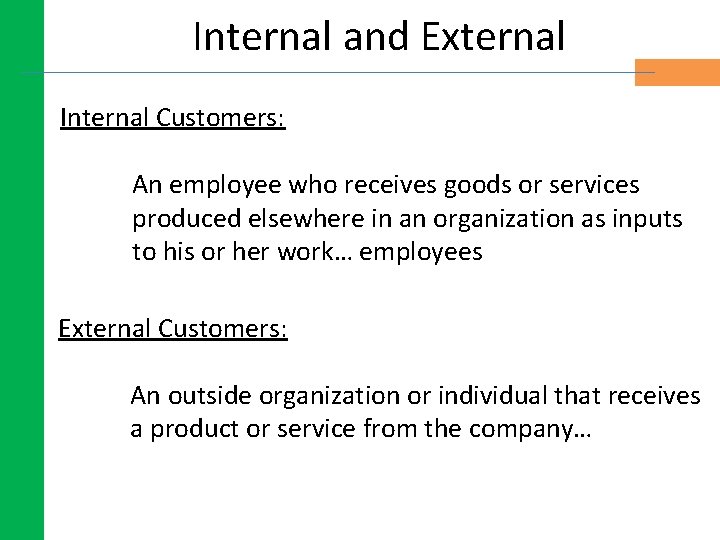
Internal and External Internal Customers: An employee who receives goods or services produced elsewhere in an organization as inputs to his or her work… employees External Customers: An outside organization or individual that receives a product or service from the company…
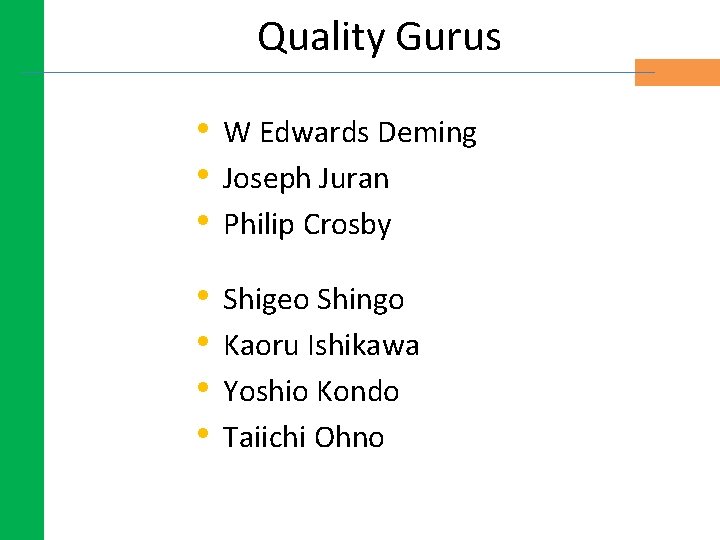
Quality Gurus • W Edwards Deming • Joseph Juran • Philip Crosby • • Shigeo Shingo Kaoru Ishikawa Yoshio Kondo Taiichi Ohno
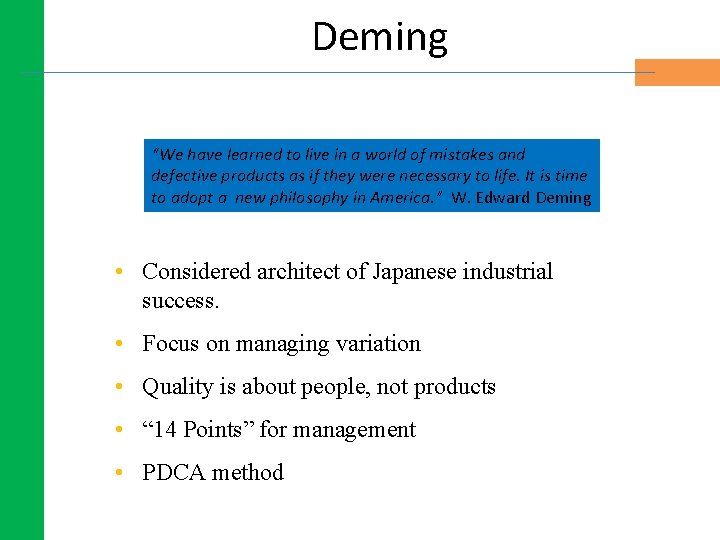
Deming “We have learned to live in a world of mistakes and defective products as if they were necessary to life. It is time to adopt a new philosophy in America. ” W. Edward Deming • Considered architect of Japanese industrial success. • Focus on managing variation • Quality is about people, not products • “ 14 Points” for management • PDCA method
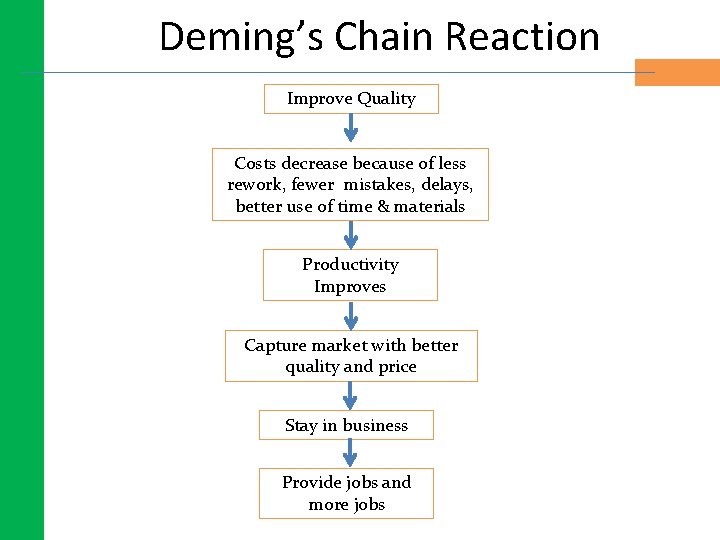
Deming’s Chain Reaction Improve Quality Costs decrease because of less rework, fewer mistakes, delays, better use of time & materials Productivity Improves Capture market with better quality and price Stay in business Provide jobs and more jobs
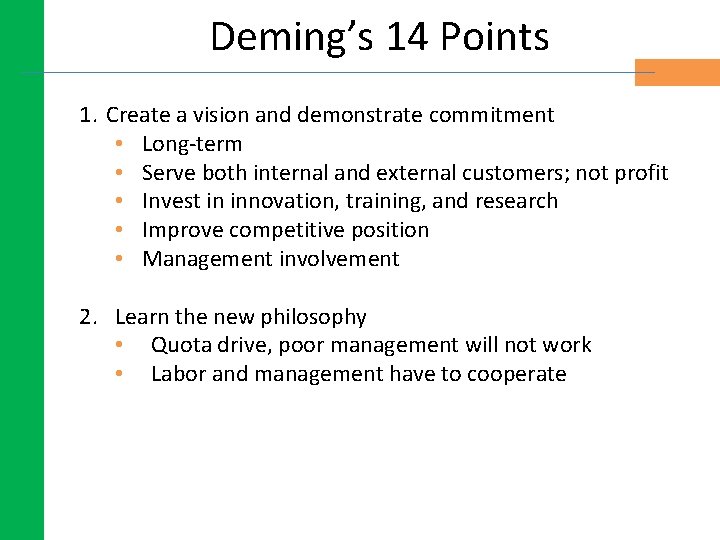
Deming’s 14 Points 1. Create a vision and demonstrate commitment • Long-term • Serve both internal and external customers; not profit • Invest in innovation, training, and research • Improve competitive position • Management involvement 2. Learn the new philosophy • Quota drive, poor management will not work • Labor and management have to cooperate
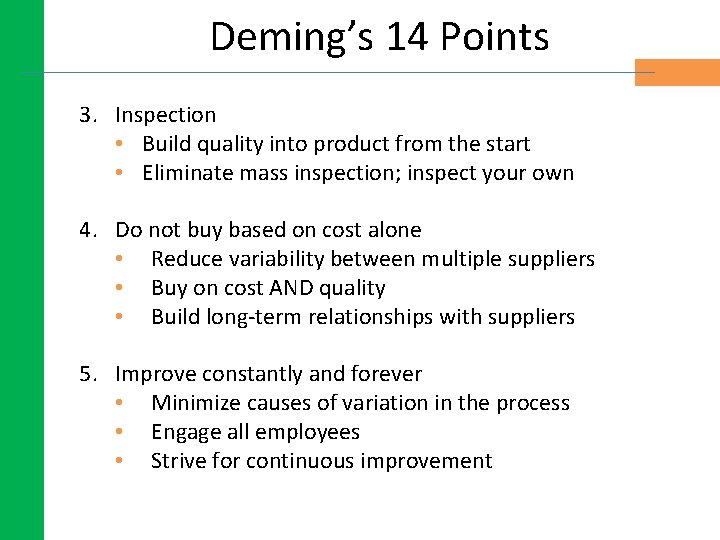
Deming’s 14 Points 3. Inspection • Build quality into product from the start • Eliminate mass inspection; inspect your own 4. Do not buy based on cost alone • Reduce variability between multiple suppliers • Buy on cost AND quality • Build long-term relationships with suppliers 5. Improve constantly and forever • Minimize causes of variation in the process • Engage all employees • Strive for continuous improvement
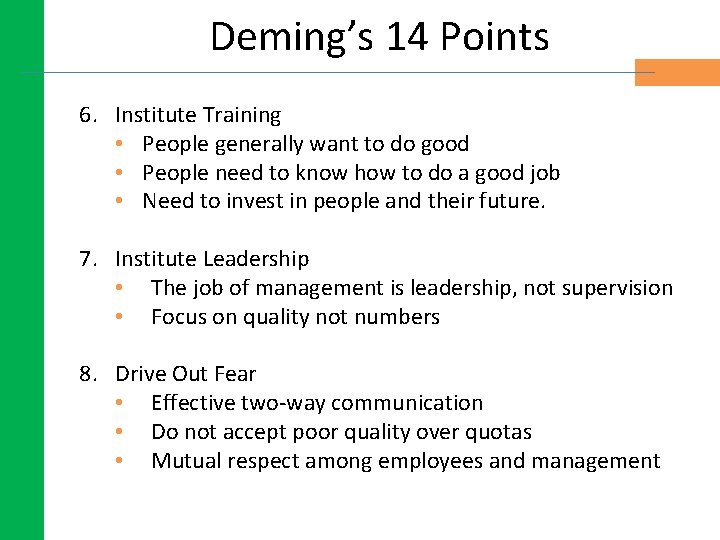
Deming’s 14 Points 6. Institute Training • People generally want to do good • People need to know how to do a good job • Need to invest in people and their future. 7. Institute Leadership • The job of management is leadership, not supervision • Focus on quality not numbers 8. Drive Out Fear • Effective two-way communication • Do not accept poor quality over quotas • Mutual respect among employees and management
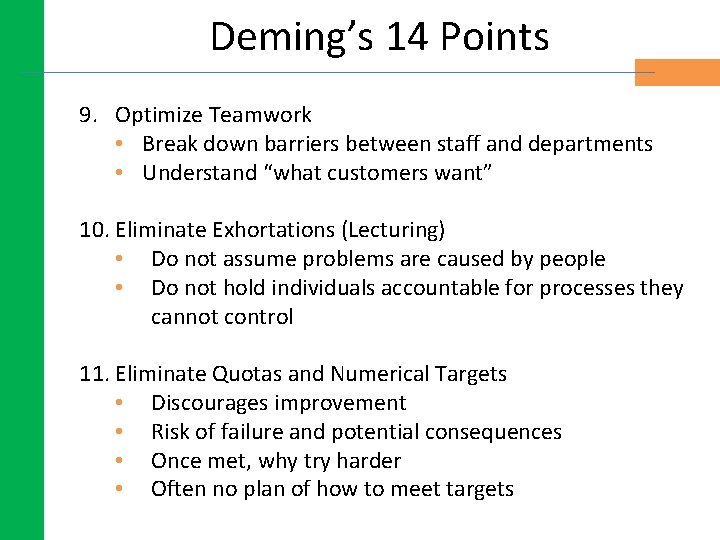
Deming’s 14 Points 9. Optimize Teamwork • Break down barriers between staff and departments • Understand “what customers want” 10. Eliminate Exhortations (Lecturing) • Do not assume problems are caused by people • Do not hold individuals accountable for processes they cannot control 11. Eliminate Quotas and Numerical Targets • Discourages improvement • Risk of failure and potential consequences • Once met, why try harder • Often no plan of how to meet targets
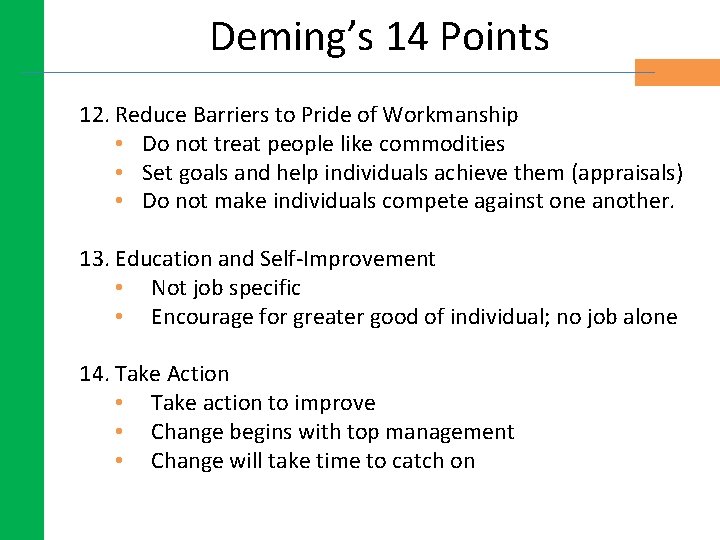
Deming’s 14 Points 12. Reduce Barriers to Pride of Workmanship • Do not treat people like commodities • Set goals and help individuals achieve them (appraisals) • Do not make individuals compete against one another. 13. Education and Self-Improvement • Not job specific • Encourage for greater good of individual; no job alone 14. Take Action • Take action to improve • Change begins with top management • Change will take time to catch on
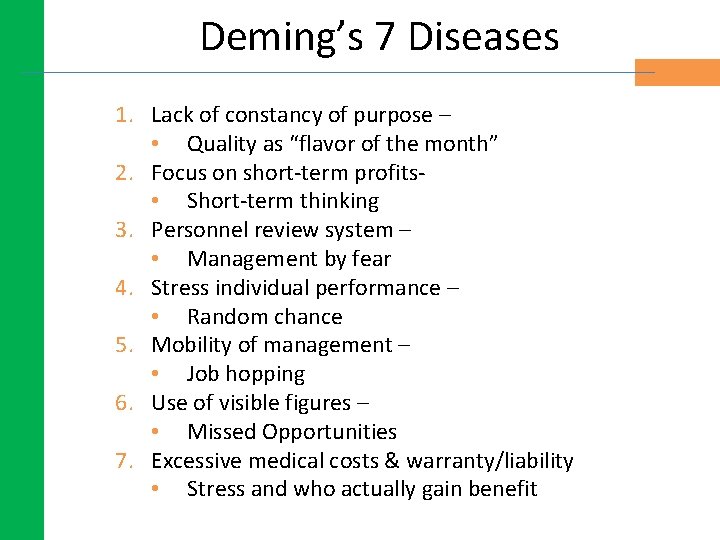
Deming’s 7 Diseases 1. Lack of constancy of purpose – • Quality as “flavor of the month” 2. Focus on short-term profits • Short-term thinking 3. Personnel review system – • Management by fear 4. Stress individual performance – • Random chance 5. Mobility of management – • Job hopping 6. Use of visible figures – • Missed Opportunities 7. Excessive medical costs & warranty/liability • Stress and who actually gain benefit
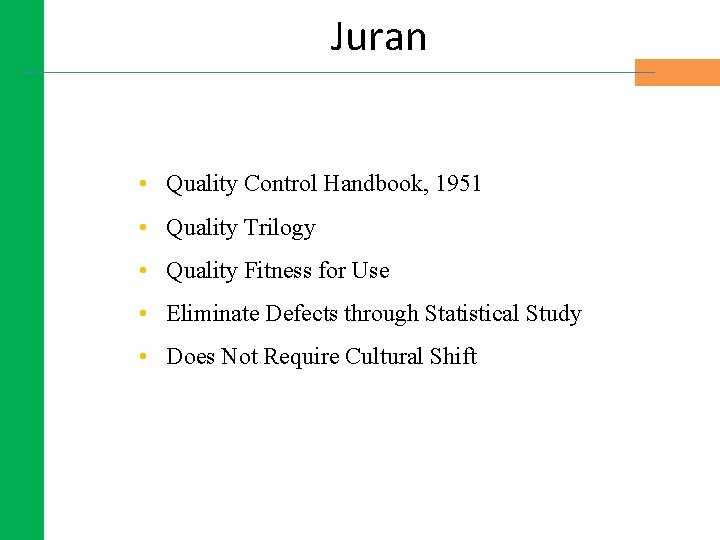
Juran • Quality Control Handbook, 1951 • Quality Trilogy 1904 - 2008 • Quality Fitness for Use • Eliminate Defects through Statistical Study • Does Not Require Cultural Shift
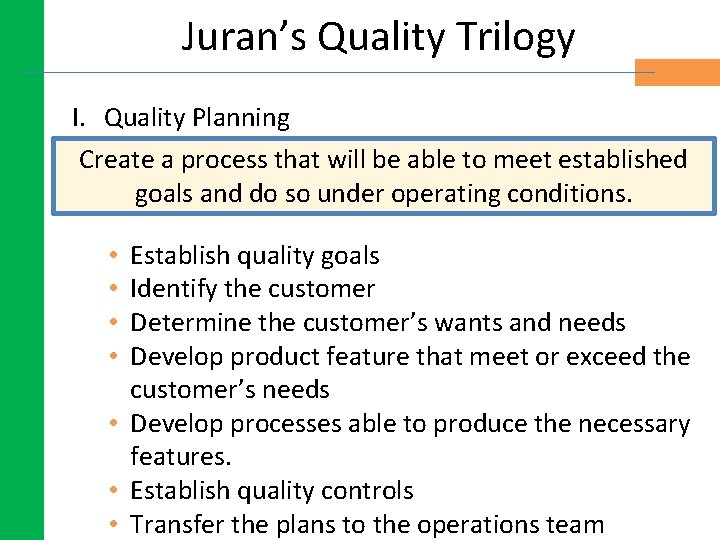
Juran’s Quality Trilogy I. Quality Planning Create a process that will be able to meet established goals and do so under operating conditions. Establish quality goals Identify the customer Determine the customer’s wants and needs Develop product feature that meet or exceed the customer’s needs • Develop processes able to produce the necessary features. • Establish quality controls • Transfer the plans to the operations team • •
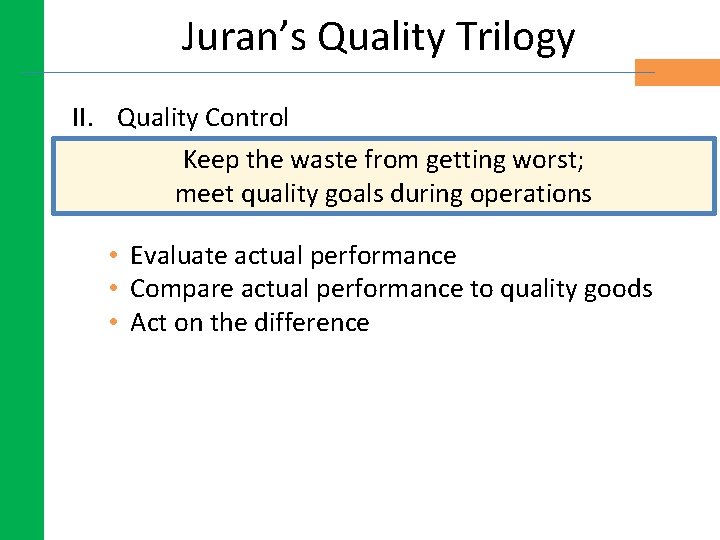
Juran’s Quality Trilogy II. Quality Control Keep the waste from getting worst; meet quality goals during operations • Evaluate actual performance • Compare actual performance to quality goods • Act on the difference
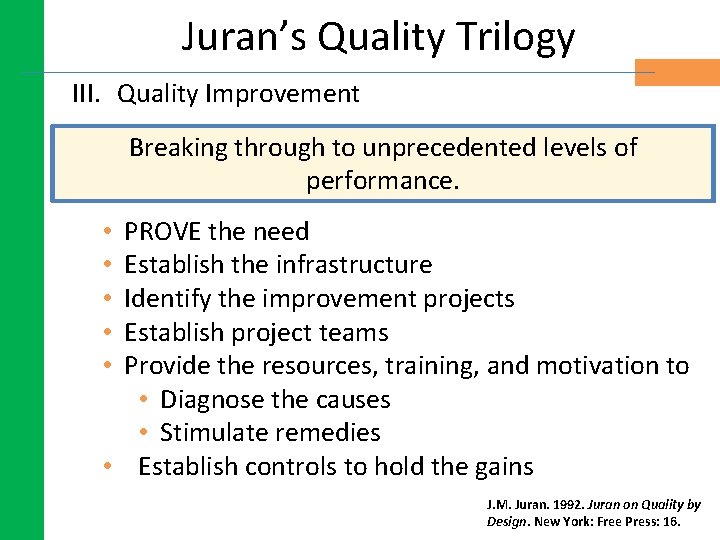
Juran’s Quality Trilogy III. Quality Improvement Breaking through to unprecedented levels of performance. PROVE the need Establish the infrastructure Identify the improvement projects Establish project teams Provide the resources, training, and motivation to • Diagnose the causes • Stimulate remedies • Establish controls to hold the gains • • • J. M. Juran. 1992. Juran on Quality by Design. New York: Free Press: 16.
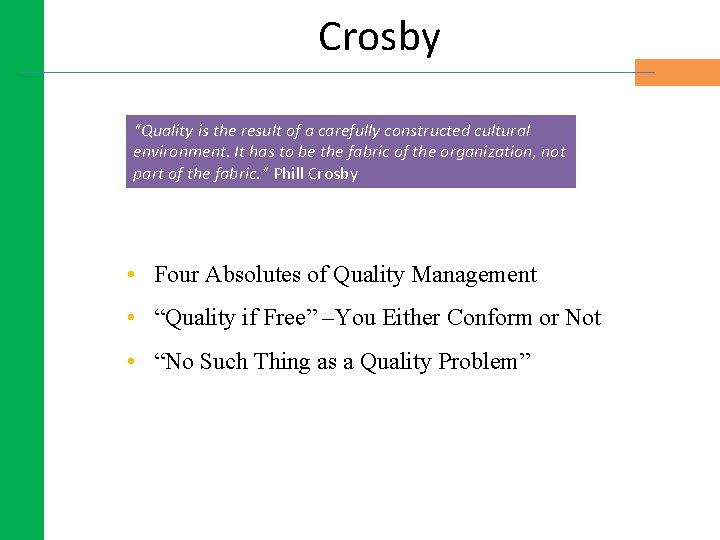
Crosby “Quality is the result of a carefully constructed cultural environment. It has to be the fabric of the organization, not part of the fabric. ” Phill Crosby 1926 - 2001 • Four Absolutes of Quality Management • “Quality if Free” –You Either Conform or Not • “No Such Thing as a Quality Problem”
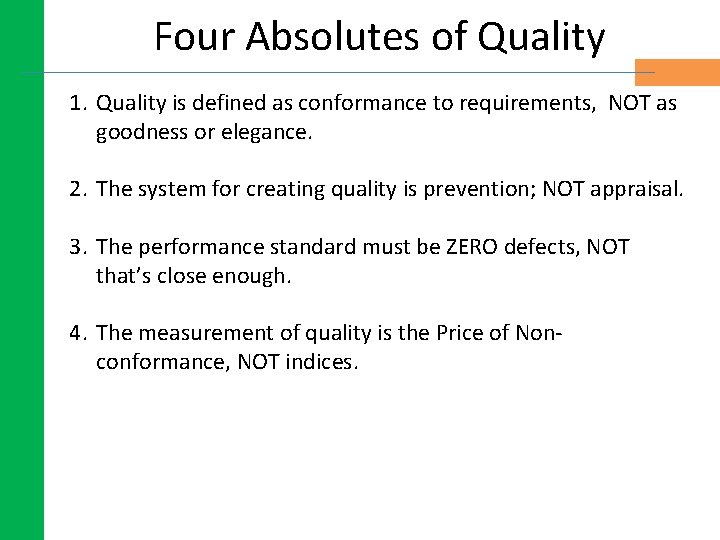
Four Absolutes of Quality 1. Quality is defined as conformance to requirements, NOT as goodness or elegance. 2. The system for creating quality is prevention; NOT appraisal. 3. The performance standard must be ZERO defects, NOT that’s close enough. 4. The measurement of quality is the Price of Nonconformance, NOT indices.
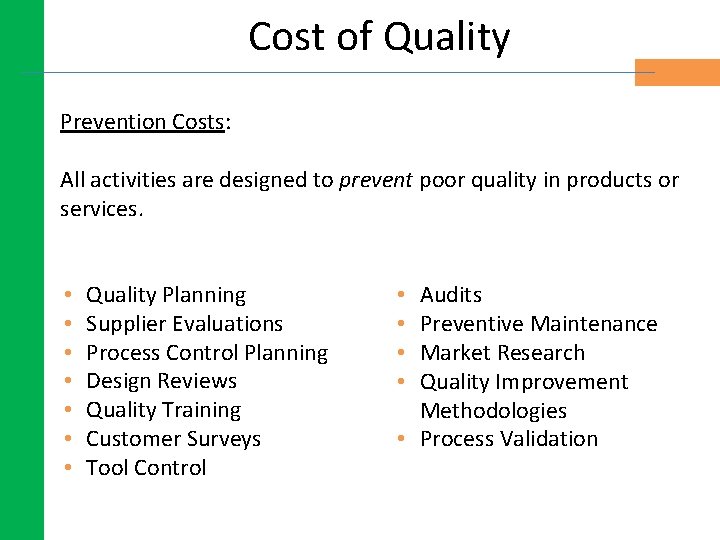
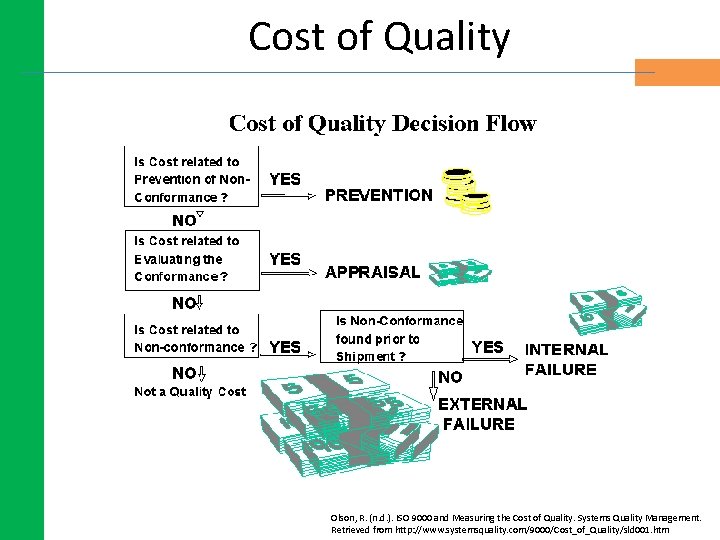
Cost of Quality Prevention Costs: All activities are designed to prevent poor quality in products or services. • • Quality Planning Supplier Evaluations Process Control Planning Design Reviews Quality Training Customer Surveys Tool Control Audits Preventive Maintenance Market Research Quality Improvement Methodologies • Process Validation • •
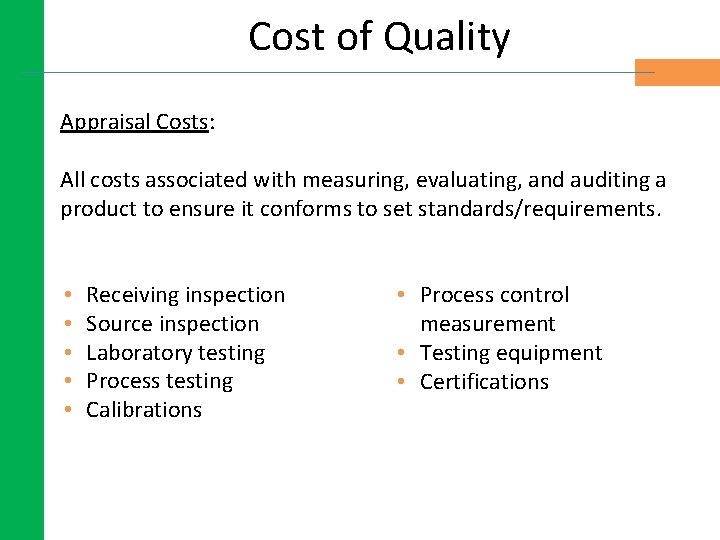
Cost of Quality Appraisal Costs: All costs associated with measuring, evaluating, and auditing a product to ensure it conforms to set standards/requirements. • • • Receiving inspection Source inspection Laboratory testing Process testing Calibrations • Process control measurement • Testing equipment • Certifications
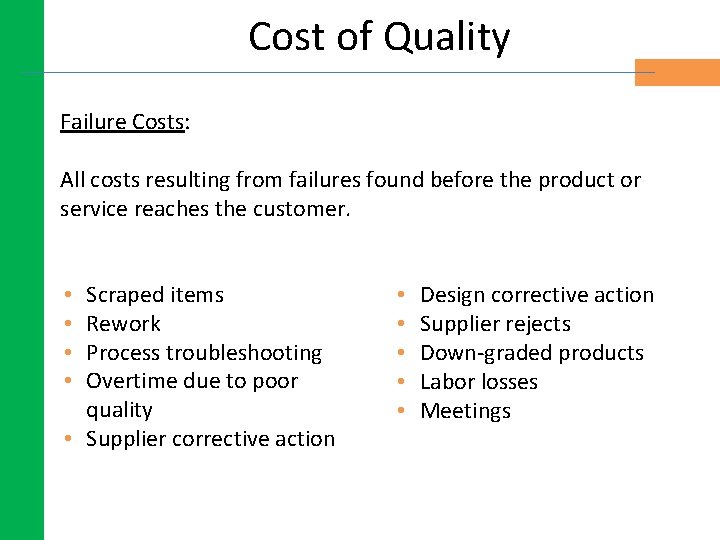
Cost of Quality Failure Costs: All costs resulting from failures found before the product or service reaches the customer. Scraped items Rework Process troubleshooting Overtime due to poor quality • Supplier corrective action • • • Design corrective action Supplier rejects Down-graded products Labor losses Meetings
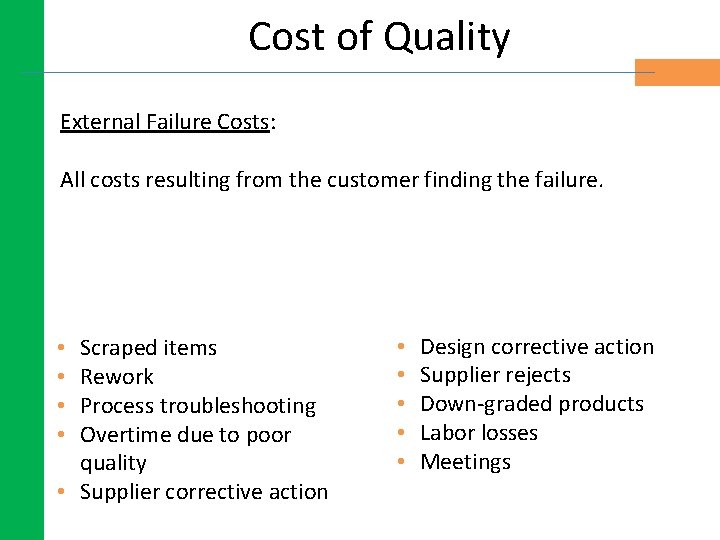
Cost of Quality External Failure Costs: All costs resulting from the customer finding the failure. Scraped items Rework Process troubleshooting Overtime due to poor quality • Supplier corrective action • • • Design corrective action Supplier rejects Down-graded products Labor losses Meetings
Cost of Quality Olson, R. (n. d. ). ISO 9000 and Measuring the Cost of Quality. Systems Quality Management. Retrieved from http: //www. systemsquality. com/9000/Cost_of_Quality/sld 001. htm
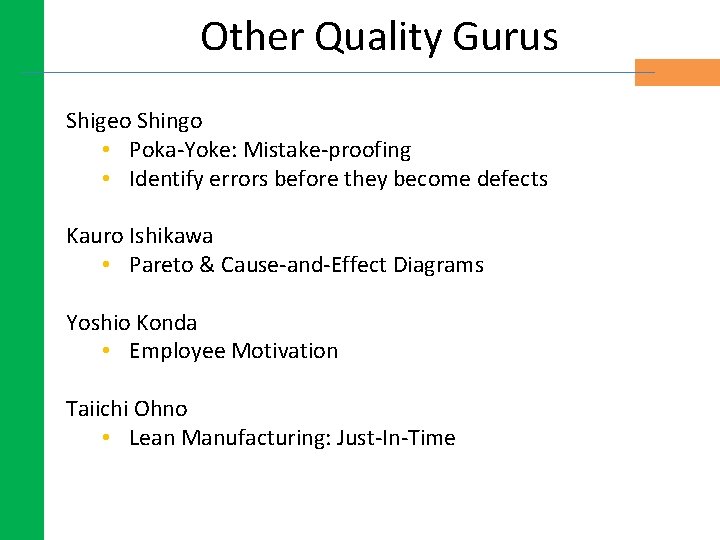
Other Quality Gurus Shigeo Shingo • Poka-Yoke: Mistake-proofing • Identify errors before they become defects Kauro Ishikawa • Pareto & Cause-and-Effect Diagrams Yoshio Konda • Employee Motivation Taiichi Ohno • Lean Manufacturing: Just-In-Time
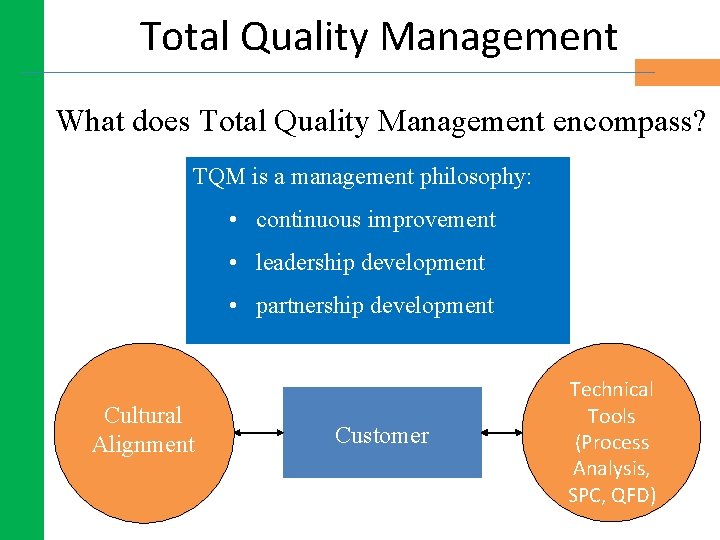
Total Quality Management What does Total Quality Management encompass? TQM is a management philosophy: • continuous improvement • leadership development • partnership development Cultural Alignment Customer Technical Tools (Process Analysis, SPC, QFD)
The End
Resources 1. J. M. Juran. 1992. Juran on Quality by Design. New York: Free Press: 16. 2. Olson, R. (n. d. ). ISO 9000 and Measuring the Cost of Quality. Systems Quality Management. Retrieved from http: //www. systemsquality. com/9000/Cost_of_Quality/sld 001. htm 3. ASQ (n. d. ). W. Edwards Deming’s 14 Points for Total Quality Management. Retrieved from http: //asq. org/learn-about-quality/total-quality-management/overview/deming-points. html 4. Osgood, Ashley (2012). Quality Management 2. 0: Deming’s 7 Deadly Diseases of Management. Retrieved from http: //www. qualitymag. com/articles/88324 -quality-management-2 -0 -deming-s-7 -deadly-diseasesof-management. 5. Hamby, Robert (2013). The Four Absolutes of Quality Management. Retrieved from https: //buildingqualityfirst. com/2013/06/20/the-four-absolutes-of-quality-management/.
Resources 6. Grant Statement This document was developed as part of Trade Adjustment Assistance Community College and Career Training (TAACCCT) Grant Program Round 2 Grant, Innovations Moving People to Achieve Certified Training (IMPACT): TC 23752 -12 -60 -A-31. Unless otherwise noted, this work by the Project IMPACT Nebraska Community College Consortium is licensed under the Creative Commons Attribution 4. 0 International License. To view a copy of this license, visit Creative. Commons. org or http: //creativecommons. org/licenses/by/4. 0/. This product was funded partial or in full by a grant awarded by the U. S. Department of Labor’s Employment and Training Administration. The product was created by the grantee and does not necessarily reflect the official position of the U. S. Department of Labor. The Department of Labor makes no guarantees, warranties, or assurances of any kind, express or implied, with respect to such information, including any information on linked sites and including, but not limited to, accuracy of the information or its completeness, timeliness, usefulness, adequacy, continued availability, or ownership.