
Introduction to Quality and Metrology Quality in MANUFACTURING

- Slides: 30
Introduction to Quality and Metrology
Quality in MANUFACTURING • Defined as product and/or service features that meet or exceed customer expectations. • Acceptable limits determined by customer requirements and company strategy. • Variability in manufacturing processes affects product quality. • Quantitative methods are used to collect data that measures quality. • Statistical methods are used to characterize process variability and help to identify sources.
Internal Quality Departments • Quality Control (QC) identifies and responds to nonconformities, such as defects. • Quality Assurance (QA) is responsible for planning, developing, and documenting processes that optimize pursuit of quality objectives.
External Quality Organizations • Regulatory: Government organizations with legal oversight of industry (e. g. FDA) • Independent: Organizations providing external review of industry processes (e. g. International Organization for Standardization (ISO)). • Trade: Organizations supported by industry representing common interests and processes (e. g. American Society for Quality (ASQ))
American Society for Quality (ASQ)) • www. asq. org • Serves as resource for all industries and organizations addressing Quality. • Provides training and certifications, including Body of Knowledge required for certifications.
Quality in MANUFACTURING • Quality is an important component of cost of goods sold. • Tracked through multiple measures. • Lack of quality can lead to product and company failure.
Cost of Quality • Internal Failure Costs: costs of defects prior to sale (e. g. nonrepairable scrap, poor supply) • External Failure Costs: costs after sale (e. g. warranty charges, complaint adjustments, cost to return material, reduced price) • Appraisal Costs: Expenditures related to determine conformance to product requirements (e. g. incoming, inprocess, and final inspection and testing, quality audits, calibration of instruments and measuring devices). • Prevention Costs: Costs of quality and process planning, process control, supplier evaluation, training.
Total Quality Management (TQM) • Management approach to long–term success through customer satisfaction. • All members of an organization participate in improving processes, products, services, and the culture in which they work. • Continuous Improvement is fundamental
Six Sigma Processes • Statistical based approach to reducing defects and reducing variability • Component of corporate approach to Quality • DMAIC – Define process or service to be improved – Measure the process to determine baseline – Analyze data to determine sources of error and variation – Improve the process – Control process to ensure errors do not return.
Total Quality Management (TQM) • Customer-focused: The customer ultimately determines the level of quality. • Total employee involvement. All employees participate in working toward common goals. • Process-centered. Steps required to carry out a process are defined, and performance measures are continuously monitored in order to detect unexpected variation.
Total Quality Management (TQM) • Integrated system. – Micro-processes add up to larger processes, and all processes aggregate into the business processes required for defining and implementing strategy. – An integrated system may be modeled after the Baldrige National Quality Program criteria and/or incorporate the ISO 9000 standards. – Every organization has a unique work culture, and it is virtually impossible to achieve excellence in its products and services unless a good quality culture has been fostered.
Total Quality Management (TQM) • Strategic and systematic approach. Formulation of a strategic plan that integrates quality as a core component. • Continual improvement drives an organization to be both analytical and creative in finding ways to become more competitive and more effective.
Total Quality Management (TQM) • Fact-based decision making. TQM requires that an organization continually collect and analyze data in order to improve decision making accuracy, achieve consensus, and allow prediction based on past history. • Communications Effective communications plays a large part in maintaining morale and in motivating employees at all levels.
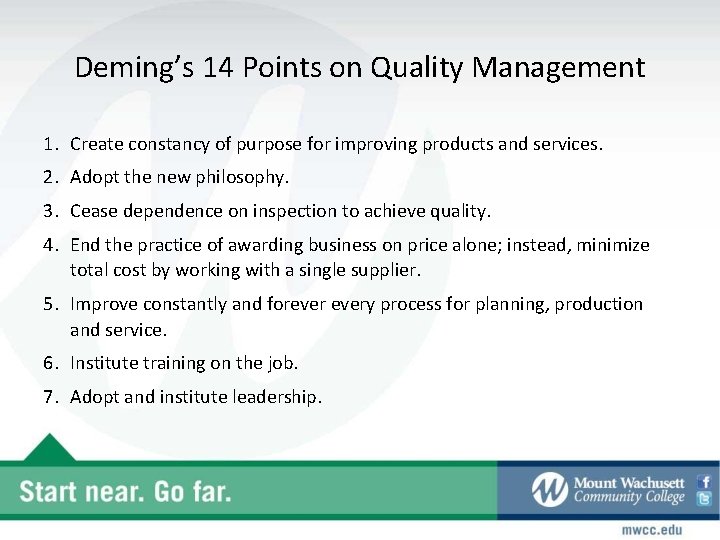
Deming’s 14 Points on Quality Management 1. Create constancy of purpose for improving products and services. 2. Adopt the new philosophy. 3. Cease dependence on inspection to achieve quality. 4. End the practice of awarding business on price alone; instead, minimize total cost by working with a single supplier. 5. Improve constantly and forevery process for planning, production and service. 6. Institute training on the job. 7. Adopt and institute leadership.
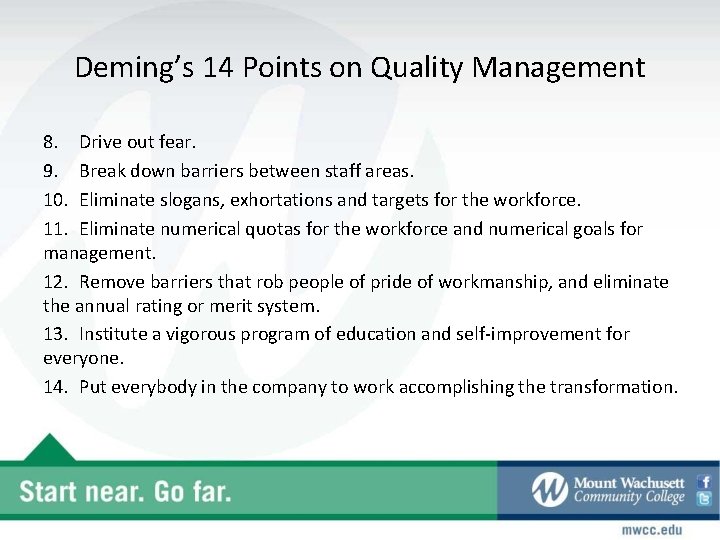
Deming’s 14 Points on Quality Management 8. Drive out fear. 9. Break down barriers between staff areas. 10. Eliminate slogans, exhortations and targets for the workforce. 11. Eliminate numerical quotas for the workforce and numerical goals for management. 12. Remove barriers that rob people of pride of workmanship, and eliminate the annual rating or merit system. 13. Institute a vigorous program of education and self-improvement for everyone. 14. Put everybody in the company to work accomplishing the transformation.
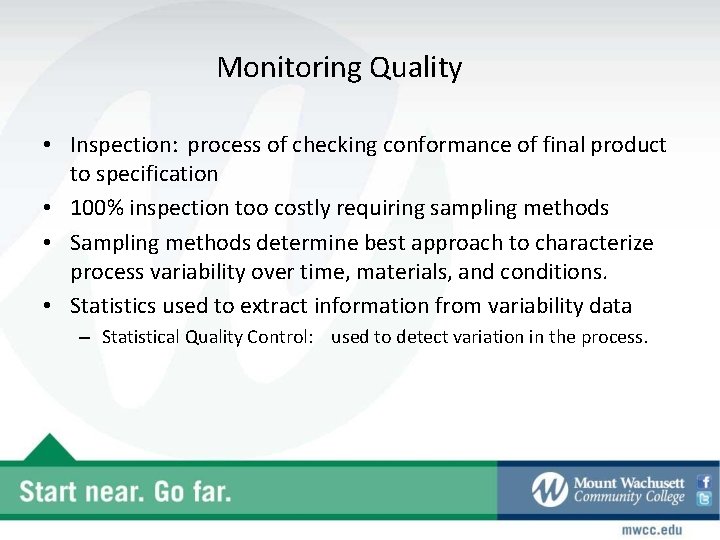
Monitoring Quality • Inspection: process of checking conformance of final product to specification • 100% inspection too costly requiring sampling methods • Sampling methods determine best approach to characterize process variability over time, materials, and conditions. • Statistics used to extract information from variability data – Statistical Quality Control: used to detect variation in the process.
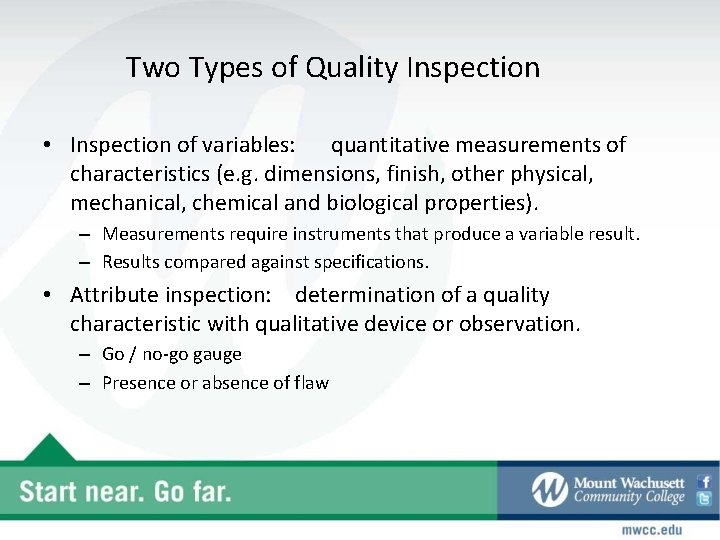
Two Types of Quality Inspection • Inspection of variables: quantitative measurements of characteristics (e. g. dimensions, finish, other physical, mechanical, chemical and biological properties). – Measurements require instruments that produce a variable result. – Results compared against specifications. • Attribute inspection: determination of a quality characteristic with qualitative device or observation. – Go / no-go gauge – Presence or absence of flaw
Statistical Methods • Statistical methods used to analyze data and to evaluate variability. • Sources of Variability: – Natural variability : inherent, uncontrolled changes that occur randomly with no pattern or trend. – Assignable variability: can be traced to a specific cause • Statistical Quality Control (SQC): intended to distinguish between natural and assignable variability and to improve process control. • Statistical Process Control (SPC): Evaluation of process data over time, utilizes control charts.
Statistical Parameters • Normal Distribution: “Bell-shaped” plot of frequency versus measured value resulting when entire population sampled. • Mean: average value of measurements, calculated by summing all measurements and dividing by number of measurements. • Median: Middle observation in a group of measurements ordered by magnitude. • Dispersion: Measure of spread of measurement values. – Range: Minimum value subtracted from Maximum value – Standard Deviation: calculated by summing squares of individual values compared to mean, divided by the (number of measurements – 1) and taking the square root.
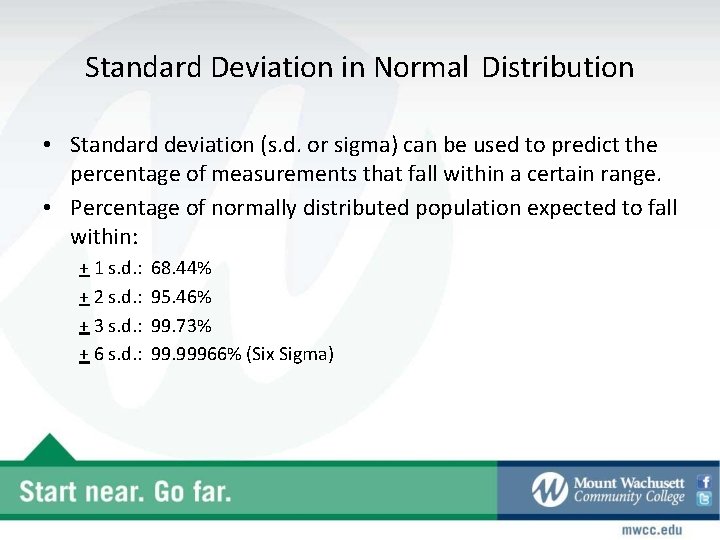
Standard Deviation in Normal Distribution • Standard deviation (s. d. or sigma) can be used to predict the percentage of measurements that fall within a certain range. • Percentage of normally distributed population expected to fall within: + 1 s. d. : + 2 s. d. : + 3 s. d. : + 6 s. d. : 68. 44% 95. 46% 99. 73% 99. 99966% (Six Sigma)
Control Charts • SPC uses control charts to plot quality characteristic with respect to time. • Control charts may be based on individual measurements, averages or medians and ranges or standard deviations plotted versus time. • Control limits set based on historical data and acceptance limits. • Evaluation of control charts can lead to determination of process offsets and/or “out-of-control” processes.
ASQ Certified Quality Inspector • Must know basic quality terms, definitions and concepts. • Must know basic statistical terms and techniques, how to plot data and how to recognize out-of-control conditions. • Must understand types of measurement, measurement terminology and the different types of measurement scales. • Must know the difference between accuracy and precision and be able to select the appropriate measuring tools and techniques. • Must know how to measure using surface plate layouts. • Must be able to identify/recognize inspection errors and initiate resolution. • Must have basic calibration knowledge.
ASQ Certified Quality Inspector • Must be able to read and interpret blueprints and know definitions of critical, major and minor characteristics. • Must have a general knowledge of ASME Y 14. 5 M, working knowledge of GD&T, and must understand the x, y, z coordinate system. • Must be able to use inspection planning tools and perform a product audit; determine sample size for lots; pull random samples. • Must have knowledge of testing methods. • Must be able to identify and report nonconforming material. • Must understand traceability (product, material and calibration). • Must have a strong knowledge of basic mathematical operations and perform measurement conversions; be able to solve for x; add and subtract degrees, minutes, and seconds.
Introduction to Metrology is the science of measurement. • Scientific metrology concerns the establishment of measurement units and systems, the development of new measurement methods and standards and the transfer of traceability from these standards to users. • Applied or industrial metrology concerns the application of measurement science to manufacturing and other processes, incorporating measurement instruments, their calibration and quality of measurements. • Legal metrology concerns regulatory requirements of measurements and measuring instruments for the protection of health, public safety, the environment, enabling taxation, protection of consumers and fair trade.
Introduction to Metrology The Metrology Department is responsible for keeping measurement tools in properating condition. • Preventative Maintenance: Schedule for each measurement tool is maintained and followed. • Calibration: Most measurement tools require calibration, frequently to traceable standard reference material. • Updating Equipment: New analytical tools require validation and development of Standard Operating Procedures prior to implementation.
Metrology Parameters 1. Accuracy is the degree of exactness which the final product corresponds to the measurement standard. 2. Precision refers to the degree of exactness which a measuring instrument can determine accuracy. 3. Reliability refers to the consistency of accurate results over consecutive measurements. 4. Traceability refers to the ongoing validations that the measurement of the final product conforms to the original standard of measurement.
Calibration • Calibration is the process of adjusting the output or indication on a measurement instrument to agree with value of the applied standard, within a specified accuracy. • Calibration frequently requires use of traceable standard material, often referenced to National Institute of Standards and Technology. • Calibration generally determined at multiple points to ensure accuracy of results. • Standards may be prepared or a result from a second device.
Calibration • All measurement tools exhibit a specific response function when exposed to constituent being measured. • Response changes as a result in change in the amount of constituent. • Response to standard reference enables setting offset and slope of instrument response to optimize accuracy of measurement within defined range. • Calibration resets measurement tool to compensate for drift and other changes in response function over time.
Calibration Technician • • Job Summary: Perform routine calibration and preventive maintenance of company and customer equipment. Calibration may include temperature, relative humidity, CO 2, voltage, pressure, time, rotation, etc. following documented procedures using precision standards. Calibration and PM will be performed in-house and at customer sites. Create, modify and execute calibration procedures and calibration certificates. Perform testing to support the quality management system and report, troubleshoot and make recommendations about quality issues relating to calibration. Assist in filing, data entry and general record keeping.
Calibration Technician Duties/Responsibilities: • • • Attention to detail and accuracy are essential Pre-requisite to performing calibration procedures: signed off on General Calibration work instruction and Measurement & Test Equipment work instruction Perform equipment and instrumentation calibration Proficient in specific calibration procedures Perform preventive maintenance and repair equipment and instrumentation Understand interval and tolerance relating to calibration Update the calibration database/equipment history Report questionable calibration results to supervisor for evaluation and determination Abide by ISO 17025 principles and NVLAP principles Maintain good housekeeping practices All other duties as assigned by supervisor