
Introduction to Python III CIS 391 Artificial Intelligence
- Slides: 51
Introduction to Python III CIS 391: Artificial Intelligence Fall, 2008 CIS 391 - Intro to AI
Importing and Modules CIS 391 - Intro to AI
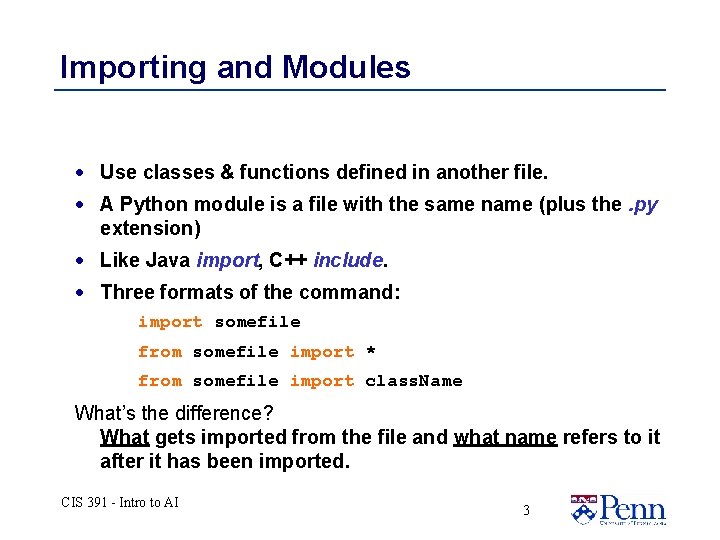
Importing and Modules · Use classes & functions defined in another file. · A Python module is a file with the same name (plus the. py extension) · Like Java import, C++ include. · Three formats of the command: import somefile from somefile import * from somefile import class. Name What’s the difference? What gets imported from the file and what name refers to it after it has been imported. CIS 391 - Intro to AI 3
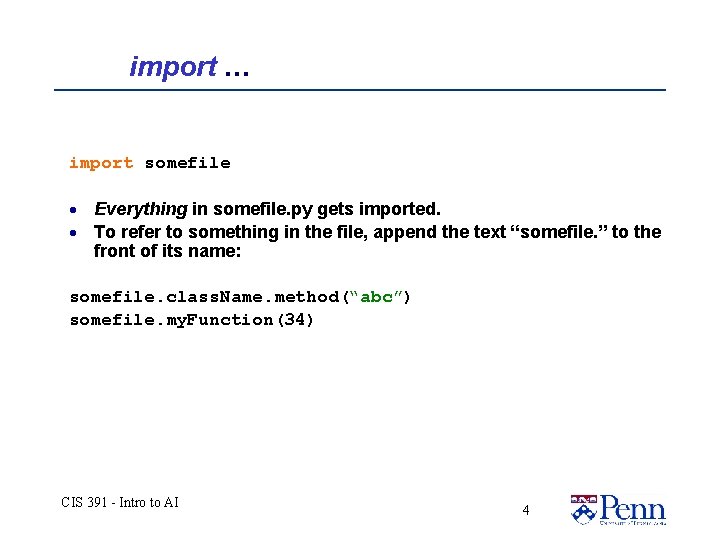
import … import somefile · Everything in somefile. py gets imported. · To refer to something in the file, append the text “somefile. ” to the front of its name: somefile. class. Name. method(“abc”) somefile. my. Function(34) CIS 391 - Intro to AI 4
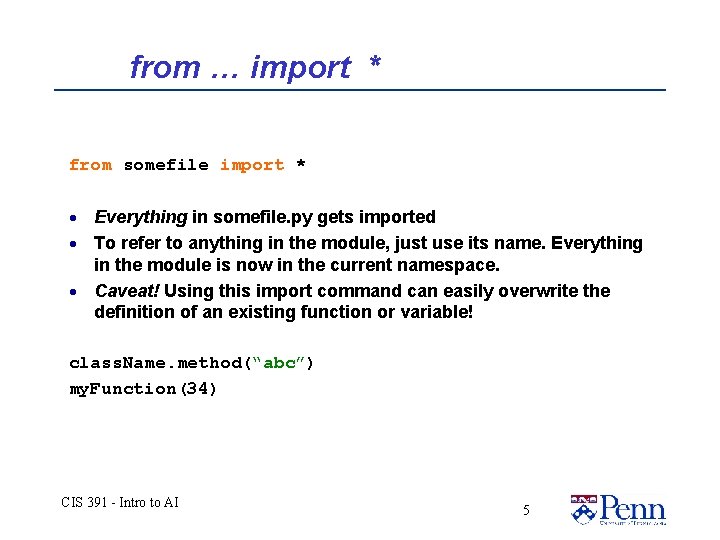
from … import * from somefile import * · Everything in somefile. py gets imported · To refer to anything in the module, just use its name. Everything in the module is now in the current namespace. · Caveat! Using this import command can easily overwrite the definition of an existing function or variable! class. Name. method(“abc”) my. Function(34) CIS 391 - Intro to AI 5
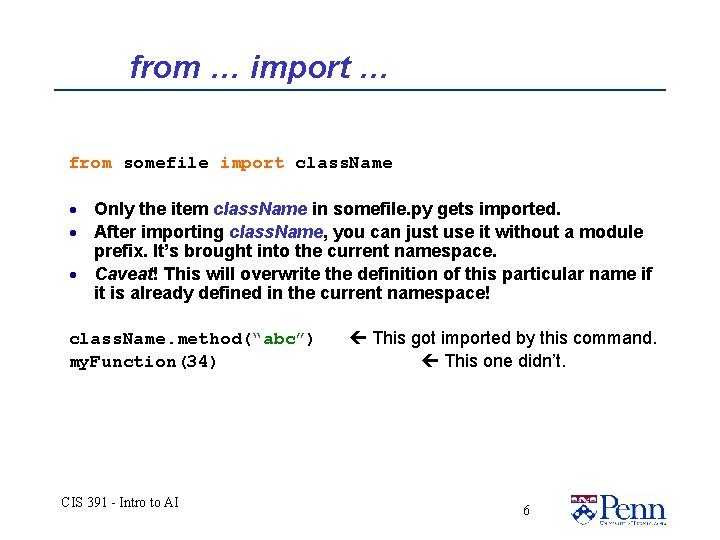
from … import … from somefile import class. Name · Only the item class. Name in somefile. py gets imported. · After importing class. Name, you can just use it without a module prefix. It’s brought into the current namespace. · Caveat! This will overwrite the definition of this particular name if it is already defined in the current namespace! class. Name. method(“abc”) my. Function(34) CIS 391 - Intro to AI This got imported by this command. This one didn’t. 6
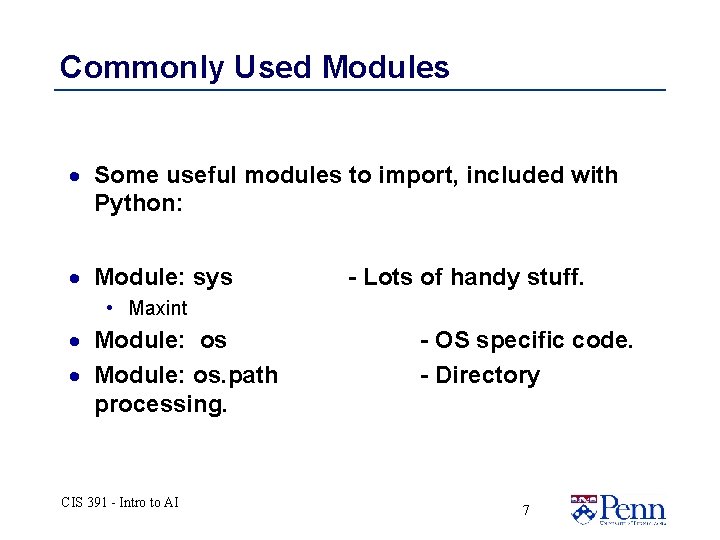
Commonly Used Modules · Some useful modules to import, included with Python: · Module: sys - Lots of handy stuff. • Maxint · Module: os. path processing. CIS 391 - Intro to AI - OS specific code. - Directory 7
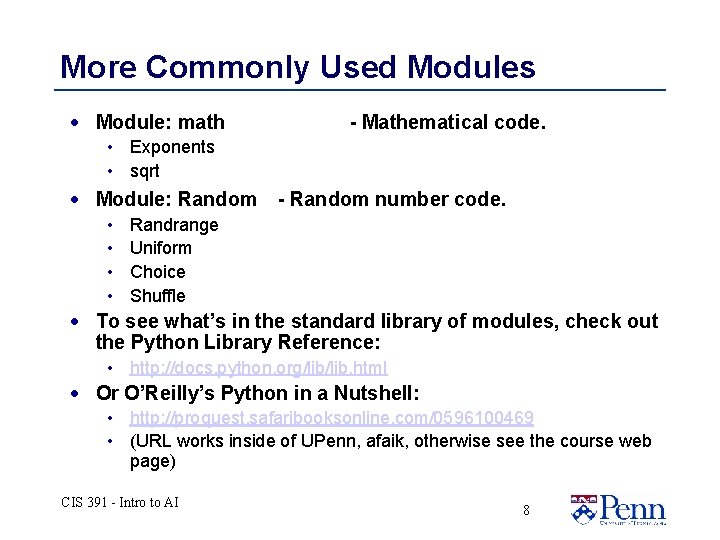
More Commonly Used Modules · Module: math - Mathematical code. • Exponents • sqrt · Module: Random - Random number code. • • Randrange Uniform Choice Shuffle · To see what’s in the standard library of modules, check out the Python Library Reference: • http: //docs. python. org/lib. html · Or O’Reilly’s Python in a Nutshell: • http: //proquest. safaribooksonline. com/0596100469 • (URL works inside of UPenn, afaik, otherwise see the course web page) CIS 391 - Intro to AI 8
Defining your own modules ● ● ● You can save your own code files (modules) and import them into Python. You can import any of the modules from the AI textbook containing search algorithms or other useful code. Useful for future homework! CIS 391 - Intro to AI 9
Directories for module files Where does Python look for module files? · The list of directories in which Python will look for the files to be imported: sys. path (Variable named ‘path’ stored inside the ‘sys’ module. ) · To add a directory of your own to this list, append it to this list. sys. path. append(‘/my/new/path’) CIS 391 - Intro to AI 10
Object Oriented Programming in Python: Defining Classes CIS 391 - Intro to AI
It’s all objects… · Everything in Python is really an object. • We’ve seen hints of this already… “hello”. upper() list 3. append(‘a’) dict 2. keys() • These look like Java or C++ method calls. • New object classes can easily be defined in addition to these built-in data-types. · In fact, programming in Python is typically done in an object oriented fashion. CIS 391 - Intro to AI 12
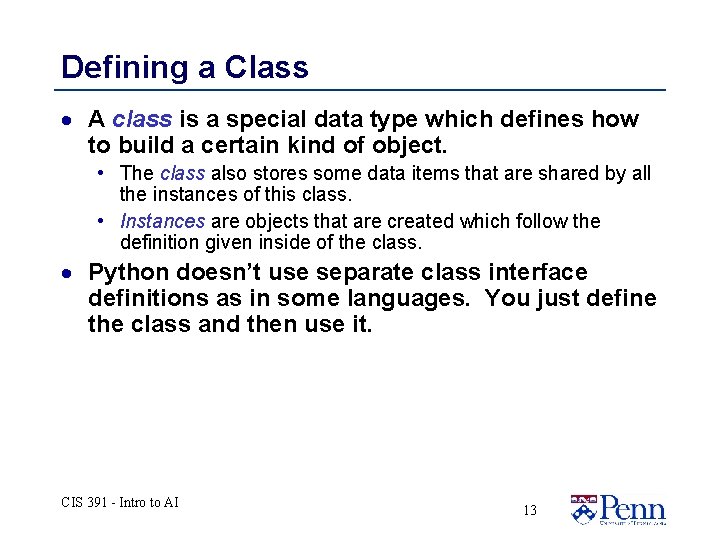
Defining a Class · A class is a special data type which defines how to build a certain kind of object. • The class also stores some data items that are shared by all the instances of this class. • Instances are objects that are created which follow the definition given inside of the class. · Python doesn’t use separate class interface definitions as in some languages. You just define the class and then use it. CIS 391 - Intro to AI 13
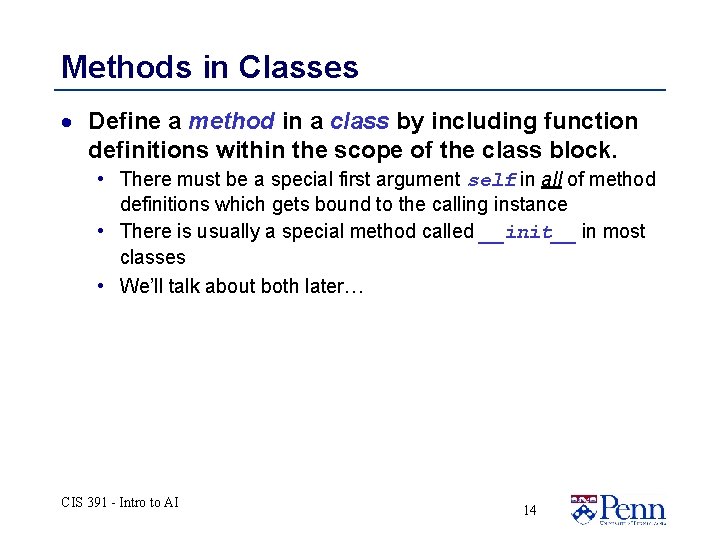
Methods in Classes · Define a method in a class by including function definitions within the scope of the class block. • There must be a special first argument self in all of method definitions which gets bound to the calling instance • There is usually a special method called __init__ in most classes • We’ll talk about both later… CIS 391 - Intro to AI 14
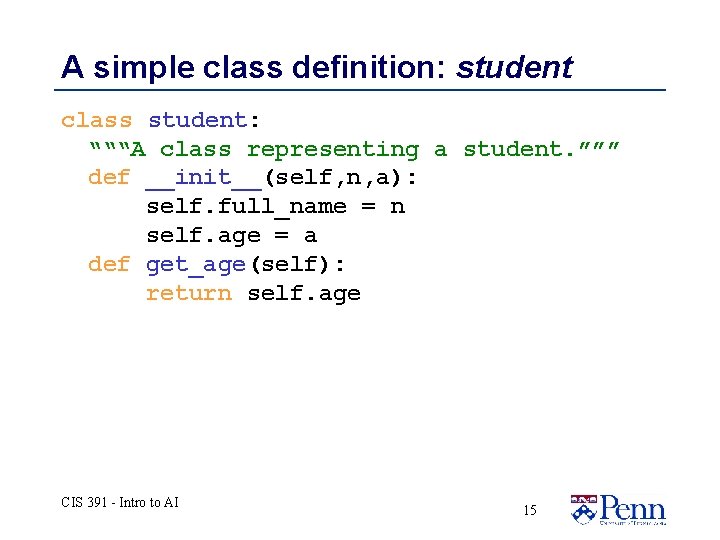
A simple class definition: student class student: “““A class representing a student. ””” def __init__(self, n, a): self. full_name = n self. age = a def get_age(self): return self. age CIS 391 - Intro to AI 15
Creating and Deleting Instances CIS 391 - Intro to AI
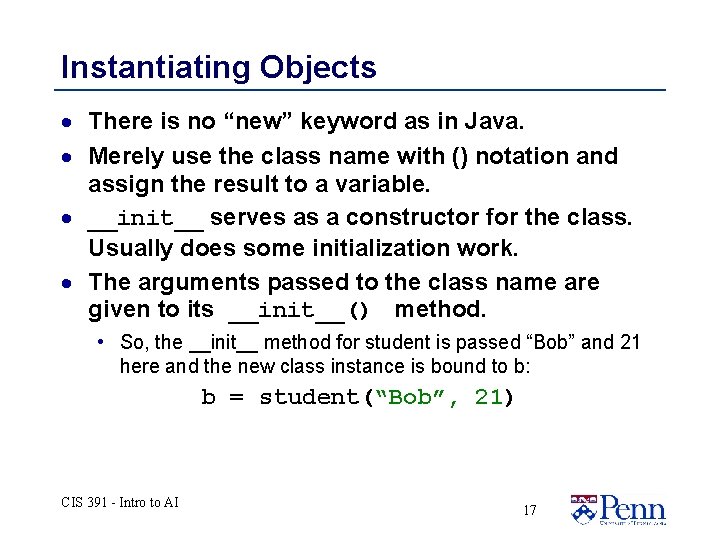
Instantiating Objects · There is no “new” keyword as in Java. · Merely use the class name with () notation and assign the result to a variable. · __init__ serves as a constructor for the class. Usually does some initialization work. · The arguments passed to the class name are given to its __init__() method. • So, the __init__ method for student is passed “Bob” and 21 here and the new class instance is bound to b: b = student(“Bob”, 21) CIS 391 - Intro to AI 17
Constructor: __init__ · An __init__ method can take any number of arguments. • Like other functions or methods, the arguments can be defined with default values, making them optional to the caller. · However, the first argument self in the definition of __init__ is special… CIS 391 - Intro to AI 18
Self · The first argument of every method is a reference to the current instance of the class. • By convention, we name this argument self. · In __init__, self refers to the object currently being created; so, in other class methods, it refers to the instance whose method was called. • Similar to the keyword this in Java or C++. • But Python uses self more often than Java uses this. CIS 391 - Intro to AI 19
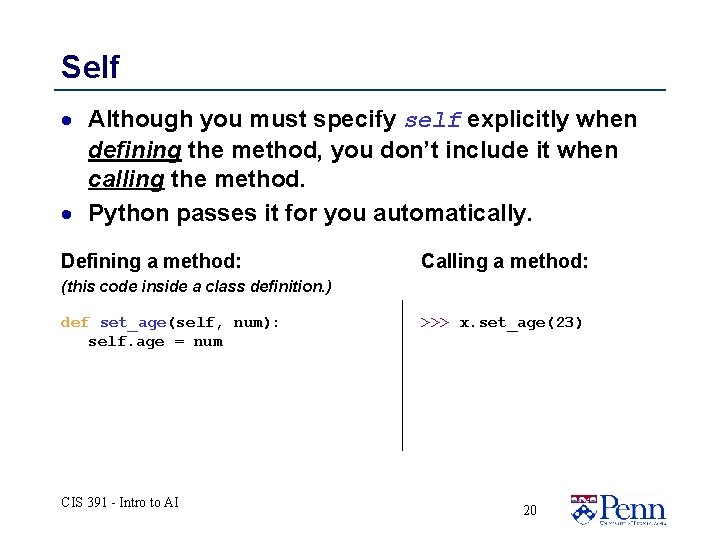
Self · Although you must specify self explicitly when defining the method, you don’t include it when calling the method. · Python passes it for you automatically. Defining a method: Calling a method: (this code inside a class definition. ) def set_age(self, num): self. age = num CIS 391 - Intro to AI >>> x. set_age(23) 20
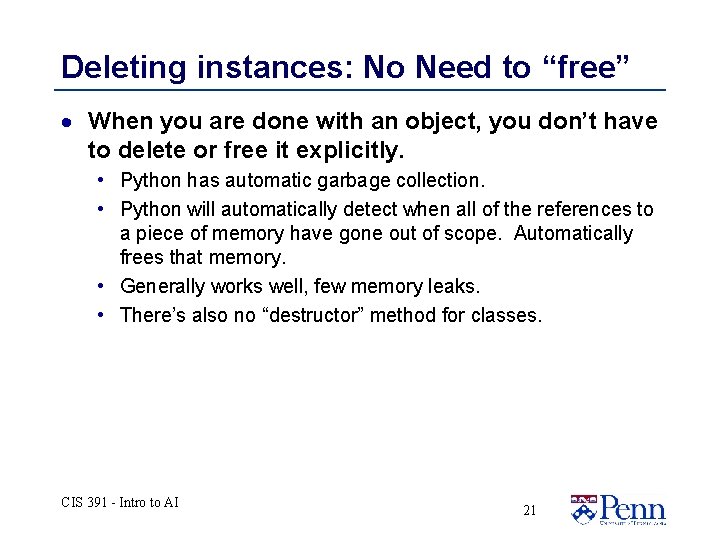
Deleting instances: No Need to “free” · When you are done with an object, you don’t have to delete or free it explicitly. • Python has automatic garbage collection. • Python will automatically detect when all of the references to a piece of memory have gone out of scope. Automatically frees that memory. • Generally works well, few memory leaks. • There’s also no “destructor” method for classes. CIS 391 - Intro to AI 21
Access to Attributes and Methods CIS 391 - Intro to AI
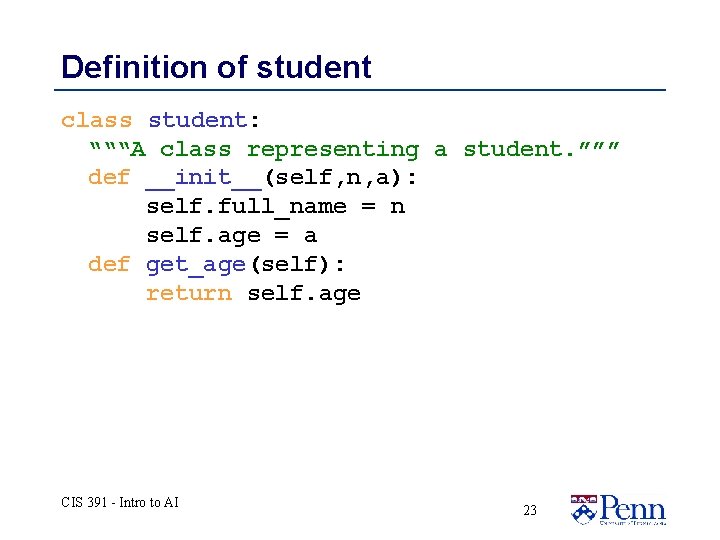
Definition of student class student: “““A class representing a student. ””” def __init__(self, n, a): self. full_name = n self. age = a def get_age(self): return self. age CIS 391 - Intro to AI 23
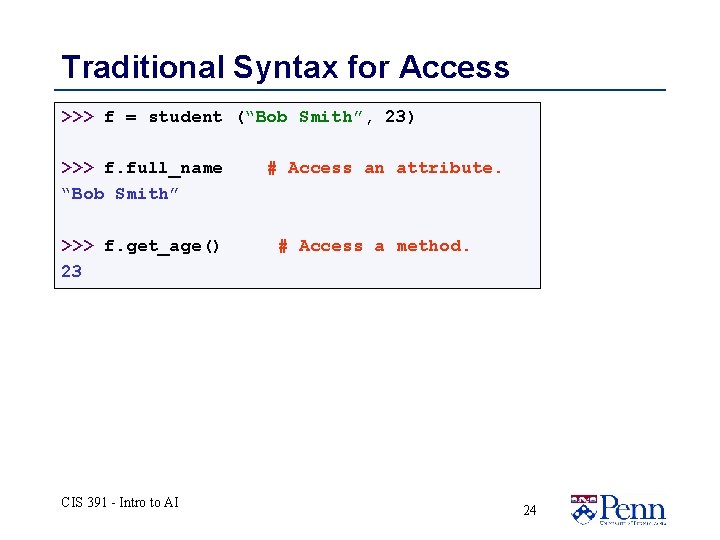
Traditional Syntax for Access >>> f = student (“Bob Smith”, 23) >>> f. full_name “Bob Smith” >>> f. get_age() 23 CIS 391 - Intro to AI # Access an attribute. # Access a method. 24
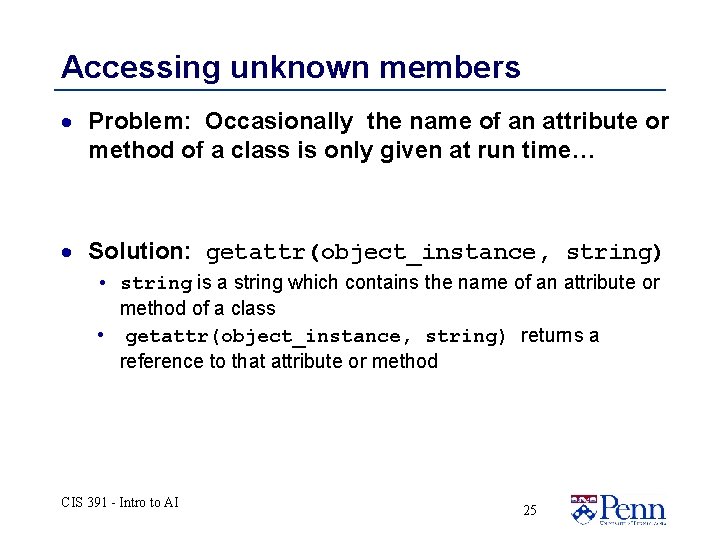
Accessing unknown members · Problem: Occasionally the name of an attribute or method of a class is only given at run time… · Solution: getattr(object_instance, string) • string is a string which contains the name of an attribute or method of a class • getattr(object_instance, string) returns a reference to that attribute or method CIS 391 - Intro to AI 25
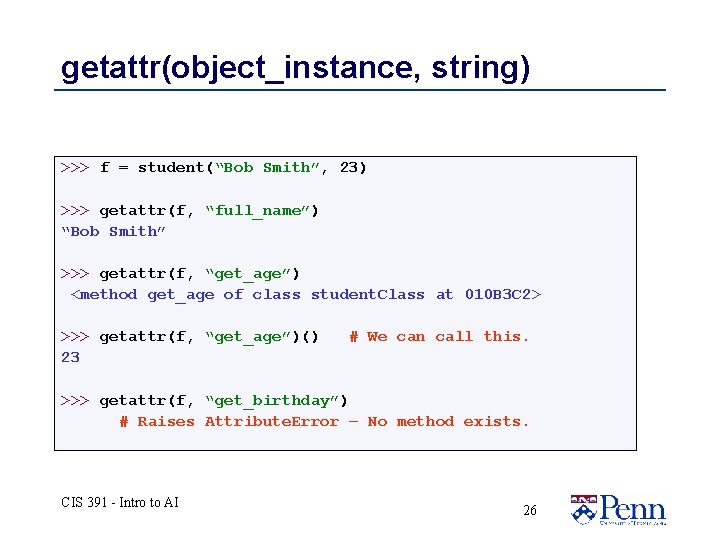
getattr(object_instance, string) >>> f = student(“Bob Smith”, 23) >>> getattr(f, “full_name”) “Bob Smith” >>> getattr(f, “get_age”) <method get_age of class student. Class at 010 B 3 C 2> >>> getattr(f, “get_age”)() 23 # We can call this. >>> getattr(f, “get_birthday”) # Raises Attribute. Error – No method exists. CIS 391 - Intro to AI 26
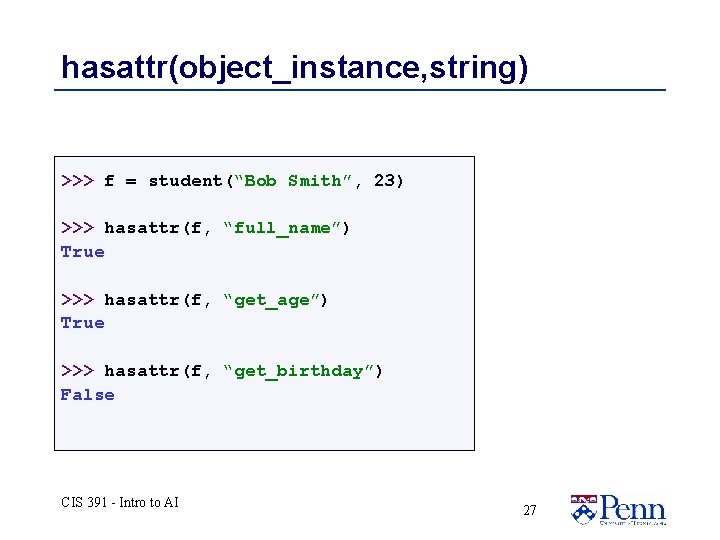
hasattr(object_instance, string) >>> f = student(“Bob Smith”, 23) >>> hasattr(f, “full_name”) True >>> hasattr(f, “get_age”) True >>> hasattr(f, “get_birthday”) False CIS 391 - Intro to AI 27
Attributes CIS 391 - Intro to AI
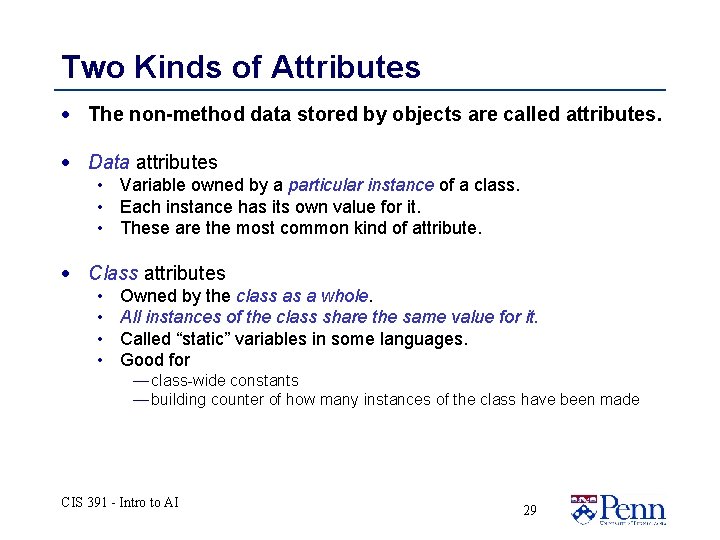
Two Kinds of Attributes · The non-method data stored by objects are called attributes. · Data attributes • Variable owned by a particular instance of a class. • Each instance has its own value for it. • These are the most common kind of attribute. · Class attributes • • Owned by the class as a whole. All instances of the class share the same value for it. Called “static” variables in some languages. Good for — class-wide constants — building counter of how many instances of the class have been made CIS 391 - Intro to AI 29
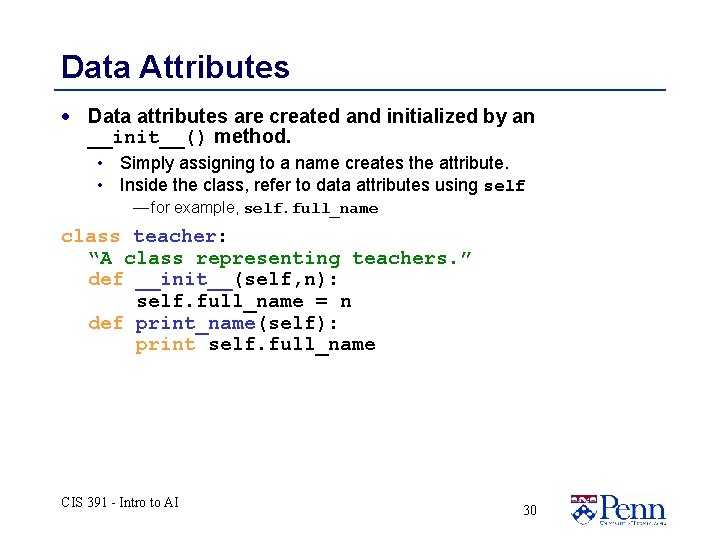
Data Attributes · Data attributes are created and initialized by an __init__() method. • Simply assigning to a name creates the attribute. • Inside the class, refer to data attributes using self — for example, self. full_name class teacher: “A class representing teachers. ” def __init__(self, n): self. full_name = n def print_name(self): print self. full_name CIS 391 - Intro to AI 30
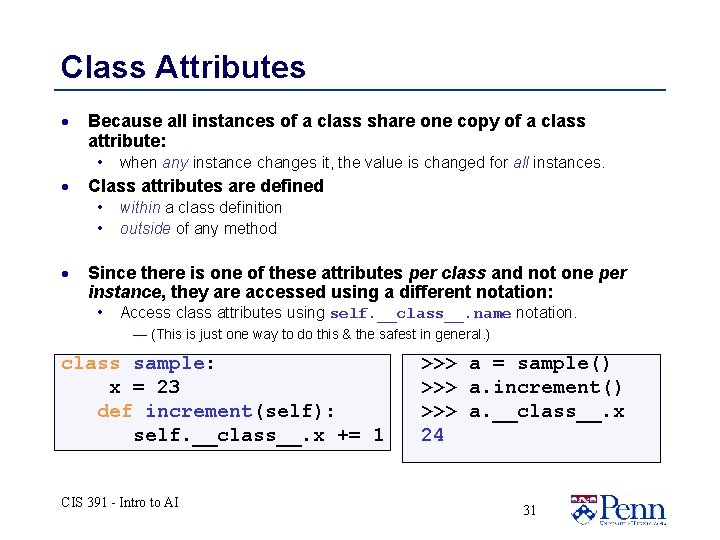
Class Attributes · Because all instances of a class share one copy of a class attribute: • · Class attributes are defined • • · when any instance changes it, the value is changed for all instances. within a class definition outside of any method Since there is one of these attributes per class and not one per instance, they are accessed using a different notation: • Access class attributes using self. __class__. name notation. — (This is just one way to do this & the safest in general. ) class sample: x = 23 def increment(self): self. __class__. x += 1 CIS 391 - Intro to AI >>> a = sample() >>> a. increment() >>> a. __class__. x 24 31
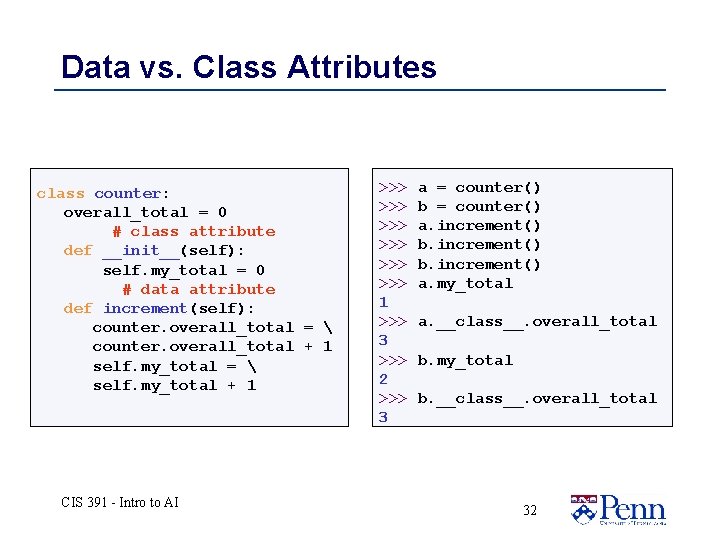
Data vs. Class Attributes class counter: overall_total = 0 # class attribute def __init__(self): self. my_total = 0 # data attribute def increment(self): counter. overall_total = counter. overall_total + 1 self. my_total = self. my_total + 1 CIS 391 - Intro to AI >>> >>> >>> 1 >>> 3 >>> 2 >>> 3 a = counter() b = counter() a. increment() b. increment() a. my_total a. __class__. overall_total b. my_total b. __class__. overall_total 32
Inheritance CIS 391 - Intro to AI
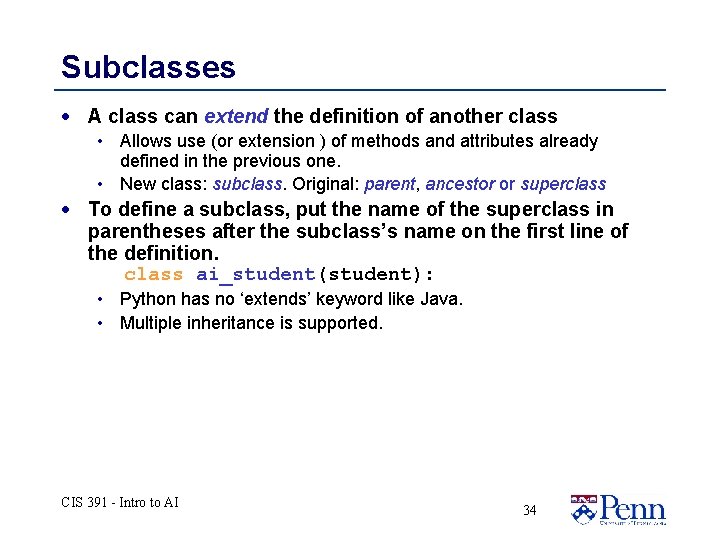
Subclasses · A class can extend the definition of another class • Allows use (or extension ) of methods and attributes already defined in the previous one. • New class: subclass. Original: parent, ancestor or superclass · To define a subclass, put the name of the superclass in parentheses after the subclass’s name on the first line of the definition. class ai_student(student): • Python has no ‘extends’ keyword like Java. • Multiple inheritance is supported. CIS 391 - Intro to AI 34
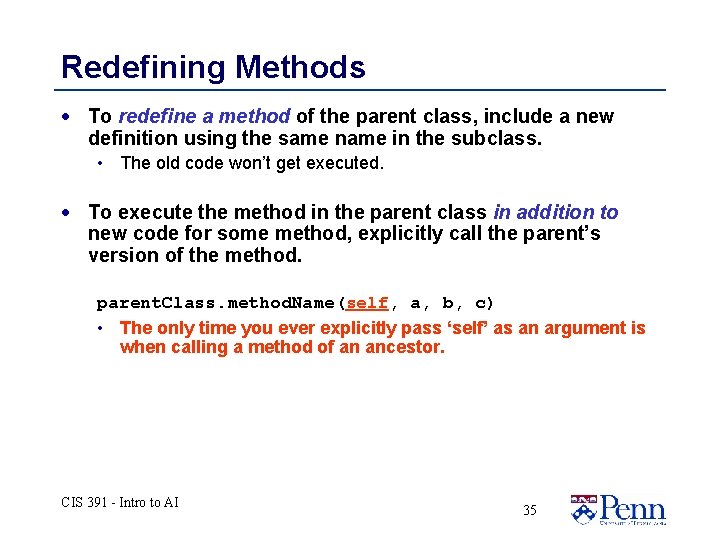
Redefining Methods · To redefine a method of the parent class, include a new definition using the same name in the subclass. • The old code won’t get executed. · To execute the method in the parent class in addition to new code for some method, explicitly call the parent’s version of the method. parent. Class. method. Name(self, a, b, c) • The only time you ever explicitly pass ‘self’ as an argument is when calling a method of an ancestor. CIS 391 - Intro to AI 35
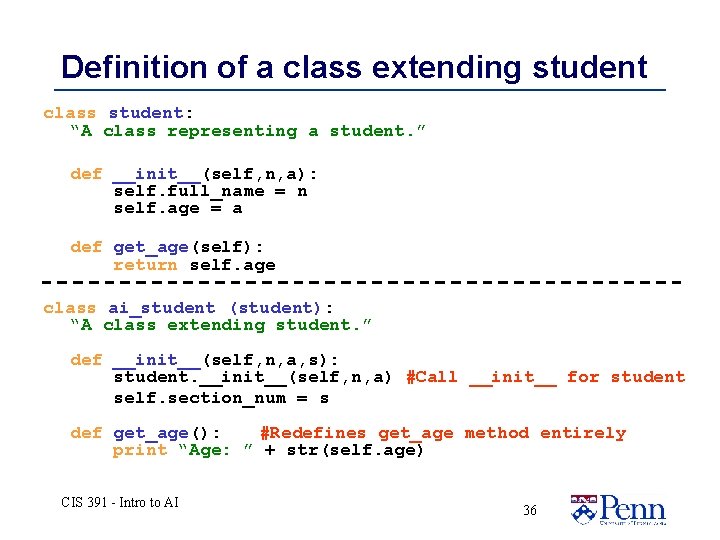
Definition of a class extending student class student: “A class representing a student. ” def __init__(self, n, a): self. full_name = n self. age = a def get_age(self): return self. age class ai_student (student): “A class extending student. ” def __init__(self, n, a, s): student. __init__(self, n, a) #Call __init__ for student self. section_num = s def get_age(): #Redefines get_age method entirely print “Age: ” + str(self. age) CIS 391 - Intro to AI 36
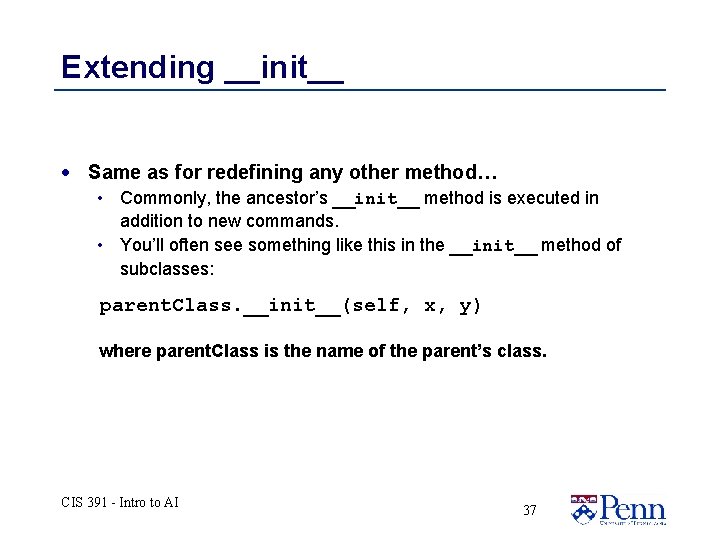
Extending __init__ · Same as for redefining any other method… • Commonly, the ancestor’s __init__ method is executed in addition to new commands. • You’ll often see something like this in the __init__ method of subclasses: parent. Class. __init__(self, x, y) where parent. Class is the name of the parent’s class. CIS 391 - Intro to AI 37
Special Built-In Methods and Attributes CIS 391 - Intro to AI
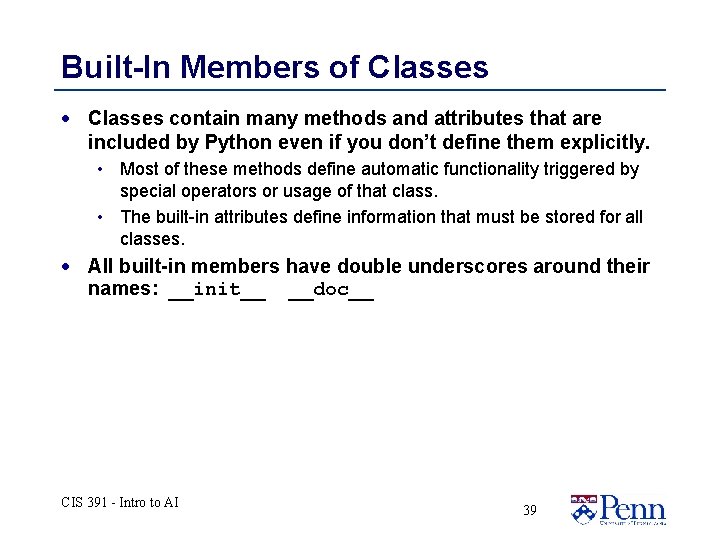
Built-In Members of Classes · Classes contain many methods and attributes that are included by Python even if you don’t define them explicitly. • Most of these methods define automatic functionality triggered by special operators or usage of that class. • The built-in attributes define information that must be stored for all classes. · All built-in members have double underscores around their names: __init__ __doc__ CIS 391 - Intro to AI 39
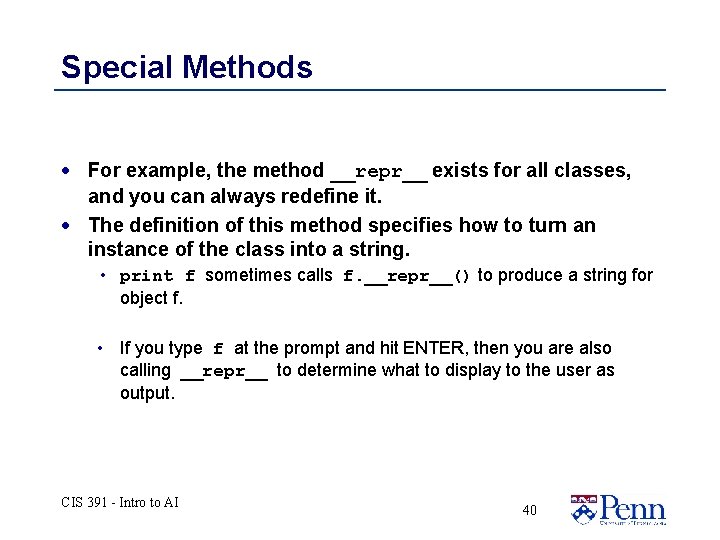
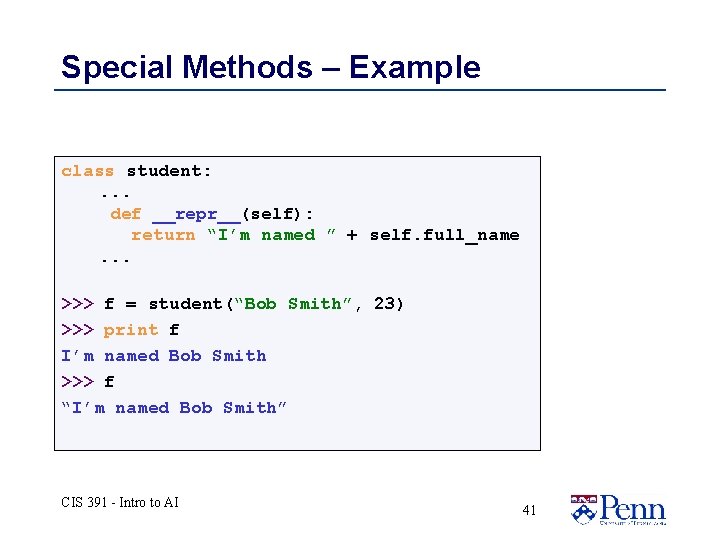
Special Methods · For example, the method __repr__ exists for all classes, and you can always redefine it. · The definition of this method specifies how to turn an instance of the class into a string. • print f sometimes calls f. __repr__() to produce a string for object f. • If you type f at the prompt and hit ENTER, then you are also calling __repr__ to determine what to display to the user as output. CIS 391 - Intro to AI 40
Special Methods – Example class student: . . . def __repr__(self): return “I’m named ” + self. full_name. . . >>> f = student(“Bob Smith”, 23) >>> print f I’m named Bob Smith >>> f “I’m named Bob Smith” CIS 391 - Intro to AI 41
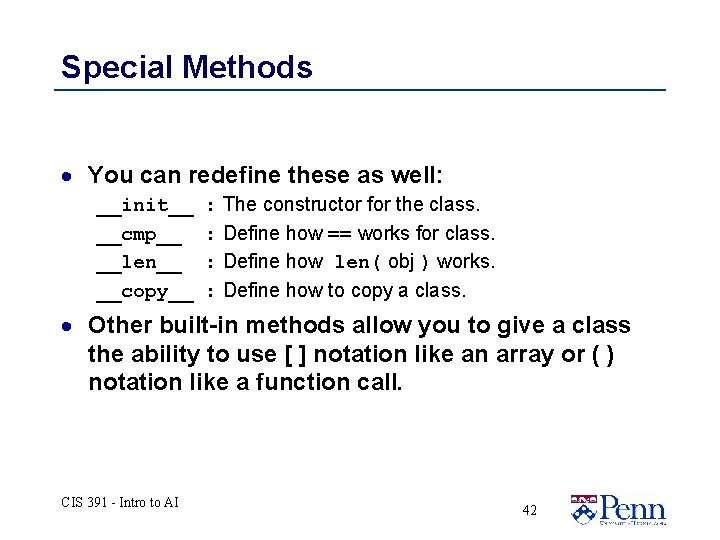
Special Methods · You can redefine these as well: __init__ __cmp__ __len__ __copy__ : The constructor for the class. : Define how == works for class. : Define how len( obj ) works. : Define how to copy a class. · Other built-in methods allow you to give a class the ability to use [ ] notation like an array or ( ) notation like a function call. CIS 391 - Intro to AI 42
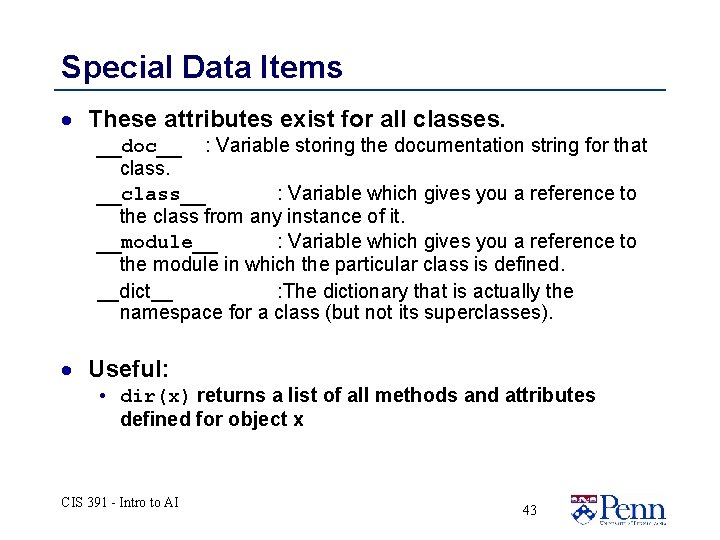
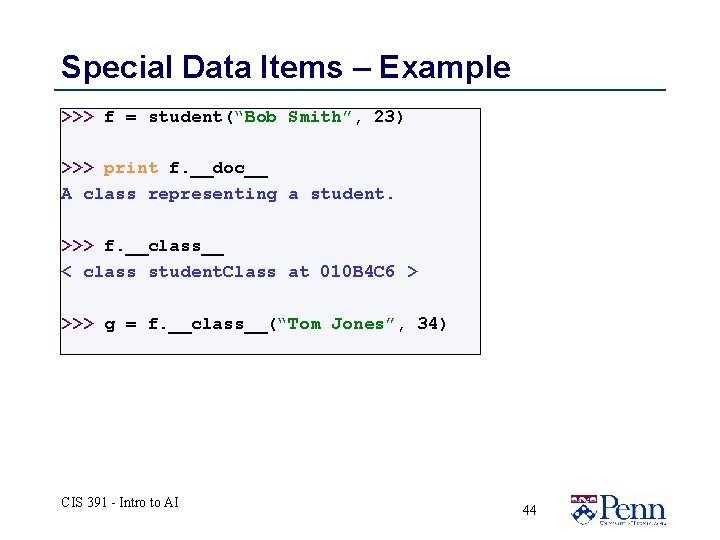
Special Data Items · These attributes exist for all classes. __doc__ : Variable storing the documentation string for that class. __class__ : Variable which gives you a reference to the class from any instance of it. __module__ : Variable which gives you a reference to the module in which the particular class is defined. __dict__ : The dictionary that is actually the namespace for a class (but not its superclasses). · Useful: • dir(x) returns a list of all methods and attributes defined for object x CIS 391 - Intro to AI 43
Special Data Items – Example >>> f = student(“Bob Smith”, 23) >>> print f. __doc__ A class representing a student. >>> f. __class__ < class student. Class at 010 B 4 C 6 > >>> g = f. __class__(“Tom Jones”, 34) CIS 391 - Intro to AI 44
Private Data and Methods · Any attribute or method with two leading underscores in its name (but none at the end) is private. It cannot be accessed outside of that class. • Note: Names with two underscores at the beginning and the end are for built-in methods or attributes for the class. • Note: There is no ‘protected’ status in Python; so, subclasses would be unable to access these private data either. CIS 391 - Intro to AI 45
File Processing, Error Handling, Regular Expressions, etc: Learning on your own… CIS 391 - Intro to AI
File Processing with Python This is a good way to play with the error handing capabilities of Python. Try accessing files without permissions or with non-existent names, etc. You’ll get plenty of errors to look at and play with! fileptr = open(‘filename’) somestring = fileptr. read() for line in fileptr: print line fileptr. close() For more, see section 3. 9 of the Python Library reference at http: //docs. python. org/lib/bltin-file-objects. html CIS 391 - Intro to AI 47
Exception Handling · Exceptions are Python classes • More specific kinds of errors are subclasses of the general Error class. · You use the following commands to interact with them: • • Try Except Finally Catch CIS 391 - Intro to AI 48
My favorite statement in Python · yield(a, b, c) • Turns a loop into a generator function that can be used for —Lazy evaluation —Creating potentially infinite lists in a usable way… · See Section 6. 8 of the Python reference manual (click here) CIS 391 - Intro to AI 49
Regular Expressions and Match Objects · Python provides a very rich set of tools for pattern matching against strings in module re (for regular expression) · As central as they are to much of the use of Python, we won’t be using them in this course… · For a gentle introduction to regular expressions in Python see http: //www. diveintopython. org/regular_expressions/index. html Or http: //www. amk. ca/python/howto/regex. html CIS 391 - Intro to AI 50
Finally… · pass • It does absolutely nothing. · Just holds the place of where something should go syntactically. Programmers like to use it to waste time in some code, or to hold the place where they would like put some real code at a later time. for i in range(1000): pass Like a “no-op” in assembly code, or a set of empty braces {} in C++ or Java. CIS 391 - Intro to AI 51