
INTRODUCTION TO PUBLIC FINANCE MANAGEMENT Module 4 1

INTRODUCTION TO PUBLIC FINANCE MANAGEMENT Module 4. 1: Coding and classification
International standards and local requirements Ø Classification systems must follow international standards defined in the IMF Government Finance Statistics (GFS) manual. Ø Information on the Government Functions. Ø Budget management – administrative unit, line item, programmatic… Ø National Public Sector Accounting Standards. Ø 2
Module outline Ø Budget classifications Ø Using budget classification systems and coding Ø The Chart of Accounts 3
Budget classifications A single data source for administering the budget and providing information for all financial reports. • The budget should be presented in a format that reflects the most important classifications. • The classification should be embedded in the government’s chart of accounts (the accounting classification) to ensure that every transaction can be reported in accordance with any of the classifications used. • There is a need to know both the economic activities and the functions of government both for budget management and financial statistics. 4
Budget classifications • Object – line-item or economic (inflows and outflows, including revenue): Purpose: budget management, compliance controls, fiscal management, reporting and analysis (deficit/surplus) e. g. IMF government statement of operations; International standard: IMF GFS. • Organisation/Administrative – ministry, department, agency. Purpose: budget management, accountability; No international standard. 5
Budget classifications • Function – functions of government spending Purpose: historical analysis, international comparison, policy formulation; International standard: IMF GFS and COFOG. • Programme – programmatic breakdown of government spending: Purpose: planning, performance monitoring, accountability; No International standard. • Other – e. g. fund, financing sources: Purpose: budget management, special needs, accountability. 6
Budget classifications Economic - Government Finance Statistics (GFS) • Transactions affecting net worth i. e. revenue and expense. • Transactions in non-financial assets. • Transactions in financial assets and liabilities (financing). 7

GFS Economic 8
Budget classifications Economic/Revenue - Government Finance Statistics (GFS) • Taxes are classified mainly according to the base on which they are levied. • Grants are classified by the source from which the revenue is derived. • Property income is classified by type of income. 9
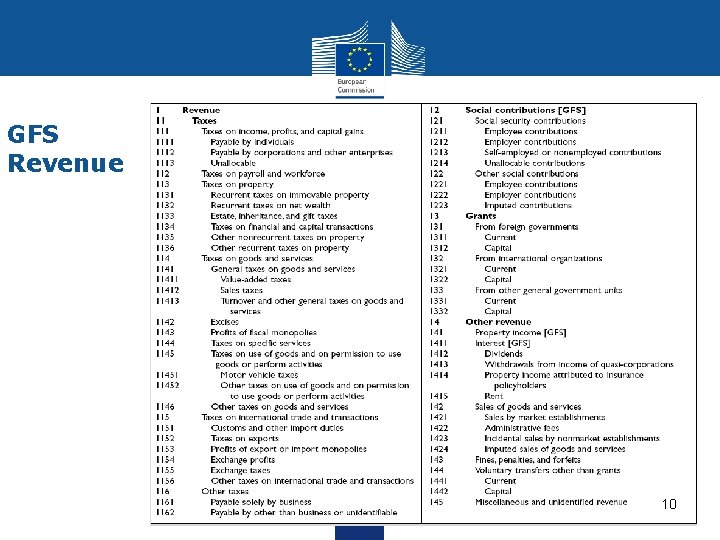
GFS Revenue 10
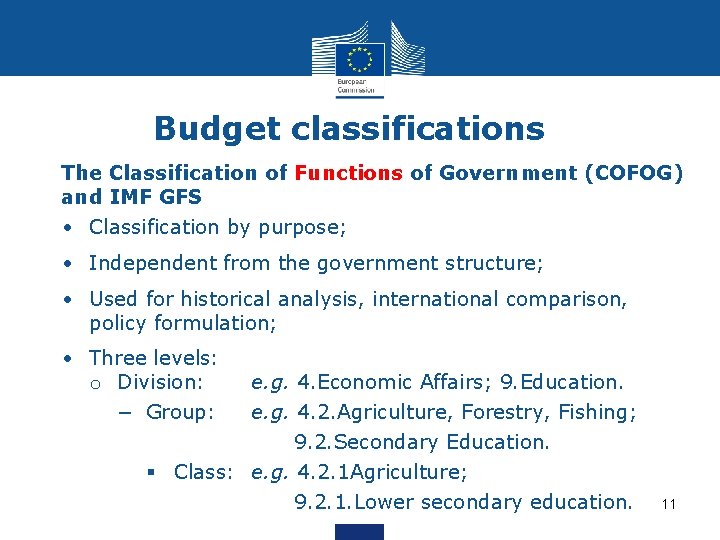
Budget classifications The Classification of Functions of Government (COFOG) and IMF GFS • Classification by purpose; • Independent from the government structure; • Used for historical analysis, international comparison, policy formulation; • Three levels: o Division: − Group: e. g. 4. Economic Affairs; 9. Education. e. g. 4. 2. Agriculture, Forestry, Fishing; 9. 2. Secondary Education. § Class: e. g. 4. 2. 1 Agriculture; 9. 2. 1. Lower secondary education. 11

GFS/ COFOG Function 12
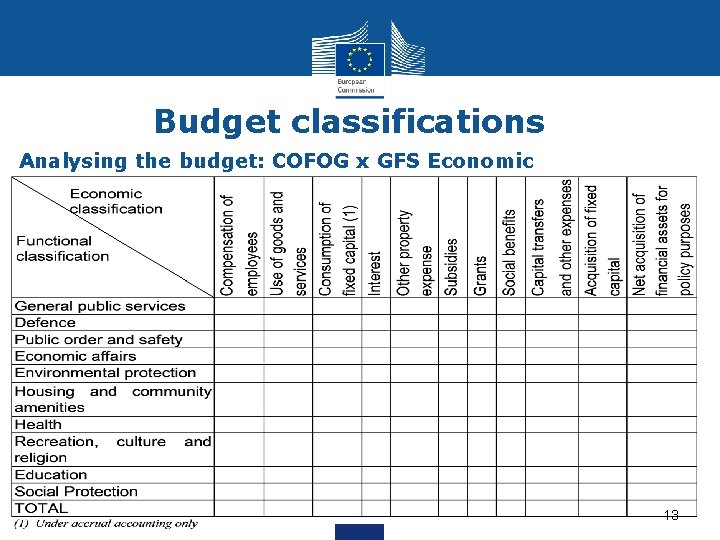
Budget classifications Analysing the budget: COFOG x GFS Economic 13
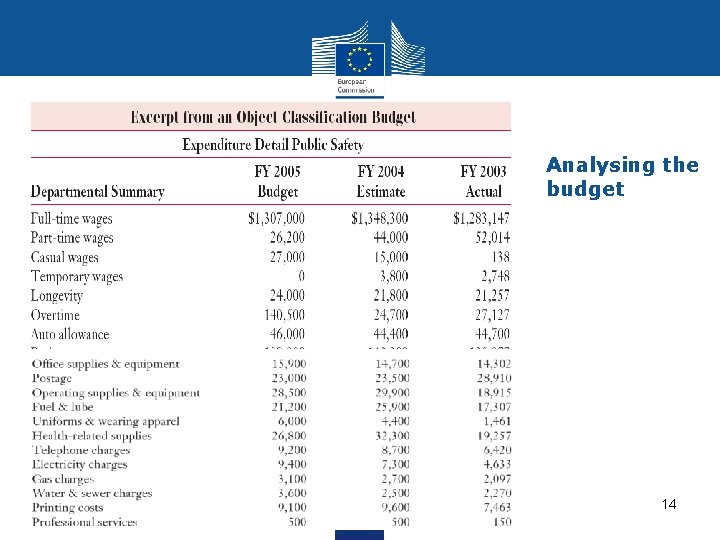
Analysing the budget 14
Budget classifications The Programme as element of the budget classification system • Used for budget management, grouping spending against policy objectives, planning for results. • Generally, overheads administrative expenses are grouped into a ‘general administration programme’… often a catch all. • The Programme and the COFOG: o The notions of Programme and Function can be confused, o … COFOG is very broad international standard grouping while the Programme classification must take into account the country policy context and requirements for managing 15 the budget!
Module outline Ø Budget classifications Ø Using budget classification systems and coding Ø The Chart of Accounts 16
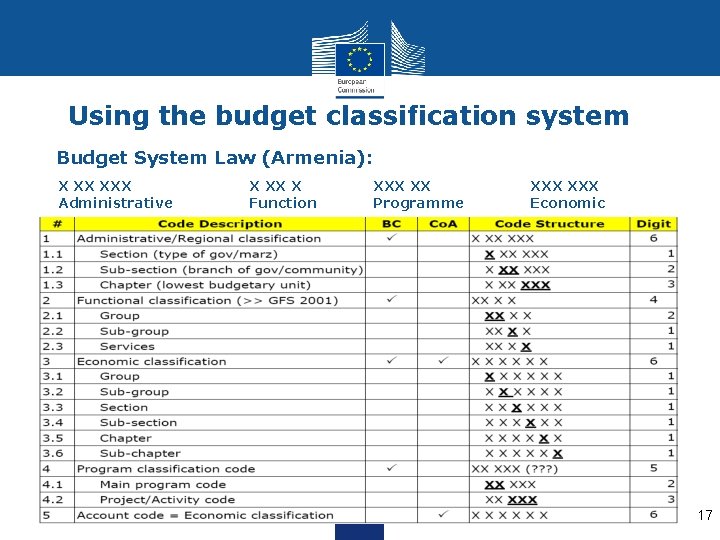
Using the budget classification system Budget System Law (Armenia): X XX XXX Administrative X XX X Function XXX XX Programme XXX Economic 17
Using the budget classification system • The coding system needs to allow for spare capacity (segments, digits) for future expansion such as new initiatives/programmes. 18
Module outline Ø Budget classifications Ø Using budget classification systems and coding Ø The Chart of Accounts 19
The Chart of Accounts • Is used to classify financial transactions and events and prepare financial statements for reporting in accordance with national Public Sector Accounting Standards. • A move to the International Public Sector Accounting Standards (IPSAS) means a coding system to allow a greater range and level of detail than the traditional cash based systems. 20
The Chart of Accounts (Cash based) • The published accounts were traditionally the budget out-turn with a need for additional information on financial assets and liabilities. 21
The Chart of Accounts IPSAS (Accruals) • A move to IPSAS means a coding system to allow that information to be collated. • Major change in coding requirements to add non financial assets and liabilities (discussed in the Module on Accounting & Reporting) such as: o Fixed assets: Premises, Plant and Equipment; Depreciation. o Liabilities: Pensions. 22
Key messages ü The budget classification system must suit the needs for reporting, accountability and budgetary control. ü Whatever the budget approach it must include: • administrative, economic and function classifications to allow reporting according to the GFS and COFOG standards. • information for budget execution. ü Information for Chart of Accounts: • either cash assets/liabilities (cash based); • or all assets/liabilities (accruals/IPSAS based). 23
- Slides: 23