
INTRODUCTION TO PUBLIC FINANCE MANAGEMENT Module 2 3
INTRODUCTION TO PUBLIC FINANCE MANAGEMENT Module 2. 3: Budget Execution
Module outline • • • Expenditure cycle from allotment to payment Getting the Basics Right Budgetary Control Payment Controls Budget Reporting 2
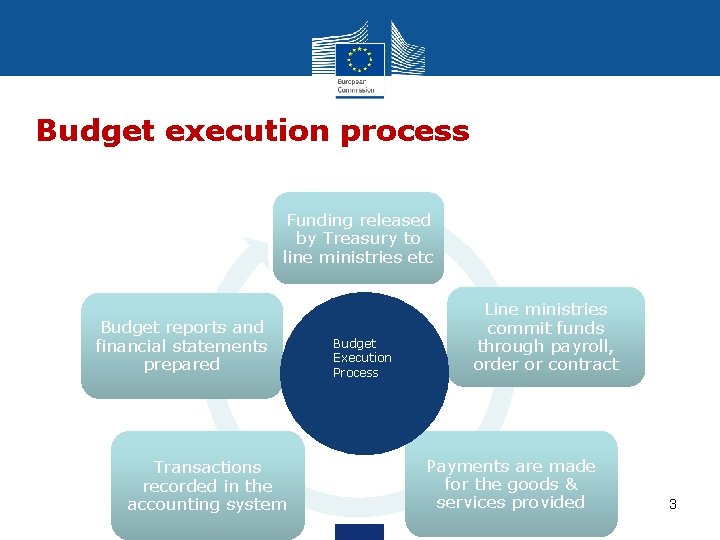
Budget execution process Funding released by Treasury to line ministries etc Budget reports and financial statements prepared Transactions recorded in the accounting system Budget Execution Process Line ministries commit funds through payroll, order or contract Payments are made for the goods & services provided 3
Issues in budget implementation • Budget implementation is not simply a matter of executing the approved budget – all countries expenditure differs from the budget • Variance depends on fiscal conditions, stability and certainty in the country’s finances, the role of the finance ministry and budget system • A highly itemized budget usuall experience more variance than where managers have more spending discretion • The trend is to give spending units more flexibility in implementing their budgets • Might not be appropriate in countries with inadequate managerial controls. 4
Common budgetary problems • Approved budget is unrealistic, • Extreme uncertainty concerning available resources, with quarterly or monthly allotments • Extra-budgetary funds outside the budget process, hoarded by spending units • Significant payment arrears that are not included in financial statements • Funds diverted to unauthorized purposes or private accounts 5
Module outline • • • Expenditure cycle from allotment to payment Getting the Basics Right Budgetary Control Payment Controls Budget reporting 6
Getting the basics right • Functions aimed at ensuring the credibility of the budget and aggregate fiscal discipline can be included in the set of basic PFM functions: • (i) functions required to ensure financial compliance; • (ii) other functions that contribute to the credibility of the budget, together with financial compliance functions. • • Jack Diamond 2013 7
Getting the basics right • • • The PFM objectives (i) financial compliance/due processes; (ii) second, aggregate fiscal discipline; (iii) then, strategic allocation of resources and efficient public service delivery • • Jack Diamond 2013 • 8
Getting the basics right • financial compliance • adequate control system, • clear and transparent financial regulations • Control of expenditures and revenues • controls performed by the ministry of finance, or other central agencies • and controls performed within the spending units • Jack Diamond 2013 9
Getting the basics right • A credible annual budget is implemented with few significant deviations • High transparency • Public funds spent for authorized purposes only • Spending units have reasonable certainty on the funds to be made available • Compliance with formal rules 10
Module outline • • • Expenditure cycle from allotment to payment Getting the Basics Right Budgetary Control Payment Controls Budget Reporting 11
Principles of budgetary control • Each area of the budget has one, and only one, budget holder. All budget managers are clear on the income and costs they are responsible for and the size of their budget • Budget managers are able to control the level of expenditure or income from their budgets. Financial responsibility matches the reality of management control • All revenue deposited in bank account – not used locally • Budgets are shown gross (not net of receipts). 12
Budgetary Control Mo. F 13
Budget modifications In-year budgetary adjustments: • Transfer of resources – across sub-codes o by line manager/ ministry • Virements – between departments o by Treasury • Supplementary budgets o by Parliament 14
Supplementary budgets • Budget revisions should be submitted to Parliament for approval • should be limited to one revision per year • Good practice: the mid-term budget review which may include in year (t): • budget execution report for the first months of year (t) • supplementary estimates for year (t) budget • budget policy paper for year (t+1), and indicative spending for the following two years 15
Reasons for commitment control • Ensures budget units only spend what appropriated by Parliament & released by Treasury • Reduces payment voucher arrears • Improves effectiveness • Increases the confidence in vendors that they will get paid • Reduces the opportunity for rent seeking by payment offices 16
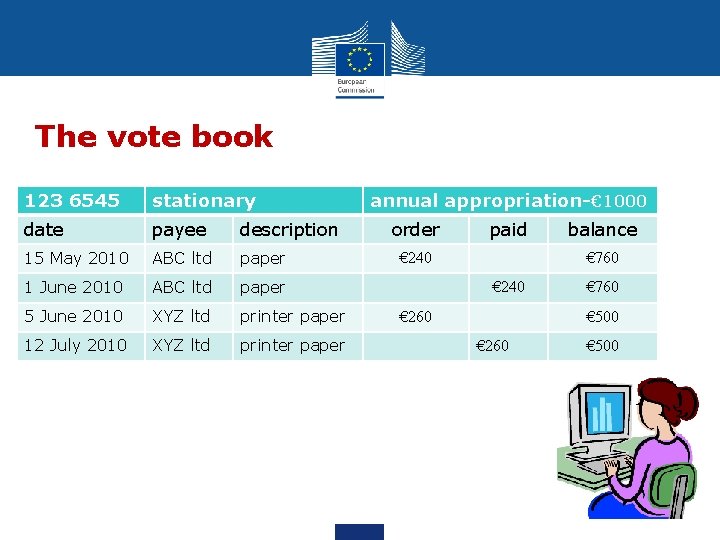
The vote book 123 6545 stationary date payee description 15 May 2010 ABC ltd paper 1 June 2010 ABC ltd paper 5 June 2010 XYZ ltd printer paper 12 July 2010 XYZ ltd printer paper annual appropriation-€ 1000 order paid € 240 balance € 760 € 240 € 260 € 760 € 500 € 260 € 500 17
Module outline • • • Expenditure cycle from allotment to payment Getting the Basics Right Budgetary Control Payment Controls Budget reporting 18
Cash Rationing • Imbalances between cash inflows and outflows: appropriation freezes, commitment limits, cash budgeting, informal borrowing from vendors (arrears) • They are disruptive for sound budget execution management (non-predictability) • During budget preparation indicate new & on-going projects (delay or cancel? ), scalable versus non scalable projects (no half bicycles) • Often resulted from IMF quarterly ceilings on bank 19 borrowing
Alternative forms of payment or cash release • Main treasury system • Running costs paid locally • Some income may be retained locally • Larger sums controlled centrally 20
Main Treasury system • The standard payment system is through the ‘Treasury’: • The Ministry of Finance is responsible for making the actual cash, cheque and direct bank transfers. • There may be local treasuries in MDAs and/or regional locations across the country.
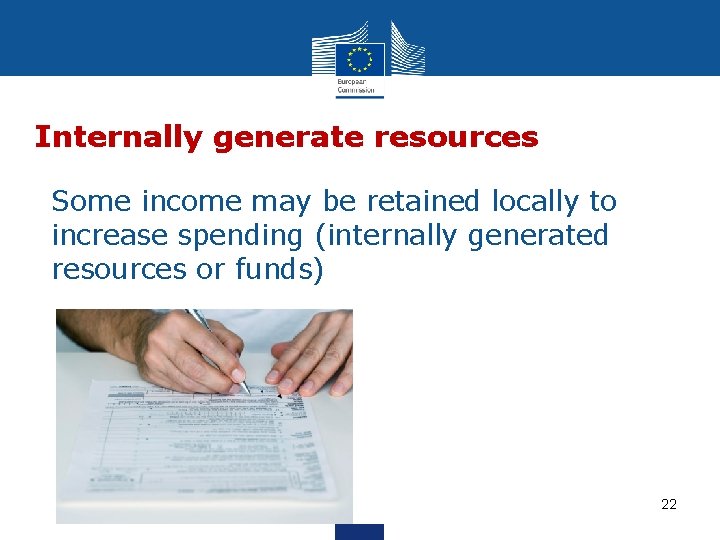
Internally generate resources • Some income may be retained locally to increase spending (internally generated resources or funds) 22
Module outline • • • Expenditure cycle from allotment to payment Getting the Basics Right Budgetary Control Payment Controls Budget reporting 23
Monthly Expenditure Returns • Reflect the structure of the budget • Show funds received, committed funds, expenditures and transfers, opening and closing balance of bank accounts • For example, submitted by the line ministry to the Accountant General’s Office (Mo. F) for reporting & the Budget Office for the budget release process • Non submitted Monthly Expenditure returns may result in suspension of further budget releases 24
Quarterly budget reports • Details of receipts and payments by each ministry • Compared with the performance of the previous year and relevant budget • Reported to politicians (cabinet and/or parliamentary finance committee) and public • May lead to supplementary budget 25
Involvement of civil society • International Budget Project: www. internationalbudget. org • Open Budget Index 2012 (100 countries) 87 % of governments don’t adequately account to public for their spending • Our Money, Our Responsibility: A Citizens' Guide to Monitoring Government Expenditures 26
Involvement of civil society • International Budget Project: www. internationalbudget. org • Open Budget Index 2015 (102 countries) 78 % of governments don’t adequately account to public for their spending • So an improvement of 9% but still the vast majority do not meet satisfactory levels 27
2015 OBI report The largest improvements in budget transparency between the Open Budget Surveys in 2012 and 2015 were made, by countries that were among the least transparent. Countries that in 2012, had scores of 40 or less, have improved markedly: their average OBI score rose from 18 in 2012 to 28 in 2015 The Kyrgyz Republic’s OBI score jumped from 20 in 2012 to 54 in 2015; Tunisia from 11 in 2012 to 42 in 2015. The transparency scores for countries in Francophone West Africa rose substantially from 2012 to 2015, continuing the rapid improvements seen in the region from 2010 to 2012
2015 OBI report • too many countries with unacceptably low levels of budget transparency are failing to advance reforms. For example, Algeria, Bolivia, Cambodia, Chad, China, Equatorial Guinea, Fiji, Iraq, Myanmar, Qatar, Saudi Arabia, and Vietnam have been among the least transparent countries (with OBI scores of 20 or less) every single year they have been in the Survey. • Only (down from 6 in 2012) countries surveyed release extensive budget information. Those top-tier countries are: New Zealand, South Africa, USA, Sweden, Norway, • The United Kingdom and France fell out of the list the USA joined the list
Key messages • Budget execution system should ensure compliance with legislature’s authorisations • Virement rules should provide managers with a certain degree of flexibility, but within the government’s policy framework • Uses of appropriations should be regularly monitored • The budgetary horizon (when payments and receipts are predictable) will vary over time and between countries 30
- Slides: 30