
Introduction to Psychology Virginia Union University Friday October
Introduction to Psychology Virginia Union University Friday October 7, 2011 Module 10: Operant & Cognitive Approaches
*New* Office Hours �I will be hosting office hours regularly beginning this afternoon. They will be from 6 -8 pm every Friday in the Psychology computer lab of Grays (Room 207). If you have any questions about material covered in the class, your performance in class, or need additional help, please feel free to see me during that time.
Necessary Course Study Skills �Read the text before class �Attend class and take notes in your own words �Ask questions if you do not understand course material �Review the course lectures and rewrite in your own words �If you continue to have questions, visit me during office hours to get your questions addressed
Pop Quiz! � What is Classical Conditioning (2 sentence max definition)? � Classical Conditioning Example – identify the UCR in this example: A student is conditioned to become anxious when instructed by the teacher to “Clear your desk”, because this usually suggests that a pop quiz will be given � What is the difference between Classical & Operant Conditioning? What is the difference between the responses given in Classical & Operant Conditioning?
Comparing Classical & Operant Conditioning � Operant Conditioning Goal: to increase or decrease the rate of some response Voluntary Response: A voluntary response must first be performed before a reward/reinforcer, or punishment is given Emitted Response: A voluntary response is emitted, or acted/operated Contingent on Behavior: Performance of a desired response depends or is contingent upon what happens next, or the consequences (whether it be a reinforcer/reward or punishment) Consequences: Animals & humans learns that performing or emitting some behavior is followed by a consequence (reward or punishment) that increases or decreases the chances of performing the behavior again
What is Classical Conditioning?
What is Classical Conditioning? �Classical Conditioning The basic learning process that involves repeatedly pairing a neutral stimulus with a response-producing stimulus until the neutral stimulus elicits the same response ▪ Involves a reflexive behavior (or an automatic behavior) ▪ A new behavior isn’t produced, an existing behavior is
What is the name of the individual credited for Classical Conditioning?
What is the name of the individual credited for Classical Conditioning? �Ivan Pavlov!
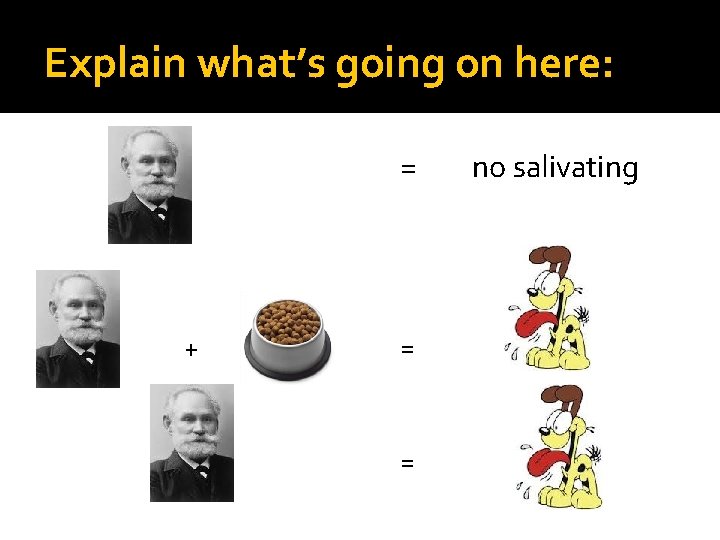
Explain what’s going on here: = + = = no salivating
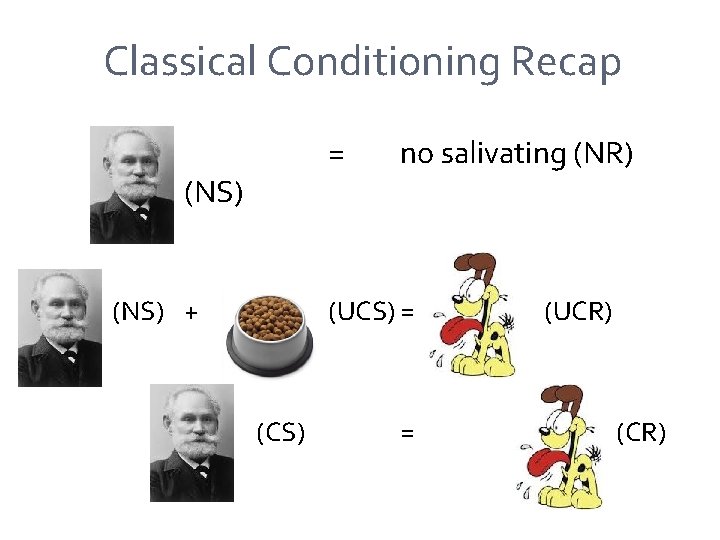
Classical Conditioning Recap = (NS) + no salivating (NR) (UCS) = (UCR) (CR)
Classical Conditioning Practice Problems 20. Todd feels happy whenever he smells chocolate-chip cookies baking because, when he was a child, his grandmother, whom he loved very much, used to bake chocolate-chip cookies for him whenever he visited her. In this example, the CS is � A. the smell of chocolate-chip cookies baking. B. the happiness Todd feels when he smells chocolate-chip cookies baking. C. Todd's grandmother. D. the happiness Todd felt when he visited his grandmother. � 22. When I was a child, as a joke my mother used to put on a goalie mask, start up her chain saw, and chase the neighborhood children around until they passed out from fright. Even now I have a phobia of goalie masks and cannot watch a hockey game without soiling myself. For me, the goalie mask is a(n) � A. CS. B. CR. C. UCS. D. UCR. � 23. A stimulus that causes an automatic (reflexive) response in an organism BEFORE the organism has been classically conditioned is called a(n) � A. CS. B. CR. C. UCS. D. UCR. �
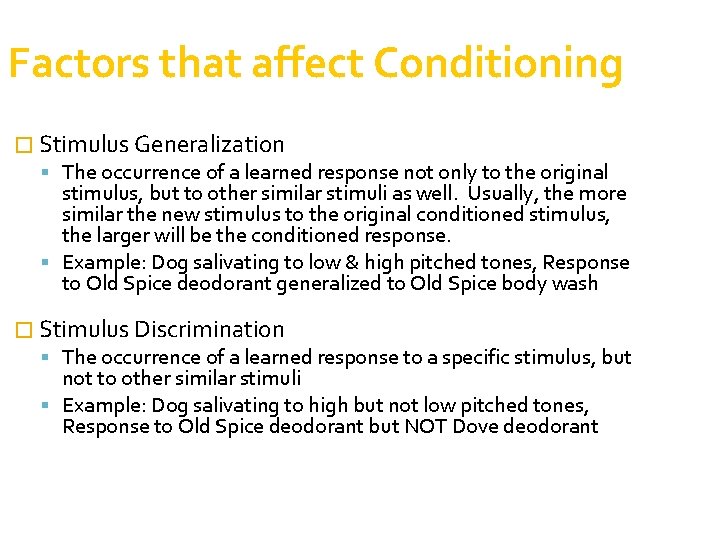
Factors that affect Conditioning � Stimulus Generalization The occurrence of a learned response not only to the original stimulus, but to other similar stimuli as well. Usually, the more similar the new stimulus to the original conditioned stimulus, the larger will be the conditioned response. Example: Dog salivating to low & high pitched tones, Response to Old Spice deodorant generalized to Old Spice body wash � Stimulus Discrimination The occurrence of a learned response to a specific stimulus, but not to other similar stimuli Example: Dog salivating to high but not low pitched tones, Response to Old Spice deodorant but NOT Dove deodorant
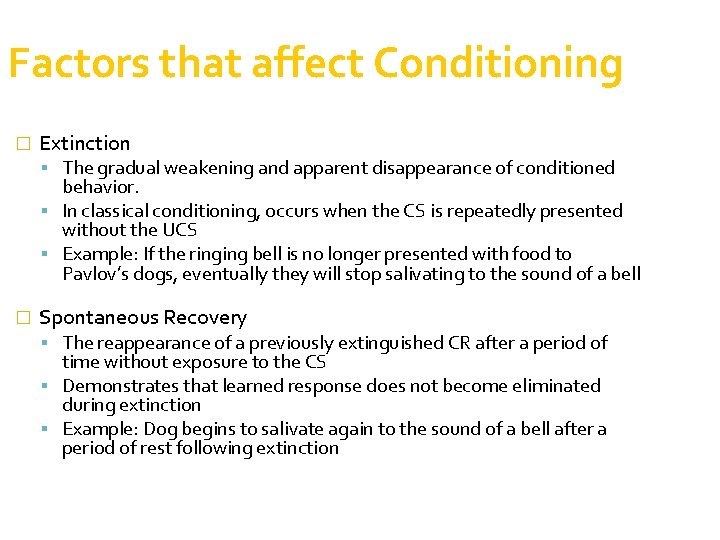
Factors that affect Conditioning � Extinction The gradual weakening and apparent disappearance of conditioned behavior. In classical conditioning, occurs when the CS is repeatedly presented without the UCS Example: If the ringing bell is no longer presented with food to Pavlov’s dogs, eventually they will stop salivating to the sound of a bell � Spontaneous Recovery The reappearance of a previously extinguished CR after a period of time without exposure to the CS Demonstrates that learned response does not become eliminated during extinction Example: Dog begins to salivate again to the sound of a bell after a period of rest following extinction
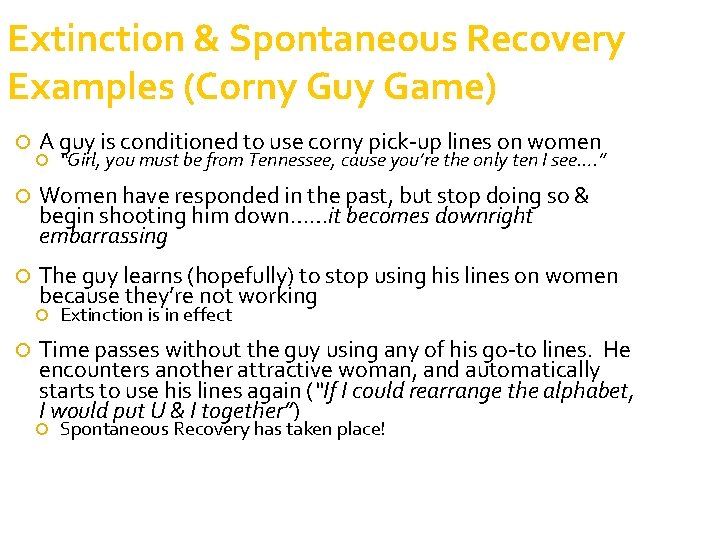
Extinction & Spontaneous Recovery Examples (Corny Guy Game) A guy is conditioned to use corny pick-up lines on women “Girl, you must be from Tennessee, cause you’re the only ten I see…. ” Women have responded in the past, but stop doing so & begin shooting him down……it becomes downright embarrassing The guy learns (hopefully) to stop using his lines on women because they’re not working Extinction is in effect Time passes without the guy using any of his go-to lines. He encounters another attractive woman, and automatically starts to use his lines again (“If I could rearrange the alphabet, I would put U & I together”) Spontaneous Recovery has taken place!
Listen to these sound clips & observe how they make you feel �How do they make you feel? Clip 1: http: //youtu. be/g. MLPnk 9 -6 MM Clip 2: http: //youtu. be/Qm. MQf. TJ 3 g. Yk Clip 3: http: //youtu. be/C 4 g 8 r. LSh. URw Clip 4: http: //youtu. be/Vg. SMx. Y 6 aso. E
Conditioning Emotional Responses �Behaviorist John Watson (who supported the study of observable behaviors) believed that just like dogs reflexively salivated to food, human emotional responses were also reflexive �He studied fear, rage and love – three emotions he believed represented inborn and natural unconditioned reflexes
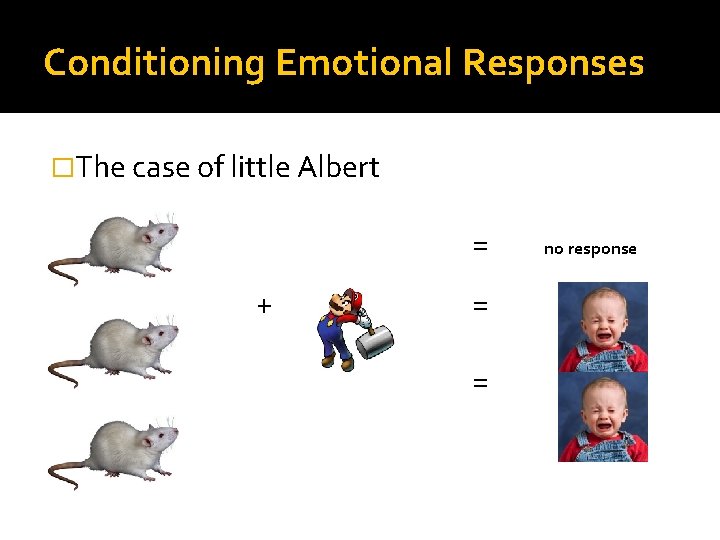
Conditioning Emotional Responses �The case of little Albert = + = = no response
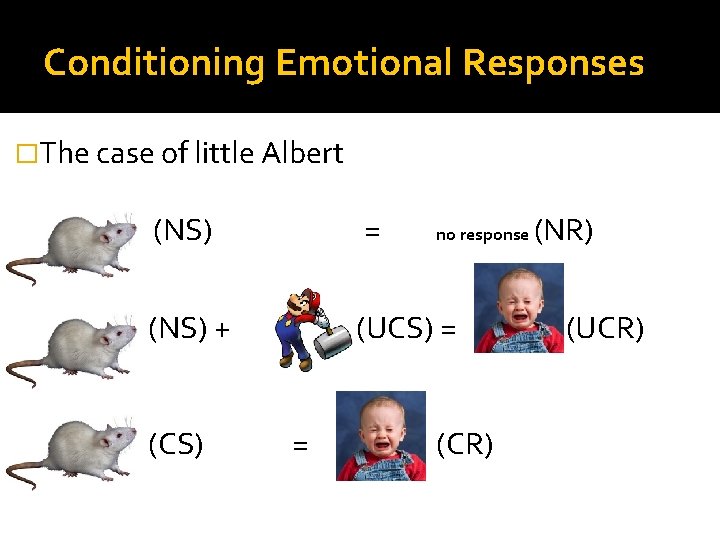
Conditioning Emotional Responses �The case of little Albert (NS) = (NS) + (UCS) = (CS) = no response (CR) (NR) (UCR)
Conditioning Emotional Responses The Case of Little Albert Before conditioning ▪ White Rat (NS) = No Fear/Crying (NR) During conditioning ▪ White Rat (NS) + Loud Noise of a Hammer (UCS) = Fear/Crying (UCR) After conditioning ▪ White Rat (CS) = Fear/Crying (CR) Little Albert was conditioned to fear a white rat, and expressed his fear by crying. This fear generalized to other furry objects (i. e. , rabbits, cotton, a fur coat & Santa Claus beard). Other examples of conditioning emotional responses? Blood pressure increased when hearing the name of someone you have a strong dislike for?
Comparing Classical & Operant Conditioning � Operant Conditioning (applying this formula to Bart the Bear) Goal: to increase the rate of Bart holding the teddy bear (response) Voluntary Response: Bart holding a teddy bear is a voluntary response b/c he can perform it at will. He must perform this response before receiving a reward/reinforcement. Emitted Response: Bart voluntary emits the response of holding the teddy bear. Contingent on Behavior: Bart holds the teddy bear and is rewarded or reinforced for his actions with an apple. Consequences: Bart learns that holding the teddy bear means that he will receive an apple. The apple is desirable, thus increasing the chances that he will hold the teddy bear again.
Comparing Classical & Operant Conditioning � Apply the operant conditioning formula that was just discussed to this example: Training a puppy to obey the command “sit” by using treats. � Here is the previously mentioned formula: Goal: to increase or decrease the rate of some response Voluntary Response: A voluntary response must first be performed before a reward/reinforcer, or punishment is given Emitted Response: A voluntary response is emitted, or acted/operated Contingent on Behavior: Performance of a desired response depends or is contingent upon what happens next, or the consequences (whether it be a reinforcer/reward or punishment) Consequences: Animals & humans learns that performing or emitting some behavior is followed by a consequence (reward or punishment) that increases or decreases the chances of performing the behavior again
Operant Conditioning � The discovery of operant conditioning involved two different researchers � E. L. Thorndike Built a series of puzzle boxes from which a cat could learn to escape by � learning to make a specific response. Outside the puzzle box was a reward for escaping – a piece of fish. Thorndike graphed his data, and found that over time the cat needed less time to escape. Through trial and error, the cat learned to associate certain responses with successfully escaping the box & gaining the food reward The Law of Effect: states that behaviors followed by positive consequences are strengthened, while behaviors followed by negative consequences are weakened
Operant Conditioning � Thorndike’s emphasis on studying the consequences of behavior were further developed by B. F. Skinner � B. F. Skinner Interested in analyzing the ongoing behaviors of animals, but needed an objective way to measure the ongoing behaviors Created a unit of behavior called an operant response Operant response: a response that can be modified by its consequences and is a meaningful unit of ongoing behavior that can be easily measured (ex: Bart picking up the teddy bear) By measuring/recording operant responses, Skinner was able to analyze animal’s ongoing behaviors during learning. He called this kind of learning operant conditioning.
Operant Conditioning � The Skinner Box An empty box for rats that has a bar for the rat to press and an empty food bowl The box is automated to record the rat’s bar presses and deliver food pellets Used to study how an animal’s ongoing behaviors may be modified by changing the consequences of what happens after the bar is pressed 3 factors involved in operantly conditioning the rat to press the bar in the Skinner Box 1. 2. 3. The rat has not been fed for hours and will be more likely to roam looking for food and eat food that is rewarded The goal is to condition the rat to press the bar, this is the operant response A procedure called shaping is used to get the rat to press the bar
Operant Conditioning �Shaping A procedure in which an experimenter successively reinforces behavior that leads up to or approximates the desired behavior ▪ Rat rewarded for first facing the bar ▪ Rat rewarded for touching the bar ▪ Rat rewarded for pressing the bar Other examples of shaping: teaching a baby how to talk Other examples?
Operant Conditioning �Immediate reinforcement Skinner explains that in shaping behavior, the food pellet or reinforcer should immediately follow after the desired behavior. By following immediately, the reinforcer is associated with the desired behavior & not some other behavior that happened to occur. ▪ Superstitious behavior: a behavior that increases in frequency because its occurrence is accidentally paired with the delivery of a reinforcer ▪ Ex: Wearing a specific item of clothing on the day that you perform outstandingly in a game
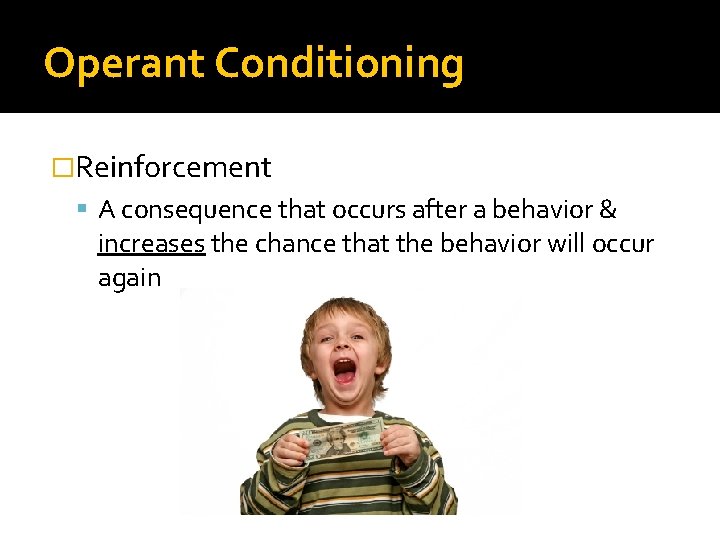
Operant Conditioning �Reinforcement A consequence that occurs after a behavior & increases the chance that the behavior will occur again
Reinforcement �Positive Reinforcement The presentation of a stimulus that increases the probability that a behavior will occur again Examples: ▪ Bart receiving an apple for holding the teddy bear ▪ A hungry rat presses a bar in its cage and receives food ▪ A student studies for a course and receives a good grade. Other Examples?
Reinforcement � Negative Reinforcement An aversive or unpleasant stimulus whose removal increases the likelihood that the preceding response will occur again Examples: ▪ Taking an aspirin to remove a headache ▪ A rat is placed in a cage and immediately receives a mild electrical shock on its feet. . The rat presses a bar and the shock stops. ▪ Your safe driving record for a period of time leads your car insurance company to reduce your monthly car insurance premium Other Examples?
Reinforcers �Primary Reinforcer A stimulus such as food, water, or sex, that is innately satisfying and requires no learning on the part of the subject to become pleasurable ▪ You don’t have to learn to like �Secondary Reinforcer Any stimulus that has acquired its reinforcing powers through experience, are learned through pairing with primary reinforcers or other secondary reinforcers ▪ Example: coupons, money, grades
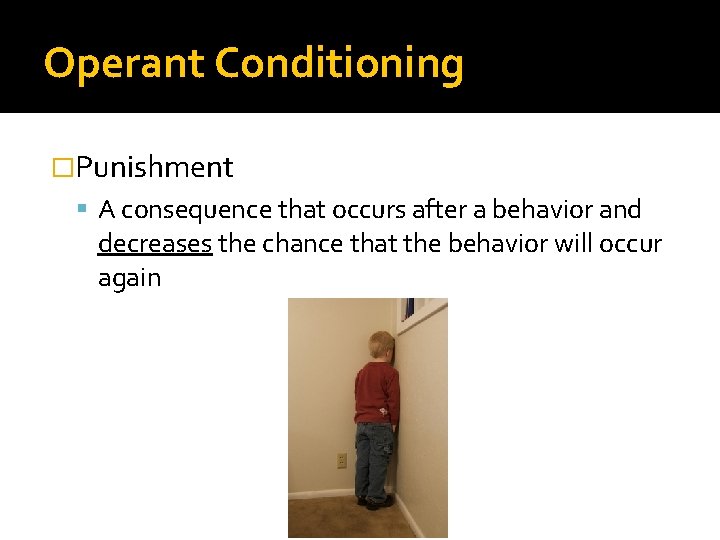
Operant Conditioning �Punishment A consequence that occurs after a behavior and decreases the chance that the behavior will occur again
Punishment �Positive Punishment Presenting an aversive or unpleasant stimulus after a response. The aversive stimulus decreases the chances that the response will occur again. Examples: ▪ Spanking/scolding a young child for misbehaving ▪ Getting a ticket for speeding Other Examples?
Punishment �Negative Punishment Removing a reinforcing stimulus after a response. This removal decreases the chances that the response will occur again. Examples: ▪ Timeout or getting allowance or toys removed for not obeying parents ▪ Having your license suspended for not paying fines Other Examples?
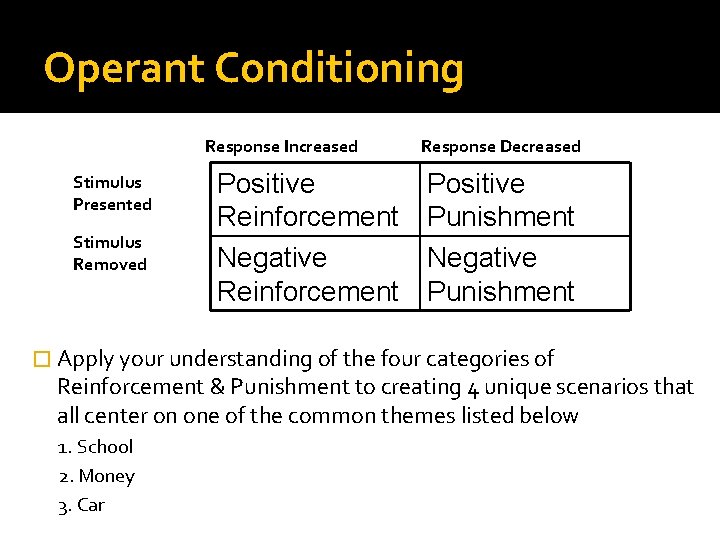
Operant Conditioning Response Increased Stimulus Presented Stimulus Removed Positive Reinforcement Negative Reinforcement Response Decreased Positive Punishment Negative Punishment � Apply your understanding of the four categories of Reinforcement & Punishment to creating 4 unique scenarios that all center on one of the common themes listed below 1. School 2. Money 3. Car
Operant Conditioning �Schedule of reinforcement When a reinforcement is given influences how consequent behaviors are shaped ▪ Continuous Reinforcement ▪ The desired behavior is reinforced every single time it occurs ▪ This schedule is best used during the initial stages of learning ▪ Once the behavior is learned, there is usually a switch to a partial reinforcement schedule ▪ Partial Reinforcement ▪ The desired behavior is reinforced only part of time ▪ Behaviors learned more slowly, but the response is more resistant to extinction
Operant Conditioning �Partial Reinforcement Schedules Fixed-ratio (FR) Schedule ▪ Reinforcement occurs after a fixed number of responses ▪ Schedule produces a high, steady rate of responding with only a brief pause after the delivery of the reinforcer ▪ Examples: ▪ Rat on a 10 -to-1 fixed ratio schedule receives 1 food pellet per 10 bar presses ▪ Frequent buyer punch cards ▪ Other Examples?
Operant Conditioning �Partial Reinforcement Schedules Variable-ratio (VR) Schedule ▪ Reinforcement occurs after an average number of responses, which varies from trial to trial ▪ Schedule creates a high, steady rate of responding ▪ Examples: ▪ Rat on a variable ratio 20 schedule might have to press the bar 25 X on the 1 st trial & 15 X on the 2 nd trial – the ratio works out to a predetermined average ▪ Gambling ▪ Other Examples?
Operant Conditioning �Partial Reinforcement Schedules Fixed-interval (FI) schedule ▪ Reinforcement delivered after a preset time interval has elapsed ▪ Schedule causes high amounts of responding near the end of the interval, but much slower responding following the delivery of the reinforcer ▪ Examples: ▪ Rat on a 2 minute FI schedule would receive food pellets 2 minutes after the first bar press, independent of the number of additional bar presses ▪ Paychecks ▪ Other Examples?
Operant Conditioning � Partial Reinforcement Schedules Variable-interval (VI) schedule ▪ Reinforcement occurs for the first response emitted after an average amount of time has elapsed, but the interval varies from trial to trial ▪ Produces slow, steady rate of responding ▪ Examples: ▪ Rat on a VI-30 second schedule might be reinforced for the 1 st bar press after 10 seconds for the 1 st trial, after 50 seconds for the 2 nd trial, and after 30 seconds for the 3 rd trial – time elapsed works out to a predetermined average amount of time ▪ Whining kids ▪ Other Examples?
Schedules of Reinforcement Practice Problems
- Slides: 41