
INTRODUCTION TO PSYCHOLOGY UNIT I INTRODUCTION History and

- Slides: 40
INTRODUCTION TO PSYCHOLOGY
UNIT : I INTRODUCTION History and origin of science of psychology Definitions & Scope of psychology Relevance to nursing Methods of psychology
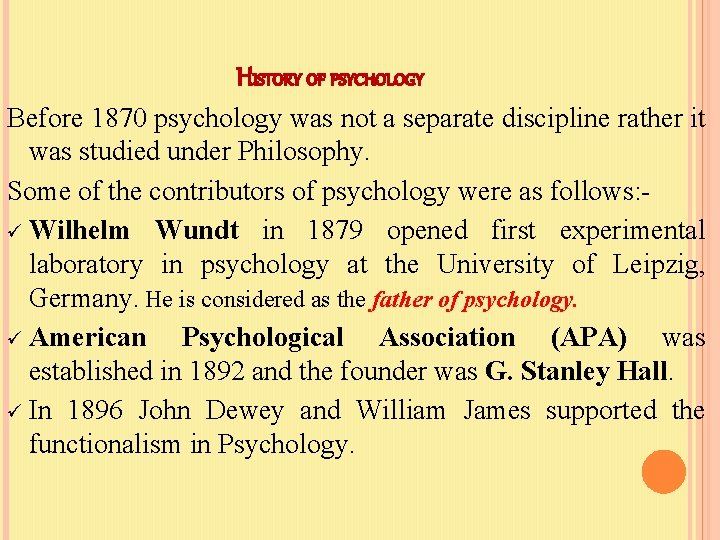
HISTORY OF PSYCHOLOGY Before 1870 psychology was not a separate discipline rather it was studied under Philosophy. Some of the contributors of psychology were as follows: ü Wilhelm Wundt in 1879 opened first experimental laboratory in psychology at the University of Leipzig, Germany. He is considered as the father of psychology. ü American Psychological Association (APA) was established in 1892 and the founder was G. Stanley Hall. ü In 1896 John Dewey and William James supported the functionalism in Psychology.
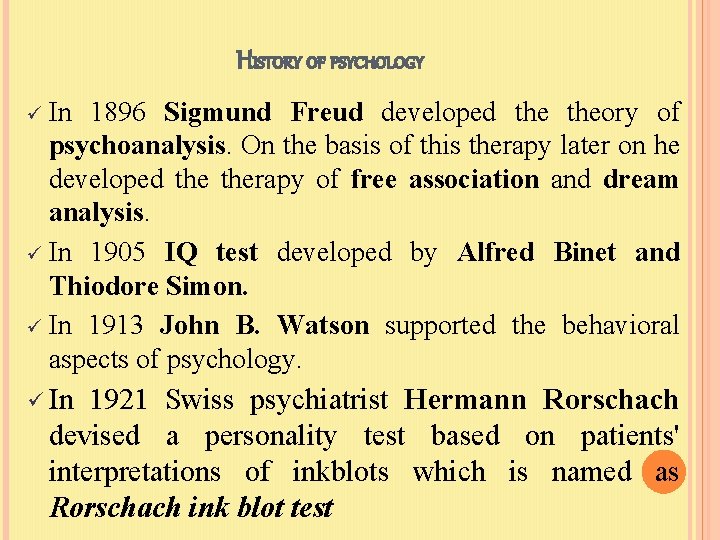
HISTORY OF PSYCHOLOGY ü In 1896 Sigmund Freud developed theory of psychoanalysis. On the basis of this therapy later on he developed therapy of free association and dream analysis. ü In 1905 IQ test developed by Alfred Binet and Thiodore Simon. ü In 1913 John B. Watson supported the behavioral aspects of psychology. ü In 1921 Swiss psychiatrist Hermann Rorschach devised a personality test based on patients' interpretations of inkblots which is named as Rorschach ink blot test
HISTORY OF PSYCHOLOGY ü In 1921 First Nobel Prize for psychological research was given to Charles Frederick Menninger. ü In 1921, Ivan Pavlov developed theory of classical conditioning through the experimental approach ü In 1935 Gestalt Psychology came into existence ü B. F. skinner proposed theory of Operant conditioning
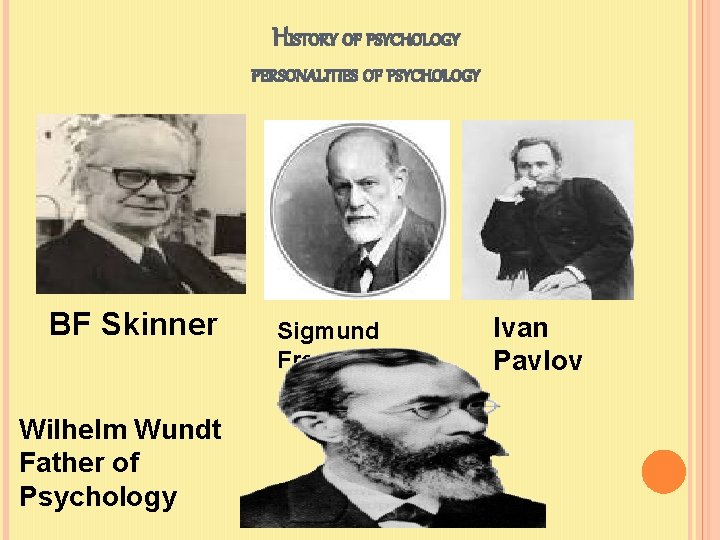
HISTORY OF PSYCHOLOGY PERSONALITIES OF PSYCHOLOGY BF Skinner Wilhelm Wundt Father of Psychology Sigmund Freud Ivan Pavlov
MEANING…. The word "psychology" comes from the Greek word psyche meaning "breath or spirit or soul", and logos meaning the study of something.
DEFINITION OF PSYCHOLOGY “ psychology is the science which aims to give us better understanding and control of the behavior of the organism as a whole” “William Mc. Dougall” “Psychology is a science and the properly trained psychologist is a scientist or at least a practitioner, who uses scientific methods or information resulting from scientific investigation” N. L Munn
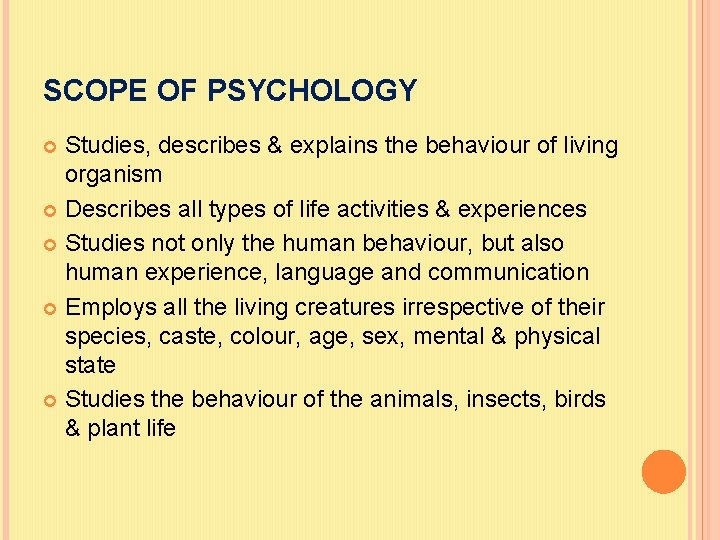
SCOPE OF PSYCHOLOGY Studies, describes & explains the behaviour of living organism Describes all types of life activities & experiences Studies not only the human behaviour, but also human experience, language and communication Employs all the living creatures irrespective of their species, caste, colour, age, sex, mental & physical state Studies the behaviour of the animals, insects, birds & plant life
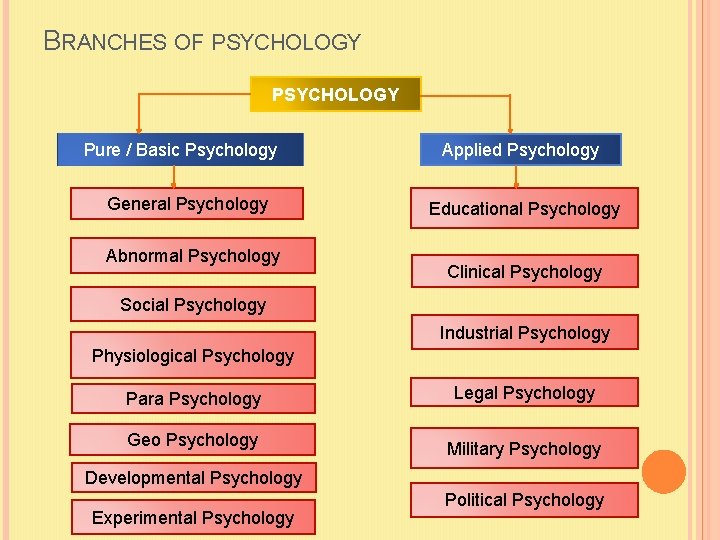
BRANCHES OF PSYCHOLOGY Pure / Basic Psychology General Psychology Abnormal Psychology Applied Psychology Educational Psychology Clinical Psychology Social Psychology Industrial Psychology Physiological Psychology Para Psychology Legal Psychology Geo Psychology Military Psychology Developmental Psychology Experimental Psychology Political Psychology
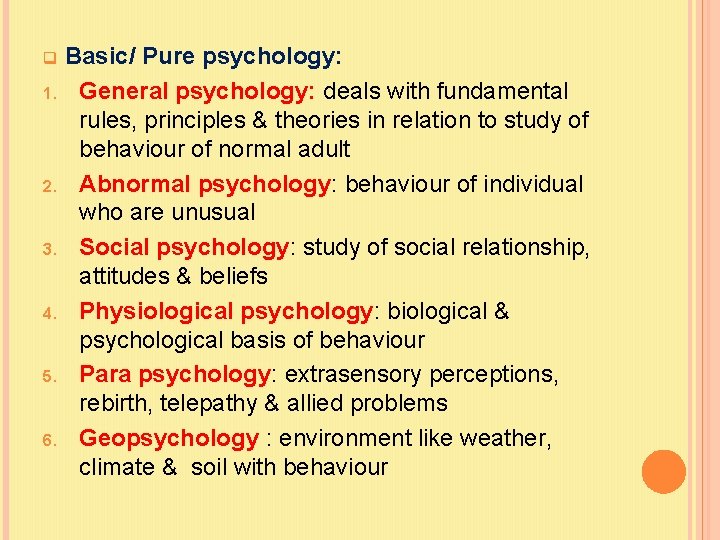
Basic/ Pure psychology: 1. General psychology: deals with fundamental rules, principles & theories in relation to study of behaviour of normal adult 2. Abnormal psychology: behaviour of individual who are unusual 3. Social psychology: study of social relationship, attitudes & beliefs 4. Physiological psychology: biological & psychological basis of behaviour 5. Para psychology: extrasensory perceptions, rebirth, telepathy & allied problems 6. Geopsychology : environment like weather, climate & soil with behaviour q
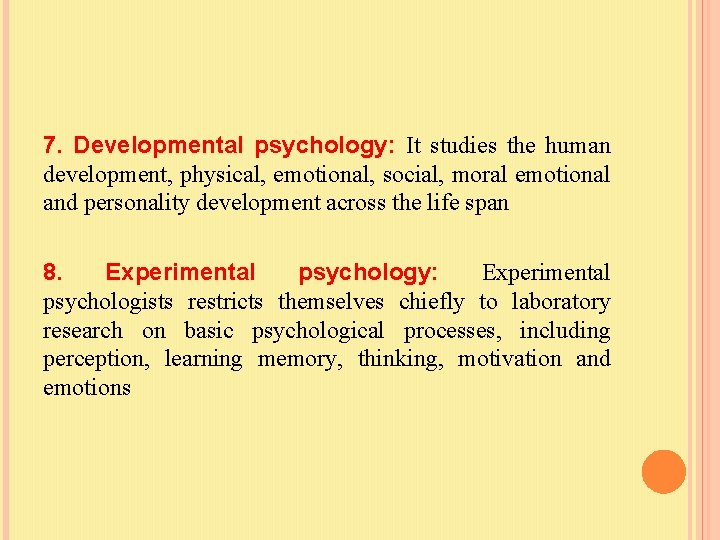
7. Developmental psychology: It studies the human development, physical, emotional, social, moral emotional and personality development across the life span 8. Experimental psychology: Experimental psychologists restricts themselves chiefly to laboratory research on basic psychological processes, including perception, learning memory, thinking, motivation and emotions
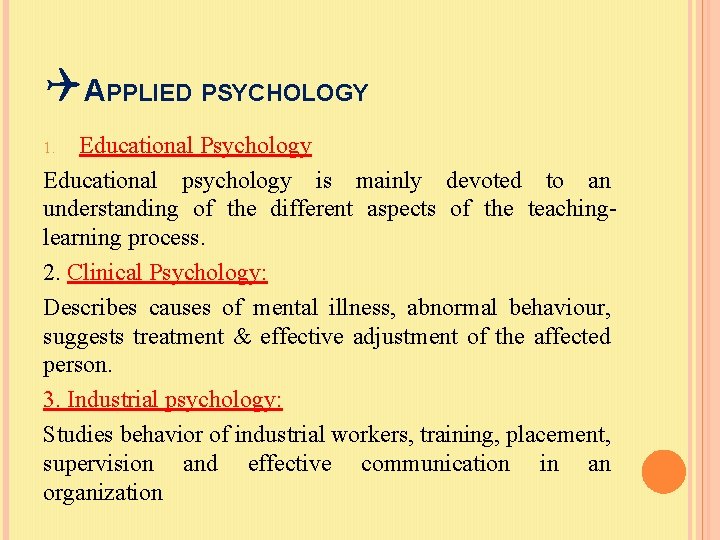
QAPPLIED PSYCHOLOGY Educational Psychology Educational psychology is mainly devoted to an understanding of the different aspects of the teachinglearning process. 2. Clinical Psychology: Describes causes of mental illness, abnormal behaviour, suggests treatment & effective adjustment of the affected person. 3. Industrial psychology: Studies behavior of industrial workers, training, placement, supervision and effective communication in an organization 1.
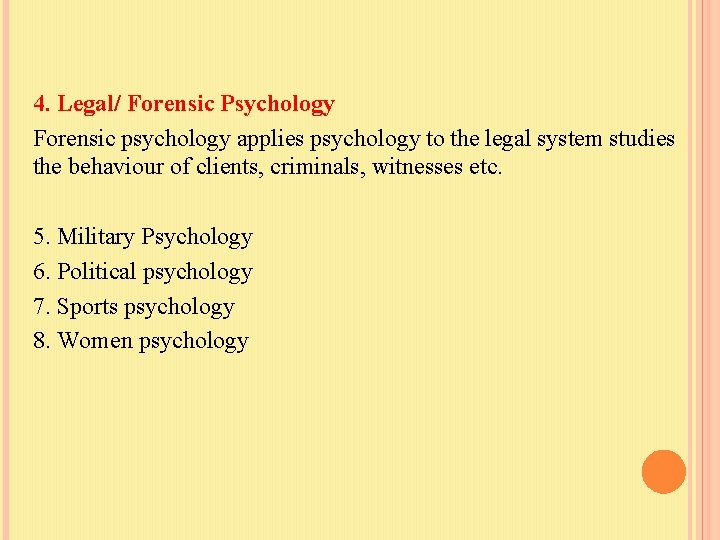
4. Legal/ Forensic Psychology Forensic psychology applies psychology to the legal system studies the behaviour of clients, criminals, witnesses etc. 5. Military Psychology 6. Political psychology 7. Sports psychology 8. Women psychology
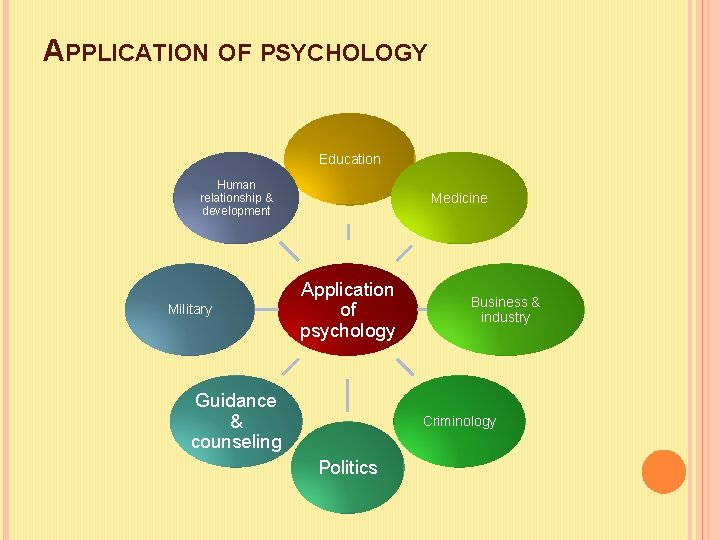
APPLICATION OF PSYCHOLOGY Education Human relationship & development Military Medicine Application of psychology Guidance & counseling Business & industry Criminology Politics
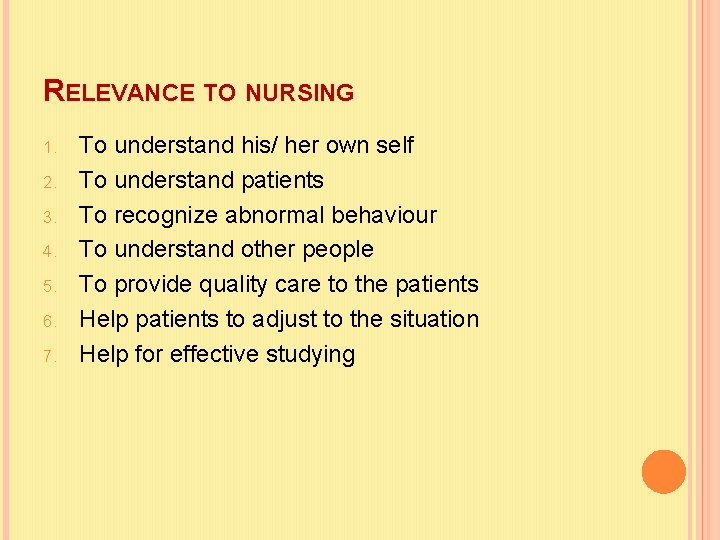
RELEVANCE TO NURSING 1. 2. 3. 4. 5. 6. 7. To understand his/ her own self To understand patients To recognize abnormal behaviour To understand other people To provide quality care to the patients Help patients to adjust to the situation Help for effective studying
RELEVANCE TO NURSING Physical and mental well being of a patient depends largely on the nurse A nurse should know the science of behavior for better result to deal with the patient. Psychology explains the relationship between the psychological stress and physical disorders. After detail study of the psychology nurse can apply the principles of psychology in the dealing with the patients. Psychology helps the nurse to accept the individual differences in terms of likings, disliking, emotions, response to stress etc.
RELEVANCE TO NURSING Psychology also contributes in many therapeutic measures like- behavior therapy, play therapy, psychoanalysis etc. Psychology helps to understand the concept of self awareness, self esteem. It describes the coping abilities, defense mechanism used by the patients and theis relevance to diseased conditions.
RELEVANCE TO NURSING Psychology helps to understand herself Psychology helps to understand other people It will help her to improve situations by helping others Make her to understand close relationship between body mind and spirit.
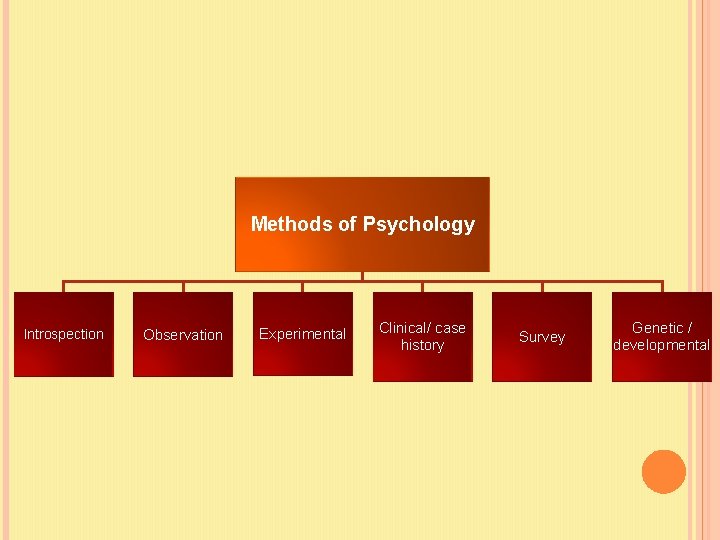
METHODS OF PSYCHOLOGY Methods are special tools and procedures a psychologist uses for gathering information or facts or data
Methods of Psychology Introspection Observation Experimental Clinical/ case history Survey Genetic / developmental
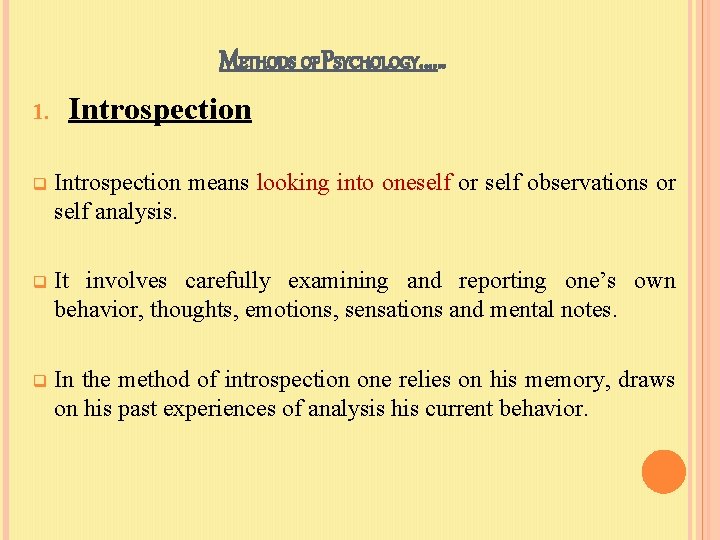
METHODS OF PSYCHOLOGY…… 1. Introspection q Introspection means looking into oneself or self observations or self analysis. q It involves carefully examining and reporting one’s own behavior, thoughts, emotions, sensations and mental notes. q In the method of introspection one relies on his memory, draws on his past experiences of analysis his current behavior.
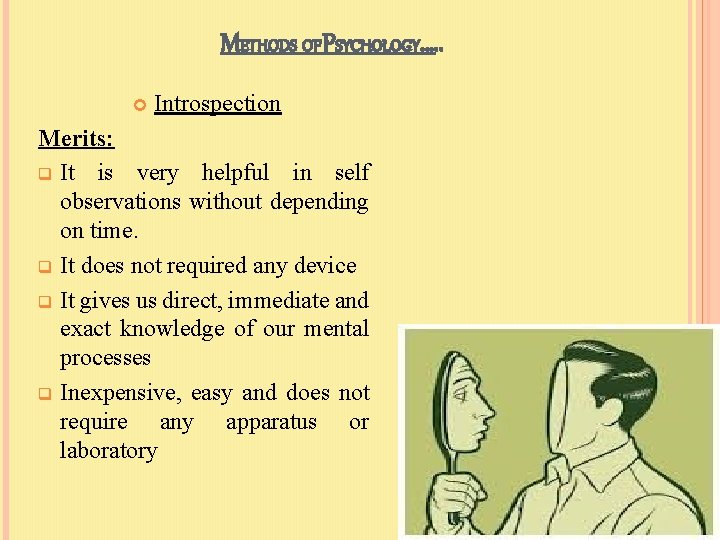
METHODS OF PSYCHOLOGY…. . Introspection Merits: q It is very helpful in self observations without depending on time. q It does not required any device q It gives us direct, immediate and exact knowledge of our mental processes q Inexpensive, easy and does not require any apparatus or laboratory
METHODS OF PSYCHOLOGY… Demerits: q It is a purely private affaire & cannot be verified by other observers. q They can not be verified objectively q Repeatability is not confirmed q In many cases, the patient may not have the insight to know about their conditions q Provide little or no informations about the experiences of infants, children, mentally ill person or animals.
2. OBSERVATIONAL METHOD Objective method of studying the behaviour of individuals Perception of an individuals behaviour under natural conditions by other individuals & interpretation & analysis of perceived behaviour by them Observer observes & collects the data
Steps in Observational Method: q Observation of behaviour q Noting of behaviour q Interpretation & analysis of behaviour q Generalization
Merits: ü Economical, natural, as well as flexible ü The data can be analysed, measured, classified & interpreted ü Suitable for observing developmental characteristics like children’s habits and interests
Demerits: q Chances for subjective report & also prejudices of observer may creep in q Observer may have to spend more time, energy & money q Lacks repeatability, as each natural situation can occur only once
3. EXPERIMENTAL METHOD q Considered most scientific & objective method of studying behaviour q The word “experiment” derived from a Latin word “ to try”, “ to put test” q Used to study cause & effect relationship regarding the nature of human behaviour
Essential feature of experimental method: q Requires two persons, the experimenter & the subject or person q Experimentation should be done on living organisms q Conducted under controlled settings
Merits: q Scientific method q Finds out cause & effect relationship q Maximum control of phenomena q Repetition is possible
Demerits: q All problems of psychology cannot be studied by this method q Costly & time consuming q Requires special skill
4. CLINICAL / CASE HISTORY METHOD: Used by clinical psychologists, psychiatric social workers in child guidance clinics or mental hygiene clinics and allied institutions Studying the cause basis of people’s anxieties, fears & personal maladjustments Data collected by using case histories, interviews, home visits & psychological tests
Merits: q Gives the clinician an insight into the cause of the problem & suggest possible solutions q Can be productive sources of ideas for further investigation by other methods
Demerits: ü Depends largely on memory of incidents which may have been observed inaccurately or over interrupted
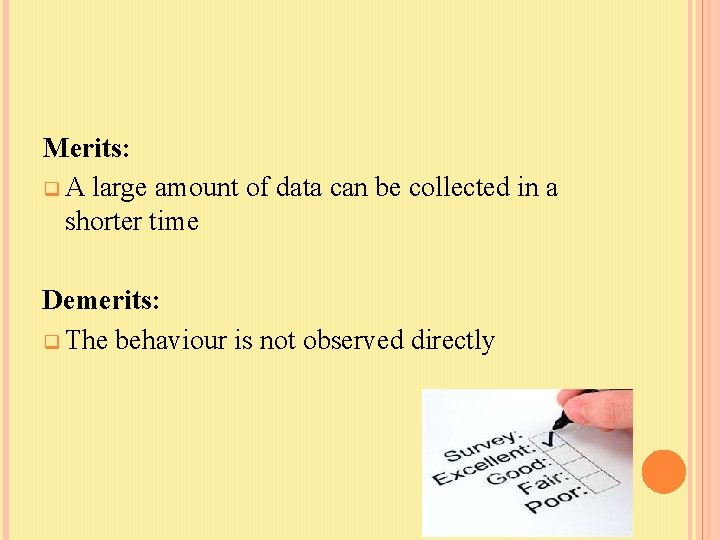
5. SURVEY METHOD o Involves collection or gathering information from a large number of people by using questionnaires, inventories. Checklists, rating scales & interviews o It collects informations about behavior, opinion, attitudes, life experiences or personal characteristics.
Merits: q A large amount of data can be collected in a shorter time Demerits: q The behaviour is not observed directly
6. DEVELOPMENTAL/ GENETIC METHOD Ø Studies human development from birth- death Ø Used in the field of developmental psychology Ø Physical, social, moral, language and emotions are observed in the children Ø Developmental method uses the following techniques. Longitudinal study ( same child will be studied in different stages of life) Cross sectional study (children of different age groups will be studied simultaneously)
Merits: q More useful method to understand the behaviour from point of view of heredity & environmental influences Demerits: q Requires more time & energy