
Introduction to Psychology The Development of Psychological Approaches
- Slides: 10
Introduction to Psychology The Development of Psychological Approaches in History
Structuralism WILLIAM WUNDT (1832 -1920) Set up the first psychological laboratory in 1879 in Germany � Inner workings of the mind � � › Sensation › Perception › Attention � � � Introspection Scientific methods to research First time Psychology is considered a scientific discipline › G. Stanley Hall – 1 st research lab, Johns Hopkins; 1 st psychological journal; American Psychological Association
Functionalism � WILLIAM JAMES (1842 -1910) � Adaptation to environment › Based on Darwin’s theory � Looks at the function rather than structure of consciousness � Development of children › Improving learning and education › Men vs. Women
Psychoanalysis SIGMUND FREUD (1865 - 1939) � Nervous problems which stemmed from unconscious mental forces and conflicts � New ideas about: � › › Motivation Child development Personality Abnormal behaviour Process of uncovering patients’ unconscious thoughts by uncovering their past � Karen Horney (1885 – 1952) � › Feminine Psychology
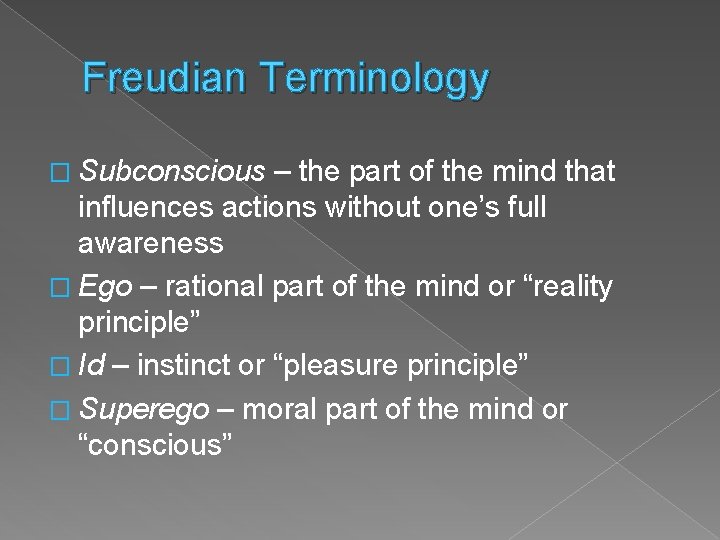
Freudian Terminology � Subconscious – the part of the mind that influences actions without one’s full awareness � Ego – rational part of the mind or “reality principle” � Id – instinct or “pleasure principle” � Superego – moral part of the mind or “conscious”
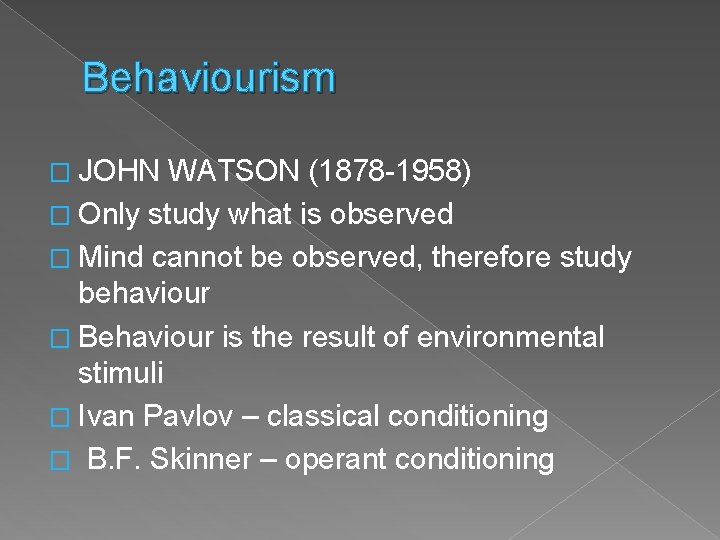
Behaviourism � JOHN WATSON (1878 -1958) � Only study what is observed � Mind cannot be observed, therefore study behaviour � Behaviour is the result of environmental stimuli � Ivan Pavlov – classical conditioning � B. F. Skinner – operant conditioning
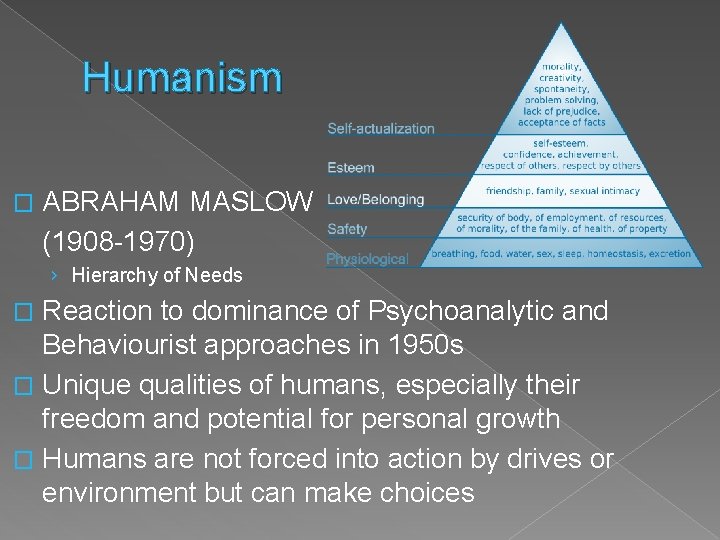
Humanism � ABRAHAM MASLOW (1908 -1970) › Hierarchy of Needs Reaction to dominance of Psychoanalytic and Behaviourist approaches in 1950 s � Unique qualities of humans, especially their freedom and potential for personal growth � Humans are not forced into action by drives or environment but can make choices �
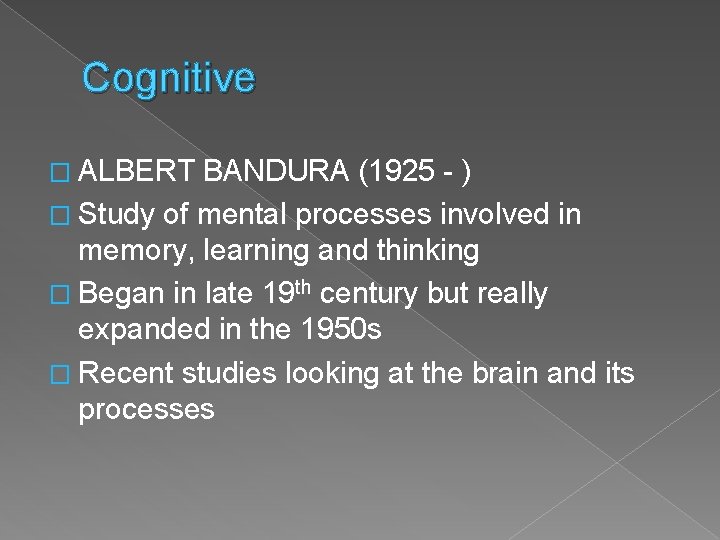
Cognitive � ALBERT BANDURA (1925 - ) � Study of mental processes involved in memory, learning and thinking � Began in late 19 th century but really expanded in the 1950 s � Recent studies looking at the brain and its processes
Psychology “the science of mind and behaviour” “the way a person or group thinks” - Webster’s Dictionary “The scientific study of behaviour and mental processes, and the factors that influence these processes. ” - Wayne Sproule, Our Social World
Sources � Sproule, Wayne. Our Social World: An Introduction to Anthropology, Psychology and Sociology. Toronto: Prentice Hall, 2001. � Weiten, Wayne and Doug Mc. Cann. Psychology: Themes and Variations. Toronto: Thomas Canada Limited, 2007. � Haskings-Winner, Jan. Social Science: An Introduction. Toronto: Mc. Graw-Hill Ryerson Ltd, 2011.