
Introduction to Psychology Psychological Foundations What is Psychology
- Slides: 20
Introduction to Psychology Psychological Foundations
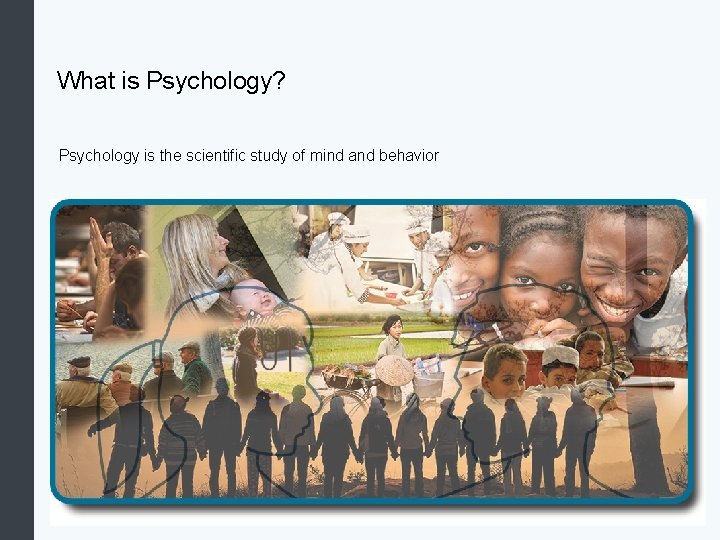
What is Psychology? Psychology is the scientific study of mind and behavior
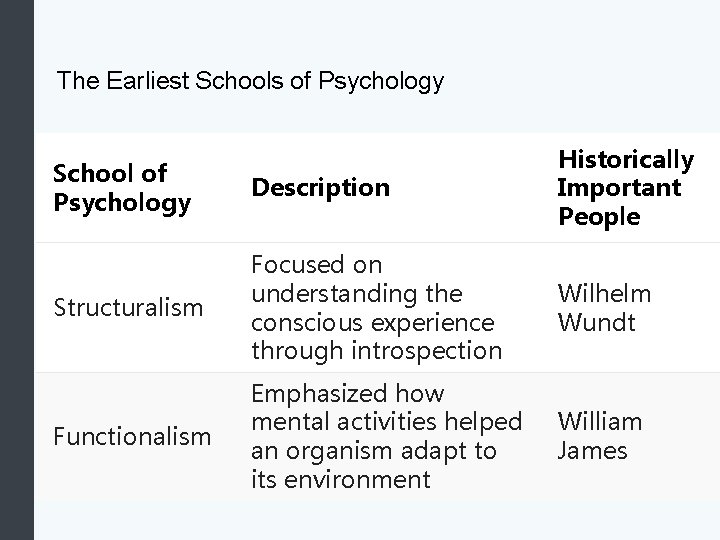
The Earliest Schools of Psychology School of Psychology Description Historically Important People Structuralism Focused on understanding the conscious experience through introspection Wilhelm Wundt Functionalism Emphasized how mental activities helped an organism adapt to its environment William James
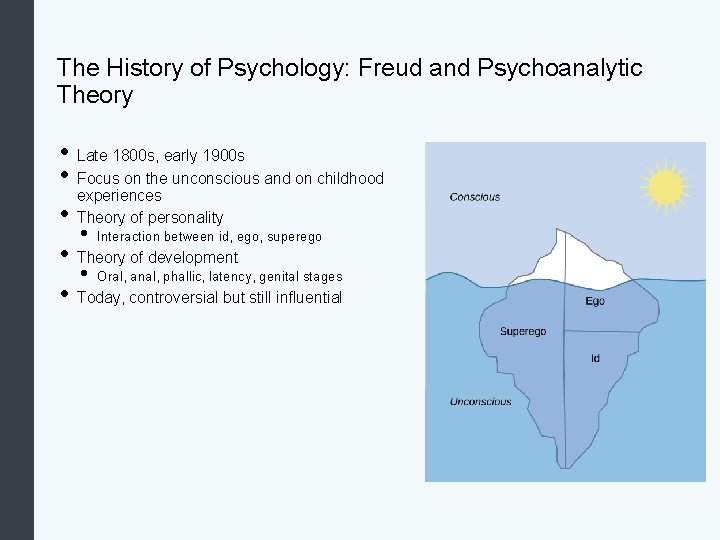
The History of Psychology: Freud and Psychoanalytic Theory • Late 1800 s, early 1900 s • Focus on the unconscious and on childhood experiences • Theory of personality • Interaction between id, ego, superego • Theory of development • Oral, anal, phallic, latency, genital stages • Today, controversial but still influential
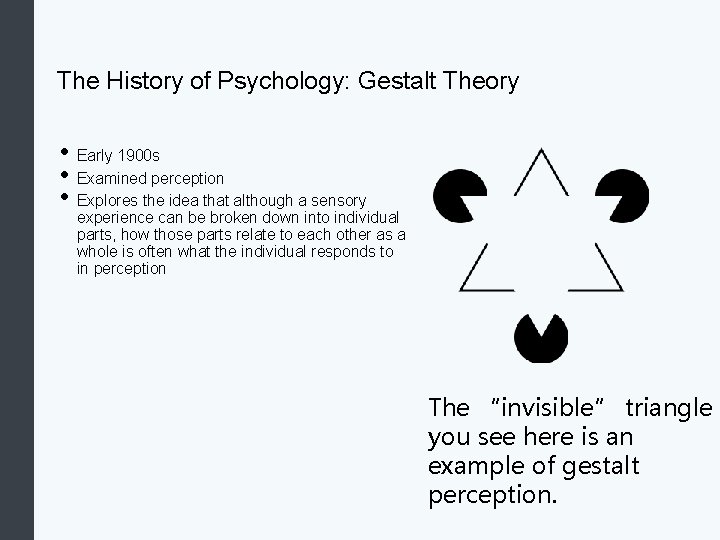
The History of Psychology: Gestalt Theory • Early 1900 s • Examined perception • Explores the idea that although a sensory experience can be broken down into individual parts, how those parts relate to each other as a whole is often what the individual responds to in perception The “invisible” triangle you see here is an example of gestalt perception.
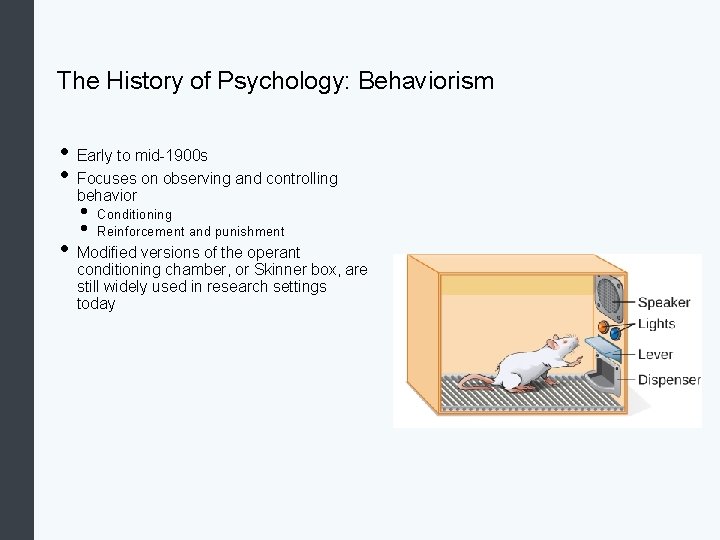
The History of Psychology: Behaviorism • Early to mid-1900 s • Focuses on observing and controlling behavior • • Conditioning Reinforcement and punishment • Modified versions of the operant conditioning chamber, or Skinner box, are still widely used in research settings today
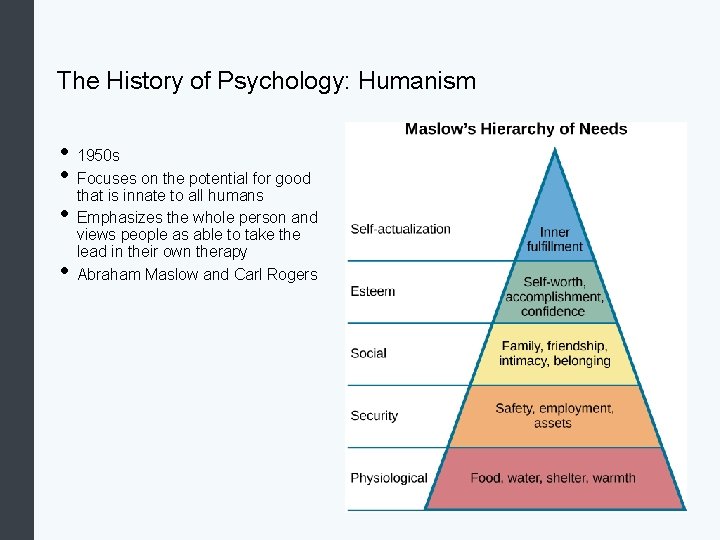
The History of Psychology: Humanism • 1950 s • Focuses on the potential for good that is innate to all humans • Emphasizes the whole person and • views people as able to take the lead in their own therapy Abraham Maslow and Carl Rogers
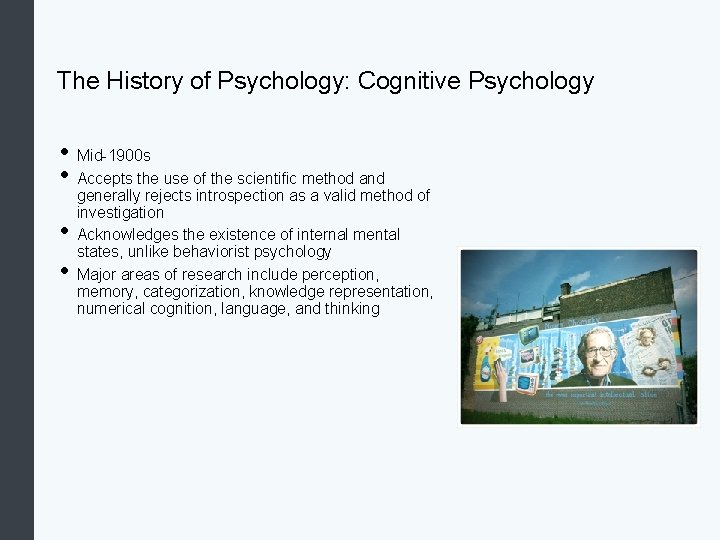
The History of Psychology: Cognitive Psychology • Mid-1900 s • Accepts the use of the scientific method and • • generally rejects introspection as a valid method of investigation Acknowledges the existence of internal mental states, unlike behaviorist psychology Major areas of research include perception, memory, categorization, knowledge representation, numerical cognition, language, and thinking
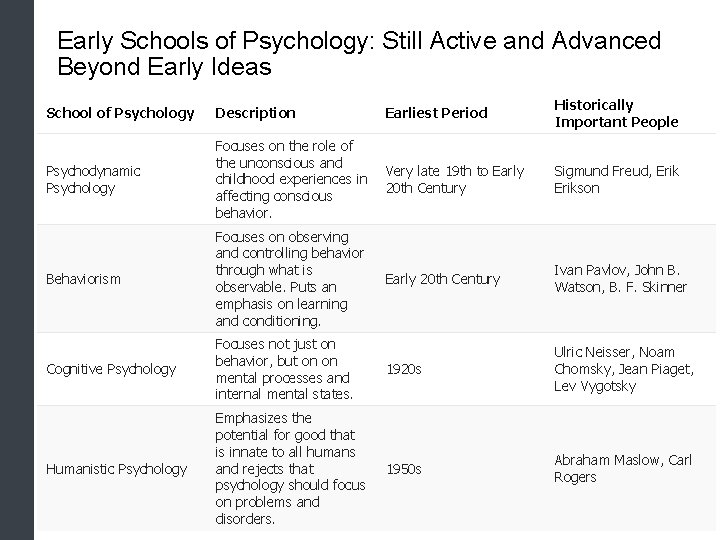
Early Schools of Psychology: Still Active and Advanced Beyond Early Ideas School of Psychology Description Earliest Period Historically Important People Psychodynamic Psychology Focuses on the role of the unconscious and childhood experiences in affecting conscious behavior. Very late 19 th to Early 20 th Century Sigmund Freud, Erikson Behaviorism Focuses on observing and controlling behavior through what is observable. Puts an emphasis on learning and conditioning. Early 20 th Century Ivan Pavlov, John B. Watson, B. F. Skinner Cognitive Psychology Focuses not just on behavior, but on on mental processes and internal mental states. 1920 s Ulric Neisser, Noam Chomsky, Jean Piaget, Lev Vygotsky Humanistic Psychology Emphasizes the potential for good that is innate to all humans and rejects that psychology should focus on problems and disorders. 1950 s Abraham Maslow, Carl Rogers
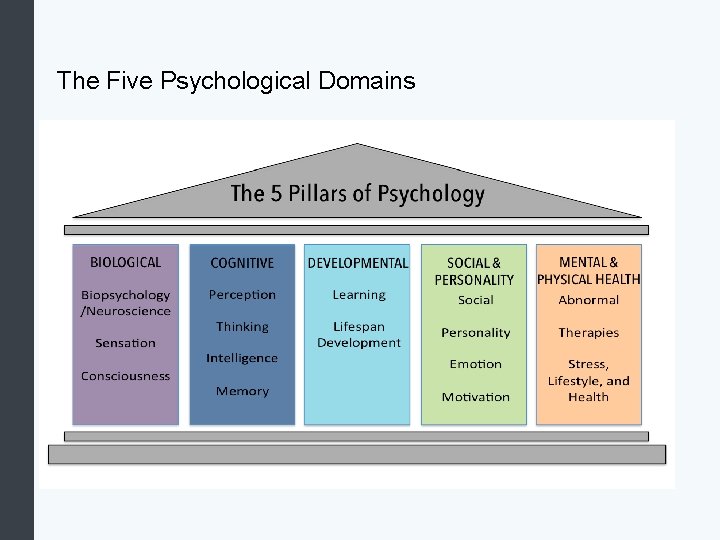
The Five Psychological Domains
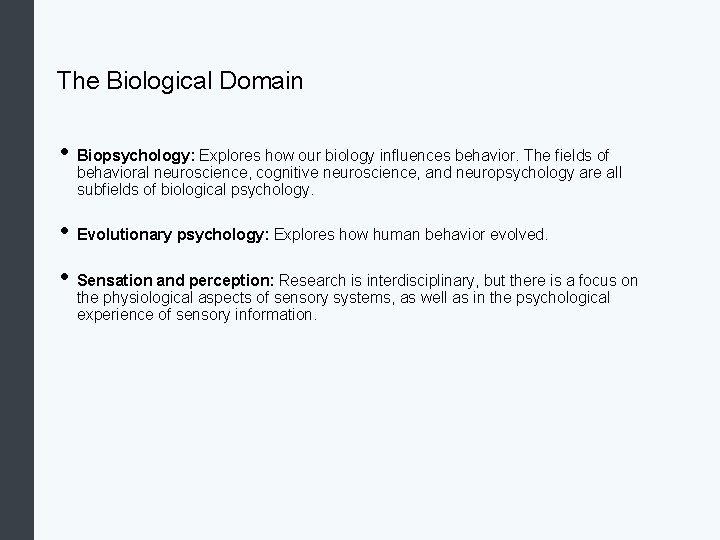
The Biological Domain • Biopsychology: Explores how our biology influences behavior. The fields of behavioral neuroscience, cognitive neuroscience, and neuropsychology are all subfields of biological psychology. • Evolutionary psychology: Explores how human behavior evolved. • Sensation and perception: Research is interdisciplinary, but there is a focus on the physiological aspects of sensory systems, as well as in the psychological experience of sensory information.
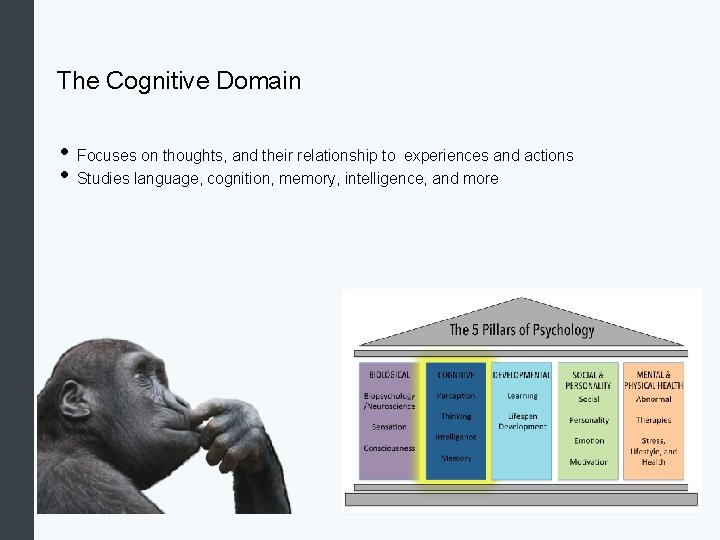
The Cognitive Domain • Focuses on thoughts, and their relationship to experiences and actions • Studies language, cognition, memory, intelligence, and more
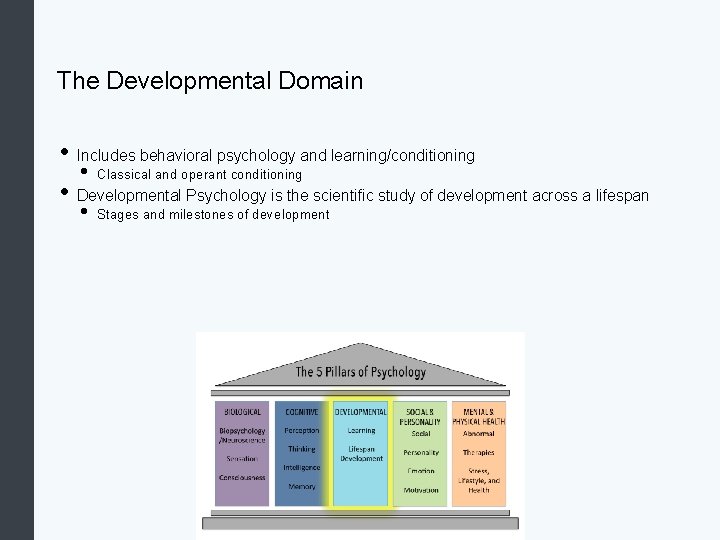
The Developmental Domain • Includes behavioral psychology and learning/conditioning • Classical and operant conditioning • Developmental Psychology is the scientific study of development across a lifespan • Stages and milestones of development
The Social and Personality Psychology Domain • Social psychology is the scientific study of how people’s thoughts, feelings, and behaviors are influenced by the actual, imagined, or implied presence of others • Personality psychology is the study of patterns of thoughts and behaviors that make each individual unique • A personality trait is a consistent pattern of thought and behavior
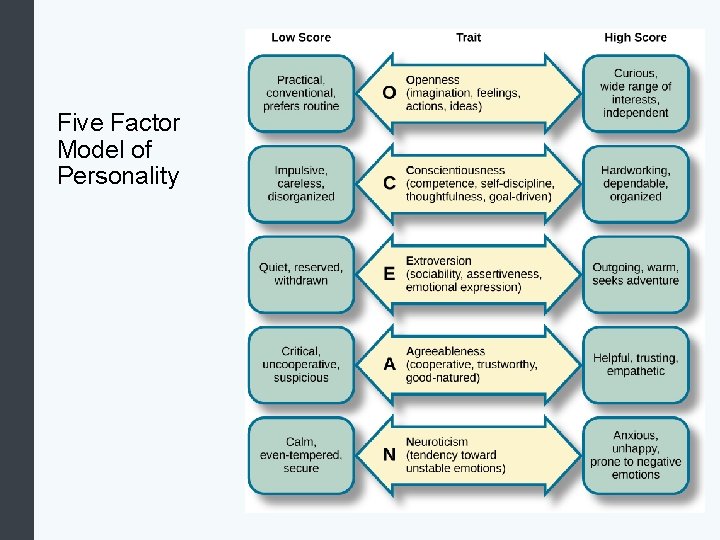
Five Factor Model of Personality
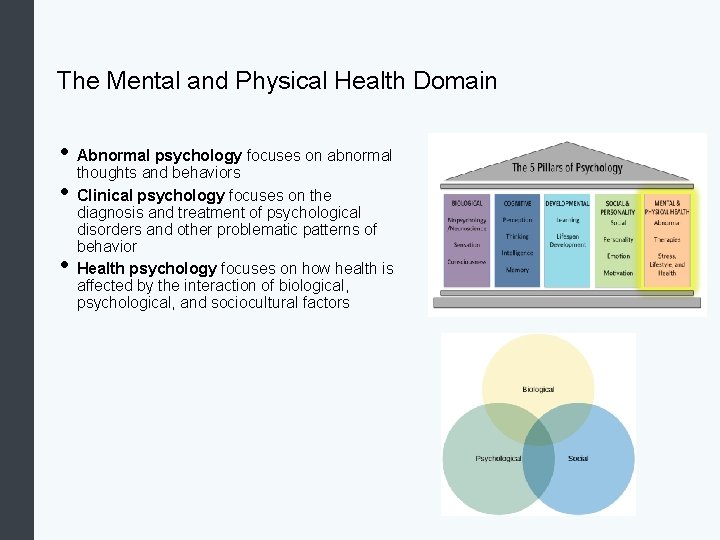
The Mental and Physical Health Domain • Abnormal psychology focuses on abnormal thoughts and behaviors • Clinical psychology focuses on the • diagnosis and treatment of psychological disorders and other problematic patterns of behavior Health psychology focuses on how health is affected by the interaction of biological, psychological, and sociocultural factors
Other Sub-fields in Psychology Industrial-Organizational psychology applies psychological theories, principles, and research findings in industrial and organizational settings. Forensic psychology applies the science and practice of psychology to the justice system. Sport and exercise psychology focuses on the interactions between mental and emotional factors and physical performance in sports, exercise, and other activities
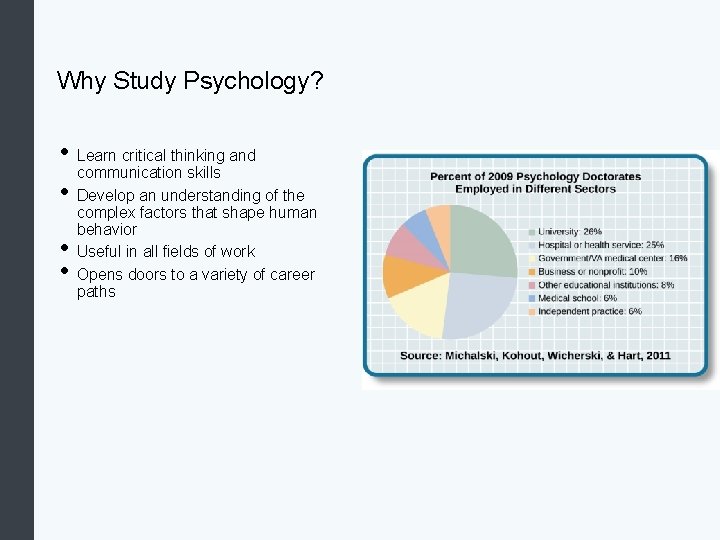
Why Study Psychology? • Learn critical thinking and communication skills • Develop an understanding of the • • complex factors that shape human behavior Useful in all fields of work Opens doors to a variety of career paths
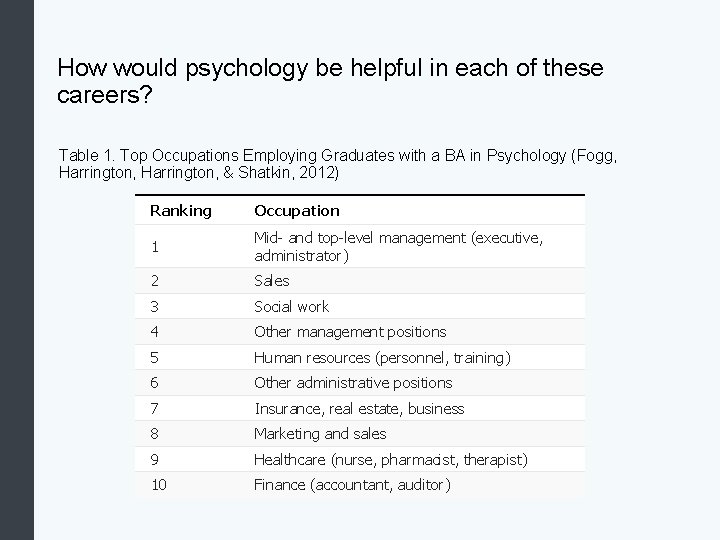
How would psychology be helpful in each of these careers? Table 1. Top Occupations Employing Graduates with a BA in Psychology (Fogg, Harrington, & Shatkin, 2012) Ranking Occupation 1 Mid- and top-level management (executive, administrator) 2 Sales 3 Social work 4 Other management positions 5 Human resources (personnel, training) 6 Other administrative positions 7 Insurance, real estate, business 8 Marketing and sales 9 Healthcare (nurse, pharmacist, therapist) 10 Finance (accountant, auditor)
Quick Review • What is psychology? • Summarize the history of psychology • Describe the early schools of psychology • What are the approaches, fields, and subfields of contemporary psychology? • What major concepts are part of each field? • Why is studying psychology valuable? • What possible career paths are there in psychology?