
Introduction to Psychology Mental Disorders Chapter 15 Journal
- Slides: 47
Introduction to Psychology Mental Disorders
Chapter 15 Journal When you think of a person with a mental illness, what comes to mind? What examples can you think of from TV, movies, or books? How would you react to a person with a mental illness? Should the rights of people with mental illness be different?
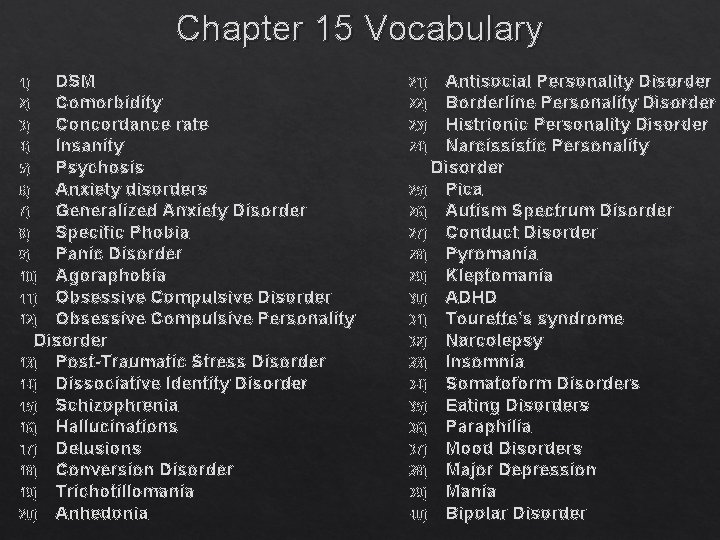
Chapter 15 Vocabulary DSM 2) Comorbidity 3) Concordance rate 4) Insanity 5) Psychosis 6) Anxiety disorders 7) Generalized Anxiety Disorder 8) Specific Phobia 9) Panic Disorder 10) Agoraphobia 11) Obsessive Compulsive Disorder 12) Obsessive Compulsive Personality Disorder 13) Post-Traumatic Stress Disorder 14) Dissociative Identity Disorder 15) Schizophrenia 16) Hallucinations 17) Delusions 18) Conversion Disorder 19) Trichotillomania 20) Anhedonia 1) Antisocial Personality Disorder 22) Borderline Personality Disorder 23) Histrionic Personality Disorder 24) Narcissistic Personality Disorder 25) Pica 26) Autism Spectrum Disorder 27) Conduct Disorder 28) Pyromania 29) Kleptomania 30) ADHD 31) Tourette’s syndrome 32) Narcolepsy 33) Insomnia 34) Somatoform Disorders 35) Eating Disorders 36) Paraphilia 37) Mood Disorders 38) Major Depression 39) Mania 40) Bipolar Disorder 21)
Chapter 15 Project Each student will create a 5 -10 minute Power. Point presentation on a specific mental disorder. The presentation must include the following: Statistics on Prevalence Diagnostic Criteria/Symptoms Psychopathology/Causes and Course Neurological Correlates Comorbidity Treatments Examples of people with the disorder All information must be accurate as per the DSM-V https: //cdn. websiteeditor. net/30 f 11123991548 a 0 af 708722 d 458 e 476/files/uploaded/DSM%25 20 V. pdf
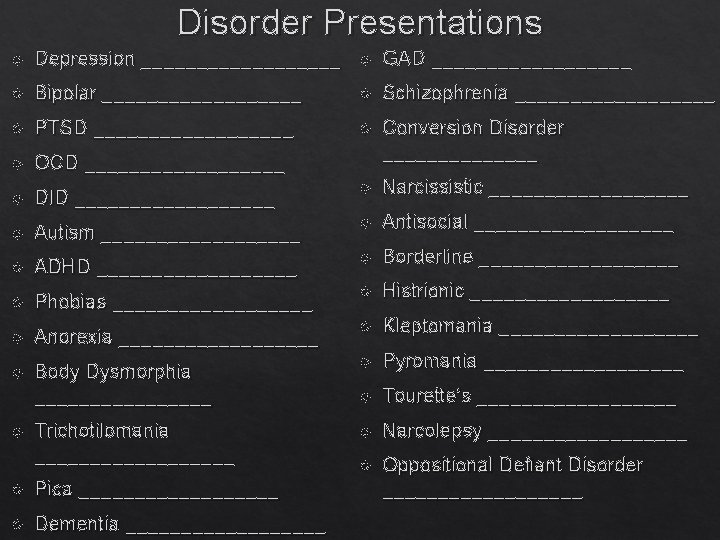
Disorder Presentations Depression _________ GAD _________ Bipolar _________ Schizophrenia _________ PTSD _________ OCD _________ Conversion Disorder _______ DID _________ Narcissistic _________ Autism _________ Antisocial _________ ADHD _________ Borderline _________ Phobias _________ Histrionic _________ Anorexia _________ Kleptomania _________ Body Dysmorphia ________ Pyromania _________ Tourette’s _________ Trichotilomania _________ Narcolepsy _________ Oppositional Defiant Disorder _________ Pica _________ Dementia _________
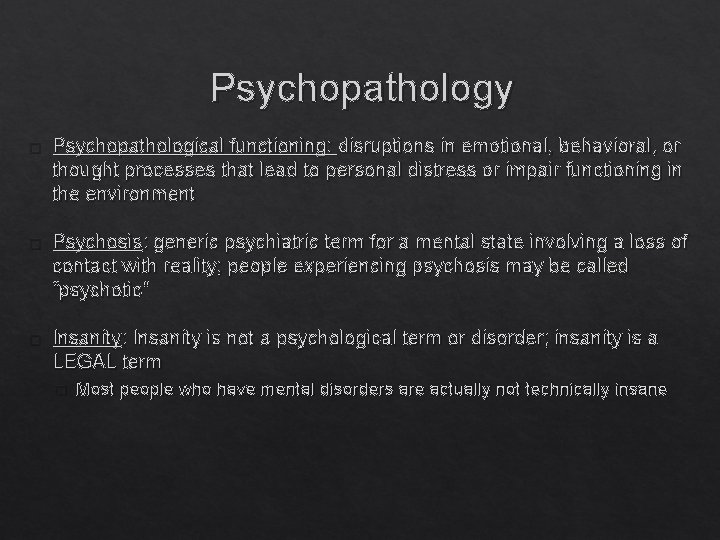
Psychopathology � Psychopathological functioning: disruptions in emotional, behavioral, or thought processes that lead to personal distress or impair functioning in the environment � Psychosis: generic psychiatric term for a mental state involving a loss of contact with reality; people experiencing psychosis may be called “psychotic” � Insanity: Insanity is not a psychological term or disorder; insanity is a LEGAL term � Most people who have mental disorders are actually not technically insane
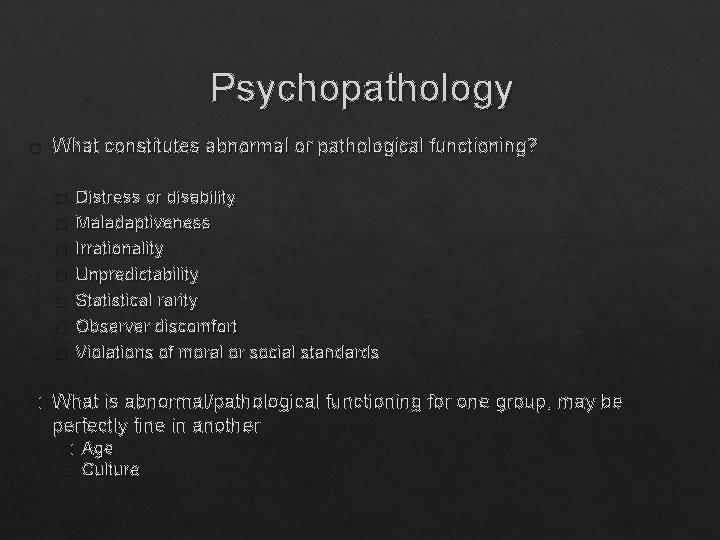
Psychopathology � What constitutes abnormal or pathological functioning? � � � � Distress or disability Maladaptiveness Irrationality Unpredictability Statistical rarity Observer discomfort Violations of moral or social standards What is abnormal/pathological functioning for one group, may be perfectly fine in another � � Age Culture
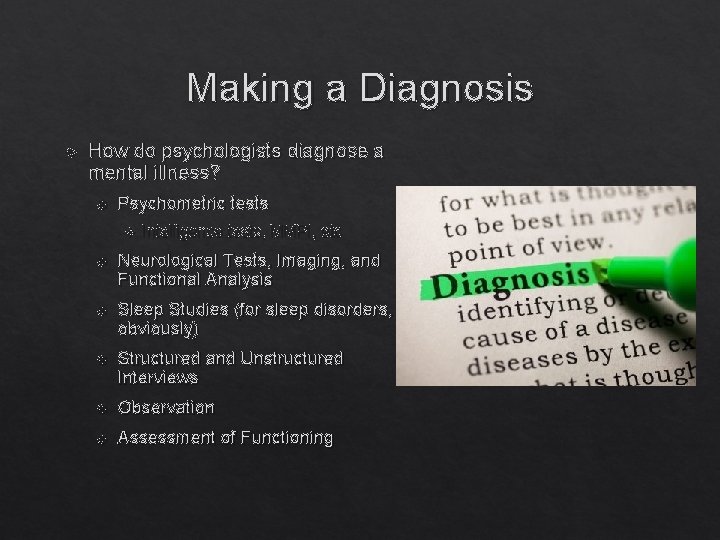
Making a Diagnosis How do psychologists diagnose a mental illness? Psychometric tests Intelligence tests, MMPI, etc Neurological Tests, Imaging, and Functional Analysis Sleep Studies (for sleep disorders, obviously) Structured and Unstructured Interviews Observation Assessment of Functioning
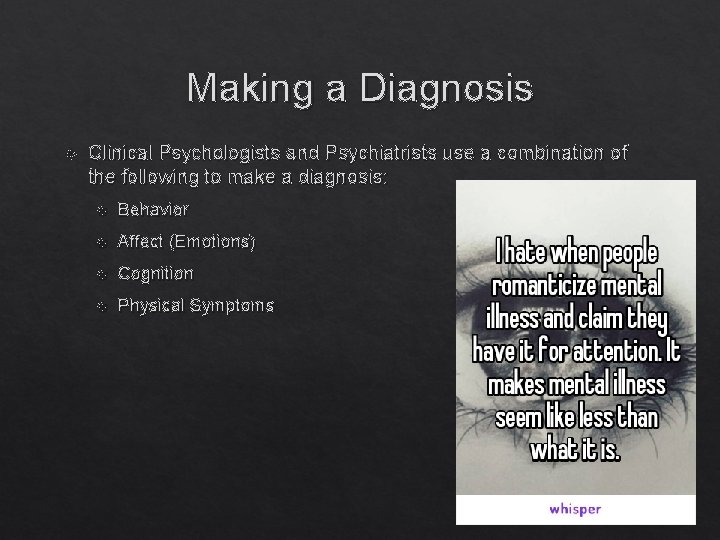
Making a Diagnosis Clinical Psychologists and Psychiatrists use a combination of the following to make a diagnosis: Behavior Affect (Emotions) Cognition Physical Symptoms
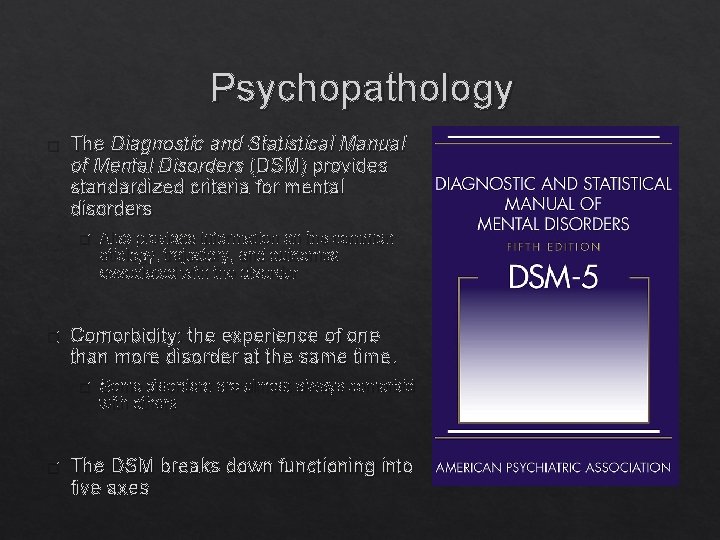
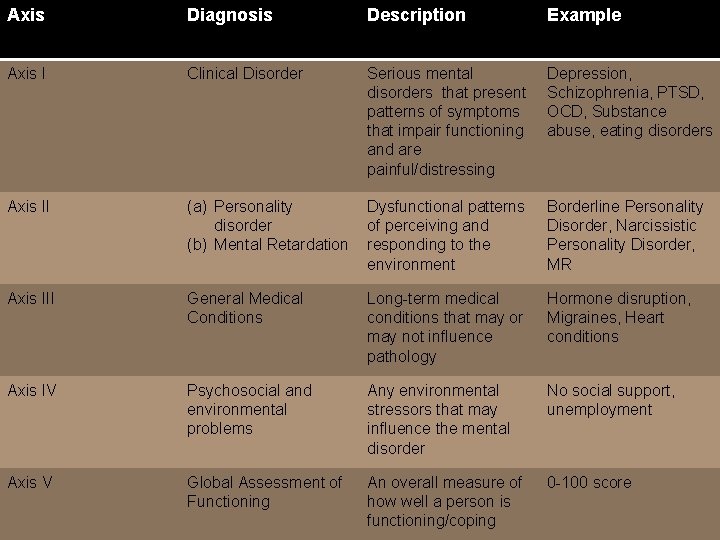
Psychopathology � The Diagnostic and Statistical Manual of Mental Disorders (DSM) provides standardized criteria for mental disorders � � Comorbidity: the experience of one than more disorder at the same time. � � Also provides information on the common etiology, trajectory, and outcomes associated with the disorder Some disorders are almost always comorbid with others The DSM breaks down functioning into five axes
Axis Diagnosis Description Example Axis I Clinical Disorder Serious mental disorders that present patterns of symptoms that impair functioning and are painful/distressing Depression, Schizophrenia, PTSD, OCD, Substance abuse, eating disorders Axis II (a) Personality disorder (b) Mental Retardation Dysfunctional patterns of perceiving and responding to the environment Borderline Personality Disorder, Narcissistic Personality Disorder, MR Axis III General Medical Conditions Long-term medical conditions that may or may not influence pathology Hormone disruption, Migraines, Heart conditions Axis IV Psychosocial and environmental problems Any environmental stressors that may influence the mental disorder No social support, unemployment Axis V Global Assessment of Functioning An overall measure of how well a person is functioning/coping 0 -100 score
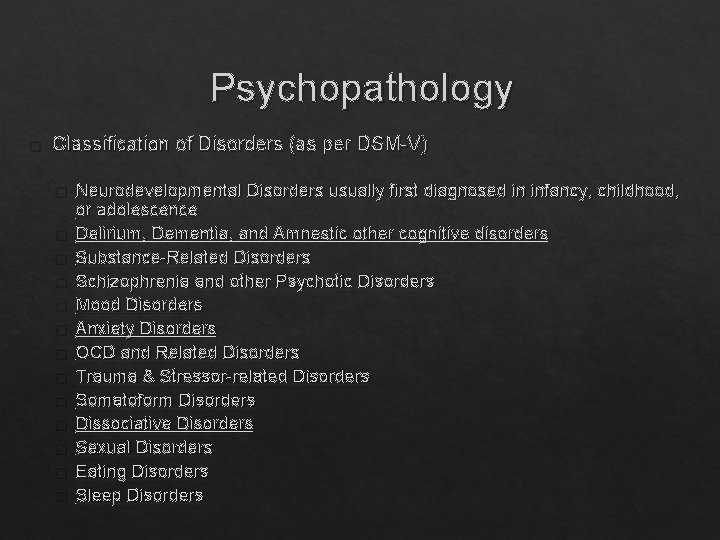
Psychopathology � Classification of Disorders (as per DSM-V) � � � � Neurodevelopmental Disorders usually first diagnosed in infancy, childhood, or adolescence Delirium, Dementia, and Amnestic other cognitive disorders Substance-Related Disorders Schizophrenia and other Psychotic Disorders Mood Disorders Anxiety Disorders OCD and Related Disorders Trauma & Stressor-related Disorders Somatoform Disorders Dissociative Disorders Sexual Disorders Eating Disorders Sleep Disorders
Neurodevelopmental Disorders � Intellectual Disabilities � Communication Disorders � Autism Spectrum Disorder � Attention Deficit/Hyperactivity Disorder (ADHD) � Motor/Tic Disorders (i. e. Tourette’s)
Neurodevelopmental Disorders � Intellectual Disability � Deficits in intellectual functions such as reasoning, problem solving, planning, academic learning, and learning from experience � Deficits in adaptive functioning result in failure to meet developmental and sociocultural standards; limitations in communication, social participation, and independent living across multiple situations � Onset of intellectual and adaptive deficits during childhood
Neurodevelopmental Disorders � Communication Disorders � Class of disorders that includes deficits in language, speech, and communication. � Language disorder � Speech sound disorder � Stuttering � Pragmatic communication disorder
Neurodevelopmental Disorders � Autism Spectrum Disorder (ASD) � � Persistent deficits in social communication and social interaction across multiple contexts � Social emotional reciprocity � Deficits in nonverbal communicative behaviors � Deficits in developing and maintaining relationships Restricted repetitive patters of behavior, interests, or activities as manifested by two or more of the following � Stereotyped or repetitive motor movements � Insistence on routine � Fixed interests that are abnormal in intensity � Hyper- or hypo-activity to sensory input � Symptoms must be present in early childhood � Symptoms cause clinically significant impairment � Symptoms are not better explained by intellectual disability
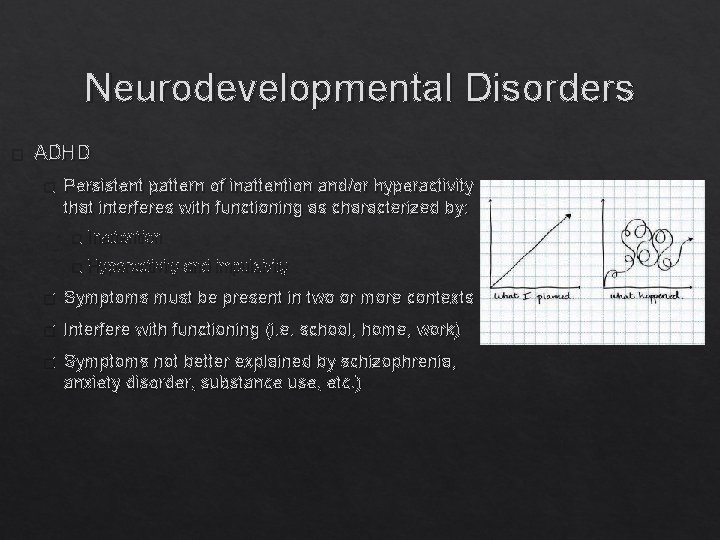
Neurodevelopmental Disorders � ADHD � Persistent pattern of inattention and/or hyperactivity that interferes with functioning as characterized by: � Inattention � Hyperactivity and impulsivity � Symptoms must be present in two or more contexts � Interfere with functioning (i. e. school, home, work) � Symptoms not better explained by schizophrenia, anxiety disorder, substance use, etc. )
Neurodevelopmental Disorders � Tourette’s Syndrome � Both multiple motor and vocal tics have been present at some time during the illness � Tic – a sudden, rapid, recurrent, nonrhythmic motor movement or vocalization � Onset before age 18 � Tics have persisted for more than 1 year � Only 10% of people with Tourette’s have coprolalia (involuntary swearing)
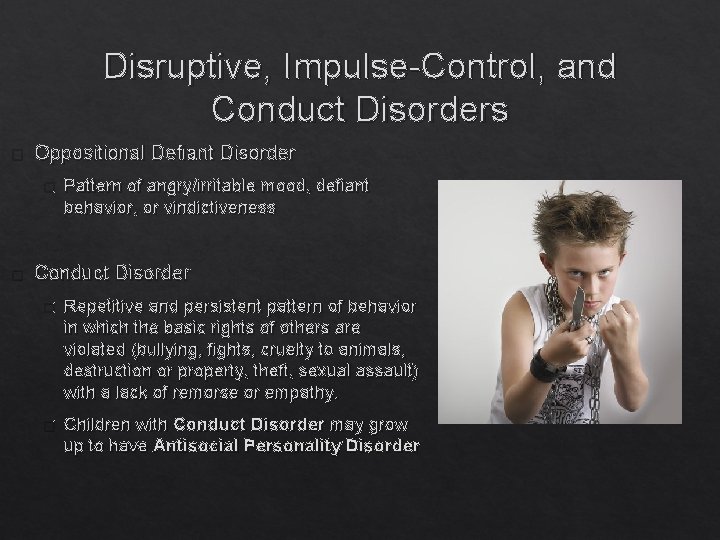
Disruptive, Impulse-Control, and Conduct Disorders � Oppositional Defiant Disorder � � Pattern of angry/irritable mood, defiant behavior, or vindictiveness Conduct Disorder � Repetitive and persistent pattern of behavior in which the basic rights of others are violated (bullying, fights, cruelty to animals, destruction or property, theft, sexual assault) with a lack of remorse or empathy. � Children with Conduct Disorder may grow up to have Antisocial Personality Disorder
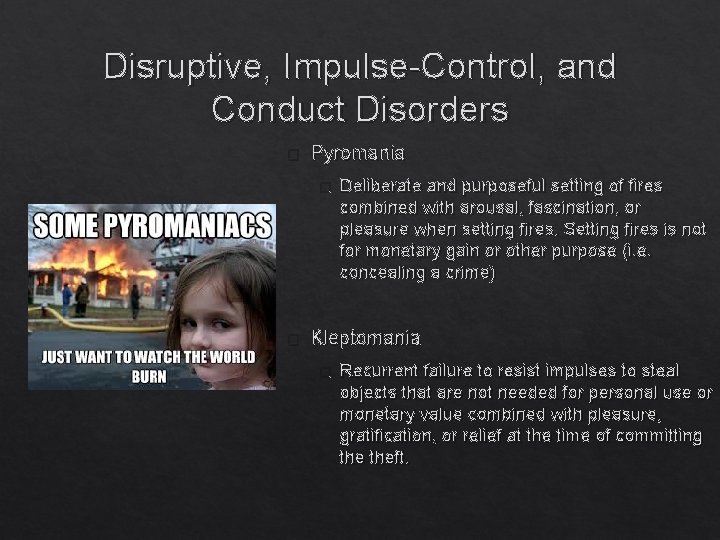
Disruptive, Impulse-Control, and Conduct Disorders � Pyromania � � Deliberate and purposeful setting of fires combined with arousal, fascination, or pleasure when setting fires. Setting fires is not for monetary gain or other purpose (i. e. concealing a crime) Kleptomania � Recurrent failure to resist impulses to steal objects that are not needed for personal use or monetary value combined with pleasure, gratification, or relief at the time of committing theft.
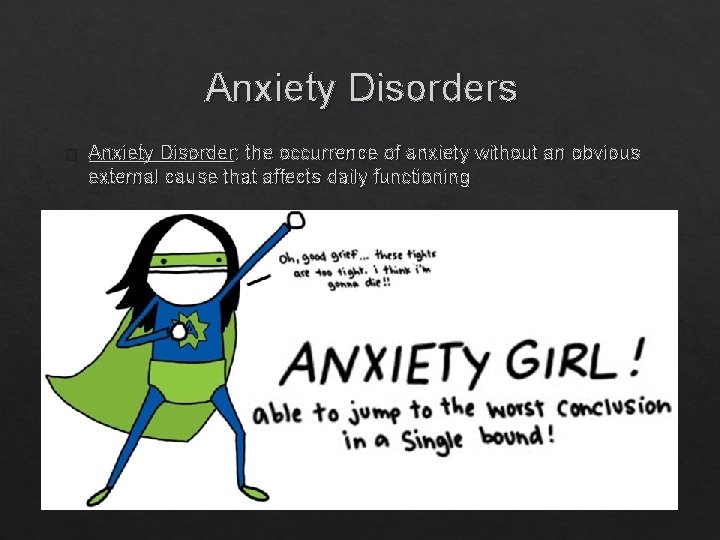
Anxiety Disorders � Anxiety Disorder: the occurrence of anxiety without an obvious external cause that affects daily functioning
Anxiety Disorders � Generalized Anxiety Disorder � � Panic Disorder � � Excessive anxiety or worry in a variety of events and situations Recurrent panic attacks Specific Phobias � Unreasonable and excessive fear of a particular stimulus � Agoraphobia
Obsessive Compulsive and Related Disorders � Obsessive Compulsive Disorder � � Hoarding Disorder � � Recurrent, unreasonable, severe obsessions (thoughts) and compulsions (behaviors) marked by distress Persistent difficulty discarding or parting with possessions, regardless of actual value to the extent that it impairs the function of the living area as well as social impairment Trichotillomania � Recurrent, compulsive pulling out of one’s hair resulting in hair loss and causing distress or impairment in social, occupational, or other areas of functioning
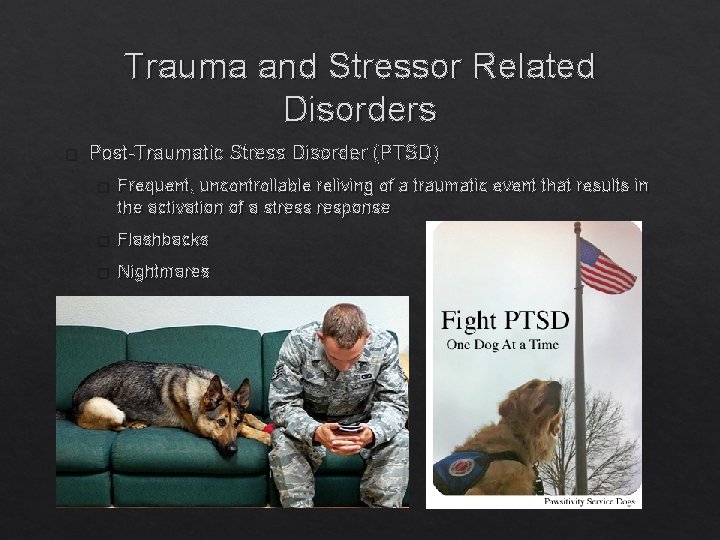
Trauma and Stressor Related Disorders � Post-Traumatic Stress Disorder (PTSD) � Frequent, uncontrollable reliving of a traumatic event that results in the activation of a stress response � Flashbacks � Nightmares
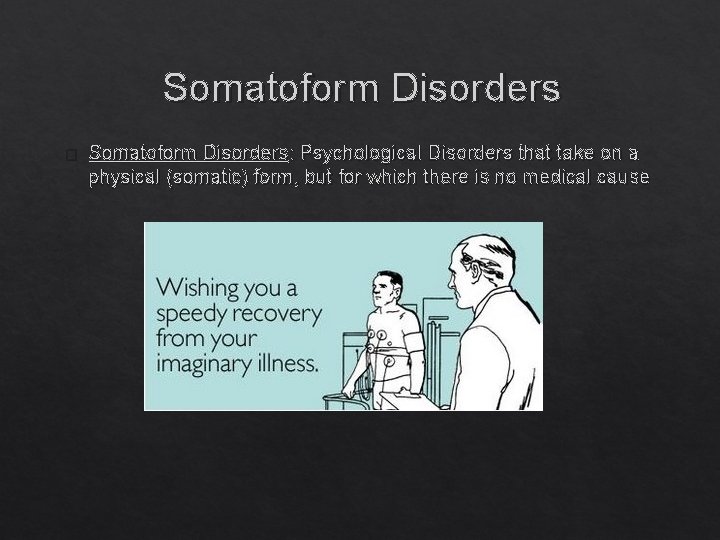
Somatoform Disorders � Somatoform Disorders: Psychological Disorders that take on a physical (somatic) form, but for which there is no medical cause
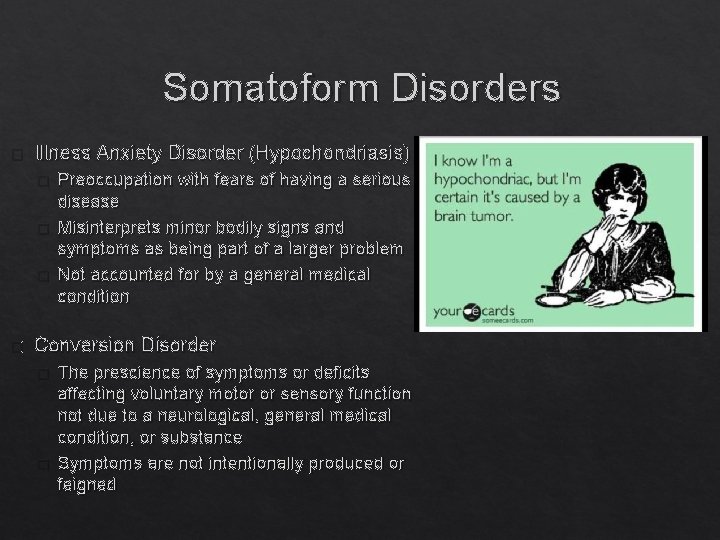
Somatoform Disorders � Illness Anxiety Disorder (Hypochondriasis) � � Preoccupation with fears of having a serious disease Misinterprets minor bodily signs and symptoms as being part of a larger problem Not accounted for by a general medical condition Conversion Disorder � � The prescience of symptoms or deficits affecting voluntary motor or sensory function not due to a neurological, general medical condition, or substance Symptoms are not intentionally produced or feigned
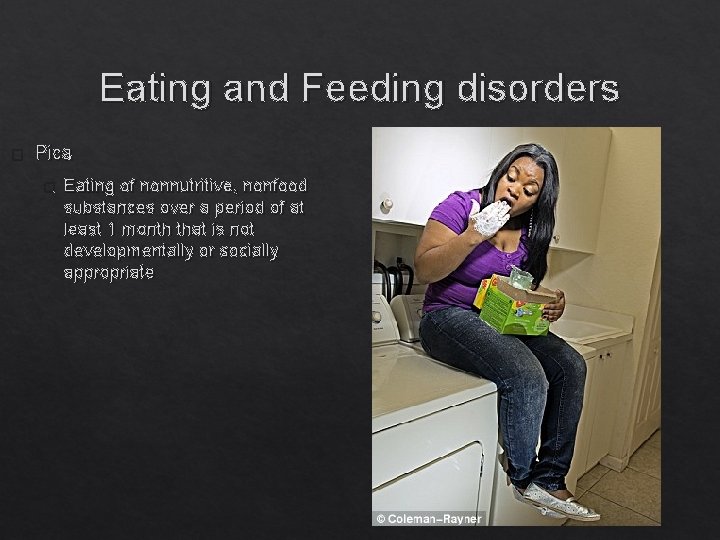
Eating and Feeding disorders � Pica � Eating of nonnutritive, nonfood substances over a period of at least 1 month that is not developmentally or socially appropriate
Eating and Feeding disorders � Anorexia Nervosa � � Bulimia Nervosa � � Severe restriction of food intake combined with an intense fear of gaining weight and a disturbance in the way in which one’s body weight or shape is perceived Recurrent episodes of binge eating and recurrent compensatory behaviors (purging) to prevent weight gain Binge-Eating Disorder � Recurrent episodes of binge eating that is typically associated with eating rapidly, eating until feeling uncomfortably full, eating alone, eating without being hungry, and eating with shame and guilt
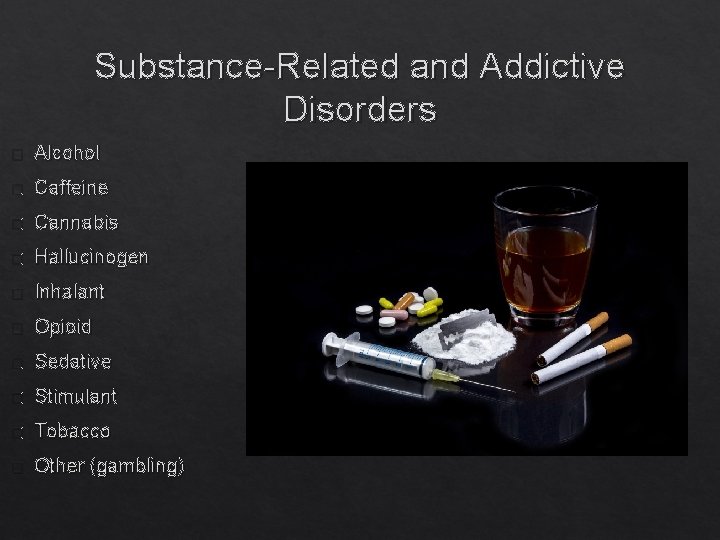
Substance-Related and Addictive Disorders � Alcohol � Caffeine � Cannabis � Hallucinogen � Inhalant � Opioid � Sedative � Stimulant � Tobacco � Other (gambling)
Sleep-Wake Disorders � Insomnia � � Narcolepsy � � Persistent difficulty intimating and maintaining sleep; early morning awakening with inability to return to sleep that causes significant impairment in occupational, educational, behavioral or other important areas Recurrent period of an irresistible need to sleep, typically with cataplexy or other involuntary motor disturbance NREM Sleep Arousal Disorders � Sleepwalking � Sleep Terrors
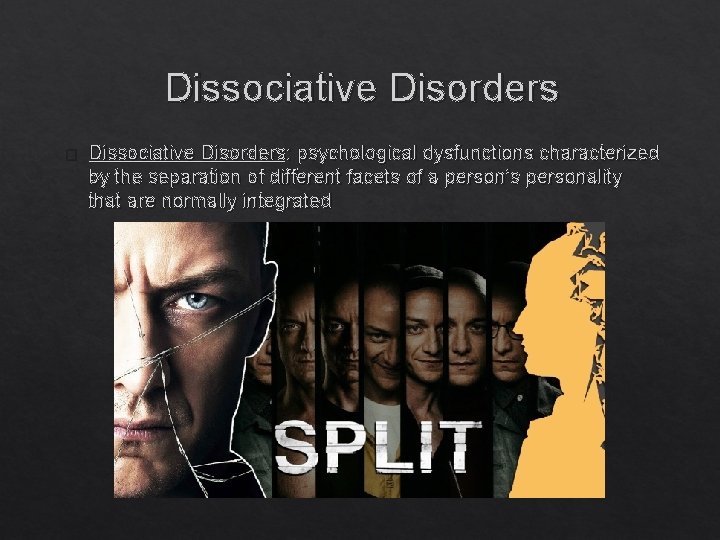
Dissociative Disorders � Dissociative Disorders: psychological dysfunctions characterized by the separation of different facets of a person’s personality that are normally integrated
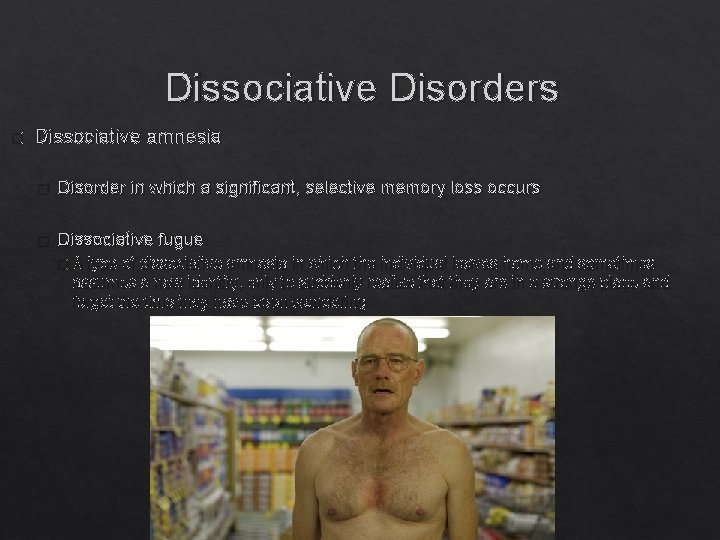
Dissociative Disorders � Dissociative amnesia � Disorder in which a significant, selective memory loss occurs � Dissociative fugue �A type of dissociative amnesia in which the individual leaves home and sometimes assumes a new identity, only to suddenly realize that they are in a strange place and forget the time they have been wondering
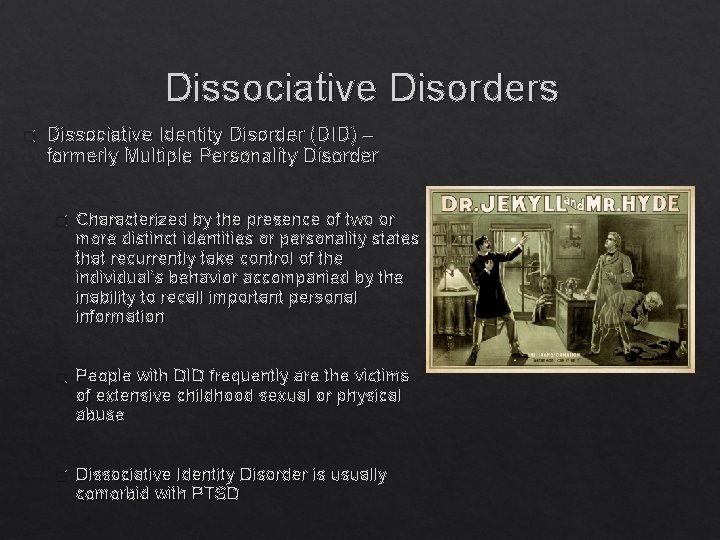
Dissociative Disorders � Dissociative Identity Disorder (DID) – formerly Multiple Personality Disorder � Characterized by the presence of two or more distinct identities or personality states that recurrently take control of the individual’s behavior accompanied by the inability to recall important personal information � People with DID frequently are the victims of extensive childhood sexual or physical abuse � Dissociative Identity Disorder is usually comorbid with PTSD
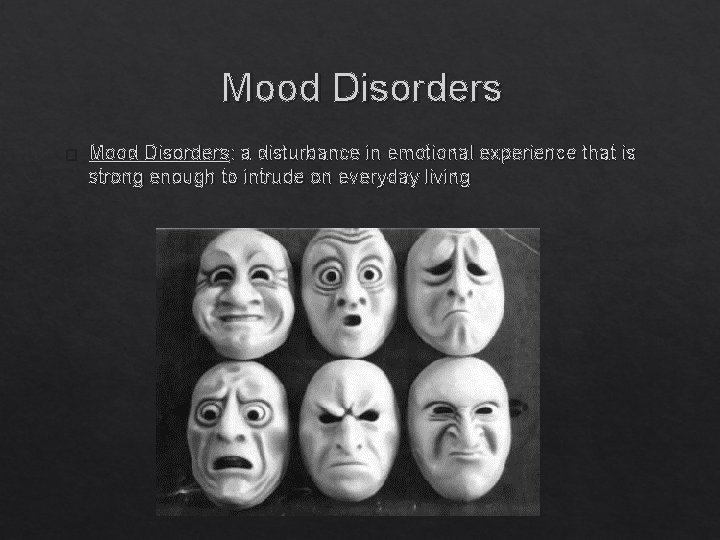
Mood Disorders � Mood Disorders: a disturbance in emotional experience that is strong enough to intrude on everyday living
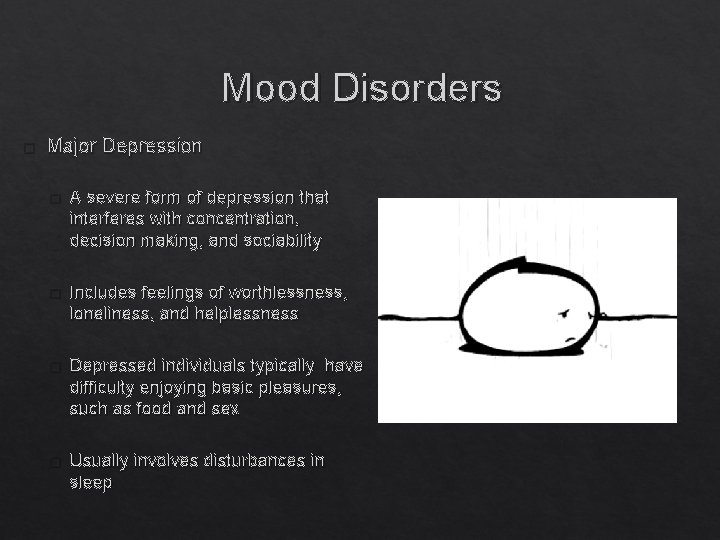
Mood Disorders � Major Depression � A severe form of depression that interferes with concentration, decision making, and sociability � Includes feelings of worthlessness, loneliness, and helplessness � Depressed individuals typically have difficulty enjoying basic pleasures, such as food and sex � Usually involves disturbances in sleep
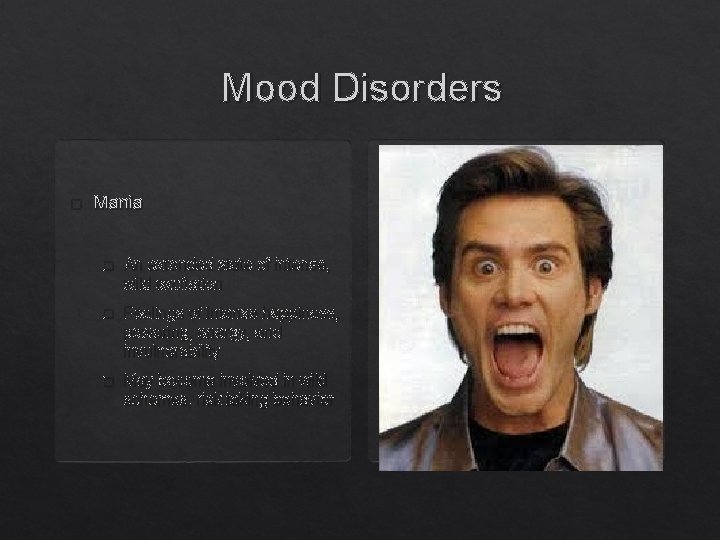
Mood Disorders � Mania � An extended state of intense, wild excitation � Feelings of intense happiness, powering, energy, and invulnerability � May become involved in wild schemes, risk taking behavior
Mood Disorders � Bipolar disorder � Disorder in which a person experiences alternating periods of mania and depression � Most antidepressants warn against use in children, as children may be suffering from bipolar disorder, but the mania is masked by expectations in childhood energy
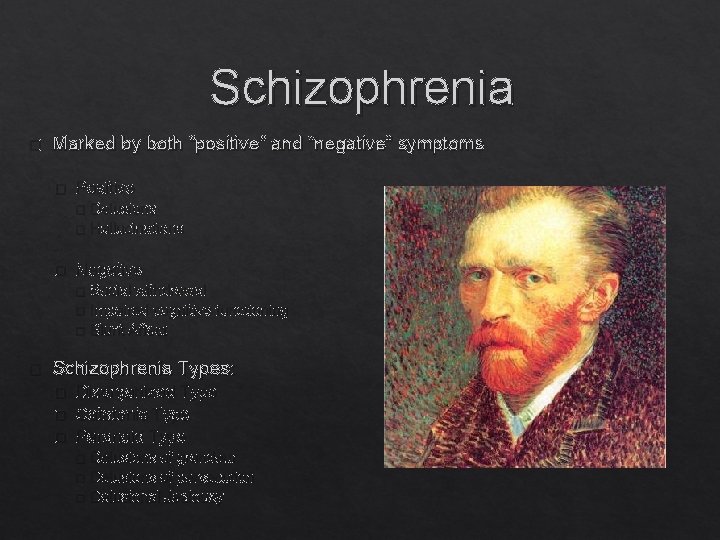
Schizophrenia � Marked by both “positive” and “negative” symptoms � Positive Delusions � Hallucinations � � Negative Social withdrawal � Impaired cognitive functioning � Blunt Affect � � Schizophrenia Types: � � � Disorganized Type Catatonic Type Paranoid Type Delusions of grandeur � Delusions of persecution � Delusional Jealousy �
Neurocognitive Disorders � Major and Mild Neurocognitive Disorder � Evidence of a significant cognitive decline from previous performance (complex attention, language, perceptual-motor, learning & memory) that interfere with independence in everyday life. � Can be the result of: � Alzheimer’s Disease � Traumatic Brain Injury � Prion Disease � Parkinson’s Disease � Huntington’s Disease
Sexual Disorders � � Sexual Dysfunctions � Sexual Pain Disorder � Hypoactive Sexual Disorders Paraphilias � Exhibitionism � Fetishism � Pedophilia � Sexual Masochism � Sexual Sadism � Paraphilia NOS
Personality Disorders � Personality Disorders: a class of mental disorders characterized by enduring maladaptive patterns of behavior, cognition, and inner experience, exhibited across many contexts � � � Cluster A: odd disorders Cluster B: dramatic, emotional or erratic disorders Cluster C: anxious or fearful disorders
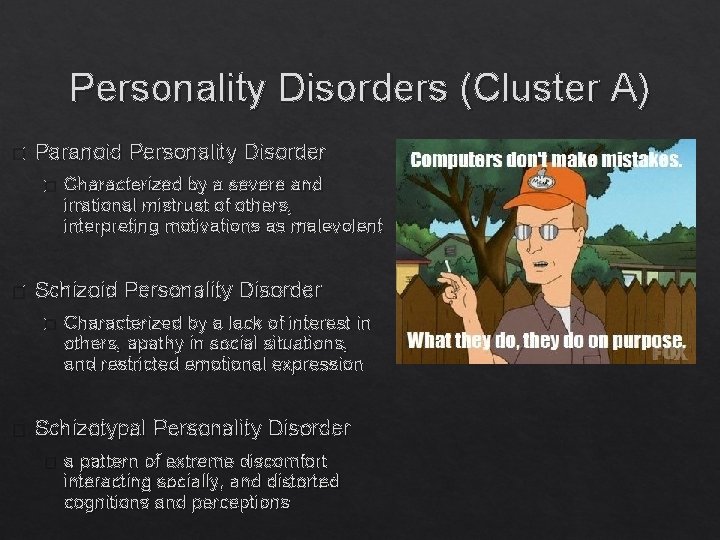
Personality Disorders (Cluster A) � Paranoid Personality Disorder � � Schizoid Personality Disorder � � Characterized by a severe and irrational mistrust of others, interpreting motivations as malevolent Characterized by a lack of interest in others, apathy in social situations, and restricted emotional expression Schizotypal Personality Disorder � a pattern of extreme discomfort interacting socially, and distorted cognitions and perceptions
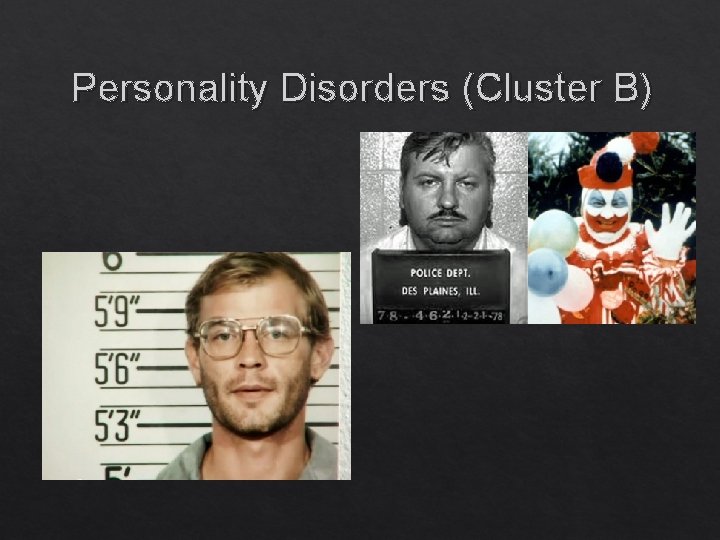
Personality Disorders (Cluster B) � Borderline Personality Disorder � � Antisocial Personality Disorder � � Pattern of disregard for and violation of the rights of others In children, Conduct Disorder (the homicidal triad) Commonly (but incorrectly) referred to as “psychopath” or “psychotic” in movies and TV Narcissistic Personality Disorder � � Pattern of instability in interpersonal relationships, self-image, affects, and marked impulsivity Pattern of grandiosity, need for admiration, and lack of empathy Histrionic Personality Disorder � pattern of excessive attention-seeking emotions, usually beginning in early adulthood, including inappropriately seductive behavior and an excessive need for approval
Personality Disorders (Cluster B)
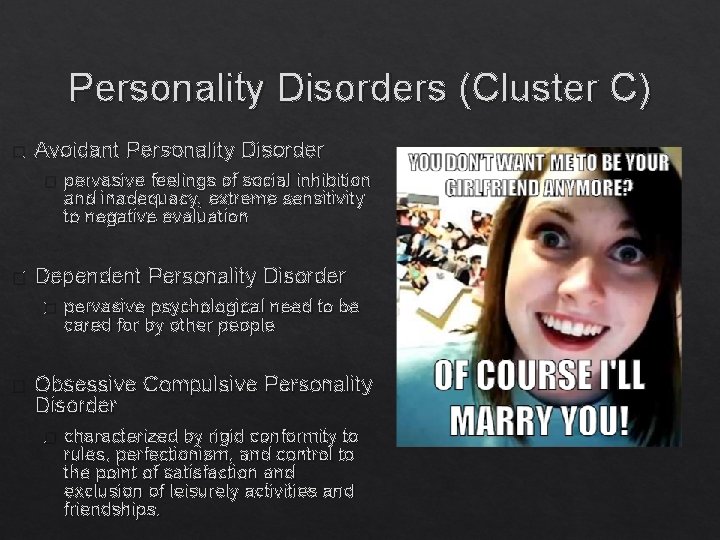
Personality Disorders (Cluster C) � Avoidant Personality Disorder � � Dependent Personality Disorder � � pervasive feelings of social inhibition and inadequacy, extreme sensitivity to negative evaluation pervasive psychological need to be cared for by other people Obsessive Compulsive Personality Disorder � characterized by rigid conformity to rules, perfectionism, and control to the point of satisfaction and exclusion of leisurely activities and friendships.
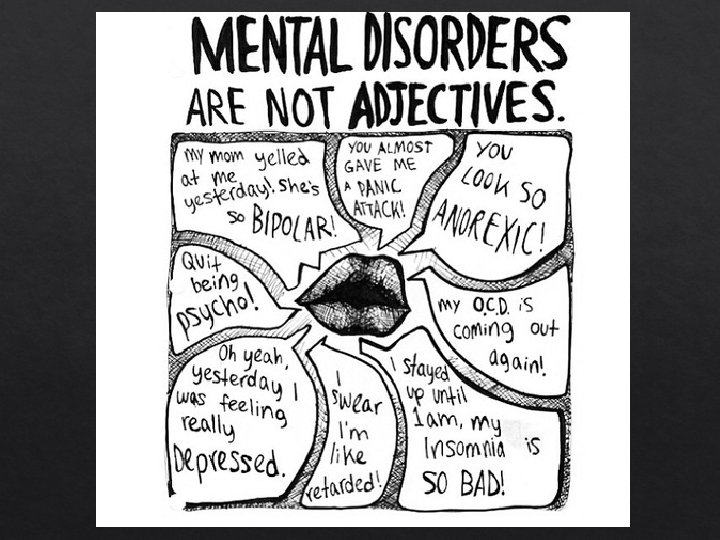
The Stigma of Mental Illness � The Rosenhan Experiment (1973) � � “being sane in insane places” Mental disorders change as historical and cultural developments occur � Homosexuality used to be a mental disorder, as per the DSM II � Autism Spectrum Disorders were once considered a form of “childhood schizophrenia”