
INTRODUCTION TO PSYCHOLOGY CHAPTER 1 HISTORICAL PERSPECTIVES JOURNAL


- Slides: 34
INTRODUCTION TO PSYCHOLOGY CHAPTER 1: HISTORICAL PERSPECTIVES
JOURNAL • What do you think of when you hear “psychology”? Why is psychology worth studying? Why did you take this course? Is there are particular topic that you are interested in?
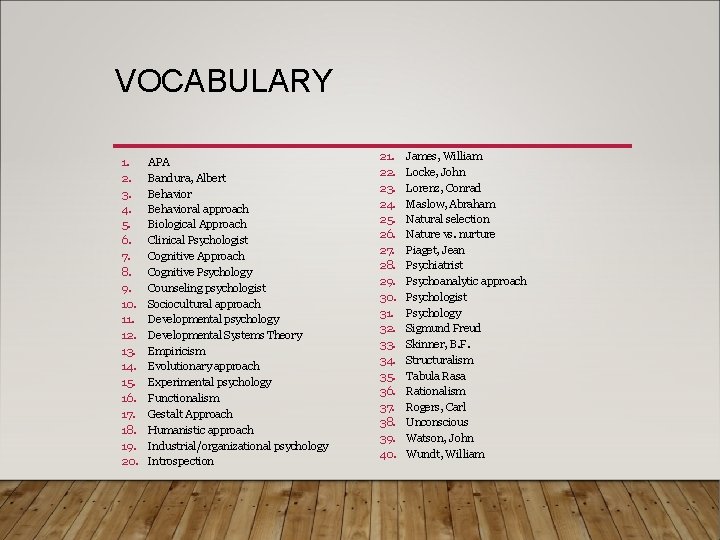
VOCABULARY 1. 2. 3. 4. 5. 6. 7. 8. 9. 10. 11. 12. 13. 14. 15. 16. 17. 18. 19. 20. APA Bandura, Albert Behavioral approach Biological Approach Clinical Psychologist Cognitive Approach Cognitive Psychology Counseling psychologist Sociocultural approach Developmental psychology Developmental Systems Theory Empiricism Evolutionary approach Experimental psychology Functionalism Gestalt Approach Humanistic approach Industrial/organizational psychology Introspection 21. 22. 23. 24. 25. 26. 27. 28. 29. 30. 31. 32. 33. 34. 35. 36. 37. 38. 39. 40. James, William Locke, John Lorenz, Conrad Maslow, Abraham Natural selection Nature vs. nurture Piaget, Jean Psychiatrist Psychoanalytic approach Psychologist Psychology Sigmund Freud Skinner, B. F. Structuralism Tabula Rasa Rationalism Rogers, Carl Unconscious Watson, John Wundt, William
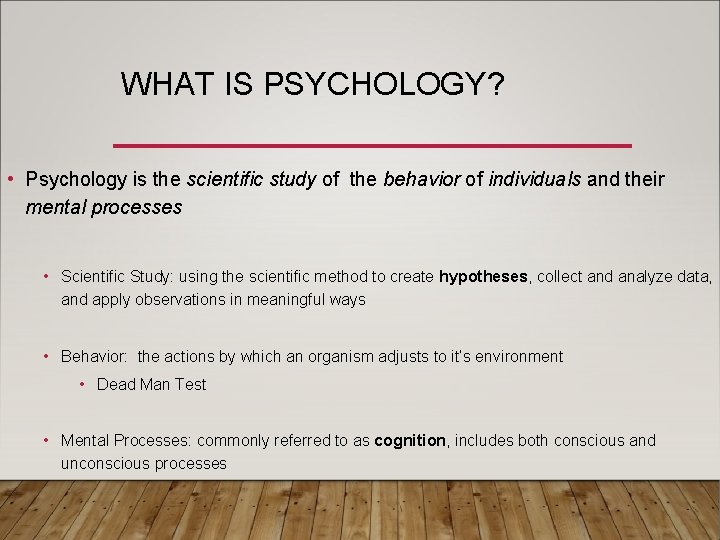
WHAT IS PSYCHOLOGY? • Psychology is the scientific study of the behavior of individuals and their mental processes • Scientific Study: using the scientific method to create hypotheses, collect and analyze data, and apply observations in meaningful ways • Behavior: the actions by which an organism adjusts to it’s environment • Dead Man Test • Mental Processes: commonly referred to as cognition, includes both conscious and unconscious processes
GOALS OF PSYCHOLOGY • Describe • Explain • Predict • Control
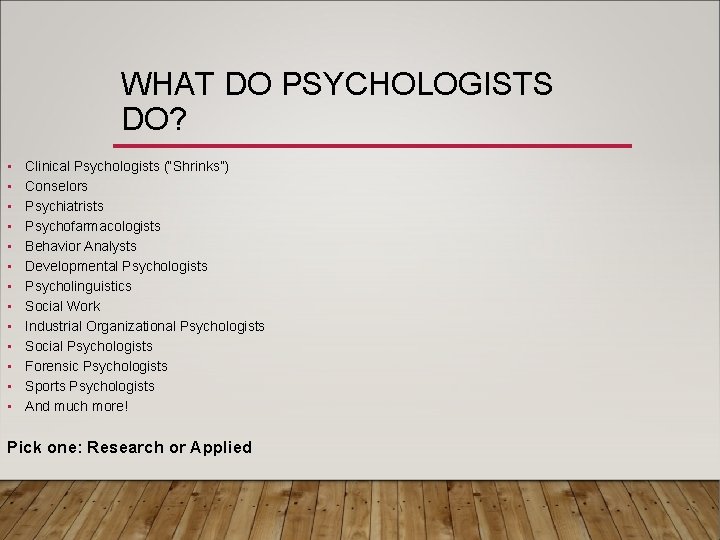
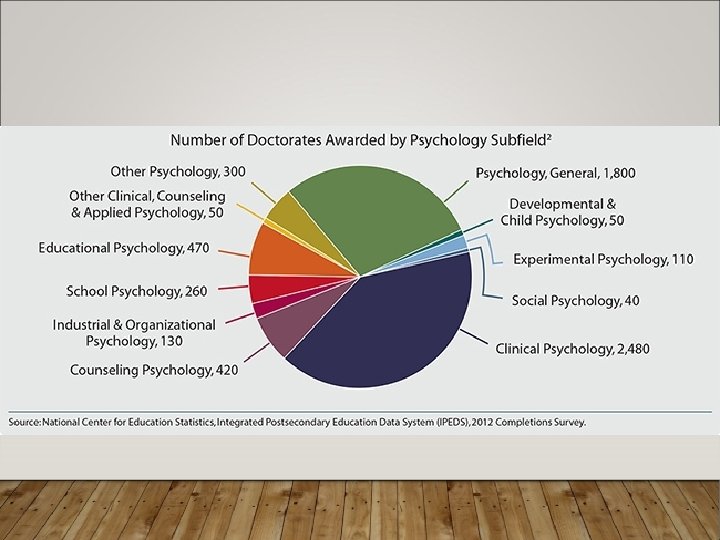
WHAT DO PSYCHOLOGISTS DO? • • • • Clinical Psychologists (“Shrinks”) Conselors Psychiatrists Psychofarmacologists Behavior Analysts Developmental Psychologists Psycholinguistics Social Work Industrial Organizational Psychologists Social Psychologists Forensic Psychologists Sports Psychologists And much more! Pick one: Research or Applied
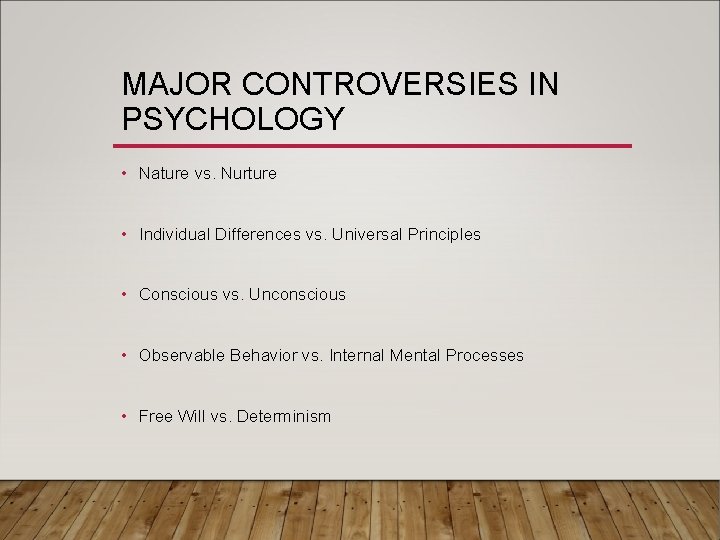
MAJOR CONTROVERSIES IN PSYCHOLOGY • Nature vs. Nurture • Individual Differences vs. Universal Principles • Conscious vs. Unconscious • Observable Behavior vs. Internal Mental Processes • Free Will vs. Determinism
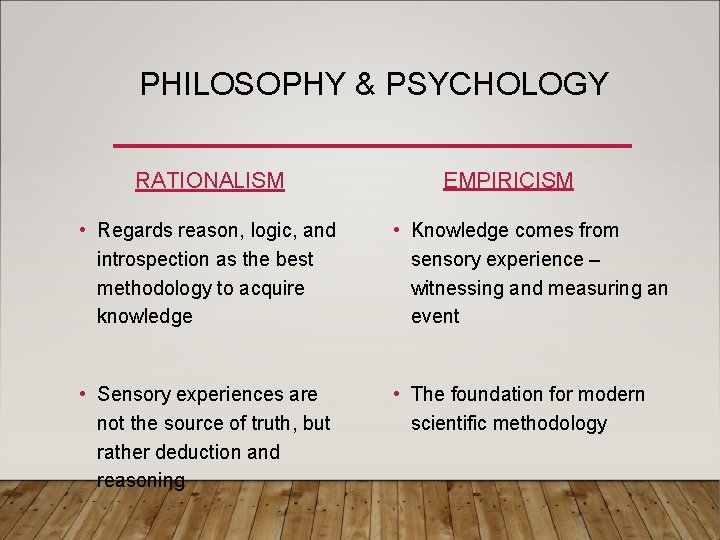
PHILOSOPHY & PSYCHOLOGY RATIONALISM EMPIRICISM • Regards reason, logic, and introspection as the best methodology to acquire knowledge • Knowledge comes from sensory experience – witnessing and measuring an event • Sensory experiences are not the source of truth, but rather deduction and reasoning • The foundation for modern scientific methodology
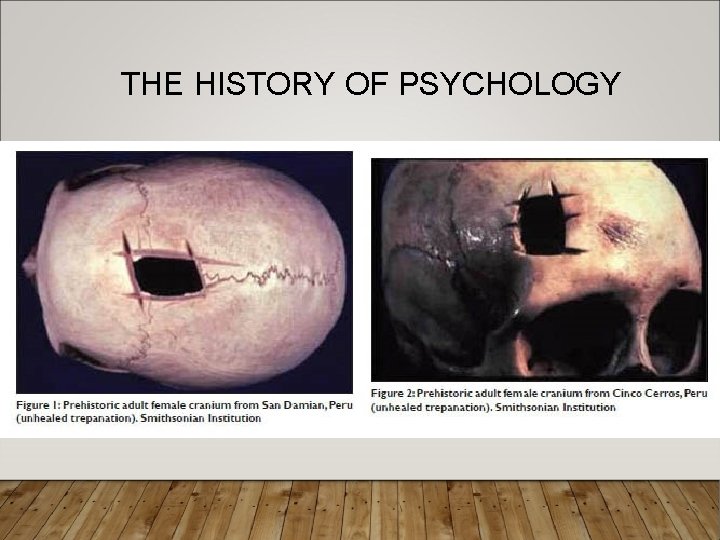
THE HISTORY OF PSYCHOLOGY
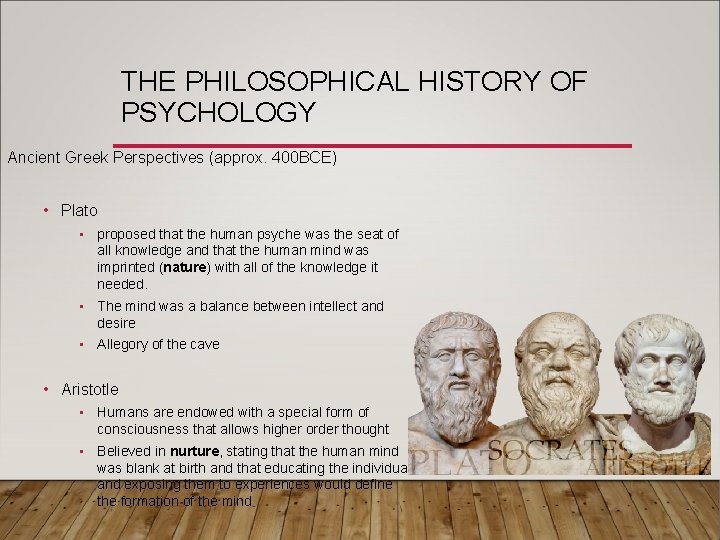
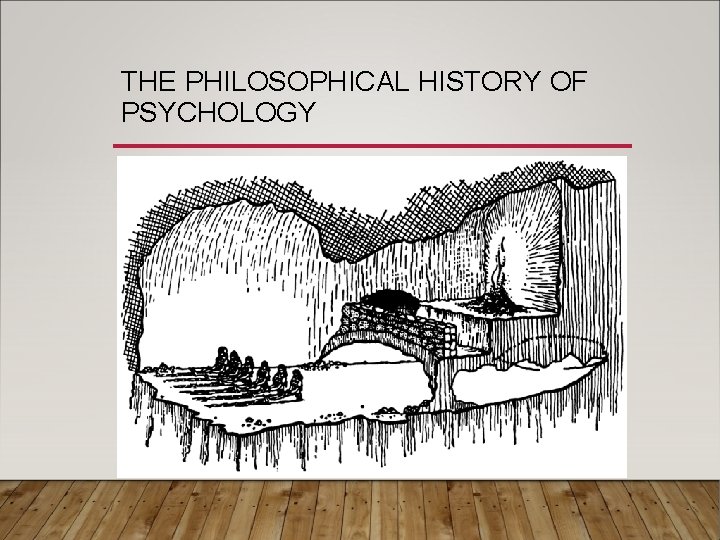
THE PHILOSOPHICAL HISTORY OF PSYCHOLOGY Ancient Greek Perspectives (approx. 400 BCE) • Plato • proposed that the human psyche was the seat of all knowledge and that the human mind was imprinted (nature) with all of the knowledge it needed. • The mind was a balance between intellect and desire • Allegory of the cave • Aristotle • Humans are endowed with a special form of consciousness that allows higher order thought • Believed in nurture, stating that the human mind was blank at birth and that educating the individual and exposing them to experiences would define the formation of the mind
THE PHILOSOPHICAL HISTORY OF PSYCHOLOGY
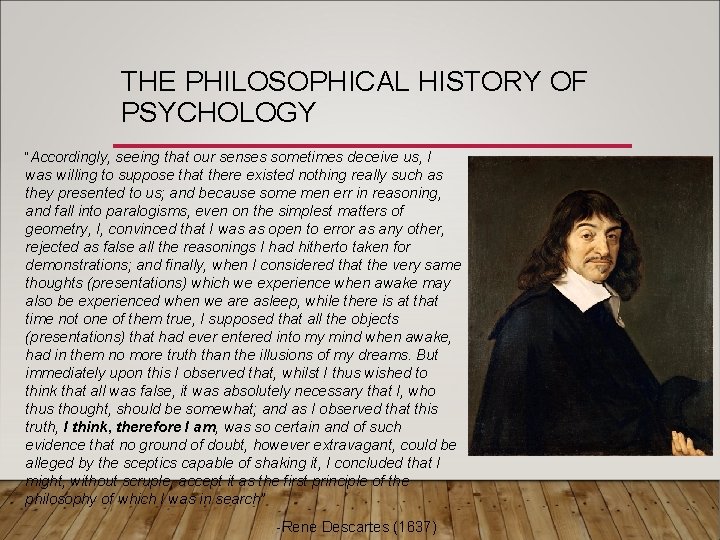
THE PHILOSOPHICAL HISTORY OF PSYCHOLOGY “Accordingly, seeing that our senses sometimes deceive us, I was willing to suppose that there existed nothing really such as they presented to us; and because some men err in reasoning, and fall into paralogisms, even on the simplest matters of geometry, I, convinced that I was as open to error as any other, rejected as false all the reasonings I had hitherto taken for demonstrations; and finally, when I considered that the very same thoughts (presentations) which we experience when awake may also be experienced when we are asleep, while there is at that time not one of them true, I supposed that all the objects (presentations) that had ever entered into my mind when awake, had in them no more truth than the illusions of my dreams. But immediately upon this I observed that, whilst I thus wished to think that all was false, it was absolutely necessary that I, who thus thought, should be somewhat; and as I observed that this truth, I think, therefore I am, was so certain and of such evidence that no ground of doubt, however extravagant, could be alleged by the sceptics capable of shaking it, I concluded that I might, without scruple, accept it as the first principle of the philosophy of which I was in search” -Rene Descartes (1637)
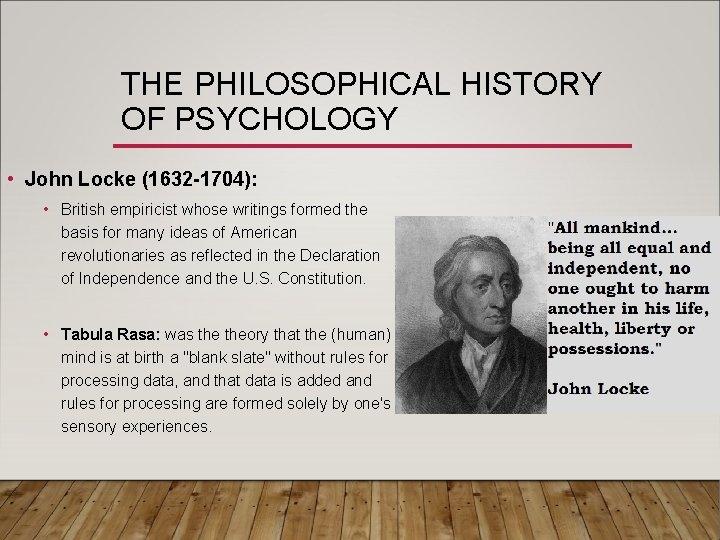
THE PHILOSOPHICAL HISTORY OF PSYCHOLOGY • John Locke (1632 -1704): • British empiricist whose writings formed the basis for many ideas of American revolutionaries as reflected in the Declaration of Independence and the U. S. Constitution. • Tabula Rasa: was theory that the (human) mind is at birth a "blank slate" without rules for processing data, and that data is added and rules for processing are formed solely by one's sensory experiences.
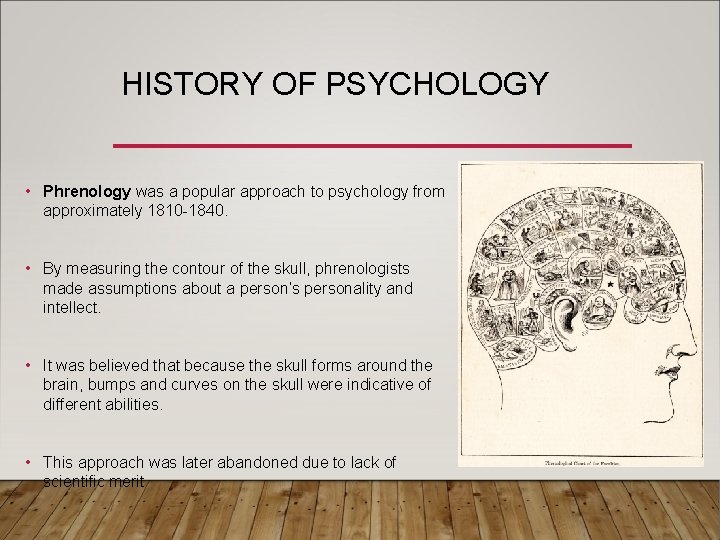
HISTORY OF PSYCHOLOGY • Phrenology was a popular approach to psychology from approximately 1810 -1840. • By measuring the contour of the skull, phrenologists made assumptions about a person’s personality and intellect. • It was believed that because the skull forms around the brain, bumps and curves on the skull were indicative of different abilities. • This approach was later abandoned due to lack of scientific merit
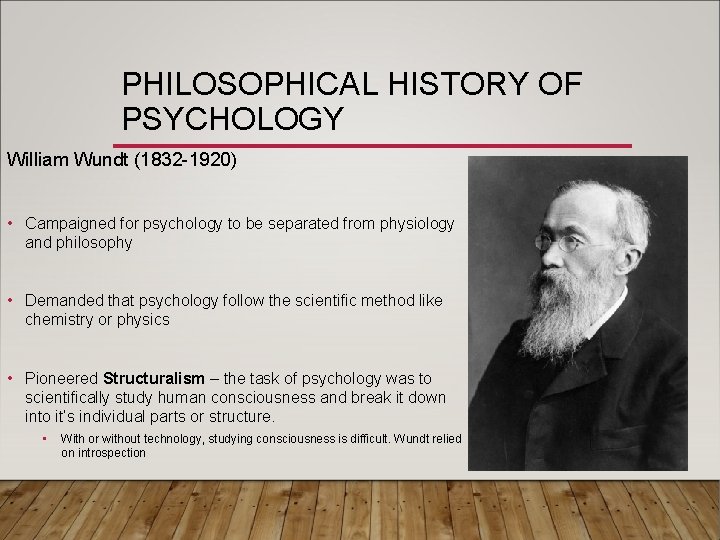
PHILOSOPHICAL HISTORY OF PSYCHOLOGY William Wundt (1832 -1920) • Campaigned for psychology to be separated from physiology and philosophy • Demanded that psychology follow the scientific method like chemistry or physics • Pioneered Structuralism – the task of psychology was to scientifically study human consciousness and break it down into it’s individual parts or structure. • With or without technology, studying consciousness is difficult. Wundt relied on introspection
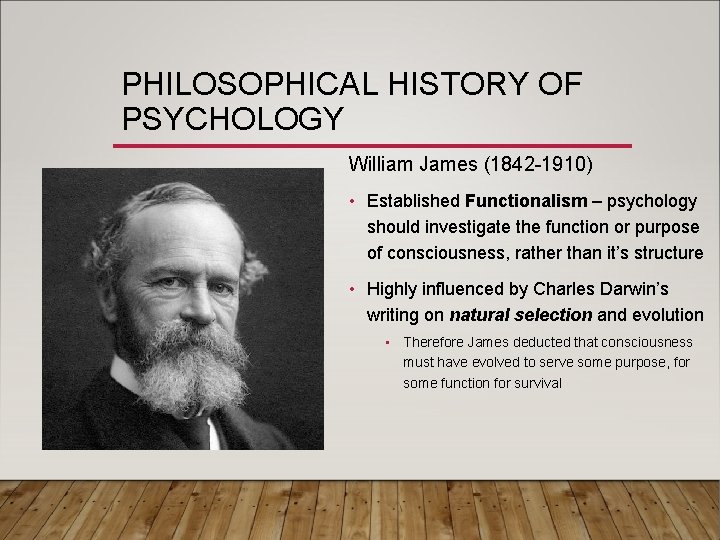
PHILOSOPHICAL HISTORY OF PSYCHOLOGY William James (1842 -1910) • Established Functionalism – psychology should investigate the function or purpose of consciousness, rather than it’s structure • Highly influenced by Charles Darwin’s writing on natural selection and evolution • Therefore James deducted that consciousness must have evolved to serve some purpose, for some function for survival
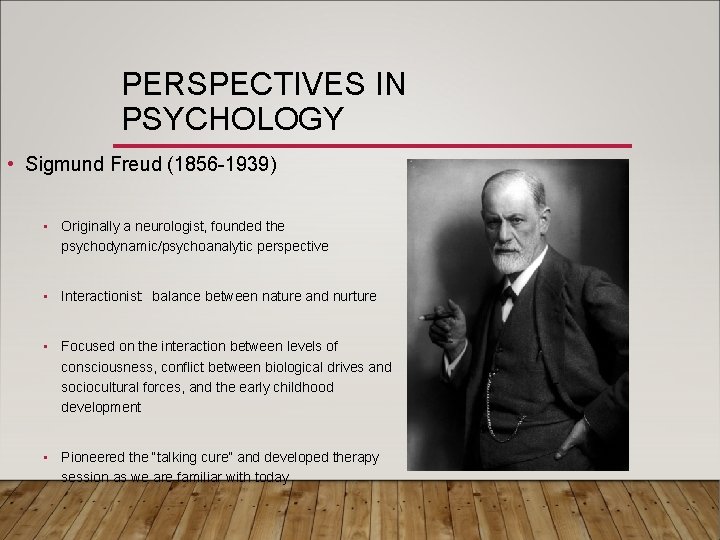
PERSPECTIVES IN PSYCHOLOGY • Sigmund Freud (1856 -1939) • Originally a neurologist, founded the psychodynamic/psychoanalytic perspective • Interactionist: balance between nature and nurture • Focused on the interaction between levels of consciousness, conflict between biological drives and sociocultural forces, and the early childhood development • Pioneered the “talking cure” and developed therapy session as we are familiar with today
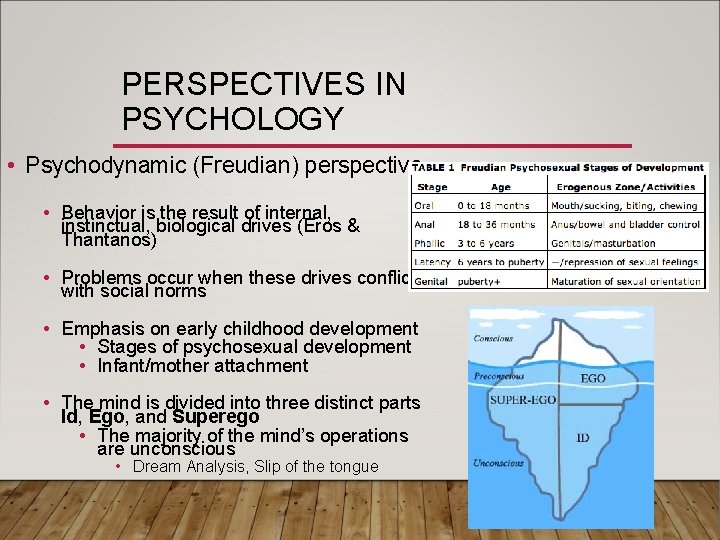
PERSPECTIVES IN PSYCHOLOGY • Psychodynamic (Freudian) perspective • Behavior is the result of internal, instinctual, biological drives (Eros & Thantanos) • Problems occur when these drives conflict with social norms • Emphasis on early childhood development • Stages of psychosexual development • Infant/mother attachment • The mind is divided into three distinct parts Id, Ego, and Superego • The majority of the mind’s operations are unconscious • Dream Analysis, Slip of the tongue
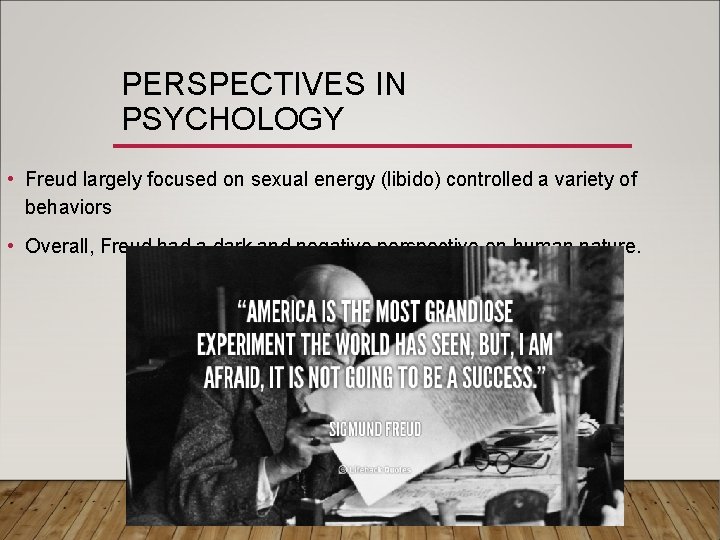
PERSPECTIVES IN PSYCHOLOGY • Freud largely focused on sexual energy (libido) controlled a variety of behaviors • Overall, Freud had a dark and negative perspective on human nature.
PERSPECTIVES IN PSYCHOLOGY • Neo-Freudian Psychoanalysts kept the same basic ideas as Freud, but disagreed on key details • Carl Jung: focused on levels on unconsciousness that connect all humanity (collective unconscious) • Alfred Adler: looked at how social influences motivate behavior (inferiority complex) • Karen Horney: looked at feminist issues in psychoanalysis, replacing Freud’s “penis envy” with “womb envy”.
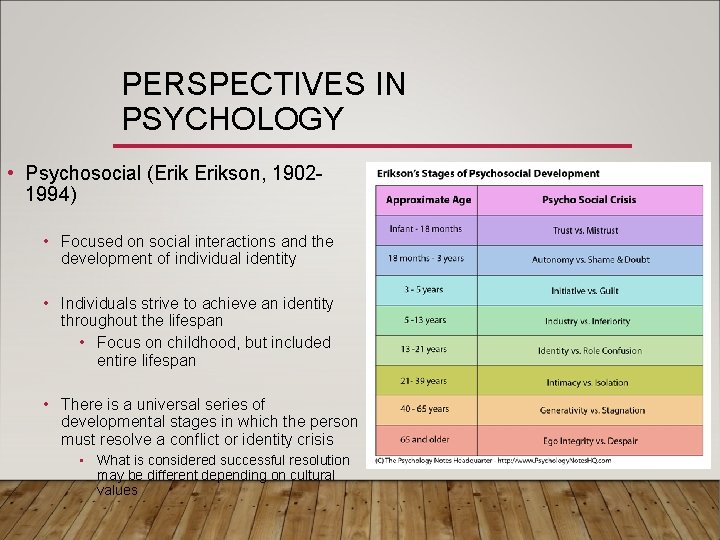
PERSPECTIVES IN PSYCHOLOGY • Psychosocial (Erikson, 19021994) • Focused on social interactions and the development of individual identity • Individuals strive to achieve an identity throughout the lifespan • Focus on childhood, but included entire lifespan • There is a universal series of developmental stages in which the person must resolve a conflict or identity crisis • What is considered successful resolution may be different depending on cultural values
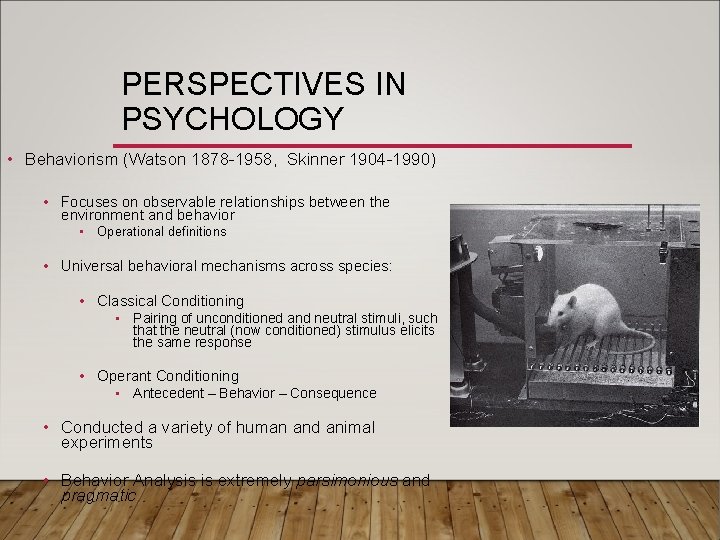
PERSPECTIVES IN PSYCHOLOGY • Behaviorism (Watson 1878 -1958, Skinner 1904 -1990) • Focuses on observable relationships between the environment and behavior • Operational definitions • Universal behavioral mechanisms across species: • Classical Conditioning • Pairing of unconditioned and neutral stimuli, such that the neutral (now conditioned) stimulus elicits the same response • Operant Conditioning • Antecedent – Behavior – Consequence • Conducted a variety of human and animal experiments • Behavior Analysis is extremely parsimonious and pragmatic
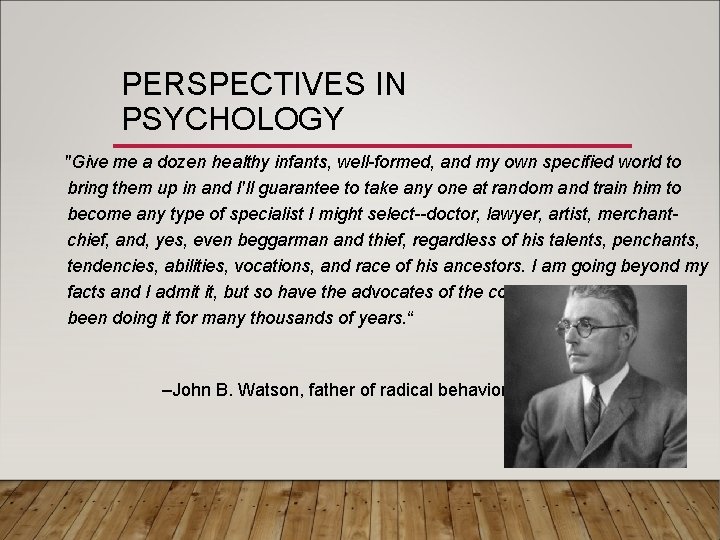
PERSPECTIVES IN PSYCHOLOGY "Give me a dozen healthy infants, well-formed, and my own specified world to bring them up in and I'll guarantee to take any one at random and train him to become any type of specialist I might select--doctor, lawyer, artist, merchantchief, and, yes, even beggarman and thief, regardless of his talents, penchants, tendencies, abilities, vocations, and race of his ancestors. I am going beyond my facts and I admit it, but so have the advocates of the contrary and they have been doing it for many thousands of years. “ –John B. Watson, father of radical behaviorism
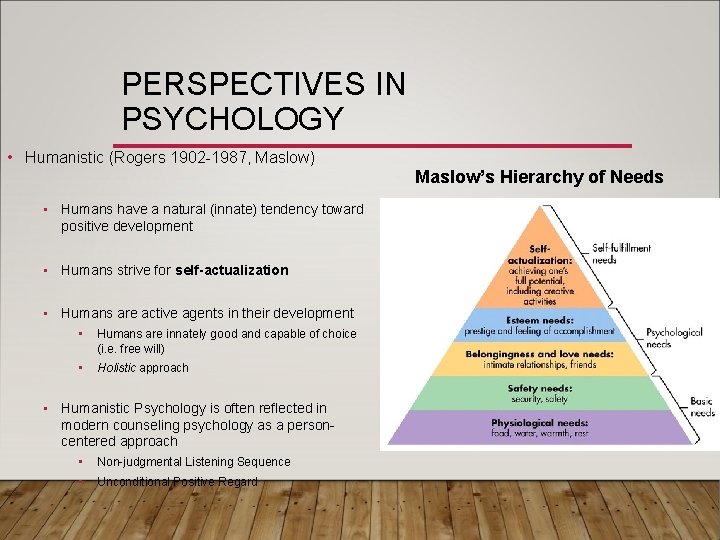
PERSPECTIVES IN PSYCHOLOGY • Humanistic (Rogers 1902 -1987, Maslow) Maslow’s Hierarchy of Needs • Humans have a natural (innate) tendency toward positive development • Humans strive for self-actualization • Humans are active agents in their development • Humans are innately good and capable of choice (i. e. free will) • Holistic approach • Humanistic Psychology is often reflected in modern counseling psychology as a personcentered approach • Non-judgmental Listening Sequence • Unconditional Positive Regard
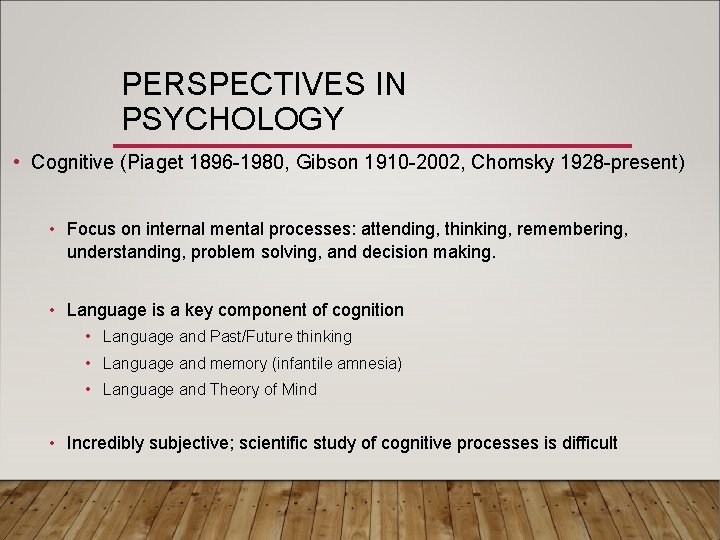
PERSPECTIVES IN PSYCHOLOGY • Cognitive (Piaget 1896 -1980, Gibson 1910 -2002, Chomsky 1928 -present) • Focus on internal mental processes: attending, thinking, remembering, understanding, problem solving, and decision making. • Language is a key component of cognition • Language and Past/Future thinking • Language and memory (infantile amnesia) • Language and Theory of Mind • Incredibly subjective; scientific study of cognitive processes is difficult
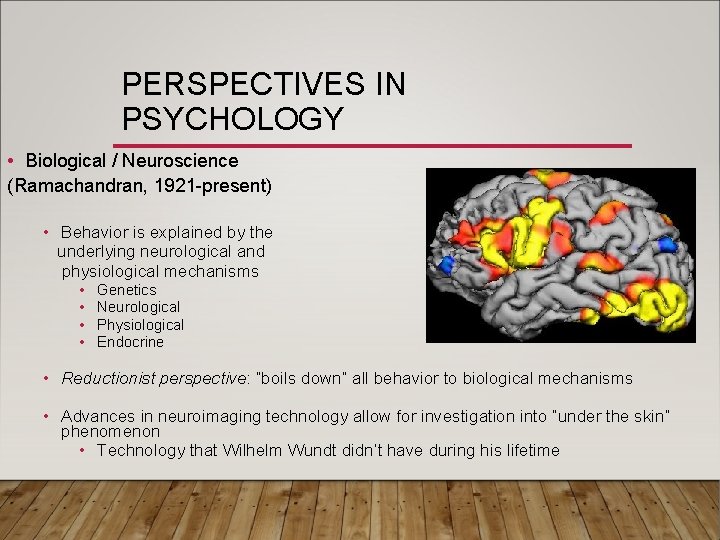
PERSPECTIVES IN PSYCHOLOGY • Biological / Neuroscience (Ramachandran, 1921 -present) • Behavior is explained by the underlying neurological and physiological mechanisms • • Genetics Neurological Physiological Endocrine • Reductionist perspective: “boils down” all behavior to biological mechanisms • Advances in neuroimaging technology allow for investigation into “under the skin” phenomenon • Technology that Wilhelm Wundt didn’t have during his lifetime
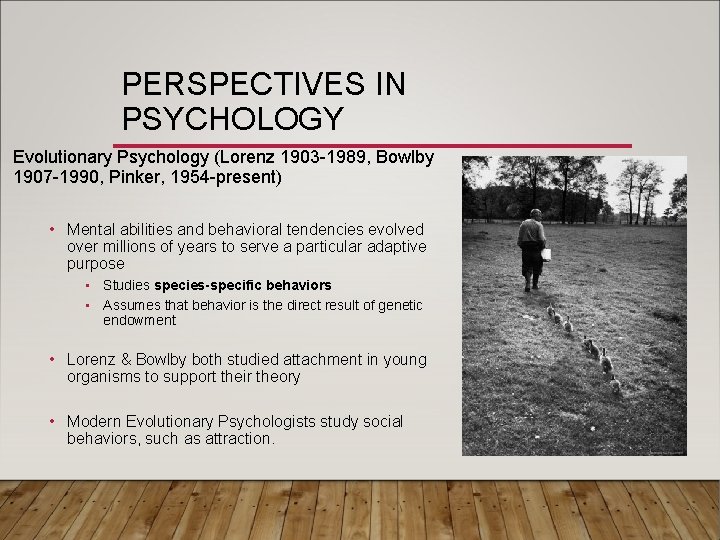
PERSPECTIVES IN PSYCHOLOGY Evolutionary Psychology (Lorenz 1903 -1989, Bowlby 1907 -1990, Pinker, 1954 -present) • Mental abilities and behavioral tendencies evolved over millions of years to serve a particular adaptive purpose • Studies species-specific behaviors • Assumes that behavior is the direct result of genetic endowment • Lorenz & Bowlby both studied attachment in young organisms to support their theory • Modern Evolutionary Psychologists study social behaviors, such as attraction.
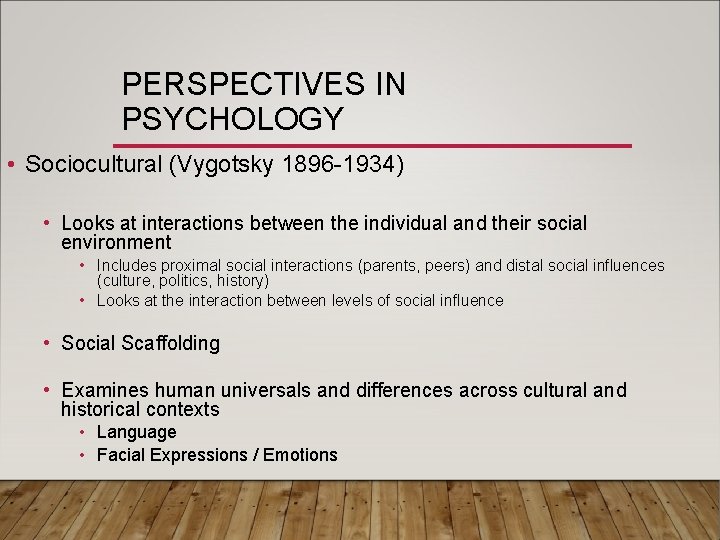
PERSPECTIVES IN PSYCHOLOGY • Sociocultural (Vygotsky 1896 -1934) • Looks at interactions between the individual and their social environment • Includes proximal social interactions (parents, peers) and distal social influences (culture, politics, history) • Looks at the interaction between levels of social influence • Social Scaffolding • Examines human universals and differences across cultural and historical contexts • Language • Facial Expressions / Emotions
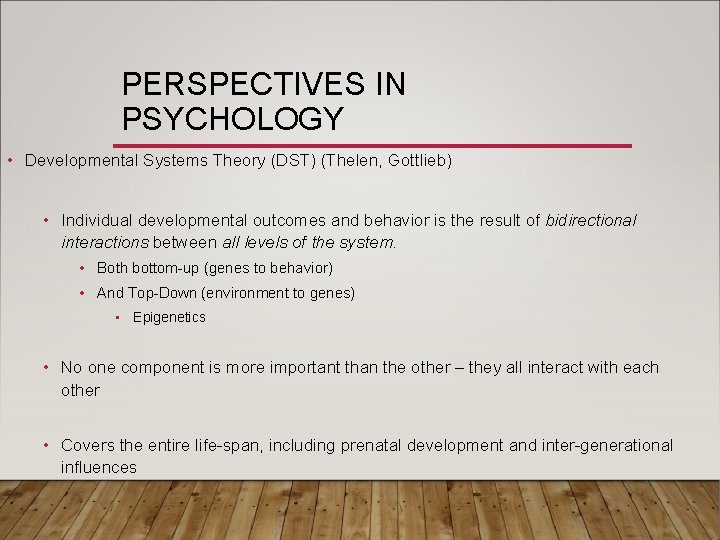
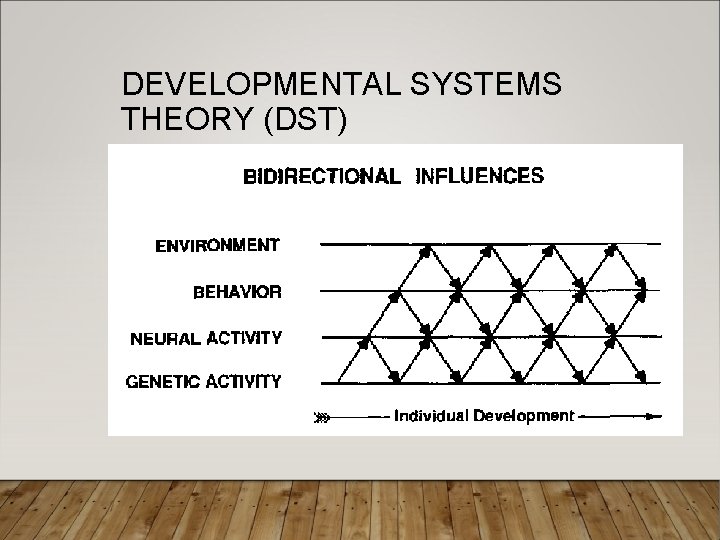
PERSPECTIVES IN PSYCHOLOGY • Developmental Systems Theory (DST) (Thelen, Gottlieb) • Individual developmental outcomes and behavior is the result of bidirectional interactions between all levels of the system. • Both bottom-up (genes to behavior) • And Top-Down (environment to genes) • Epigenetics • No one component is more important than the other – they all interact with each other • Covers the entire life-span, including prenatal development and inter-generational influences
DEVELOPMENTAL SYSTEMS THEORY (DST)
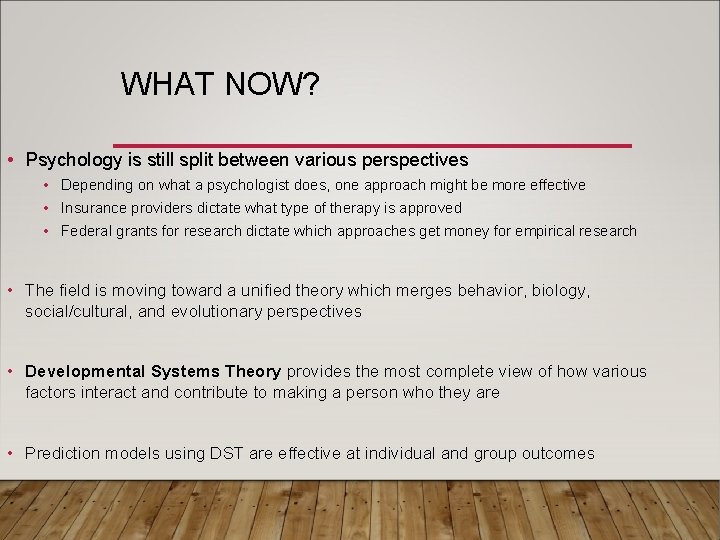
WHAT NOW? • Psychology is still split between various perspectives • Depending on what a psychologist does, one approach might be more effective • Insurance providers dictate what type of therapy is approved • Federal grants for research dictate which approaches get money for empirical research • The field is moving toward a unified theory which merges behavior, biology, social/cultural, and evolutionary perspectives • Developmental Systems Theory provides the most complete view of how various factors interact and contribute to making a person who they are • Prediction models using DST are effective at individual and group outcomes
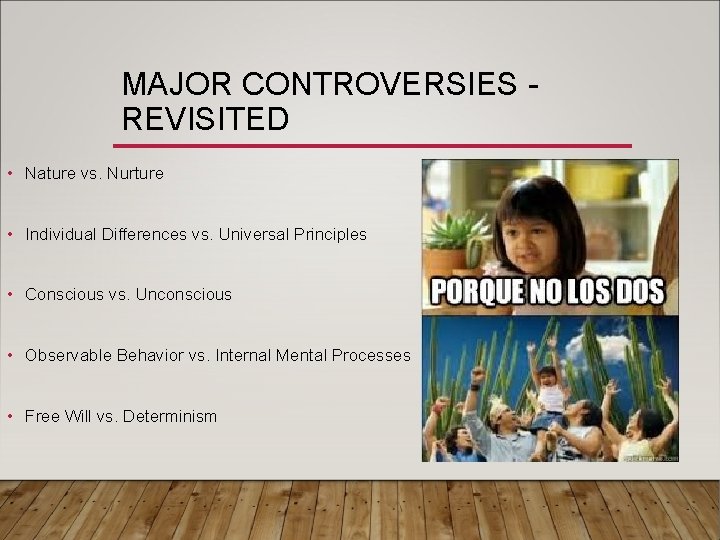
MAJOR CONTROVERSIES REVISITED • Nature vs. Nurture • Individual Differences vs. Universal Principles • Conscious vs. Unconscious • Observable Behavior vs. Internal Mental Processes • Free Will vs. Determinism