
Introduction to Protein Structure Prediction BMICS 576 www
Introduction to Protein Structure Prediction BMI/CS 576 www. biostat. wisc. edu/bmi 576/ Colin Dewey cdewey@biostat. wisc. edu Fall 2008
The Protein Folding Problem • we know that the function of a protein is determined in large part by its 3 D shape (fold, conformation) • can we predict the 3 D shape of a protein given only its amino-acid sequence?
Protein Architecture • proteins are polymers consisting of amino acids linked by peptide bonds • each amino acid consists of – a central carbon atom – an amino group – a carboxyl group – a side chain • differences in side chains distinguish different amino acids

Amino Acids and Peptide Bonds amino group side chain carboxyl group a carbon (common reference point for coordinates of a structure)

Amino Acid Side Chains • side chains vary in – shape – size – charge – polarity
What Determines Conformation? • in general, the amino-acid sequence of a protein determines the 3 D shape of a protein [Anfinsen et al. , 1950 s] • but some exceptions – all proteins can be denatured – some proteins are inherently disordered (i. e. lack a regular structure) – some proteins get folding help from chaperones – there are various mechanisms through which the conformation of a protein can be changed in vivo – post-translational modifications such as phosphorylation – prions – etc.
What Determines Conformation? • What physical properties of the protein determine its fold? – rigidity of the protein backbone – interactions among amino acids, including • electrostatic interactions • van der Waals forces • volume constraints • hydrogen, disulfide bonds – interactions of amino acids with water
Levels of Description • protein structure is often described at four different scales – primary structure – secondary structure – tertiary structure – quaternary structure
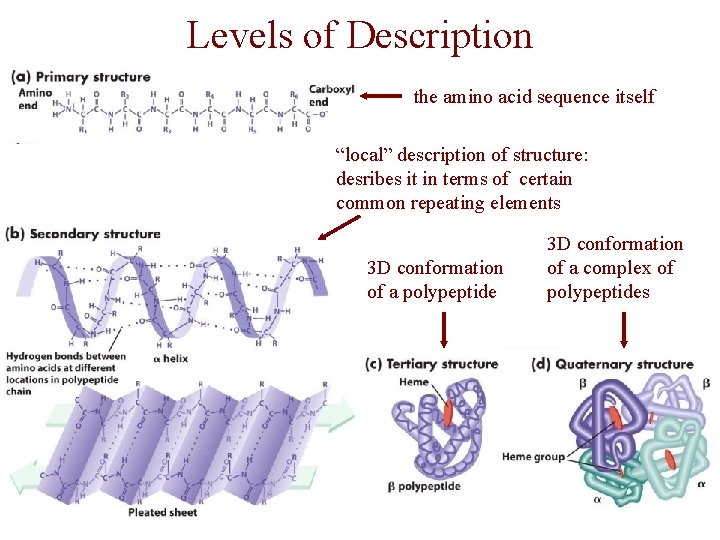
Levels of Description the amino acid sequence itself “local” description of structure: desribes it in terms of certain common repeating elements 3 D conformation of a polypeptide 3 D conformation of a complex of polypeptides
Secondary Structure • secondary structure refers to certain common repeating structures • it is a “local” description of structure • two common secondary structures a helices b strands/sheets • a third category, called coil or loop, refers to everything else
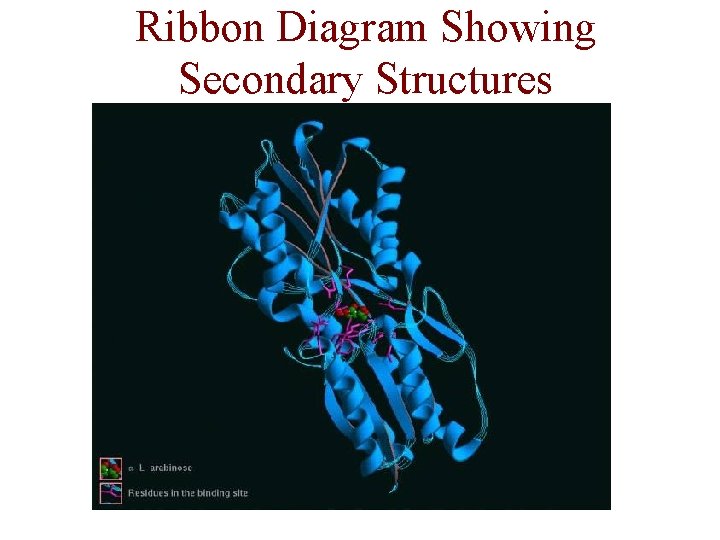
Ribbon Diagram Showing Secondary Structures
Determining Protein Structures • protein structures can be determined experimentally (in most cases) by – x-ray crystallography – nuclear magnetic resonance (NMR) • but this is very expensive and time-consuming • there is a large sequence-structure gap ≈ 300 K protein sequences in Swiss. Prot database < 50 K protein structures in PDB database • key question: can we predict structures by computational means instead?
Types of Protein Structure Predictions • prediction in 1 D – secondary structure – solvent accessibility (which residues are exposed to water, which are buried) – transmembrane helices (which residues span membranes) • prediction in 2 D – inter-residue/strand contacts • prediction in 3 D – homology modeling – fold recognition (e. g. via threading) – ab initio prediction (e. g. via molecular dynamics)
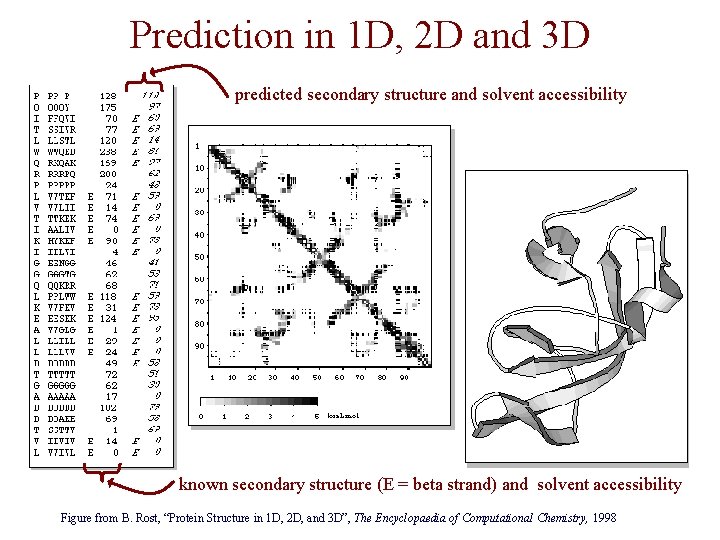
Prediction in 1 D, 2 D and 3 D predicted secondary structure and solvent accessibility known secondary structure (E = beta strand) and solvent accessibility Figure from B. Rost, “Protein Structure in 1 D, 2 D, and 3 D”, The Encyclopaedia of Computational Chemistry, 1998
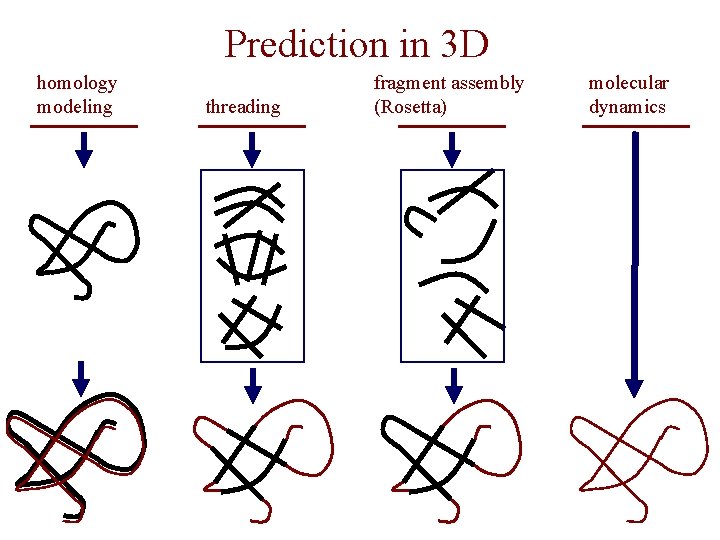
Prediction in 3 D • homology modeling given: a query sequence Q, a database of protein structures do: • find protein P such that – structure of P is known – P has high sequence similarity to Q • return P’s structure as an approximation to Q’s structure • fold recognition (threading) given: a query sequence Q, a database of known folds do: • find fold F such that Q can be aligned with F in a highly compatible manner • return F as an approximation to Q’s structure
Prediction in 3 D • “fragment assembly” (Rosetta) given: a query sequence Q, a database of structure fragments do: • find a set of fragments that Q can be aligned with in a highly compatible manner • return fragment assembly as an approximation to Q’s structure • molecular dynamics given: a query sequence Q do: use laws of Physics to simulate folding of Q
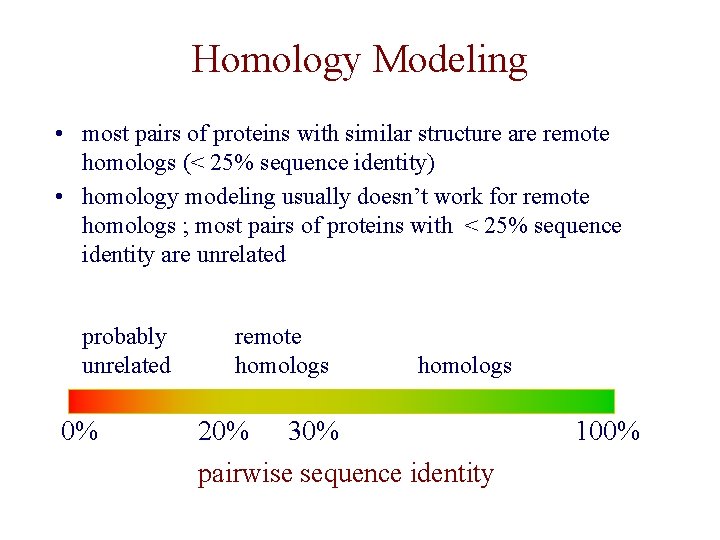
Homology Modeling • most pairs of proteins with similar structure are remote homologs (< 25% sequence identity) • homology modeling usually doesn’t work for remote homologs ; most pairs of proteins with < 25% sequence identity are unrelated probably unrelated 0% remote homologs 20% 30% pairwise sequence identity 100%
Prediction in 3 D homology modeling threading fragment assembly (Rosetta) molecular dynamics
- Slides: 18