
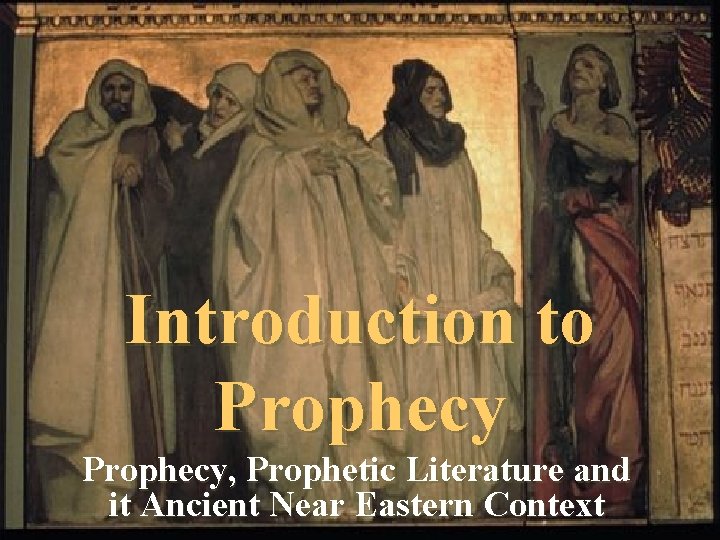
Introduction to Prophecy Prophetic Literature and it Ancient
![I. Introduction 3. ~yhla[h] vya – "The title "man of God" occurs about sixty-six](https://slidetodoc.com/presentation_image_h2/2a2fd071f4a02eb6e74906f07648d382/image-8.jpg "I. Introduction 3. ~yhla[h] vya – \"The title \"man of God\" occurs about sixty-six")
![3. ~yhla[h] vya (1) The presence of certain distinctive social and ecological pressures may](https://slidetodoc.com/presentation_image_h2/2a2fd071f4a02eb6e74906f07648d382/image-9.jpg "3. ~yhla[h] vya (1) The presence of certain distinctive social and ecological pressures may")
- Slides: 39
Introduction to Prophecy, Prophetic Literature and it Ancient Near Eastern Context
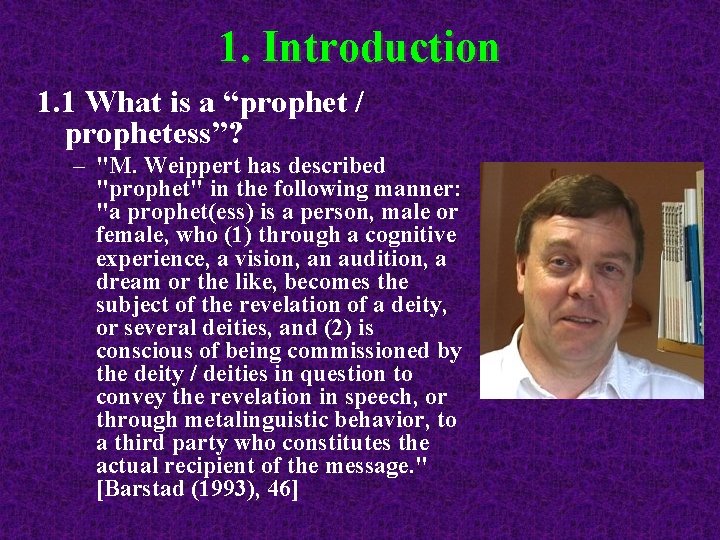
1. Introduction 1. 1 What is a “prophet / prophetess”? – "M. Weippert has described "prophet" in the following manner: "a prophet(ess) is a person, male or female, who (1) through a cognitive experience, a vision, an audition, a dream or the like, becomes the subject of the revelation of a deity, or several deities, and (2) is conscious of being commissioned by the deity / deities in question to convey the revelation in speech, or through metalinguistic behavior, to a third party who constitutes the actual recipient of the message. " [Barstad (1993), 46]
1. Introduction 1. 2 Terms: 1. aybn na 4 b|, – "Approximately fifty years ago W. F. Albright suggested that the Hebrew word na 4 b|= , "prophet, " is a noun from a passive form of the Semitic root nb), "to call"; he based this primarily on comparison with the Akkadian verb nabu=, "to name, invoke. " The prophet is therefore "one called" by God. Scholars who had opted for an active interpretation explained the nab|=) as a "proclaimer" or "spokesman". "
1. aybn na 4 b|, • "Unfortunately, the actual use of the Akkadian word is commonly obscured in the discussion centered on the Bible. In particular, the primary meaning of the verb nabu= (m) is "to name, " which may then indicate "calling" on the name of a god, naming to kingship or rule, or even naming a price. " • "If the original meaning of na 4 b|=) involved not "being named" but "naming, " then perhaps the biblical tradition of "calling on the name" preserves an ancient identity of the Israelite prophet as "one who invokes" the name of Yahweh for power and guidance. " Fleming, "The Etymological Origins of the Hebrew
I. Introduction 2. har ro 4 eh • "The Ephraimite literature applies the title "seer" (ro)eh) only to Samuel, and even in this case the use of the title is confined to the old story of Saul's search for the lost asses (1 Sam 9. 11, 18, 19). . The function of the seer is explictly state in an explanatory gloss in 1 Sam 9. 9, in which later Ephraimite authors interpreted the meaning of the archaic title. " [Wilson]
2. har ro 4 eh (a) The role of the ro)eh is enacted in an urban setting. . (b) The role is enacted at the high place in the city. This fact tells us that the role was not enacted privately, either at a private shrine or in someone's home. The role was enacted publicly. . (d) The activity of the ro eh required payment. . (e) Enactment of the ro eh's role entailed participation in a sacrificial cultus. Such a cultus involved animal slaughter and the communal consumption of food, the latter element no doubt yet another form of payment for the ro eh service. . [Petersen]
2. har ro 4 eh • (f) The ro eh was in the business of responding to requests for information. Such activity is consistent with payment of a fee to the ro eh. . • (g) The role, or more precisely role label, fell into desuetude at some point in Israel's history. 1 Samuel 9. 9 gives unequivocal evidence of this fact. When the term ro eh lost currency, we do not know. " [Petersen]
I. Introduction 3. ~yhla[h] vya – "The title "man of God" occurs about sixty-six times in the Ephriamite corpus and is widely attested in extrabiblical literature. The phrase "man of God" should probably be understood to mean "servant of God, " and there is some indication that the designation was an honorific title applied to certain members of prophetic groups. " [Wilson]
3. ~yhla[h] vya (1) The presence of certain distinctive social and ecological pressures may be discerned during the historical period in which the ~yhla[h] vya and ~yhla-vya were active in Israel. (2)Those individuals active as ~yhla[h] vya in the legenda contexts are depicted as oppressed, or as relating to peripheral members of the society. (3)The role enactment of the ~yhla[h] vya entails group activity. This is a particularly important point since the group denoted by the phrase ~yaiybi. N>h; -yn. Eb. is so markedly absent from the periods before and after the ninth century B. C. E. [Petersen, The Role of the Prophets of Israel]
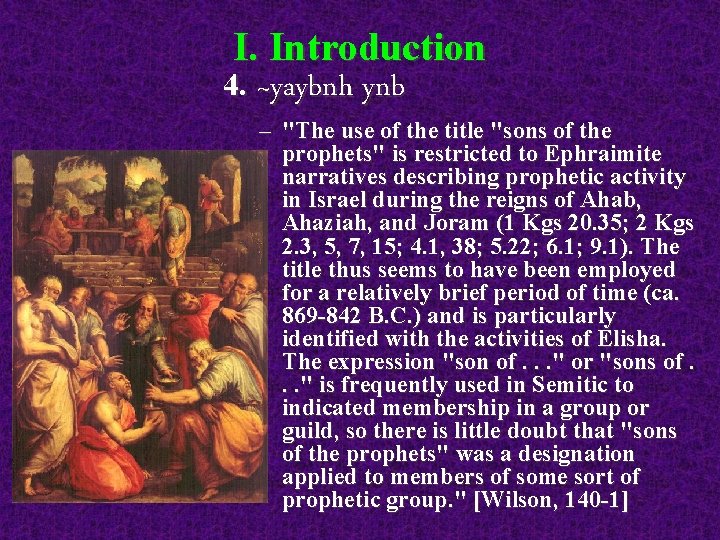
I. Introduction 4. ~yaybnh ynb – "The use of the title "sons of the prophets" is restricted to Ephraimite narratives describing prophetic activity in Israel during the reigns of Ahab, Ahaziah, and Joram (1 Kgs 20. 35; 2 Kgs 2. 3, 5, 7, 15; 4. 1, 38; 5. 22; 6. 1; 9. 1). The title thus seems to have been employed for a relatively brief period of time (ca. 869 -842 B. C. ) and is particularly identified with the activities of Elisha. The expression "son of. . . " or "sons of. . . " is frequently used in Semitic to indicated membership in a group or guild, so there is little doubt that "sons of the prophets" was a designation applied to members of some sort of prophetic group. " [Wilson, 140 -1]
4. ~yaybnh ynb • ". . . the "hard core" of "sons of the prophets. " These groups were undoubtedly formed during Ahab's reign - small fanatical bands that gathered around Elijah in his struggle against the foreign queen and her Canaanite abominations. They, too, like their master Elijah, were forced to flee the cruel queen's persecution, to hide in caves and deserts and seek shelter in the homes of the remaining faithful. Jezebel massacred as many of them as she could (1 Kgs 19. 10), and the assistance of clandestine allies at the royal court, such as Obadiah, the king's steward (18. 13), could not alter the balance of power between the two parties. " [Uffenheimer]
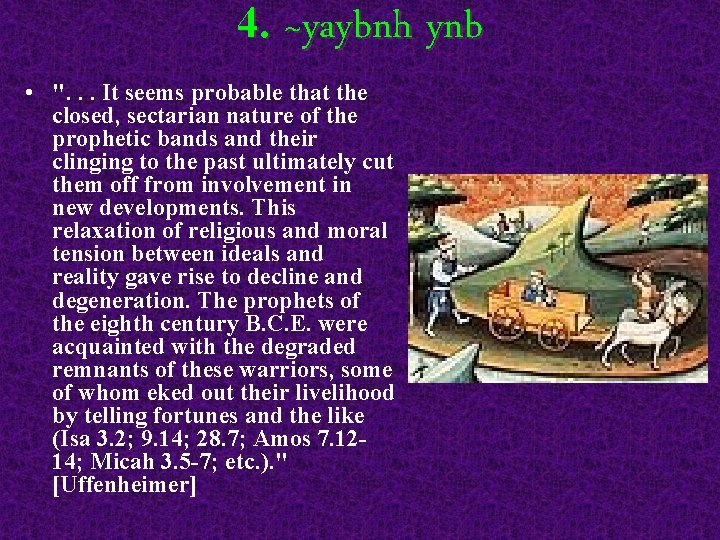
4. ~yaybnh ynb • ". . . It seems probable that the closed, sectarian nature of the prophetic bands and their clinging to the past ultimately cut them off from involvement in new developments. This relaxation of religious and moral tension between ideals and reality gave rise to decline and degeneration. The prophets of the eighth century B. C. E. were acquainted with the degraded remnants of these warriors, some of whom eked out their livelihood by telling fortunes and the like (Isa 3. 2; 9. 14; 28. 7; Amos 7. 1214; Micah 3. 5 -7; etc. ). " [Uffenheimer]
I. Introduction 4. hz. Exo or hz. EAx – "The title "visionary is a participle of the verb ha 4 zah, "to see" or "to have a vision. " The majority of the occurrences of the verb and its nominal derivatives are in visionary contexts, so we may safely assume that the hz. Exo was one who obtained revelations through visions. The title is employed primarily by Judean authors and is almost always given to individuals who can be identified as Judeans. " [Wilson] – Amos is called this by Amaziah; Mic 3. 7 of Jerusalemite royal theology; Isa 29. 10; 30. 10 used by Isaiah about Jerusalem prophets.
4. hz. Exo or hz. EAx – According to the Judean tradition reflected in Chronicles, visionaries were particularly active in Judah around the time of the united monarchy (1 Chr 21. 9; 25. 5; 29. 29; 2 Chr 9. 29; 12. 15; 19. 2; 29. 25, 30), although the prophetic books themselves indicate that these intermediaries were still present in Judah in later times (cf. 2 Chr 33. 18; 2 Kgs 17. 13). If the evidence of the Chronicler is reliable, then it is clear that the visionary was a central intermediary. " [Wilson]
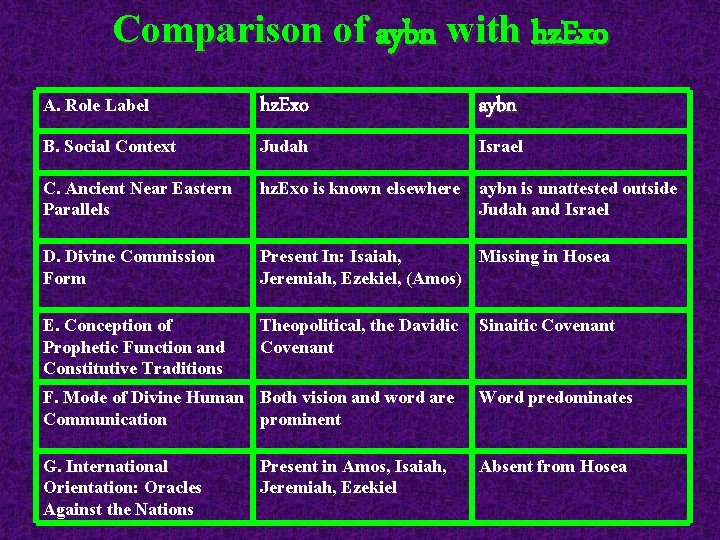
Comparison of aybn with hz. Exo A. Role Label hz. Exo aybn B. Social Context Judah Israel C. Ancient Near Eastern Parallels hz. Exo is known elsewhere aybn is unattested outside Judah and Israel D. Divine Commission Form Present In: Isaiah, Missing in Hosea Jeremiah, Ezekiel, (Amos) E. Conception of Prophetic Function and Constitutive Traditions Theopolitical, the Davidic Covenant Sinaitic Covenant F. Mode of Divine Human Both vision and word are Communication prominent Word predominates G. International Orientation: Oracles Against the Nations Absent from Hosea Present in Amos, Isaiah, Jeremiah, Ezekiel
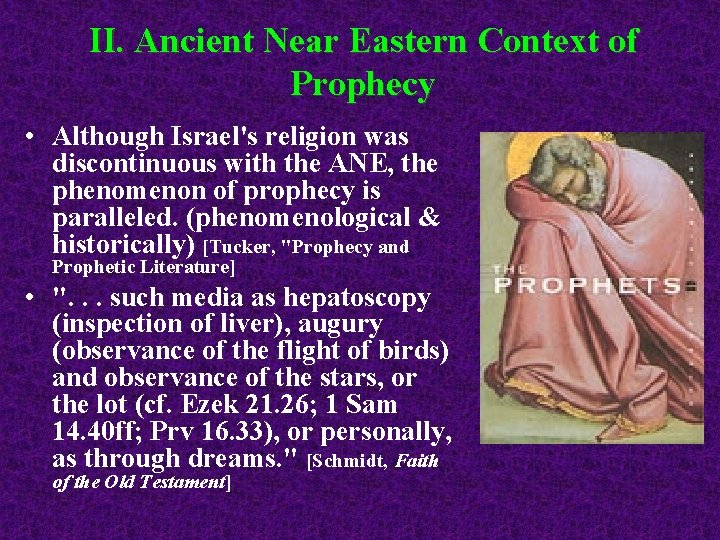
II. Ancient Near Eastern Context of Prophecy • Although Israel's religion was discontinuous with the ANE, the phenomenon of prophecy is paralleled. (phenomenological & historically) [Tucker, "Prophecy and Prophetic Literature] • ". . . such media as hepatoscopy (inspection of liver), augury (observance of the flight of birds) and observance of the stars, or the lot (cf. Ezek 21. 26; 1 Sam 14. 40 ff; Prv 16. 33), or personally, as through dreams. " [Schmidt, Faith of the Old Testament]
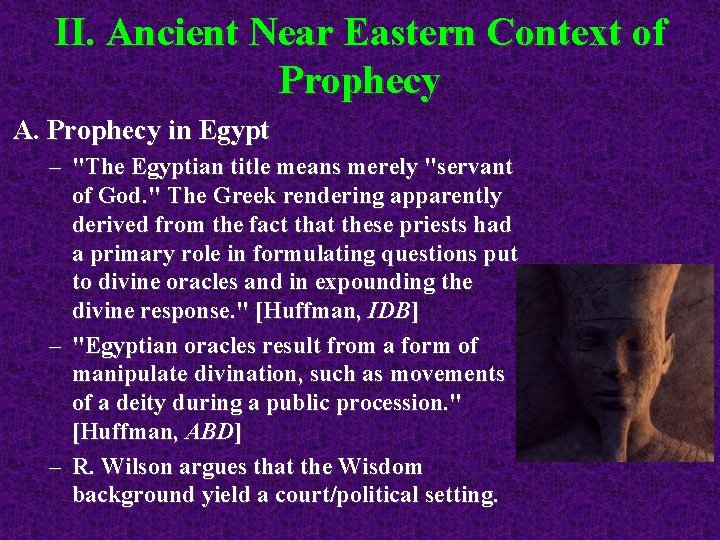
II. Ancient Near Eastern Context of Prophecy A. Prophecy in Egypt – "The Egyptian title means merely "servant of God. " The Greek rendering apparently derived from the fact that these priests had a primary role in formulating questions put to divine oracles and in expounding the divine response. " [Huffman, IDB] – "Egyptian oracles result from a form of manipulate divination, such as movements of a deity during a public procession. " [Huffman, ABD] – R. Wilson argues that the Wisdom background yield a court/political setting.
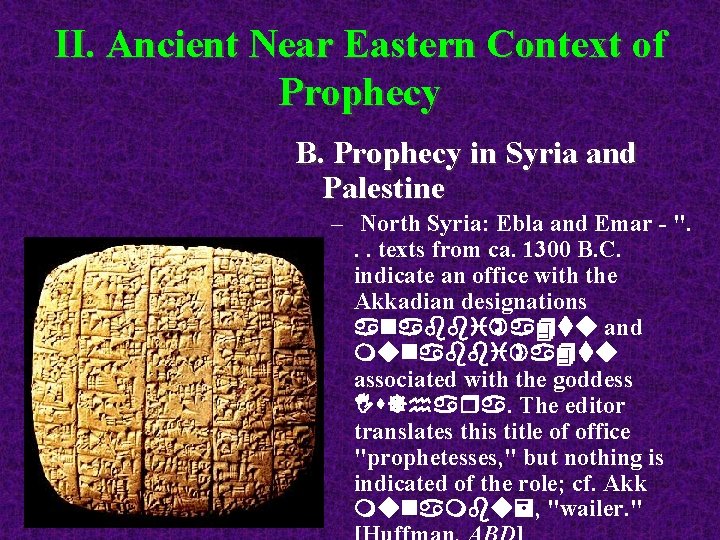
II. Ancient Near Eastern Context of Prophecy B. Prophecy in Syria and Palestine – North Syria: Ebla and Emar - ". . . texts from ca. 1300 B. C. indicate an office with the Akkadian designations anabbi a 4 tu and munabbi a 4 tu associated with the goddess Is]hara. The editor translates this title of office "prophetesses, " but nothing is indicated of the role; cf. Akk munambu=, "wailer. "
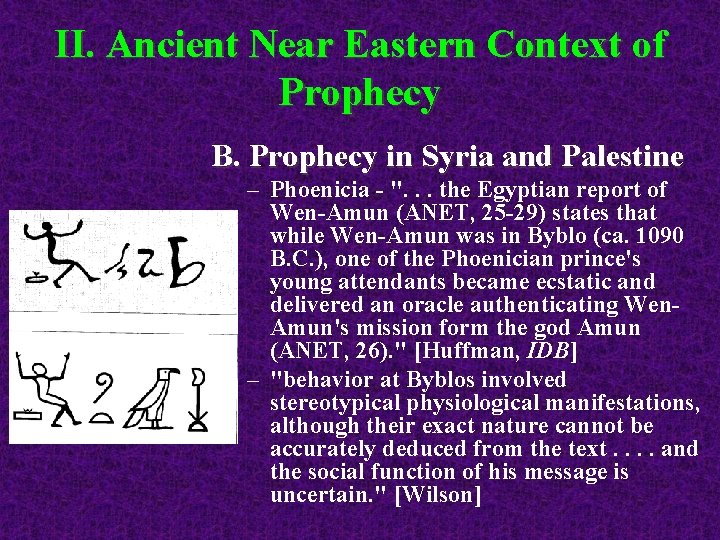
II. Ancient Near Eastern Context of Prophecy B. Prophecy in Syria and Palestine – Phoenicia - ". . . the Egyptian report of Wen-Amun (ANET, 25 -29) states that while Wen-Amun was in Byblo (ca. 1090 B. C. ), one of the Phoenician prince's young attendants became ecstatic and delivered an oracle authenticating Wen. Amun's mission form the god Amun (ANET, 26). " [Huffman, IDB] – "behavior at Byblos involved stereotypical physiological manifestations, although their exact nature cannot be accurately deduced from the text. . and the social function of his message is uncertain. " [Wilson]
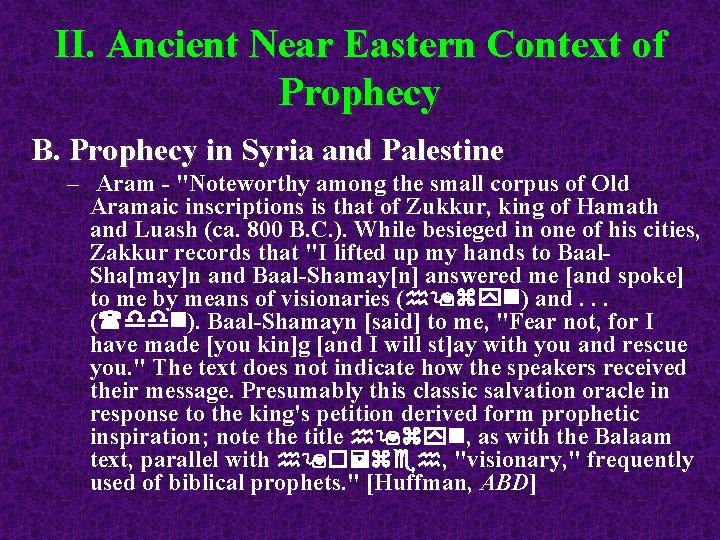
II. Ancient Near Eastern Context of Prophecy B. Prophecy in Syria and Palestine – Aram - "Noteworthy among the small corpus of Old Aramaic inscriptions is that of Zukkur, king of Hamath and Luash (ca. 800 B. C. ). While besieged in one of his cities, Zakkur records that "I lifted up my hands to Baal. Sha[may]n and Baal-Shamay[n] answered me [and spoke] to me by means of visionaries (h 9 zyn) and. . . ((ddn). Baal-Shamayn [said] to me, "Fear not, for I have made [you kin]g [and I will st]ay with you and rescue you. " The text does not indicate how the speakers received their message. Presumably this classic salvation oracle in response to the king's petition derived form prophetic inspiration; note the title h 9 zyn, as with the Balaam text, parallel with h 9 o=zeh, "visionary, " frequently used of biblical prophets. " [Huffman, ABD]
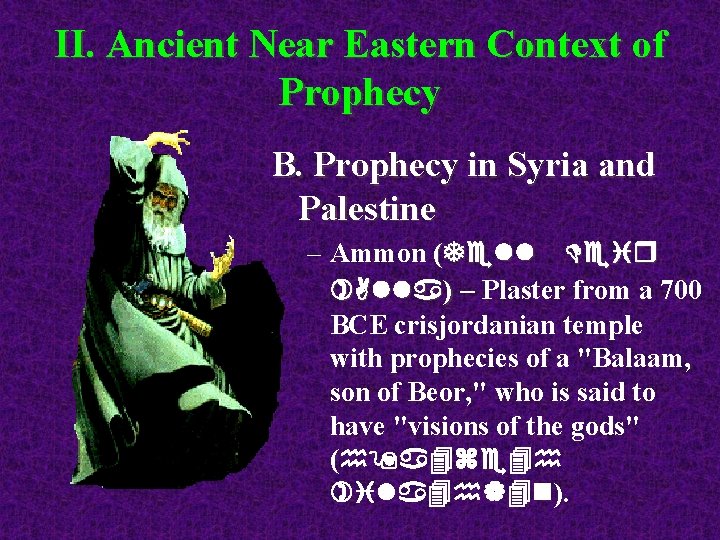
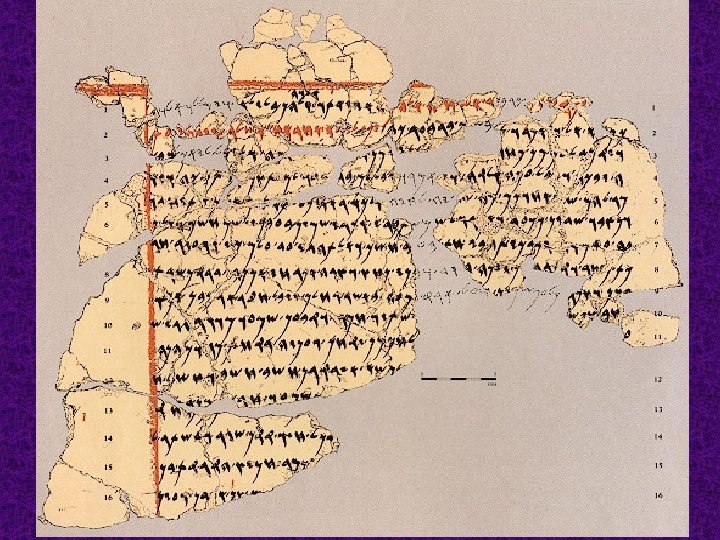
II. Ancient Near Eastern Context of Prophecy B. Prophecy in Syria and Palestine – Ammon (Tell Deir Alla) – Plaster from a 700 BCE crisjordanian temple with prophecies of a "Balaam, son of Beor, " who is said to have "visions of the gods" (h 9 a 4 ze 4 h ila 4 h|4 n).
Why study about Balaam? • The complexity of Numbers 22 -24, 25 and its characterization of Balaam? – Is he a “sinner” or a “saint”? • Balaam is referred to throughout the Old and the New Testaments! • There is even a 6 th century B. C. Aramaic Inscription referring to Balaam the seer and his prophecies.
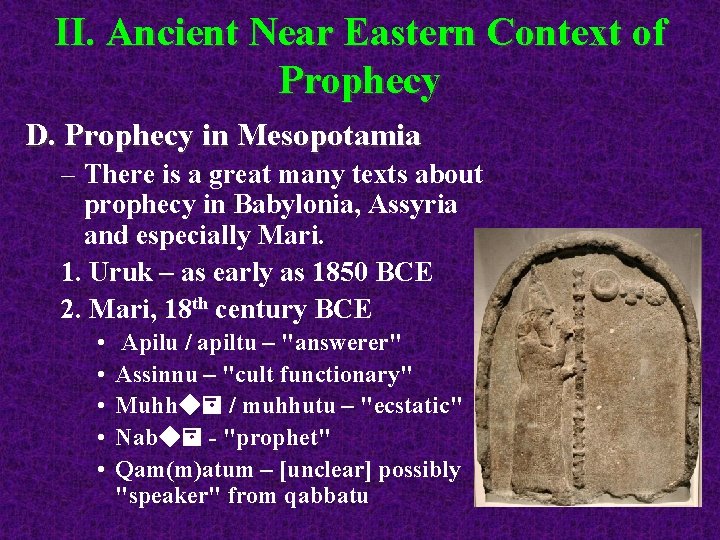
II. Ancient Near Eastern Context of Prophecy D. Prophecy in Mesopotamia – There is a great many texts about prophecy in Babylonia, Assyria and especially Mari. 1. Uruk – as early as 1850 BCE 2. Mari, 18 th century BCE • • • Apilu / apiltu – "answerer" Assinnu – "cult functionary" Muhhu= / muhhutu – "ecstatic" Nabu= - "prophet" Qam(m)atum – [unclear] possibly "speaker" from qabbatu
III. A History of Prophecy In Israel A. Presuppositions – "Prophecy must be understood as one element among others in the larger whole of the religious and social culture of the ancient Hebrews. Prophecy functioned as a complement to priestly tradition and wisdom (Jer 18. 18) and is not fully understandable when isolated from the other components of Israelite life. " [Hayes] – Cult Prophet theory
III. A History of Prophecy In Israel A. Pre-Classical Prophecy: – Abraham as Prophet: Gen. 20. 7 – Israelites in the Wilderness: Num 11. 16 -17, 24 -30; 12; Exod 15. 20 (Miriam) – Judges 4. 4 (Deborah); 6. 7 -10 – Samuel – Nathan (2 Sam 7; 1 Chr 17; 2 Sam 12; 1 Kgs 1, etc. ) – Gad (1 Sam 22; 24; etc. ) – Early Period of the Divided Monarchy
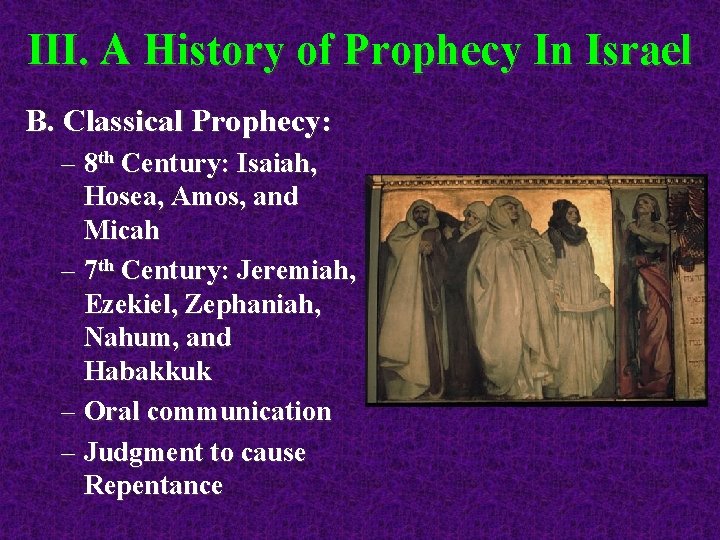
III. A History of Prophecy In Israel B. Classical Prophecy: – 8 th Century: Isaiah, Hosea, Amos, and Micah – 7 th Century: Jeremiah, Ezekiel, Zephaniah, Nahum, and Habakkuk – Oral communication – Judgment to cause Repentance
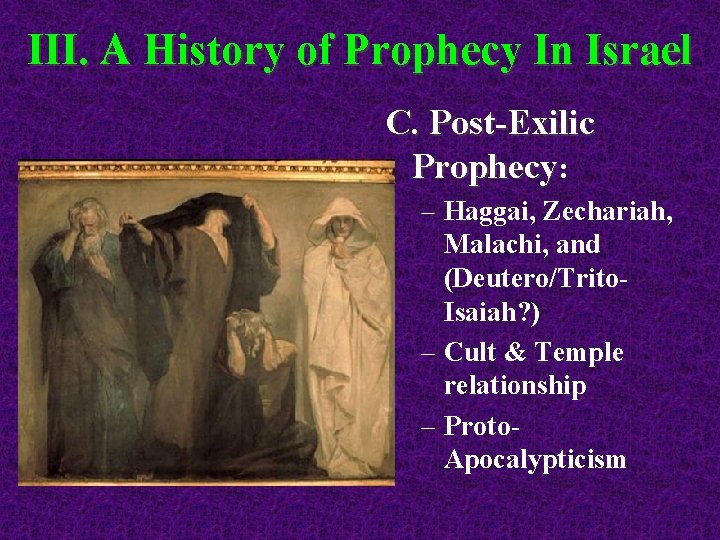
III. A History of Prophecy In Israel C. Post-Exilic Prophecy: – Haggai, Zechariah, Malachi, and (Deutero/Trito. Isaiah? ) – Cult & Temple relationship – Proto. Apocalypticism
IV. Theological Role of the Prophet: 1. Called 2. Messenger of Yahweh 3. Intercession 4. Worker of Miracles 5. Anointer of Kings & Political leaders Priest: 1. Hereditary 2. Cult functionary – sacrifices, praise, atoning, etc. 3. Teach the Torah
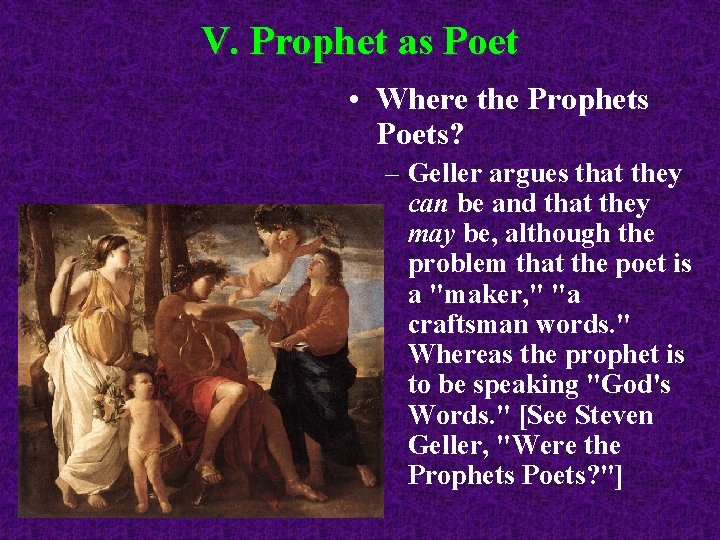
V. Prophet as Poet • Where the Prophets Poets? – Geller argues that they can be and that they may be, although the problem that the poet is a "maker, " "a craftsman words. " Whereas the prophet is to be speaking "God's Words. " [See Steven Geller, "Were the Prophets Poets? "]
OT Poetry 1. "Poetry comprises one third of the Hebrew Bible - this fact was fully appreciated only within the past two hundred years. The poetry of the OT is unlike classical, European, and even later Jewish poetry. Rhyme is virtually non-existent, and rhythm is flexible, being marked, not by syllabic feet, but by an elusive tonal system supplied by medieval scholars. " [Gottwald, N. K. "Poetry, Hebrew, " IDB]
OT Poetry 2. "The fundamental formal feature of canonical poetry is the correspondence of thought in successive half lines, known as parallelism of members. The thought may be repeated, contrasted, or advanced; it may be figurative, stairlike, or inverted. The parallelism may be both within lines and between lines. " [Gottwald, N. K. "Poetry, Hebrew, " IDB]
OT Poetry 3. "We have devised recently a mechanical test to separate poetry from prose in the Bible, and preliminary test show that it will work efficiently in most cases. The particles ta (the sign of the definite direct object), rva (the relative pronoun), and –h (the definite article) all have been identified as prosaic elements, not common in or suitable to poetry. " [Freedman, Pottery, Poetry, and Prophecy]
OT Poetry 3. 1 ". . . what is called biblical "poetry" is a complex of heightening effects used in combinations and intensities that vary widely from composition to composition even within a single "genre. " [Kugel, The Idea of Biblical Poetry]
OT Poetry 4. Wifred G. E. Watson, Classical Hebrew Poetry: A Guide to its Techniques: Prose or poetry table of indicators: 4. 1 Broad Indicators: a) presence of established line-forms, b) ellipsis, especially verb-gapping, c) unusual vocabulary, d) conciseness, e) unusual word-order, f) archaisms, g) use of metre and rhythm, h) regularity and symmetry
OT Poetry 4. 2 Structural Indicators: a) parallelism in various forms, b) word-pairs, c) chiastic patterns, c) envelope figure, d) break-up of stereotyped phrases, e) repetition in various forms, f) gender-matched parallelism, g) tricolon 4. 3 Other. a) rhyme, b) other sound patterns 4. 4 Negative. Absence/rarity of prose elements [Watson, Classical Hebrew Poetry, 46 -62]
Parallelism 5. Definition of Parallelism: – “. . . parallelism is a matter of relationships - between lines and/or parts of lines. ” [Berlin, A. , “Parallelism, ” ABD] – Kugel argues for “A, what’s more, B” while Alter the “consequentiality of parallel lines. ” Therefore they both as literary critics see the differences verses the similarities that an early generation saw.
James Kugel & Parallelism 5. 1 "The parallelistic style in the Bible consists not of stringing together clauses that bear some semantic, syntactic, or phonetic resemblance, nor yet of "saying the same thing twice, " but of the sequence ------// in which B is both a continuation of A and yet broken from it by a pause, a typically emphatic, "seconding" style in which parallelism plays an important part but whose essence is not parallelism, but the "seconding sequence. "" [Kugel, 54]
Parallelism 6. The three basic types: – Synonymous – Antithetic – Synthetic 7. Miscellaneous Types: – Emblematic (similes/metaphors) – Staircase – Chiastic – Janus (single word)
Parallelism 8. Techniques: – Alliteration (beginning of words/syllables) – Assonance (accented vowels) – Paranomasia – Onomatopoeia – Word Pairs [Ugaritc Poetry has given us a whole series of standard word pairs that are found in OT poetry