
Introduction to properties of materials BADI 1 John
Introduction to properties of materials BADI 1 John Errington MSc 1
Classes of Materials are grouped into categories or classes based on their chemical composition. Material selection is determined by the capabilities and qualities of materials, or their properties. The following slide shows four classes of materials, their definitions, types of materials within the class, properties, and examples of usage. 2
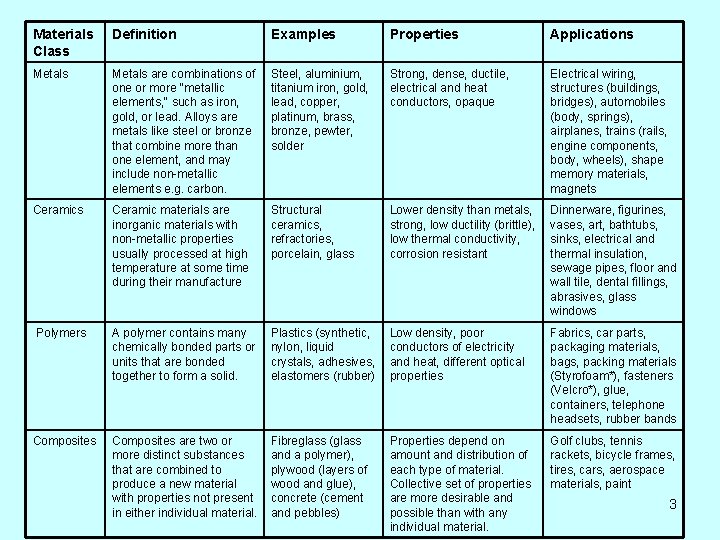
Materials Class Definition Examples Properties Applications Metals are combinations of one or more "metallic elements, " such as iron, gold, or lead. Alloys are metals like steel or bronze that combine more than one element, and may include non-metallic elements e. g. carbon. Steel, aluminium, titanium iron, gold, lead, copper, platinum, brass, bronze, pewter, solder Strong, dense, ductile, electrical and heat conductors, opaque Electrical wiring, structures (buildings, bridges), automobiles (body, springs), airplanes, trains (rails, engine components, body, wheels), shape memory materials, magnets Ceramic materials are inorganic materials with non-metallic properties usually processed at high temperature at some time during their manufacture Structural ceramics, refractories, porcelain, glass Lower density than metals, strong, low ductility (brittle), low thermal conductivity, corrosion resistant Dinnerware, figurines, vases, art, bathtubs, sinks, electrical and thermal insulation, sewage pipes, floor and wall tile, dental fillings, abrasives, glass windows Polymers A polymer contains many chemically bonded parts or units that are bonded together to form a solid. Plastics (synthetic, nylon, liquid crystals, adhesives, elastomers (rubber) Low density, poor conductors of electricity and heat, different optical properties Fabrics, car parts, packaging materials, bags, packing materials (Styrofoam*), fasteners (Velcro*), glue, containers, telephone headsets, rubber bands Composites are two or more distinct substances that are combined to produce a new material with properties not present in either individual material. Fibreglass (glass and a polymer), plywood (layers of wood and glue), concrete (cement and pebbles) Properties depend on amount and distribution of each type of material. Collective set of properties are more desirable and possible than with any individual material. Golf clubs, tennis rackets, bicycle frames, tires, cars, aerospace materials, paint 3
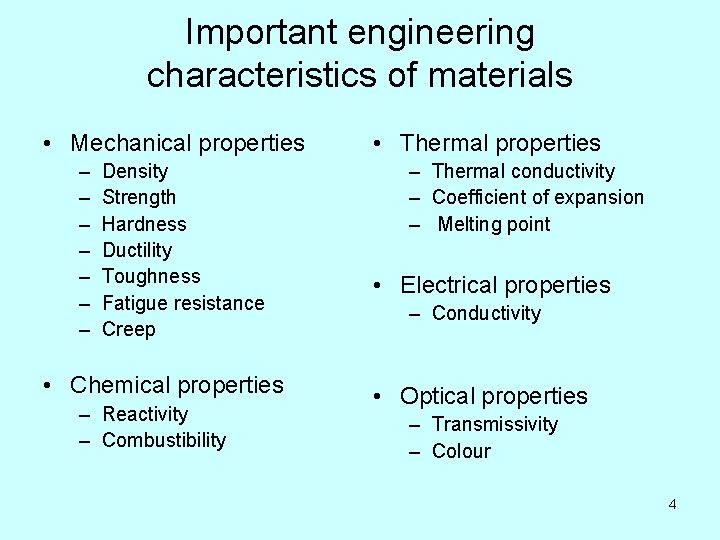
Important engineering characteristics of materials • Mechanical properties – – – – Density Strength Hardness Ductility Toughness Fatigue resistance Creep • Chemical properties – Reactivity – Combustibility • Thermal properties – Thermal conductivity – Coefficient of expansion – Melting point • Electrical properties – Conductivity • Optical properties – Transmissivity – Colour 4
Other concerns about materials • • Availability - sizes, minimum quantities. Sustainability – plentiful sustainable resources Ease of manufacture - machinability, weldability. Compatibility - electrochemical compatibility with other parts of the system. • Reliability - how consistent are the material properties. • Cost - although 5 th in this list, this factor may well be used first to eliminate a large number of possible options. • Recycleability - increasing environmental concern (and resulting legislation) worldwide is driving manufacturers to use materials that can be recycled with minimum difficulty. 5
6
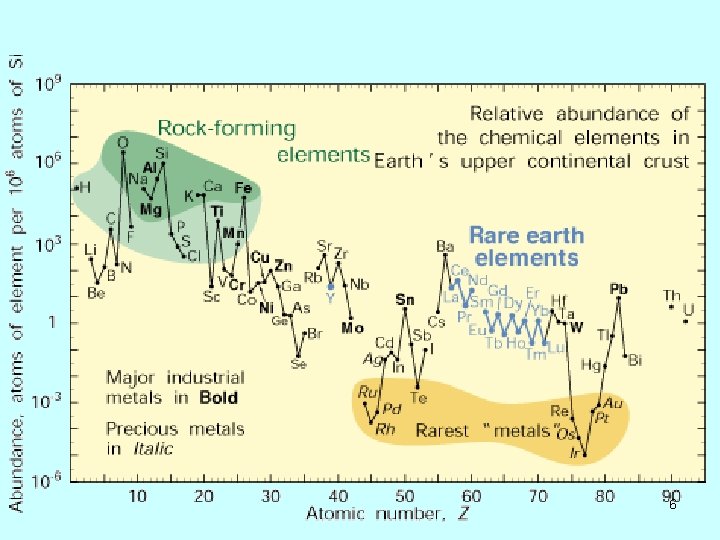
Recycling Steel Recycling: Recycling rates for steel have consistently exceeded 50%. Each year, more steel is recycled than aluminum, paper, glass and plastic combined! Aluminum Recycling: Aluminum recycling is considered the most profitable type of recycled material. It is sorted using magnets to separate steel and aluminum. Aluminum is very reactive is not found in the earth in its pure form. Extraction is a complex and very energy-intensive process that takes aluminum oxide from bauxite and then removes the oxygen in a smelting process to produce aluminum. Recycling aluminum is relatively easy, and saves up to 95 percent of the energy required to refine it after original extraction. Precious metals: Platinum, Rhodium, Gold, Silver, even metals such as Nickel and Cadmium all used in electronic equipment and can be recovered reasonably easily due to their low reactivity. Glass Recycling: Glass is a highly effective recycled material and a very stable, nontoxic material when disposed of. Glass recycling is dependent on effective color separation of the material. Paper Recycling: The recycling of paper and cardboard is easily attained and very effective. The quantity of paper recycled has increased. The quality of paper recycling depends on the process used. Paper cannot be recycled forever. Each process reduces the fiber length, thus reducing the ability of the fibers to stick together without the use of additional adhesives. Plastics Recycling: The primary problem with plastics recycling is cross-contamination of resins. If one type of plastic is recycled with another, it can significantly degrade the quality of the end product. Therefore, a careful process of sorting is required to ensure this does not occur. There are different methods used to sort plastics. Once the material has been sorted, it can be remanufactured using a number of different techniques including extrusion, blow molding, and injection molding, and reused in many different applications 7

Densities of structural materials Comparison: density of water is 1000 kg/m 3 8
Strength • A measure of the material’s ability to resist deformation and to maintain its shape. • It is quantified in terms of yield stress or ultimate tensile strength. • High carbon steels and metal alloys have higher strength than pure metals. • Ceramics also exhibit high strengths. 9
Hardness • A measure of the material’s ability to resist indentation, abrasion and wear. • It is quantified by a hardness scale such as Rockwell and Brinell hardness scales. • Hardness and Strength correlate well because both properties are related to in-molecular bonding. 10
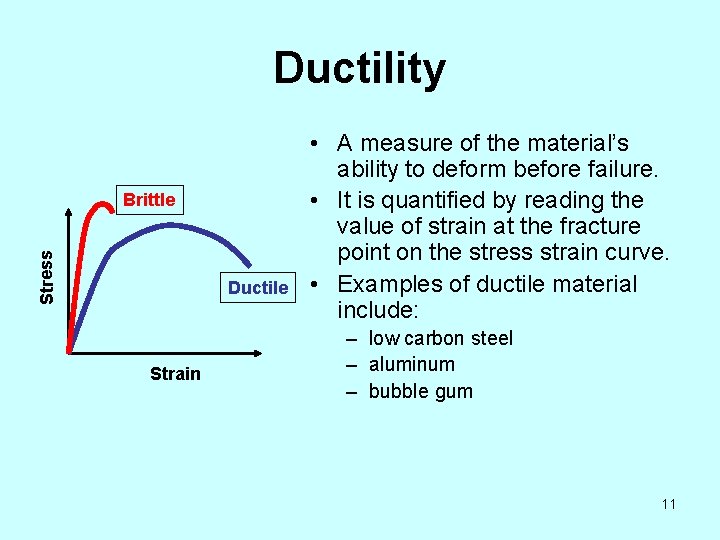
Ductility Stress Brittle Ductile Strain • A measure of the material’s ability to deform before failure. • It is quantified by reading the value of strain at the fracture point on the stress strain curve. • Examples of ductile material include: – low carbon steel – aluminum – bubble gum 11
Toughness A measure of the material’s ability to absorb energy. It is measured by two methods. a) Integration of stress strain curve • Slow absorption of energy • Absorbed energy per unit volume unit : • (lb/in²) *(in/in) =lb·in/in³ b) Charpy test This measures impact toughness (see later) 12
Since the properties we are concerned with all deal with how structures deform in response to forces, we need some way to normalize: • Force • Amount of deformation 13
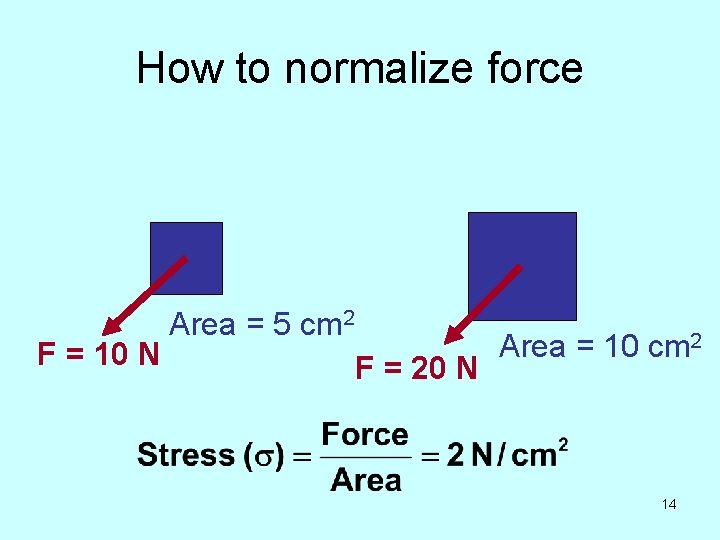
How to normalize force F = 10 N Area = 5 cm 2 F = 20 N Area = 10 cm 2 14
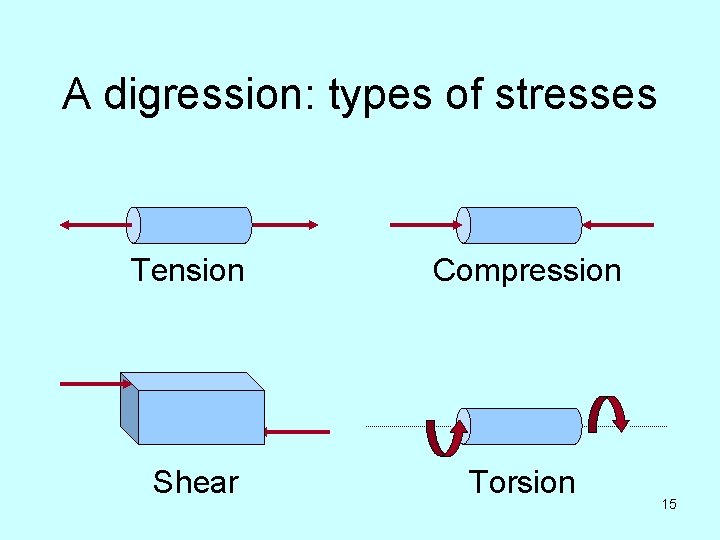
A digression: types of stresses Tension Compression Shear Torsion 15
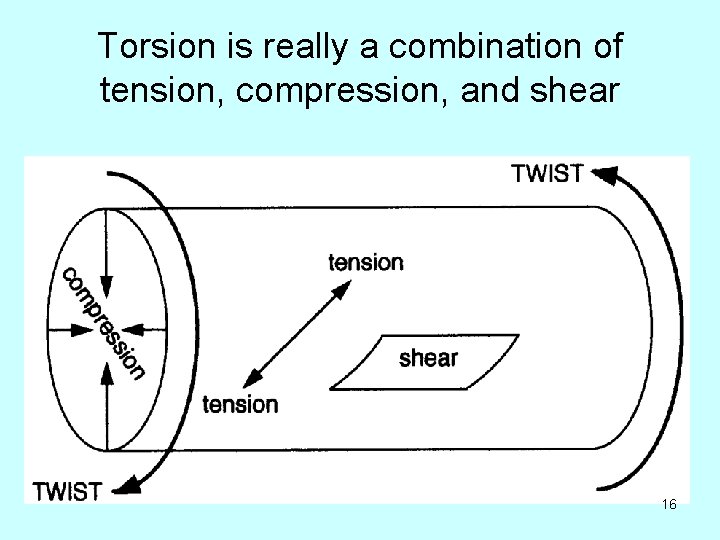
Torsion is really a combination of tension, compression, and shear 16
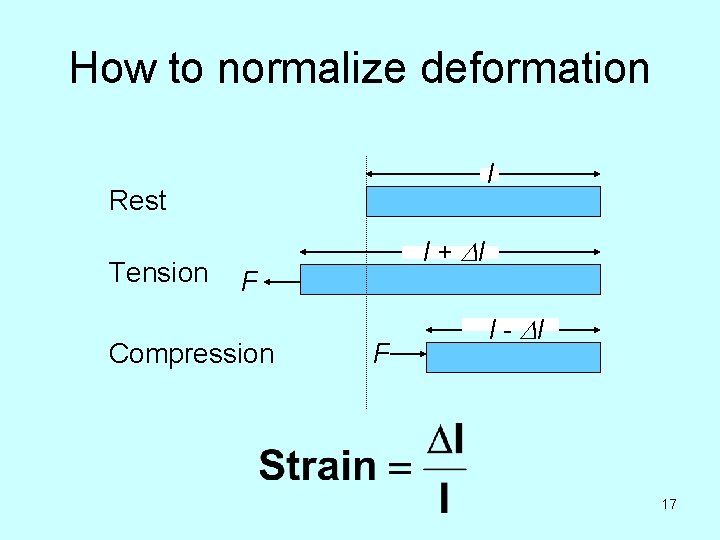
How to normalize deformation l Rest Tension l + Dl F Compression F l - Dl 17
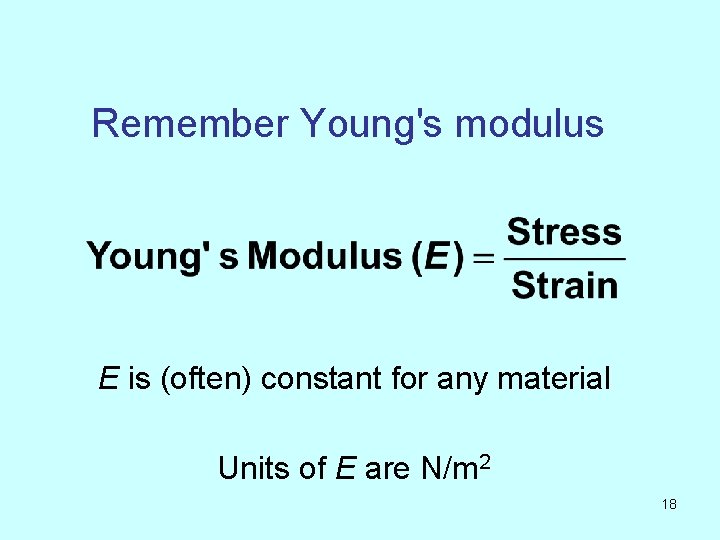
Remember Young's modulus E is (often) constant for any material Units of E are N/m 2 18
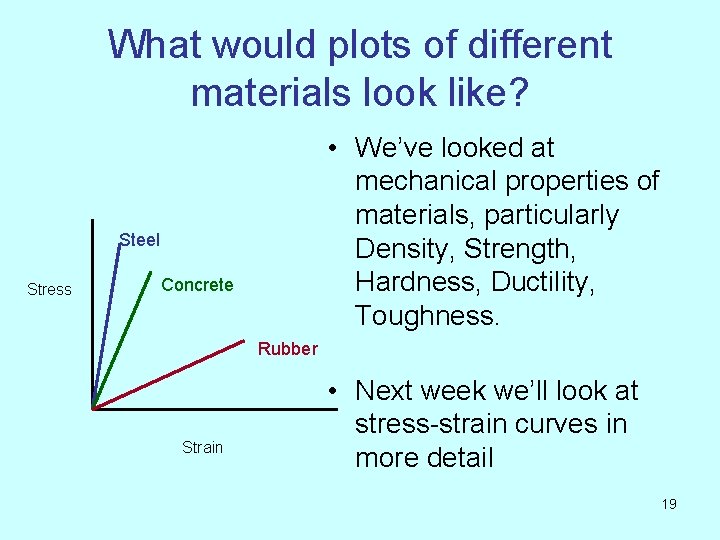
What would plots of different materials look like? • We’ve looked at mechanical properties of materials, particularly Density, Strength, Hardness, Ductility, Toughness. Steel Stress Concrete Rubber Strain • Next week we’ll look at stress-strain curves in more detail 19
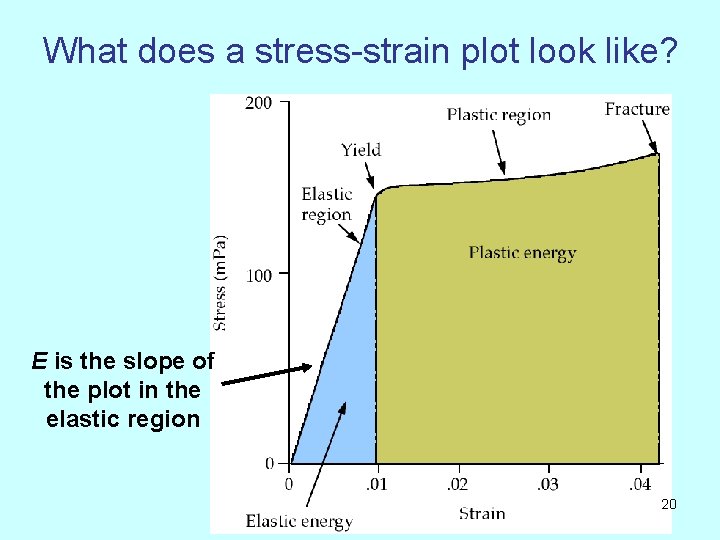
What does a stress-strain plot look like? E is the slope of the plot in the elastic region 20
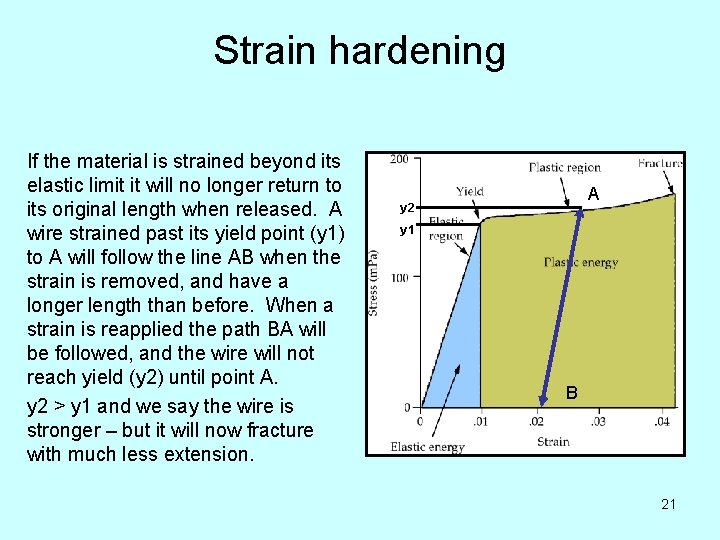
Strain hardening If the material is strained beyond its elastic limit it will no longer return to its original length when released. A wire strained past its yield point (y 1) to A will follow the line AB when the strain is removed, and have a longer length than before. When a strain is reapplied the path BA will be followed, and the wire will not reach yield (y 2) until point A. y 2 > y 1 and we say the wire is stronger – but it will now fracture with much less extension. A y 2 y 1 B 21
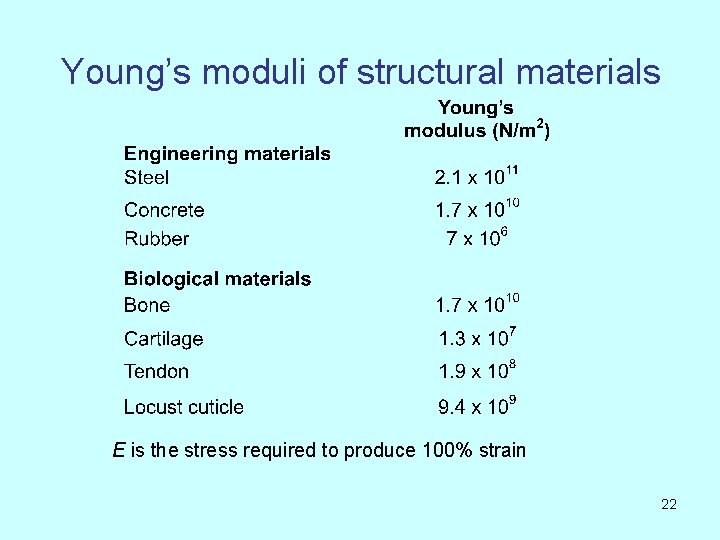
Young’s moduli of structural materials E is the stress required to produce 100% strain 22
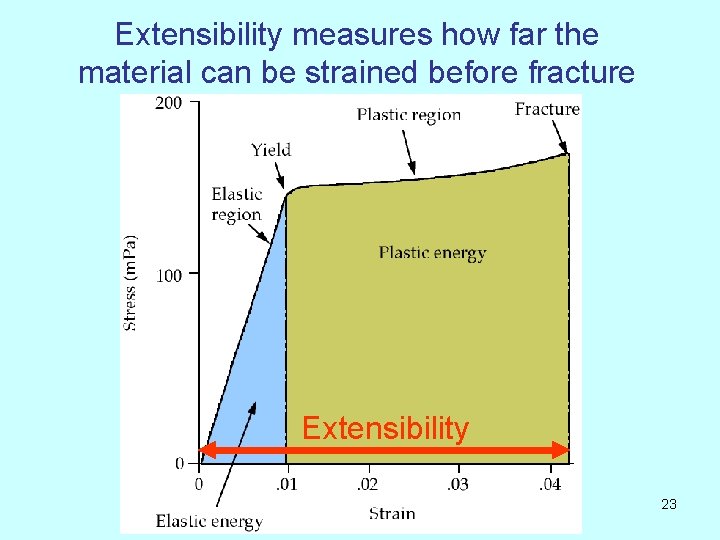
Extensibility measures how far the material can be strained before fracture Extensibility 23
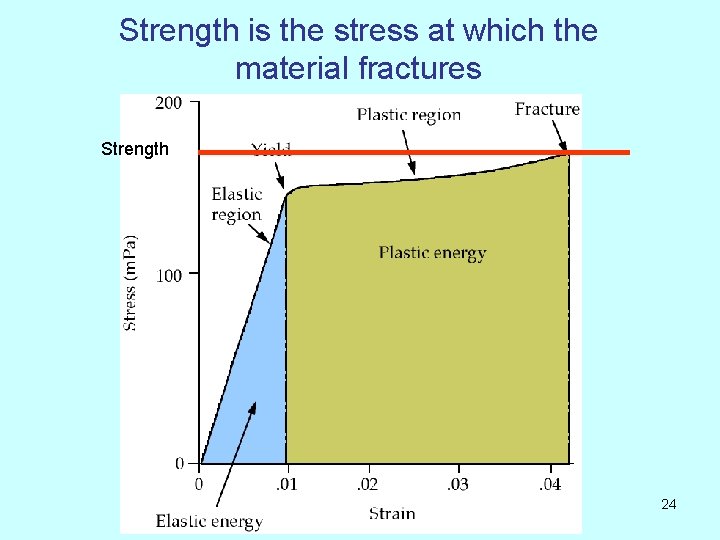
Strength is the stress at which the material fractures Strength 24
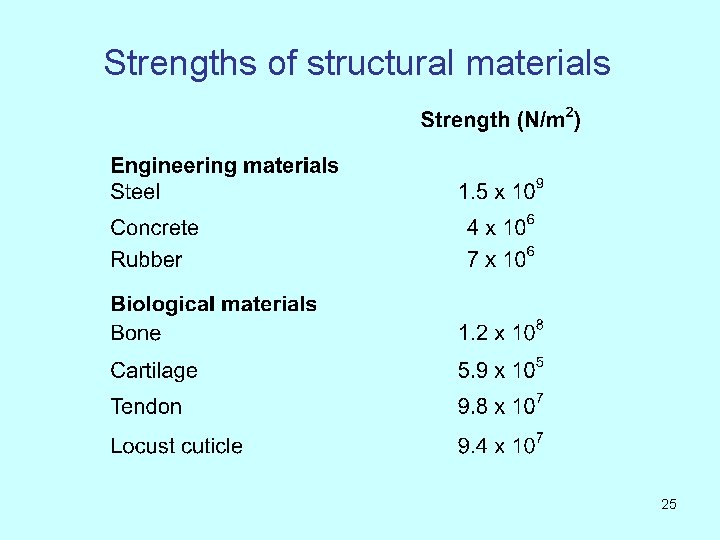
Strengths of structural materials 25
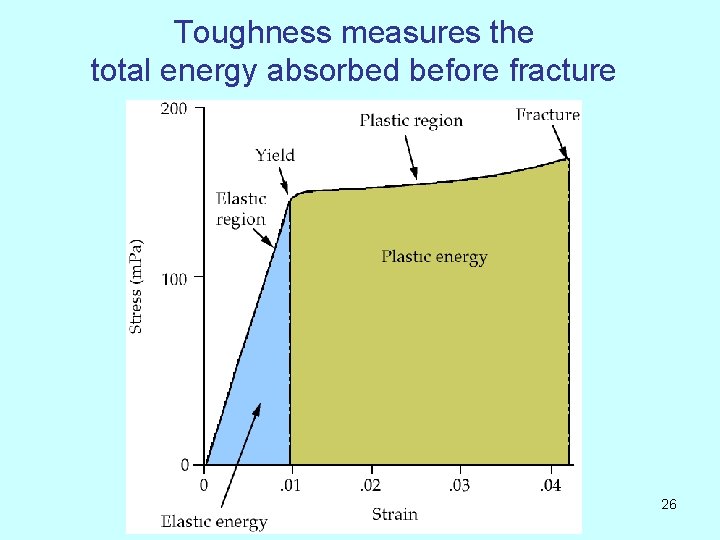
Toughness measures the total energy absorbed before fracture 26
So far we’ve considered only solid materials What else is there, and what characterizes them? 27
Basic types of materials: • Gases • Liquids • Solids These can be distinguished by: • Molecular behavior • Types of stresses they resist 28
Stresses and states of matter • Gases -- resist only compression • Liquids -- resist both compression and tension • Solids -- resist compression, tension, and shear 29
Caveat Gases and liquids (both are “fluids”) resist rate of shear They are viscoelastic materials 30
How to classify solids • Based on chemical composition: – Protein vs carbohydrate, etc. • Collagen vs silk • Based on mechanical behavior: – Isotropic* vs anisotropic – Simple vs composite – Rigid vs tensile vs pliant * Means of uniform composition and properties throughout – e. g. steel is isotropic, wood is anisotropic 31
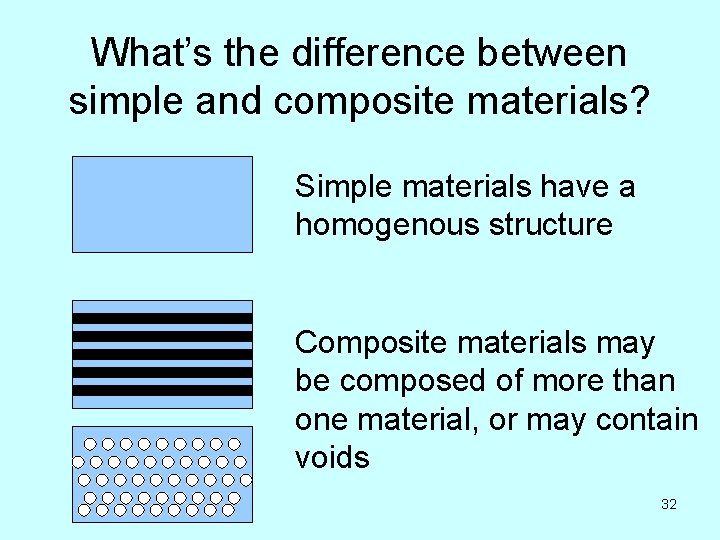
What’s the difference between simple and composite materials? Simple materials have a homogenous structure Composite materials may be composed of more than one material, or may contain voids 32
Composite materials • We shall see later that discontinuities in composite materials can help to prevent fractures from propagating. • A good example of a composite structure is a modern panel door, in which the surfaces are made of wood, with an infill of paper honeycomb that provides strength with lightness. • Concrete and fibreglass (grp) are also composites 33
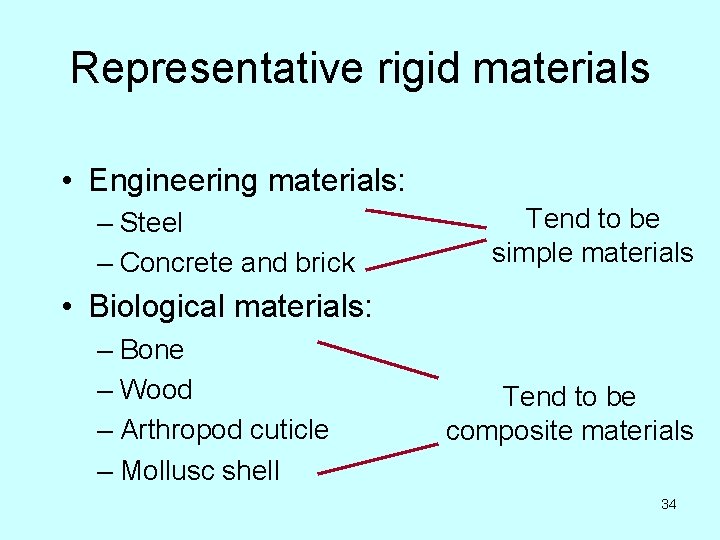
Representative rigid materials • Engineering materials: – Steel – Concrete and brick Tend to be simple materials • Biological materials: – Bone – Wood – Arthropod cuticle – Mollusc shell Tend to be composite materials 34

Testing for toughness: Charpy V-Notch Test 35
Charpy V-Notch Test (continued) The potential energy of the pendulum before and after impact can be calculated from the initial and final location of the pendulum. - The potential energy difference is the energy it took to break the material. (absorbed during the impact. ) - Charpy test is an impact toughness measurement test because the energy is absorbed by the specimen very rapidly. 36
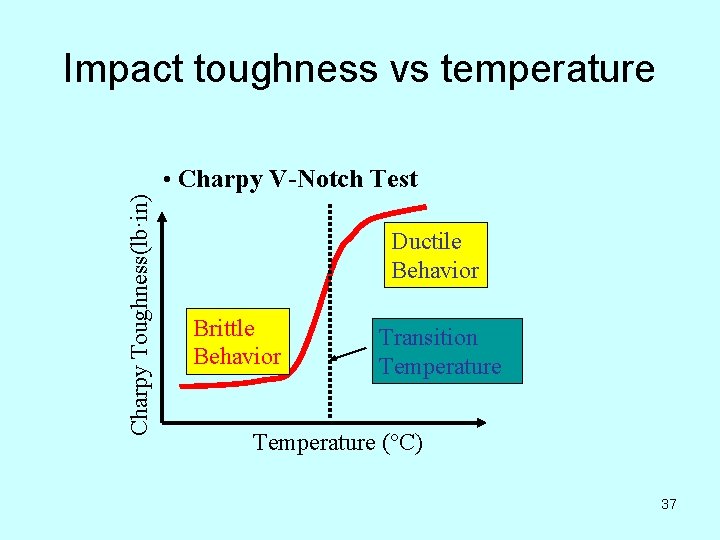
Impact toughness vs temperature Charpy Toughness(lb·in) • Charpy V-Notch Test Ductile Behavior Brittle Behavior Transition Temperature (°C) 37
Transition temperature • At low temperature, where the material is brittle and not strong, little energy is required to fracture the material. • At high temperature, where the material is more ductile and stronger, greater energy is required to fracture the material. • The transition temperature is the boundary between brittle and ductile behavior. This is an extremely important parameter in selection of construction material. 38
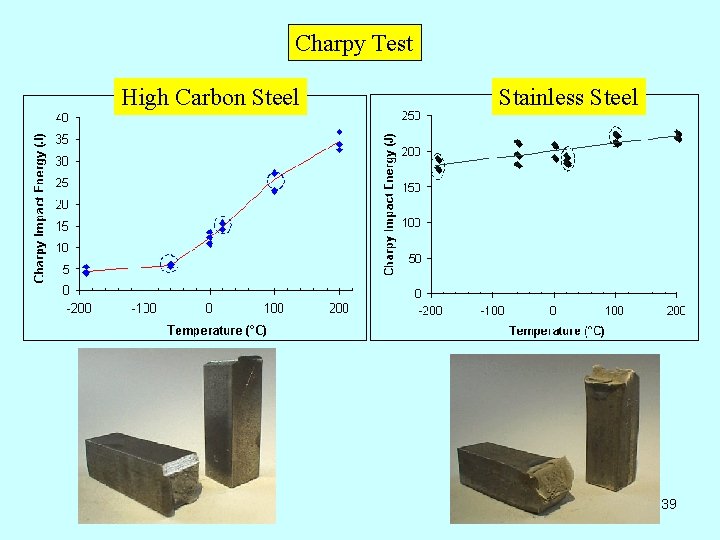
Charpy Test High Carbon Steel Stainless Steel 39
Factors affecting material properties • Temperature : – Increasing temperature will decrease - Modulus of Elasticity - Yield Strength - Tensile Strength – Decreasing temperature will: - Increase ductility - Reduce brittleness • Environment: Sulfites, Chlorine, Oxygen in water, Radiation 40
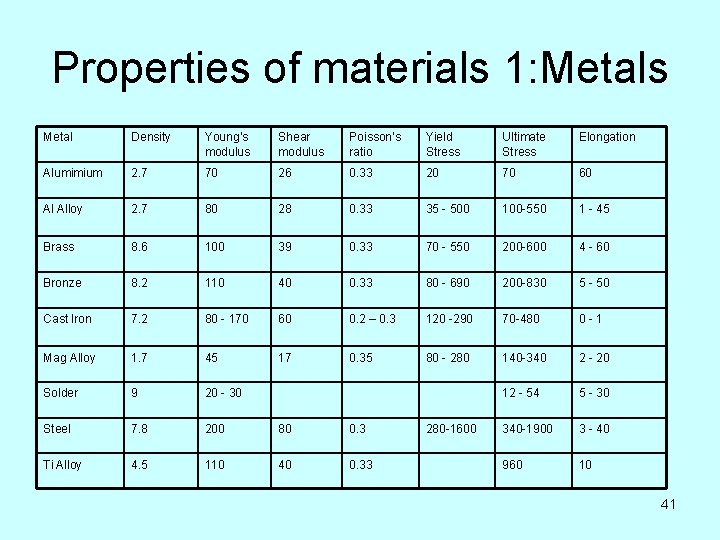
Properties of materials 1: Metals Metal Density Young’s modulus Shear modulus Poisson’s ratio Yield Stress Ultimate Stress Elongation Alumimium 2. 7 70 26 0. 33 20 70 60 Al Alloy 2. 7 80 28 0. 33 35 - 500 100 -550 1 - 45 Brass 8. 6 100 39 0. 33 70 - 550 200 -600 4 - 60 Bronze 8. 2 110 40 0. 33 80 - 690 200 -830 5 - 50 Cast Iron 7. 2 80 - 170 60 0. 2 – 0. 3 120 -290 70 -480 0 -1 Mag Alloy 1. 7 45 17 0. 35 80 - 280 140 -340 2 - 20 Solder 9 20 - 30 12 - 54 5 - 30 Steel 7. 8 200 80 0. 3 340 -1900 3 - 40 Ti Alloy 4. 5 110 40 0. 33 960 10 280 -1600 41

Properties of materials 2 Material Density Mg/m 3 Young’s modulus GPa Poisson’s ratio Yield Stress MPa Ultimate Stress MPa Brick (compression) 1. 8 – 2. 4 10 - 24 Concrete 2. 4 18 - 30 0. 1 – 0. 2 Glass 2. 6 48 - 83 0. 2 – 0. 27 Nylon 1. 1 2. 1 – 2. 8 0. 4 Stone: Granite (compression) 2. 6 40 - 70 0. 2 – 0. 3 70 – 280 Stone: Marble (compression) 2. 8 50 - 100 0. 2 – 0. 3 50 - 180 Wood: Ash (Bending) 0. 6 10 - 11 40 - 70 50 - 100 Wood: Oak (Bending) 0. 7 11 - 12 40 - 60 50 - 100 Wood: Pine (Bending) 0. 6 11 - 14 40 - 60 50 - 100 7 - 70 230 - 380 40 - 70 42
- Slides: 42